International Baccalaureate · PYP 5
Whole Numbers to Millions
I
Big Numbers
Extending to 6-Digit Numbers
The place value table can always be extended: adding a new column for the hundred thousands lets us write 6-digit numbers, from \(100\,000\) to \(999\,999\). For example, the number \(214\,365\):
$$214\,365 = 2\times 100\,000 + 1\times 10\,000 + 4\times 1\,000 + 3\times 100 + 6\times 10 + 5\times 1$$ In words: two hundred fourteen thousand, three hundred sixty-five.
| Hundred Thousands | Ten Thousands | Thousands | Hundreds | Tens | Ones |
| 2 | 1 | 4 | 3 | 6 | 5 |
Where our way of writing numbers comes from. Writing every whole number with only ten digits, \(0\) to \(9\), the value of each digit being given by its place, is called the Hindu-Arabic system. It was invented in India, where a symbol for zero was used as a digit to mark an empty place, and it reached Europe through mathematicians who wrote in Arabic. With ten digits and the places, it can write every whole number, however large.
Definition — Decimal Place-Value Notation
Whole numbers are written with ten digits: \(0\), \(1\), \(2\), …, \(9\). This is decimal place-value notation: the value of a digit depends on its place in the number. - Each place is worth ten units of the place on its right: \(1\) ten \(= 10\) ones, \(1\) hundred \(= 10\) tens, \(1\) thousand \(= 10\) hundreds, and so on to the left.
- A zero marks an empty place: in \(305\), the tens place is empty; without the zero, the number would read \(35\).
- The same digit changes value when it changes place: in \(5\,555\), the first \(5\) is worth \(5\,000\) and the last one is worth \(5\).
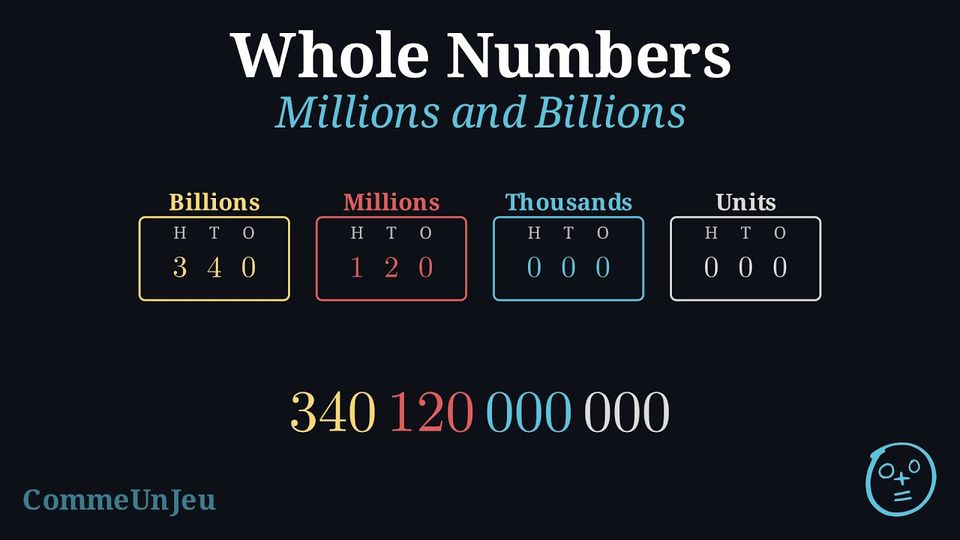
In mathematics, our number system is organised to handle numbers of any size. To read, write, and understand large numbers such as millions and billions, we group digits into sets of three.
Definition — Place Value Periods
Each period has a specific name and consists of three place values: ones, tens and hundreds. Each period is worth a thousand times the one before. - After \(999\,999\) comes \(1\,000\,000\): \(10\) hundred thousands make \(1\) million, as \(10\) hundreds make \(1\) thousand.
- A thousand is \(1\,000\) ones.
- A million is a thousand thousand (\(1\,000\,000\)).
- A billion is a thousand million (\(1\,000\,000\,000\)).
- Place Value Chart:

- In digits: $$340\,120\,000\,000$$
- In words:
Three hundred forty billion, one hundred twenty million - Expanded Form: $$300\,000\,000\,000 + 40\,000\,000\,000 + 100\,000\,000 + 20\,000\,000$$
Example — Visualising the Scale of Large Numbers
To see how big these numbers are, consider the height of a stack of single one-dollar bills: - One Thousand Dollars (\(\dollar 1\,000\)) would be approximately \(10\) centimetres high.
- One Million Dollars (\(\dollar 1\,000\,000\)) would be approximately \(100\) metres high, like a skyscraper.
- One Billion Dollars (\(\dollar 1\,000\,000\,000\)) would be approximately \(100\) kilometres high, reaching into space.
Method — Reading and Writing a Big Number in Words
To read a big number, or to write it in words: - Split the digits into periods of three, from the right: \(7\,040\,300\) is \(7 \mid 040 \mid 300\).
- Read each period as a number from \(0\) to \(999\), then say the name of its period (nothing is said for the ones period): “seven million”, “forty thousand”, “three hundred”. A period \(000\) is not read.
- Write everything in a row: “seven million forty thousand three hundred”.
Example
Consider the number \(4\,035\,208\). Give the digit of the thousands, the number of thousands, the digit of the tens and the number of tens. | Millions | Hundred Thousands | Ten Thousands | Thousands | Hundreds | Tens | Ones |
| \(4\) | \(0\) | \(3\) | \(\textcolor{colordef}{5}\) | \(2\) | \(\textcolor{colordef}{0}\) | \(8\) |
- The digit of the thousands is \(\textcolor{colordef}{5}\): it is the digit written in the thousands place.
- The number of thousands is \(\textcolor{colorprop}{4\,035}\): read everything written up to the thousands place, since \(4\,035\,208\) is \(4\,035\) thousands and \(208\) ones.
- The digit of the tens is \(\textcolor{colordef}{0}\): once the hundreds are counted, no ten is left; the zero holds this place.
- The number of tens is \(\textcolor{colorprop}{403\,520}\), since \(4\,035\,208\) is \(403\,520\) tens and \(8\) ones.
Example — Big Numbers on a Number Line
On the number line below, the marks are equally spaced. 
- What is the gap between two consecutive marks?
- Which numbers do the points \(A\) and \(B\) mark?
- Where would the number \(4\,500\,000\) be placed?
- From \(0\) to \(10\,000\,000\) there are \(10\) equal gaps: each gap is \(10\,000\,000 \div 10 = 1\,000\,000\). The marks go from million to million.
- \(A\) is \(3\) gaps after \(0\): it marks \(3 \times 1\,000\,000 = 3\,000\,000\). \(B\) is in the middle of the gap that goes from \(7\,000\,000\) to \(8\,000\,000\): it marks \(7\,500\,000\).
- \(4\,500\,000\) lies halfway between \(4\,000\,000\) and \(5\,000\,000\): it is placed in the middle of the gap between these two marks.

After the billions. The period after the billions is the trillions: a trillion is \(1\,000\) billion, that is \(1\,000\,000\,000\,000\), a one followed by twelve zeros. Each period is worth a thousand times the one before: thousands, millions, billions, trillions. Watch out: in French, the word “billion” names a trillion, and a thousand millions is called “milliard”.
Skills to practice
- Reading a Number in a Place-Value Chart
- Writing Numbers from Words
- Writing Big Numbers from Real Data
- Telling the Digit of a Place from the Number of Units
- Locating Big Numbers on a Number Line
- Writing Big Numbers in Words
- Writing Billions in Words
- Solving Problems about Big Numbers
II
Comparing and Ordering Big Numbers
Method — Comparing Two Whole Numbers
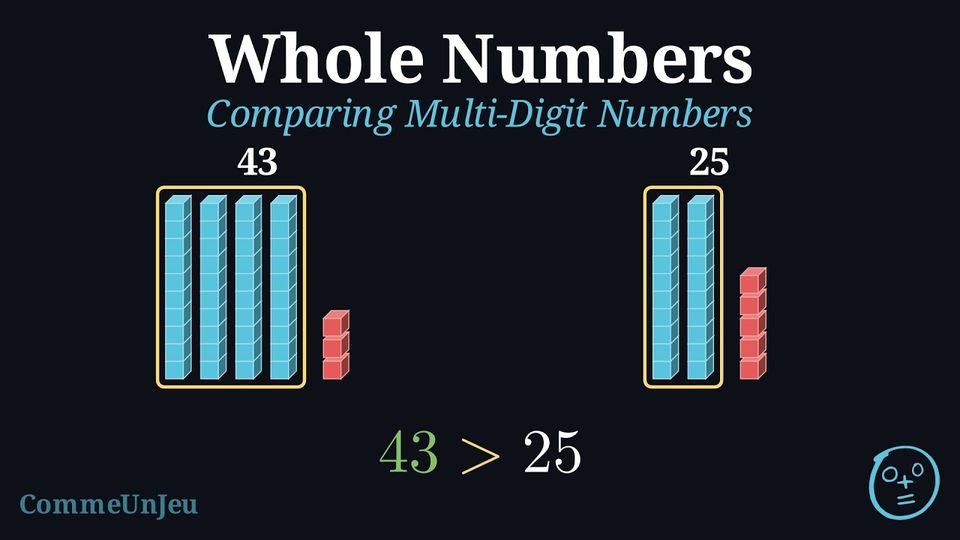
To compare two whole numbers: - Count the digits: the number with more digits is the greater one.
- If both numbers have the same number of digits, compare the digits from left to right, place by place: the first different digit decides.
Example — Comparing and Ordering Big Numbers
- Compare \(7\,089\,500\) and \(7\,098\,050\).
- Order from smallest to largest: \(12\,050\,000\), \(9\,875\,000\), \(12\,005\,000\), \(12\,500\,000\).
- Both numbers have \(7\) digits, so they are compared place by place from the left. The millions digits are equal (\(7\)), the hundred thousands digits are equal (\(0\)), and the ten thousands digits decide: \(8 < 9\). So $$7\,089\,500 < 7\,098\,050.$$
- \(9\,875\,000\) has \(7\) digits and the three others have \(8\): it is the smallest. The three others have the same ten millions and millions digits (\(1\) and \(2\)); in the hundred thousands place, \(12\,500\,000\) has a \(5\) and the two others a \(0\): it is the largest. Between \(12\,050\,000\) and \(12\,005\,000\), the ten thousands digits decide: \(0 < 5\). So $$9\,875\,000 < 12\,005\,000 < 12\,050\,000 < 12\,500\,000.$$
Skills to practice
- Comparing Big Numbers
- Ordering Big Numbers
- Writing Big Numbers in Order
III
Placing Big Numbers Between Two Consecutive Multiples
Definition — Placing a Number Between Two Consecutive Multiples
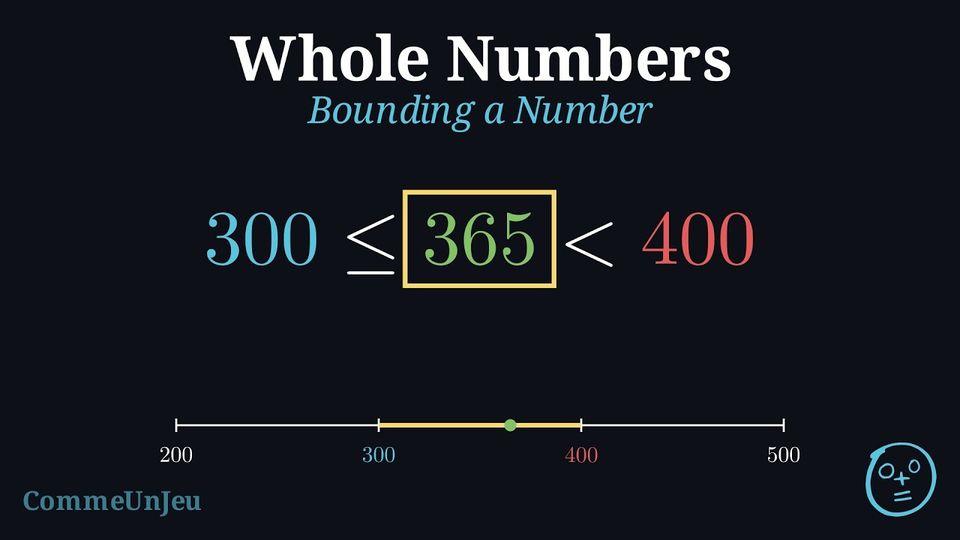
Placing a number between two consecutive multiples of \(10\) (of \(100\), of \(1\,000\)…) means giving the two consecutive multiples between which it lies: the smaller one is the lower bound, the larger one the upper bound. The lower bound can be the number itself: to the hundred, \(365\) lies between \(300\) and \(400\), and \(300\) between \(300\) and \(400\). Example — Placing Big Numbers Between Two Numbers
- Place \(5\,382\,000\) between two consecutive millions, then between two consecutive hundred thousands.
- Place \(7\,000\,000\) between two consecutive hundred thousands.
- Give all the whole numbers that lie strictly between \(2\,999\,998\) and \(3\,000\,002\) (strictly: the two given numbers do not count).
- \(5\,382\,000\) contains \(5\) whole millions, and one more million gives \(6\,000\,000\): $$5\,000\,000 \leq 5\,382\,000 < 6\,000\,000.$$ It contains \(53\) whole hundred thousands, and one more gives \(54\) hundred thousands: $$5\,300\,000 \leq 5\,382\,000 < 5\,400\,000.$$
- \(7\,000\,000\) is exactly \(70\) hundred thousands: it sits on a mark, and the lower bound is the number itself. $$7\,000\,000 \leq 7\,000\,000 < 7\,100\,000.$$
- Counting on from \(2\,999\,998\): \(2\,999\,999\), then \(3\,000\,000\) (the millions change), then \(3\,000\,001\), and the next one is \(3\,000\,002\). There are exactly three: $$2\,999\,999, \quad 3\,000\,000, \quad 3\,000\,001.$$
Skills to practice
- Placing Big Numbers Between Two Numbers
- Finding Whole Numbers Between Two Numbers
IV
Rounding Big Numbers
Method — Standard Procedure for Rounding
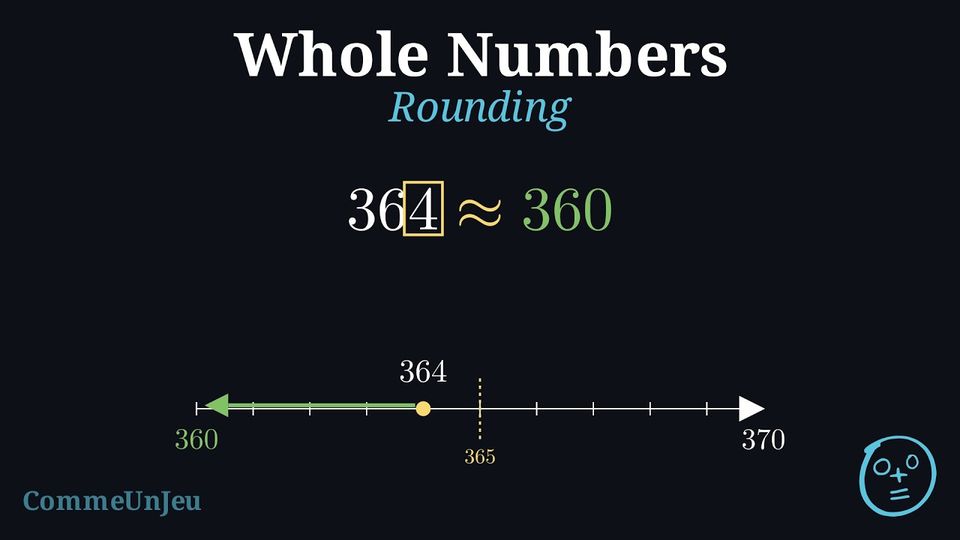
To round a number to a given place (the ten, the hundred, the thousand…): - Find the target digit: the digit in the place the number is rounded to.
- Look at the digit just to its right.
- Apply the rule:
- If that digit is 5 or more (5, 6, 7, 8, 9), round up: add 1 to the target digit.
- If that digit is 4 or less (0, 1, 2, 3, 4), round down: the target digit stays the same.
- Replace the digits after it by zeros: every digit to the right of the target digit becomes \(0\).
Example — Rounding Big Numbers
- Round \(6\,482\,519\) to the nearest million, then to the nearest hundred thousand.
- Round \(3\,500\,000\) to the nearest million.
- Round \(9\,960\,000\) to the nearest hundred thousand.
- To the nearest million, the target digit is the \(\textcolor{colordef}{6}\) of the millions; the digit on its right is \(\textcolor{colorprop}{4}\), and \(4\) is “4 or less”: the target digit stays. \(6\,482\,519\) lies between \(6\,000\,000\) and \(7\,000\,000\), nearer to \(6\,000\,000\). To the nearest hundred thousand, the target digit is the \(\textcolor{colordef}{4}\); the digit on its right is \(\textcolor{colorprop}{8}\), and \(8\) is “5 or more”: the \(4\) becomes \(5\). $$\begin{aligned}[t] 6\,482\,519 &\approx 6\,000\,000 &&\text{(nearest million)}\\ 6\,482\,519 &\approx 6\,500\,000 &&\text{(nearest hundred thousand)} \end{aligned}$$
- \(3\,500\,000\) is exactly halfway between \(3\,000\,000\) and \(4\,000\,000\); by convention, a number exactly halfway is rounded up: $$3\,500\,000 \approx 4\,000\,000.$$
- The target digit is the \(\textcolor{colordef}{9}\) of the hundred thousands; the digit on its right is \(\textcolor{colorprop}{6}\), so one is added: \(9 + 1 = 10\). The \(9\) becomes \(0\) and \(1\) is carried to the millions; the millions digit is also a \(9\), so it becomes \(0\) in turn and \(1\) is carried to the ten millions: $$9\,960\,000 \approx 10\,000\,000.$$
Skills to practice
- Rounding Big Numbers
- Estimating with Rounded Big Numbers
V
Going further
Skills to practice
- Comparing, Placing and Rounding Big Numbers
- Decomposing Numbers in Multiplicative Form
- Reasoning About Digits and Place Value
- Solving Problems
- Quiz
Jump to section