International Baccalaureate · MYP 1
Whole Numbers and Operations
I
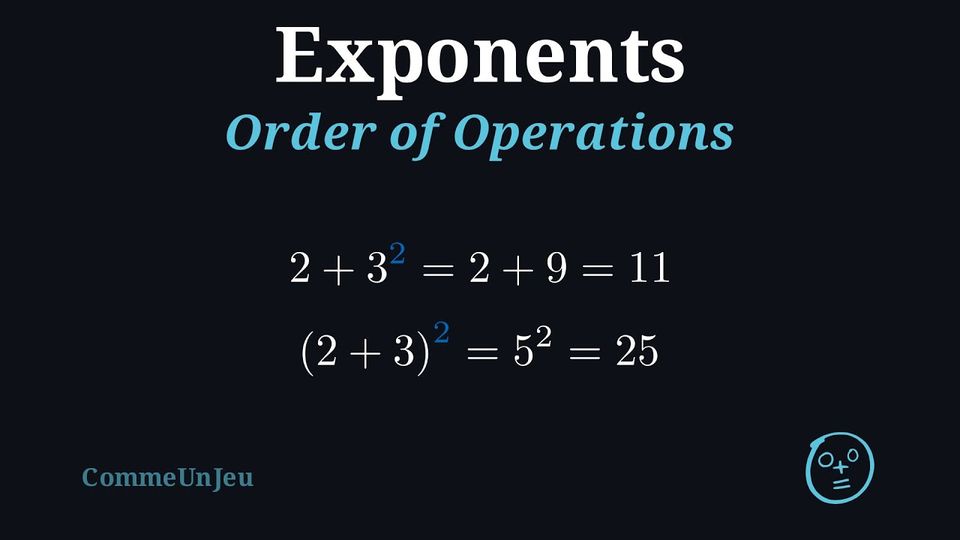
Using the Order of Operations with Exponents
Definition — Powers
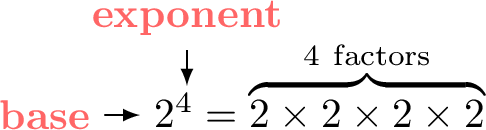
A power is a short way to write a repeated multiplication of a number by itself: For a number \(a\) and a whole number \(n \geq 1\), $$ a^n = \overbrace{a \times a \times \dots \times a}^{n\ \text{factors}}. $$
The order of operations is a set of rules that tells us which calculations to do first in a mathematical expression.
Definition — Order of Operations
In an expression, the calculations are carried out in this order of operations, remembered with the acronym BEDMAS: - first the calculations in brackets ( ) (also called parentheses), starting with the innermost ones;
- then the exponents (also called indices);
- then the multiplications and divisions, from left to right;
- finally the additions and subtractions, from left to right.
Other names for the same order. The same order of operations is also remembered as PEMDAS or BIDMAS. PEMDAS stands for Parentheses (another word for brackets), Exponents, Multiplication and Division, Addition and Subtraction; in BIDMAS, the I stands for Indices, another word for exponents. Whatever the acronym, the order of two letters on the same level gives no priority: PEMDAS writes M before D and BEDMAS writes D before M, but multiplication and division are performed from left to right, and so are addition and subtraction. $$ \begin{aligned}[t] 12\div 3\times 2 &= 4\times 2 && (\text{left to right: } 12\div 3=4 \text{ first})\\
&= 8 \end{aligned} $$
Example
Compute \(20 - (2 + 3 \times 4)\).
$$\begin{aligned} 20 - (2 + 3 \times 4) &= 20 - (2 + 12) &&\text{(inside the brackets, multiplication first)}\\
&= 20 - 14 &&\text{(finish the brackets)}\\
&= 6 \end{aligned}$$
Example
Evaluate \((1+2) \times 2^3 + 4\).
$$ \begin{aligned}[t] (1+2) \times 2^3 + 4 &= \textcolor{colordef}{3} \times 2^3 + 4 && (\text{brackets: } 1+2 = 3) \\
&= 3 \times \textcolor{colordef}{8} + 4 && (\text{exponent: } 2^3 = 8) \\
&= \textcolor{colordef}{24} + 4 && (\text{multiplication: } 3 \times 8 = 24) \\
&= \textcolor{colordef}{28} && (\text{addition: } 24 + 4 = 28) \end{aligned} $$
Skills to practice
- Calculating with Brackets
- Calculating with Several Operations
- Evaluating Expressions with Exponents in Two Steps
- Evaluating Expressions with Exponents in Three Steps
- Finding the Operators
II
Writing One Expression for a Problem
Method — Writing an Expression
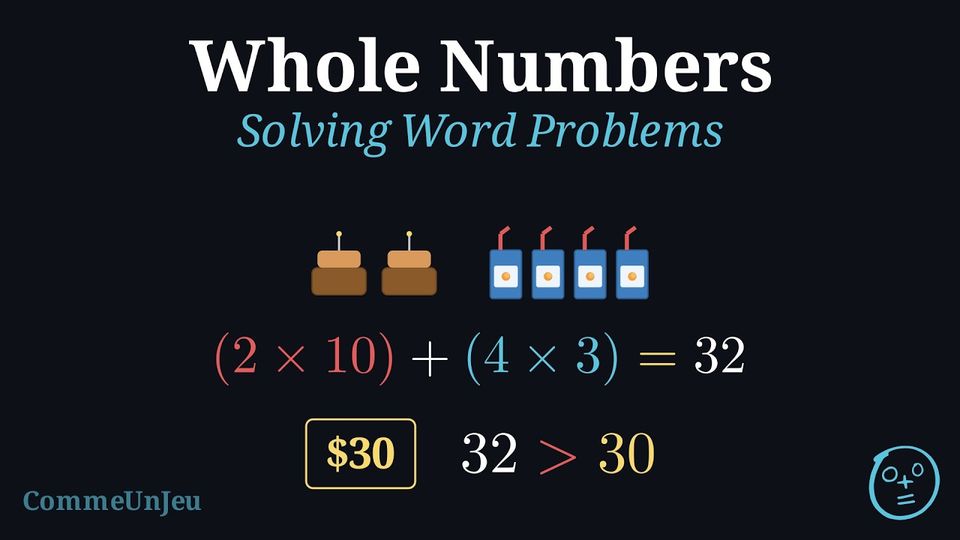
To turn a sentence into one expression: - Spot the operation named first: in a sentence that names the calculation, it is performed last (“twice the sum” — “twice” applies to the whole sum). In a list of instructions it is the other way round: “add \(3\) to \(2\), then multiply the result by \(4\)” is written \((2 + 3) \times 4\) — the first instruction is performed first, so it goes between brackets.
- Put between brackets every calculation that must be done first: the sum in “twice the sum”, the result that the next instruction uses.
- Check by computing: calculate the expression back, brackets first — is the sentence recovered?
Skills to practice
- Writing the Expression from a Sentence
III
Going further
Skills to practice
- Solving Multi-Step Problems
- Checking and Comparing Calculations
- Quiz
Jump to section