International Baccalaureate · PYP 4
Money
I
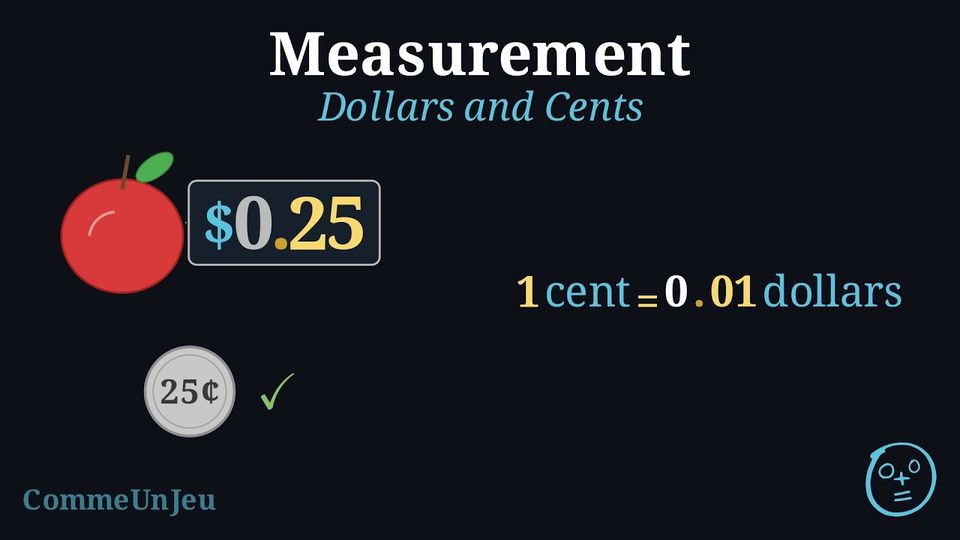
Cents Are Hundredths of a Dollar
Cents Are Hundredths of a Dollar
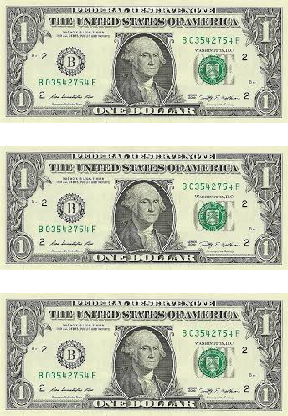
One dollar is \(100\) cents: one cent is therefore one hundredth of a dollar. $$1\text{ cent}=\dfrac{1}{100}\text{ dollar}=\dollar 0.01$$ The decimal point of a price is the decimal point of the decimal numbers: a price written with a decimal point is a decimal number of dollars. $$\dollar 3.45=3\text{ dollars and }45\text{ cents}=3+\dfrac{45}{100}\text{ dollars}$$
| Dollars | . | Tenths (\(10\) cents) | Hundredths (\(1\) cent) |
 | . |  |  |
| \(3\) | . | \(4\) | \(5\) |
- On a price label, a price is usually written with two digits after the point: the digits before the point count the dollars, and the two digits after the point count the cents, that is the hundredths of a dollar.
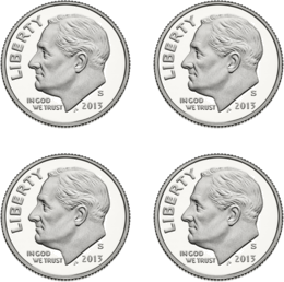
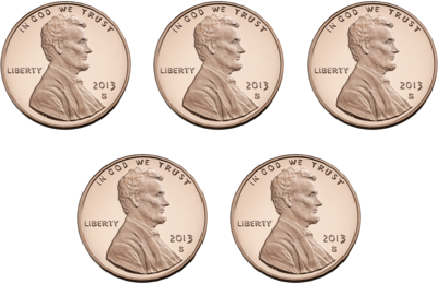
- The first digit after the point counts the tenths of a dollar: one tenth of a dollar is \(10\) cents, the value of a \(10\)-cent coin. In \(\dollar 3.45\), the \(4\) tenths are \(40\) cents and the \(5\) hundredths are \(5\) cents: \(\dollar 3.45=3+\dfrac{4}{10}+\dfrac{5}{100}\) dollars.
- As a decimal number, the same price can also be written with one digit after the point: \(\dollar 2.5=\dollar 2.50\), because \(5\) tenths are \(50\) hundredths. It is \(2\) dollars and \(50\) cents, not \(2\) dollars and \(5\) cents.
Definition — Coins and Bills
| 1 dollar |  |
| 2 dollars |  |
| 5 dollars |  |
| 10 dollars |  |
| 20 dollars |  |
| 1 cent \(= \dollar 0.01\) |  |
| 5 cents \(= \dollar 0.05\) |  |
| 10 cents \(= \dollar 0.10\) |  |
| 25 cents \(= \dollar 0.25\) |  |
| 50 cents \(= \dollar 0.50\) |  |
Skills to practice
- Calculating the Total in Decimal Form
- Checking If You Have Enough Money to Buy Items
- Reading a Price in Tenths and Hundredths of a Dollar
II
Giving Change from a Bill
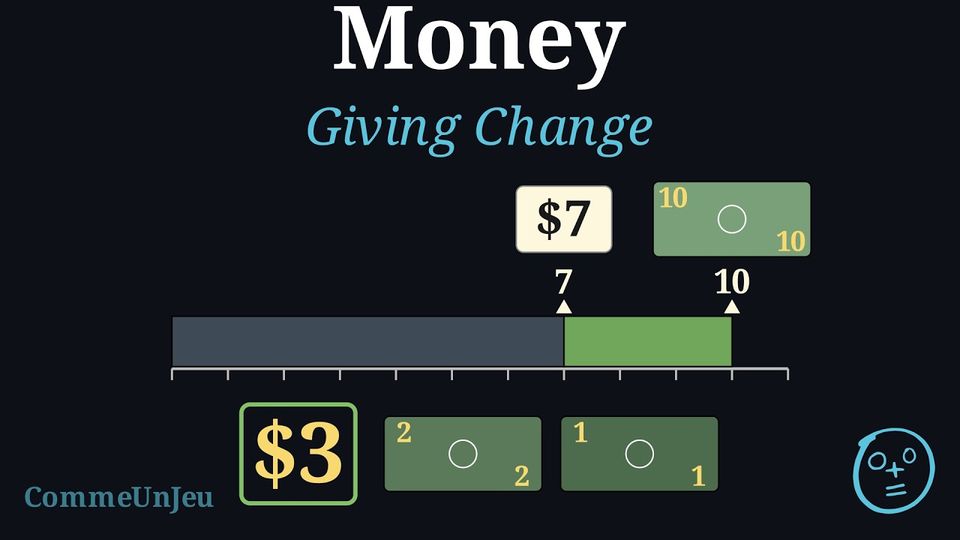
Method — Counting Up to the Next Dollar
To give change when the price has cents and the customer pays with bills or dollar coins, the seller counts up from the price: - To the next dollar: add the cents that are missing to make \(100\).
- Then in dollars: add dollars until the money given is reached.
- The change is the cents and the dollars counted on the way.
Skills to practice
- Giving Change from a Bill
III
Rounding a Cash Total to the Nearest 5 Cents
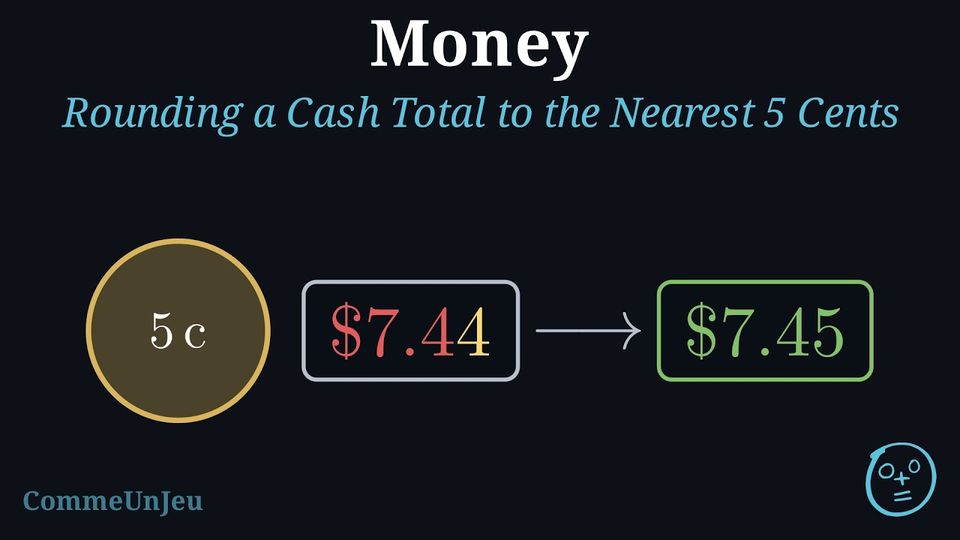
Rounding a Cash Total to the Nearest 5 Cents
In some countries, there are no 1-cent or 2-cent coins: the coin with the smallest value is the \(5\)-cent coin. There, a total paid in cash is rounded to the nearest 5 cents, because a total that does not end in \(0\) or \(5\) cents could not be paid exactly with the coins. A total paid by card is not rounded.
This is a rule of those countries, not a general rule for money: it is used only where there are no \(1\)-cent or \(2\)-cent coins.
Only the last digit of the cents is looked at:
A total that ends in \(0\) or in \(5\), such as \(\dollar 7.40\) or \(\dollar 7.45\), stays as it is. Going up can reach the next dollar: \(\dollar 7.98\) and \(\dollar 7.99\) become \(\dollar 8.00\).
For example, a total of \(\dollar 7.44\) paid in cash with a \(\dollar 10\) bill: the cash total is \(\dollar 7.45\), and the change is \(\dollar 10 - \dollar 7.45 = \dollar 2.55\).
This is a rule of those countries, not a general rule for money: it is used only where there are no \(1\)-cent or \(2\)-cent coins.
Only the last digit of the cents is looked at:
| Total | \(\dollar 7.41\), \(\dollar 7.42\) | \(\dollar 7.43\), \(\dollar 7.44\) | \(\dollar 7.46\), \(\dollar 7.47\) | \(\dollar 7.48\), \(\dollar 7.49\) |
| Last digit | \(1\) or \(2\) | \(3\) or \(4\) | \(6\) or \(7\) | \(8\) or \(9\) |
| Cash total | \(\dollar 7.40\) (down) | \(\dollar 7.45\) (up) | \(\dollar 7.45\) (down) | \(\dollar 7.50\) (up) |
For example, a total of \(\dollar 7.44\) paid in cash with a \(\dollar 10\) bill: the cash total is \(\dollar 7.45\), and the change is \(\dollar 10 - \dollar 7.45 = \dollar 2.55\).
Skills to practice
- Rounding a Cash Total
IV
Solving Money Problems
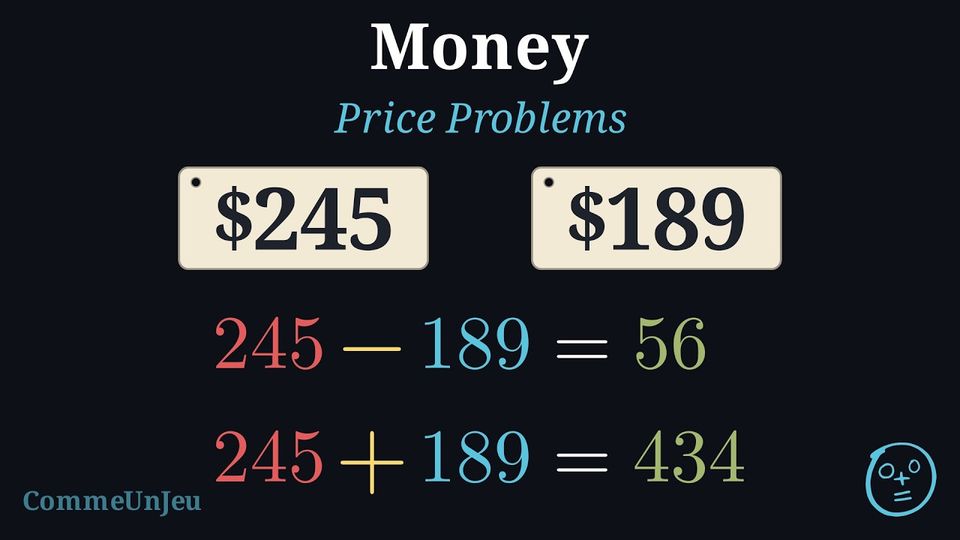
Method — Choosing the Operation in a Price Problem
- Together, in all, the total \(\rightarrow\) an addition.
- How much more, how much less, what is left \(\rightarrow\) a subtraction.
- The same article several times \(\rightarrow\) a multiplication.
- The double is twice the price; the half is the price shared in two.
- Two steps: sometimes the answer needs an intermediate number that the statement does not give — the price of the three notebooks, the total of two purchases. That number is computed first, and only then the question is answered.
Skills to practice
- Solving Money Problems
V
Review & Quizz
Skills to practice
- Quiz
Jump to section