International Baccalaureate · PYP 4
Time
I
Converting to Mixed Time Units
Method — Converting Minutes into Hours and Minutes
To write a number of minutes as hours and minutes, find how many times \(60\) fits in it: count in sixties, \(60\), \(120\), \(180\), and stop before going past the number of minutes. Each \(60\) minutes is one hour. What is left, less than \(60\), is the number of minutes. Example
A trip lasts \(135\) minutes. How many hours and minutes is that?
$$\begin{aligned}135~\text{min} &= 60~\text{min} + 60~\text{min} + 15~\text{min} &&\text{(\(60\) fits twice in \(135\): \(3 \times 60 = 180\) is too much)}\\
&= 1~\text{h} + 1~\text{h} + 15~\text{min} &&\text{(\(60\) min \(= 1\) h)}\\
&= 2~\text{h}~15~\text{min}\end{aligned}$$ So the trip lasts \(2\) h \(15\) min.
Method — Converting Seconds into Minutes and Seconds
To write a time given in seconds as minutes and seconds, we find how many full groups of \(60\) seconds (minutes) it contains: it is a division by \(60\), done by counting in sixties. - Find how many 60s fit. Since there are \(60\) seconds in \(1\) minute, count in sixties, \(60\), \(120\), \(180\), \(240\), and stop at the last one that is not more than the number of seconds.
- The quotient is the minutes. The number of sixties (the quotient) is the number of full minutes.
- The remainder is the seconds. Subtract that last number from the number of seconds: what is left (the remainder, less than \(60\)) is the number of seconds left over.
Example
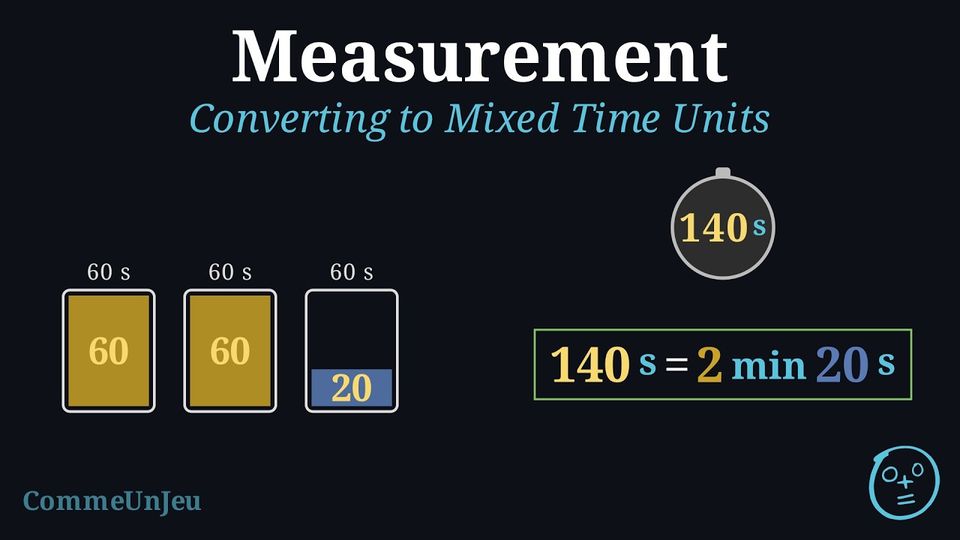
You run a race in 140 seconds. How many minutes and seconds is that?
We use the method to convert \(140\) seconds.
- Step 1: Find how many 60s fit. We count in sixties: \(60\), \(120\), \(180\). \(180\) is more than \(140\), so we stop at \(120\): $$2 \times 60 = 120 \le 140 < 180 = 3 \times 60$$
- Step 2: Identify the quotient and remainder.
- \(60\) fits \(2\) times in \(140\): the quotient is 2.
- \(140 - 120 = 20\): the remainder is 20.
- Step 3: Interpret the result.
- The quotient (2) means we have 2 full minutes.
- The remainder (20) means we have 20 seconds left over.
Skills to practice
- Separating a Single Unit into Mixed Units
- Combining Units into a Single Unit
II
Durations in Hours and Minutes
Method — Measuring a Duration by Going Through the Next O'Clock Time
An o'clock time is a whole hour, like \(16\):\(00\): the long hand points to the \(12\). - If the two times are in the same hour, simply count the minutes from the first to the second.
- Otherwise, go through the next o'clock time:
- Count the minutes up to the next o'clock time.
- Count the whole hours up to the last o'clock time before the arrival (the arrival itself if it falls on an o'clock time).
- Count the remaining minutes, then add everything.
Example
A film starts at the time of the first clock and ends at the time of the second one. How long does it last? 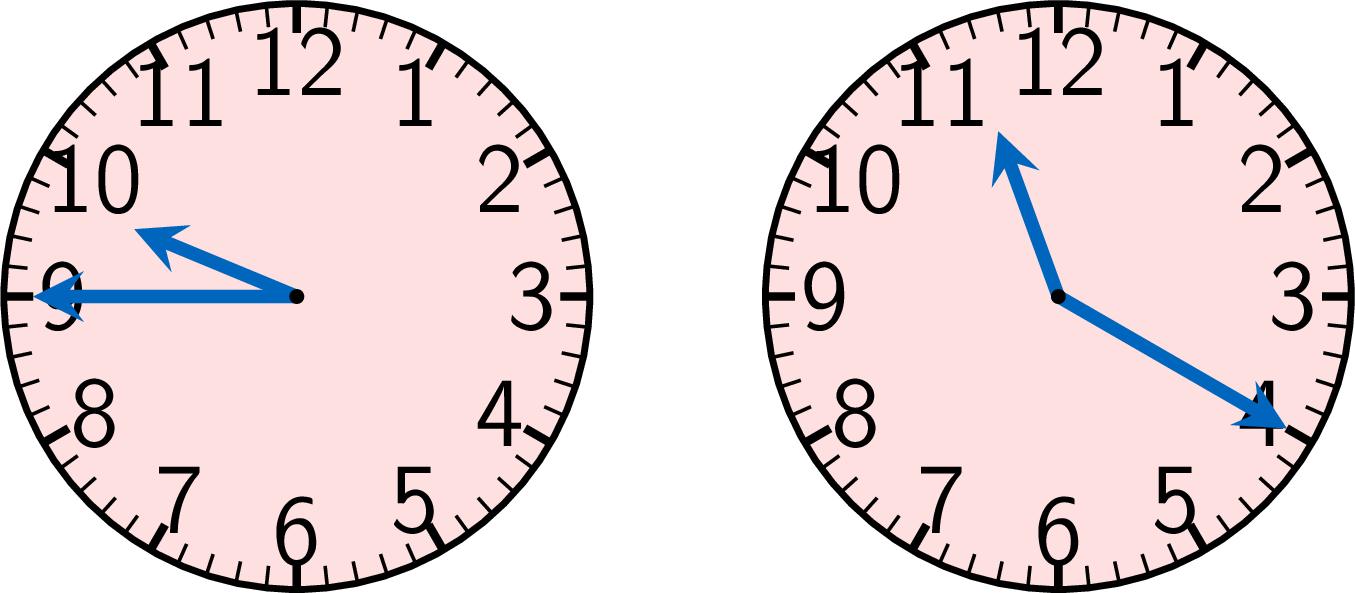
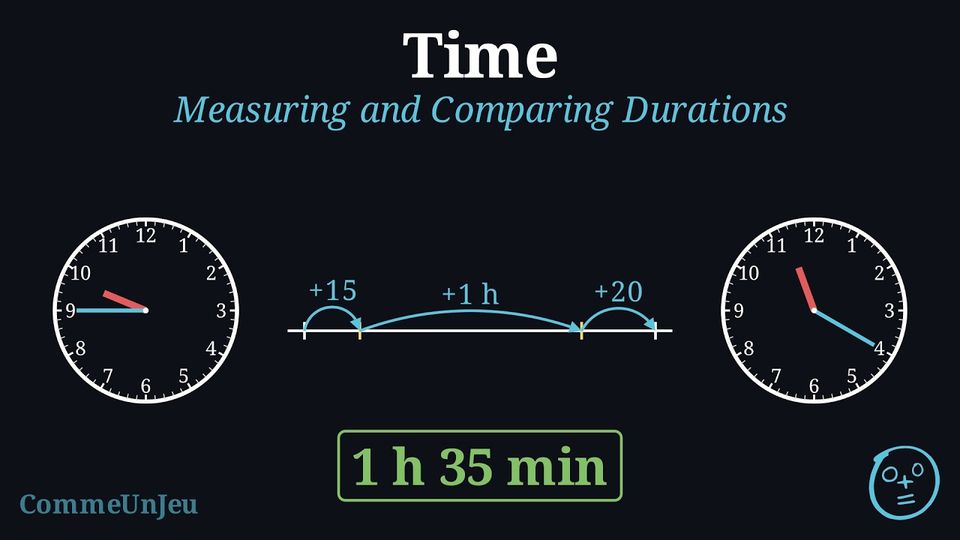
The film starts at \(9\):\(45\) and ends at \(11\):\(20\). Going through the next o'clock time: $$9\text{:}45 \xrightarrow{\;+15\text{ min}\;} 10\text{:}00 \xrightarrow{\;+1\text{ h}\;} 11\text{:}00 \xrightarrow{\;+20\text{ min}\;} 11\text{:}20$$ In all: \(15 + 20 = 35\) minutes and \(1\) hour. The film lasts \(\textbf{1}\) h \(\textbf{35}\) min.
Method — Comparing Two Durations
To compare two durations, write them in the same unit: since \(1\) h \(= 60\) min, a duration in hours and minutes becomes a number of minutes. Example
Which is longer: a swimming lesson of \(1\) h \(20\) min, or a bike ride of \(95\) min?
The swimming lesson lasts \(1\) h \(20\) min \(= 60 + 20 = 80\) minutes. The bike ride lasts \(95\) minutes. Since \(95 > 80\), the bike ride is longer.
Example
The train journey takes \(2\) hours; the coach journey takes \(130\) minutes. Which one is longer?
In the same unit: \(2\) h \(= 60 + 60 = 120\) min. Since \(130 > 120\), the coach journey is longer, by \(130 - 120 = 10\) minutes.
Skills to practice
- Measuring a Duration
- Comparing Durations
- Explaining Durations
III
Timelines
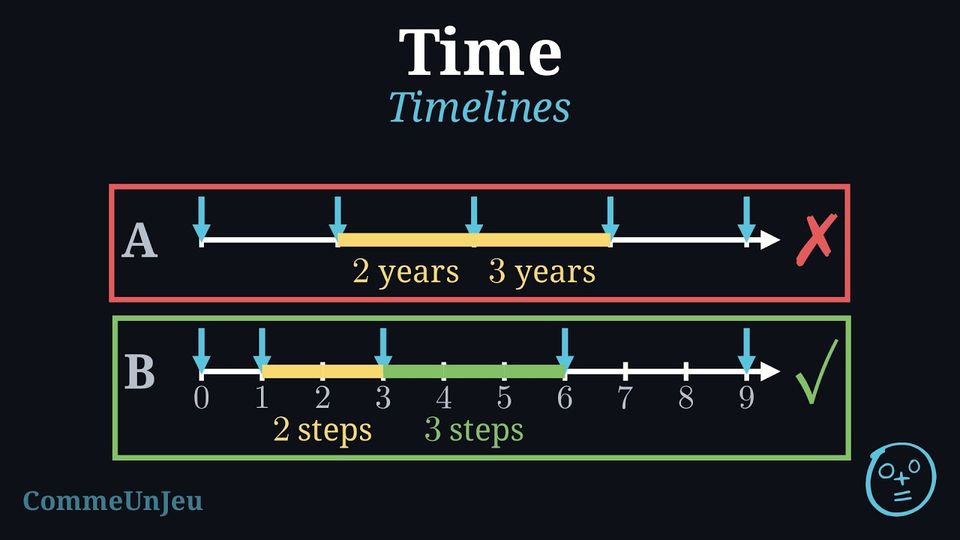
Léa took her first steps when she was \(1\) year old, started school at \(3\), learned to ride a bike at \(6\), and she is \(9\) today. She draws these events on a line (drawing A). Tom draws the same events on a line whose marks are one year apart (drawing B). 

Say in which drawing equal distances stand for equal durations. Use it to say which wait was longer: from the first steps to school, or from school to the bike.
In drawing A, the events are only in order: they are all the same distance apart, yet \(2\) years pass from the first steps to school and \(3\) years from school to the bike. The distances say nothing about the durations.
In drawing B, all the marks are the same distance apart and each step is one year: equal distances stand for equal durations. From the first steps (mark \(1\)) to school (mark \(3\)) there are \(2\) steps, and from school to the bike (mark \(6\)) there are \(3\) steps. The wait from school to the bike was longer, by one year, and drawing B shows it at a glance.
In drawing B, all the marks are the same distance apart and each step is one year: equal distances stand for equal durations. From the first steps (mark \(1\)) to school (mark \(3\)) there are \(2\) steps, and from school to the bike (mark \(6\)) there are \(3\) steps. The wait from school to the bike was longer, by one year, and drawing B shows it at a glance.
Definition — Timeline
A timeline is a line on which events are placed in the order they happened, from the oldest on the left to the most recent on the right. Unlike the time axis used to count a duration, a timeline is drawn to scale: its marks cut it into equal steps, each standing for the same duration — one month, one year, ten years — so equal distances stand for equal durations.Ten years make a decade.
Method — Reading and Placing Events on a Timeline
- Find what one step stands for: take two numbered marks, find the duration between them and count the steps. From \(2000\) to \(2010\), \(10\) years make \(5\) equal steps, so one step is \(2\) years.
- To place an event, find the last numbered mark before its date (or the start of its month) and count the steps from it up to the date. A date halfway between two marks goes halfway between them: \(1985\) is halfway between \(1980\) and \(1990\).
- To find the duration between two events, count the steps between them and add what each step stands for, or, when the dates are years, subtract the earlier year from the later one.
Example
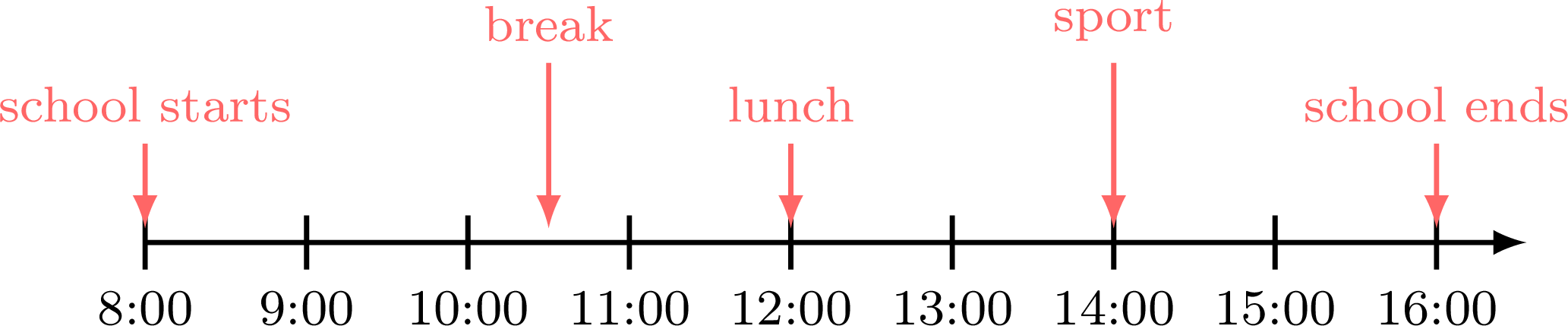
Tom's school day: school starts at \(8\):\(00\), break is at \(10\):\(30\), lunch at \(12\):\(00\), sport at \(14\):\(00\), and school ends at \(16\):\(00\). Draw a timeline of Tom's school day from \(8\):\(00\) to \(16\):\(00\), one step per hour, and place the five events on it. - Choose the step and count the steps. One step is one hour. From \(8\):\(00\) to \(16\):\(00\) there are \(16 - 8 = 8\) hours, so the line has \(8\) equal steps.
- Draw the line and the marks. We draw a line with \(9\) marks the same distance apart, one for each hour, and number them from \(8\):\(00\) to \(16\):\(00\).
- Place each event at its time. The start of school, lunch, sport and the end of school are on marks. Break, at \(10\):\(30\), is halfway between the marks \(10\):\(00\) and \(11\):\(00\).
Example
Here is a timeline of Léa's year. Each step is one month, and the mark at the start of a month is its first day. All the months are drawn the same length, although a month has from \(28\) to \(31\) days: for counting in months, that is close enough. 
The birthday is at the start of April and the holidays at the start of July: from one to the other there are \(3\) steps (April, May, June), so \(3\) months pass.
The first of October is at the start of October: \(1\) step after the start of September. 
The first of October is at the start of October: \(1\) step after the start of September.
Example
Tom's grandmother was born in \(1950\). She found her first job in \(1970\), opened a bakery in \(1985\) and ran it until she retired in \(2015\). Here is the timeline of her life, one decade per step. 
- \(1985\) is halfway between the marks \(1980\) and \(1990\). From \(1970\) to \(1985\): one whole step (\(10\) years) and half a step (\(5\) years). $$\begin{aligned} 1985 - 1970 &= \textcolor{colorprop}{15} &&\text{(later date minus earlier date)} \end{aligned}$$ \(15\) years passed.
- From \(1985\) to \(1990\): half a step; from \(1990\) to \(2010\): two whole steps; from \(2010\) to \(2015\): half a step. In all \(3\) steps: \(2015 - 1985 = 30\) years, that is \(3\) decades.
Skills to practice
- Placing an Event on a Timeline
- Reading a Date on a Timeline
- Finding a Duration on a Timeline
- Drawing a Timeline
IV
Going further
Skills to practice
- Solving Problems with Several Questions
- Quiz
Jump to section