International Baccalaureate · PYP 3
Division
I
The Multiplication and Division Connection
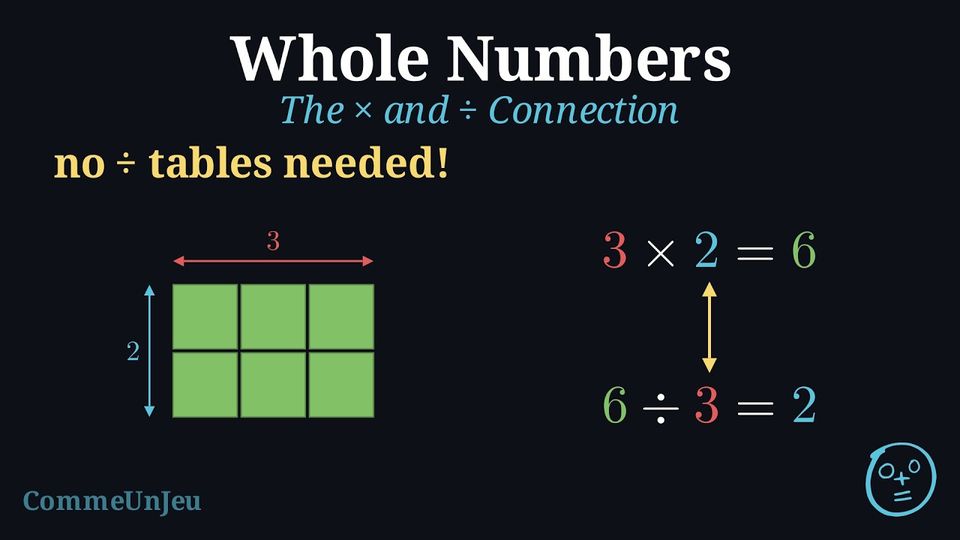
Proposition — The Multiplication and Division Connection
Multiplication and division are inverse operations. This means one operation undoes the other. 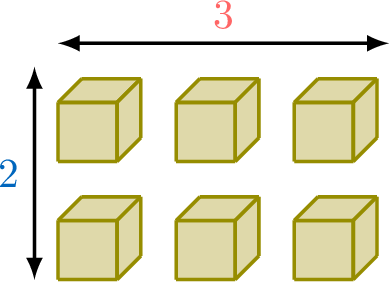
Example
We know that \(7 \times 13 = 91\). Without any further calculation, give \(91 \div 7\) and \(91 \div 13\).
Division undoes multiplication. The fact family of \(\textcolor{colordef}{7}\), \(\textcolor{colorprop}{13}\) and \(\textcolor{olive}{91}\) is: $$\begin{aligned}[t] \textcolor{colordef}{7} \times \textcolor{colorprop}{13} &= \textcolor{olive}{91} \\
\textcolor{colorprop}{13} \times \textcolor{colordef}{7} &= \textcolor{olive}{91} \end{aligned} \qquad \qquad \begin{aligned}[t] \textcolor{olive}{91} \div \textcolor{colordef}{7} &= \textcolor{colorprop}{13} \\
\textcolor{olive}{91} \div \textcolor{colorprop}{13} &= \textcolor{colordef}{7} \end{aligned}$$ So \(91 \div 7 = 13\) and \(91 \div 13 = 7\): one multiplication gives two divisions, even beyond the times tables.
Skills to practice
- Calculating Divisions with Tables
- Calculating Divisions with Larger Numbers
- Getting Two Divisions from One Multiplication
- Solving Division Problems
II
Halving Is Dividing by 2
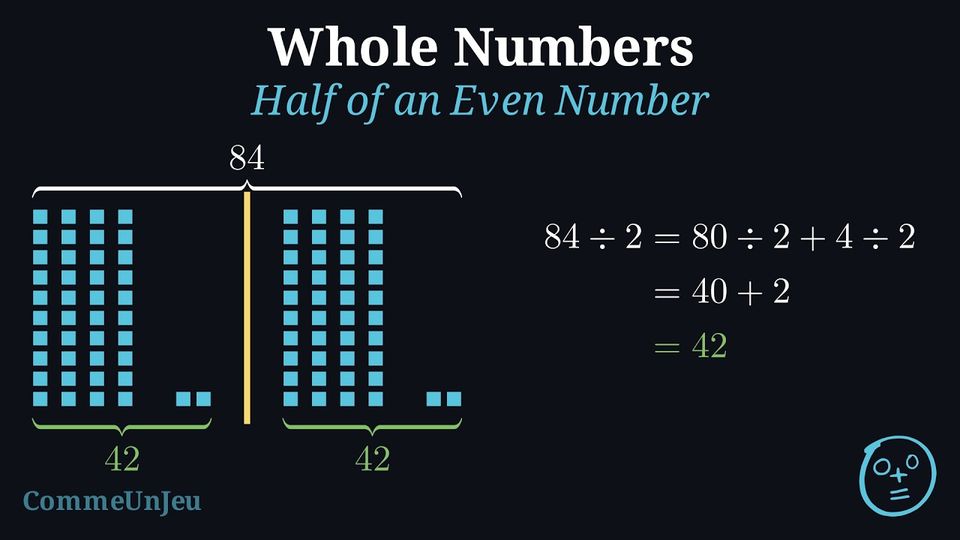
Method — Halving a 3-Digit Number
Taking half of a number means sharing it into two equal parts.To find half of an even number, split it into hundreds, tens and ones, take half of each part, then add. This works because sharing the whole into two means sharing each of its parts into two.
Half of \(46\): split \(46\) into \(40 + 6\); half of \(40\) is \(20\) and half of \(6\) is \(3\), so half of \(46\) is \(20 + 3 = 23\).
Half of \(470\): split \(470\) into \(400 + 70\).
Half of \(400\) is \(200\), and half of \(70\) is \(35\) (\(70 = 60 + 10\): \(30 + 5\)).
Add: \(200 + 35 = 235\). So half of \(470\) is \(235\).
When the hundreds digit is odd, first split off one hundred: \(500 = 400 + 100\); half of \(400\) is \(200\) and half of \(100\) is \(50\), so half of \(500\) is \(250\).
Halving Is Dividing by 2
Half of a number is that number divided by \(2\): $$\text{Half of } 34 = 34 \div 2 = 17$$ Halving by splitting is dividing by \(2\) by splitting.
Skills to practice
- Halving Larger Numbers
- Explaining the Halving
III
Dividing by Splitting
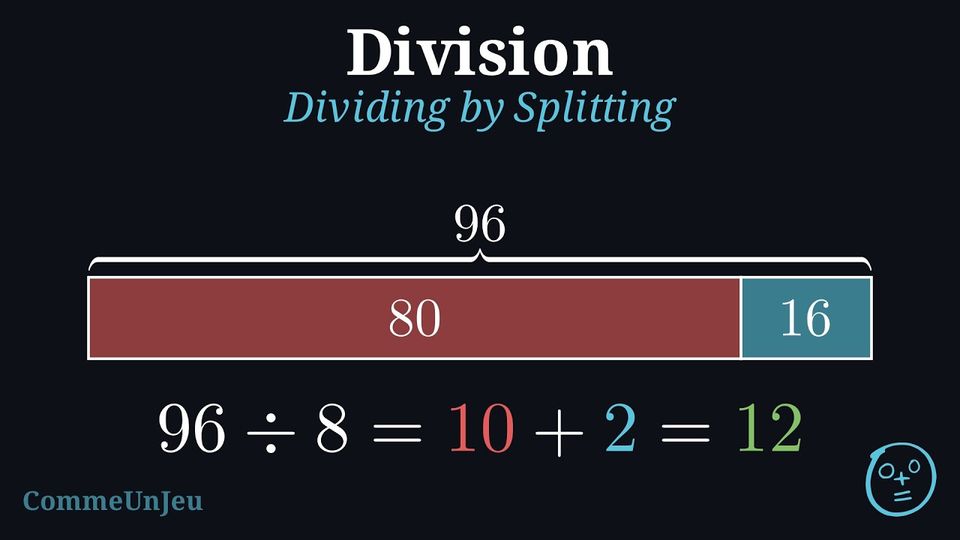
Method — Dividing by Splitting
To divide a number that is beyond the times tables, split it into two parts that the divisor divides exactly: first as many tens of the divisor as possible (\(10\) times, \(20\) times, \(30\) times the divisor …), then the other part, a fact of the table. Divide each part, then add the two results. 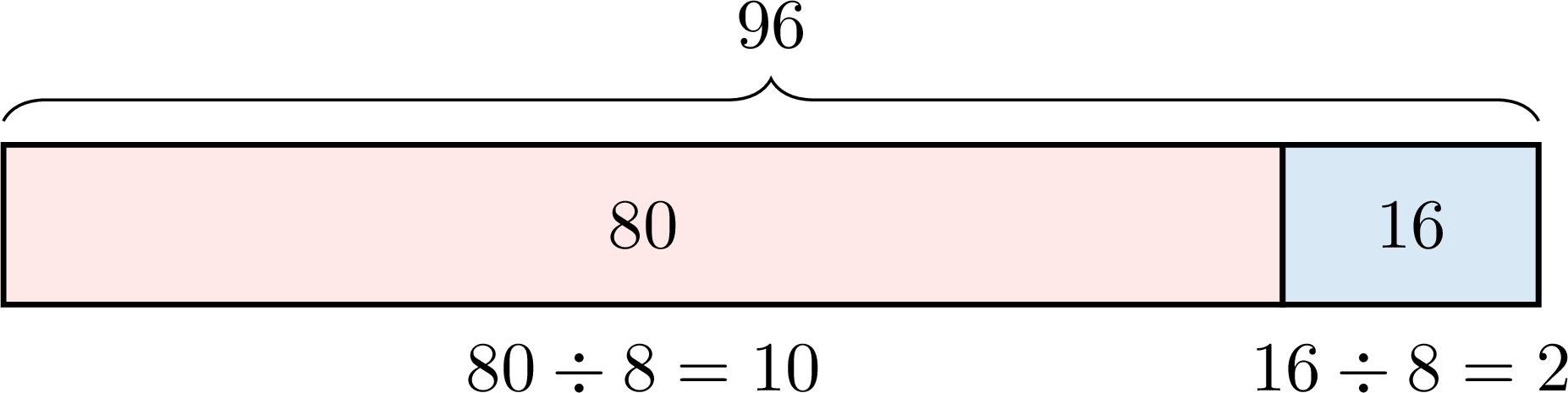
Example
Calculate \(84 \div 6\) and \(84 \div 3\) by splitting.
For \(\div 6\), ten times \(6\) is \(60\): split \(84\) into \(60 + 24\). $$\begin{aligned}[t] 84 \div 6 &= (60 \div 6) + (24 \div 6) && {\scriptstyle\left(84 = 60 + 24\right)} \\
&= 10 + 4 \\
&= 14 \end{aligned}$$ For \(\div 3\), twenty times \(3\) is \(60\): split \(84\) into \(60 + 24\) again. $$\begin{aligned}[t] 84 \div 3 &= (60 \div 3) + (24 \div 3) && {\scriptstyle\left(84 = 60 + 24\right)} \\
&= 20 + 8 \\
&= 28 \end{aligned}$$ Check: \(6 \times 14 = 84\) and \(3 \times 28 = 84\).
Skills to practice
- Dividing by Splitting: Step by Step
- Calculating Divisions by Splitting
IV
Going further
Skills to practice
- Reasoning with Division
- Quiz
Jump to section