International Baccalaureate · PYP 4
Turns and Angles
I
Degrees
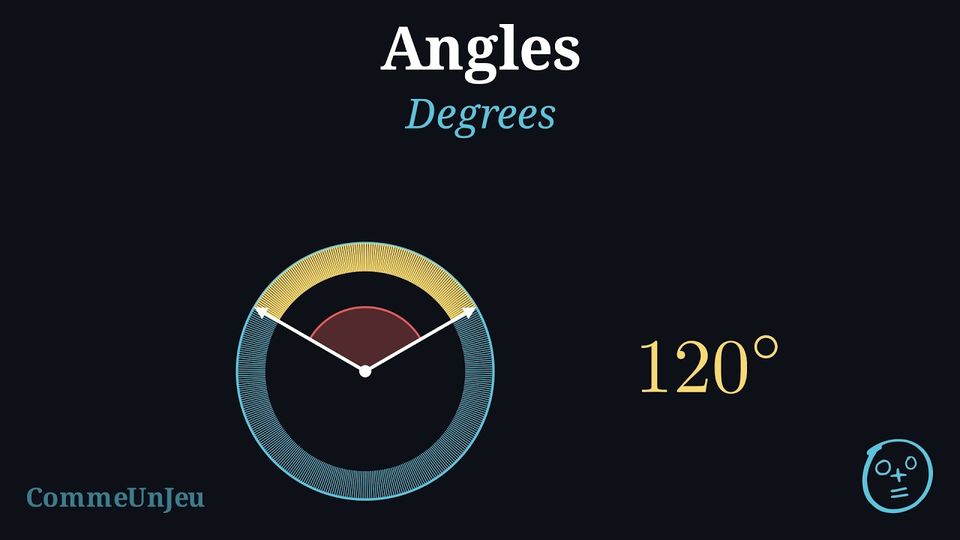
A full turn, or complete circle, can be divided into 360 equal parts. The angle corresponding to one of these parts measures one degree (\(1^\circ\)).
Definition — Degree Unit
A degree, written with the symbol \(^\circ\), is a unit of angle measurement. A full turn measures \(360^\circ\). 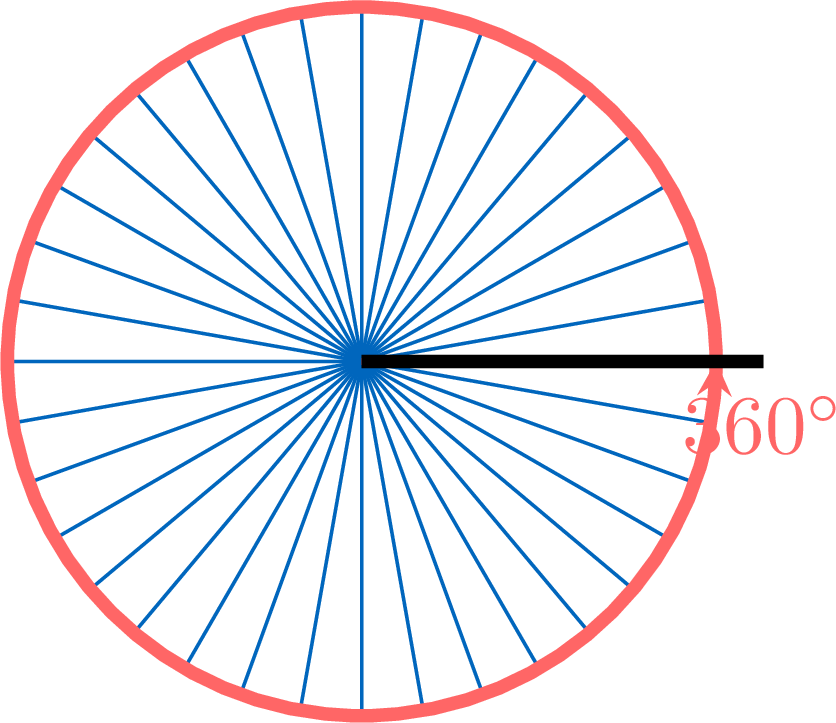
Definition — Measure of an Angle in Degrees
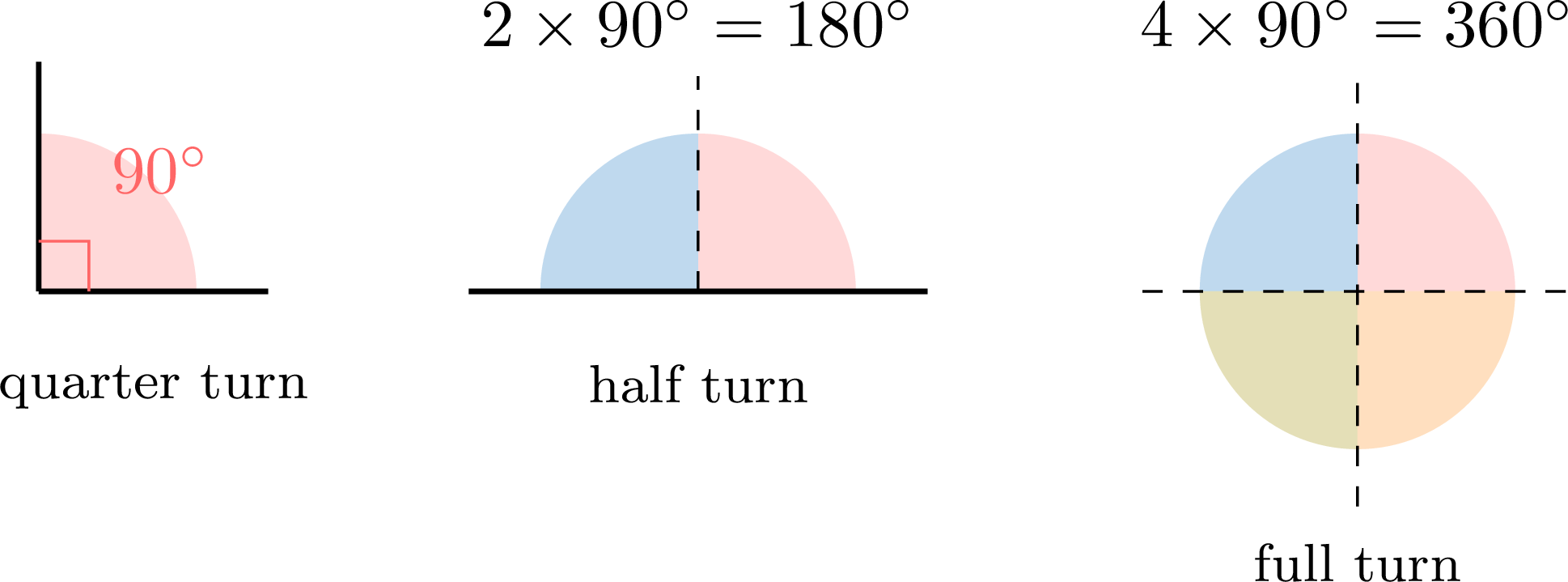
The measure of an angle in degrees counts how many of the 360 equal parts of a full turn the angle covers: a quarter of a turn is a quarter of \(360^\circ\), that is \(90^\circ\). Proposition — The Right Angle Measures 90°
- A right angle — the corner of the set square, the quarter turn — measures \(90^\circ\).
- A half turn is two right angles: \(2 \times 90^\circ = 180^\circ\).
- A full turn is four right angles: \(4 \times 90^\circ = 360^\circ\).
Example
Calculate the measure of an angle that represents one-third of a full turn. 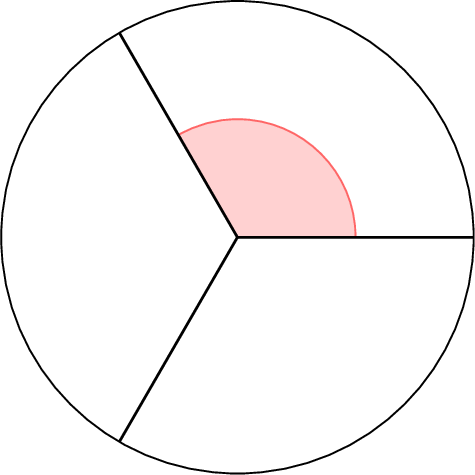
$$\begin{aligned} \text{Angle} &= \frac{1}{3} \text{ of } 360^\circ \\
&= 360^\circ \div 3 \\
&= 120^\circ \end{aligned}$$ 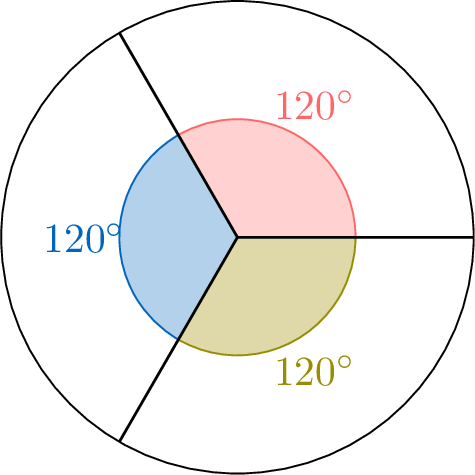
Skills to practice
- Dividing the Full Turn
- Explaining Degrees with Right Angles
II
Classification of Angles
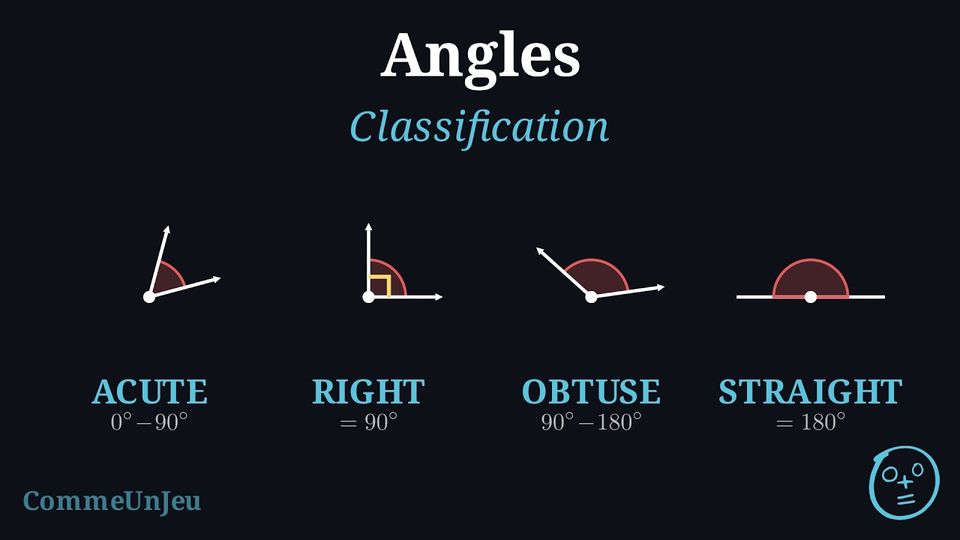
An acute angle is more closed than a right angle, an obtuse angle more open. Since a right angle measures \(90^\circ\), the measure is enough to classify them: the table below gives four types of angles, acute, right, obtuse and straight.
Definition — Classification of Angles
| Name | Fraction of a Full Turn | Angle Measure | Figure |
| Acute Angle | Less than \(\dfrac{1}{4}\) of a full turn | More than \(0^{\circ}\), less than \(90^{\circ}\) | 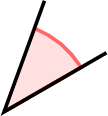 |
| Right Angle | \(\dfrac{1}{4}\) of a full turn | Exactly \(90^{\circ}\) | 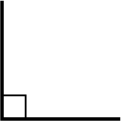 |
| Obtuse Angle | Between \(\dfrac{1}{4}\) and \(\dfrac{1}{2}\) of a full turn | More than \(90^{\circ}\), less than \(180^{\circ}\) | 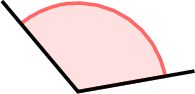 |
| Straight Angle | \(\dfrac{1}{2}\) of a full turn | Exactly \(180^{\circ}\) | 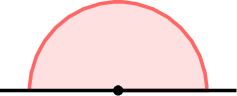 |
Method — Checking an Angle with a Set Square
First estimate by eye: does the angle look more closed or more open than a right angle? Then check with the set square: place its corner on the vertex, one edge along one arm of the angle. - The other arm lines up with the set square's edge: the angle is right.
- The other arm is inside the corner: the angle is acute.
- The other arm goes past the corner, without making a straight line with the first arm: the angle is obtuse.
Method — Estimating an Angle with Benchmark Angles
Without a protractor, an angle is estimated by comparing it with a few angles we know well, the benchmark angles: - the right angle, \(90^\circ\) — the corner of the set square;
- half a right angle, \(45^\circ\) — the corner of the set square cut into two equal openings;
- the straight angle, \(180^\circ\) — two right angles side by side, the two arms in a straight line.
Example
Estimate the measure of each angle with the benchmark angles, and give its type. 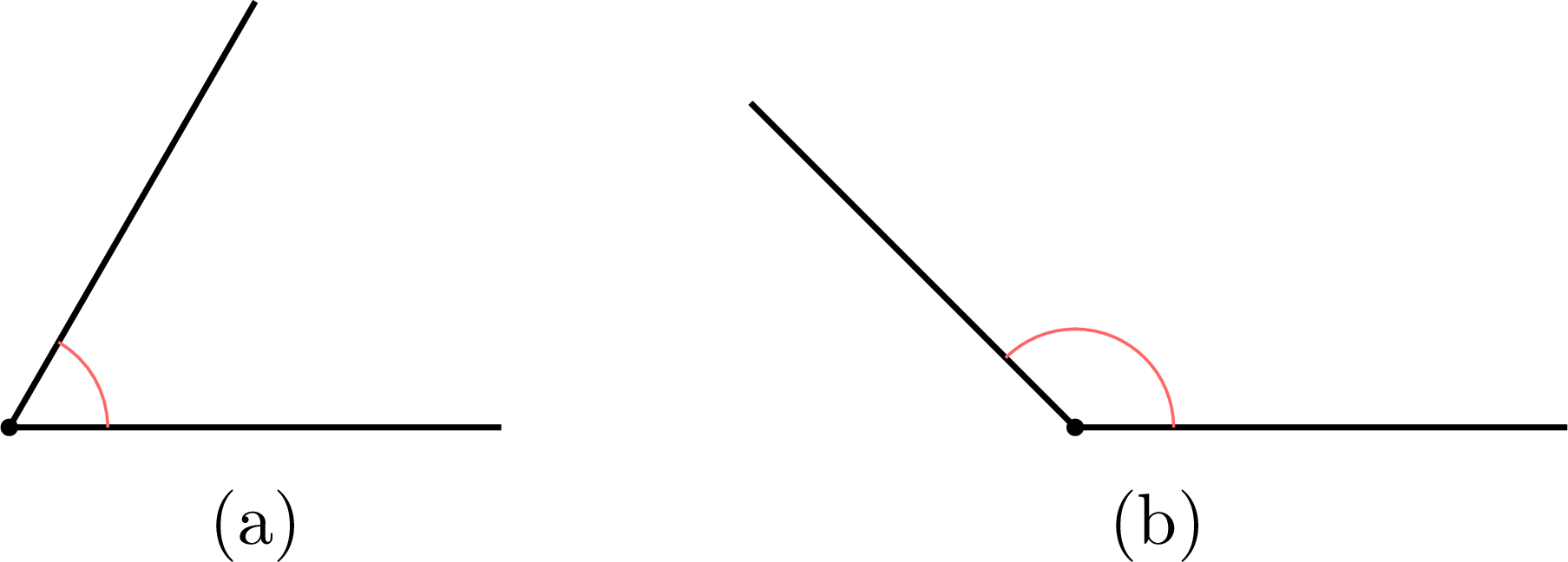
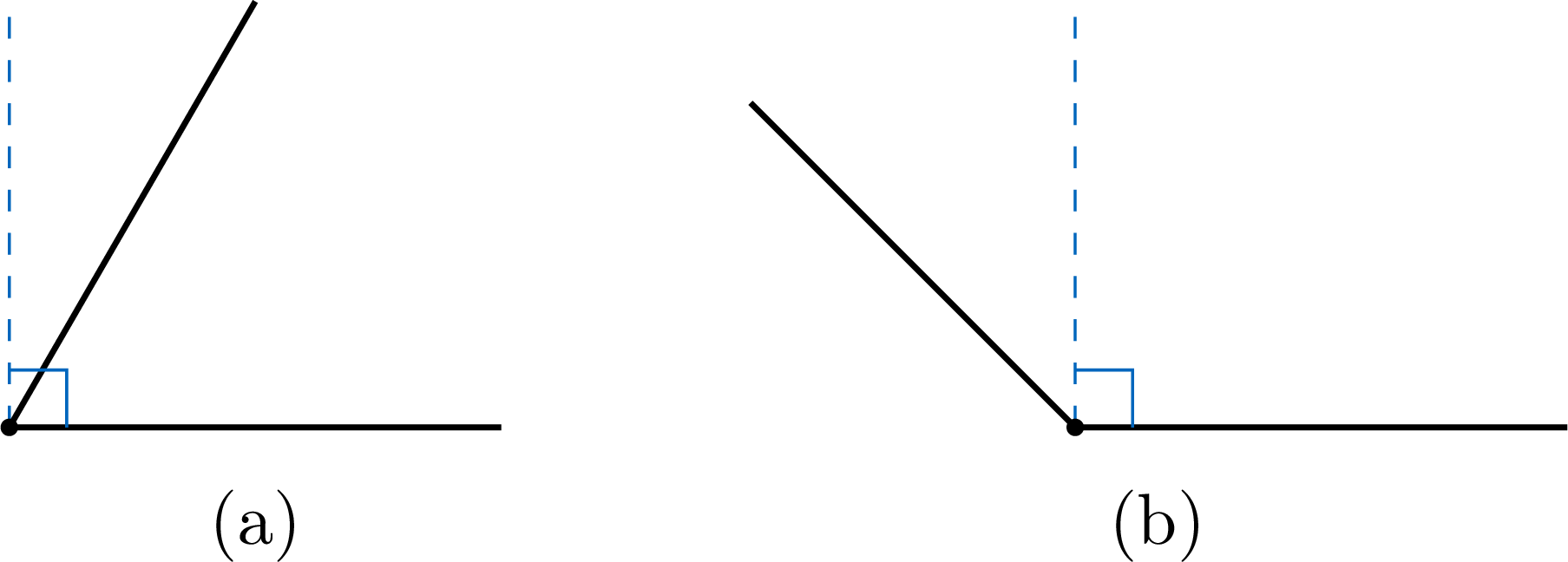
- [(a)] With the set square (dashed), the second arm stays inside the corner: the angle is acute, less than \(90^\circ\). It is more open than half the corner (\(45^\circ\)) but clearly more closed than the corner: it lies between \(45^\circ\) and \(90^\circ\), about \(60^\circ\).
- [(b)] The second arm goes past the corner: the angle is obtuse, more than \(90^\circ\). It lies about halfway between the right angle and the straight angle: it measures about \(90^\circ + 45^\circ\), that is about \(135^\circ\).
Skills to practice
- Identifying Angle Types by Measure
- Identifying Angle Types
- Drawing and Estimating Angles
III
Review & Quizz
Skills to practice
- Quiz
Jump to section