International Baccalaureate · PYP 2
Word problems
I
Part-Whole Problems up to 1000
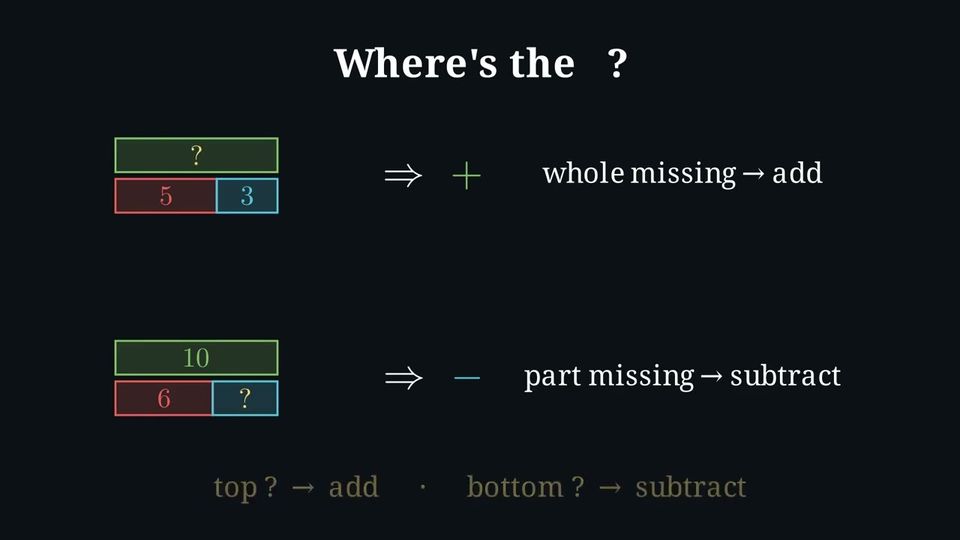
Method — Steps to Solve Word Problems
These are the four steps already known (search, try, check, say), made more precise by the model: searching becomes understanding the story; trying becomes drawing a model and choosing the operation; checking and saying are in the last step: we calculate, make sure the answer makes sense, then give it. - Understand the Story: Read the problem to identify the parts and the whole.
- Draw a Model: Use a part-whole bar model to organize the information.
- Choose the Operation: If the whole is unknown, you add the parts. If a part is unknown, you subtract the known part from the whole.
- Solve and Check: Calculate the answer and make sure it makes sense in the context of the story.
The school library owns \(245\) books. \(128\) are picture books, and the rest are novels. How many novels are there?
- Analysis: We know the whole (\(245\) books) and one part (\(128\) picture books). The other part is unknown: we subtract.
- Model:
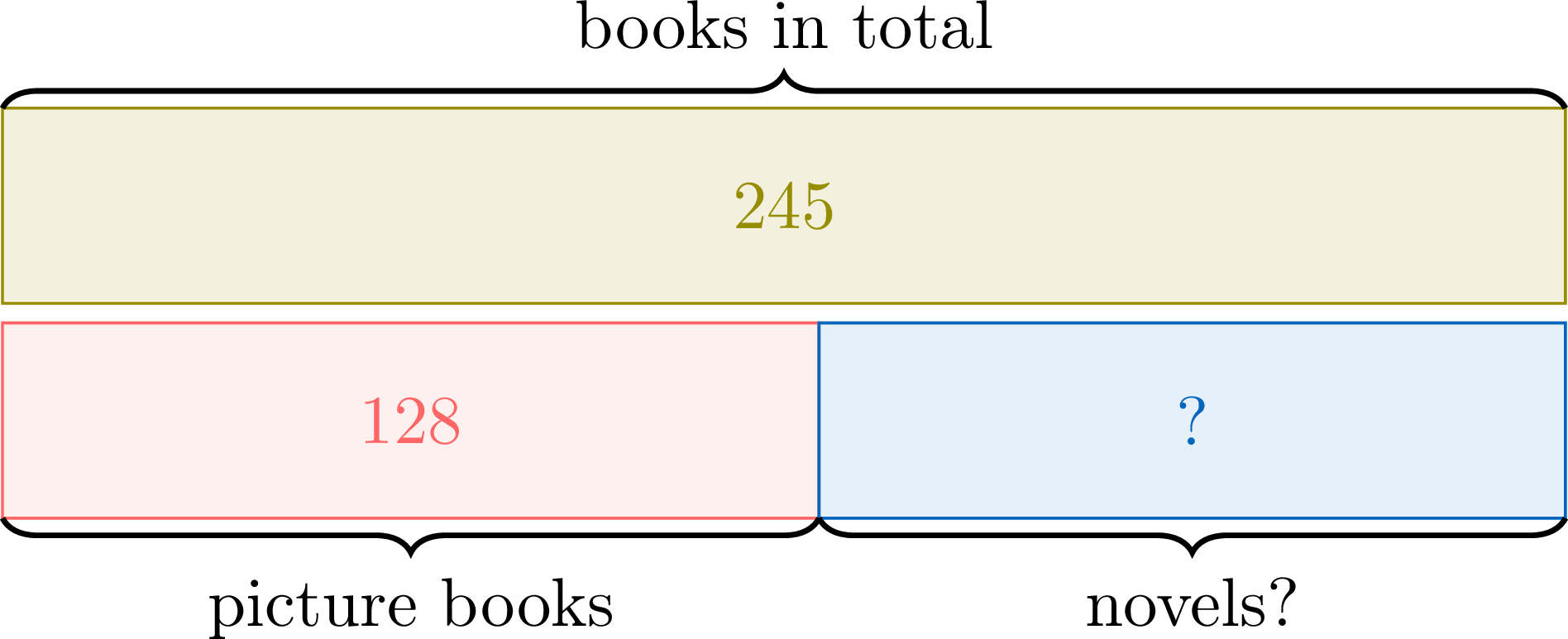
- Solve: the missing part is the gap from \(128\) to \(245\). Count up: \(128 + 2 = 130\), \(130 + 70 = 200\), \(200 + 45 = 245\), so \(2 + 70 + 45 = 117\). $$\textcolor{olive}{245}-\textcolor{colordef}{128}=\textcolor{colorprop}{117}$$ There are \(\textcolor{colorprop}{117}\) novels.
Method — The Bar Model up to 1000
The same bar model works for big numbers. Remember: the bar does not need to be drawn to scale — its job is to help choose the operation, not to measure. - If the whole is unknown, add the parts.
- If a part is unknown, subtract the known part from the whole.
- Compute in your head when the numbers allow it, otherwise set it out in columns.
Big Numbers in Your Head
Before setting out a calculation in columns, look at the numbers: many calculations with big numbers are done in your head.
- Nothing to regroup: hundreds with hundreds, tens with tens, ones with ones. \(423 + 154\): \(4 + 1 = 5\) hundreds, \(2 + 5 = 7\) tens, \(3 + 4 = 7\) ones, so \(577\).
- Whole tens or whole hundreds: the ones do not move. \(368 - 50\): \(6\) tens minus \(5\) tens make \(1\) ten, so \(318\).
- \(9\), \(19\) or \(29\): go through the whole ten. \(256 + 19\): \(256 + 20 = 276\), then \(275\).
- Two close numbers: to find their difference, count up from the smaller number to the bigger one. \(410 - 385\): from \(385\) to \(390\) is \(5\), from \(390\) to \(410\) is \(20\), so \(25\).
Example
This morning, the baker had some baguettes. He sold \(176\) of them. He has \(148\) left. How many baguettes did he have this morning? - Analysis: the morning baguettes are the whole; the two parts are the sold ones (\(176\)) and the remaining ones (\(148\)). The whole is unknown: we add.
- Model:
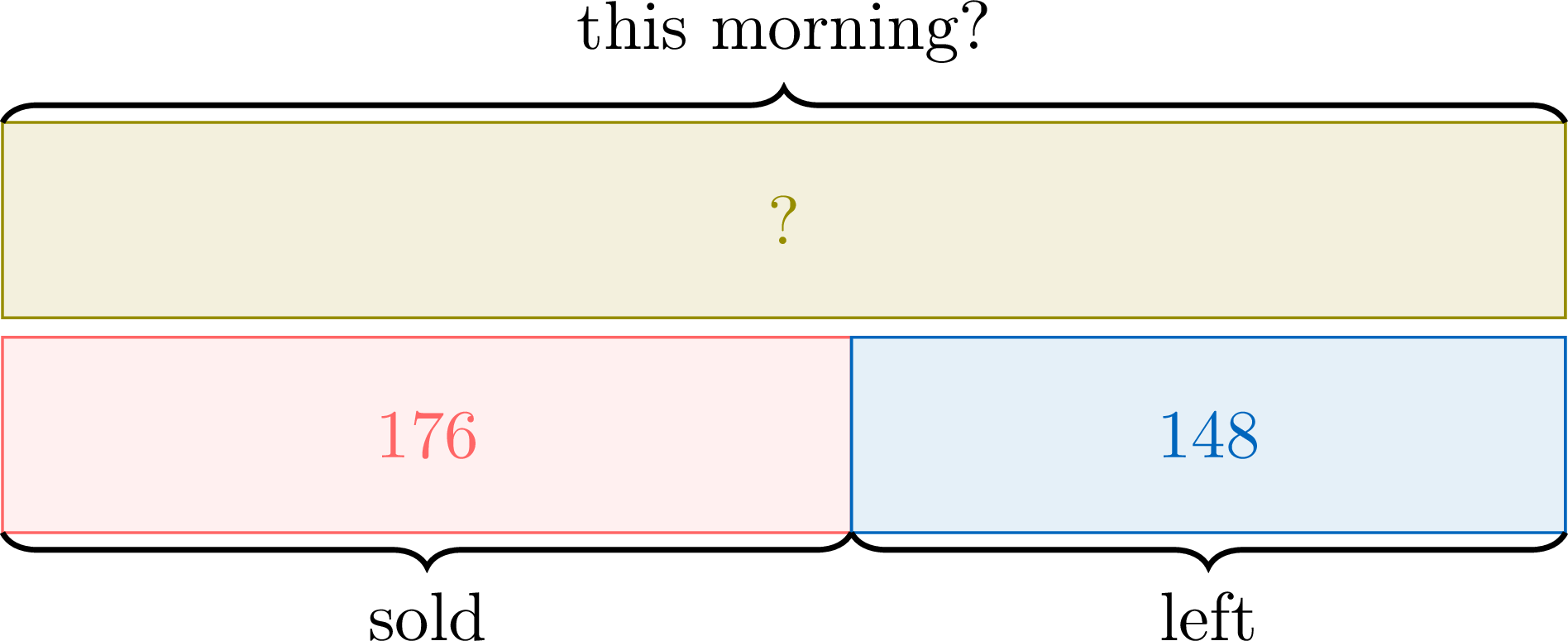
- Solve: \(\textcolor{colordef}{176}+\textcolor{colorprop}{148}=\textcolor{olive}{324}\) (a column calculation, met fully later). He had \(\textcolor{olive}{324}\) baguettes this morning.
Skills to practice
- Finding the Whole, a Part or the Starting Number
II
Comparison Problems
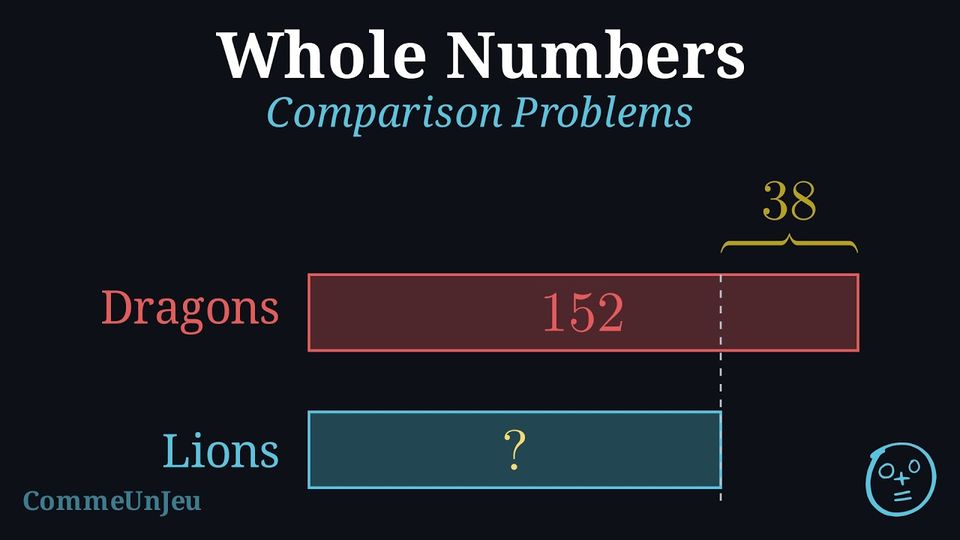
At the school tournament, the Red team scored \(152\) points. They scored \(38\) points more than the Blue team. How many points did the Blue team score?
Careful: the problem says “more”… but should we really add?
Careful: the problem says “more”… but should we really add?
- Analysis: two teams are compared: we draw one bar for each. The Red team has the bigger score: its bar is longer. The Blue team's bar is shorter by \(38\).
- Model:
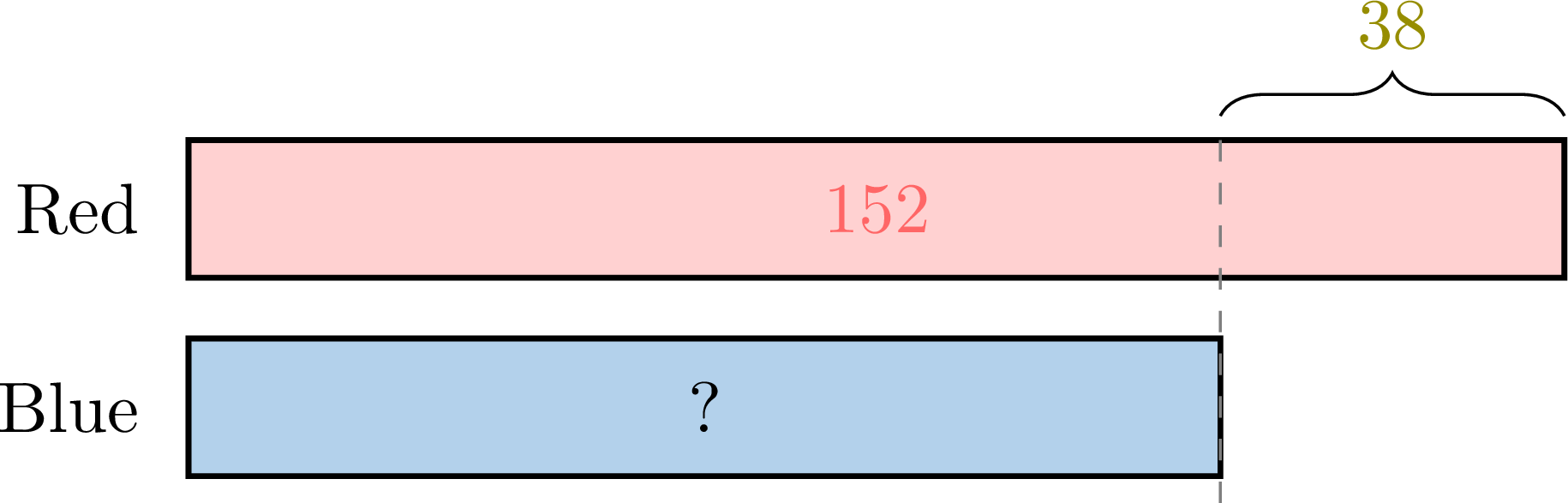
- Solve: the model shows it: the Blue team has less, so we subtract, even though the story says “more”: $$\textcolor{colordef}{152}-\textcolor{olive}{38}=\textcolor{colorprop}{114}$$ The Blue team scored \(\textcolor{colorprop}{114}\) points.
Method — Two Bars to Compare
In a comparison problem, nothing is split into parts: two quantities are compared. So we draw two separate bars, one under the other, and we mark the difference. - Draw one bar per quantity: the bigger one is longer.
- Read the model, not the words: “more than” or “less than” tells you who has more — the model then tells you whether to add or subtract.
- To find the bigger: add the difference. To find the smaller: subtract it. To find the difference: subtract the smaller from the bigger.
Example
Théo has \(246\) trading cards. Mia has \(57\) cards more than Théo. How many cards does Mia have? - Analysis: Mia has more: her bar is longer — it is Théo's bar plus \(57\).
- Model:
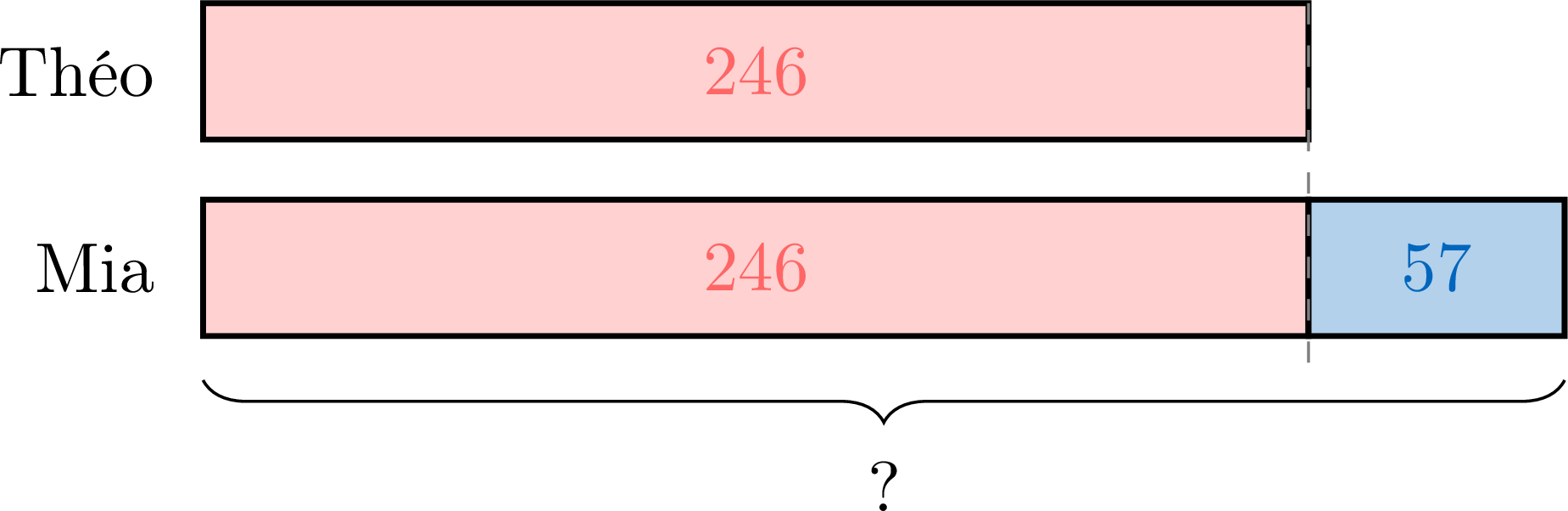
- Solve: \(\textcolor{colordef}{246}+\textcolor{colorprop}{57}=\textcolor{olive}{303}\) (a column calculation, met fully later). Mia has \(\textcolor{olive}{303}\) cards.
Example
An apple tree gave \(428\) apples; a pear tree gave \(385\) pears. How many more apples than pears are there? - Analysis: both quantities are known; the difference is unknown.
- Model:
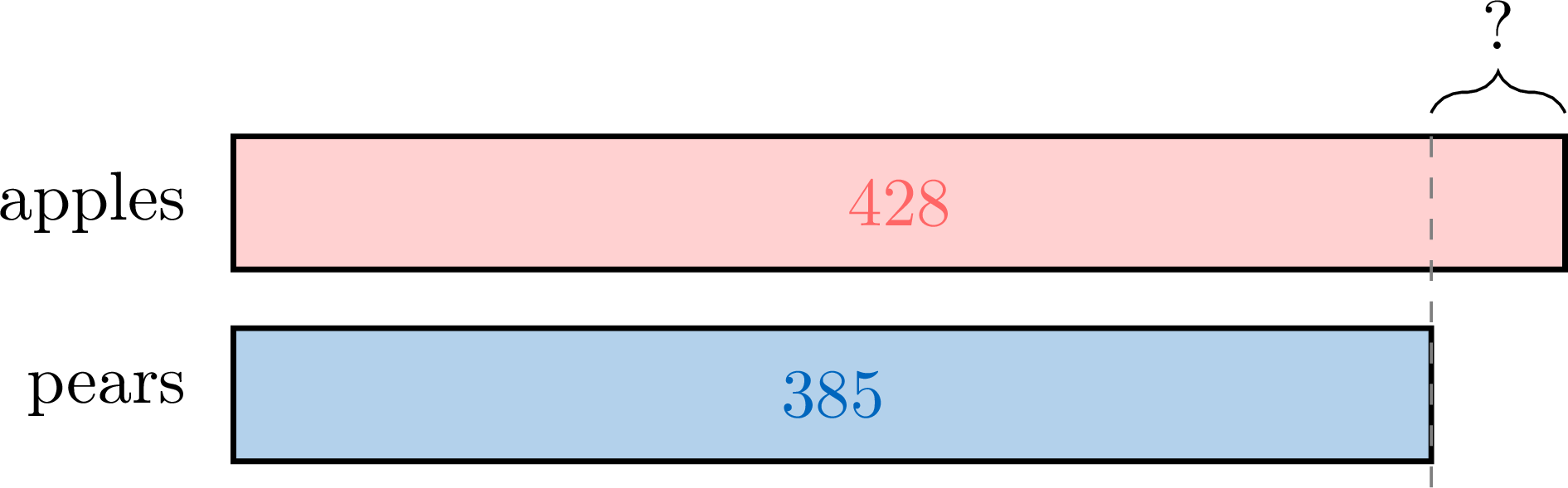
- Solve: the two numbers are close: count up from \(385\) to \(428\). \(385 + 15 = 400\), \(400 + 28 = 428\), so \(15 + 28 = 43\) and \(\textcolor{colordef}{428}-\textcolor{colorprop}{385}=\textcolor{olive}{43}\). There are \(\textcolor{olive}{43}\) more apples than pears.
Skills to practice
- Finding the Bigger, the Smaller or the Difference
III
Two-Step Problems up to 1000
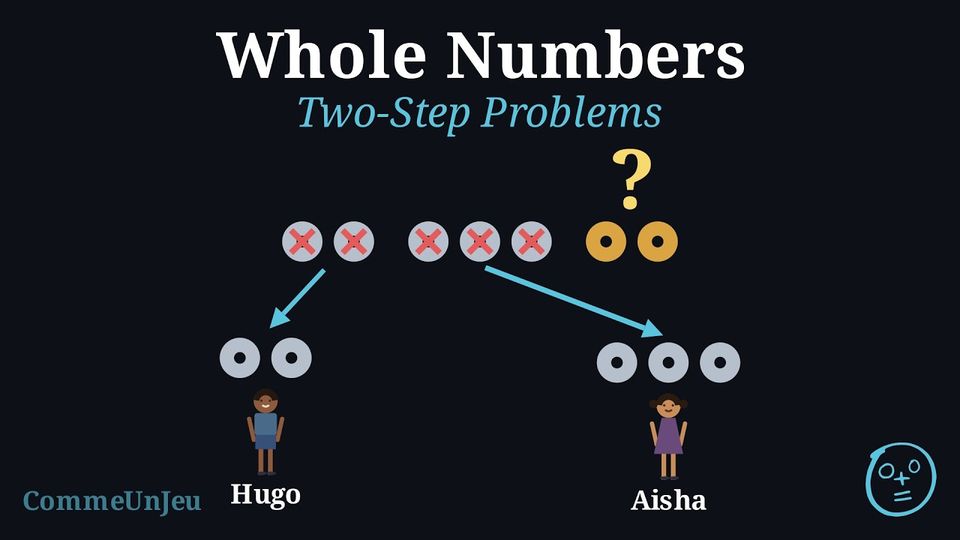
Method — Solving a Problem in Two Steps
Some problems cannot be solved with one calculation: the question hides another number that you must find first. - Find the hidden number: Read the story and find the number the question needs but does not give. Calculate it first.
- Answer the question: Use the hidden number in a second calculation to answer the question.
- Check: Make sure the answer makes sense in the story.
The market stall prepared \(450\) crêpes. It sold \(217\) in the morning and \(186\) in the afternoon. How many crêpes are left?
One calculation is not enough: which number is hiding?
One calculation is not enough: which number is hiding?
- Step 1 — the hidden number: the question needs the number of crêpes sold in all. We know its two parts:
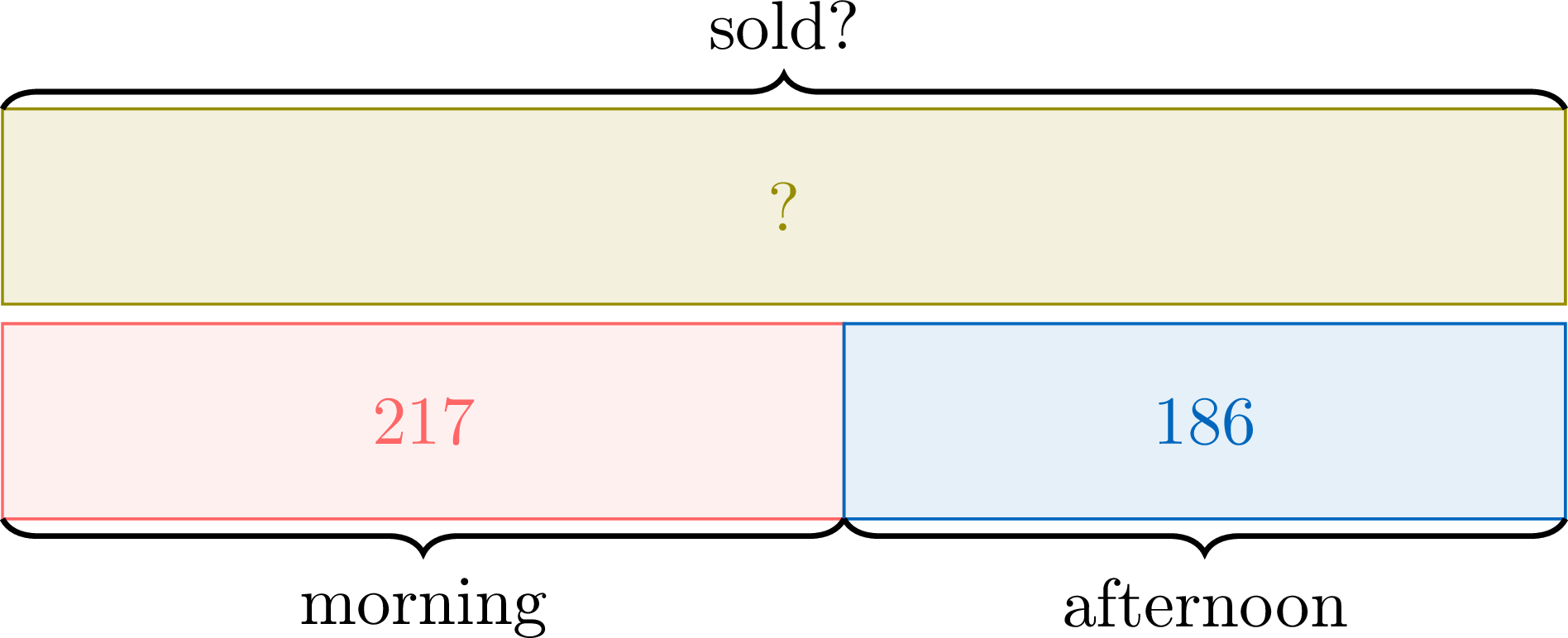
- Step 2 — the answer: now the whole (\(450\)) and one part (\(403\)) are known:
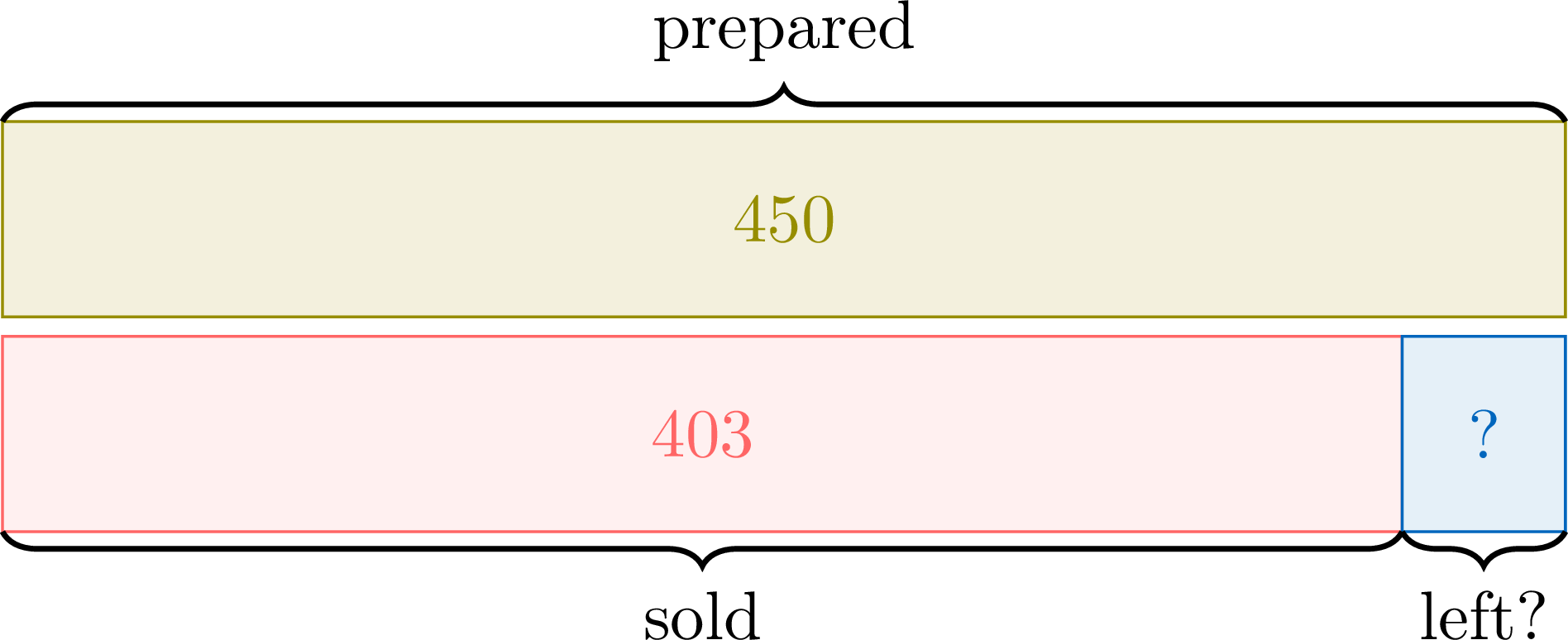
- Check: \(403+47=450\): everything is accounted for.
Method — Two Steps with Big Numbers
The “hidden number” method still works with big numbers. To stay organized: - one step per line: name the hidden number, then write its calculation;
- compute in your head when the numbers allow it, otherwise set it out in columns;
- a bar model for each step helps choose each operation.
Example
A school has \(216\) pupils in the older classes and \(148\) in the younger classes. The neighbouring school has \(305\) pupils. How many pupils do the two schools have together? - Step 1 — the hidden number: the first school's total: \(216+148=364\) pupils (a column calculation, met fully later).
- Step 2 — the answer: the two schools together: \(364+305=669\) pupils.
- Check: \(669\) is bigger than each school alone: it makes sense.
Example
A water tank holds \(850\) litres. The gardener draws \(265\) litres in the morning and \(190\) litres in the evening. How many litres are left in the tank? - Step 1: after the morning: \(850-265=585\) litres.
- Step 2: after the evening: \(585-190=395\) litres.
- These two subtractions are column calculations, met fully later.
- Check: the tank empties little by little: \(395\) is smaller than \(585\), itself smaller than \(850\).
Skills to practice
- Solving Two Steps in a Row
IV
Mixed Problems
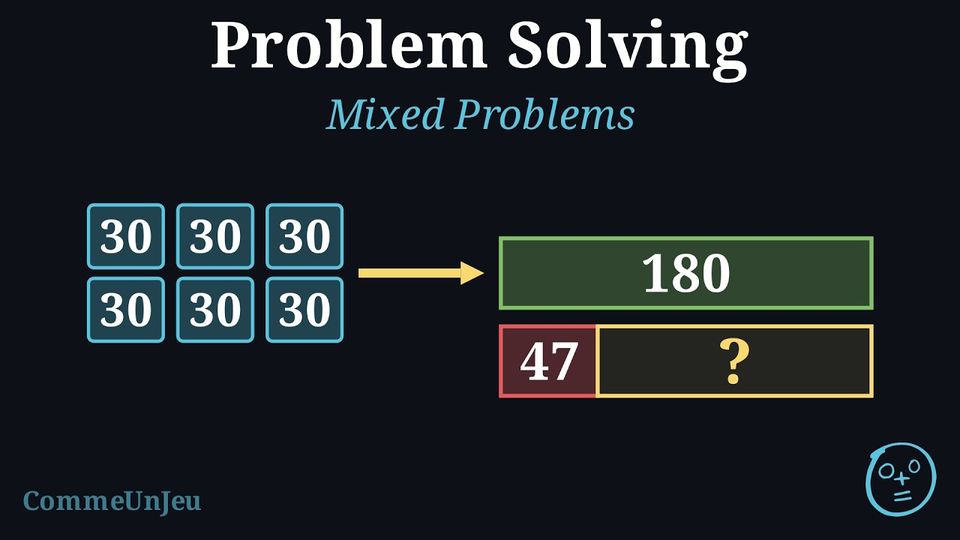
For the school party, the school orders \(6\) packs of \(30\) cups. \(47\) cups arrive damaged. How many cups can be used?
Two different operations hide in this story: which ones?
Two different operations hide in this story: which ones?
- Step 1 — a multiplication: \(6\) packs of \(30\) cups are \(6\) equal groups: \(6 \times 30 = 180\) cups delivered.
- Step 2 — a subtraction: the whole (\(180\)) and one part (\(47\), damaged) are known:
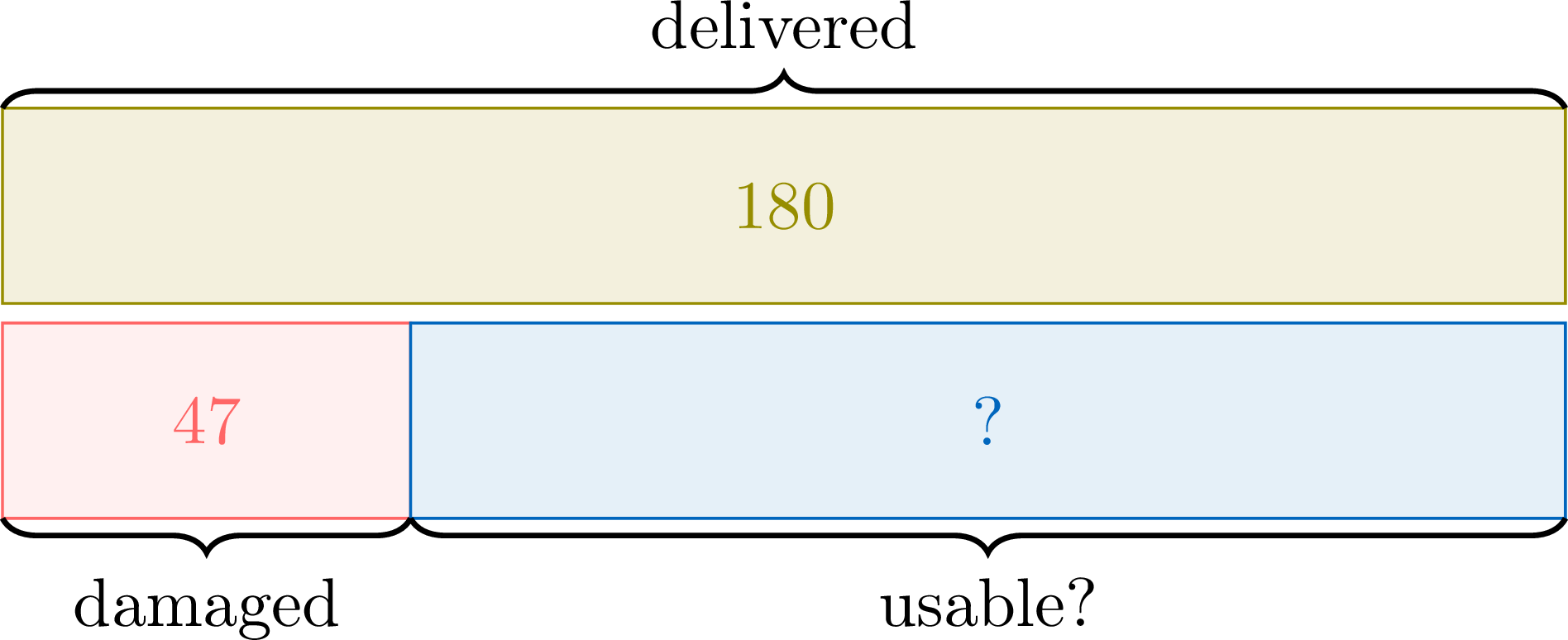
- Check: \(133+47=180\): all the cups are accounted for.
Method — Spotting the Two Operations
In a mixed problem, one step is a multiplication, the other an addition or a subtraction. - Equal groups in the story (“packs of…”, “boxes of…”, “rows of…”): when the number of groups and the size of a group are both known, the multiplication gives the hidden number.
- Then read the rest of the story as a part-whole problem: it gives the second step.
- One step per line — the times tables and the whole tens do the work.
Example
A bookcase has \(3\) shelves of \(40\) books. \(65\) more books are waiting on a cart. How many books are there in all? - Step 1 — multiplication: \(3 \times 40 = 120\) books on the shelves.
- Step 2 — addition: \(120+65=185\) books in all.
- Check: \(185\) is more than \(120\): the cart added books, it makes sense.
Example
A farmer collects \(5\) trays of \(20\) eggs. She sells \(76\) eggs at the market. How many eggs does she have left? - Step 1 — multiplication: \(5 \times 20 = 100\) eggs collected.
- Step 2 — subtraction: \(100-76=24\) eggs left.
- Check: \(24+76=100\): all the eggs are accounted for.
Skills to practice
- Multiplying Then Adding or Subtracting
V
Sharing and Grouping
\(60\) children come to a maths rally. The head teacher makes teams of \(5\) children. How many teams will there be? Léa draws a bar: \(60\) children on top, parts of \(5\) underneath. 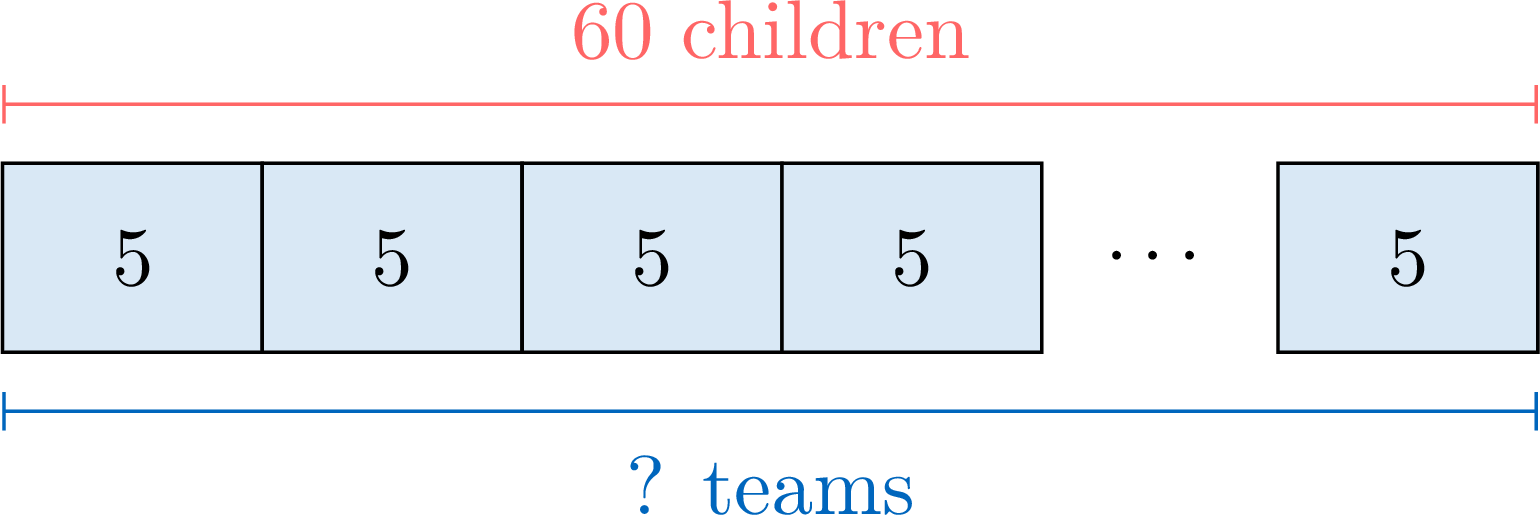
We look for how many times \(5\) makes \(60\). In the \(5\)s table: \(5 \times 10 = 50\), then two jumps of \(5\): \(55\), \(60\). That is \(10 + 2 = 12\) fives. There will be \(12\) teams. Check: \(12\) teams of \(5\) make \(60\) children.
Method — Finding with the Times Table or by Jumps
In an equal share, the bar shows the whole on top and the parts underneath. Two questions can be asked: - How many parts? The size of a part is known. Look for how many times it makes the whole: \(60\) children in teams of \(5\): \(5 \times \ldots = 60\), so \(12\) teams.
- How many in each part? The number of parts is known. Look for the number that, taken that many times, makes the whole: \(200\) pupils in \(40\) teams: \(40 \times \ldots = 200\), so \(5\) pupils per team.
Example
(a) Three children share \(18\) pictures equally. How many pictures does each child get? (b) Tom puts \(30\) marbles into bags of \(10\). How many bags does he fill? 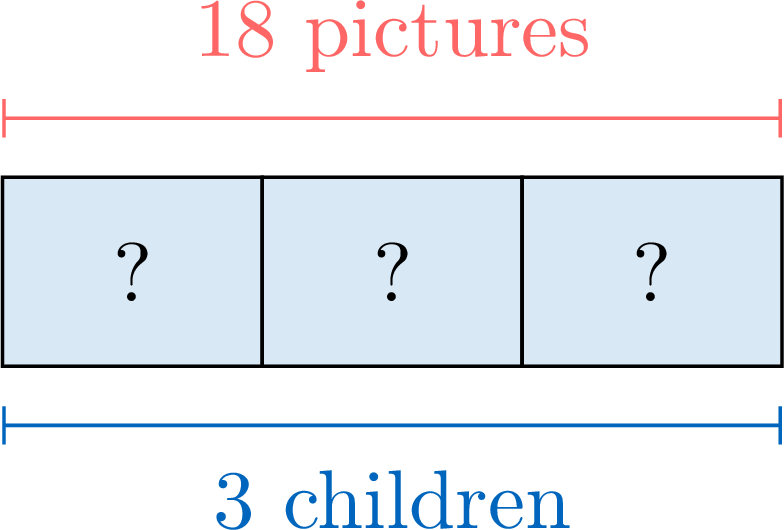
(a) Three parts: \(3 \times \ldots = 18\). In the \(3\)s table, \(3 \times 6 = 18\): each child gets \(6\) pictures. (b) Parts of \(10\): \(10 \times \ldots = 30\), \(10 \times 3 = 30\): \(3\) bags. Check: \(6 + 6 + 6 = 18\) and \(10 + 10 + 10 = 30\).
Method — When Some Are Left
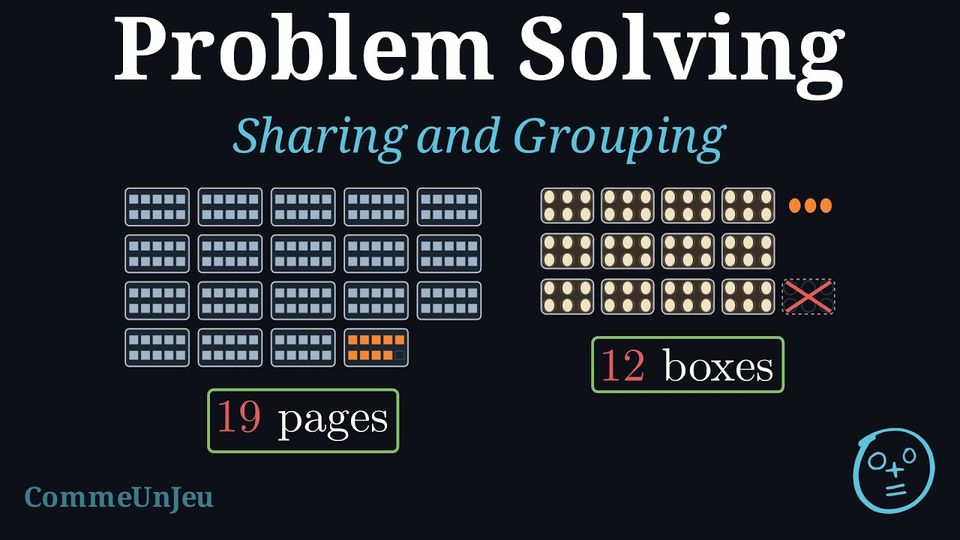
Sometimes the parts do not make the whole exactly. Find the biggest number of full parts, then say what is left, and answer the question that was asked: - \(189\) photos, \(10\) per page: \(10 \times 18 = 180\), \(9\) photos are left. They need a page too: \(19\) pages are needed.
- \(38\) eggs, to be sold in boxes of \(4\): \(4 \times 9 = 36\), \(2\) eggs are left. They do not fill a box: \(9\) boxes can be sold.
Example
Nour has \(23\) stickers and makes packs of \(4\). How many full packs does she make? How many stickers are left?
\(4 \times 5 = 20\) and \(4 \times 6 = 24\) is too much: \(5\) full packs, and \(23 - 20 = 3\) stickers are left.
Skills to practice
- Finding How Many Parts
- Finding How Many in Each Part
- Telling Which Question Is Asked
- Sharing with Some Left Over
VI
Going further
Skills to practice
- Inventing Stories
- Quiz
Jump to section