International Baccalaureate · PYP 3
Number Patterns
I
Adding or Subtracting the Same Number
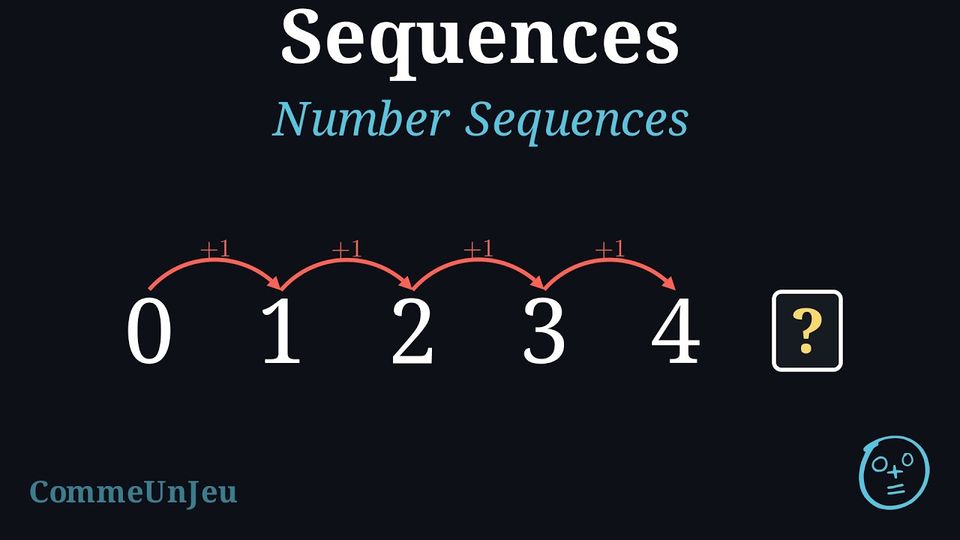
A sequence is a list of numbers in a special order that follows a rule. By finding the rule or pattern, we can figure out what number comes next.
In some patterns, we always add the same number, or we always subtract the same number. In others, we always multiply by the same number, or we always divide by the same number.
In some patterns, we always add the same number, or we always subtract the same number. In others, we always multiply by the same number, or we always divide by the same number.
Definition — The Step of a Pattern
In some patterns the same number is added each time, or the same number is subtracted each time: that number is the step. It is the difference between two terms that are next to each other in the pattern.Such a pattern is also called an arithmetic sequence, and its step the common difference.
Example
What is the next number in the sequence?$$3, 6, 9, 12, ?$$
The next number is \(15\), because each number increases by \(3\). 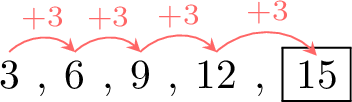
Skills to practice
- Finding the Next Term
- Finding the First Term
- Finding the Step
II
Multiplying or Dividing by the Same Number
Example
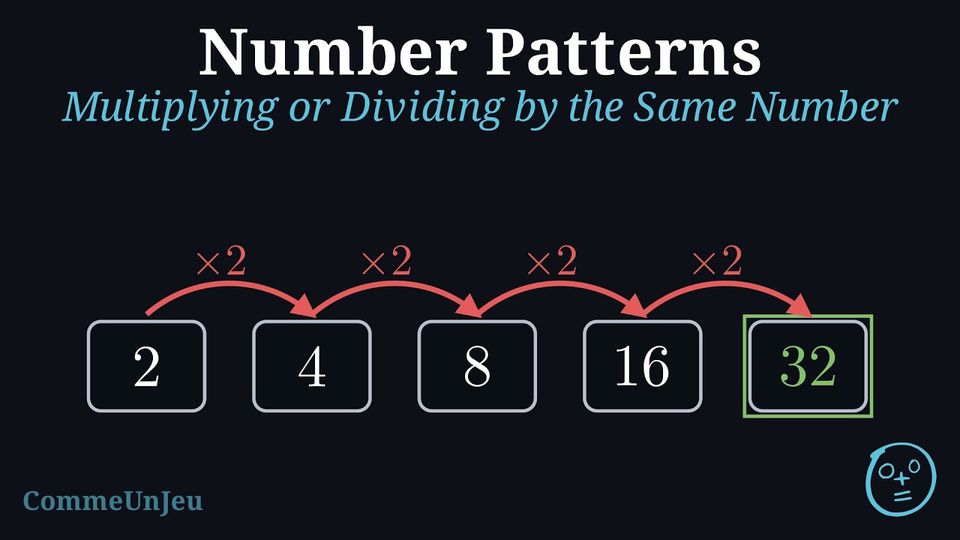
What is the next number in the sequence?$$2, 4, 8, 16, ?$$
The next number is \(32\). Each number doubles: the rule is “multiply by \(2\)”. 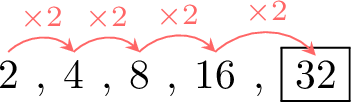
Example
In this pattern, each term is divided by the same number to give the next one.
From \(80\) to \(40\), from \(40\) to \(20\), from \(20\) to \(10\): each term is half of the one before. The rule is divide by \(2\) (halve). 
$$\begin{aligned} 10 \div 2 &= 5 &&\text{(the rule)}\\
80 \times 2 &= 160 &&\text{(the rule undone, to go back one term)} \end{aligned}$$ The next term is \(5\). Extended backwards, the term just before \(80\) would be \(160\): halving \(160\) gives \(80\).
Skills to practice
- Finding the Next Term
- Finding the First Term
III
Rules in a Table and in Two Steps
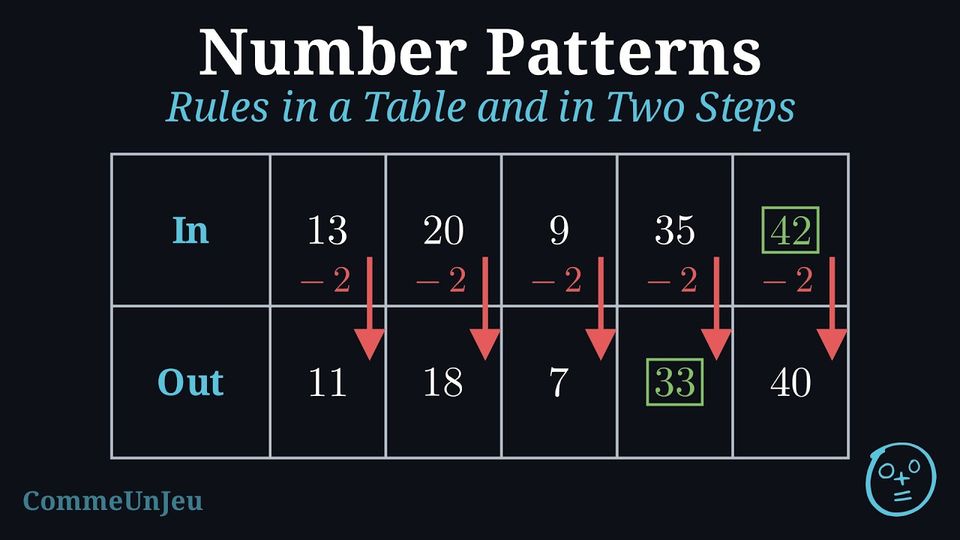
Example
In this table, one rule in a single step — adding, subtracting or multiplying by the same whole number — changes each number of the In row into the number below it, in the Out row, always in the same way. | In | \(13\) | \(20\) | \(9\) | \(35\) | ? |
| Out | \(11\) | \(18\) | \(7\) | ? | \(40\) |
- Compare each In number with its Out number. \(13\) becomes \(11\): \(2\) less. \(20\) becomes \(18\): \(2\) less. \(9\) becomes \(7\): \(2\) less. The rule is the same for every pair: subtract \(2\).
- Use the rule. For the In number \(35\): \(35 - 2 = 33\).
- Undo the rule to go back. Which In number gives \(40\) once \(2\) is taken away? The one that is \(2\) more: \(40 + 2 = 42\). Check: \(42 - 2 = 40\).
| In | \(13\) | \(20\) | \(9\) | \(35\) | \(\boxed{42}\) |
| Out | \(11\) | \(18\) | \(7\) | \(\boxed{33}\) | \(40\) |
Example
The rule of this pattern has two steps: double the number, then add \(1\). The first term is \(1\).
Each new term needs the two steps, always in the same order: first double, then add \(1\). $$\begin{aligned} 1 \times 2 &= 2 &\qquad 2 + 1 &= 3\\
3 \times 2 &= 6 &\qquad 6 + 1 &= 7\\
7 \times 2 &= 14 &\qquad 14 + 1 &= 15 \end{aligned}$$ 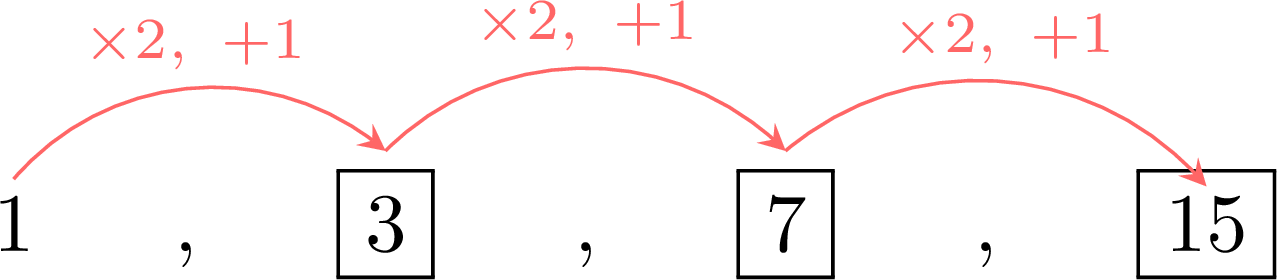
The pattern is \(1, 3, 7, 15\). A rule with one single step cannot give it:
- adding the same number each time would make the step from one term to the next always the same, but it is \(+2\), then \(+4\), then \(+8\);
- multiplying by the same number: from \(1\) to \(3\) that number would be \(3\), but \(3 \times 3 = 9\), not \(7\);
- subtracting or dividing by a whole number cannot turn \(1\) into the bigger number \(3\).
Skills to practice
- Finding the Rule in a Table
- Following a Rule in Two Steps
IV
Going further
Skills to practice
- Creating and Describing Patterns
- Quiz
Jump to section