International Baccalaureate · PYP 1
Division: Equal Sharing
I
Equal Shares
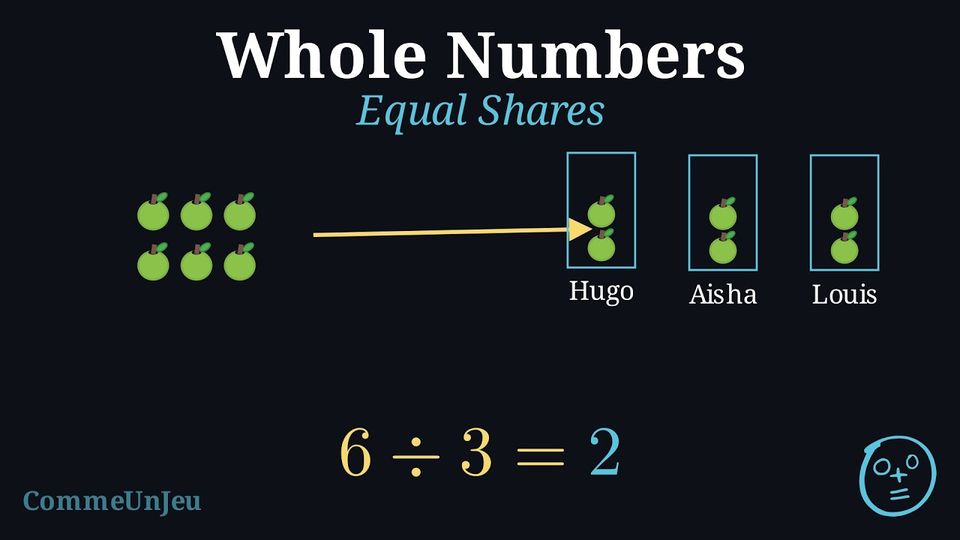
Hugo, Aisha, and Louis have 6 apples. They want to share them equally. How can they do it so that it's fair? 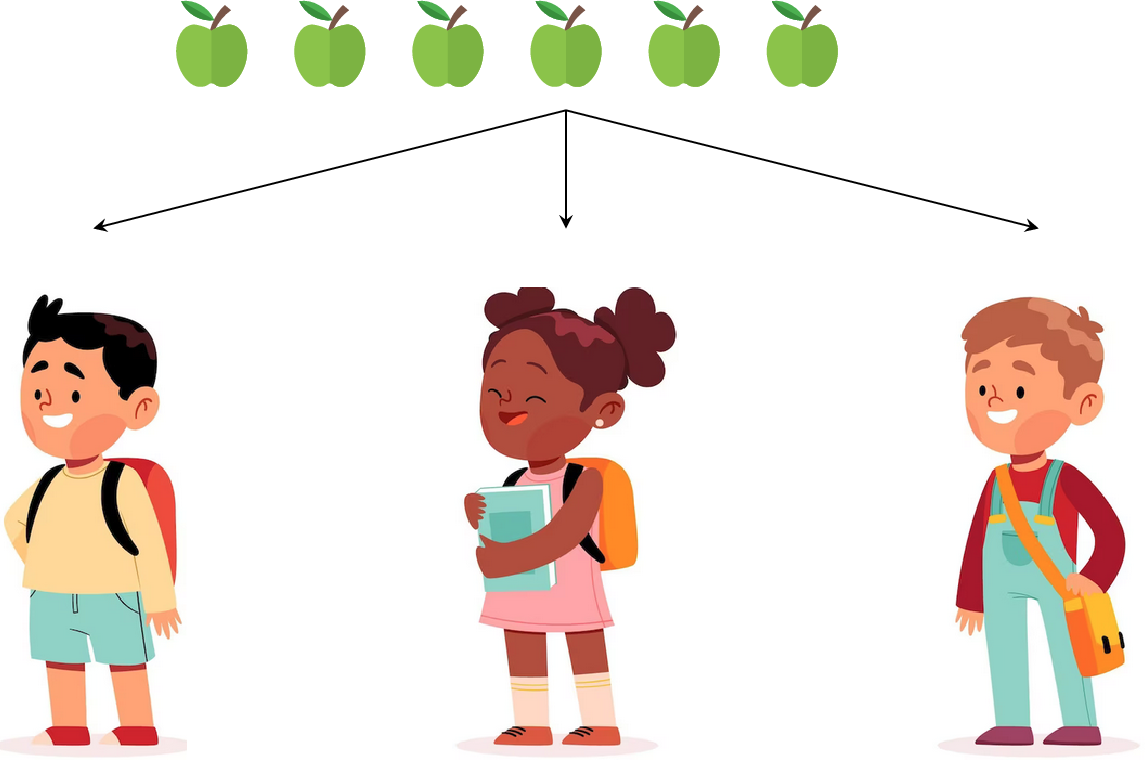
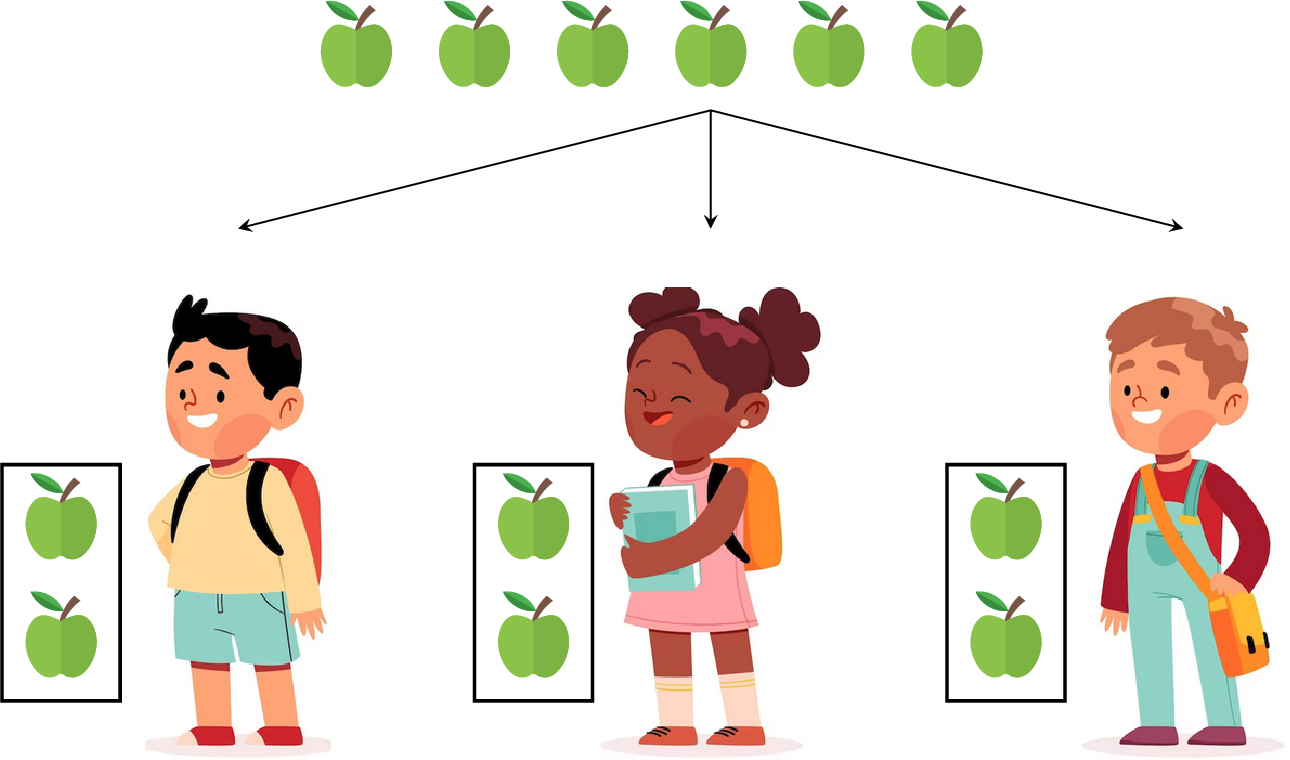
We can give one apple to each friend until all the apples are gone. Each friend gets \(\textcolor{colorprop}{2}\) apples. This process of fair sharing is called division.
Definition — Sharing Equally
Sharing equally means giving the same number to each. When 6 apples are shared equally among 3 friends, each friend gets 2.
Example
Chloé and Sam have 8 apples. They want to share them equally. How many apples does each one get? 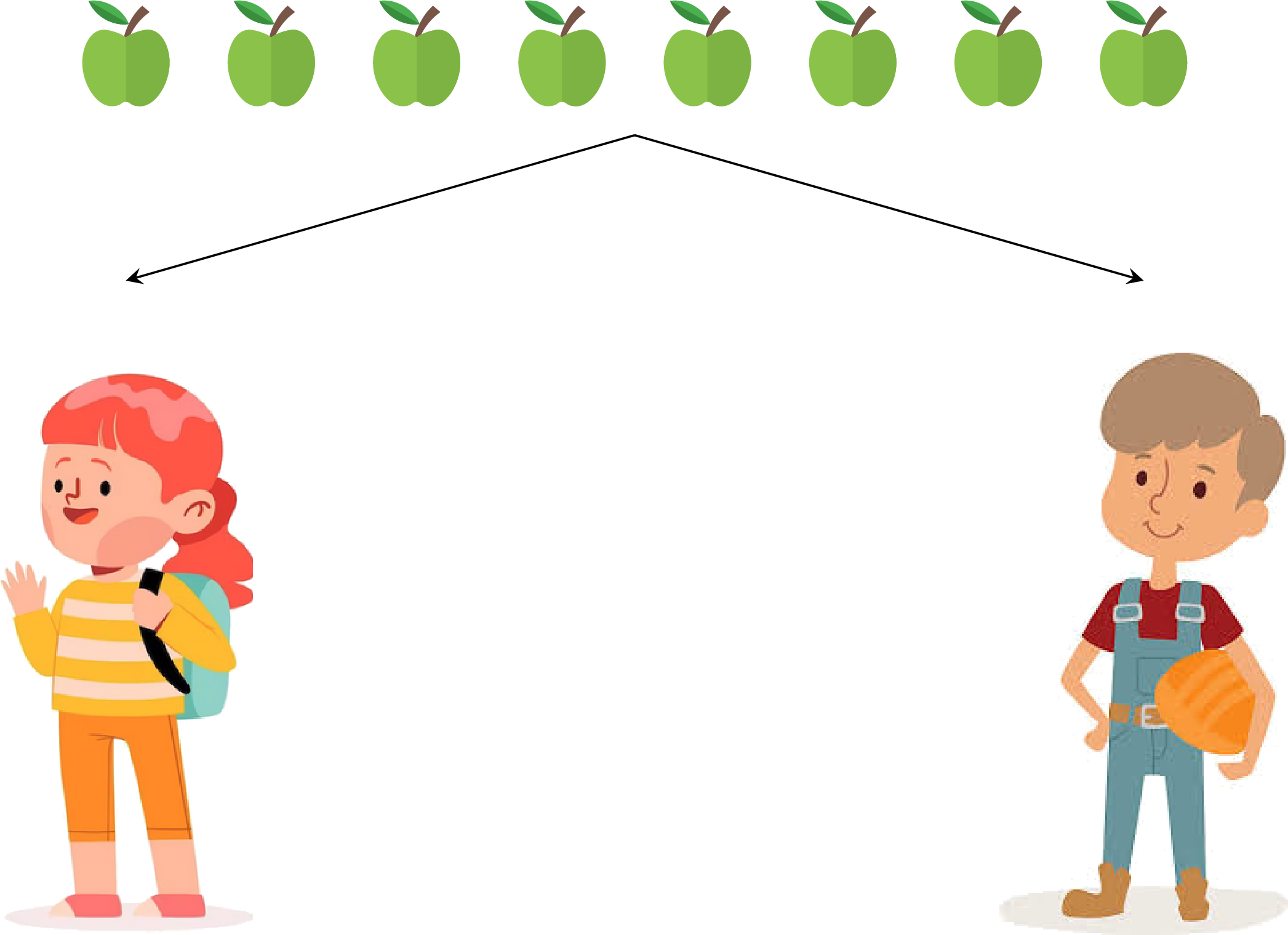
We give the apples out one at a time, turn by turn, until there are none left. 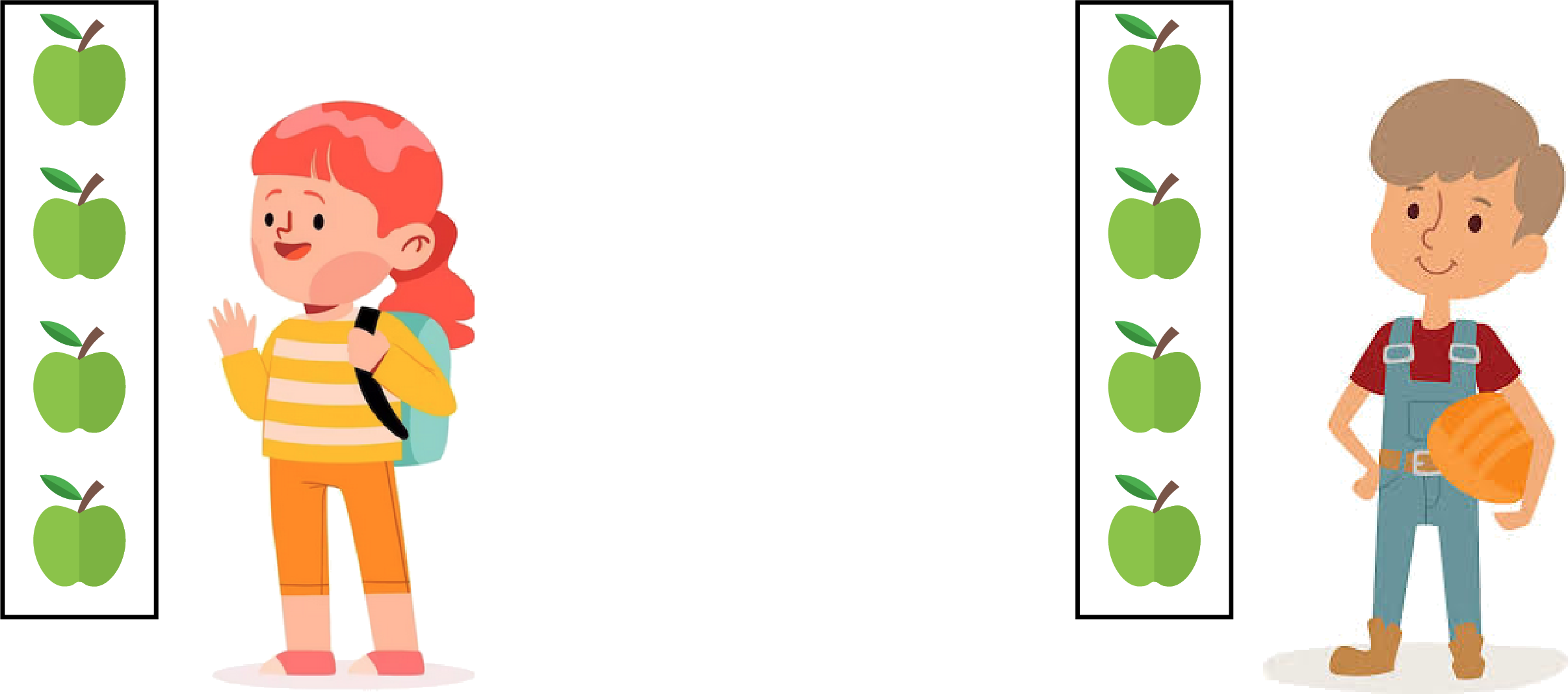
When 8 apples are shared equally between 2 friends, each friend gets 4.
When 8 apples are shared equally between 2 friends, each friend gets 4.
Skills to practice
- Sharing Apples
- Sharing Items
- Completing the Number Sentences
II
Sharing with One Left Over
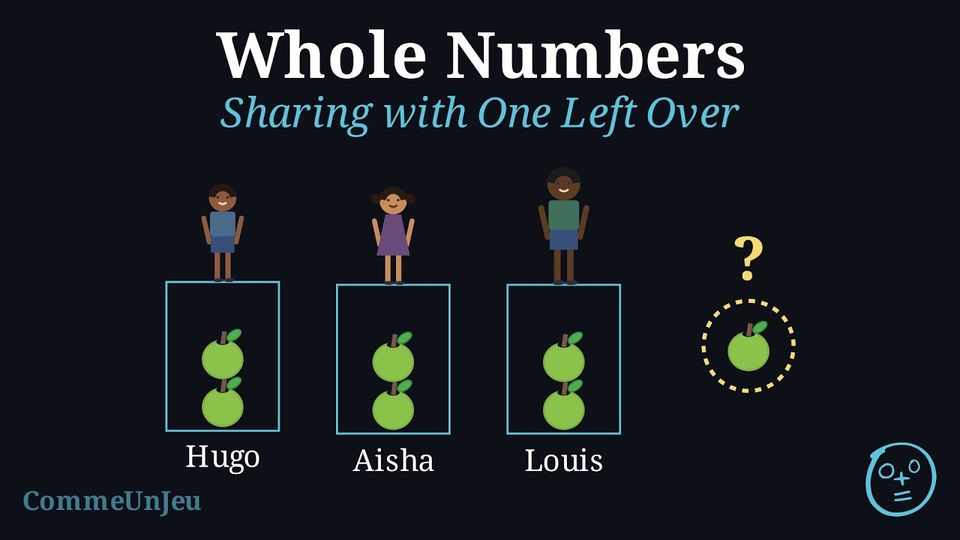
An equal share does not always come out even. Sometimes, after everyone has been given the same number, there is still something left — and it cannot be given to anyone without breaking the fair share.
Example
Hugo, Aisha and Louis have 7 apples this time. They still want to share them equally. What happens? 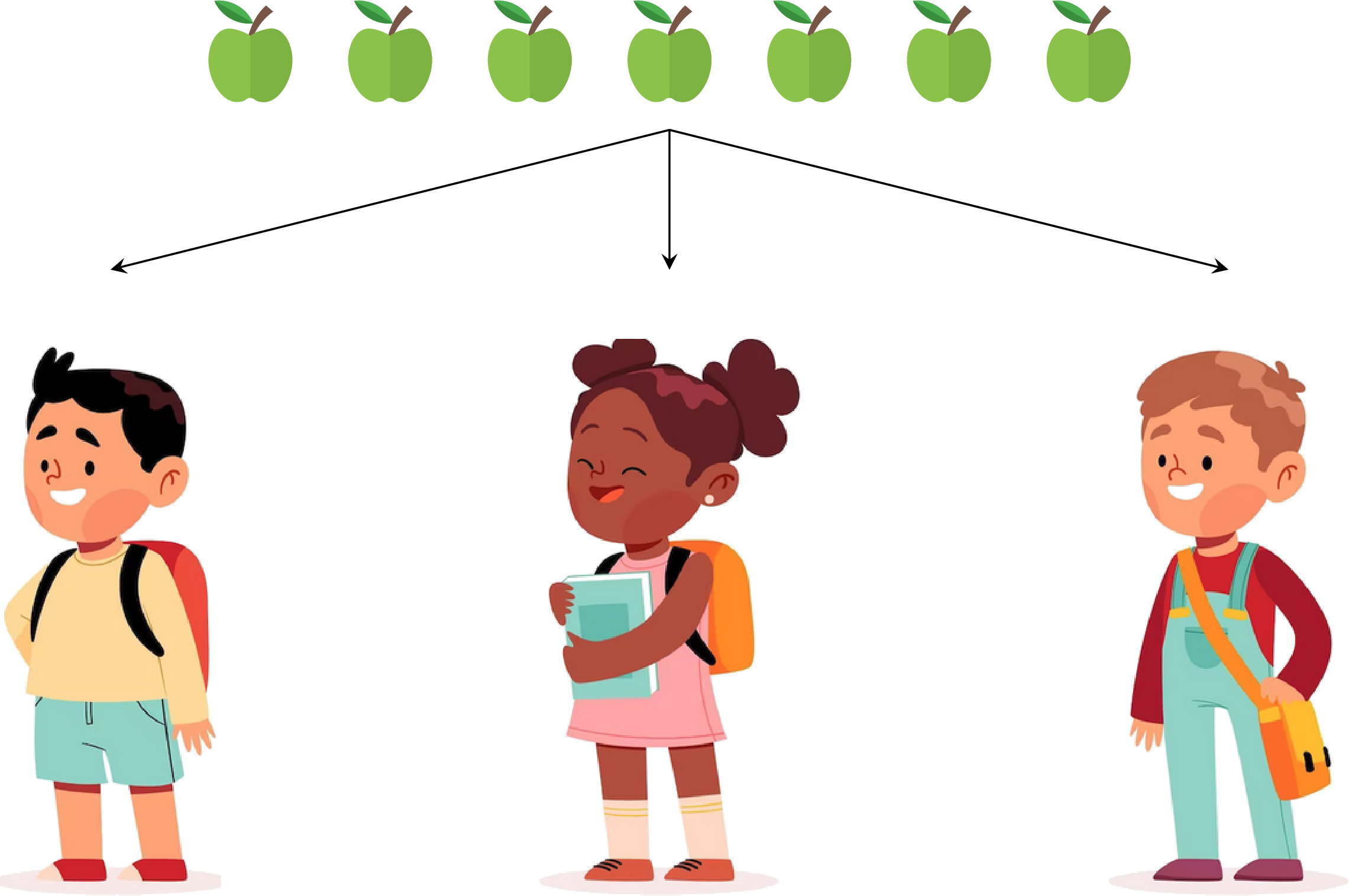
Each friend gets 2 apples, just like before. But this time one apple is left over: it stays outside the boxes, because giving it to one friend would break the fair share. 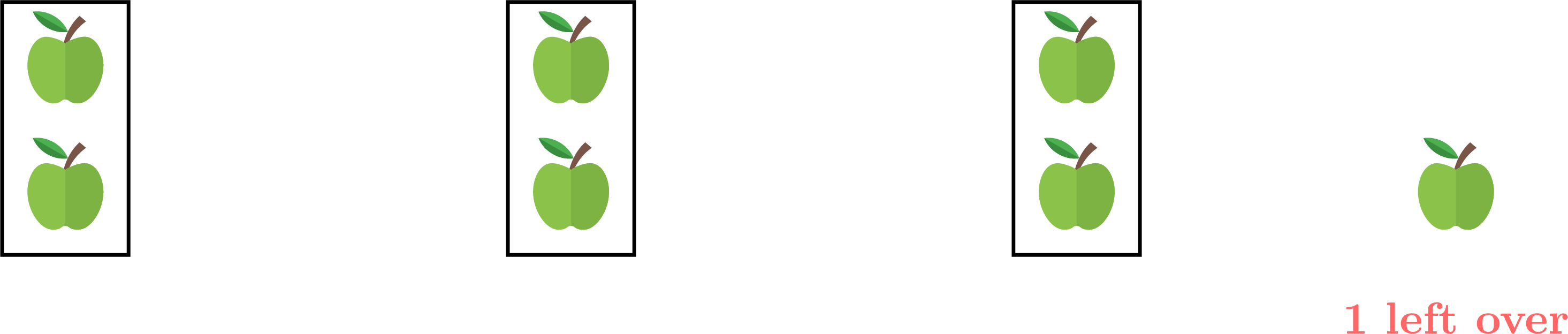
7 apples shared among 3 friends: each friend gets 2, and 1 apple is left over.
7 apples shared among 3 friends: each friend gets 2, and 1 apple is left over.
Skills to practice
- Sharing Equally and What Is Left
III
How Many Groups?
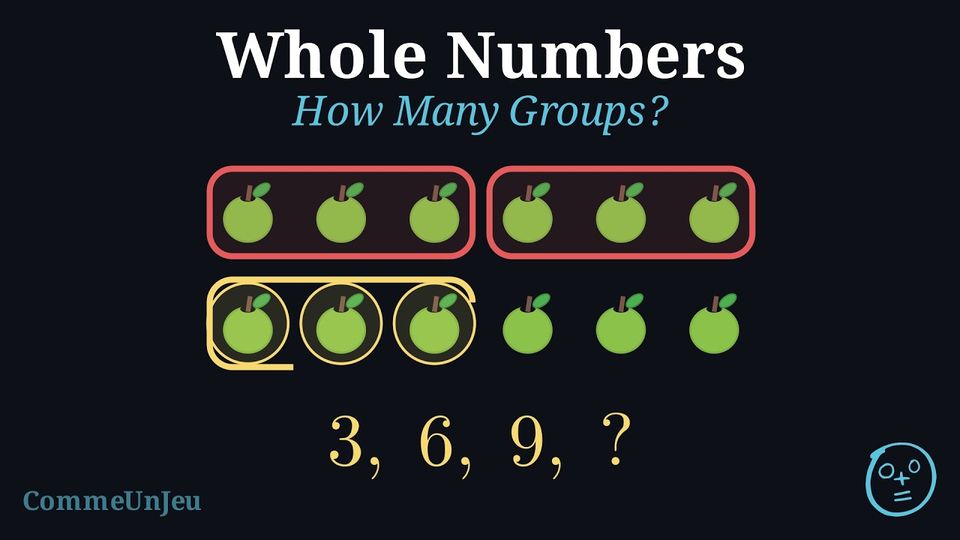
Nina has \(12\) apples. She puts them in bags of \(3\). How many bags does she fill? 
We circle groups of \(3\) apples until none is left: \(1\), \(2\), \(3\), \(4\) groups. Nina fills \(4\) bags. Here we know the size of a group (\(3\)) and we look for the number of groups. 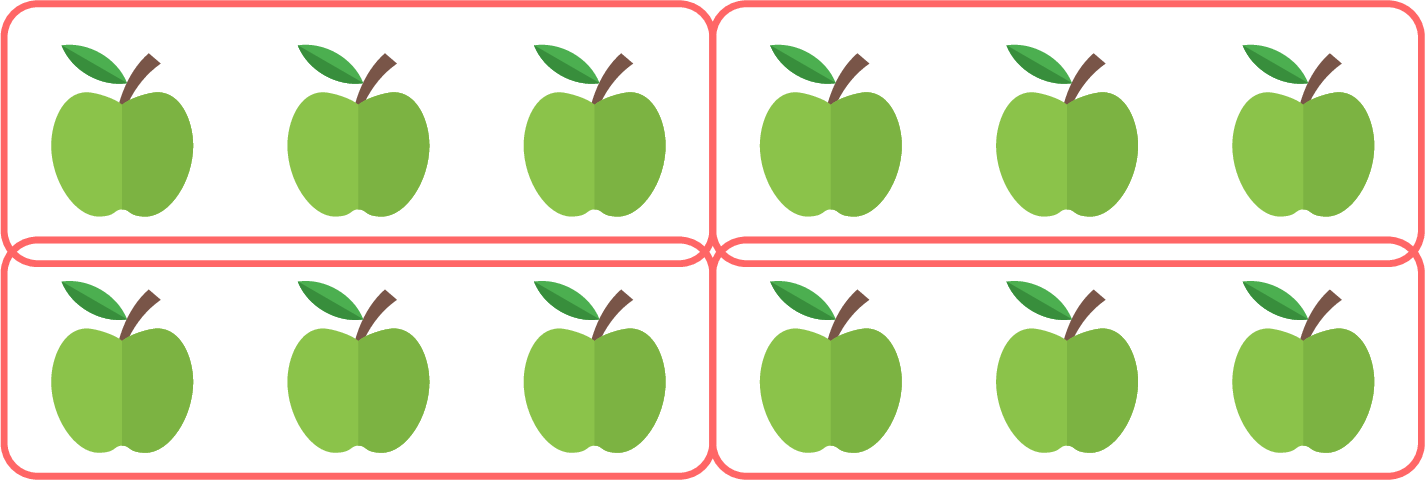
Method — Sharing or Grouping?
Two questions look alike but are not the same: - Sharing: “\(12\) apples for \(3\) children, how many each?” — we give out one by one and count what each child gets.
- Grouping: “\(12\) apples in bags of \(3\), how many bags?” — we circle groups of \(3\) and count the groups.
Example
There are \(24\) pupils in the class. The teacher makes teams of \(4\). How many teams?
We add \(4\) again and again until we reach \(24\): \(4\), \(8\), \(12\), \(16\), \(20\), \(24\). Six numbers: \(6\) teams. With a drawing, we would circle \(6\) groups of \(4\) pupils.
Skills to practice
- Circling Groups
- Without a Drawing
IV
The Halves
Granny brings 8 strawberries for Hugo and Louis. To be fair, each one must get the same number. 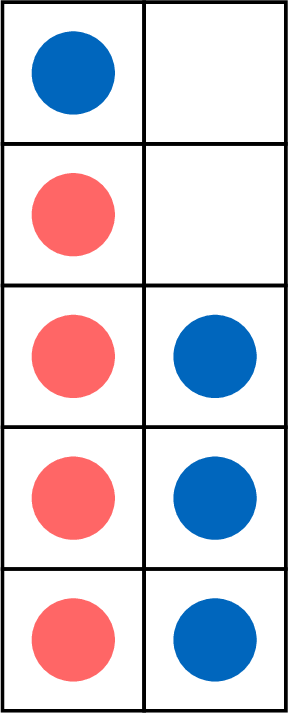
How many strawberries does each child get?
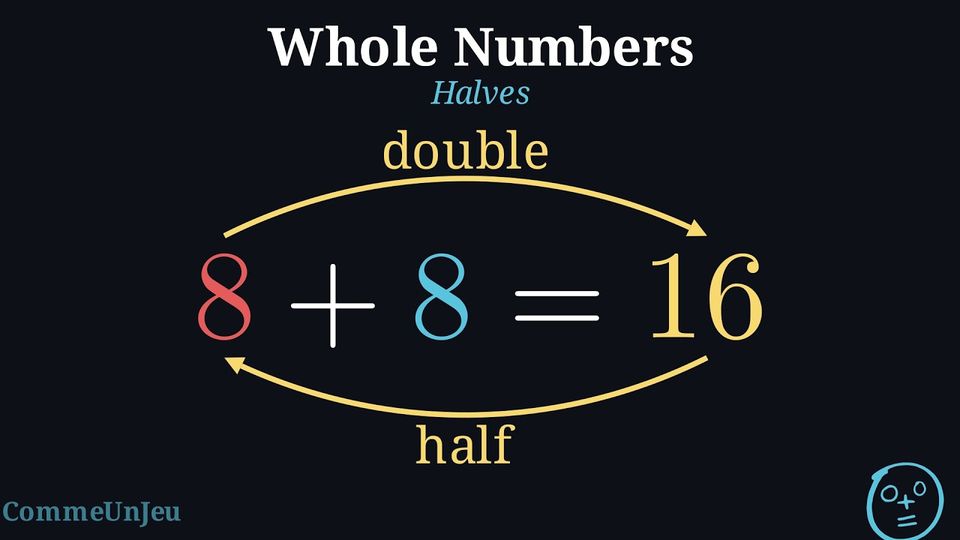
Each child gets 4 strawberries, because \(4 + 4 = 8\). Sharing into two equal parts gives the half: half of 8 is 4.
Definition — Half
Half of a number is what each one gets when we share it into two equal parts.Not every number can be shared this way without cutting any object: with \(7\) marbles, one marble is left over.
Halves and doubles are two ways of reading the same equality: $$3 + 3 = 6 : \quad \text{the double of } 3 \text{ is } 6, \quad \text{half of } 6 \text{ is } 3.$$ The halves to know by heart:
| Number | 2 | 4 | 6 | 8 | 10 | 12 | 14 | 16 | 18 | 20 |
| Half | 1 | 2 | 3 | 4 | 5 | 6 | 7 | 8 | 9 | 10 |
Example
Find half of \(14\).
Half of \(14\) is \(\textbf{7}\), because the double of \(7\) is \(14\).
Example
Find half of \(80\).
Half of \(80\) is \(\textbf{40}\), because \(4\) tens plus \(4\) tens make \(8\) tens.
Method — Halving by Splitting
To find half of a number too big for the doubles we know: - Split the number into tens and ones: \(46 = 40 + 6\).
- Halve each part: half of \(40\) is \(20\), half of \(6\) is \(3\).
- Add: \(20 + 3 = 23\). Check with the double: \(23 + 23 = 46\).
Example
Find half of \(84\) and half of \(70\).
\(84 = 80 + 4\): halves \(40\) and \(2\), so \(42\). \(70\) is \(7\) tens: \(70 = 60 + 10\), halves \(30\) and \(5\), so \(35\).
Skills to practice
- Finding Halves
- Finding the Number from its Half
- Halving by Splitting
- Solving Problems with Halves
V
Going further
Skills to practice
- Sharing and Grouping with Pictures
- Quiz
Jump to section