International Baccalaureate · PYP 3
Time
I
Instant and Duration
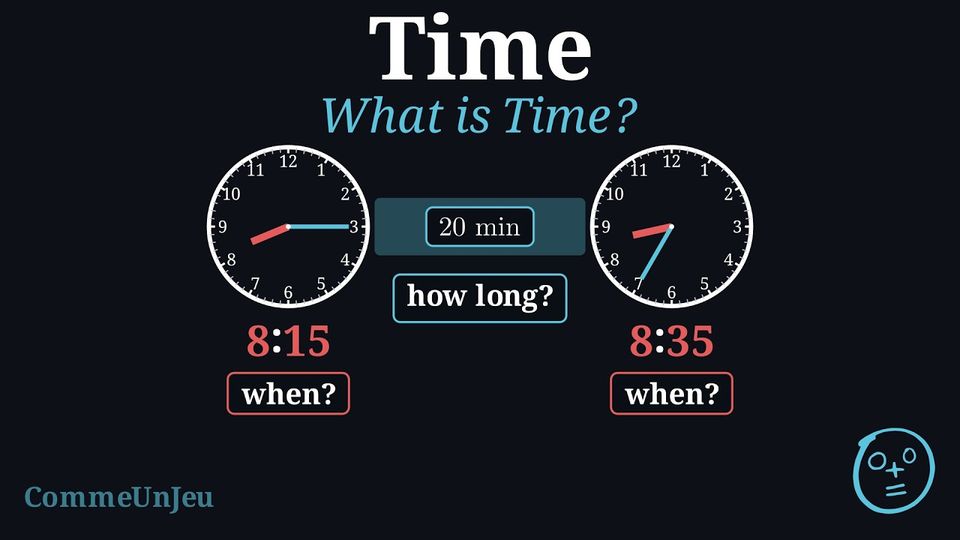
Time is a fundamental part of our world. It helps us measure and organise our lives. Understanding time allows us to plan our days, coordinate with others, and explore history. As we learn more about time, we can answer important questions such as:
- What time does the school bus arrive?
- How long until my birthday?
- How do we convert hours into minutes?
- How long does the break last?
Léa takes the school bus. The bus leaves at 8:15 and drops her at school at 8:35: the trip takes 20 minutes. 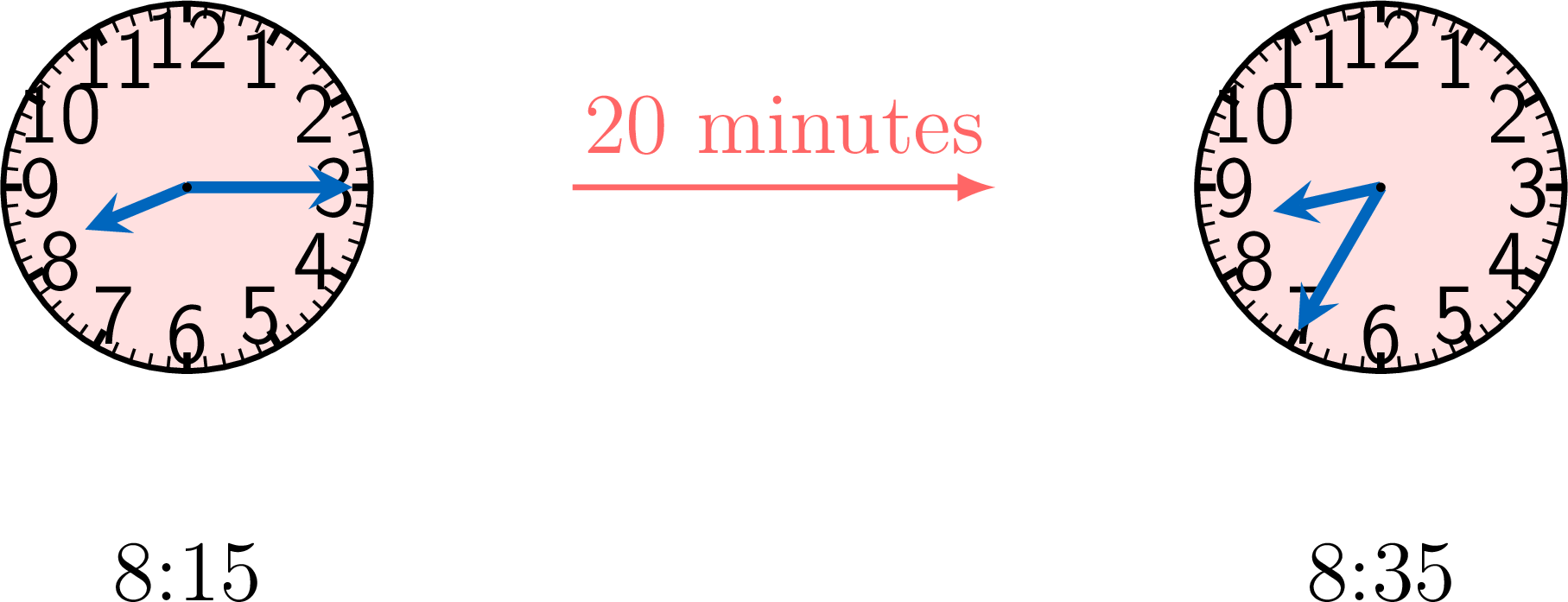
Léa says: “8:15, 8:35 and 20 minutes are three times of day.” Her brother Tom answers: “No: two of them are alike, and the third one is different.” Who is correct?
Tom is correct. 8:15 and 8:35 are read on the clock: they say when the bus leaves and when it arrives. They are instants. 20 minutes says how long the trip lasts, from the first instant to the second: it is a duration.
Definition — Instant and Duration
- An instant is a moment. It answers the question “when?” We read it on a clock (8:15) or on a calendar (Tuesday 12 May).
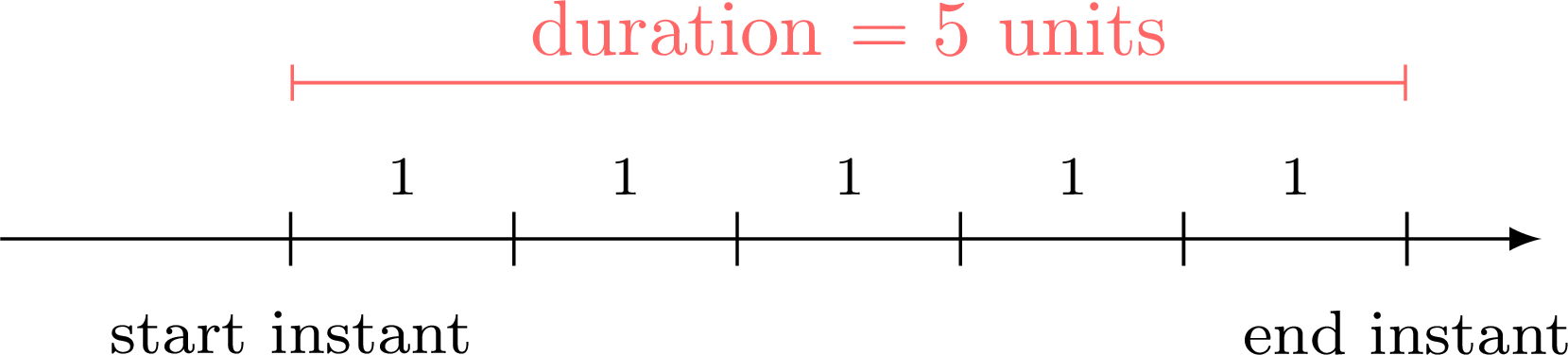
- A duration is the time that passes between a start instant and an end instant. It answers the question “how long?” We measure it by counting how many minutes, hours, days… fit between the two instants.
Definition — The Instruments of Time
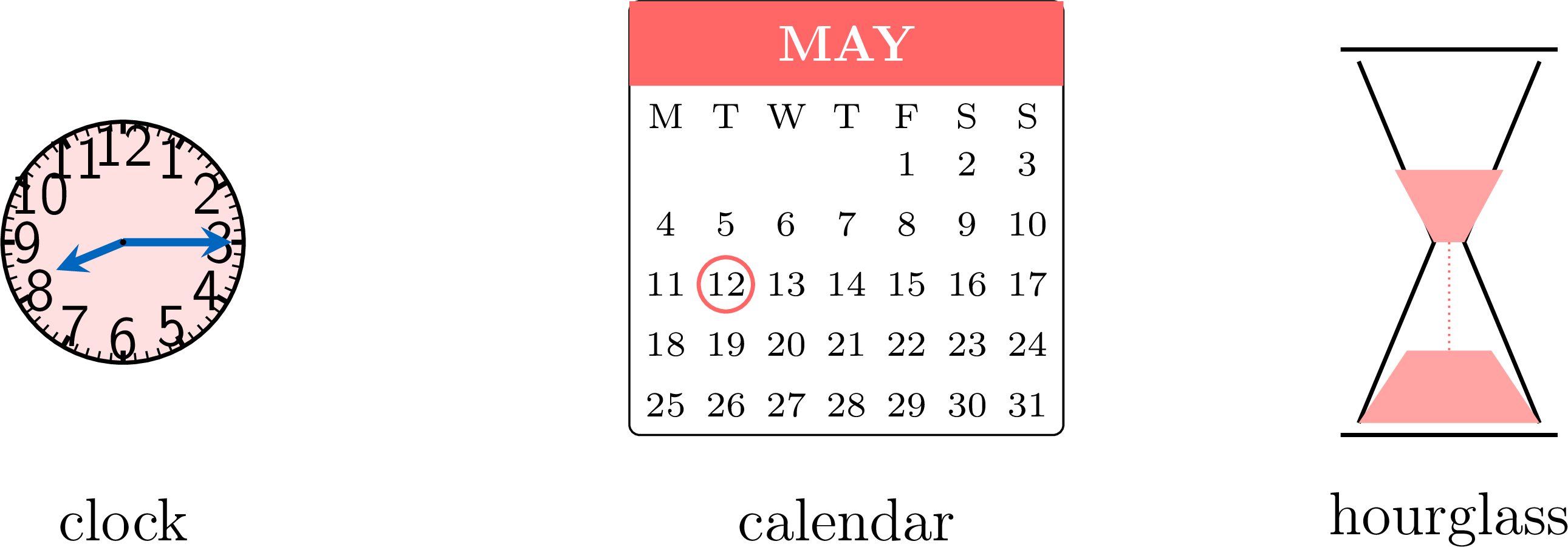
- To read an instant: the clock and the watch give the time of the day; the calendar gives the day, the month and the year.
- To measure a duration: the stopwatch counts the seconds and the minutes from a start; the hourglass and the timer let a chosen duration run out.
Example
Instant or duration? - The film starts at 8:30 in the evening.
- The film lasts 1 h 45 min.
- The break lasts 15 minutes.
- Léo was born on 3 March 2018.
- The summer holidays last two months.
- Instants: 1 and 4. “At 8:30 in the evening” is read on a clock, “3 March 2018” on a calendar: they say when.
- Durations: 2, 3 and 5. “1 h 45 min”, “15 minutes” and “two months” say how long something lasts. The word “lasts” is the sign of a duration.
Skills to practice
- Telling Instants from Durations
II
Converting Units of Time
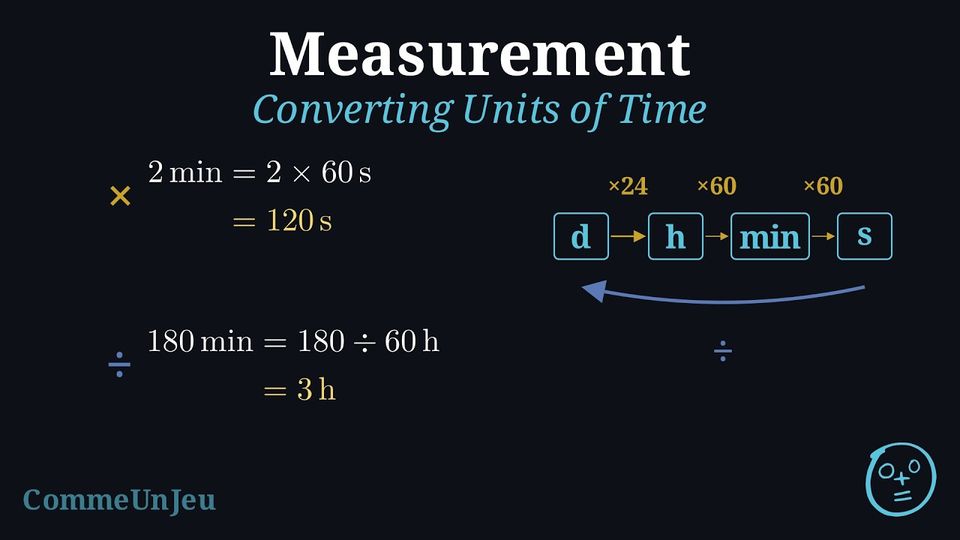
Definition — Converting Units of Time
To convert between units, we must know their relationships: - 1 minute (min) = 60 seconds (s)
- 1 hour (h) = 60 minutes (min)
- 1 day (d) = 24 hours (h)
- 1 week (wk) = 7 days (d)
- 1 year = 12 months; a common year has 365 days, which is about 52 weeks.
- 1 century = 100 years
- 1 millennium = 1 000 years = 10 centuries
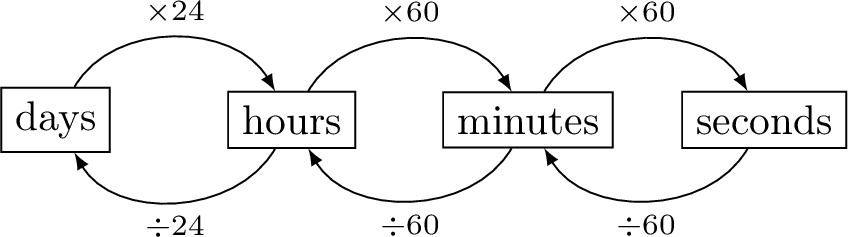
Method — How to Convert Units
- To convert from a larger unit to a smaller one, you multiply. (There are many smaller units in one larger unit.)
- To convert from a smaller unit to a larger one, you divide. (You are putting many small units together to make a bigger unit.)
Example
Convert 2 minutes to seconds.
We are going from a larger unit (minutes) to a smaller one (seconds), so we multiply.
Since 1 minute = 60 seconds: $$\begin{aligned}[t] 2 \, \text{min} &= 2 \times 60 \, \text{s} \\ &= 120 \, \text{s} \end{aligned}$$ So, 2 minutes is 120 seconds.
Since 1 minute = 60 seconds: $$\begin{aligned}[t] 2 \, \text{min} &= 2 \times 60 \, \text{s} \\ &= 120 \, \text{s} \end{aligned}$$ So, 2 minutes is 120 seconds.
Example
Convert 120 seconds to minutes.
We are going from a smaller unit (seconds) to a larger one (minutes), so we divide.
Since 1 minute = 60 seconds: $$\begin{aligned}[t] 120 \div 60 &= 2 \\ 120 \, \text{s} &= 2 \, \text{min} \end{aligned}$$ So, 120 seconds is 2 minutes.
Since 1 minute = 60 seconds: $$\begin{aligned}[t] 120 \div 60 &= 2 \\ 120 \, \text{s} &= 2 \, \text{min} \end{aligned}$$ So, 120 seconds is 2 minutes.
Skills to practice
- Converting to Smaller Units
- Converting to Larger Units
III
The Afternoon Hours and the 24-Hour Clock
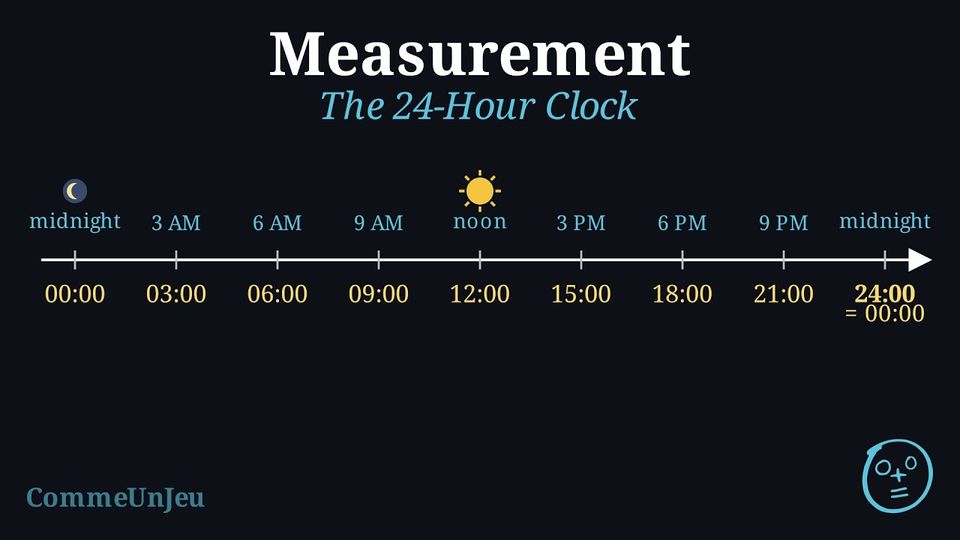
The TV guide says the film starts at “20:30”. Tom says: “There is no 20 on the clock!” Why is it written like this, and what time is it on the clock?
The clock shows \(8\):\(30\) twice a day: in the morning and in the evening. Writing \(20\):\(30\) says, in one number, that it is the evening: \(8 + 12 = 20\). On the clock, it is half past eight.
Proposition — The Afternoon Hours
In one day, the short hand goes round the clock twice: once in the morning, once in the afternoon and evening. After noon, we keep counting: \(1\) o'clock in the afternoon is \(13\):\(00\), \(2\) o'clock is \(14\):\(00\), and so on until midnight, \(24\):\(00\) (or \(00\):\(00\)). 
Example
It is \(3\) o'clock in the afternoon. What hour of the day is it? What does a digital clock show? 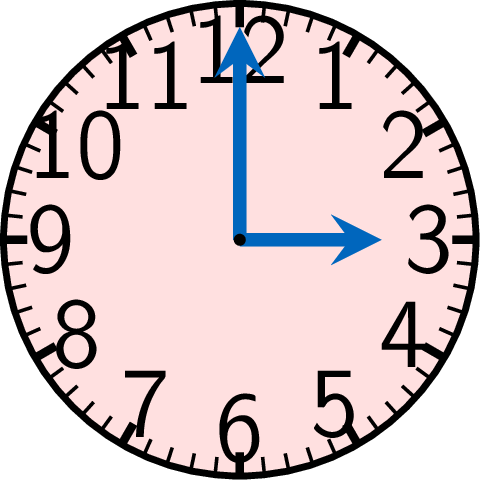
After noon we keep counting: \(12 + 3 = 15\). The hour of the day is \(15\), and the digital clock shows 15:00. The hands are the same as at \(3\) o'clock in the morning: only the moment of the day tells them apart.
Definition — AM and PM
On a clock with \(12\) hours, the short hand goes round twice a day, so each time can be read twice. To say which one we mean, we add: - AM for the times from midnight to noon: the night and the morning. \(7\):\(30\) AM is half past seven in the morning.
- PM for the times from noon to midnight: the afternoon, the evening and the night until midnight. \(6\):\(15\) PM is quarter past six in the evening.
Definition — 24-Hour Time
The 24-hour clock is a system for telling time that avoids using AM and PM. The day runs from 00:00 (midnight) to 23:59. Hours under 10 can be written 07:45 or 7:45. Sometimes 24:00 is used to show midnight at the very end of the day; it is the same moment as 00:00 on the next day. This format is used in many parts of the world, in the military, and for travel schedules to avoid confusion.  }
Example
Write 6:15 PM in 24-hour format.
To convert an afternoon or evening time to 24-hour format, add \(12\) to the hours; the minutes do not change. Two special cases: noon (12:00, 12:30) keeps its \(12\), and the half hour after midnight is written 00:30.
Hours: \(6 + 12 = 18\). Minutes: \(15\), unchanged.
So 6:15 PM becomes 18:15.
Hours: \(6 + 12 = 18\). Minutes: \(15\), unchanged.
So 6:15 PM becomes 18:15.
Example
What time does this clock show? It is evening. Give the hour of the day too. 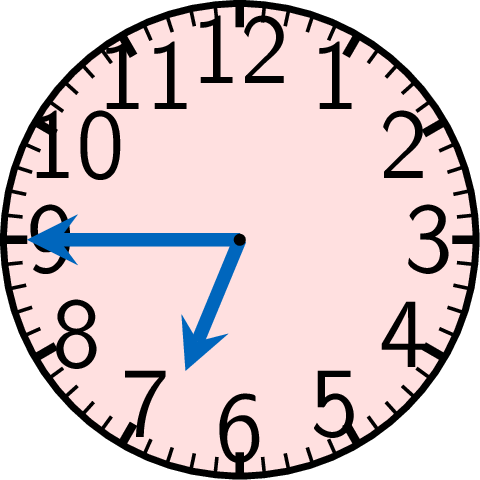
- The long hand is on the 9: a quarter of an hour is missing before the next hour.
- The short hand is between the \(6\) and the \(7\), almost on the \(7\): it has passed the \(6\), and it is coming to the \(7\).
- It is quarter to seven; in numbers, \(6\):\(45\).
- In the evening, we add \(12\): \(6 + 12 = 18\). The hour of the day is \(18\), and the digital clock shows 18:45.
Example
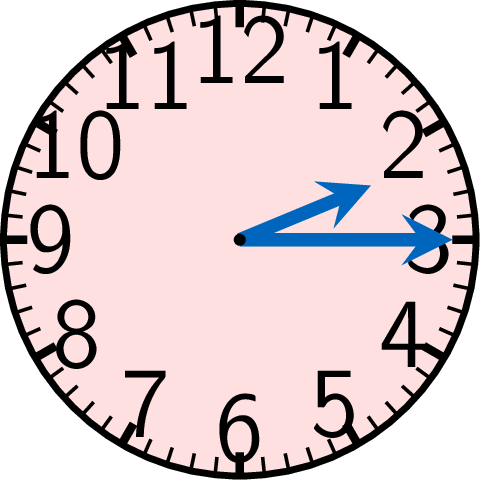
It is quarter past two in the afternoon. Write this time in two ways, then place the hands. - With the afternoon hour: \(2\):\(15\) in the afternoon.
- With the hour of the day: \(2 + 12 = 14\), so the digital clock shows 14:15.
- The hands: the long hand on the \(3\) (\(15\) minutes), the short hand just after the \(2\), a quarter of the way to the \(3\).
Skills to practice
- Writing the Afternoon Hours
- Converting to 24-Hour Time
- Converting from 24-Hour Time
IV
Reading to the Nearest 5 Minutes
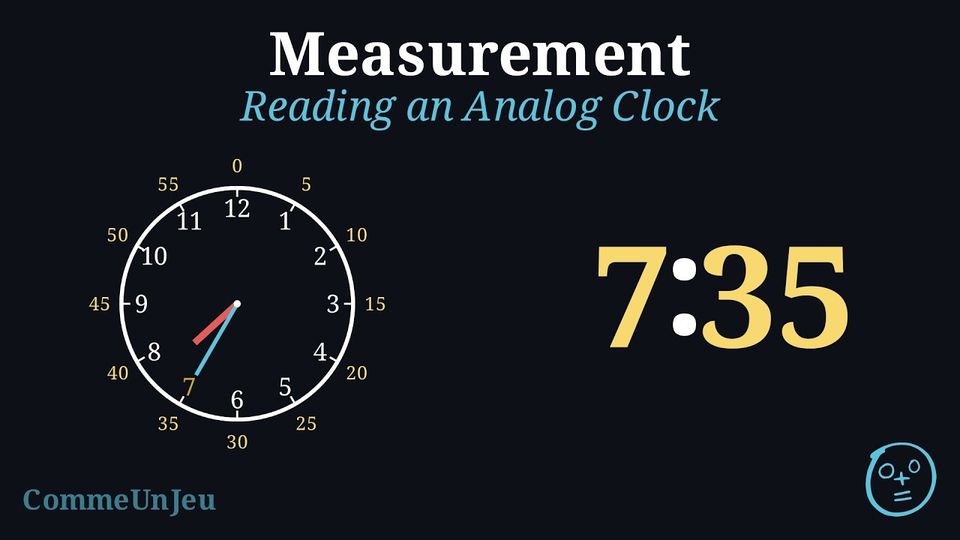
The school bus timetable says “7:35”. Léa looks at the clock in the kitchen. Is the bus already gone? 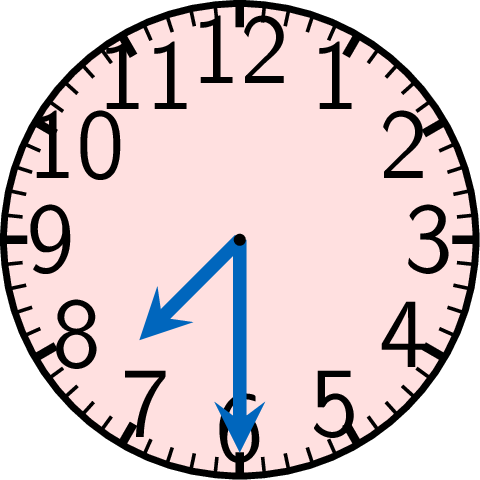
The short hand has passed the \(7\): it is \(7\) o'clock and something. The long hand is on the \(6\): counting by \(5\)s from the \(12\), \(5\), \(10\), \(15\), \(20\), \(25\), \(30\). It is \(7\):\(30\): the bus has not left yet, Léa has \(5\) minutes.
Method — Reading to the Nearest 5 Minutes
- The Hour Hand (Short Hand): This hand moves slowly from one hour to the next. The hour is the number that the hand has just passed (or the number it points to, at an exact hour).
- The Minute Hand (Long Hand): This hand moves faster. To read the minutes, we skip-count by 5s starting from the 12. The number 1 is 5 minutes, 2 is 10 minutes, 3 is 15 minutes, and so on. The 12 represents 0 minutes, or “o'clock”.
Example
What time does this clock show? It is morning. 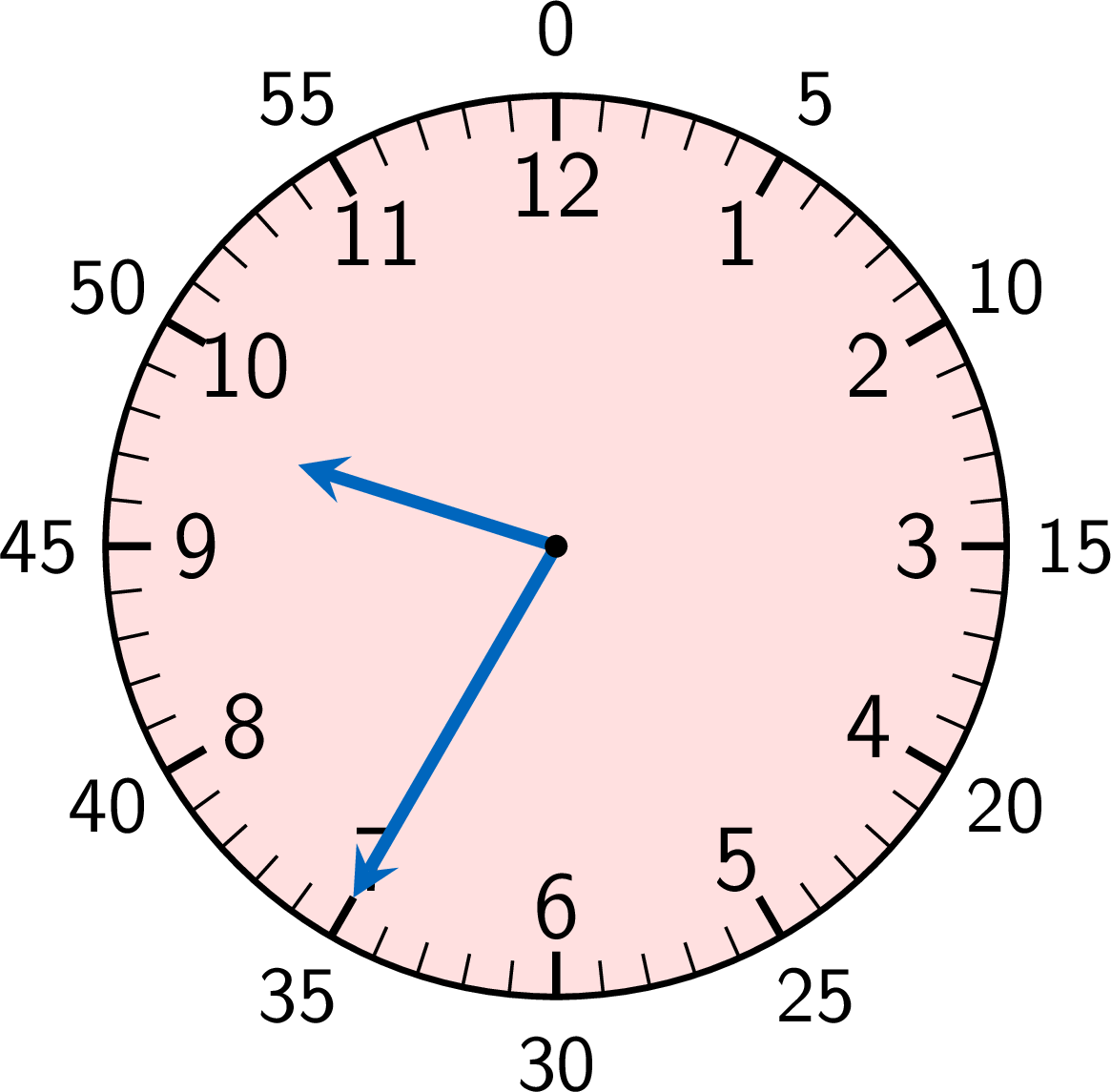
- The short hour hand has passed the 9 but has not reached the 10. Therefore, the hour is 9.
- The long minute hand is pointing at the 7. We skip-count by 5s: 5, 10, 15, 20, 25, 30, 35. The minutes are 35.
- The time is 9:35 in the morning.
Skills to practice
- Telling Time to 5-Minute Intervals
- Reading Clocks with 24-Hour Time
V
Reading to the Exact Minute
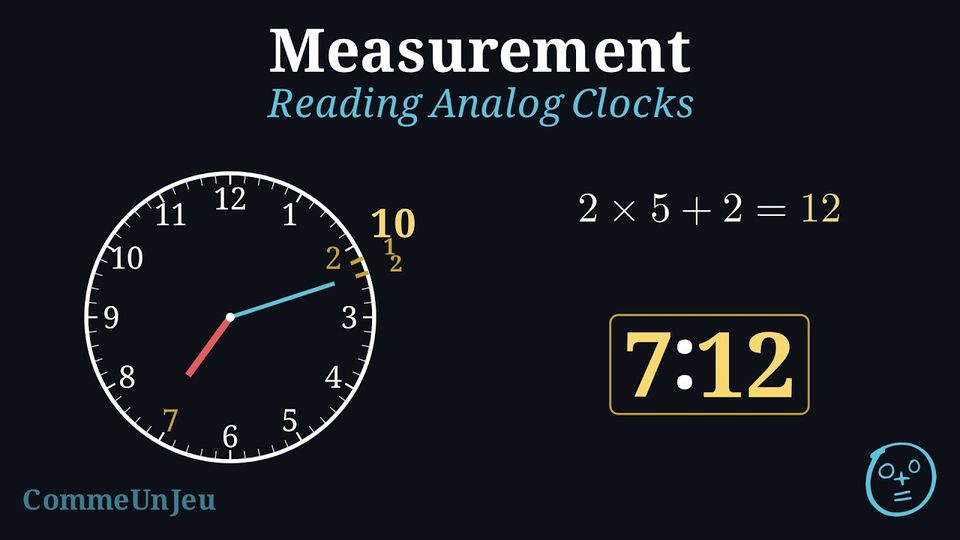
The oven clock shows “6:18”. On the wall clock, the long hand is not on a number. How can we read \(18\) minutes on a clock with hands? 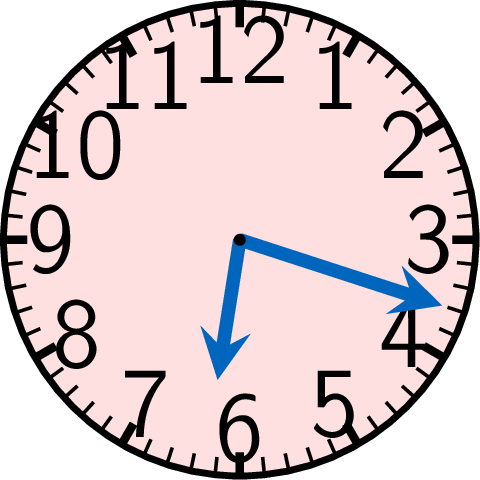
The long hand has passed the \(3\), which is \(15\) minutes, and then \(3\) small marks: \(15 + 3 = 18\) minutes. Each small mark is one minute. The short hand is just after the \(6\): it is \(6\):\(18\).
Method — How to Read an Analog Clock
To read time to the exact minute, we look at both hands and the small tick marks on the clock face. - Read the Hour Hand (the short hand): As the minutes pass, the hour hand slowly moves from one hour to the next. The hour is the number that the hand has most recently passed.
- Read the Minute Hand (the long hand): This is a two-step process:
- First, find the last big number the minute hand has reached or passed. Each big number stands for 5 minutes, so multiply that number by 5 to get the main minutes (the 12 counts as 0 minutes).
- Then, count the small tick marks from that big number to where the minute hand is pointing. Each tick mark is 1 minute. Add these to your total.
Example
What time does this clock show? It is morning. 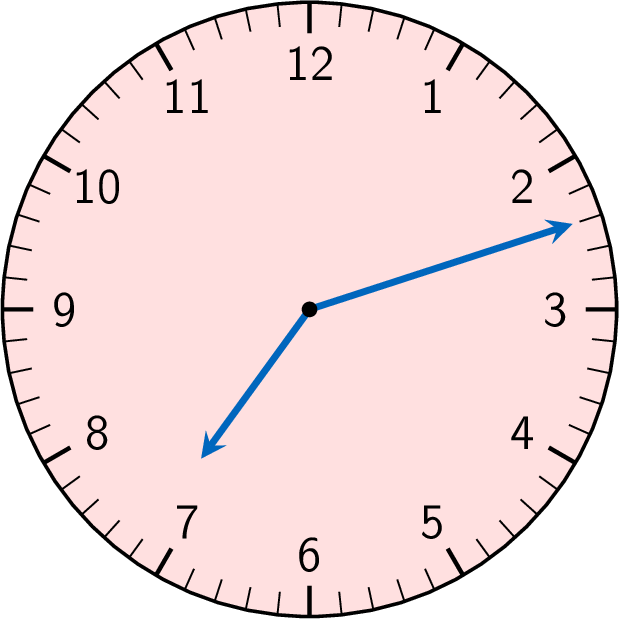
Let’s follow the steps to read the time: 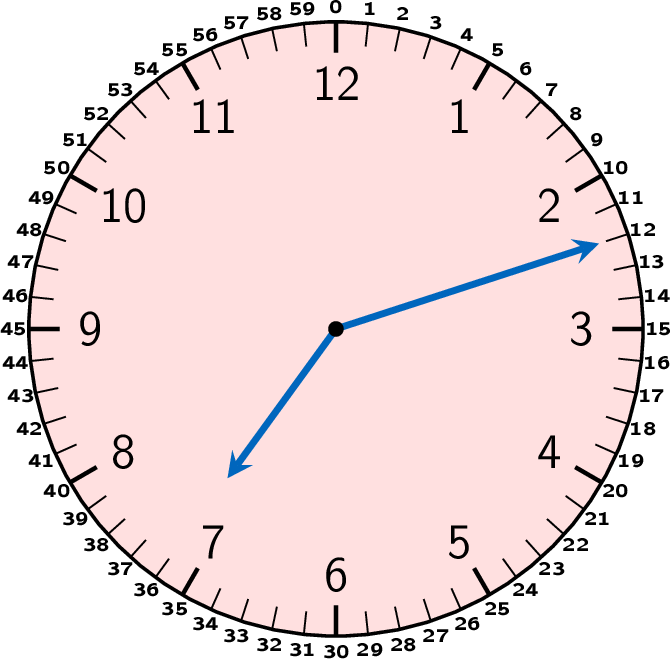
- Hour Hand: The short hand has passed the 7 but has not yet reached the 8. Therefore, the hour is 7.
- Minute Hand: The long hand has passed the 2.
- The 2 represents \(2 \times 5 = 10\) minutes.
- It is pointing 2 small tick marks past the 2.
- We add the minutes together: $$ \begin{aligned} 10 \,\text{minutes} + 2 \,\text{minutes} = 12 \,\text{minutes} \end{aligned} $$
- Combine and add AM/PM: Since it is morning, the time is 7:12 AM.
Method — Telling the Time with “To”
When the long hand has passed the \(6\), we may announce the next hour and say how many minutes are missing to reach it. A round hour is an o'clock time, like \(16\):\(00\). - Read the time as usual: \(3\):\(40\).
- Count the minutes up to the next round hour: from \(40\) to \(60\), \(20\) minutes are missing.
- Say “next hour” and “to”: twenty to four.
Morning or afternoon does not change the words: twenty to four is \(3\):\(40\) in the morning and \(15\):\(40\) in the afternoon.
Example
- Say the time shown on the clock with “to”.
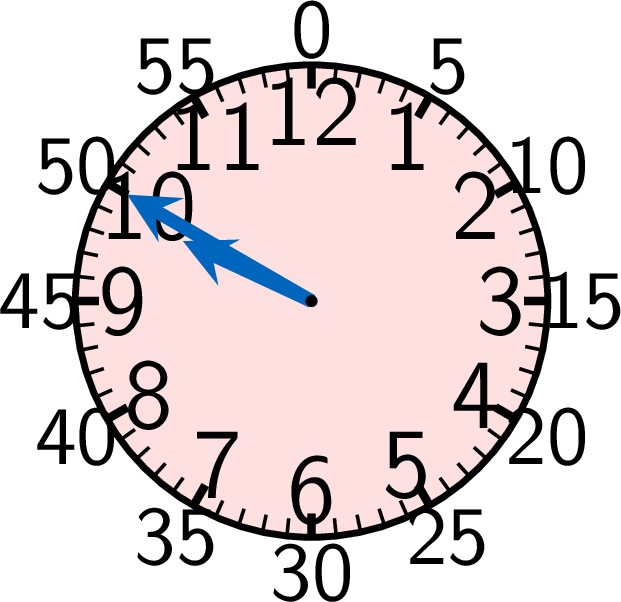
- Write “ten to eight in the evening” in digits.
- The clock shows \(9\):\(50\). From \(50\) to \(60\), \(10\) minutes are missing: it is ten to ten.
- “Ten to eight” is \(10\) minutes before \(8\) o'clock: \(7\):\(50\). In the evening, \(7 + 12 = 19\): \(19\):\(50\).
Skills to practice
- Telling Time to the Minute
VI
Positioning the Hands
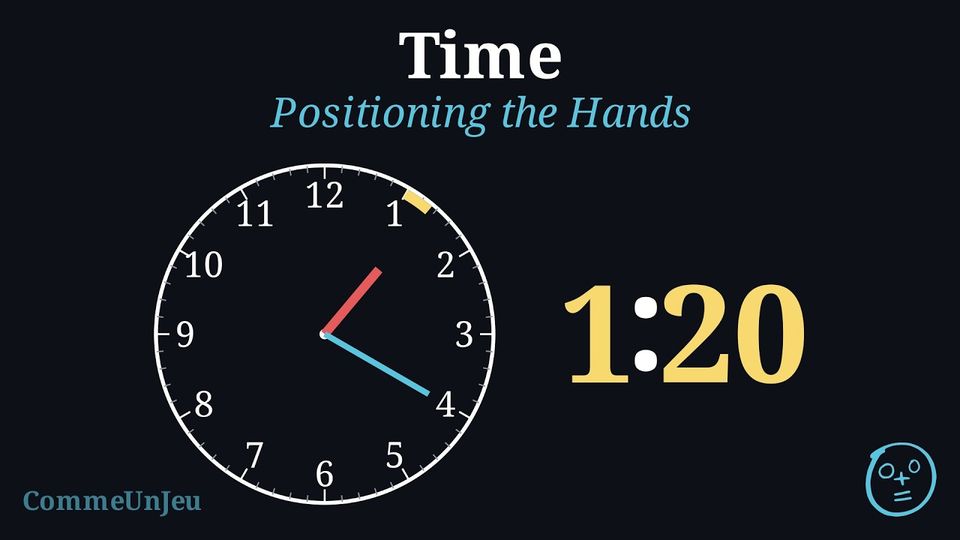
After a power cut, the kitchen clock stopped. The radio says it is “13:20”. Where should the two hands be placed?
A clock with hands only counts up to \(12\): \(13\):\(20\) is \(1\):\(20\) in the afternoon. The long hand goes on the \(4\) (\(20\) minutes). The short hand has left the \(1\) and is on its way to the \(2\), closer to the \(1\).
Method — Positioning the Hands
To show a given time on a clock: - Place the long hand (the minutes): start from the \(12\) (which is \(0\) minute) and turn clockwise — each number counts \(5\) more minutes (\(1 \to 5\), \(2 \to 10\), …) and each small mark counts \(1\) minute.
- Place the short hand (the hours): at an exact hour it points on the hour number; as soon as minutes have passed it leaves that number and moves between it and the next one, closer to the next one as the minutes go by.
Example
Draw the hands so that the clock shows \(3\):\(40\). 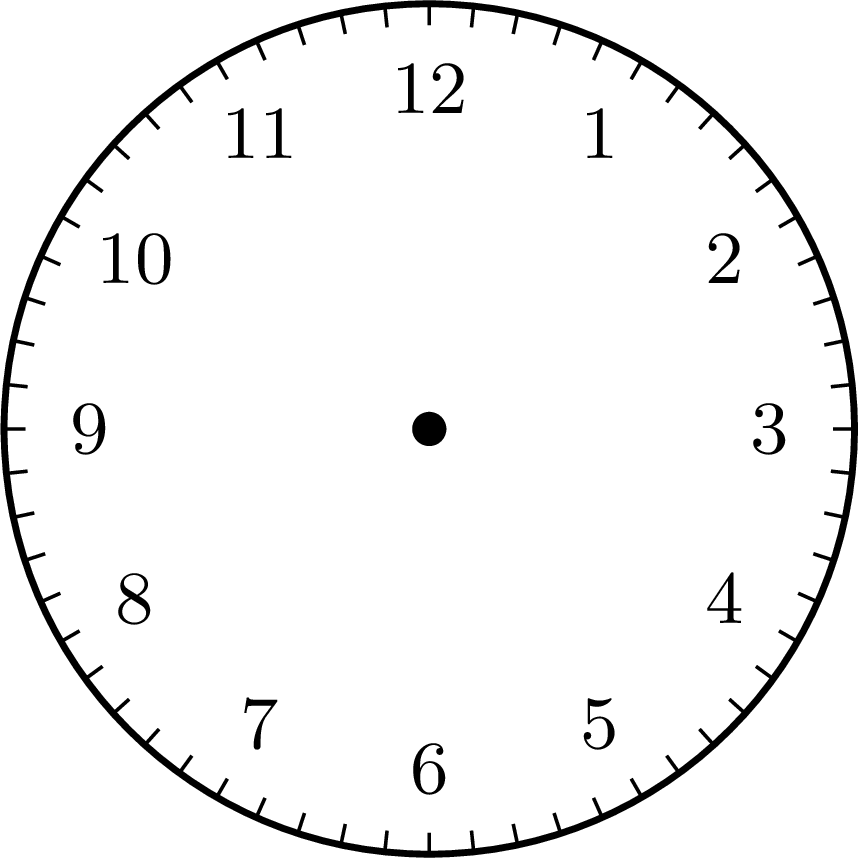
The long hand counts \(40\) minutes from the \(12\): it points to the \(8\) (\(8 \times 5 = 40\)). The short hand is between the \(3\) and the \(4\), closer to the \(4\) because \(40\) minutes of the hour have already passed. 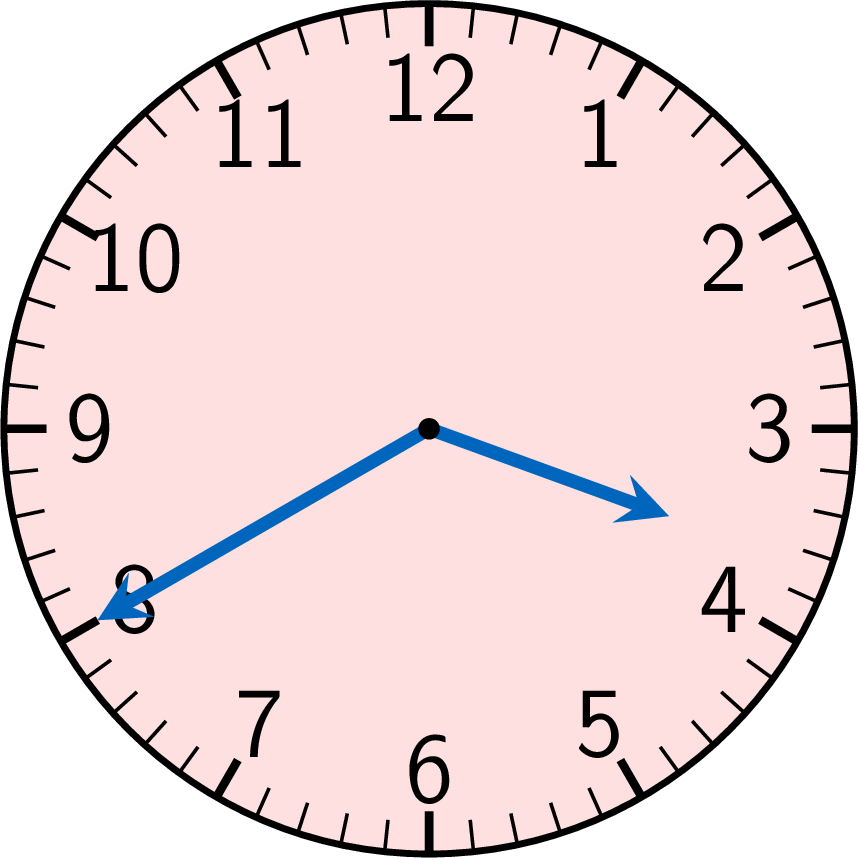
Example
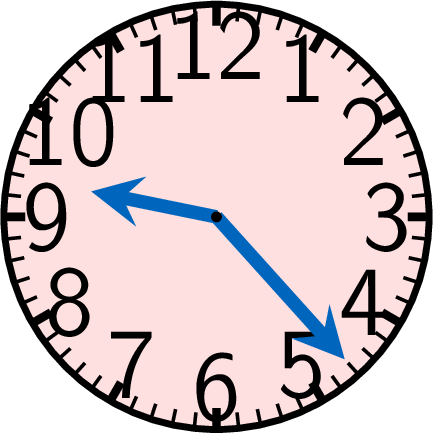
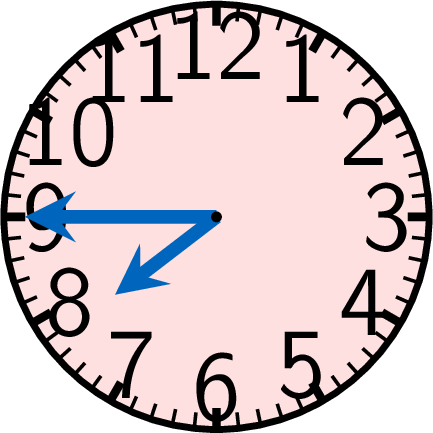
Place the hands for: (a) twenty-three minutes past nine; (b) quarter to eight. - \(23\) minutes: the long hand goes \(3\) small marks after the \(4\) (\(20 + 3 = 23\)). The short hand is a little after the \(9\).
- Quarter to eight is \(7\):\(45\): the long hand goes on the \(9\) (\(45\) minutes). The short hand is between the \(7\) and the \(8\), close to the \(8\).
Skills to practice
- Choosing Where the Hand Goes
- Drawing and Telling the Time
VII
Measuring Durations on the Time Axis
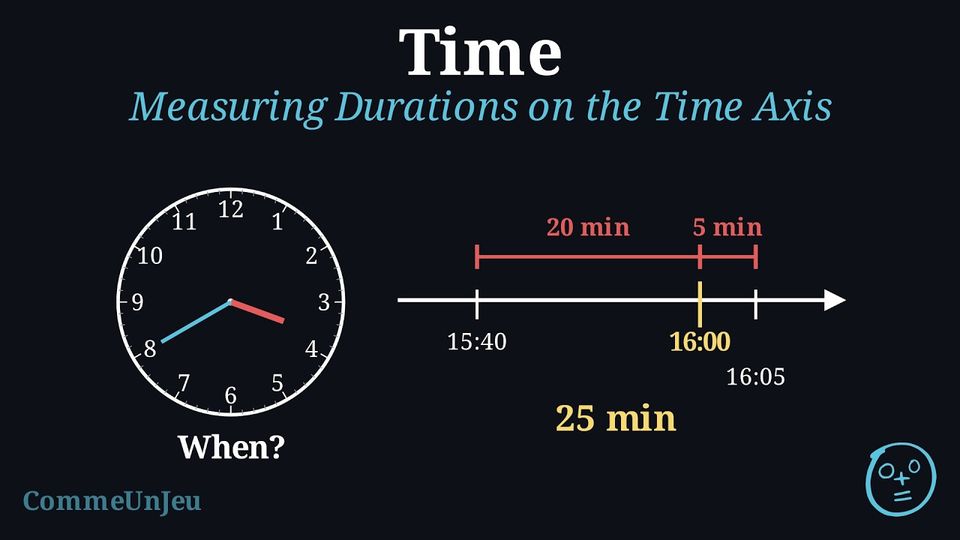
Léa's timetable. In the morning, dictation goes from \(8\):\(30\) to \(8\):\(50\). In the afternoon, reading goes from \(15\):\(40\) to \(16\):\(05\). Which one lasts longer? 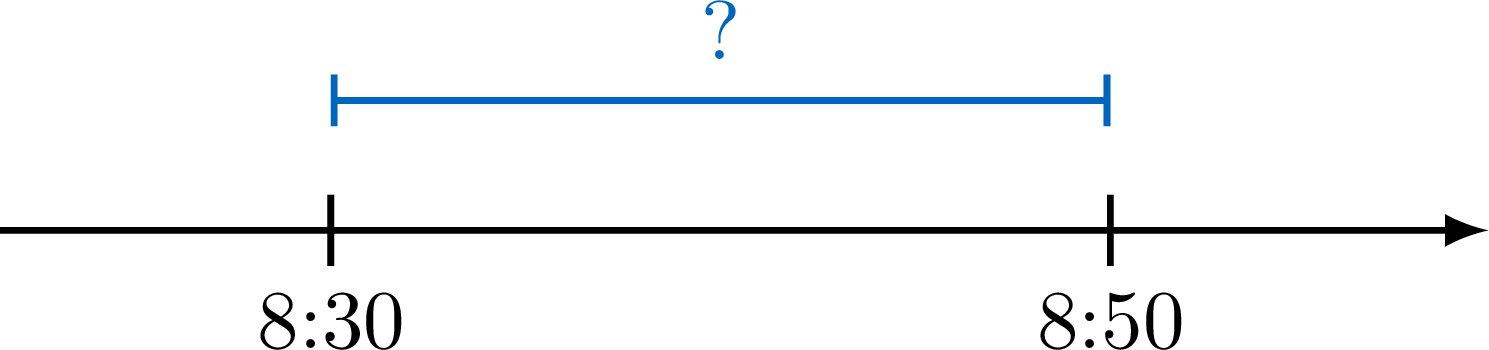
Dictation: from \(8\):\(30\) to \(8\):\(50\), both times are in the same hour, so we count the minutes: \(50 - 30 = 20\) minutes.
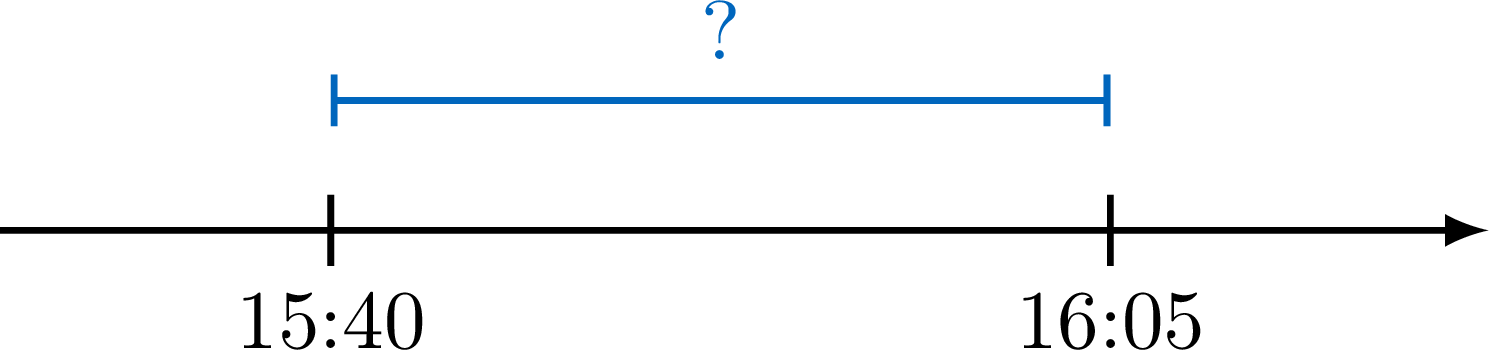
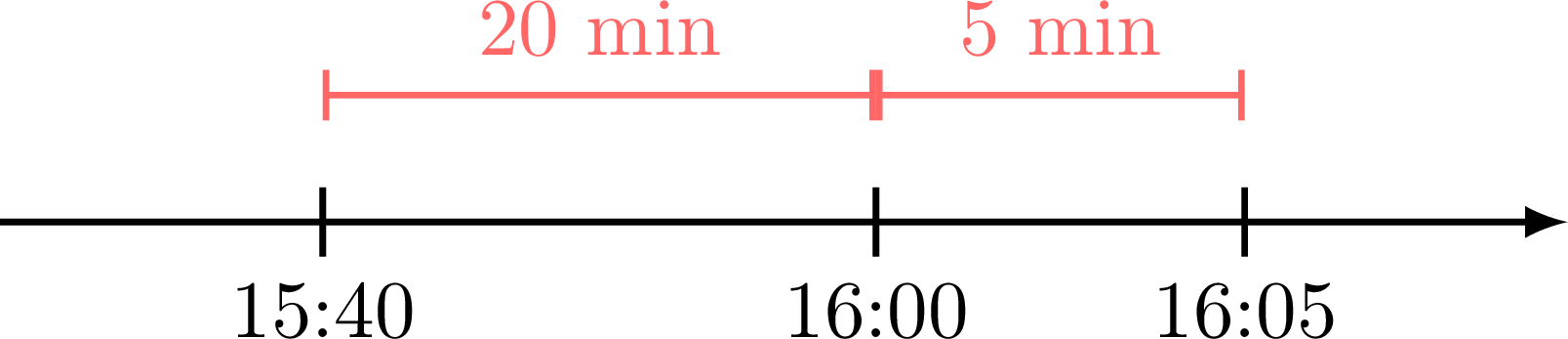
Reading: \(15\):\(40\) and \(16\):\(05\) are not in the same hour. We go through the round hour \(16\):\(00\): from \(15\):\(40\) to \(16\):\(00\), \(20\) minutes; from \(16\):\(00\) to \(16\):\(05\), \(5\) minutes; in all \(20 + 5 = 25\) minutes.
\(25 > 20\): reading lasts longer.
Reading: \(15\):\(40\) and \(16\):\(05\) are not in the same hour. We go through the round hour \(16\):\(00\): from \(15\):\(40\) to \(16\):\(00\), \(20\) minutes; from \(16\):\(00\) to \(16\):\(05\), \(5\) minutes; in all \(20 + 5 = 25\) minutes.
\(25 > 20\): reading lasts longer.
Method — Measuring a Duration on the Time Axis
The clock says when. To see how long, we unfold the day on a line: the time axis. - Draw the axis and place the two instants below it, the first one on the left.
- Same hour? If the two instants are in the same hour, count the minutes from one to the other: from \(8\):\(30\) to \(8\):\(50\), \(20\) minutes.
- Otherwise, go through the round hour that lies between them: write each piece above the axis, then add. From \(15\):\(40\) to \(16\):\(05\): \(20\) min up to \(16\):\(00\), then \(5\) min, so \(25\) min.
If several round hours lie between the two instants, go to the first one, count the whole hours up to the last one, then the remaining minutes: from 8:40 to 11:15, 20 min to 9:00, then 2 h to 11:00, then 15 min, so 2 h 35 min. The axis is a sketch: its lengths are not to scale.
Example
The bus leaves at \(9\):\(45\) and arrives at \(10\):\(20\). How long is the trip?
The two instants are not in the same hour: we go through \(10\):\(00\). 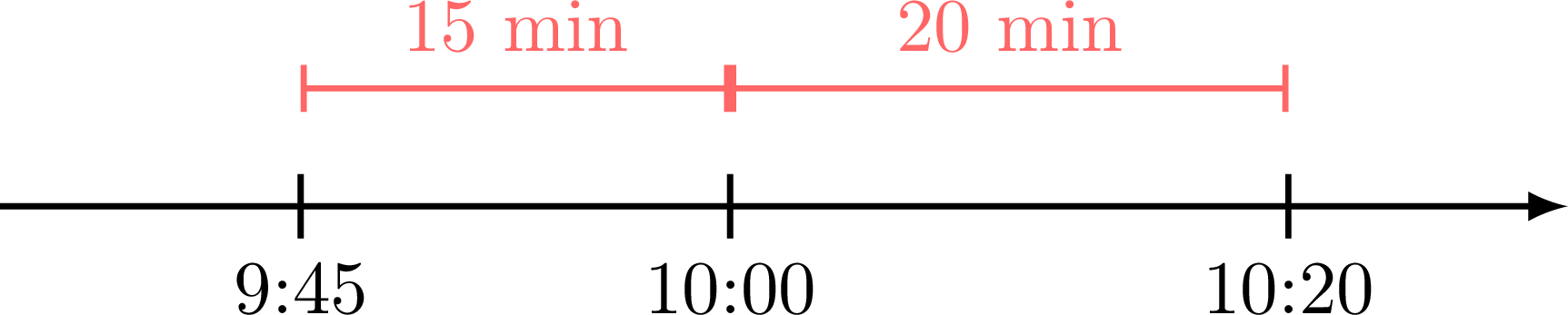
From \(9\):\(45\) to \(10\):\(00\), \(15\) minutes; from \(10\):\(00\) to \(10\):\(20\), \(20\) minutes. The trip lasts \(15 + 20 = 35\) minutes.
Method — From Hours and Minutes to Minutes
To compare or add durations, write them all in minutes: each hour is \(60\) minutes. - \(2\) h \(= 2 \times 60 = 120\) min.
- \(1\) h \(40\) min \(= 60 + 40 = 100\) min.
Example
Which is longer: \(2\) h \(20\) min or \(130\) min?
We write both durations in minutes. Each hour is \(60\) minutes, so \(2\) h \(= 2 \times 60 = 120\) min, and \(2\) h \(20\) min \(= 120 + 20 = 140\) min.
\(140 > 130\): \(2\) h \(20\) min is longer.
\(140 > 130\): \(2\) h \(20\) min is longer.
Skills to practice
- Measuring Durations
VIII
Solving Duration Problems
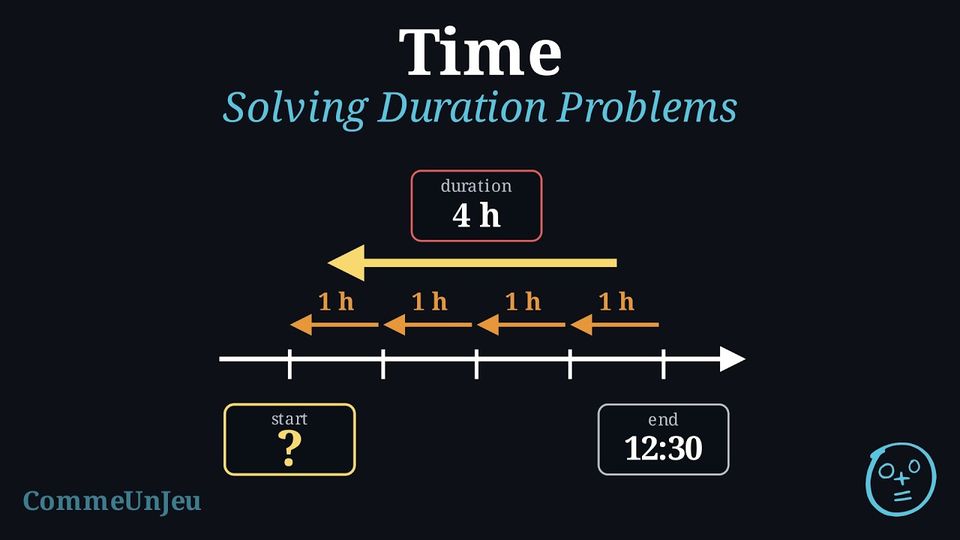
Lucie left home at \(8\):\(30\). She came back at \(12\):\(30\). How long was she out? 
On the axis, we move forward hour by hour from \(8\):\(30\): \(9\):\(30\), \(10\):\(30\), \(11\):\(30\), \(12\):\(30\). That is \(4\) jumps of one hour: Lucie was out for \(4\) hours. 
Method — The Three Questions of the Axis
A one-step duration problem has three numbers: the start instant, the duration and the end instant. We know two of them and look for the third, marked “?” on the axis. - Looking for the end: start from the start instant and move forward by the duration (through the round hour if needed).
- Looking for the start: start from the end instant and move back by the duration (through the round hour if needed).
- Looking for the duration: count from one instant to the other, as in the previous section.
Example
Lucie was out for \(4\) hours. She came back at \(12\):\(30\). At what time did she leave? 
We look for the start: from \(12\):\(30\) we move back \(4\) hours: \(11\):\(30\), \(10\):\(30\), \(9\):\(30\), \(8\):\(30\). Lucie left at \(8\):\(30\).
Example
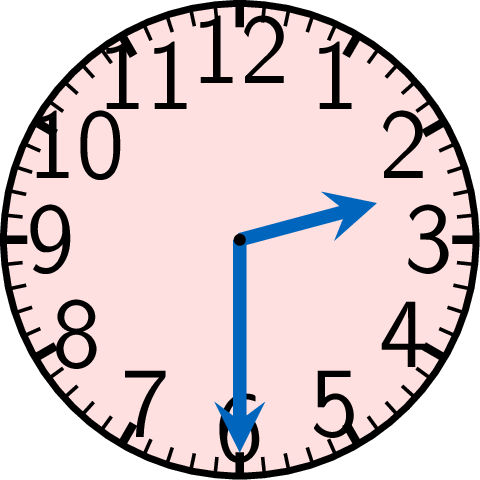
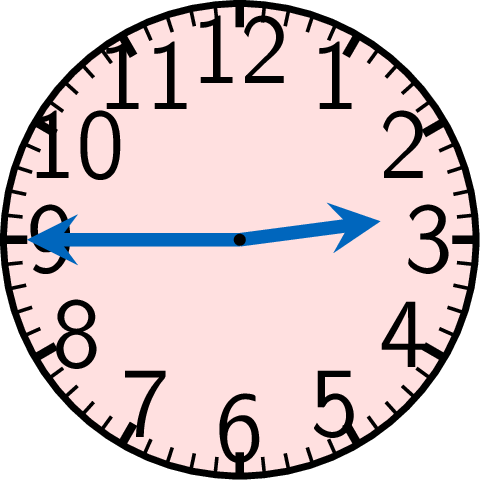
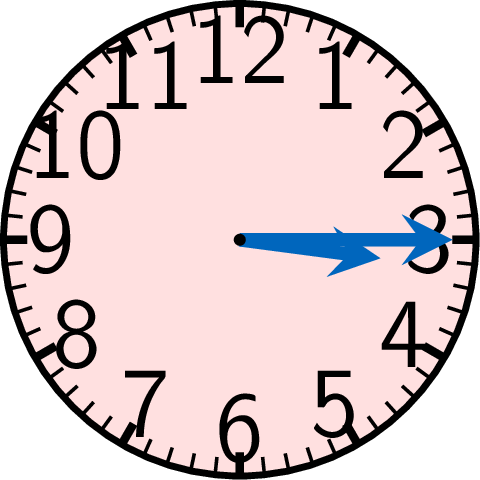
Reading starts at \(9\) o'clock and lasts a quarter of an hour. Drawing starts at \(14\):\(30\) and lasts three quarters of an hour. At what time does each one end? - Reading: one quarter of a turn from the \(12\) to the \(3\). Reading ends at \(9\):\(15\), quarter past nine.
- Drawing: three quarters of a turn from the \(6\): to the \(9\) (\(14\):\(45\)), to the \(12\) (\(15\):\(00\) — the hour goes up), to the \(3\) (\(15\):\(15\)). Drawing ends at \(15\):\(15\), quarter past three in the afternoon.
Example
The film ends at \(12\):\(10\) and lasts \(30\) minutes. At what time did it start?
We look for the start, so we move back \(30\) minutes from \(12\):\(10\), through the round hour \(12\):\(00\): from \(12\):\(10\) back to \(12\):\(00\) is \(10\) minutes; \(30 - 10 = 20\) minutes remain, and \(20\) minutes before \(12\):\(00\) is \(11\):\(40\). 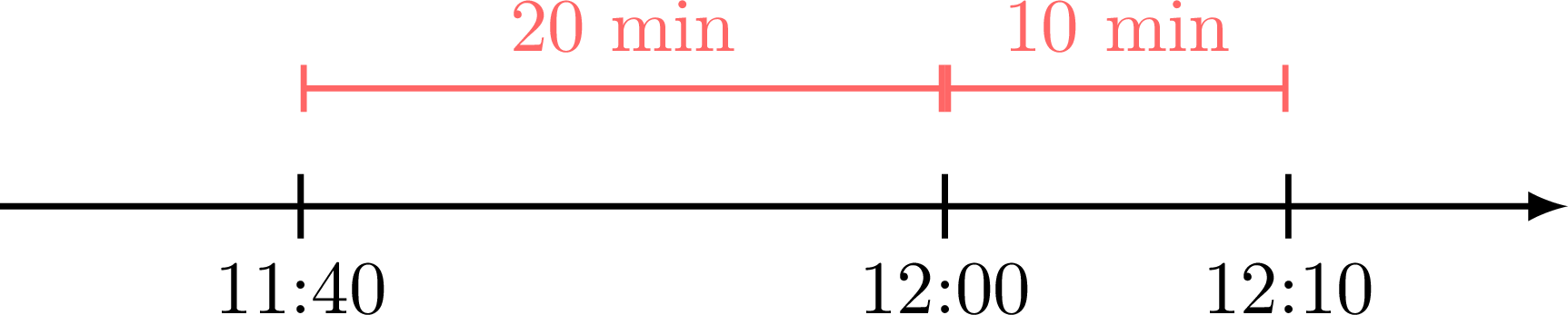
The film started at \(11\):\(40\).
Example
The train leaves at \(7\):\(10\). It takes \(1\) hour and \(30\) minutes to reach the first station, and it arrives at the second station \(40\) minutes later. At what time does the train arrive at the second station? 
Two steps, so we find the middle instant first.
First station: from \(7\):\(10\) we move forward \(1\) h \(30\) min: \(1\) hour gives \(8\):\(10\), then \(30\) minutes give \(8\):\(40\).
Second station: from \(8\):\(40\) we move forward \(40\) minutes through the round hour: \(20\) minutes to \(9\):\(00\), then the remaining \(20\) minutes give \(9\):\(20\). 
The train arrives at the second station at \(9\):\(20\).
First station: from \(7\):\(10\) we move forward \(1\) h \(30\) min: \(1\) hour gives \(8\):\(10\), then \(30\) minutes give \(8\):\(40\).
Second station: from \(8\):\(40\) we move forward \(40\) minutes through the round hour: \(20\) minutes to \(9\):\(00\), then the remaining \(20\) minutes give \(9\):\(20\).
Skills to practice
- Finding the End or the Start
- Duration Problems on the Time Axis
IX
Going further
Skills to practice
- Reading, Drawing and Elapsed Time
- Solving Problems with Several Questions
- Quiz
Jump to section