International Baccalaureate · PYP 2
Odd and Even Numbers
I
Partners for Everyone?
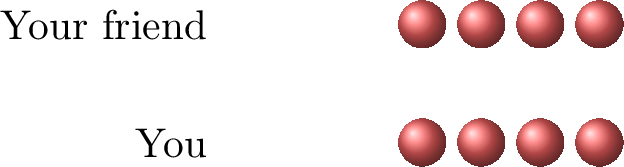
You have some marbles to share equally with a friend, so that you both have the same amount.
- First, you have 8 marbles. Can you share them equally with no marbles left over?

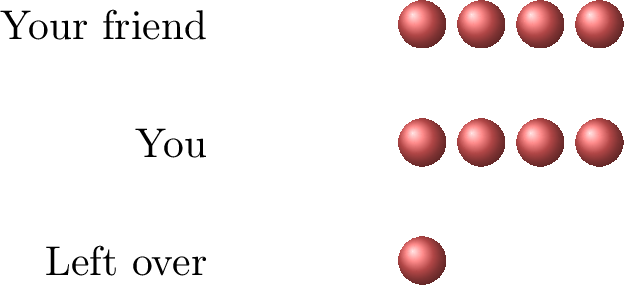
- Now you have 9 marbles. Can you still share them equally?

- With 8 marbles, you can make two equal groups of 4. There are no marbles left over.
- With 9 marbles, you can each get 4, but there is always 1 marble left over.
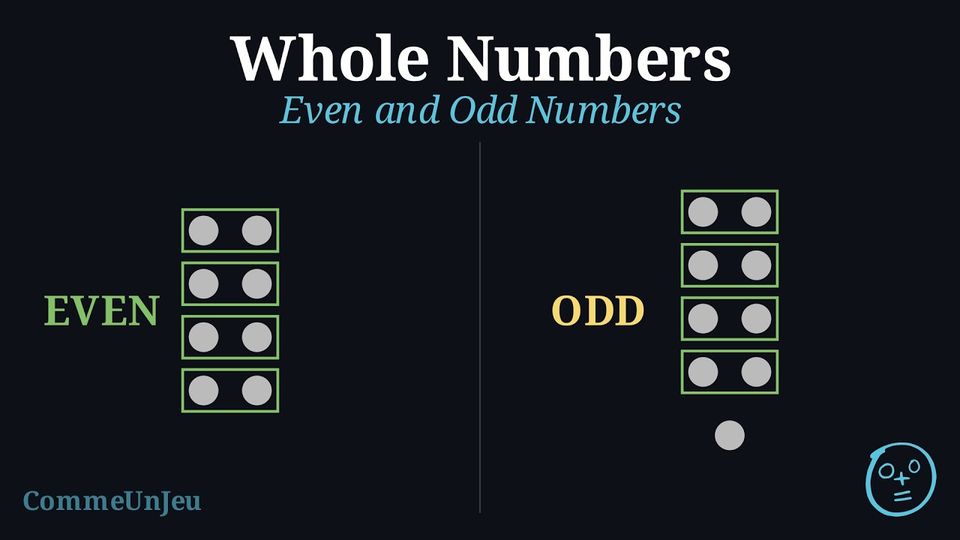
Definition — Even and Odd Numbers
- An even number is a number of whole items that can be split into two equal groups: every item has a partner and nothing is left over.
Examples: \(0, 2, 4, 6, 8, 10, 12, \dots\)
\(0\) is even too: with \(0\) objects, the two groups are empty and nothing is left over. - An odd number is a number of whole items that cannot be split into two equal groups: one item is always left without a partner.
Examples: \(1, 3, 5, 7, 9, 11, 13, \dots\)
To decide whether a number is even or odd, we look at its last digit.
- Numbers ending in 0, 2, 4, 6, or 8 are always even.
- Numbers ending in 1, 3, 5, 7, or 9 are always odd.
Method — Seeing an Even Number as a Double
An even number is a double: it is the same number written twice and added. - \(6\) is even because \(6 = 3 + 3\): two equal groups of \(3\).
- \(10\) is even because \(10 = 5 + 5\): two equal groups of \(5\).
- \(7\) is odd because \(7 = 3 + 3 + 1\): two equal groups of \(3\), and \(1\) item without a partner.
Example
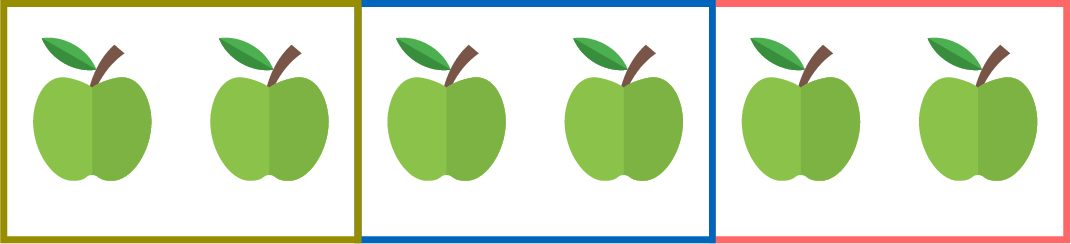
Is 6 even or odd? 
The number 6 is even. We can see this in two ways:
- We can make 2 equal groups of 3 with no apples left over.
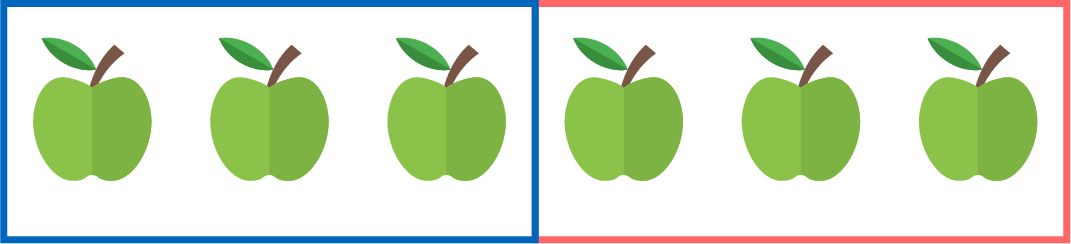
- We can make 3 pairs with no apples left over.
Example
Write every even number between \(645\) and \(657\). There are six of them.
We do not test the numbers one by one. We look at the last digit of the first one, then we go on. 
The six marked numbers are the answer. The other numbers of the line are odd, the two ends \(645\) and \(657\) included: they are not in the list. $$646 \qquad 648 \qquad 650 \qquad 652 \qquad 654 \qquad 656$$ Check. Six numbers, and each one ends in \(6\), \(8\), \(0\), \(2\), \(4\) or \(6\). Note that \(650\) crosses nothing special: the tens change, the last digit still decides on its own.
- Find the first even number. \(645\) ends in \(5\): odd. \(646\) ends in \(6\): even. That is the first one.
- Then jump by two. After an even number, the next even number is two further: \(646\), \(648\), \(650\), \(652\), \(654\), \(656\).
- The two ends are odd. \(645\) and \(657\) are odd: they are not in the list.
Skills to practice
- Sharing into Two Equal Groups
- Telling Even from Odd with Fruits
- Telling Even from Odd
- Using the Last Digit
- Listing the Even Numbers
II
Half of an Even Number
Léa and Tom share \(470\) stickers equally. Léa says: “Half of \(400\) is \(200\), and half of \(70\) is \(35\).” How many stickers does each get?
\(470 = 400 + 70\). Half of each part: \(200\) and \(35\). Add: \(200 + 35 = 235\). Each gets \(235\) stickers. Check: \(235 + 235 = 470\).
Method — Halving a 3-Digit Number
Taking half of a number means sharing it into two equal parts.To find half of an even number, split it into hundreds, tens and ones, take half of each part, then add. This works because sharing the whole into two means sharing each of its parts into two.
Half of \(46\): split \(46\) into \(40 + 6\); half of \(40\) is \(20\) and half of \(6\) is \(3\), so half of \(46\) is \(20 + 3 = 23\).
Half of \(470\): split \(470\) into \(400 + 70\).
Half of \(400\) is \(200\), and half of \(70\) is \(35\) (\(70 = 60 + 10\): \(30 + 5\)).
Add: \(200 + 35 = 235\). So half of \(470\) is \(235\).
When the hundreds digit is odd, first split off one hundred: \(500 = 400 + 100\); half of \(400\) is \(200\) and half of \(100\) is \(50\), so half of \(500\) is \(250\).
Example
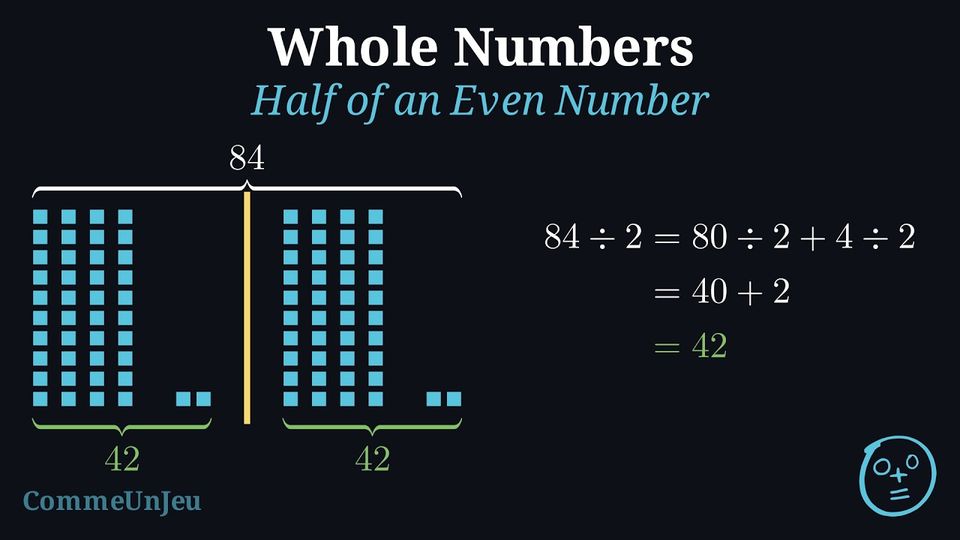
Find half of \(84\).
Split \(84\) into \(80 + 4\). Half of \(80\) is \(40\), and half of \(4\) is \(2\). $$\text{Half of } 84 = 40 + 2 = \textbf{42}$$
Example
Find half of \(58\).
Split \(58\) into \(50 + 8\). Half of \(50\) is \(25\) (\(50 = 40 + 10\): \(20 + 5\)), and half of \(8\) is \(4\). $$\text{Half of } 58 = 25 + 4 = \textbf{29}$$
Example
Find half of \(630\).
Split \(630\) into \(600 + 30\). Half of \(600\) is \(300\), and half of \(30\) is \(15\). $$\text{Half of } 630 = 300 + 15 = \textbf{315}$$
Skills to practice
- Halving Numbers up to 100
- Halving Tens and Hundreds
- Halving Step by Step
- Finding Halves of Large Numbers
- Solving Problems with Halves
III
Going further
Skills to practice
- Completing Doubles with Pictures
- Problems
- Quiz
Jump to section