International Baccalaureate · PYP 2
Division
I
What is Division?
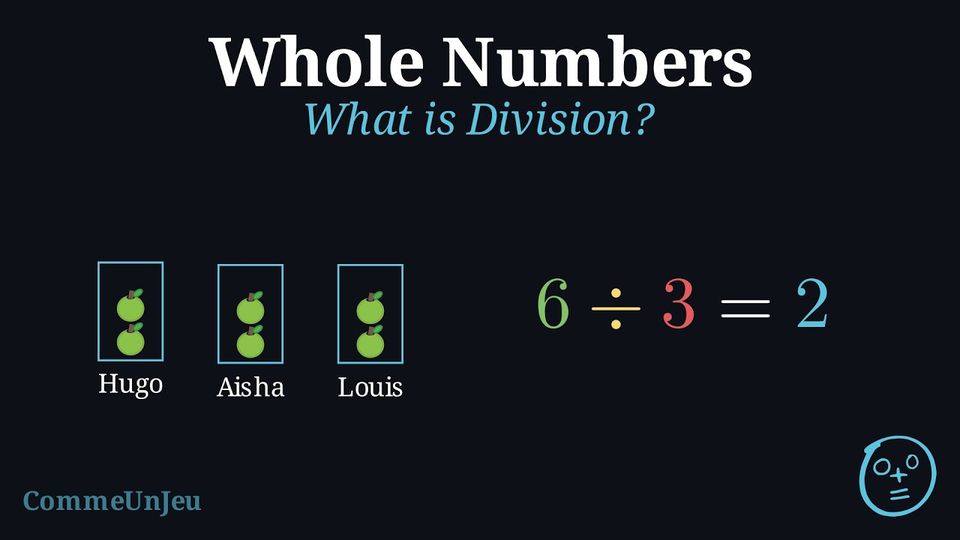
Sharing objects fairly and putting objects into equal groups use the same operation: division. Division splits a total into equal groups.
Definition — Division
Division is the process of splitting a total amount into equal groups. We use the division sign (\(\div\)) to write a division sentence.We can show “\(\textcolor{olive}{\text{six}}\) divided by \(\textcolor{colordef}{\text{three}}\) equals \(\textcolor{colorprop}{\text{two}}\)” in many ways:
- With Numbers: $$\textcolor{olive}{6}\div \textcolor{colordef}{3}=\textcolor{colorprop}{2}$$
- In Groups:
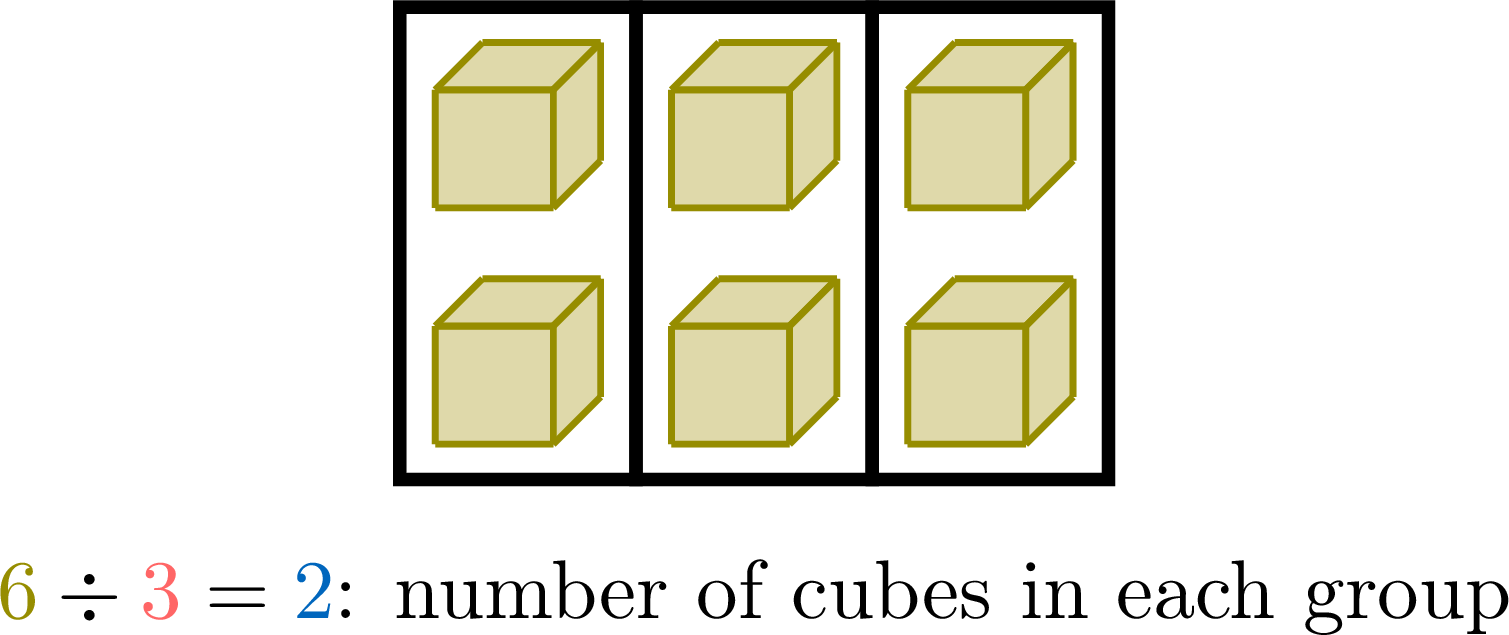
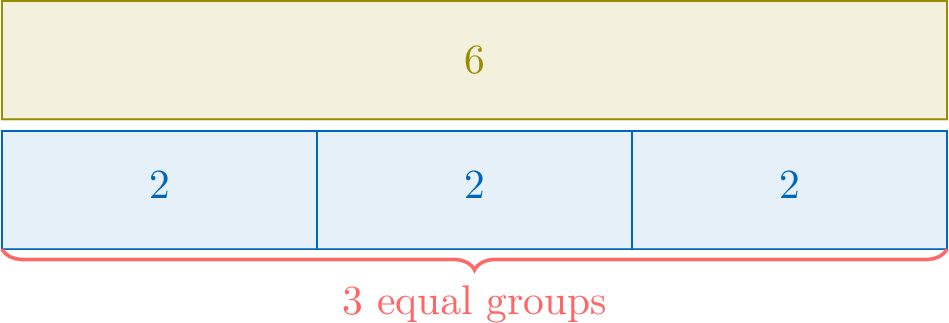
\(\textcolor{olive}{6}\) shared into \(\textcolor{colordef}{3}\) equal groups is \(\textcolor{colorprop}{2}\) in each group - Two Questions, One Division:
The same division \(\textcolor{olive}{6}\div \textcolor{colordef}{3}=\textcolor{colorprop}{2}\) answers two different questions. - Sharing: \(\textcolor{olive}{6}\) cakes are shared among \(\textcolor{colordef}{3}\) children. Each child gets \(\textcolor{colorprop}{2}\) cakes — the answer is a number of cakes.
- Grouping: \(\textcolor{olive}{6}\) cakes are put into boxes of \(\textcolor{colorprop}{3}\). We fill \(\textcolor{colordef}{2}\) boxes — the answer is a number of boxes.
- With Cubes:
- With a Part-Whole Model:
This array of cubes shows how multiplication and division are connected. 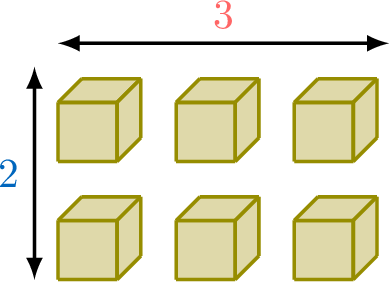
- Multiplication builds the total:
3 columns of 2 cubes each make 6 cubes in total. $$\textcolor{colordef}{3} \times \textcolor{colorprop}{2} = \textcolor{olive}{6}$$ - Division finds the group size:
6 cubes shared among 3 columns give 2 cubes per column. $$\textcolor{olive}{6} \div \textcolor{colordef}{3} = \textcolor{colorprop}{2}$$
Skills to practice
- Dividing Objects Equally into Groups
- Calculating Divisions
II
Two Kinds of Division Questions
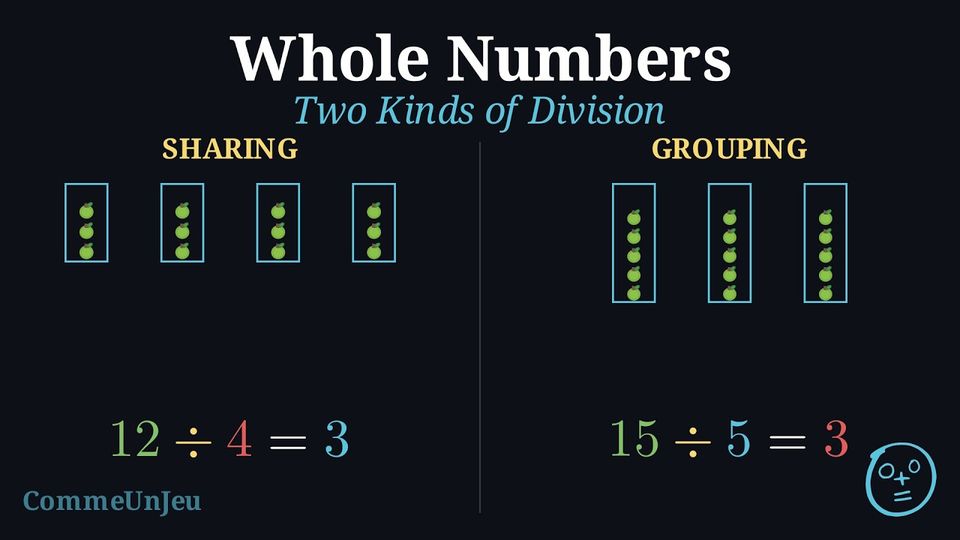
Method — Question 1: How many in each group?
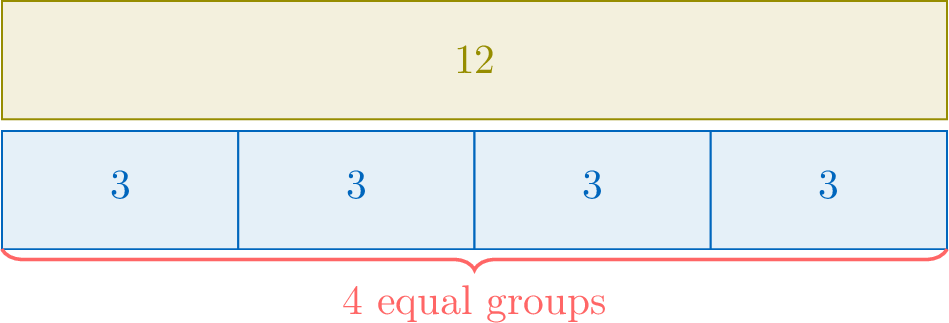
When the \(\textcolor{olive}{\text{total}}\) and the \(\textcolor{colordef}{\text{number of groups}}\) are known, division gives the \(\textcolor{colorprop}{\text{number of items in each group}}\). $$\begin{aligned}[t]\textcolor{olive}{\text{Total}} \div \textcolor{colordef}{\text{Number of groups}} &= \textcolor{colorprop}{\text{Number in each group}}\end{aligned}$$ For example, we have \(\textcolor{olive}{12}\) apples to share equally among \(\textcolor{colordef}{4}\) friends. 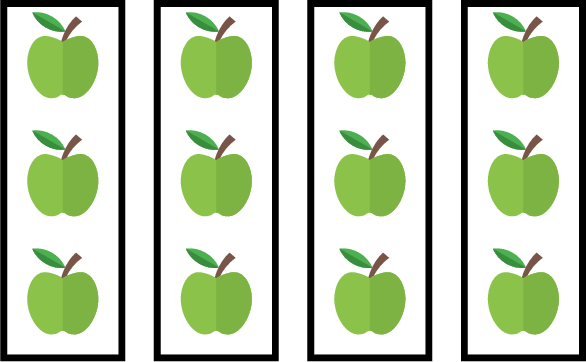
Method — Question 2: How many groups can be made?
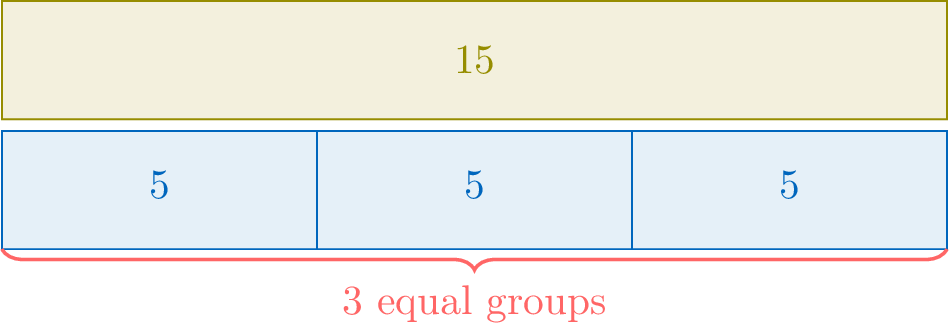
When the \(\textcolor{olive}{\text{total}}\) and the \(\textcolor{colorprop}{\text{number of items for each group}}\) are known, division gives the \(\textcolor{colordef}{\text{number of groups}}\) that can be made. $$\begin{aligned}[t]\textcolor{olive}{\text{Total}} \div \textcolor{colorprop}{\text{Number in each group}} &= \textcolor{colordef}{\text{Number of groups}}\end{aligned}$$ For example, we have \(\textcolor{olive}{15}\) apples and we put them into boxes of \(\textcolor{colorprop}{5}\). 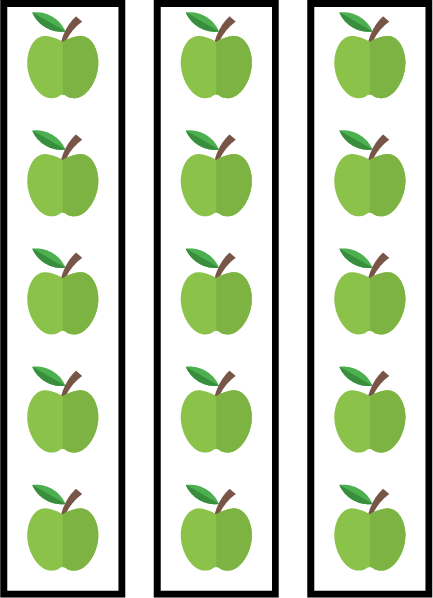
Skills to practice
- Finding the Number in Each Group
- Finding the Number of Groups
- Telling Sharing from Grouping and Finding the Correct Operation
III
Going further
Skills to practice
- Completing Divisions with Pictures
- Quiz
Jump to section