International Baccalaureate · PYP 2
Multiplication
I
What is Multiplication?
Louis loves apples and eats 2 apples every day:  .
How can we find how many apples he eats in one week (7 days)? 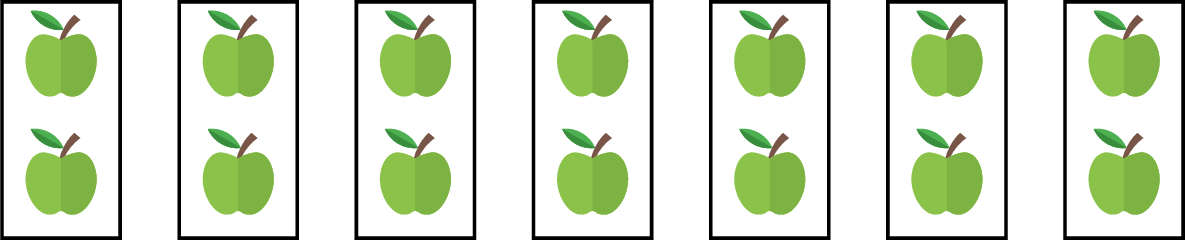
.How can we find how many apples he eats in one week (7 days)?
One way is to use repeated addition. We can add 2 apples for each of the 7 days: $$\textcolor{colorprop}{2}+\textcolor{colorprop}{2}+\textcolor{colorprop}{2}+\textcolor{colorprop}{2}+\textcolor{colorprop}{2}+\textcolor{colorprop}{2}+\textcolor{colorprop}{2} = 14$$ This works, but it takes a long time to write. A much faster way is to use multiplication.
When we have \(\textcolor{colordef}{7}\) groups of \(\textcolor{colorprop}{2}\), we can write it as \(\textcolor{colordef}{7}\times \textcolor{colorprop}{2}\). The symbol \(\times\) means “times” or “groups of”. $$\textcolor{colordef}{7}\times \textcolor{colorprop}{2} \quad \text{is the same as} \quad \textcolor{colorprop}{2}+\textcolor{colorprop}{2}+\textcolor{colorprop}{2}+\textcolor{colorprop}{2}+\textcolor{colorprop}{2}+\textcolor{colorprop}{2}+\textcolor{colorprop}{2}$$
When we have \(\textcolor{colordef}{7}\) groups of \(\textcolor{colorprop}{2}\), we can write it as \(\textcolor{colordef}{7}\times \textcolor{colorprop}{2}\). The symbol \(\times\) means “times” or “groups of”. $$\textcolor{colordef}{7}\times \textcolor{colorprop}{2} \quad \text{is the same as} \quad \textcolor{colorprop}{2}+\textcolor{colorprop}{2}+\textcolor{colorprop}{2}+\textcolor{colorprop}{2}+\textcolor{colorprop}{2}+\textcolor{colorprop}{2}+\textcolor{colorprop}{2}$$
Definition — Multiplication
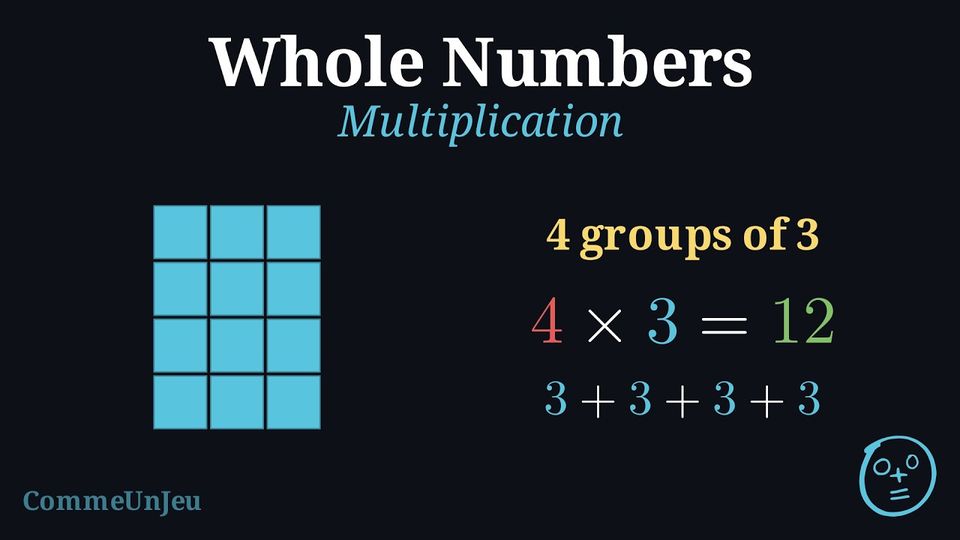
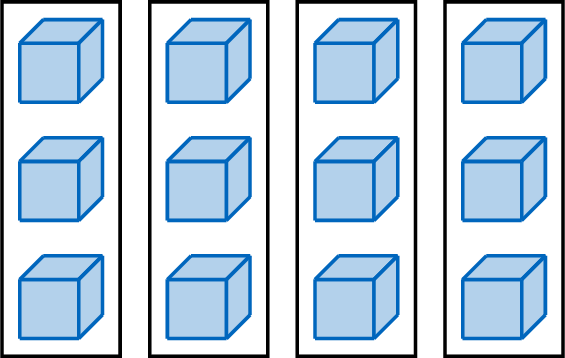
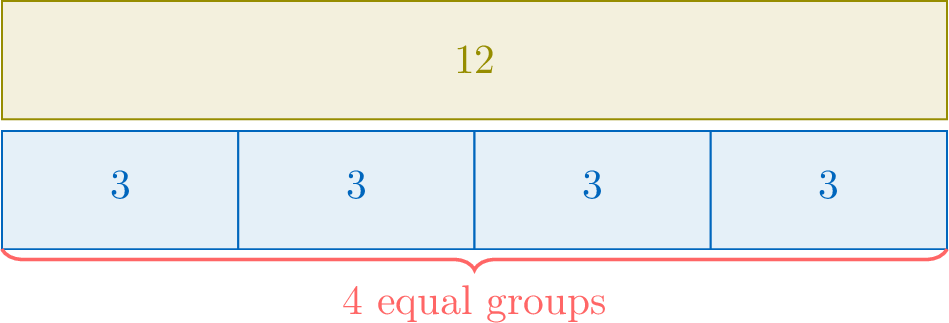
Multiplication is a fast way to show repeated addition of the same number. We can show the idea of “\(\textcolor{colordef}{\text{four}}\) times \(\textcolor{colorprop}{\text{three}}\) equals \(\textcolor{olive}{\text{twelve}}\)” in many different ways: - With Numbers: $$\textcolor{colordef}{4}\times \textcolor{colorprop}{3}=\textcolor{olive}{12}$$
- In Groups: $$\textcolor{colordef}{4}\text{ groups of }\textcolor{colorprop}{3}=\textcolor{olive}{12}$$
- As Repeated Addition: $$\textcolor{colorprop}{3}+\textcolor{colorprop}{3}+\textcolor{colorprop}{3}+\textcolor{colorprop}{3}=\textcolor{olive}{12}$$
- With Cubes:
- With a Part-Whole Model:
Example
Write the repeated addition \(\textcolor{colorprop}{5}+\textcolor{colorprop}{5}+\textcolor{colorprop}{5}\) as a multiplication.
The number 5 appears 3 times in the addition. So, the multiplication is: $$ \textcolor{colordef}{3}\times \textcolor{colorprop}{5}$$
Example
A packet holds \(20\) biscuits. Sam buys \(6\) packets. Write a multiplication and find how many biscuits Sam has. 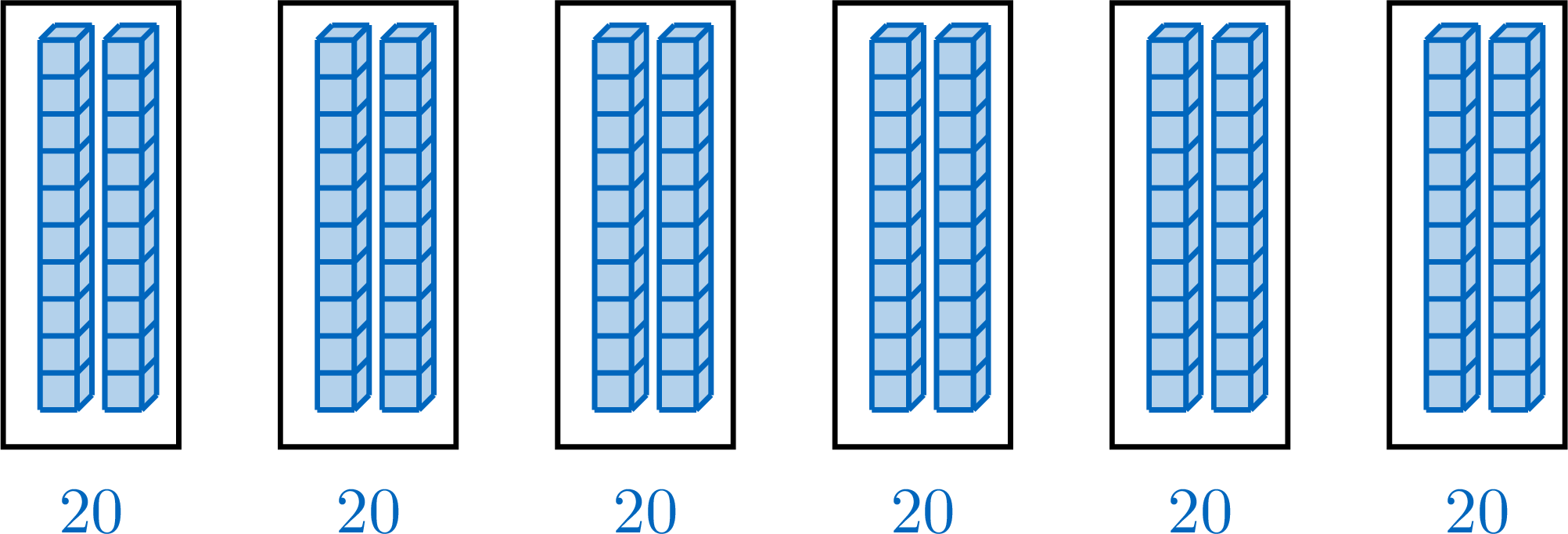
Six packets of \(20\) is \(6\) times \(20\): $$6 \times 20 \text{ biscuits}$$ No need to add \(20+20+20+20+20+20\) one by one: \(20\) is \(2\) tens, and adding six \(2\)s is easy: \(2+2+2+2+2+2 = 12\). So \(6\) times \(2\) tens makes \(12\) tens, that is \(120\). $$6 \times 20 \text{ biscuits} = 120 \text{ biscuits}$$ The multiplication is much shorter to write than the repeated addition.
Skills to practice
- Identifying Multiplications and Repeated Additions From Words
- Identifying Multiplications and Repeated Additions From Groups
- Finding the Number of Groups and the Number of Fruits in Each Group
- Writing Multiplications from Groups and from Additions
- Calculating Multiplications Using Cubes
- Multiplying Whole Tens
II
On the Number Line
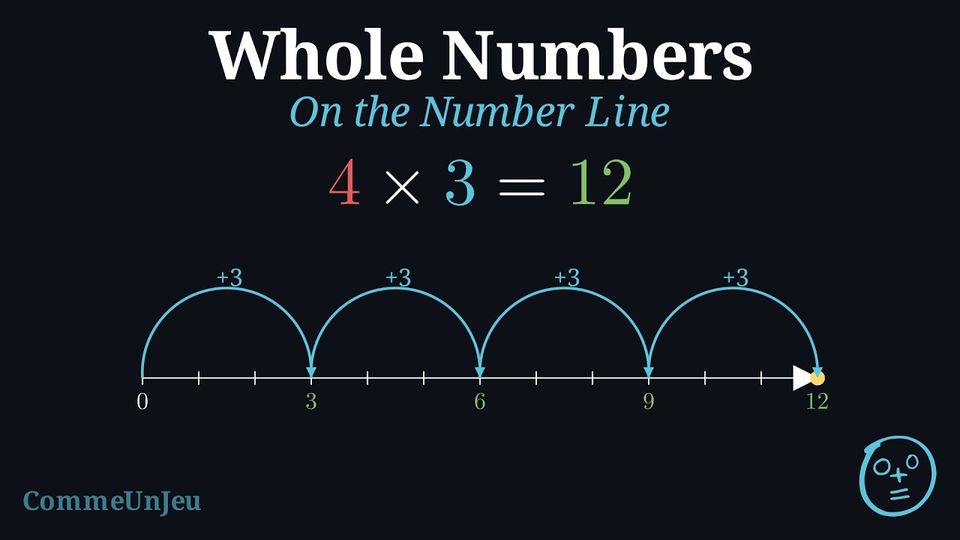
Louis shows the multiplication \(\textcolor{colordef}{4} \times \textcolor{colorprop}{3}\) on a number line: starting from \(0\), he makes \(\textcolor{colordef}{4}\) jumps of \(\textcolor{colorprop}{3}\). 
On which number does he land?
Each jump adds \(\textcolor{colorprop}{3}\): \(0 + \textcolor{colorprop}{3}\), \(3 + \textcolor{colorprop}{3}\), \(6 + \textcolor{colorprop}{3}\), \(9+\textcolor{colorprop}{3}\). After \(\textcolor{colordef}{4}\) jumps, Louis lands on \(\textcolor{olive}{12}\): $$\textcolor{colordef}{4} \times \textcolor{colorprop}{3} = \textcolor{colorprop}{3}+\textcolor{colorprop}{3}+\textcolor{colorprop}{3}+\textcolor{colorprop}{3} = \textcolor{olive}{12}$$
Method — Multiplication on the Number Line
We can show multiplication as “jumps” on a number line. To show \(\textcolor{colordef}{4} \times \textcolor{colorprop}{3}\), we can start at 0 and make \(\textcolor{colordef}{4}\) jumps of size \(\textcolor{colorprop}{3}\). Skills to practice
- Calculating Multiplications Using the Number Line
III
Multiplication in Word Problems
Method — Finding the Total with Groups
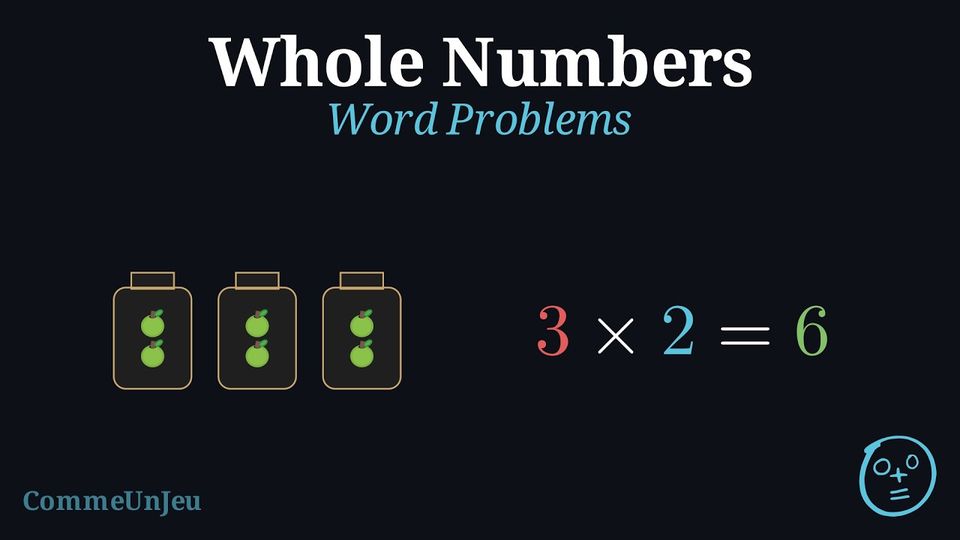
In word problems, we can find the total by multiplying the number of groups by the number of items in each group. $$\textcolor{colordef}{\text{Number of groups}} \times \textcolor{colorprop}{\text{Number in each group}} =\textcolor{olive}{\text{Total}}$$ For example, if there are \(\textcolor{colordef}{3}\) bags and each bag has \(\textcolor{colorprop}{2}\) apples, the total number of apples is: $$\textcolor{colordef}{3} \times \textcolor{colorprop}{2} = \textcolor{olive}{6}$$ 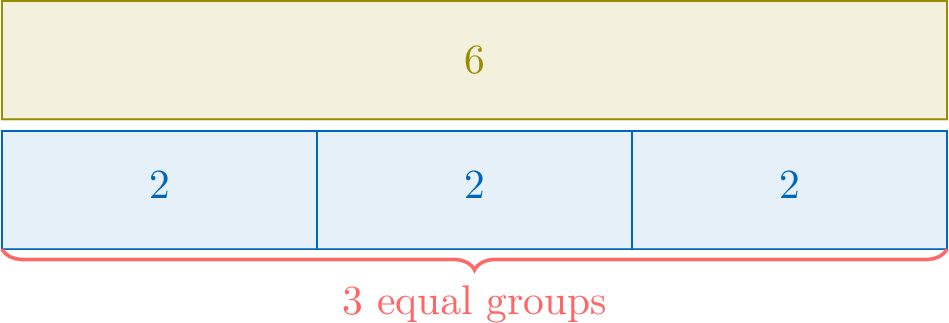
Skills to practice
- Solving Real-World Problems With Drawing
- Solving Real-World Problems
IV
Does the Order Matter?
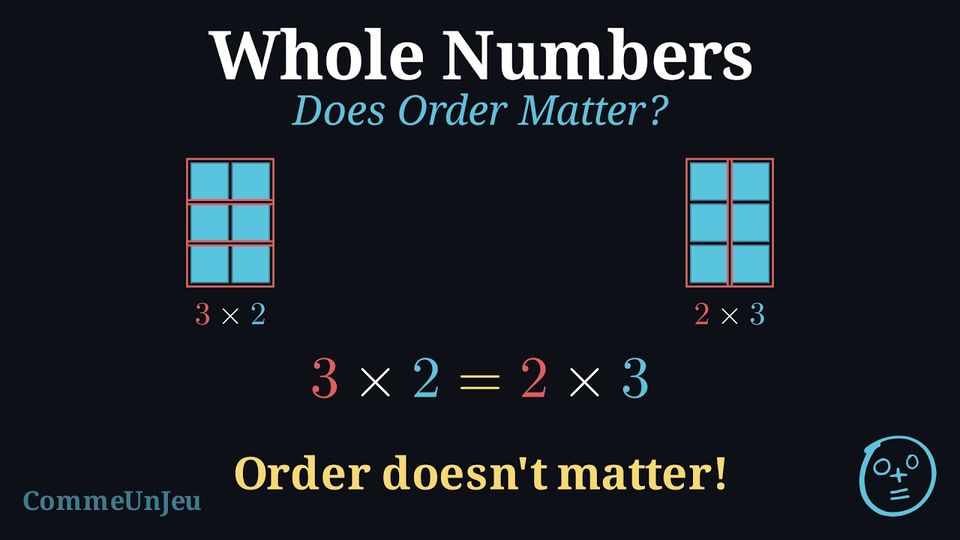
Hugo and Louis are looking at this group of cubes. 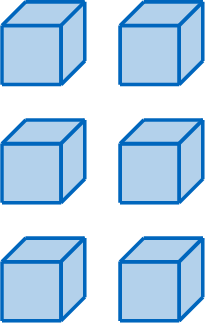
To find the total, Hugo thinks they should calculate \(\textcolor{colordef}{3}\times \textcolor{colorprop}{2}\), but Louis thinks it should be \(\textcolor{colordef}{2}\times \textcolor{colorprop}{3}\). Who is correct? Can they both be correct?
They are both correct.
- Louis sees \(\textcolor{colordef}{2}\) columns, with \(\textcolor{colorprop}{3}\) cubes in each column (2 groups of 3).
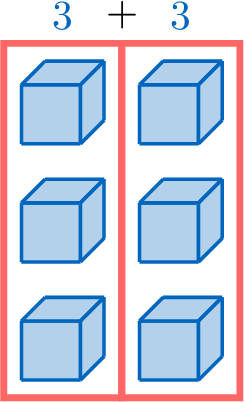
- Hugo sees \(\textcolor{colordef}{3}\) rows, with \(\textcolor{colorprop}{2}\) cubes in each row (3 groups of 2).
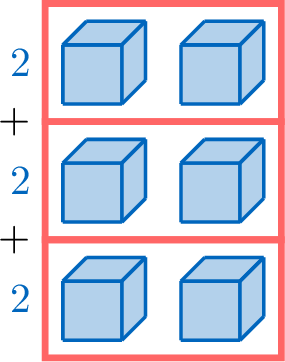
Proposition — Commutative Property
Multiplication is commutative: changing the order of the numbers does not change the result. Cubes set out in rows and columns make an array: we can count it by columns or by rows. 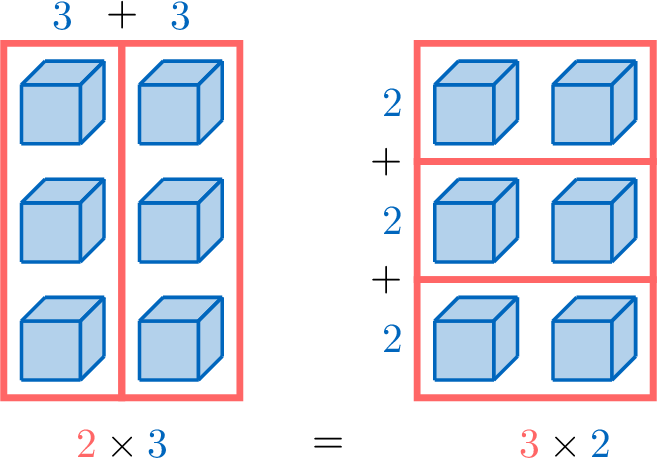
Skills to practice
- Finding Expressions from Arrays
- Finding an Easier Way to Calculate Multiplication
- Writing the Commutative Property
- Using the Order of Multiplication
V
Going further
Skills to practice
- Completing Multiplications with Pictures
- Solving Multiplication Problems
- Quiz
Jump to section