International Baccalaureate · PYP 2
Subtraction to 100 and beyond
I
Subtracting Ones Then Tens
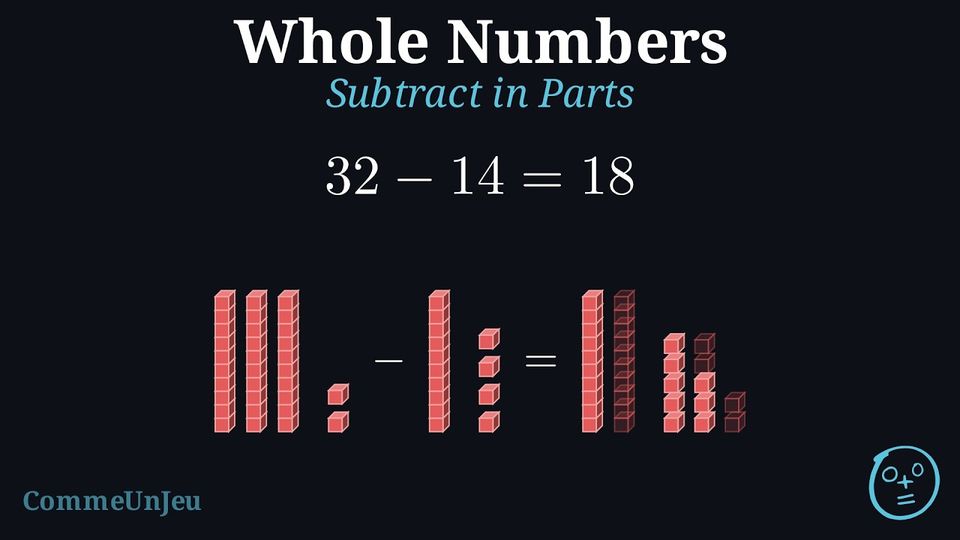
Imagine you have 32 cubes. If you give 14 of them to a friend, how can you figure out how many you have left?  \(-\)
 \(=\; ?\)
This operation is called subtraction.
\(-\) \(=\; ?\)
When we start with 32 and take 14 away, we can see what is left. 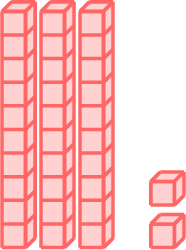 \(-\)
 \(=\)
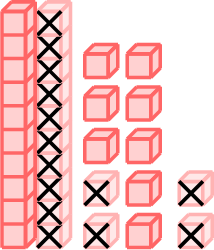
There are 18 cubes left. $$32-14=18$$ Counting cubes one by one takes a long time. Subtracting ones then tens, and subtraction in columns, are faster strategies.
\(-\) \(=\) Method — Subtracting Ones Then Tens Using Cubes
To calculate: 
- Step 1: Subtract the ones $$7 \text{ ones} - 4 \text{ ones} = 3 \text{ ones}$$
- Step 2: Subtract the tens $$3 \text{ tens} - 1 \text{ ten} = 2 \text{ tens}$$
- Result: 1 ten and 4 ones of the 37 cubes are crossed out. There are 2 tens and 3 ones left. So, $$37 - 14 = 23$$

Consider \(32 - 14\). When we look at the ones place, we need to do: $$2 \text{ ones} - 4 \text{ ones}$$ There are not enough ones to take 4 away. To solve this, we exchange 1 ten for 10 ones (we also say we borrow a ten). Then there are enough ones to subtract.
Method — Subtracting Ones Then Tens with an Exchange
To calculate: \(-\) - Step 1: Subtract the ones with an exchange $$2 \text{ ones} - 4 \text{ ones}$$ We don’t have enough ones, so we exchange 1 ten from the tens place for 10 ones. Now we have \(12\) ones. $$12 \text{ ones} - 4 \text{ ones} = 8 \text{ ones}$$
 \(-\)
 \(=\)

- Step 2: Subtract the tens After the exchange, \(32\) has \(2\) tens left. $$2 \text{ tens} - 1 \text{ ten} = 1 \text{ ten}$$
- Result: There is 1 ten and 8 ones. So, $$32 - 14 = 18$$ \(-\) \(=\)
Skills to practice
- Subtracting Without Regrouping in a Table
- Subtracting Without Regrouping
- Subtracting With Regrouping in a Table
- Subtracting With Regrouping
II
Subtraction in Columns
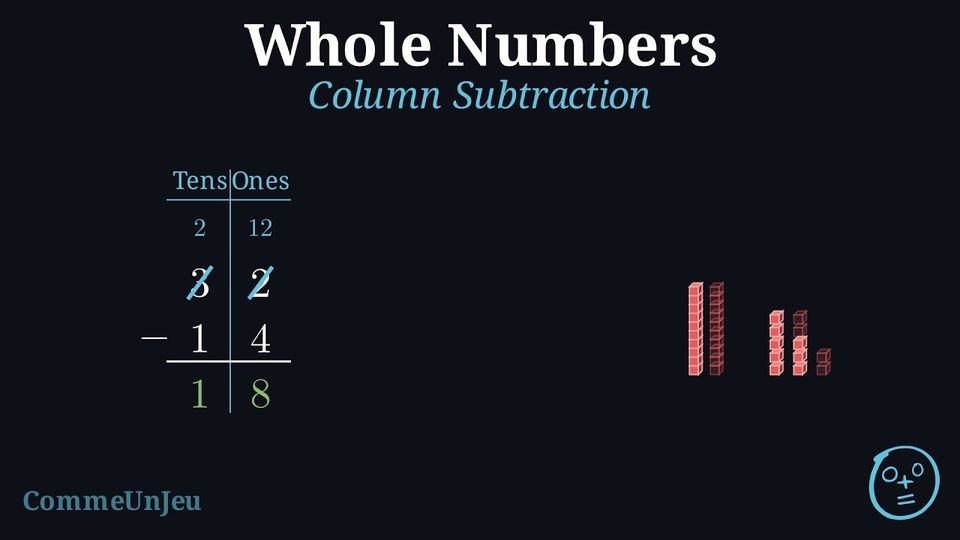
Method — Subtraction in Columns
To calculate: $$37 - 14$$ - Step 1: Set up the subtraction
Write the numbers in a vertical column, making sure the digits line up by place value (ones under ones, tens under tens).
- Step 2: Subtract the ones $$7 \text{ ones} - 4 \text{ ones} = 3 \text{ ones}$$

- Step 3: Subtract the tens $$3 \text{ tens} - 1 \text{ ten} = 2 \text{ tens}$$

- Result: There are 2 tens and 3 ones. So,$$37 - 14 = 23$$
Method — Column Subtraction with an Exchange
To calculate: - Step 1: Set up the subtraction
Write the numbers in a vertical column, making sure the digits line up by place value (ones under ones, tens under tens).
- Step 2: Exchange 1 Ten $$2 \text{ ones} - 4 \text{ ones}$$ We don’t have enough ones, so we exchange 1 ten from the tens place for 10 ones. Now we have \(12\) ones.

- Step 3: Subtract the ones $$12 \text{ ones} - 4 \text{ ones} = 8 \text{ ones}$$

- Step 4: Subtract the tens After the exchange, \(32\) has \(2\) tens left. $$2 \text{ tens} - 1 \text{ ten} = 1 \text{ ten}$$

- Result: There is 1 ten and 8 ones. So, $$32 - 14 = 18$$
Proposition — Link Between Addition and Subtraction
$$\textcolor{colordef}{\text{part 1}} + \textcolor{colorprop}{\text{part 2}}=\textcolor{olive}{\text{total}}$$ $$\textcolor{olive}{\text{total}} -\textcolor{colordef}{\text{part 1}} = \textcolor{colorprop}{\text{part 2}} \quad\quad \textcolor{olive}{\text{total}} -\textcolor{colorprop}{\text{part 2}} =\textcolor{colordef}{\text{part 1}} $$ 
Checking a Subtraction with an Addition
Addition and subtraction undo each other. So a subtraction is checked with an addition: the result plus the number taken away must give the starting number. 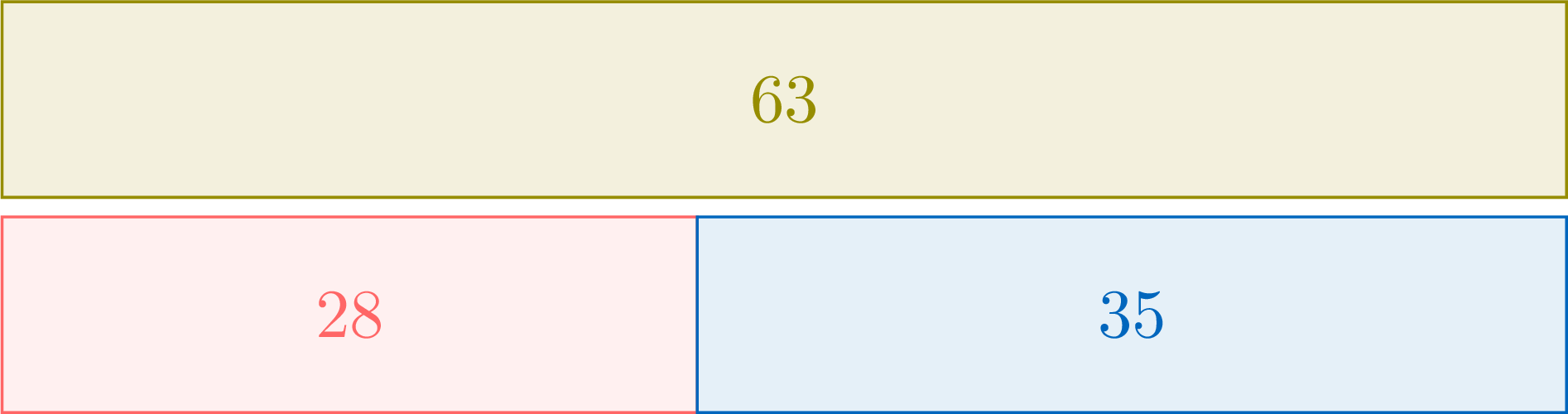
- \(63 - 28 = 35\)? Check: \(35 + 28 = 63\). We find the starting number \(63\): the subtraction is correct.
- \(72 - 38 = 44\)? Check: \(44 + 38 = 82\), not \(72\): the subtraction is wrong. Computed again: \(72 - 38 = 34\), and \(34 + 38 = 72\).
Skills to practice
- Subtracting in Columns Without Regrouping
- Subtracting in Columns With Regrouping
- Solving Real-World Problems
- Checking with an Addition
III
Taking a Small Number Away Through the Lower Ten
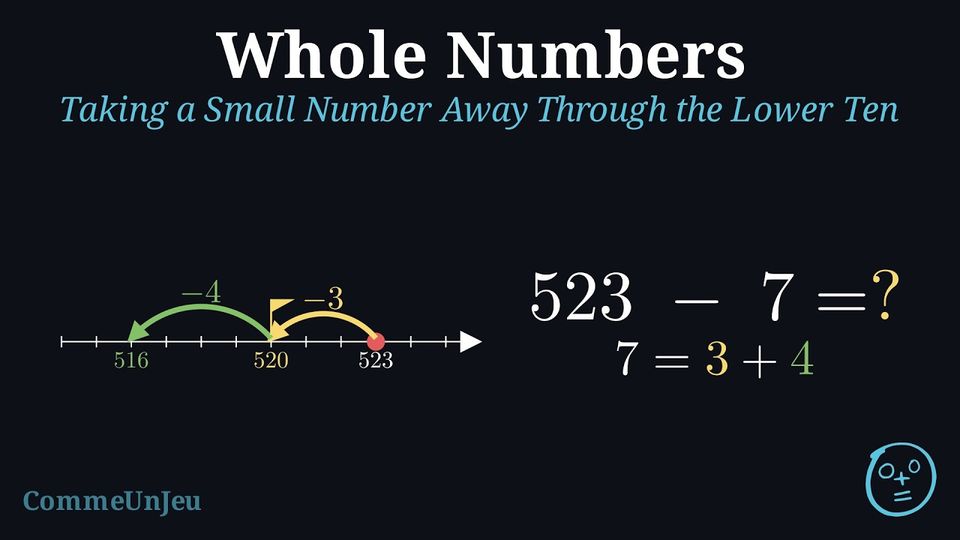
Nour has \(523\) marbles and gives \(7\) to Tom. She says: “First I take \(3\) away to reach \(520\), then the rest.” How many marbles has she left? 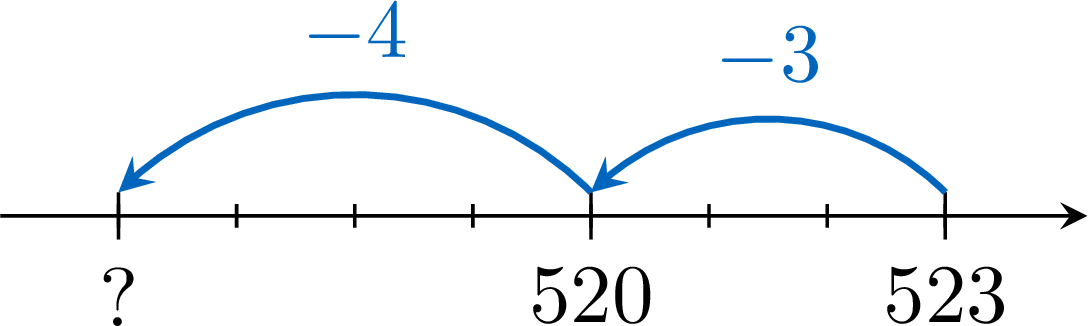
\(523 - 3 = 520\): the lower ten is reached. She has taken \(3\) away and must take \(7\): \(7 = 3 + 4\), so \(4\) remain to take. \(520 - 4 = 516\) (a whole ten minus a small number: one ten is broken, \(10 - 4 = 6\)). Nour has \(516\) marbles left. 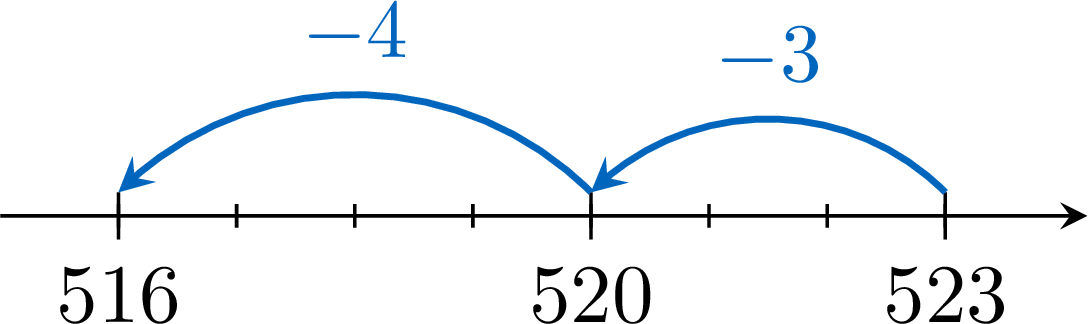
Method — Through the Lower Ten
To take a number smaller than \(10\) away from a three-digit number: - Enough ones: if the ones digit is big enough, take away from the ones only. \(157 - 5\): \(7 - 5 = 2\), so \(152\).
- Not enough ones: go through the lower ten. Take away what reaches it: \(523 - 3 = 520\). Find what is left to take: \(7 = 3 + 4\). Take it from the whole ten: \(520 - 4 = 516\).
The same with two digits: \(43 - 7\): \(43 - 3 = 40\), \(40 - 4 = 36\).
Example
Compute: (a) \(348 - 6\), (b) \(262 - 5\), (c) \(731 - 4\).
(a) \(8 - 6 = 2\): \(342\). (b) \(262 - 2 = 260\), then \(5 = 2 + 3\), \(260 - 3 = 257\). (c) \(731 - 1 = 730\), then \(4 = 1 + 3\), \(730 - 3 = 727\).
Skills to practice
- Subtracting Within the Ten or Through the Lower Ten
- Subtracting a Small Number
IV
Going further
Skills to practice
- Completing Equalities with Pictures
- Writing Each Step
- Quiz
Jump to section