International Baccalaureate · PYP 2
Time
I
One Day, 24 Hours
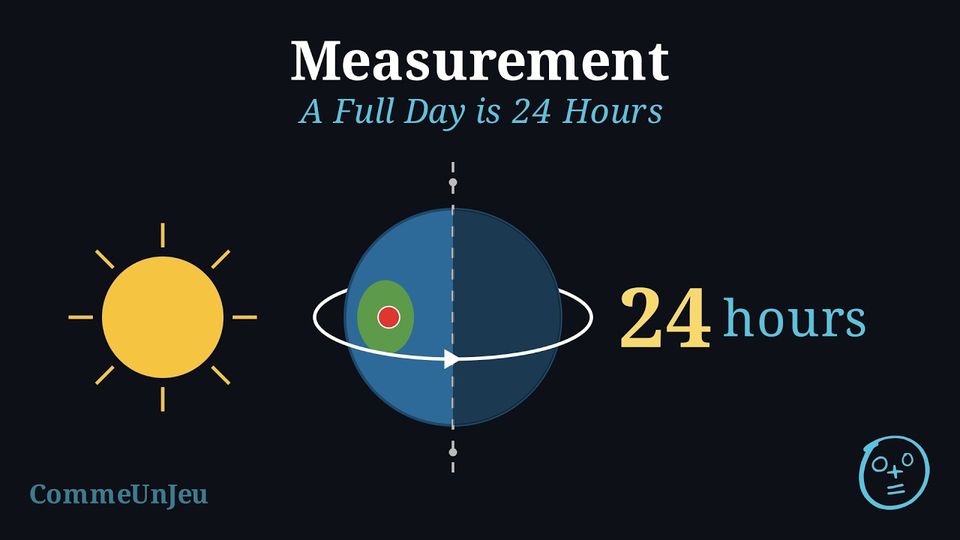
Definition — One Day, 24 Hours
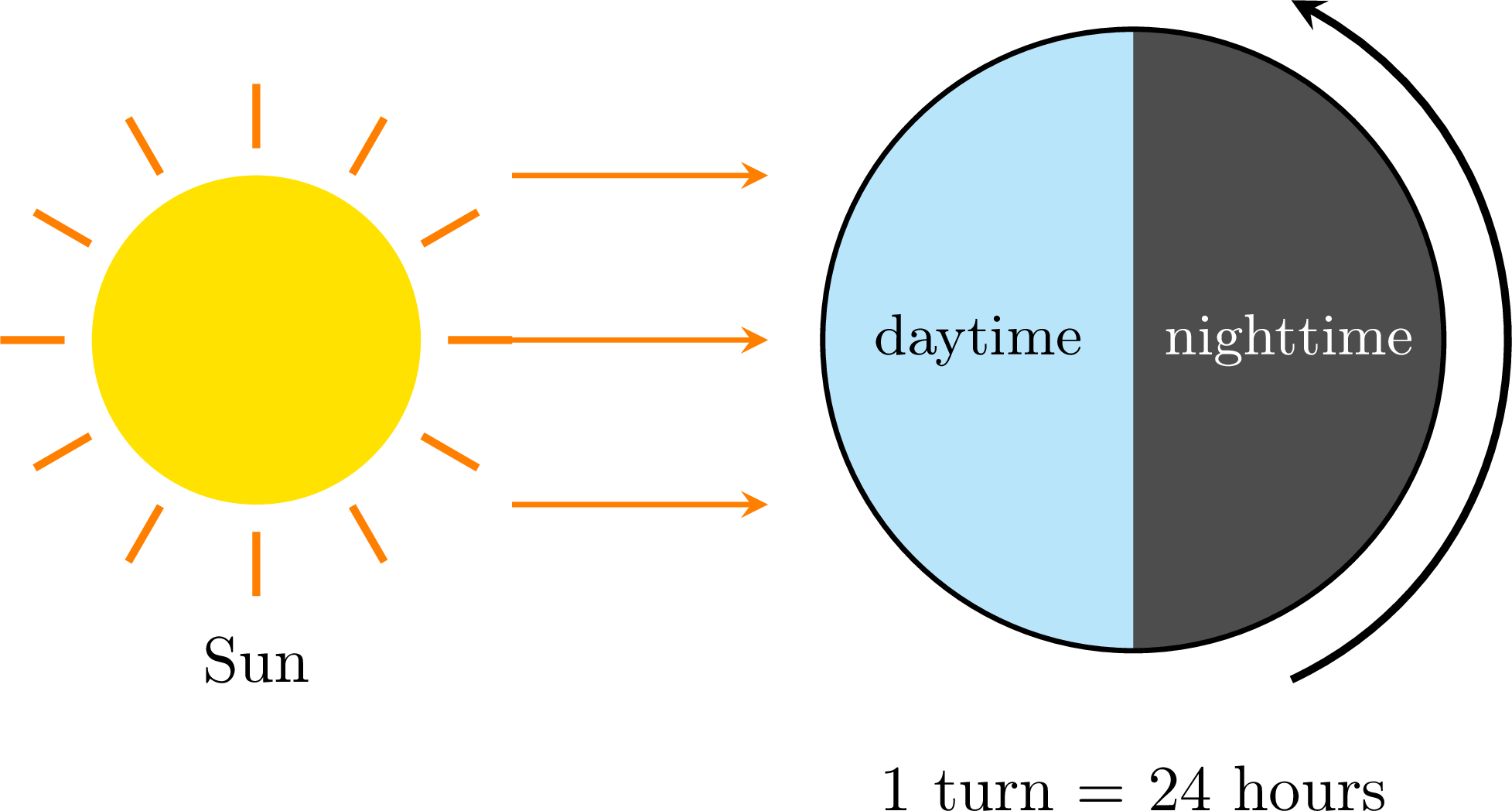
It takes the Earth 24 hours to complete one full spin on its axis. We call this spinning motion a rotation. This 24-hour period of rotation is one full day.As the Earth rotates, different parts of it face the Sun.
- The part of the Earth facing the Sun is lit up. We call this period daytime.
- The part of the Earth facing away from the Sun is in darkness. We call this period nighttime.
Skills to practice
- Counting the Hours in a Day
II
Days in Each Month
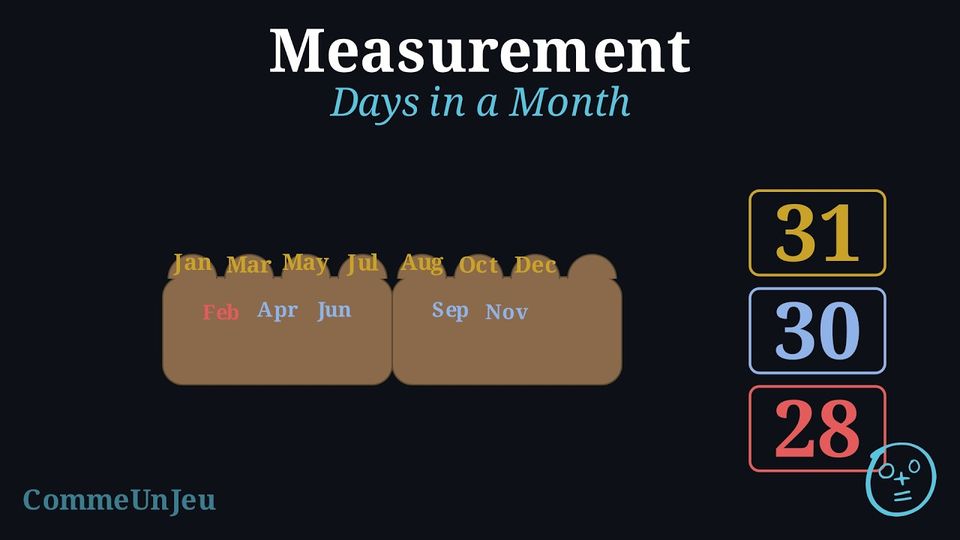
Definition — Days in Each Month
Not all months have the same number of days. Some are longer than others. - 31 days: January, March, May, July, August, October, December.
- 30 days: April, June, September, November.
- 28 or 29 days: February is a special case. It is the shortest month with 28 days. However, in general every four years, we have a leap year, and February gets an extra day, giving it 29 days.
A Trick to Remember the Months
You can use your knuckles to remember which months have 31 days. 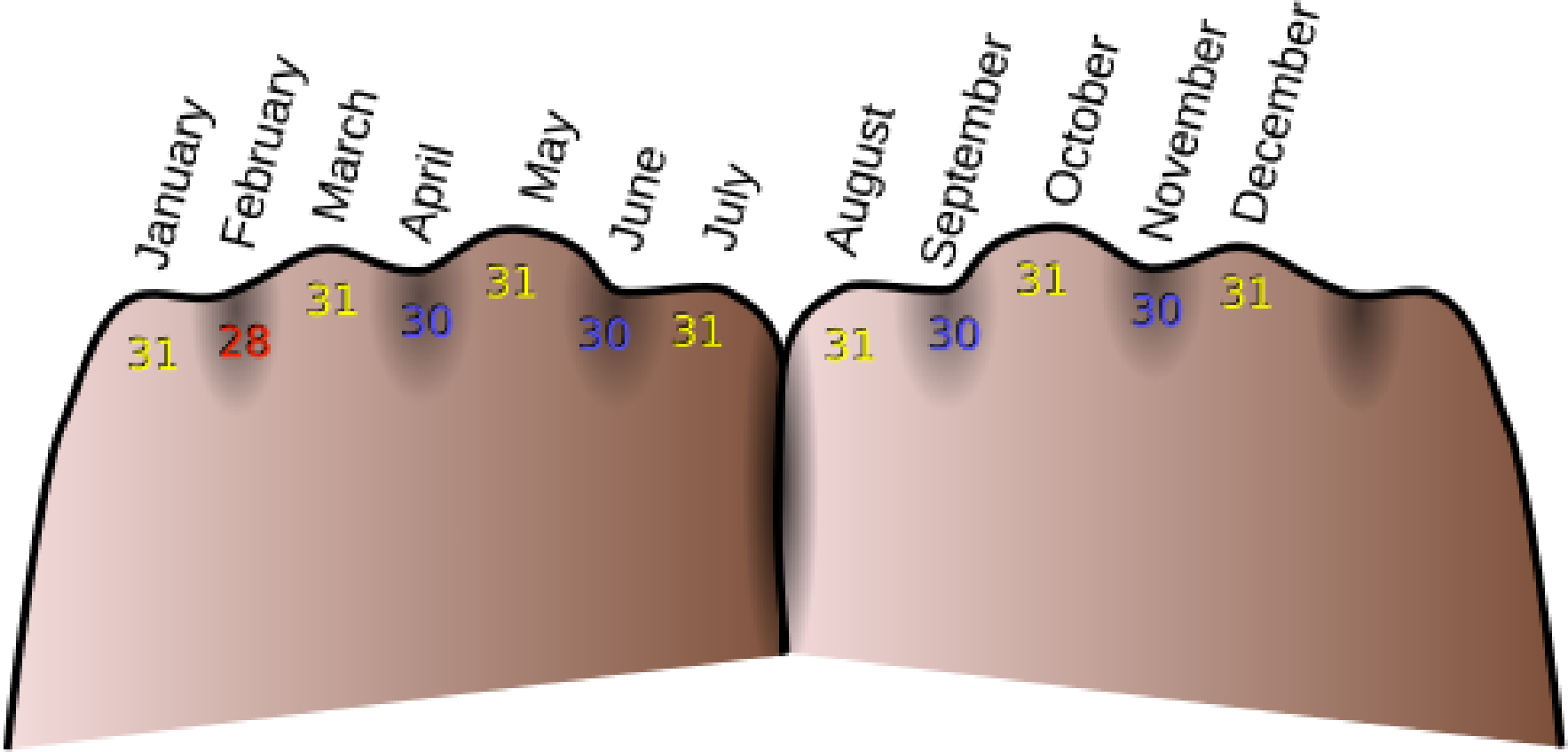
You can use your knuckles to remember which months have 31 days.
- Make a fist with both hands and place them together.
- Start with January on the first knuckle on the left, and move forward one month at a time. Each knuckle (the bumpy part) is a month with 31 days.
- Each valley (the space between knuckles) is a month with 30 days (or February).
Skills to practice
- Finding the Number of Days in a Month
III
Seasons in the North and in the South
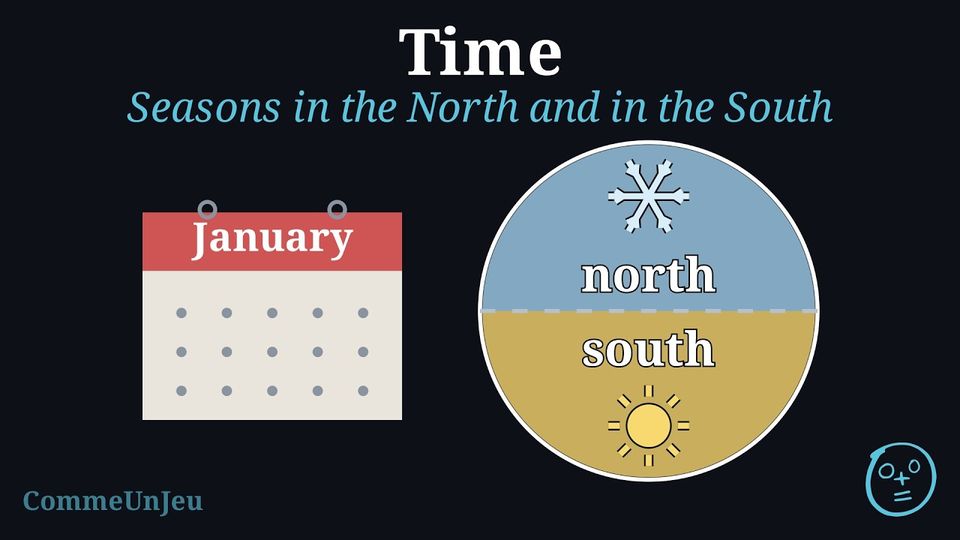
Seasons in the North and in the South
The Earth has a northern half and a southern half. In the places that have four seasons, the two halves do not have the same season at the same time: when it is summer in the north, it is winter in the south, and the other way round. Each season lasts about \(3\) months:
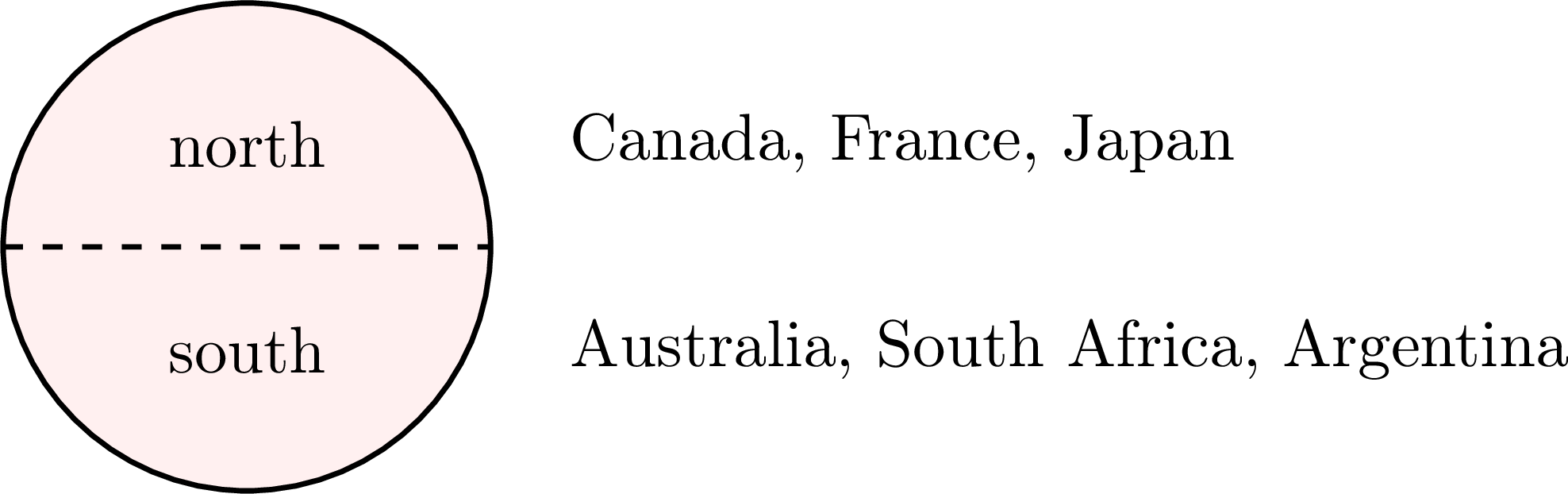
In January, children in France often wear warm coats, while children in Australia often go to the beach. Near the dashed line between the two halves, many places have a rainy season and a dry season instead.
| Months | In the north | In the south |
| December, January, February | winter | summer |
| March, April, May | spring | autumn |
| June, July, August | summer | winter |
| September, October, November | autumn | spring |
Skills to practice
- Finding the Season in the South
IV
Half and Quarter Hours
At school, the teacher says to Léa: “Break starts at quarter past ten.” On the clock, the long hand is on the \(3\) and the short hand has just passed the \(10\). What does “quarter” mean here? 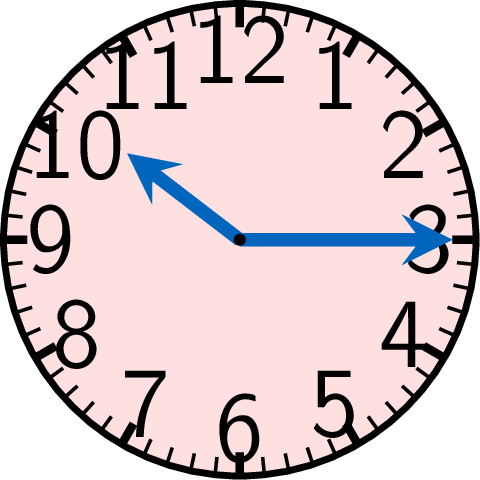
The long hand has travelled a quarter of the clock face: from the \(12\) to the \(3\). Counting the small marks from the \(12\) to the \(3\), there are \(15\): a quarter of an hour has passed since ten o'clock, that is \(15\) minutes. It is \(10\):\(15\).
Proposition — The Hour and Its Quarters
One full turn of the long hand is one hour. Each small mark is one minute: the long hand passes \(60\) small marks in one hour, \(1\) h \(= 60\) min. The numbers \(12\), \(3\), \(6\) and \(9\) cut the clock face into four quarters of an hour. 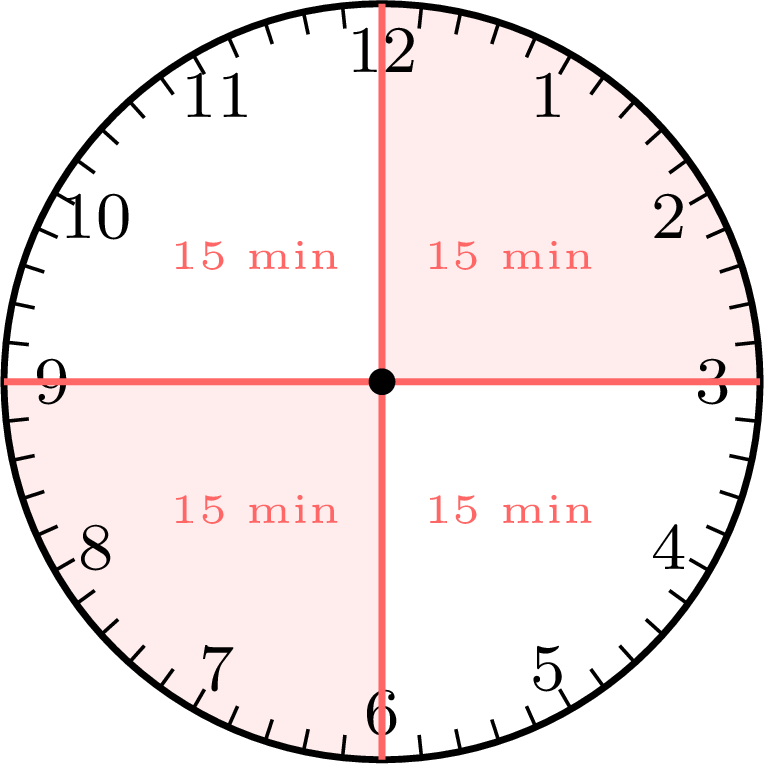
- A quarter of an hour is \(15\) minutes: the long hand goes from the \(12\) to the \(3\).
- Half an hour is \(30\) minutes: the long hand goes from the \(12\) to the \(6\). Two quarters of an hour make half an hour: \(15 + 15 = 30\).
- Three quarters of an hour is \(45\) minutes: \(15 + 15 + 15 = 45\), the long hand reaches the \(9\).
- Four quarters of an hour make one hour: \(15 + 15 + 15 + 15 = 60\).
Method — How to Read Half-Hour Times
When we tell time to the half hour, we use the phrase “half past”. - Look at the long hand. When it points straight down to the 6, it has gone half way round the clock, from the 12 to the 6: it is half past.
- Look at the short hand. Because the long hand has gone half way round, the short hand is no longer pointing directly at a number. It has moved half way past the last hour and is on its way to the next one. To know the hour, we look at the number the hand has just passed.
Method — Reading Quarter Past and Quarter To
- Long hand on the 3: a quarter of an hour has passed. The short hand has left the hour: it is a quarter of the way to the next one. Read the hour it has just passed, then say “quarter past”: \(4\):\(15\) is quarter past four.
- Long hand on the 9: a quarter of an hour is missing before the next hour. The short hand is almost on the next hour, three quarters of the way. Say “quarter to” the hour it is coming to: \(6\):\(45\) is quarter to seven. In numbers, we still write the hour that has passed: \(6\):\(45\).
Example
What time does this clock show? It is morning. 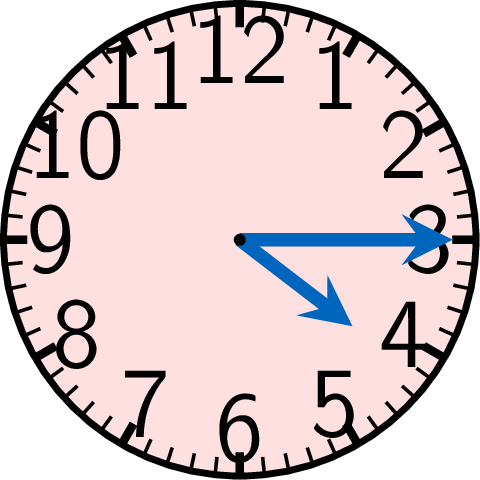
- The long hand is on the 3: a quarter of an hour, \(15\) minutes.
- The short hand has just passed the 4.
- It is \(4\):\(15\): quarter past four in the morning.
Method — Moving Forward or Back by Quarter Hours
- To add a quarter of an hour, move the long hand forward by a quarter of a turn: from the \(12\) to the \(3\), from the \(3\) to the \(6\), from the \(6\) to the \(9\), from the \(9\) to the \(12\) — and when it passes the \(12\), the short hand moves on to the next number (after \(12\) comes \(1\)).
- To take away a quarter of an hour, move the long hand back by a quarter of a turn — and when it passes the \(12\) backwards, the short hand goes back to the number before (before \(1\) comes \(12\)).
- For half an hour, move two quarters; for three quarters of an hour, move three quarters.
Skills to practice
- Reading Quarter Hours
- Changing Quarter Hours into Minutes
- Placing the Hands for Half and Quarter Hours
V
Units of Time
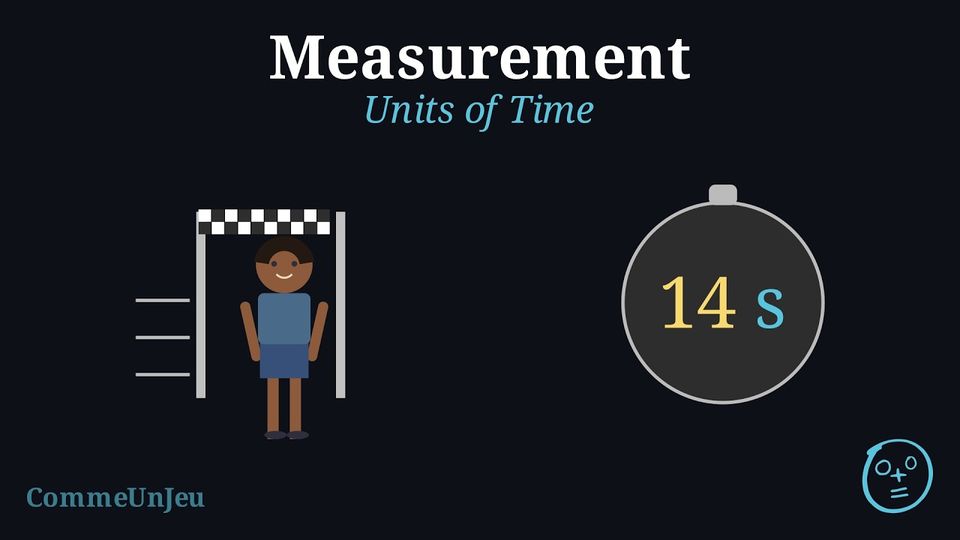
A unit of time is a standard way to measure how long something lasts. We choose the best unit based on the duration of the event.
Definition — Common Units of Time
Here are the most common units, from smallest to largest: - Second (s): For very short moments, like blinking an eye.
- Minute (min): For short durations, like the time it takes to brush your teeth.
- Hour (h): For longer activities, like a lesson at school or a film.
- Day (d): A full cycle of daytime and nighttime.
- Week (wk): A group of 7 days.
- Month (mo): Used to divide a year into parts, such as the months in a season.
- Year (yr): A long period, used to measure our age or the time between holidays.
- Century: \(100\) years. Used for history: the kings, the castles, the inventions.
- Millennium: \(1\,000\) years, that is \(10\) centuries. Used for the very distant past, like the pyramids.
Example
Which unit of time is most appropriate for measuring how long it takes to run a 100-metre sprint?
A 100-metre sprint is a very fast event, usually lasting only a few seconds.
- An hour or a minute would be far too long.
- The best unit for this quick action is seconds (s).
Skills to practice
- Choosing Appropriate Units of Time
VI
Going further
Skills to practice
- Reading and Writing Half Hours
- Quiz
Jump to section