International Baccalaureate · PYP 2
Length
I
Centimetres and Metres
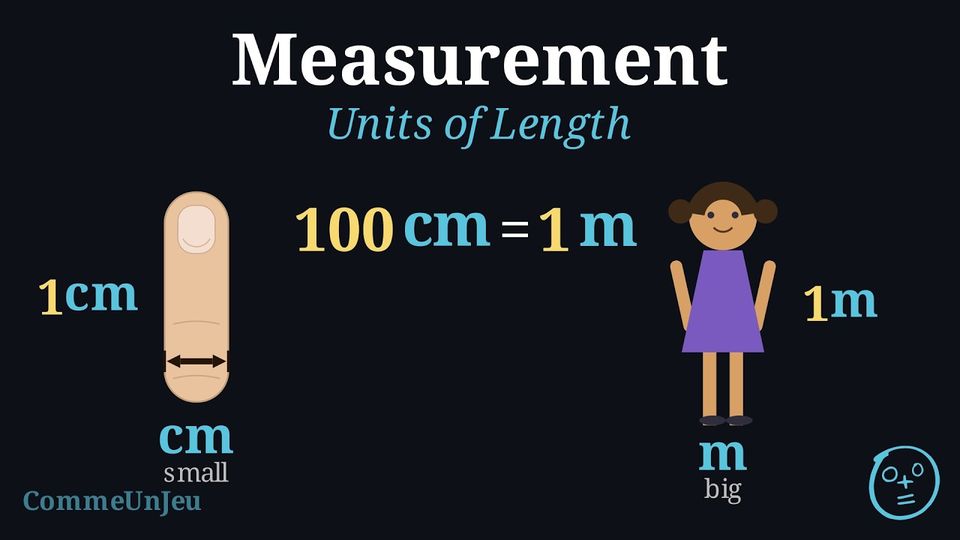
We can measure length in many ways, for example with our footsteps or with paper clips. But everyone's footsteps and paper clips are different sizes. How can we share our measurements if we all use different units?
To solve this, people all around the world agreed to use the same units. We call these standard units. One very common standard unit for length is the metre.
To solve this, people all around the world agreed to use the same units. We call these standard units. One very common standard unit for length is the metre.
Definition — Units of Length
- Centimetre \(\left(\mathrm{cm}\right)\): a small unit of length, about the width of your finger.

- Metre \(\left(\mathrm{m}\right)\): a longer unit of length, about the height of a door handle.

Proposition — Reference Lengths
To estimate a length is to say about how long it is without measuring, by comparing with lengths we know: - the width of a finger: about \(1\) cm;
- the length of a pencil: about \(20\) cm;
- the height of a door handle, or one big step: about \(1\) m;
- the height of a door: about \(2\) m.
Method — Estimating with a Reference
To estimate a length: - Choose the reference suited to the size of the object.
- Count how many times the reference fits.
- Give the estimate with a suitable unit.
Example
About \(2\) big steps fit along a dining table. Estimate its length.
One big step is about \(1\) m, and \(2\) big steps fit along the table: the table is about \(\textbf{2}\) m long.
Example — Metres and Centimetres Together
Léa measures her skipping rope with a one-metre ruler: one whole metre, then \(46\) cm more. How long is the rope in centimetres? And how long is a \(130\) cm ribbon in metres and centimetres?
\(1\) m \(= 100\) cm, so \(1\) m \(+ 46\) cm \(= 100 + 46 = 146\) cm. The other way: \(130 = 100 + 30\), so \(130\) cm \(= 1\) m \(30\) cm.
Skills to practice
- Choosing the Unit of Length
- Estimating a Length
- Combining Metres and Centimetres
II
Measuring and Drawing with a Ruler
Method — Reading the Ruler
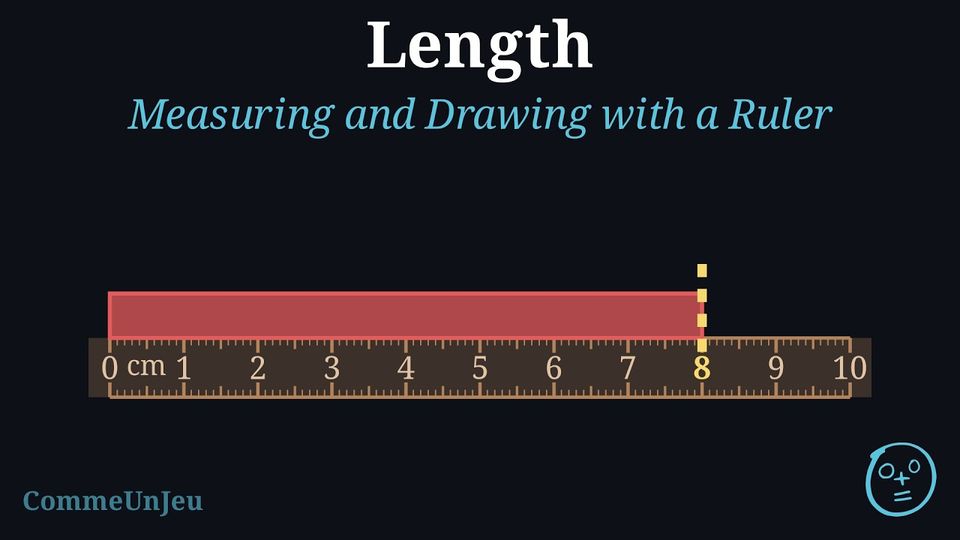
- Place the zero: Lay the object along the ruler. Put the \(0\) mark of the ruler exactly at one end of the object.
- Read the end: Look at the number of the ruler that lines up with the other end of the object.
- Write the measure: Write that number with its unit: this is the length.
Example
Read the length of the ribbon on the ruler. 
- The ribbon starts at the \(0\) mark of the ruler.
- It ends at the number \(8\).
- The ribbon is \(8\)~cm long: a length is a number and a unit.
Method — Finding the Two Whole Centimetres Around a Length
When the end of a segment falls between two marks of the ruler, its length is not a whole number of centimetres. We find the two whole centimetres around it: - Read the mark just before the end: \(8\).
- Read the mark just after the end: \(9\).
- Say the two numbers: “the segment is between \(8\) and \(9\) cm long”.
Example
Find the two whole centimetres around the length of the red segment. 
The end is after the mark \(8\) and before the mark \(9\): the segment is between \(8\) and \(9\) cm long.
Method — Drawing a Segment of a Given Length
- Mark the first end with a small cross, and put the \(0\) of the ruler on it.
- Find the number asked on the ruler (\(6\) for \(6\) cm) and mark the second end there.
- Join the two ends along the ruler, without moving it.
- Check by measuring the segment again: from \(0\) to \(6\).
Example
Draw a segment of \(4\) cm.
A cross, the \(0\) of the ruler on it, a second cross at the \(4\), then the line between them. Measured again, it goes from \(0\) to \(4\).
Skills to practice
- Finding the Two Whole Centimetres Around a Length
- Reading the Ruler
- Drawing Segments
III
Going further
Skills to practice
- Writing Lengths with the Ruler
- Quiz
Jump to section