International Baccalaureate · PYP 2
Numbers to 1000
I
Place Value
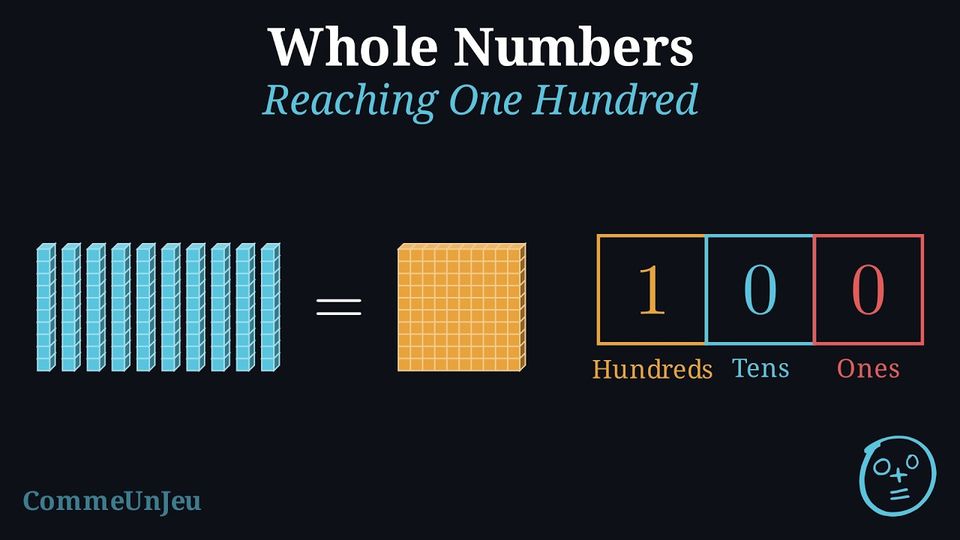
To build bigger numbers, we group smaller ones together.
This table shows we have 2 hundreds, 4 tens, and 3 ones. This makes the number 243.
- First, we group 10 ones to make 1 ten:
 = \(10\) ones = \(1\) ten =

- Next, we group 10 tens to make 1 hundred:
 = \(10\) tens = \(1\) hundred =

- A hundred is therefore also 100 ones: it holds \(10\) tens, and each ten holds \(10\) ones. = \(1\) hundred = \(10\) tens = \(100\) ones
| Hundreds | Tens | Ones |
| 2 | 4 | 3 |
 |  |  |
Definition — Base 10 system
In the base-10 system, the place of a digit tells us its value. We can show a number in many different ways: - With digits: $$243$$
- In expanded form: $$\begin{aligned}[t] 2\text{ hundreds }&+& 4\text{ tens }&+& 3\text{ ones }\\ 200 &+&40&+&3 \end{aligned}$$
- With words:
two hundred forty-three - In a place value table:
Hundreds Tens Ones 2 4 3 - With cubes:

Zero is a special digit. It acts as a placeholder to show that a place is empty. For example, in the number 20, the zero shows that no ones are left on their own: the ones place is empty.
Method — Regrouping Tens into Hundreds
The same number can be written in more than one way. When a place holds ten or more, we regroup: every \(10\) tens make \(1\) hundred. - One place overflows. \(14\) tens \(= 10\) tens \(+\ 4\) tens \(= 1\) hundred \(+\ 4\) tens.
- A place overflows next to another. \(2\) hundreds \(+\ 15\) tens: the \(15\) tens give \(1\) hundred and \(5\) tens, so \(2\) hundreds \(+\ 15\) tens \(= 3\) hundreds \(+\ 5\) tens.
- Check. Regrouping never changes the number, only the way it is written: \(14\) tens is \(140\), and \(1\) hundred \(+\ 4\) tens is \(140\) too.
Example — The Same Number, Other Units
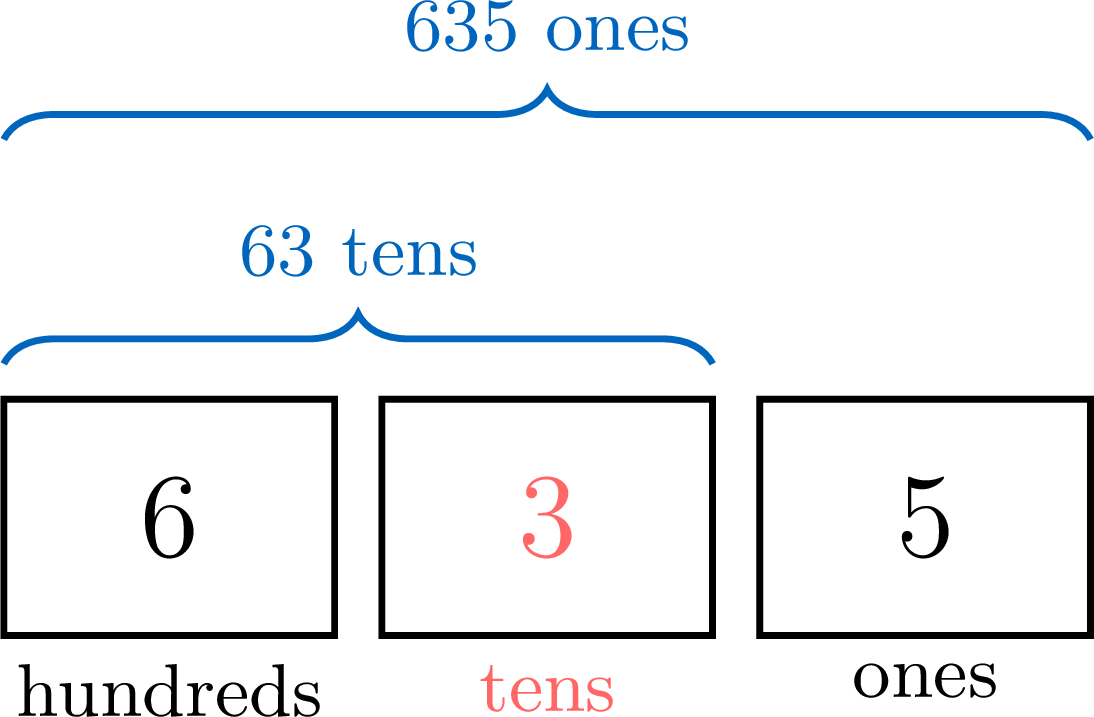
The number \(635\) is \(6\) hundreds, \(3\) tens and \(5\) ones. The same quantity can be counted with other units. - How many tens does \(635\) contain altogether? And how many ones altogether?
- Which number do \(5\) ones and \(5\) hundreds and \(13\) tens make?
- Each hundred holds \(10\) tens. Counting the tens of the \(6\) hundreds gives \(10\), \(20\), \(30\), \(40\), \(50\), \(60\): the \(6\) hundreds are \(60\) tens. $$\begin{aligned}[t] 635 &= 6\text{ hundreds} + 3\text{ tens} + 5\text{ ones}\\
&= 60\text{ tens} + 3\text{ tens} + 5\text{ ones} && \text{(each hundred is 10 tens)}\\
&= 63\text{ tens} + 5\text{ ones} \end{aligned}$$ In the same way, each hundred is \(100\) ones and each ten is \(10\) ones: \(600 + 30 + 5\), so \(635\) is also \(635\) ones.
- The order of the words does not change the number: each amount goes back to its own place. Then the \(13\) tens overflow: \(10\) of them make \(1\) hundred. $$\begin{aligned}[t] 5\text{ ones} + 5\text{ hundreds} + 13\text{ tens} &= 5\text{ hundreds} + 13\text{ tens} + 5\text{ ones}\\
&\qquad\text{(in order: hundreds, tens, ones)}\\
&= 5\text{ hundreds} + 1\text{ hundred} + 3\text{ tens} + 5\text{ ones} && \text{(10 tens = 1 hundred)}\\
&= 6\text{ hundreds} + 3\text{ tens} + 5\text{ ones}\\
&= 635 \end{aligned}$$

- \(6\) hundreds, \(3\) tens and \(5\) ones;
- \(63\) tens and \(5\) ones;
- \(635\) ones;
- \(5\) ones and \(5\) hundreds and \(13\) tens.
Definition — A Thousand
We already know how to group tens into hundreds. We group one step further: \(10\) hundreds make one thousand.  = \(10\) hundreds = \(1\) thousand =

| Thousands | Hundreds | Tens | Ones |
| 1 | 0 | 0 | 0 |
Careful — that does not mean one thousand holds no hundreds. It holds 10 of them, but they have all been grouped into \(1\) thousand, so none is left on its own. In the same way, one thousand holds \(100\) tens and \(1\,000\) ones: the same quantity, counted in different units.
Method — The Number Just After 999
In \(999\), every place is full: \(9\) hundreds, \(9\) tens and \(9\) ones. Nothing can be added to a place without making it overflow. So we count one step forward and regroup each time a place reaches ten. - The ones overflow. \(9\) ones and \(1\) more make \(10\) ones, that is \(1\) ten and \(0\) ones.
- The tens overflow in turn. That new ten joins the \(9\) tens: \(10\) tens, that is \(1\) hundred and \(0\) tens.
- The hundreds overflow in turn. That new hundred joins the \(9\) hundreds: \(10\) hundreds, that is \(1\) thousand and \(0\) hundreds.
| Thousands | Hundreds | Tens | Ones | |
| \(999\) | 9 | 9 | 9 | |
| \(1\,000\) | 1 | 0 | 0 | 0 |
Skills to practice
- Counting Cubes in a Table
- Writing Numbers From a Place Value Table
- Finding the Digit
- Counting Cubes
- Writing Numbers From Hundreds, Tens and Ones
- Writing Numbers From Expanded Form
- Grouping and Regrouping
- Breaking Down into Hundreds and Tens
- Regrouping Tens into Hundreds
- Writing a Number with Other Units
- Reaching a Thousand
- Buying Stamps
II
Estimating a Quantity
Definition — Estimate
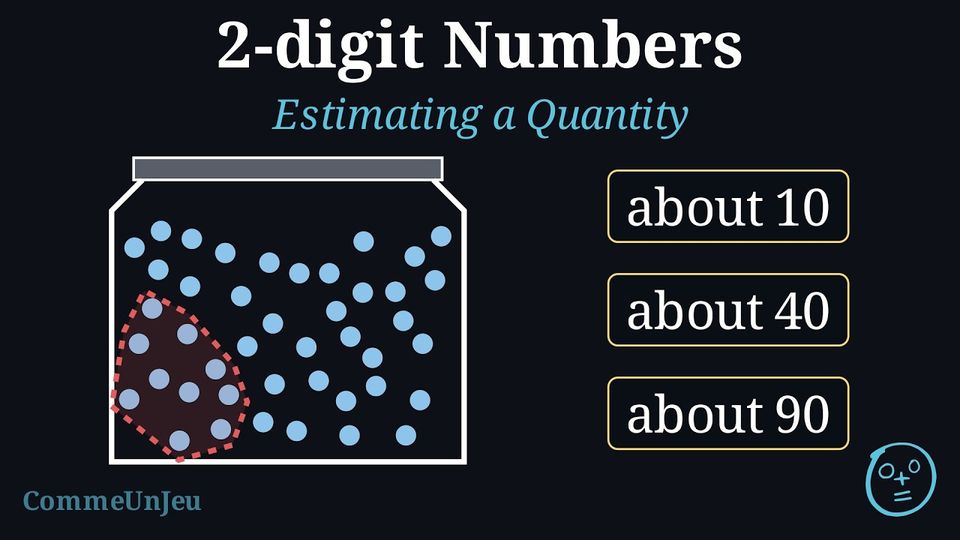
To estimate a quantity is to give quickly a number close to the real number, without counting the objects one by one. We say about: “about \(40\) marbles”.Counting gives the exact number: \(43\). Estimating gives a close number: about \(40\).
Method — Estimating with a Group of Ten
- Circle a group of ten objects: it shows how much room ten objects take.
- See how many groups like it would cover the whole collection, and count them by tens: about \(3\) groups make about \(30\).
- Check by counting in tens: put the objects in groups of ten, count the tens, then the ones left over.
A good estimate is often the ten closest to the count. For \(48\) objects: \(48\) is \(2\) steps from \(50\) and \(8\) steps from \(40\), so the ten closest to \(48\) is \(50\), and a good estimate is about \(50\).

Example — Estimating with a Square of 100
Tom's card is covered with dots. The dashed square holds \(100\) dots. 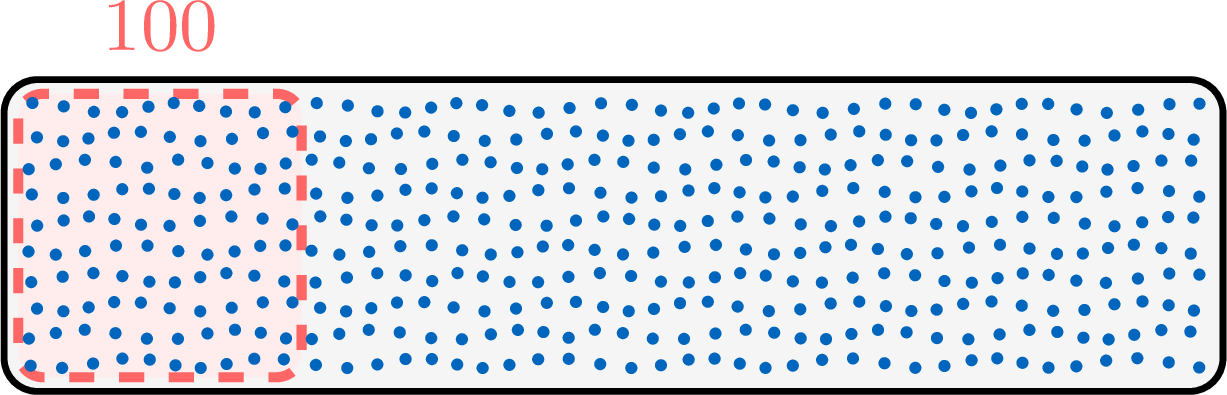
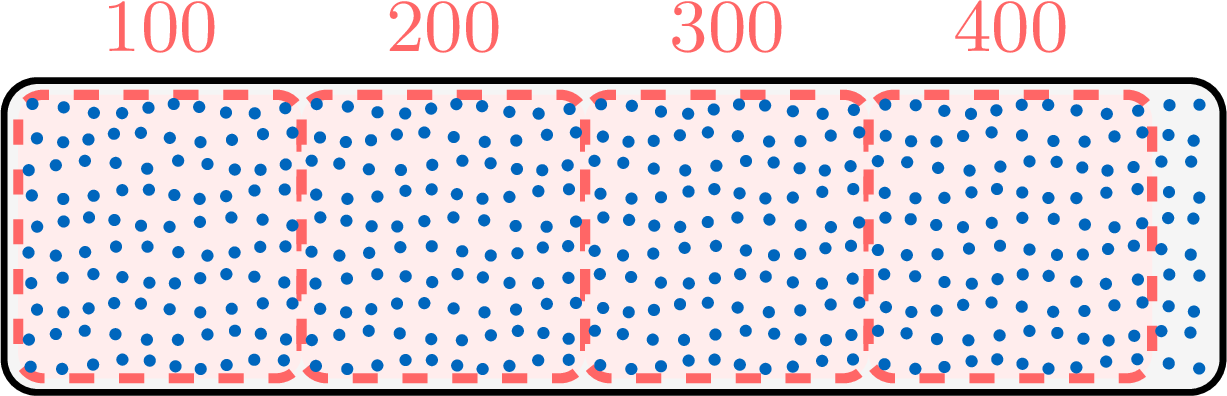
To check, look at what is left. Each square holds \(10\) columns of \(10\) dots, so the \(4\) squares cover \(40\) columns, and \(2\) columns of \(10\) dots remain: \(2\) tens. The card holds \(400 + 20 = 420\) dots, and \(420\) is close to \(400\).
Skills to practice
- Estimating with a Square of 100
III
Number Names
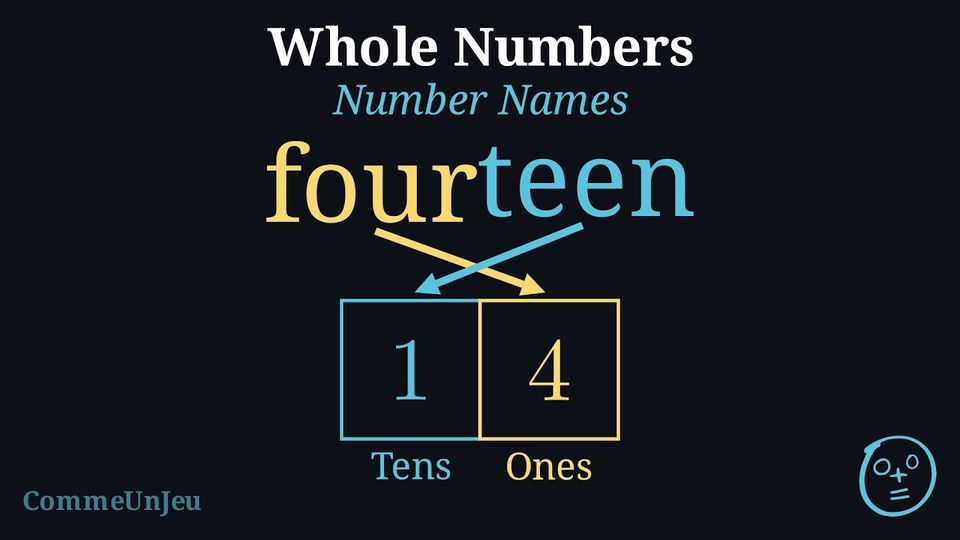
Definition — The Names of the Hundreds
Each whole hundred has its own name: we say how many hundreds, then the word hundred. Ten hundreds make one thousand. | Digits | Name | Hundreds |
| \(100\) | one hundred | \(1\) hundred |
| \(200\) | two hundred | \(2\) hundreds |
| \(300\) | three hundred | \(3\) hundreds |
| \(400\) | four hundred | \(4\) hundreds |
| \(500\) | five hundred | \(5\) hundreds |
| \(600\) | six hundred | \(6\) hundreds |
| \(700\) | seven hundred | \(7\) hundreds |
| \(800\) | eight hundred | \(8\) hundreds |
| \(900\) | nine hundred | \(9\) hundreds |
| \(1\,000\) | one thousand | \(10\) hundreds |
The name of a number is read in pieces. In English, a hyphen only joins the tens and the ones (thirty-five): it is the word hundred that shows where to cut.
- The word hundred cuts the name in two: what comes before it counts the hundreds, what comes after it gives the end of the number. Six hundred thirty-five \(\rightarrow\) six hundred \(\mid\) thirty-five \(\rightarrow\) \(6\) hundreds, then thirty-five, that is \(3\) tens and \(5\) ones: \(635\). If a single word from one to nine follows — seven hundred nine — it gives the ones, and the tens place stays empty: \(709\); if that word is ten, twenty, thirty… — seven hundred ten — it gives the tens: \(710\); if it is a word from eleven to nineteen — seven hundred twelve — it gives \(1\) ten and the ones at once: \(712\).
- The word hundred stays singular, however many there are: five hundred sixty-two, never five hundreds. So it is the word in front that counts the hundreds — five hundred sixty-two is \(562\).
Saying “and”
Many English speakers, in Britain and in Australia for example, say and after the word hundred: \(635\) is six hundred and thirty-five, \(208\) is two hundred and eight. Both ways of saying it are correct, and they name the same number: the word and adds nothing to the value. A whole hundred has nothing after it, so no and: \(700\) is seven hundred.
Skills to practice
- Writing Numbers from Their Names
- Writing Numbers in Words
IV
On the Number Line
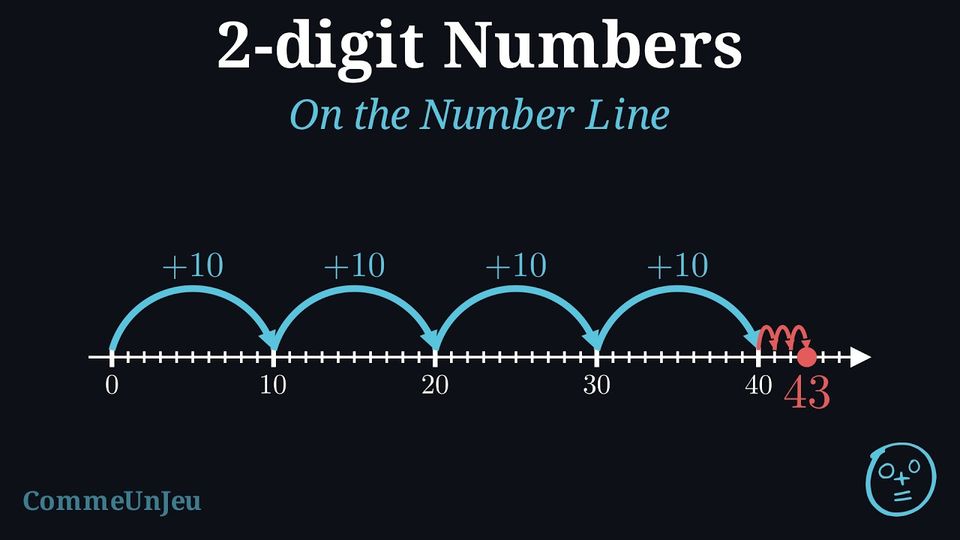
Definition — Number Line
A number line starts at an origin, marked \(0\), and shows the numbers in order, from smallest to largest; from one mark to the next, we always move on by the same step. 
Method — Counting in Steps
On the number line, we can jump with equal steps. - By twos: \(2\), \(4\), \(6\), \(8\), \(10\), \(\dots\)

- By tens: \(10\), \(20\), \(30\), \(\dots\), \(90\). We can start from any number: from \(24\), we get \(24\), \(34\), \(44\), \(\dots\)

Example — Counting in Hundreds
A number line does not have to count in ones. On this one, each mark is one hundred further than the one before. 
A number that is not a whole hundred has no mark of its own: it goes between two marks. \(350\) has \(3\) hundreds and \(5\) tens, so it stands between \(300\) and \(400\), halfway.
Example — A Number is a Distance from Zero
On a number line counting in ones, a point is marked. Starting from \(0\), we need \(7\) steps of one to reach it. Which number is written under it? And for a point \(235\) steps away from \(0\)? 
The number under a point is its distance from \(0\) counted in steps of one: \(7\) steps, the number \(7\). For \(235\) steps, the number is \(235\): we can go there with \(2\) steps of \(100\), \(3\) steps of \(10\), then \(5\) more — the same distance, counted faster. 
 {\small Not to scale: the jumps of \(100\), of \(10\) and of \(5\) are drawn the same length.}
 Method — Placing a Number on the Number Line
Often only a part of a number line is drawn, which does not start at \(0\). To place a number on it: - Read the step: the number added from one mark to the next.
- Find the written numbers nearest to the number, before it or after it.
- Count the steps from the nearest one, forward or back.
- Mark the point on the line.
- The step is given: \(10\). When it is not given, it is found on the line: from the written \(300\) to the written \(350\) there are \(5\) steps, and counting in tens — \(310\), \(320\), \(330\), \(340\), \(350\) — five steps land exactly on \(350\).
- The written numbers nearest to \(370\) are \(350\), before it, and \(400\), after it.
- \(370\) is nearer to \(350\): \(2\) steps of \(10\) from \(350\), that is \(360\), then \(370\). From \(400\), it would take \(3\) steps back.
- The point goes on the second mark after \(350\).
 {\small In green: \(370\), two marks after \(350\).}
Skills to practice
- Counting in Steps of 2, 3 and 4
- Counting by Fives, Tens and Hundreds
- Placing and Reading Numbers on the Number Line
- Placing a Number on the Number Line
V
Positions up to the Hundredth
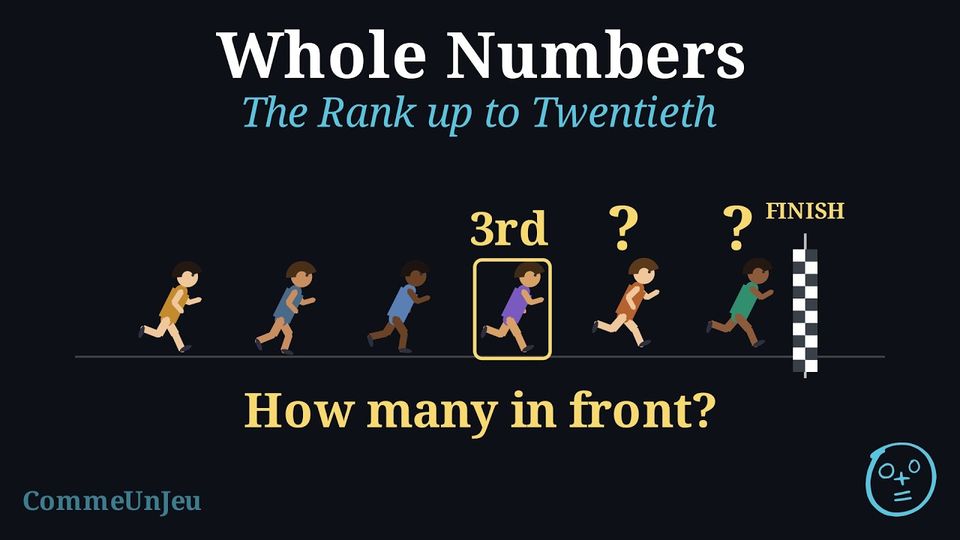
In the school race, \(100\) children cross the finish line one after the other. Léa is the thirty-second. How many children finished before her? And how many after her?
Léa is in position \(32\): all the positions from \(1\) to \(31\) are before her: \(31\) children. After her come the positions \(33\) to \(100\): \(100 - 32 = 68\) children. Check: \(31 + 1 + 68 = 100\).
Definition — Ordinal Numbers up to Hundredth
The ordinal numbers say a position. Beyond twentieth, only the last word of the name changes: it becomes the ordinal already known up to twentieth (one \(\rightarrow\) first, two \(\rightarrow\) second, three \(\rightarrow\) third, five \(\rightarrow\) fifth …); a whole ten changes -ty into -tieth (forty \(\rightarrow\) fortieth), and hundred becomes hundredth: | \(21\) twenty-first | \(40\) fortieth | \(71\) seventy-first |
| \(22\) twenty-second | \(50\) fiftieth | \(80\) eightieth |
| \(23\) twenty-third | \(60\) sixtieth | \(81\) eighty-first |
| \(30\) thirtieth | \(70\) seventieth | \(100\) hundredth |
| \(31\) thirty-first | \(90\) ninetieth | \(91\) ninety-first |
Method — Two-Digit Positions and Those Before
- From the position to those before: those before are one less than the position. The sixty-fourth has \(63\) before it.
- From those before to the position: if \(47\) people are in front of me, I am the forty-eighth (\(47 + 1\)).
- Those after: the total minus the position. The sixty-fourth of \(100\) has \(100 - 64 = 36\) behind.
Skills to practice
- Naming the Position
- Counting Those Before and After
VI
Going further
Skills to practice
- Completing Equalities with Pictures
- Drawing Numbers
- Problems
- Quiz
Jump to section