International Baccalaureate · PYP 2
Patterns and Sequences
I
Periodic Sequence
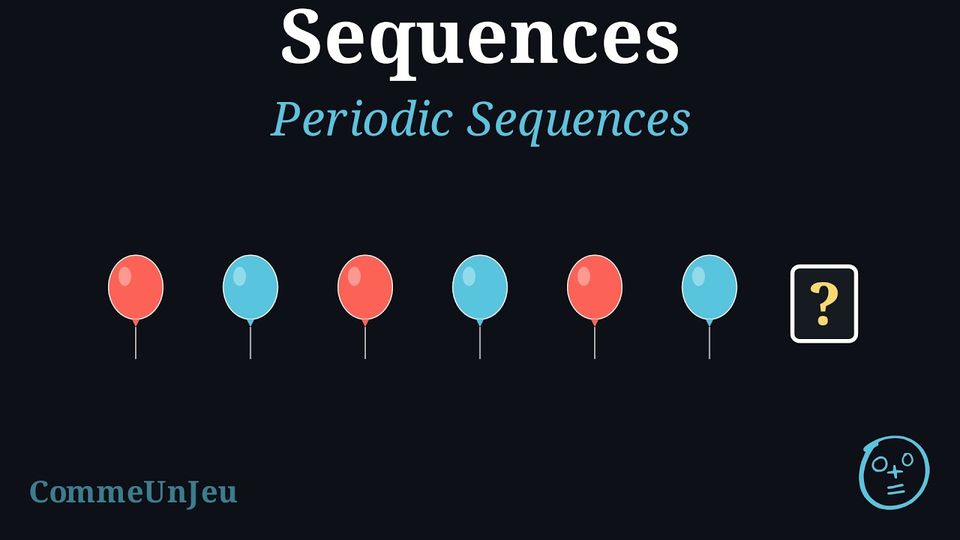
Method — Finding the Shape at a Given Position
In a repeating pattern, we do not need to draw everything up to the position asked. - Find the period: the group that repeats, and count its shapes. In A B A B A B…, the group is “A B”, it has \(2\) shapes.
- Count by whole groups up to the position asked, then count what is left. For the nineteenth letter: \(9\) groups of \(2\) make \(18\) letters, and \(1\) is left.
- Read the leftover in the group: \(1\) left means the first letter of the group: the nineteenth letter is A. If nothing is left, it is the last shape of the group.
Example — A Letter Far Along the Pattern
In the pattern A B A B A B …, what is the eighty-ninth letter?
The group “A B” has \(2\) letters. We count by whole groups: \(44\) groups make \(88\) letters, and \(1\) is left. The eighty-ninth letter is the first of the group: A. Without the groups we would have to write \(89\) letters. Another way: in A B A B …, A is at every odd position (\(1\), \(3\), \(5\), …); \(89\) is odd, so the letter is A.
Skills to practice
- Finding a Shape Far Along a Pattern
II
Numerical Sequence
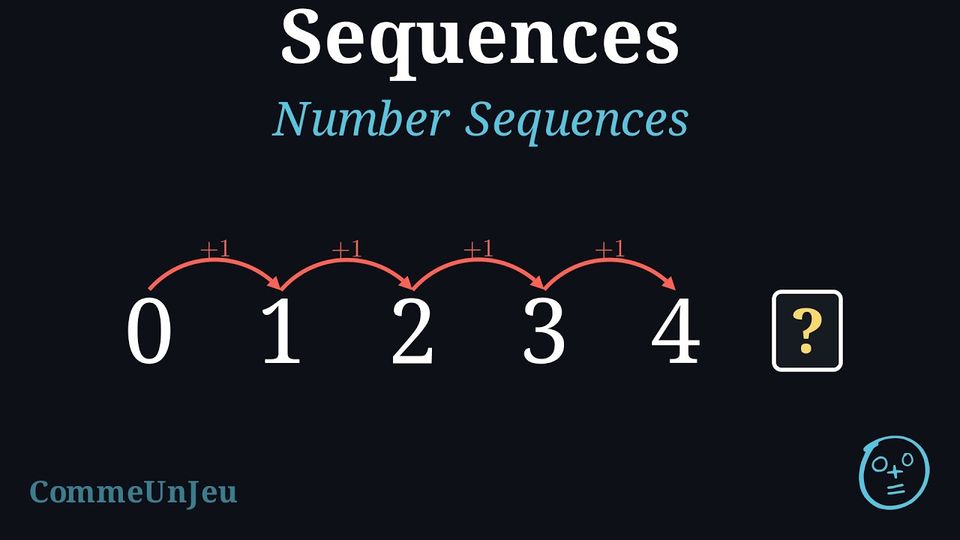
Method — Finding the Number at a Given Position
In a number sequence that moves by equal steps, we find the step (the jump from one number to the next), then we move step by step from the first number, counting the positions as we go: for \(1\), \(3\), \(5\), \(7\), \(9\)…, the step is \(+2\); first \(1\), second \(3\), third \(5\), fourth \(7\), fifth \(9\), sixth \(11\), seventh \(13\). A position counts the numbers, it is not one of them. Example
In the sequence \(5\), \(10\), \(15\), \(20\)…, what is the eighth number?
The step is \(+5\). First \(5\), second \(10\), third \(15\), fourth \(20\), fifth \(25\), sixth \(30\), seventh \(35\), eighth \(40\).
Example — Finding the Position in a Long List
(a) In the list \(10\), \(20\), \(30\), \(40\)… (starting at \(10\), going up by \(10\)), what is the fortieth number? (b) In the list \(5\), \(10\), \(15\), \(20\)…, in which position is \(40\)?
(a) First \(10\), second \(20\), third \(30\): the position tells how many tens. The fortieth number is \(40\) tens, that is \(400\). (b) Counting in fives up to \(40\): \(5\), \(10\), \(15\), \(20\), \(25\), \(30\), \(35\), \(40\): eight numbers, so \(40\) is in eighth position. The first number and the direction matter: if the list started at \(0\), the fortieth would be \(390\).
Skills to practice
- Counting On by 10
- Counting On by 5
- Counting On by 100
- Finding the Position in a Long List
III
Growing Sequences
Léa writes \(1\), \(2\), \(4\), \(7\), \(11\), \(16\)… and says: “I add \(1\), then \(2\), then \(3\), then \(4\)… each time one more.” What is the eleventh number? 
The steps are not equal: they grow by \(1\). We continue step by step, counting the positions: sixth \(16\), \(+6\) \(\to\) seventh \(22\), \(+7\) \(\to\) eighth \(29\), \(+8\) \(\to\) ninth \(37\), \(+9\) \(\to\) tenth \(46\), \(+10\) \(\to\) eleventh \(56\).
Definition — Growing Sequence
A growing sequence is a sequence of numbers whose step changes following a rule. Three usual rules: - the step grows by 1: \(1\), \(2\), \(4\), \(7\), \(11\)… (\(+1\), \(+2\), \(+3\), \(+4\));
- the step doubles: \(1\), \(3\), \(7\), \(15\)… (\(+2\), \(+4\), \(+8\));
- each number doubles: \(3\), \(6\), \(12\), \(24\)… (\(3 + 3 = 6\), then \(6 + 6 = 12\), then \(12 + 12 = 24\)).
Method — Writing the Steps
- Write the steps between the numbers given: \(1 \to 3\) is \(+2\), \(3 \to 7\) is \(+4\), \(7 \to 15\) is \(+8\).
- Find the rule of the steps: here each step is double the one before.
- Continue step by step, counting the positions, up to the position asked: fifth \(15 + 16 = 31\), sixth \(31 + 32 = 63\).
Example
(a) \(2\), \(3\), \(5\), \(8\), \(12\)… the step grows by \(1\): find the ninth number. (b) \(1\), \(3\), \(7\), \(15\)… the step doubles: find the sixth number. (c) \(3\), \(6\), \(12\), \(24\)… each number doubles: find the seventh number.
(a) Steps \(+1\), \(+2\), \(+3\), \(+4\), then \(+5\), \(+6\), \(+7\), \(+8\): fifth \(12\), sixth \(17\), seventh \(23\), eighth \(30\), ninth \(38\). (b) Steps \(+2\), \(+4\), \(+8\), then \(+16\), \(+32\): fifth \(31\), sixth \(63\). (c) Fifth \(48\), sixth \(96\), seventh \(192\).
Skills to practice
- Finding the Rule
- Continuing the Sequence
- Finding the Number at a Given Position
IV
Going further
Skills to practice
- Completing Sequences and Jumps
- Problems
- Quiz
Jump to section