International Baccalaureate · PYP 1
Adding and Subtracting to 100
I
Adding and Subtracting 10 or Whole Tens
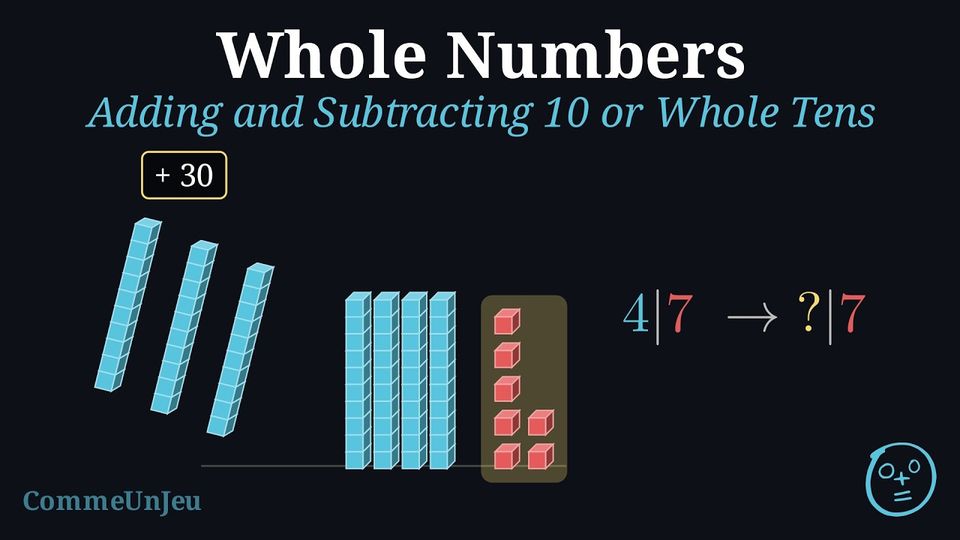
Léa has \(47\) stickers. She wins \(10\) more, then \(30\) more. How many does she have? Tom says: “No need to count one by one: only the tens change.”
\(47\) is \(4\) tens and \(7\) ones. Adding \(10\) adds one ten: \(5\) tens and \(7\) ones, \(57\). Adding \(30\) adds three tens: \(8\) tens and \(7\) ones, \(87\). The ones never moved.
Method — Adding or Subtracting Whole Tens
- \(+ 10\) or \(- 10\): one ten more or one ten less; the ones digit does not change. \(37 - 10\): one ten taken from the three tens, \(27\).
- \(+ 20\), \(30\), … \(90\) or \(- 20\), … \(90\): count in tens. \(76 - 30\): \(7\) tens minus \(3\) tens make \(4\) tens, so \(46\). \(25 + 60\): \(2\) tens plus \(6\) tens make \(8\) tens, so \(85\).
Example
Compute: (a) \(63 + 10\), (b) \(91 - 10\), (c) \(34 + 50\), (d) \(98 - 70\).
(a) One ten more: \(73\). (b) One ten less: \(81\). (c) \(3\) tens \(+ 5\) tens \(= 8\) tens: \(84\). (d) \(9\) tens \(- 7\) tens \(= 2\) tens: \(28\).
About How Much Is a Sum?
Before computing a sum, we can say about how much it is: each number is replaced by a whole ten close to it, and the tens are added. 
- \(\textcolor{colordef}{28}\) is close to \(30\) and \(\textcolor{colorprop}{31}\) is close to \(30\). So \(\textcolor{colordef}{28}+\textcolor{colorprop}{31}\) is about \(30 + 30 = 60\). The exact sum, \(59\), is close to \(60\).
- Is \(38 + 21\) more or less than \(50\)? The tens alone already make \(30 + 20 = 50\), and the ones \(8\) and \(1\) add more. So \(38 + 21\) is more than \(50\): it is about \(40 + 20 = 60\) (the exact sum is \(59\)).
Skills to practice
- Adding or Subtracting 10
- Adding or Subtracting Whole Tens
- Estimating a Sum
II
The Complement to the Next Ten
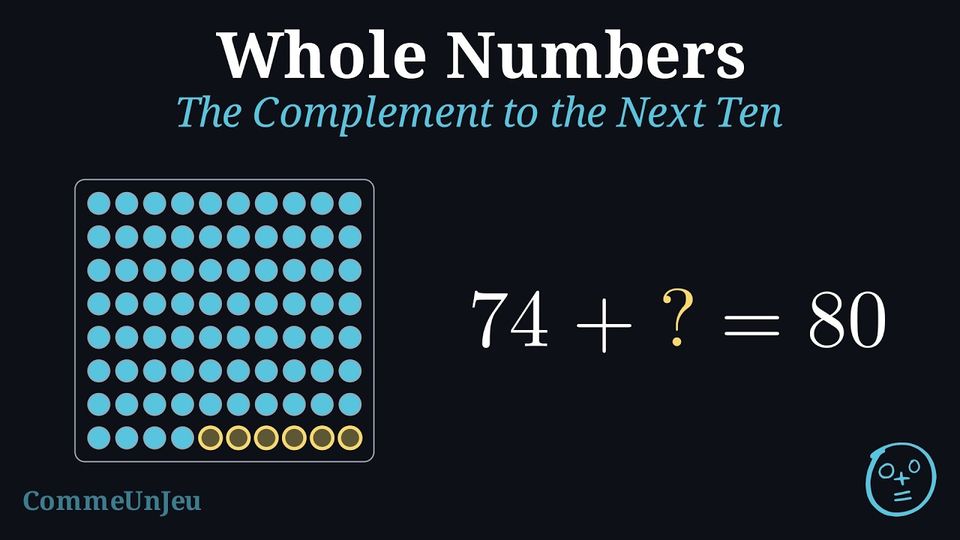
Nour has \(74\) marbles. The box can hold \(80\). How many marbles are missing to fill it? Nour says: “I know that \(4 + 6 = 10\).”
\(74\) is \(7\) tens and \(4\) ones. To reach the next ten, \(80\), we need to complete the \(4\) ones into a full ten: the complement of \(4\) to \(10\) is \(6\). So \(6\) marbles are missing: \(74 + 6 = 80\).
Method — The Complement to the Next Ten
To find what is missing from a number to the next ten: - Look at the ones digit: in \(74\), it is \(4\).
- Take its complement to 10, which we know by heart: \(4 + 6 = 10\).
- That complement is the answer: \(74 + 6 = 80\).
Example
How much to reach the next ten? (a) from \(58\), (b) from \(21\), (c) from \(95\).
(a) The ones digit is \(8\), \(8 + 2 = 10\): it takes \(2\), \(58 + 2 = 60\). (b) \(1 + 9 = 10\): it takes \(9\), \(21 + 9 = 30\). (c) \(5 + 5 = 10\): it takes \(5\), \(95 + 5 = 100\).
Skills to practice
- Reaching the Next Ten
III
Adding a Small Number Through the Ten
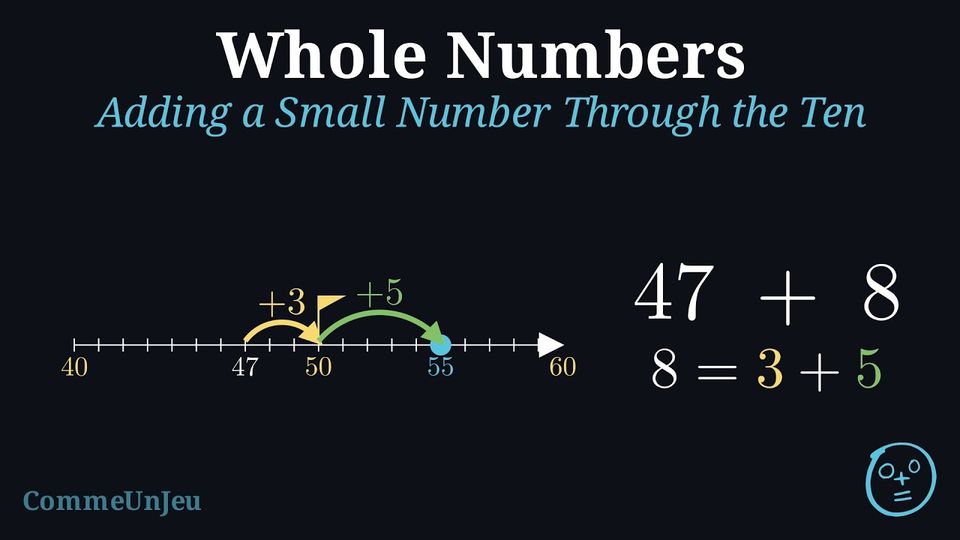
Tom has \(47\) marbles and wins \(8\). He says: “\(47\) and \(8\)… I go to \(50\) first.” Why \(50\)?
\(50\) is the next ten after \(47\). It takes \(3\) to get there (\(7 + 3 = 10\)). Tom splits the \(8\) into \(3 + 5\): \(47 + 3 = 50\), then \(50 + 5 = 55\). Going through the ten is the same trick as going through \(10\) with small numbers (\(7 + 8 = 7 + 3 + 5\)), now on bigger numbers. 
Method — Adding a Number Smaller than 10
- Without crossing a ten: when the ones do not go past \(9\), only the ones digit changes. \(32 + 4 = 36\), because \(2 + 4 = 6\).
- Crossing a ten: when the ones would go past \(9\), go through the next ten: first the complement to the ten, then what is left. \(47 + 8\): \(3\) to reach \(50\), then \(5\) more: \(55\).
Example
Compute: (a) \(63 + 5\), (b) \(63 + 9\), (c) \(86 + 7\).
(a) \(3 + 5 = 8\), no ten crossed: \(68\). (b) \(3 + 9\) goes past \(10\): \(63 + 7 = 70\), then \(+ 2\): \(72\). (c) \(86 + 4 = 90\), then \(+ 3\): \(93\).
Skills to practice
- Adding Without Crossing a Ten
- Adding by Crossing a Ten
IV
Taking a Small Number from a Whole Ten
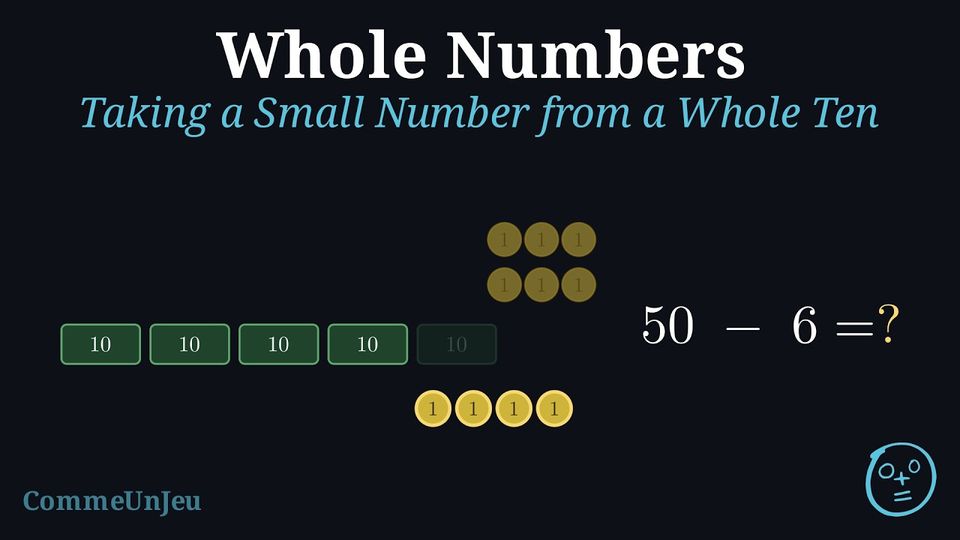
Léa has \(\dollar 50\) in five \(\dollar 10\) bills. She spends \(\dollar 6\). How much is left? She says: “I break one bill.”
She keeps four bills (\(\dollar 40\)) and breaks the fifth into ten \(\dollar 1\) coins. She pays \(6\) coins: \(10 - 6 = 4\) coins are left. In all, \(\dollar 40\) and \(\dollar 4\) make \(\dollar 44\). So \(50 - 6 = 44\).
Method — Subtracting from a Whole Ten
To take a number from \(1\) to \(9\) away from a whole ten (\(30\), \(50\), \(80\)…): - Break one ten into ten ones: \(50 = 40 + 10\).
- Take away from the ten: \(10 - 6 = 4\) — the remainder is the complement of \(6\) to \(10\).
- Put back the other tens: \(40 + 4 = 44\).
Example
Compute: (a) \(70 - 2\), (b) \(40 - 7\), (c) \(100 - 5\).
(a) \(10 - 2 = 8\), then \(60 + 8 = 68\). (b) \(10 - 7 = 3\), then \(30 + 3 = 33\). (c) \(10 - 5 = 5\), then \(90 + 5 = 95\).
Skills to practice
- Subtracting Without Crossing a Ten
- Breaking a Ten
V
Two-Step Problems
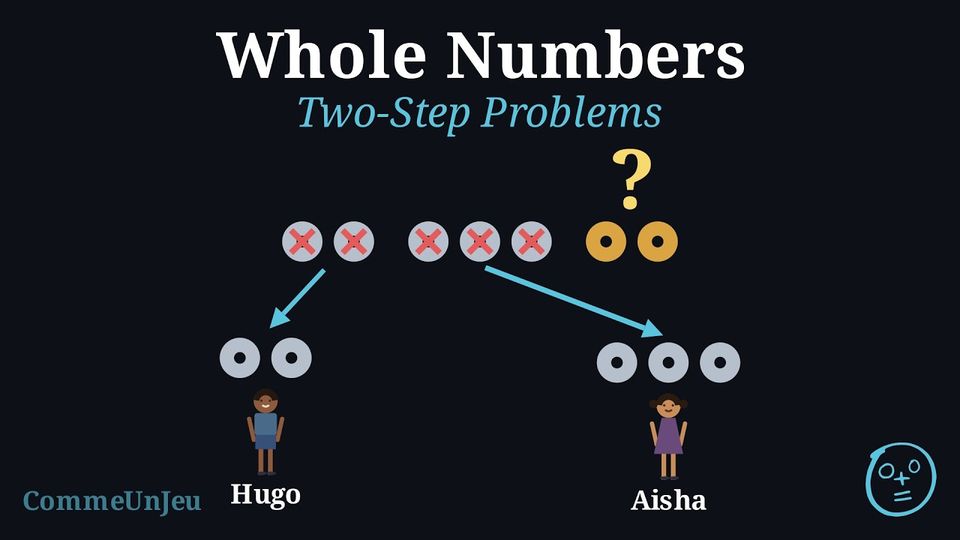
Method — Solving a Problem in Two Steps
Some problems cannot be solved with one calculation: the question hides another number that you must find first. - Find the hidden number: Read the story and find the number the question needs but does not give. Calculate it first.
- Answer the question: Use the hidden number in a second calculation to answer the question.
- Check: Make sure the answer makes sense in the story.
Example
Emma makes a necklace with 8 red beads and 7 blue beads. Then Hugo gives her 10 golden beads for her bead box. How many beads does Emma have in all? - Step 1 — the hidden number: The question needs the number of beads on the necklace. We know its two parts (8 and 7): we add.
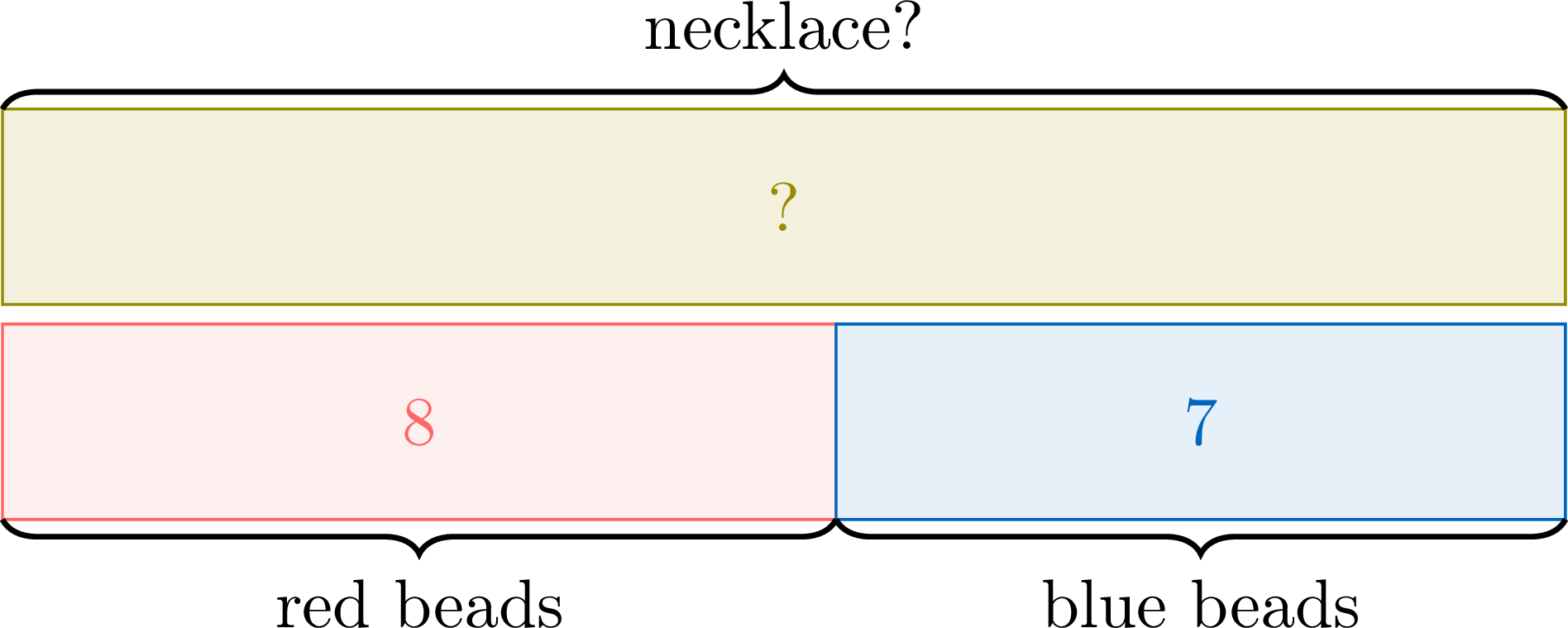
- Step 2 — the answer: Now we know the two parts (15 and 10): we add again.
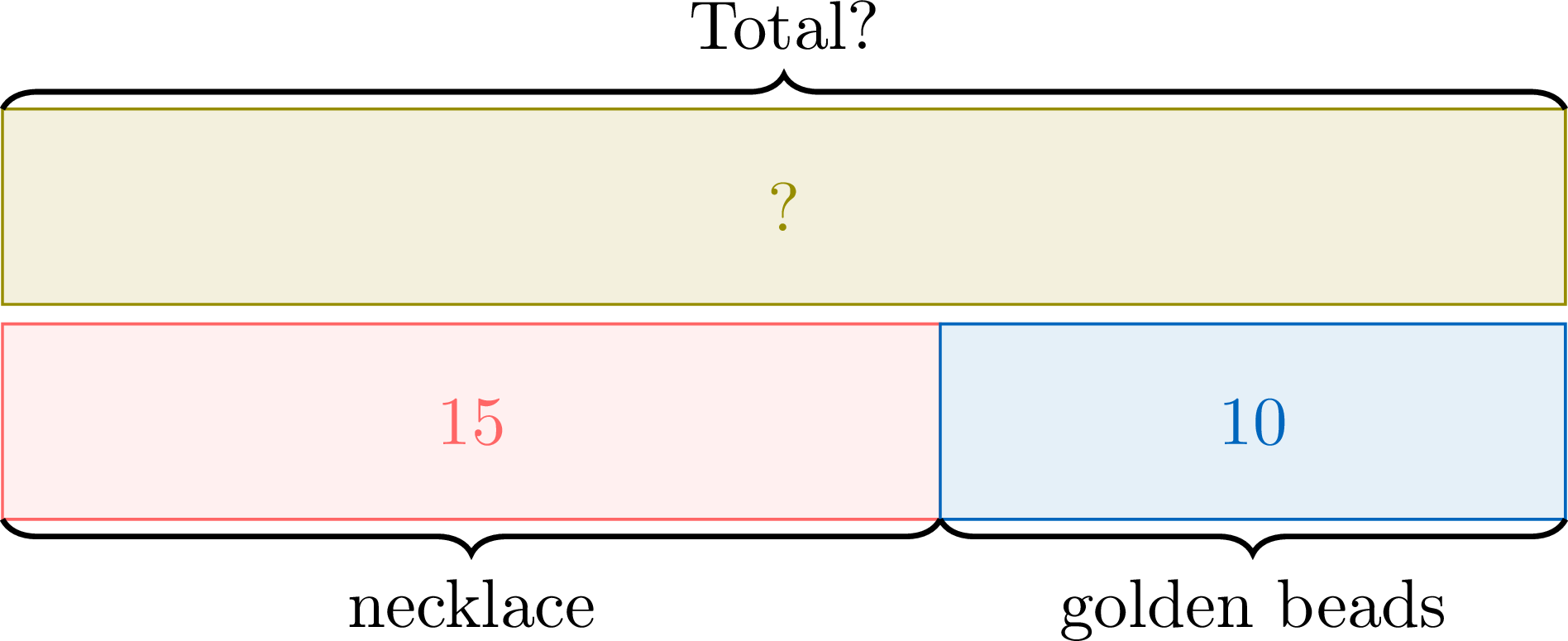
- Check: We recompose: \(15+10=25\). And \(25\) is more than \(15\): it makes sense because she received more beads.
Example
Louis has 24 marbles. He gives 9 marbles to Hugo and 6 marbles to Emma. How many marbles does Louis have left? - Step 1 — the hidden number: The question needs the number of marbles given away. We know its two parts (9 and 6): we add.
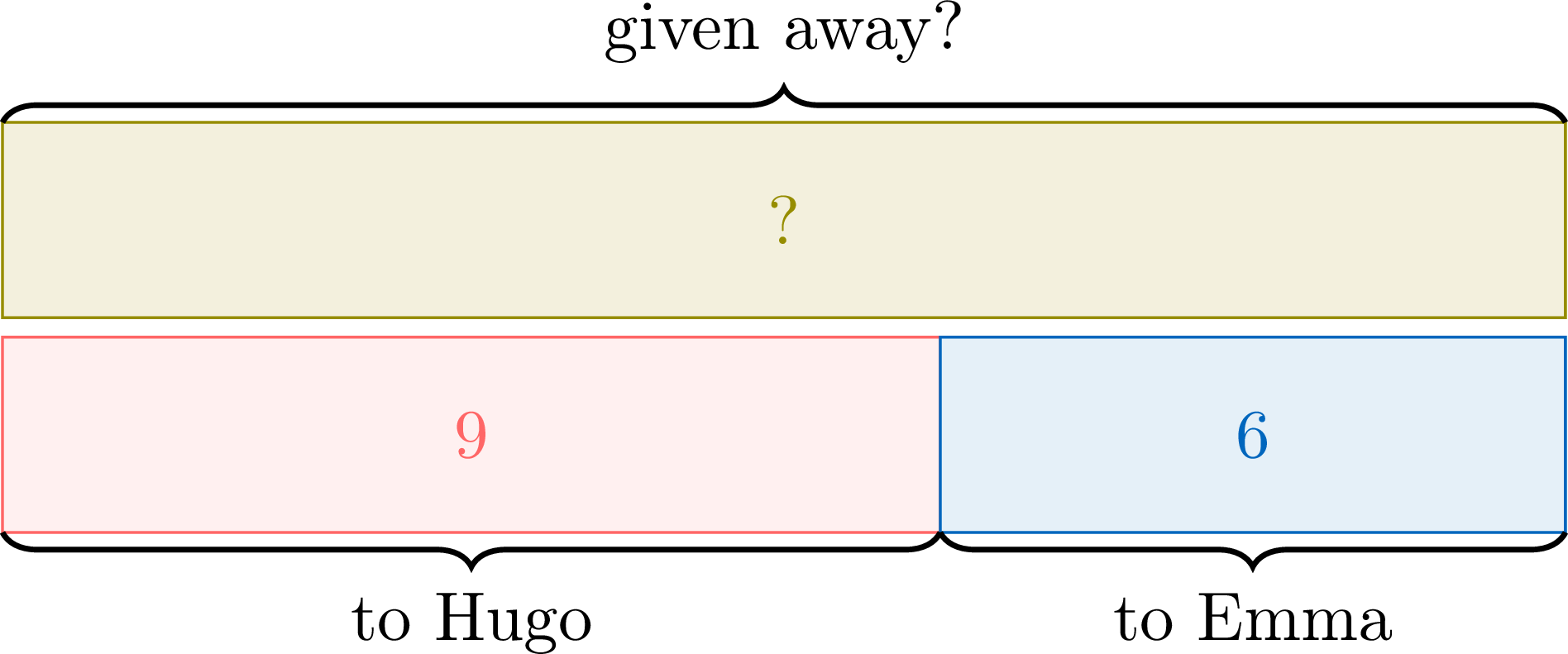
- Step 2 — the answer: We know the whole (24) and one part (15): we subtract to find the other part.
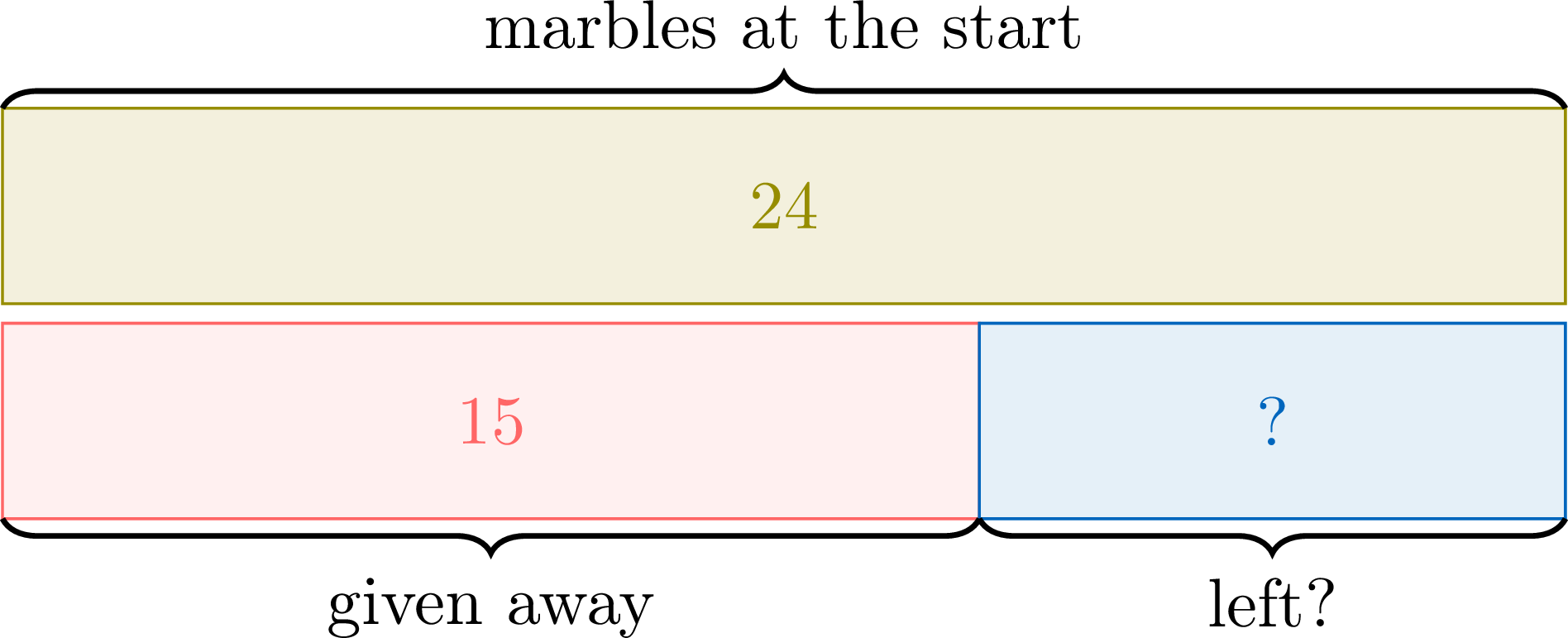
- Check: We recompose: \(15+9=24\), the marbles at the start. And \(9\) is less than \(24\): it makes sense because he gave marbles away.
Skills to practice
- Adding Twice
- Adding Then Subtracting
VI
Review & Quizz
Skills to practice
- Quiz
Jump to section