International Baccalaureate · PYP 2
Money
I
Cents
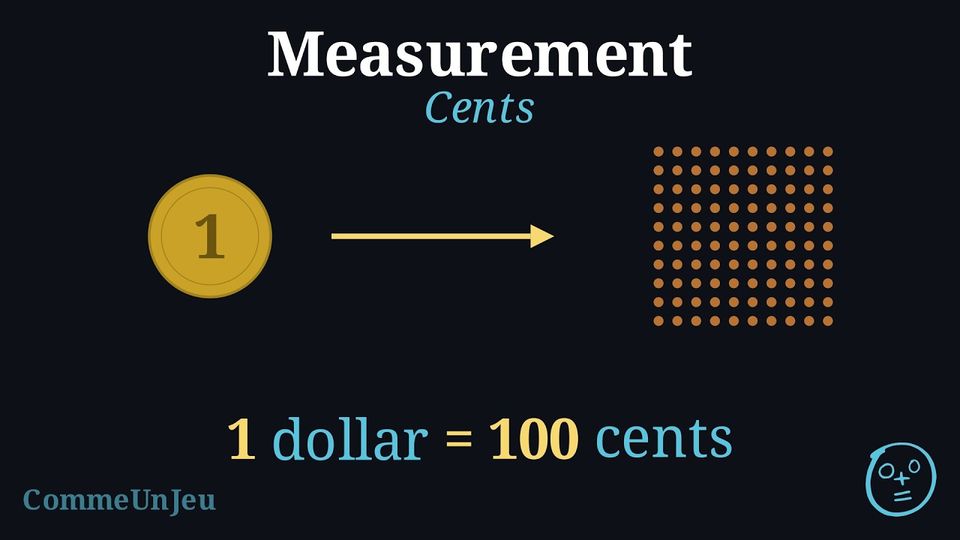
Definition — Cent
Dollars can be broken into smaller parts called cents. Cents are used to pay for things that cost less than one dollar, or for what is left over after the dollars in a price. Definition — Cents
Here are the most common US coins: | Name | Value | Coin |
| Half dollar | 50 cents |  |
| Quarter | 25 cents |  |
| Dime | 10 cents |  |
| Nickel | 5 cents |  |
| Penny | 1 cent |  |
Example
How much money is there? 
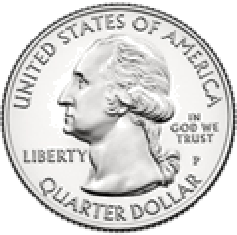

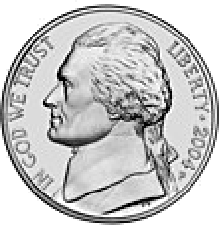
- We sort from the biggest coin to the smallest, then count on: \(50\), then \(50+25=75\), then \(75+10=85\), then \(85+5=90\).
- \(50~\text{c} + 25~\text{c} + 10~\text{c} + 5~\text{c} = 90~\text{c}\). There are \(90\) cents.
Example
How much money is there? Give the answer in dollars and cents. - Count on: \(50\), then \(100\), then \(110\). There are \(110\) cents.
- \(100\) cents make \(1\) dollar, so \(110~\text{c} = 100~\text{c} + 10~\text{c}\): there is \(\dollar 1\) and \(10\) cents.
Skills to practice
- Making an Amount with Dollars and Cents
- Counting Coins to Make Amounts
- Adding Coins to Find Total Amounts
II
Paying with Cents: Enough and Change
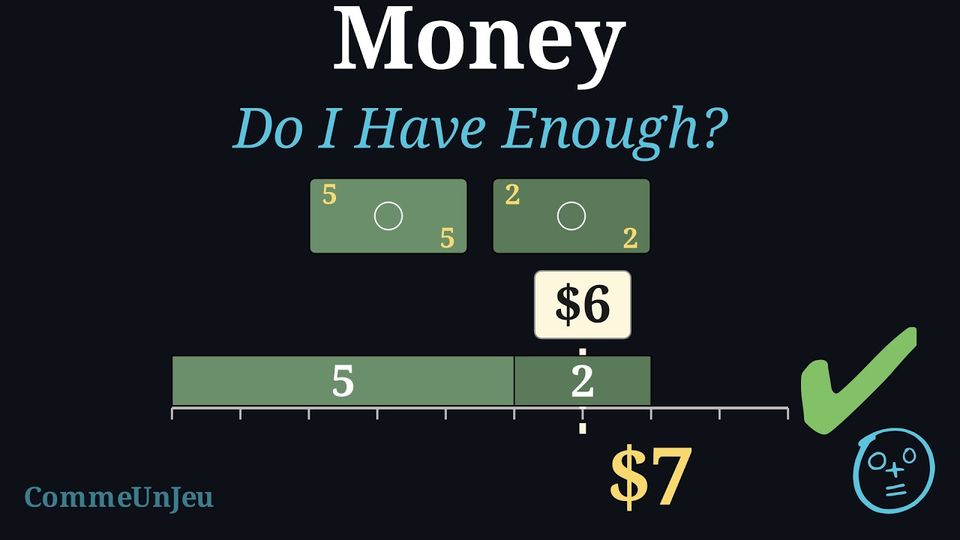
Method — Do I Have Enough?
- Count your money: Find the total you have.
- Look at the price: Find how much the item costs.
- Compare: If your money is the same as the price or more, you can buy it. If it is less, you cannot.
Example
Su has these coins. An ice cream costs \(\dollar 1\). Does she have enough? 
- Count: \(50\), then \(75\), then \(100\). Su has \(100\) cents, that is \(\dollar 1\).
- Look at the price: the ice cream costs \(\dollar 1\).
- Compare: \(\dollar 1\) is exactly the price. Su has enough: she can buy the ice cream, and nothing is left.
Example — Number of Coins or Value?
Tom has three \(\dollar 2\) bills. Nour has fifty \(10\)-cent coins. Nour says: “I have more money, I have fifty coins.” Is she correct? 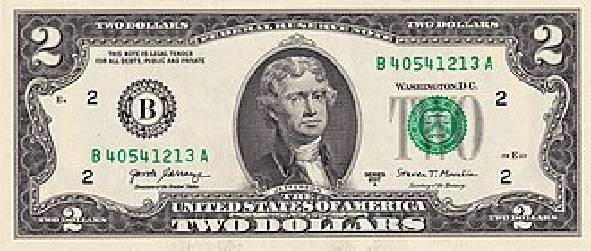
Count the value, not the coins. Tom: \(3 \times 2 = 6\), so \(\dollar 6\). Nour: ten \(10\)-cent coins make \(\dollar 1\), so fifty make \(\dollar 5\). Tom has more. In the same way, \(\dollar 12\) is more than \(60\) cents even though \(12\) is smaller than \(60\): \(\dollar 12\) is more than \(\dollar 1\), and \(60\) cents is less than \(\dollar 1\).
Method — Giving Change by Counting Up
The seller starts at the price and counts up to the money given: - Start at the price.
- Add coins or bills one by one, without going past the money given, and say the new total each time, until you reach the money given.
- The money you added is the change.
Skills to practice
- Checking If You Have Enough Money
- Comparing Coins and Value
- Calculating Change When Buying Items
III
Going further
Skills to practice
- Completing Equalities with Money
- Solving Problems with Several Questions
- Quiz
Jump to section