International Baccalaureate · PYP 3
Comparing, Ordering and Rounding
I
Comparing and Ordering 4-Digit Numbers
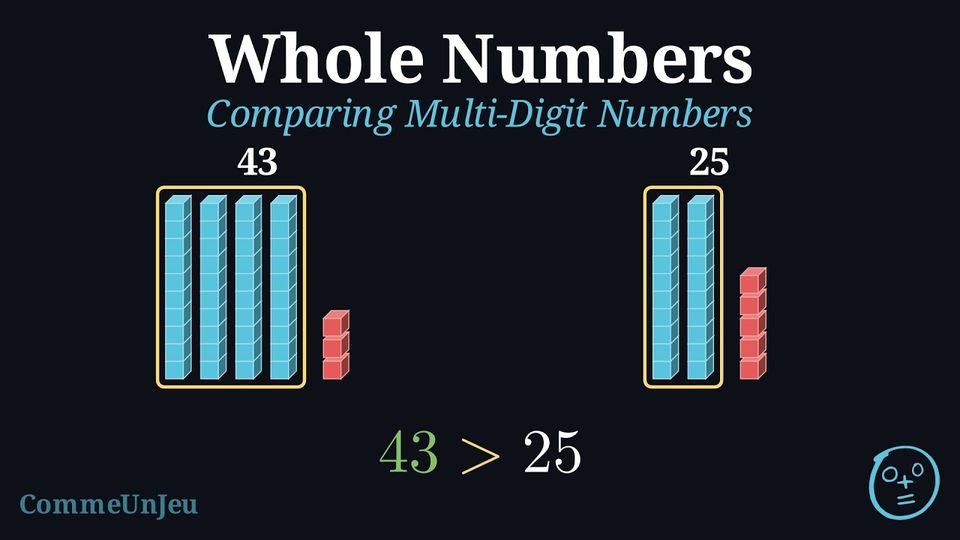
Two villages have counted their inhabitants.
There are far too many people to draw them, and both numbers start with the same digits. Say which village has more inhabitants.
| Valmont | Roches |
| \(6\,234\) inhabitants | \(6\,243\) inhabitants |
Both numbers have four digits, so we compare them place by place from the left. Thousands: \(6\) and \(6\), the same. Hundreds: \(2\) and \(2\), the same. Tens: \(3\) and \(4\) — the first difference. Since \(3 < 4\), the number \(6\,234\) is smaller: \(6\,234 < 6\,243\). Roches has more inhabitants. The ones did not even need to be looked at.
Definition — The Words of Comparison
To compare two numbers is to say whether they are equal or which one is the greater. Each symbol has its words: | Symbol | We say | Example |
| \(=\) | is equal to | \(4\,635 = 4\,635\) |
| \(<\) | is less than | \(6\,234 < 6\,243\) |
| \(>\) | is greater than | \(6\,300 > 5\,229\) |
Method — Comparing Two Whole Numbers
To compare two whole numbers: - Count the digits: the number with more digits is the greater one.
- If both numbers have the same number of digits, compare the digits from left to right, place by place: the first different digit decides.
Example
Compare \(999\) and \(1\,000\); then \(5\,229\) and \(6\,300\); then \(7\,105\) and \(7\,099\). - \(999\) has three digits and \(1\,000\) has four: \(999 < 1\,000\). No need to look at the digits.
- \(5\,229\) and \(6\,300\) both have four digits. Thousands: \(5 < 6\), the first place already decides: \(5\,229 < 6\,300\). The \(229\) and the \(300\) that follow do not matter.
- \(7\,105\) and \(7\,099\): thousands equal, hundreds \(1 > 0\): \(7\,105 > 7\,099\).
Example
Order the five numbers \(6\,234\), \(6\,243\), \(6\,239\), \(6\,300\) and \(5\,229\) from the smallest to the largest, then from the largest to the smallest.
All five numbers have four digits. We look for the smallest, write it, and start again with the others.
- Thousands: \(5\,229\) is the only one with \(5\) thousands, so it is the smallest. Written first.
- The four others start with \(6\). Hundreds digit: \(3\) for \(6\,300\), \(2\) for the others: \(6\,300\) is the largest of all, it will come last.
- Among \(6\,234\), \(6\,243\) and \(6\,239\): tens digits \(3\), \(4\), \(3\). So \(6\,243\) is the largest of the three. Between \(6\,234\) and \(6\,239\), the ones decide: \(4 < 9\).
Skills to practice
- Comparing Two Numbers
- Using the Words of Comparison
- Ordering Five Numbers
- Ordering Both Ways
II
Between Two Numbers
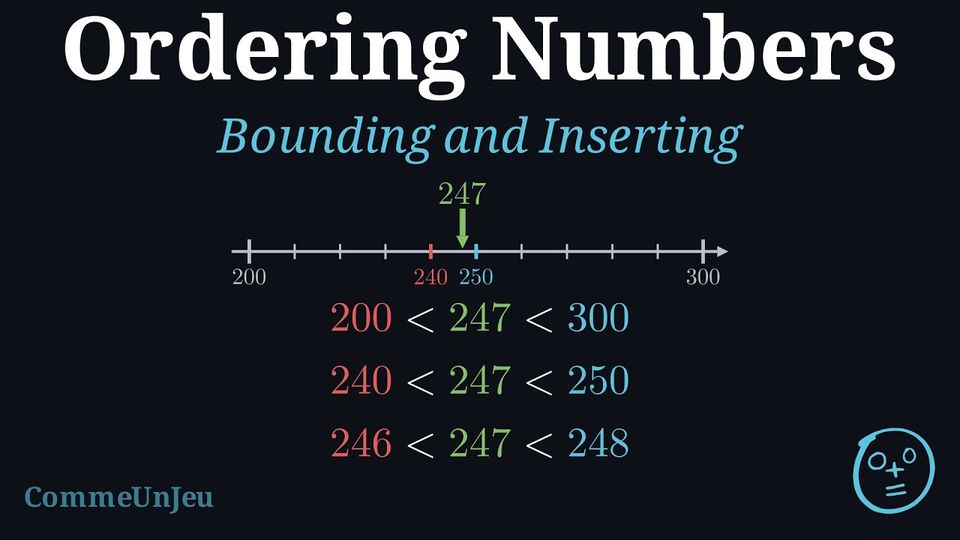
This number line counts in thousands. The arrow points at \(4\,635\) — but there is no mark for \(4\,635\). 
Say between which two marks the arrow stands.
\(4\,635\) contains \(4\) whole thousands and a bit more: the arrow stands after the mark \(4\,000\) and before the mark \(5\,000\). We write \(4\,000 < 4\,635 < 5\,000\), and we read: \(4\,635\) is between \(4\,000\) and \(5\,000\), two thousands next to each other.
Method — Placing a Number Between Two Thousands, Hundreds or Tens
To place a number between two thousands next to each other, read how many whole thousands it contains: the number lies between that many thousands and one more. It is written with two symbols at once, and read with the words between … and …: \(4\,000 < 4\,635 < 5\,000\), read: \(4\,635\) is between \(4\,000\) and \(5\,000\). Between two hundreds or two tens, it works the same way, with whole hundreds or whole tens. | Between two | It contains | Writing |
| thousands | \(4\) whole thousands | \(4\,000 < 4\,635 < 5\,000\) |
| hundreds | \(46\) whole hundreds | \(4\,600 < 4\,635 < 4\,700\) |
| tens | \(463\) whole tens | \(4\,630 < 4\,635 < 4\,640\) |
| neighbours | — | \(4\,634 < 4\,635 < 4\,636\) |
This only works if the number is not exactly a number of thousands (or of hundreds, or of tens, for those marks). \(4\,000\) is exactly \(4\) thousands: it sits on the mark, not between two marks.
Do not confuse the digit with the number of hundreds. The hundreds digit of \(4\,635\) is \(6\), but \(4\,635\) contains \(46\) hundreds: the digit says what sits in that place, the number of hundreds says how many there are altogether.
Method — Finding a Number in Between
Finding a number in between is the other way round: instead of looking for the two numbers around a number, we look for a number that fits between two given numbers. - Between \(246\) and \(249\). The numbers that fit are \(247\) and \(248\): they are bigger than \(246\) and smaller than \(249\).
- When the two numbers are neighbours, nothing fits. Between \(246\) and \(247\) there is no whole number: \(246\) and \(247\) follow each other.
- On a strip counting in ones, each empty box holds the number that follows the one before it.
| \(471\) | \(472\) | \(473\) | \(\phantom{474}\) | \(\phantom{475}\) | \(476\) | \(477\) | \(478\) |
Example
Which whole numbers fit between \(4\,635\) and \(4\,640\)? And between \(4\,635\) and \(4\,636\)? Then place \(6\,239\) in the ordered list \(5\,229 < 6\,234 < 6\,243 < 6\,300\).
Between \(4\,635\) and \(4\,640\) fit the numbers greater than \(4\,635\) and less than \(4\,640\): \(4\,636\), \(4\,637\), \(4\,638\) and \(4\,639\). Between \(4\,635\) and \(4\,636\), nothing fits: they are neighbours, one follows the other.
To place \(6\,239\) in the list, compare it with its neighbours: \(6\,239 > 6\,234\) (same tens digit, ones \(9 > 4\)) and \(6\,239 < 6\,243\) (tens digit \(3 < 4\)). It slides between them: \(5\,229 < 6\,234 < 6\,239 < 6\,243 < 6\,300\).
To place \(6\,239\) in the list, compare it with its neighbours: \(6\,239 > 6\,234\) (same tens digit, ones \(9 > 4\)) and \(6\,239 < 6\,243\) (tens digit \(3 < 4\)). It slides between them: \(5\,229 < 6\,234 < 6\,239 < 6\,243 < 6\,300\).
Skills to practice
- Placing a Number Between Two Thousands\( irgule\) Hundreds or Tens
- Finding a Number in Between
III
Rounding to the Nearest Ten or Hundred
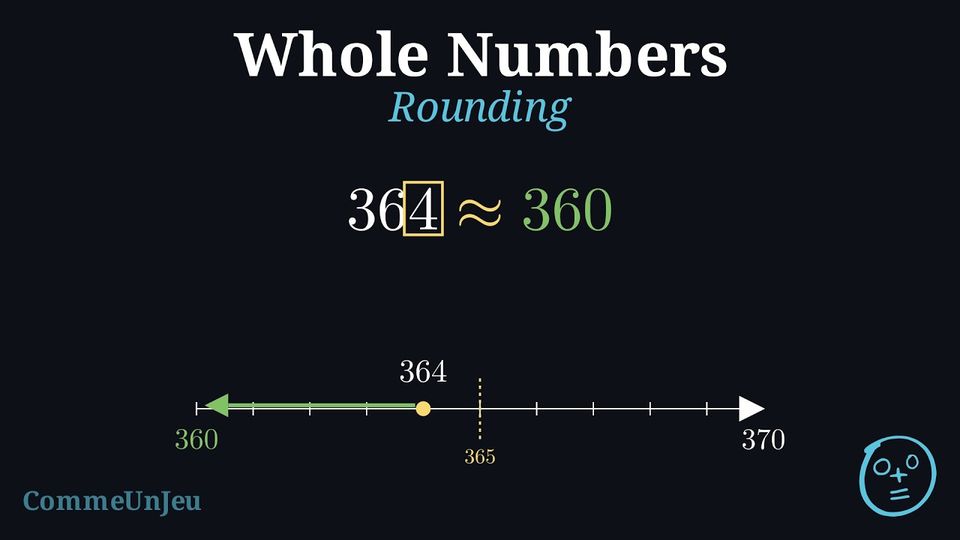
A bag contains 29 marbles. To answer the question “how many marbles?” quickly, one can say: “about 30 marbles.”
Replacing 29 by 30 is called rounding. We round numbers to make them simpler and easier to work with.
Replacing 29 by 30 is called rounding. We round numbers to make them simpler and easier to work with.
Definition — Rounding
Rounding means changing a number to a simpler nearby number. Method — Rounding to the Nearest Ten
To round to the nearest ten, we only need to look at the ones digit. - If the ones digit is 4 or less (0, 1, 2, 3, 4), we round down. The tens digit stays the same, and the ones digit becomes 0. A number whose ones digit is already 0 is a whole ten: it stays as it is.
- If the ones digit is 5 or more (5, 6, 7, 8, 9), we round up. We add one to the tens digit, and the ones digit becomes 0.
Example
Round \(324\) to the nearest ten. - Identify the ones digit: The number is \(32\underline{4}\). The ones digit is 4.
- Apply the rule: Since 4 is “4 or less”, we round down. The tens digit (2) stays the same.
- Result: 324 rounded to the nearest ten is 320.

Example
Round \(396\) to the nearest ten. - Identify the ones digit: The number is \(39\underline{6}\). The ones digit is 6.
- Apply the rule: Since 6 is “5 or more”, we round up: we add one to the tens digit. The tens digit is 9, and \(9 + 1 = 10\): we write 0 in the tens place and add 1 to the hundreds digit, \(3 + 1 = 4\). The ones digit becomes 0.
- Result: 396 rounded to the nearest ten is 400.

Just as we can round to the nearest ten, we can also round to the nearest hundred for an even simpler number.
- Instead of “A school has 372 students”, one can say “The school has about 400 students”.
Method — Rounding to the Nearest Hundred
The rule for rounding is the same. To round to the nearest hundred, we look at the digit one place to the right: the tens digit. - If the tens digit is 4 or less (0, 1, 2, 3, 4), we round down. The hundreds digit stays the same, and the tens and ones digits become 0. A number whose tens and ones digits are already 0 is a whole hundred: it stays as it is.
- If the tens digit is 5 or more (5, 6, 7, 8, 9), we round up. We add one to the hundreds digit, and the tens and ones digits become 0.
Example
Round \(324\) to the nearest hundred. - Identify the tens digit: The number is \(3\underline{2}4\). The tens digit is 2.
- Apply the rule: Since 2 is “4 or less”, we round down. The hundreds digit (3) stays the same.
- Result: 324 rounded to the nearest hundred is 300.

Example
Round \(2\,971\) to the nearest hundred. - Identify the tens digit: The number is \(2\,9\underline{7}1\). The tens digit is 7.
- Apply the rule: Since 7 is “5 or more”, we round up: we add one to the hundreds digit. The hundreds digit is 9, and \(9 + 1 = 10\): we write 0 in the hundreds place and add 1 to the thousands digit, \(2 + 1 = 3\). The tens and ones digits become 0.
- Result: \(2\,971\) rounded to the nearest hundred is \(\mathbf{3\,000}\).

Example — Estimating a Sum by Rounding
A library lends \(386\) books in March and \(213\) books in April. Estimate how many books it lends in the two months, by rounding each number to the nearest hundred.
The tens digit of \(386\) is \(8\), so \(386\) rounded to the nearest hundred is \(400\). The tens digit of \(213\) is \(1\), so \(213\) rounded to the nearest hundred is \(200\). $$\begin{aligned}[t] 386 + 213 &\approx 400 + 200 && \text{(each number rounded to the nearest hundred)}\\
&= 600 \end{aligned}$$ The sign \(\approx\) is read “is about”: \(386 + 213 \approx 600\) is read “\(386 + 213\) is about \(600\)”. The library lends about \(600\) books in the two months.
The estimate is quick, and it is close: the exact sum is \(386 + 213 = 599\).
The estimate is quick, and it is close: the exact sum is \(386 + 213 = 599\).
Skills to practice
- Rounding to the Nearest Ten Using a Number Line
- Rounding to the Nearest Ten
- Rounding to the Nearest Hundred Using a Number Line
- Rounding to the Nearest Hundred
IV
Going further
Skills to practice
- Comparing in Problems
- Rounding in Problems
- Quiz
Jump to section