International Baccalaureate · PYP 4
Temperature
I
What Is Temperature?
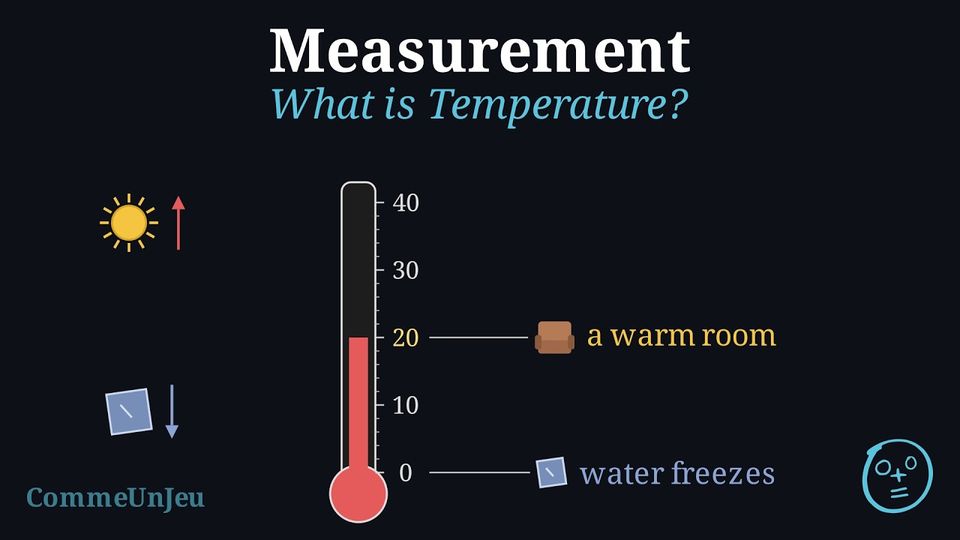
Mia gets into her bath and says: “My bath is hot.” At lunch, Tom tastes his soup and says: “My soup is hot.” Say whether these words alone tell which is hotter, the bath or the soup. Then say what is needed to compare them.
No. The word “hot” does not say how hot: Mia and Tom use the same word for two things that may be very different. To compare them, we need a number: the temperature, which tells how hot or cold something is. It is measured in degrees Celsius (\(^\circ\)C) and read on a thermometer. We measure the bath and the soup with a thermometer, then we compare the two temperatures.
Definition — Temperature
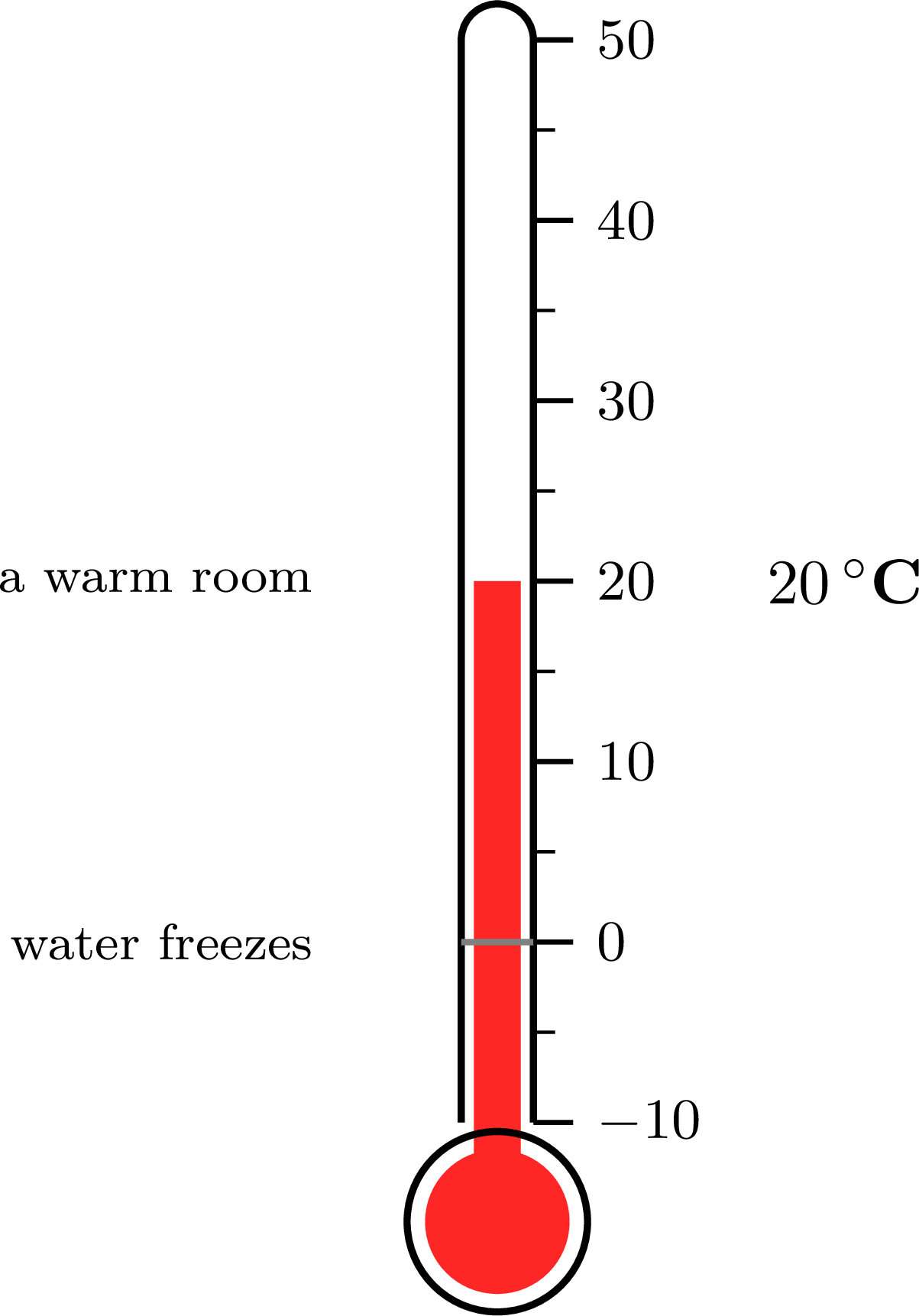
The temperature of something is a number that tells how hot or cold it is. It is measured in a unit, the degree Celsius, written \(^\circ\)C: \(20\,^\circ\)C is read “\(20\) degrees Celsius”.A thermometer is the instrument that measures temperature. A liquid thermometer has a thin tube of coloured liquid. The liquid rises when it gets warmer and falls when it gets colder. We read the temperature in \(^\circ\)C at the top of the coloured column.
Skills to practice
- Estimating Temperatures
II
Reading a Thermometer
Method — How to Read a Thermometer
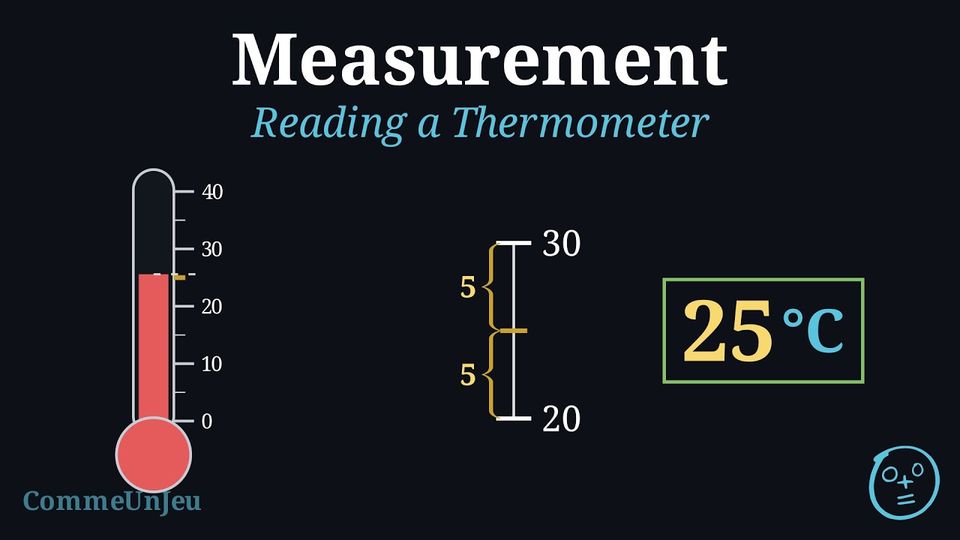
- Find what one step stands for: take two numbered marks next to each other, find how many degrees there are from one to the other, and count the steps between them. For example, from \(0\) to \(10\) there are \(10\) degrees; if there is one small mark between them, that makes \(2\) steps, so one step is \(5\,^\circ\)C: the small mark is halfway, \(5\,^\circ\)C above the large one.
- Find the top of the coloured liquid.
- Read the number: start from the numbered mark just below the top of the liquid and count the steps up to the top.
Example
Read the temperature shown. 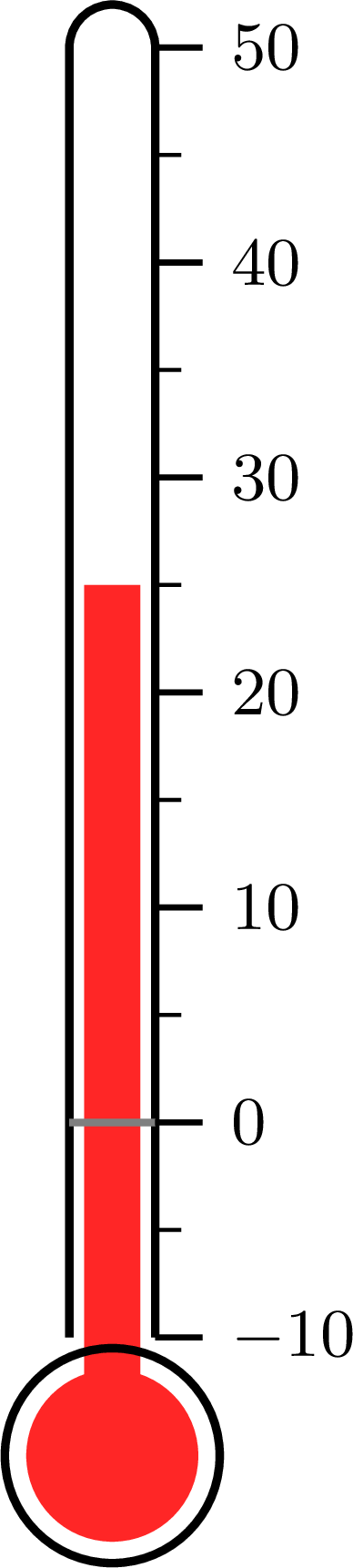
The top of the liquid is halfway between \(20\) and \(30\), on the small mark: the temperature is \(\mathbf{25\,^\circ\text{C}}\).
Skills to practice
- Reading the Temperature
- Reading Other Scales
III
Temperatures Below Zero
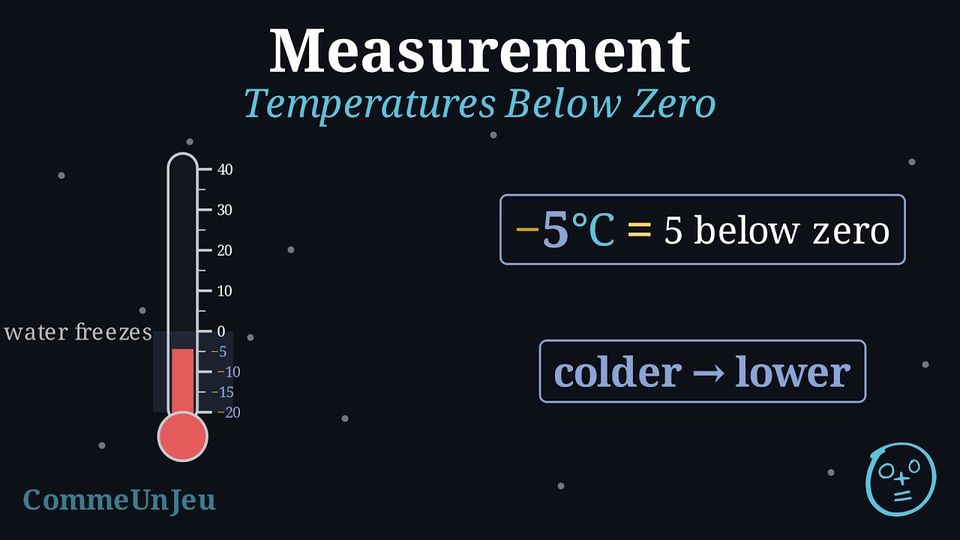
Water freezes at \(0\,^\circ\)C. When it gets even colder, the temperature drops below zero.
Definition — Temperature Below Zero
A temperature below \(0\,^\circ\)C is written with a minus sign: \(-5\,^\circ\)C means \(5\) degrees below zero. The colder it is, the lower the liquid sits. Below zero, count the marks down from \(0\): on the thermometer below, the small mark under \(0\) is \(-5\,^\circ\)C and the large one \(-10\,^\circ\)C. 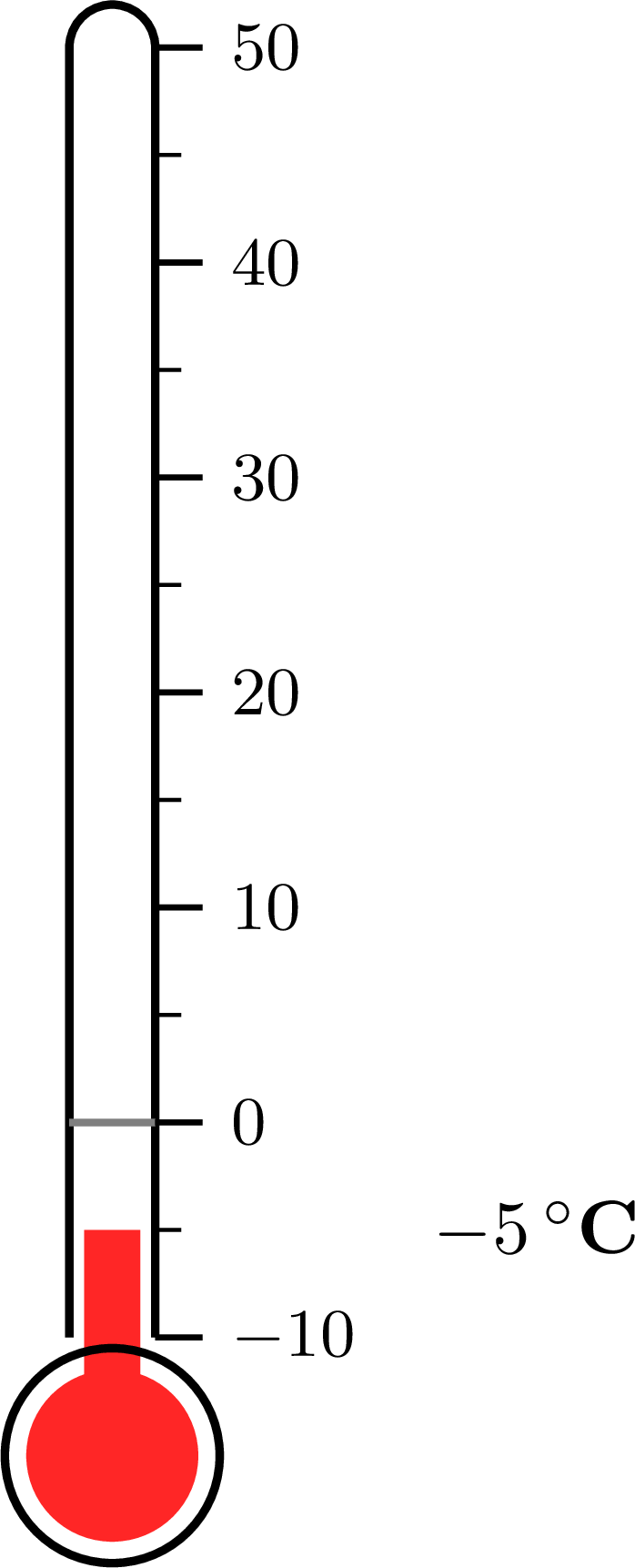
Skills to practice
- Reading Temperatures Below Zero
- Marking a Temperature
IV
Comparing Temperatures
Method — Warmer or Colder?
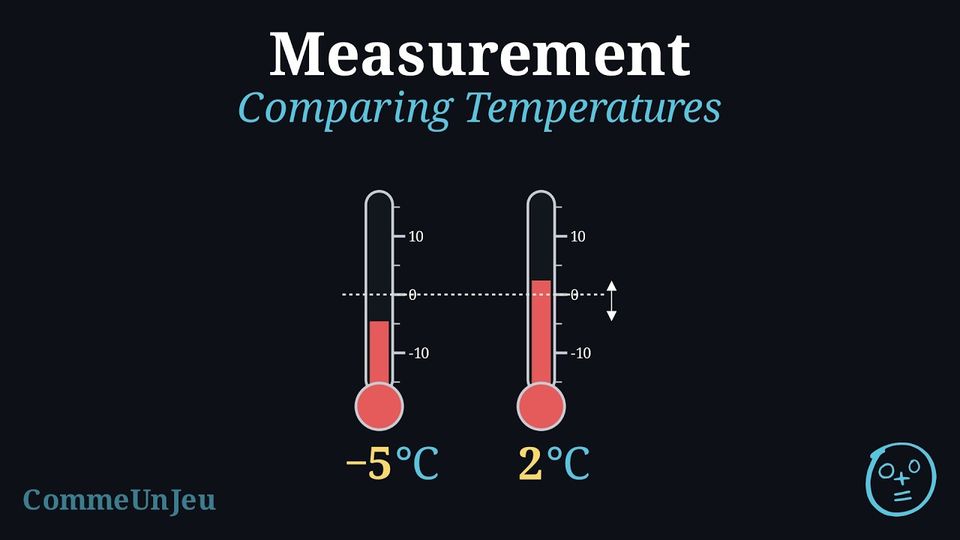
On a thermometer, the temperature that is higher up is warmer; the one lower down is colder. So \(-5\,^\circ\)C is colder than \(2\,^\circ\)C, even though \(5\) is bigger than \(2\). 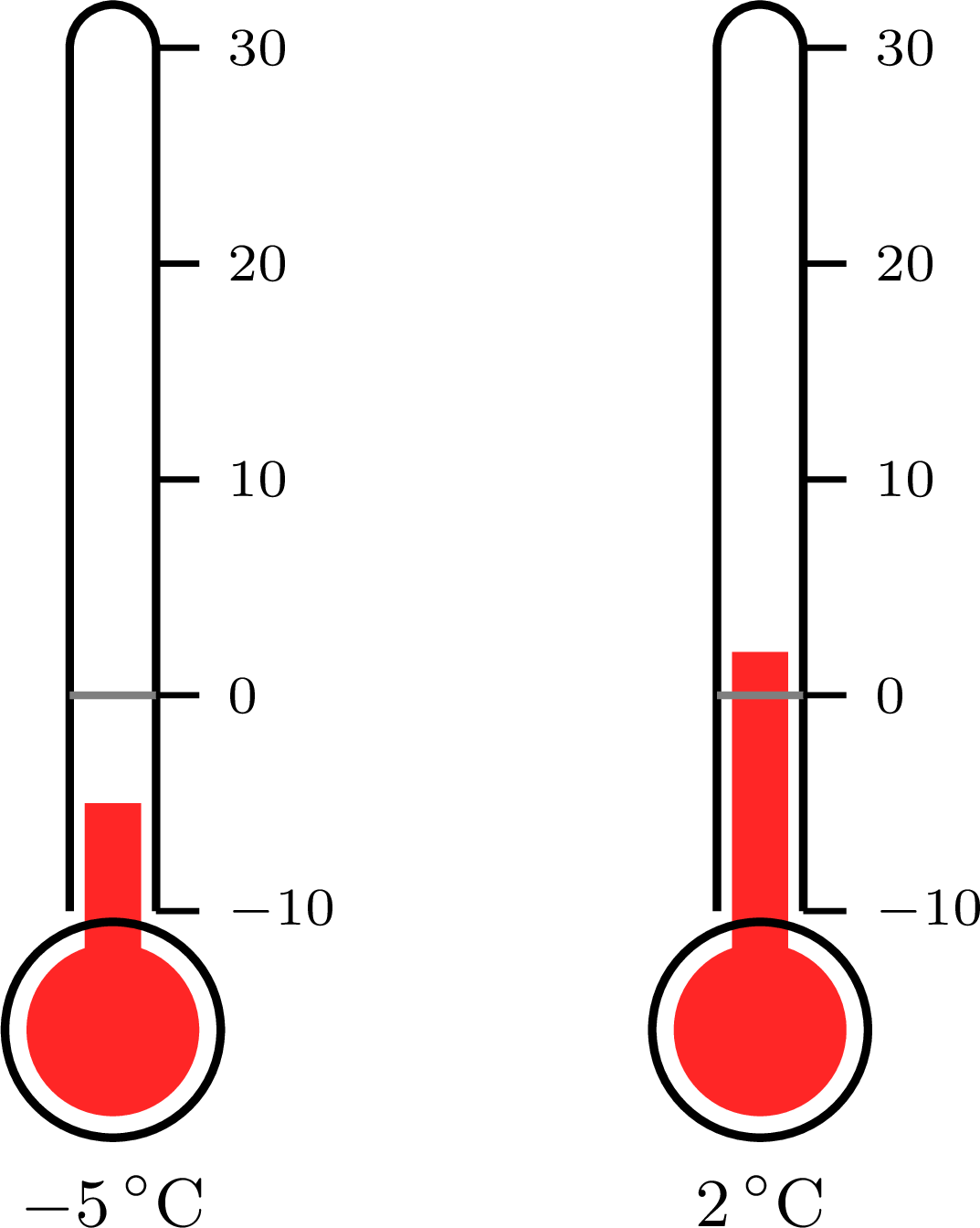
Method — Finding a Temperature Difference
The difference between two temperatures is the number of degrees from one to the other, counted on the thermometer or on an upright number line, like the scale of the thermometer. - Place the two temperatures on the thermometer or on an upright number line, like the scale of the thermometer: the one higher up is the warmer.
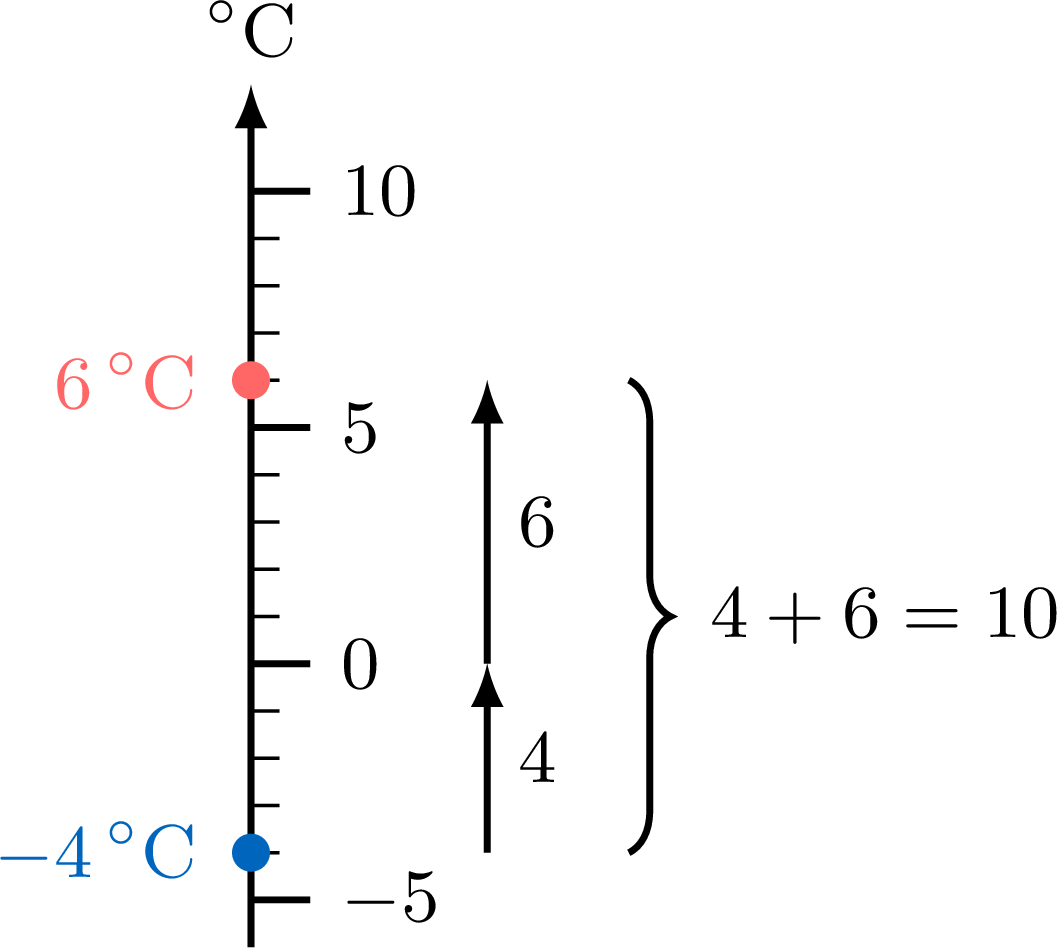
- Count the degrees from the lower one up to the higher one. When both temperatures are above zero, the smaller number can also be subtracted from the larger: from \(11\,^\circ\)C to \(23\,^\circ\)C is \(23 - 11 = 12\) degrees. When one is below zero and the other above, count up to \(0\), then from \(0\), and add: from \(-4\,^\circ\)C to \(0\,^\circ\)C is \(4\) degrees, from \(0\,^\circ\)C to \(6\,^\circ\)C is \(6\) degrees, and \(4 + 6 = 10\) degrees.
- Say the direction: compare the later temperature with the earlier one. If the later one is higher up, the temperature rose; if it is lower down, it fell; if they are the same, it did not change: the difference is \(0\) degrees. The difference itself is always a number of degrees, written without a minus sign: from \(6\,^\circ\)C down to \(-4\,^\circ\)C, the temperature fell by \(10\) degrees.
Example
During the night, the temperature was \(-6\,^\circ\)C. The next afternoon, it was \(5\,^\circ\)C. Did the temperature rise or fall? By how many degrees? 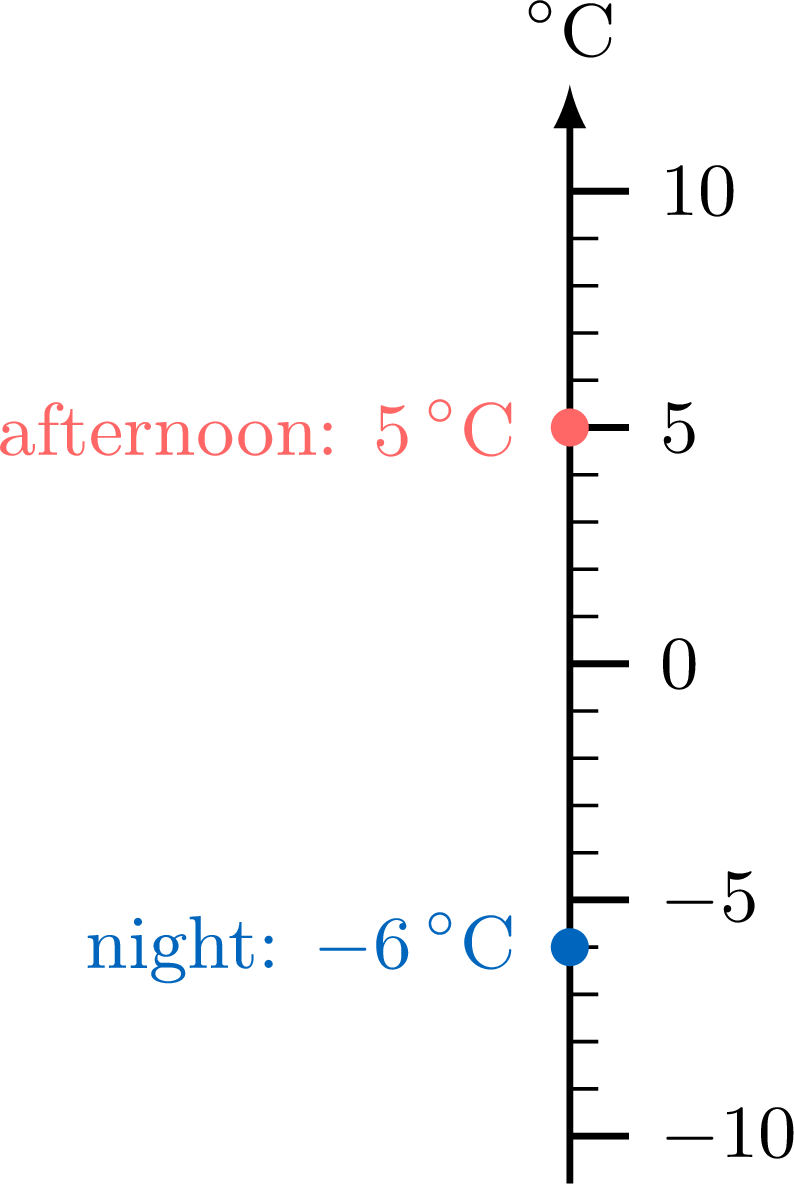
The later temperature, \(5\,^\circ\)C, is higher up than the earlier one, \(-6\,^\circ\)C: the temperature rose. \(-6\,^\circ\)C means \(6\) degrees below zero, and \(5\,^\circ\)C is above zero: count up to \(0\), then from \(0\). From \(-6\,^\circ\)C up to \(0\,^\circ\)C is \(6\) degrees; from \(0\,^\circ\)C up to \(5\,^\circ\)C is \(5\) degrees. 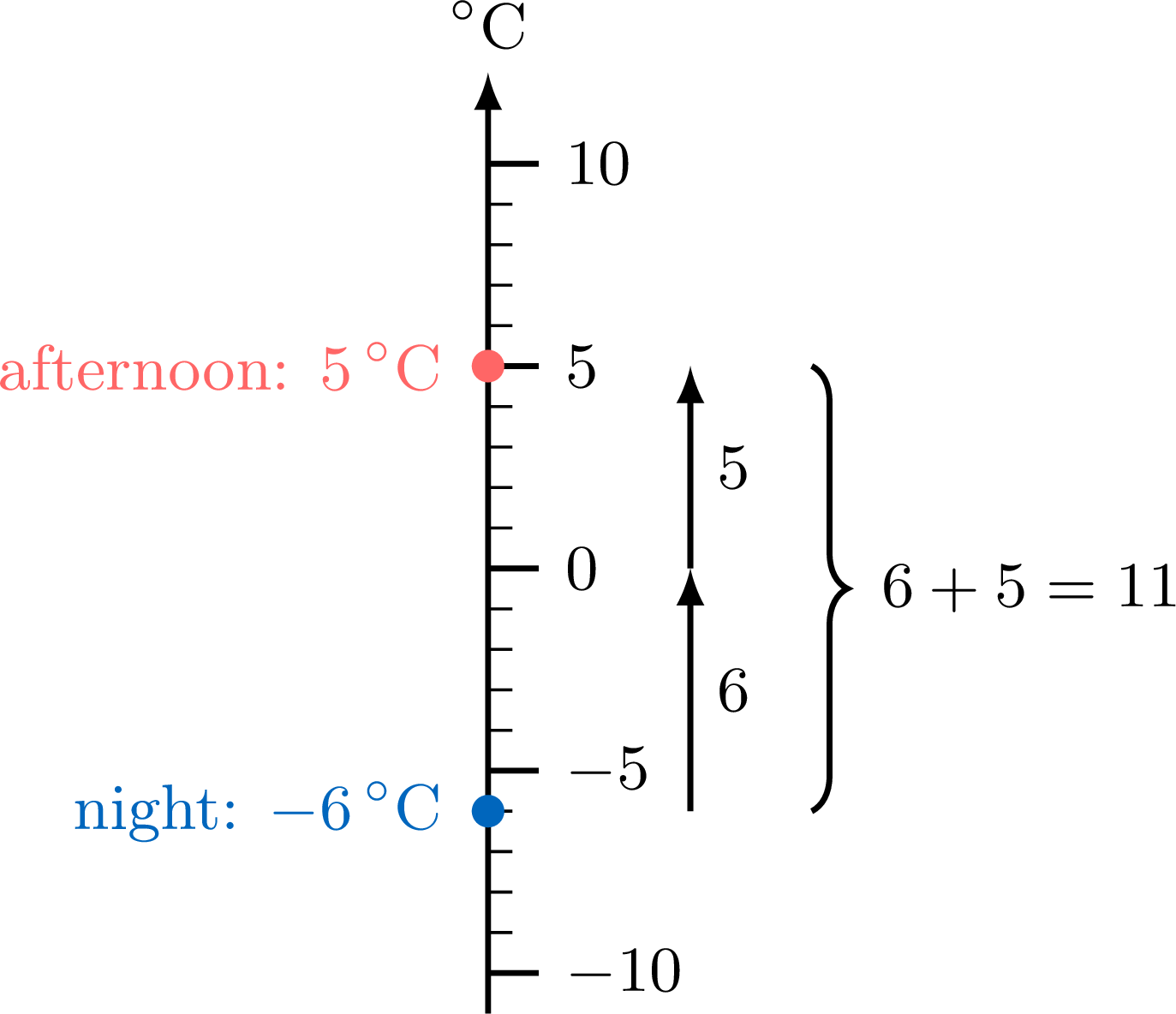
$$\begin{aligned} \text{rise} &= 6 + 5 &&\text{(from } {-6} \text{ up to } 0\text{, then from } 0 \text{ up to } 5\text{)}\\
&= \textcolor{colorprop}{11} \end{aligned}$$ The temperature rose by \(\mathbf{11}\) degrees.
Example
Early in the morning, the temperature was \(-9\,^\circ\)C. At noon, it was \(-3\,^\circ\)C. Did the temperature rise or fall? By how many degrees? 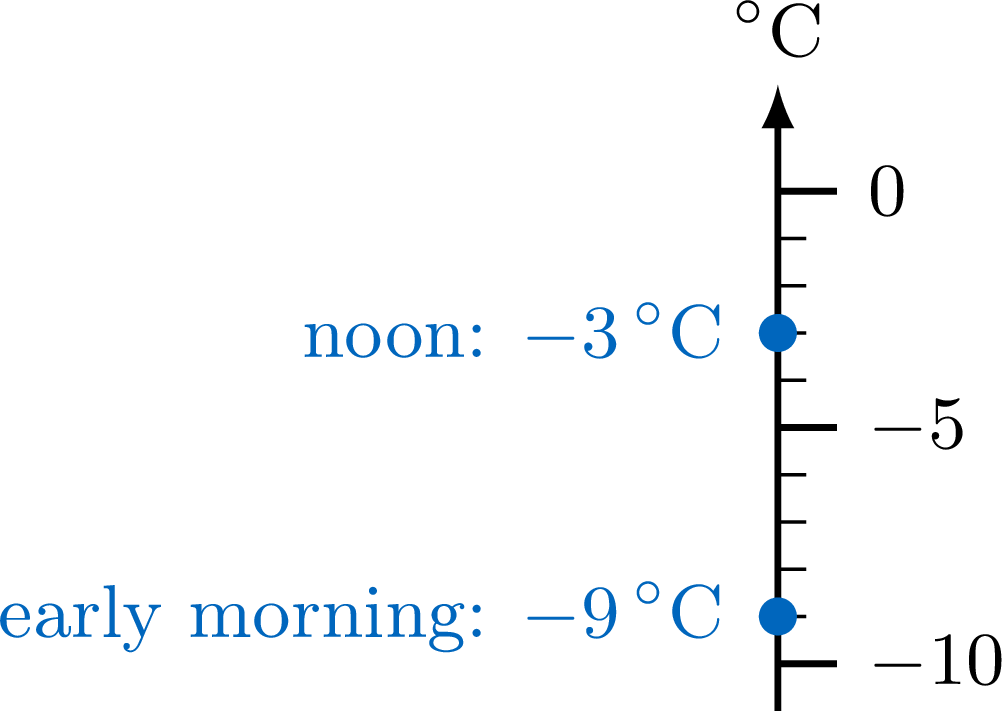
The later temperature, \(-3\,^\circ\)C, is higher up than the earlier one, \(-9\,^\circ\)C: the temperature rose. Both temperatures are below zero, so \(0\) is not between them: do not add \(9\) and \(3\). Count the steps up the line from \(-9\) to \(-3\): \(-8\), \(-7\), \(-6\), \(-5\), \(-4\), \(-3\), that is \(6\) steps. 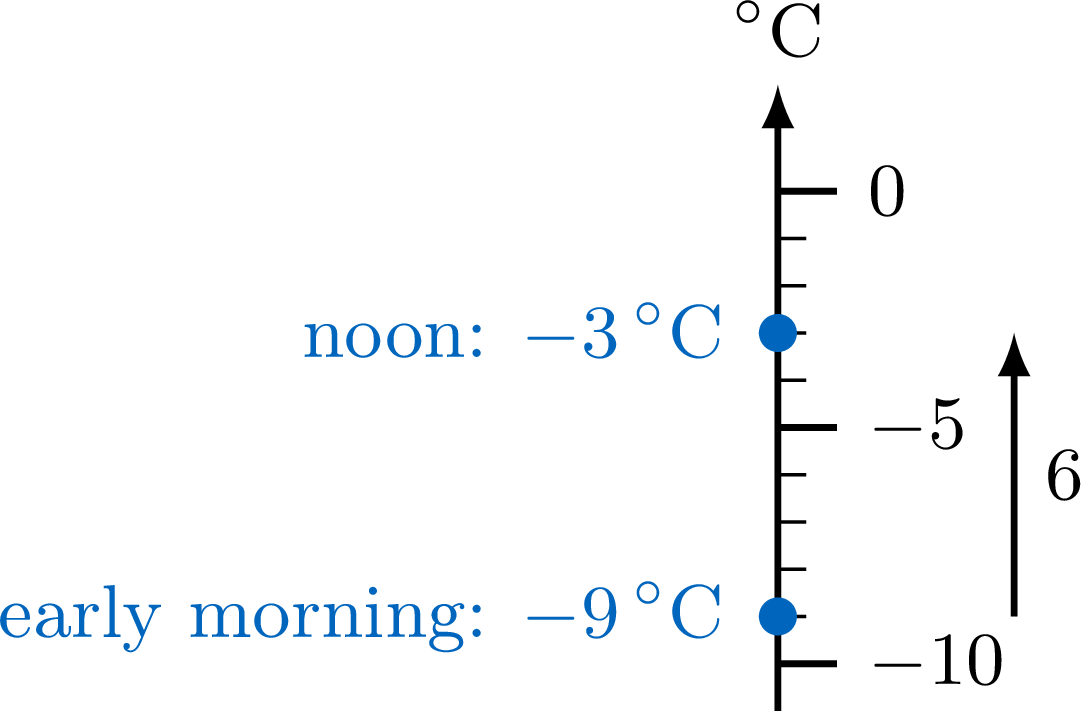
The temperature rose by \(\mathbf{6}\) degrees.
Skills to practice
- Comparing and Ordering Temperatures
- Finding Temperature Differences
V
Review & Quizz
Skills to practice
- Quiz
Jump to section