International Baccalaureate · PYP 4
Decimals
I
Decimal Fractions
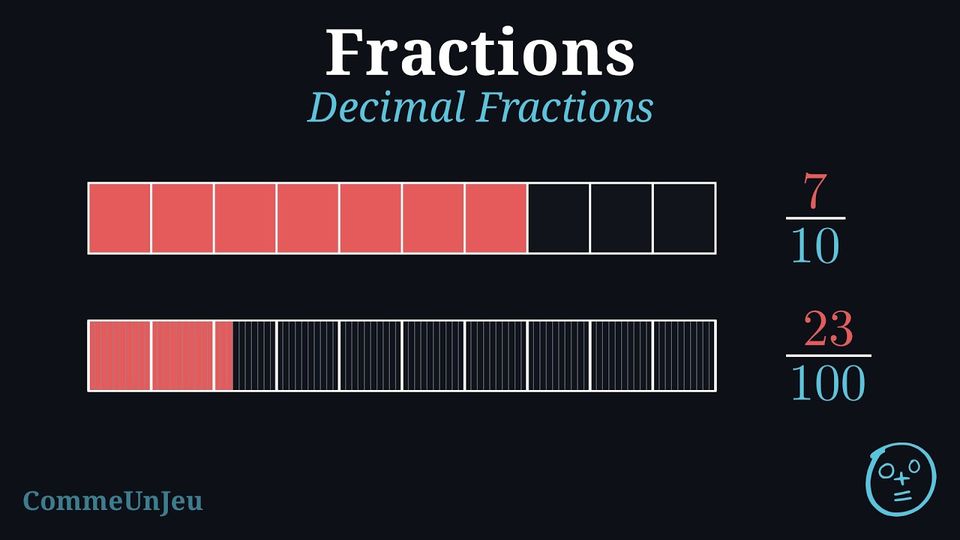
To measure a length shorter than one unit, the unit must be divided into equal parts. Consider a ribbon shorter than one metre. The unit (one metre) is divided into 10 equal parts; each part is one tenth of the unit, written \(\dfrac{1}{10}\). The ribbon covers 7 of these parts, so its length is \(\dfrac{7}{10}\) of a metre. 
On the number line, the segment from 0 to 1 is the unit. Dividing it into 10 equal parts places \(\dfrac{7}{10}\) exactly: 
Dividing the unit into 10 equal parts matches our base-ten numeration: ten parts make one unit, just as ten ones make one ten. The fractions built on this division are so useful that they receive a name of their own.
Definition — Decimal Fraction
A decimal fraction is a fraction whose denominator is \(10\), \(100\), \(1\,000\), …- \(\dfrac{7}{10}\) is read “seven tenths”: the unit is divided into 10 equal parts.
- \(\dfrac{23}{100}\) is read “twenty-three hundredths”: dividing each tenth into 10 equal parts divides the unit into 100 equal parts.
Example
The unit, from 0 to 1, is divided into 10 equal parts. - Read the decimal fraction located at the point \(A\).

- The segment from \(0\) to \(\dfrac{1}{10}\) is itself divided into 10 equal parts. Read the decimal fraction located at the point \(B\).

- The unit is divided into \(\textcolor{colorprop}{10}\) equal parts, so each part is \(\dfrac{1}{10}\). The point \(A\) is located \(\textcolor{colordef}{3}\) parts from 0, so \(A=\dfrac{\textcolor{colordef}{3}}{\textcolor{colorprop}{10}}\).
- Each tenth is divided into 10 equal parts, so the unit is divided into \(10\times 10=\textcolor{colorprop}{100}\) equal parts: each part is \(\dfrac{1}{100}\). The point \(B\) is located \(\textcolor{colordef}{7}\) parts from 0, so \(B=\dfrac{\textcolor{colordef}{7}}{\textcolor{colorprop}{100}}\).
Proposition — Whole Number and Decimal Fraction Less than 1
Since 10 tenths make one unit, \(\dfrac{10}{10}=1\). Every decimal fraction can therefore be written as the sum of a whole number and a decimal fraction less than 1, and conversely: $$\dfrac{47}{10} = 4 + \dfrac{7}{10} \qquad\text{and}\qquad 4 + \dfrac{7}{10} = \dfrac{47}{10}.$$ 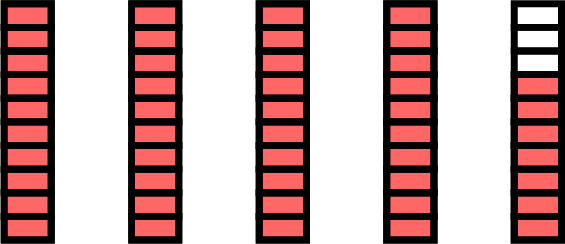
Example
- Write \(\dfrac{35}{10}\) as the sum of a whole number and a decimal fraction less than 1.
- Write \(2+\dfrac{6}{10}\) as a single decimal fraction.
- \(\begin{aligned}[t] \dfrac{35}{10} &= \dfrac{30}{10}+\dfrac{5}{10} &&\text{(split off the whole tens of tenths)}\\ &= 3+\dfrac{5}{10} &&\left(\dfrac{30}{10}=3\right) \end{aligned}\)
- \(\begin{aligned}[t] 2+\dfrac{6}{10} &= \dfrac{20}{10}+\dfrac{6}{10} &&\left(2=\dfrac{20}{10}\right)\\ &= \dfrac{26}{10} &&\text{(add the numerators)} \end{aligned}\)
Example
Decimal fractions with the same denominator are added like any fractions with a common denominator: add the numerators and keep the denominator. Compute: - \(\dfrac{3}{10}+\dfrac{4}{10}\)
- \(\dfrac{26}{100}+\dfrac{24}{100}\)
-

- \(\begin{aligned}[t] \dfrac{26}{100}+\dfrac{24}{100} &= \dfrac{26+24}{100} &&\text{(same denominator: add the numerators)}\\ &= \dfrac{50}{100}\\ &= \dfrac{5}{10} &&\text{(50 hundredths make 5 tenths)} \end{aligned}\)
Because their denominators are \(10\), \(100\), \(1\,000\), …, decimal fractions have a shorter writing that uses a decimal point: for example, \(\dfrac{7}{10}\) is also written \(0.7\). This writing with a decimal point is that of the decimal numbers: a decimal number can be written as a decimal fraction or, more briefly, with a decimal point.
Skills to practice
- Reading and Writing Decimal Fractions
- Adding Decimal Fractions
II
What Are Decimals?
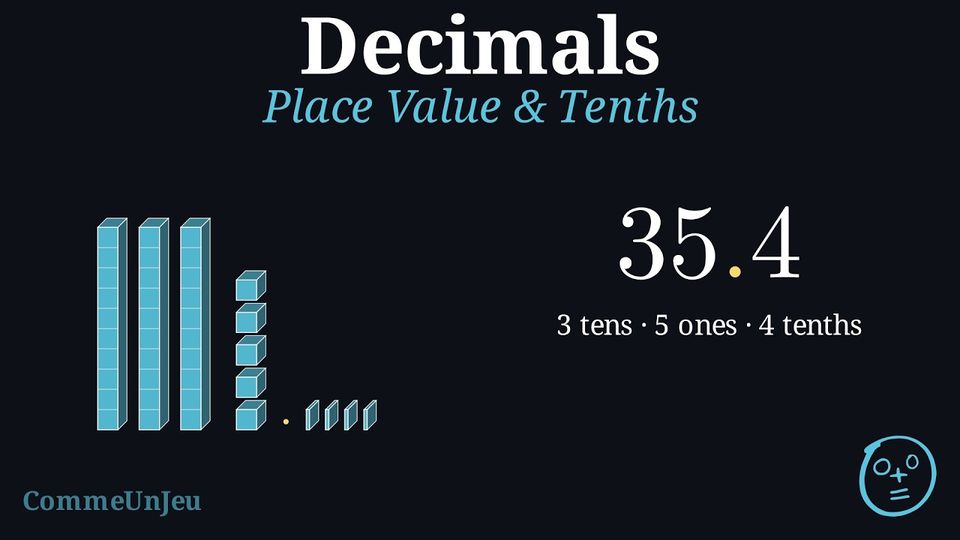
In our number system, the position of a digit tells us its value. Consider the number 235. \(235=\) 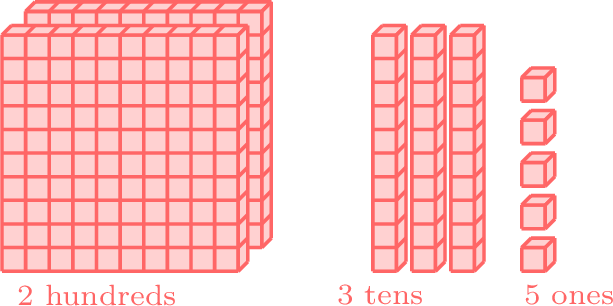
It is made of three parts:
We get a piece called a tenth. A tenth is a fraction, written as \(\dfrac{1}{10}\).
To write numbers that include these smaller pieces, we use a decimal point to separate the whole part from the fractional part. \(35.4\) = 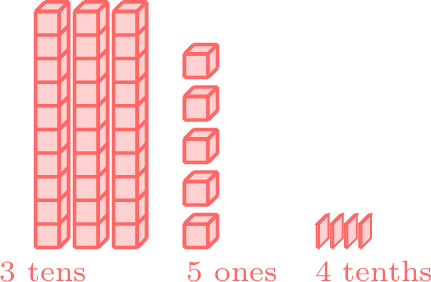
This number means 3 tens, 5 ones, and 4 tenths.
- The 5 is in the Ones place, meaning 5 ones (\(5\)).
- The 3 is in the Tens place, meaning 3 tens (\(30\)).
- The 2 is in the Hundreds place, meaning 2 hundreds (\(200\)).
- When we move left \(\leftarrow\), each place is 10 times bigger. (10 ones make a ten, 10 tens make a hundred).
- When we move right \(\rightarrow\), each place is 10 times smaller. (A hundred divided by 10 is a ten, a ten divided by 10 is a one).
We get a piece called a tenth. A tenth is a fraction, written as \(\dfrac{1}{10}\).
To write numbers that include these smaller pieces, we use a decimal point to separate the whole part from the fractional part.
Definition — Decimal Number
A decimal number is a number that can be written with a whole part and a fractional part separated by a decimal point, using a finite number of digits after the point. We can represent a decimal number in different ways: - Standard Form:
\(35.4\) - Expanded Form $$\begin{aligned} 3\text{ tens} &+& 5\text{ ones} &+& 4\text{ tenths} \\ 30 &+& 5 &+& \frac{4}{10} \end{aligned}$$
- Place Value Table:
Tens Ones . Tenths 3 5 . 4 - Base Ten Cubes:

Definition — The Hundredth
The pattern of our number system does not stop at the tenths: each place is still 10 times smaller than the place on its left. - A one divided by 10 is a tenth: \(\dfrac{1}{10} = 0.1\).
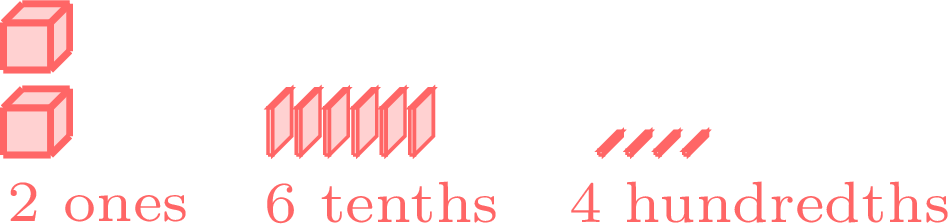
- A tenth divided by 10 is a new, smaller piece called a hundredth. A hundredth is written \(\dfrac{1}{100}\) as a fraction, or \(0.01\) as a decimal.
- 10 hundredths make 1 tenth: \(\dfrac{10}{100} = \dfrac{1}{10}\).
- 100 hundredths make 1 one: \(\dfrac{100}{100} = 1\).
| Ones | . | Tenths | Hundredths |
| 2 | . | 6 | 4 |
Example
Write in decimal form: - \(\dfrac{34}{100}\)
- \(\dfrac{207}{100}\)
- $$\begin{aligned}[t] \frac{34}{100} &= \frac{30}{100} + \frac{4}{100} && \text{(split the hundredths)} \\
&= \frac{3}{10} + \frac{4}{100} && \text{(30 hundredths are 3 tenths)} \\
&= 0.34 && \text{(3 tenths and 4 hundredths)} \end{aligned}$$
\(\dfrac{34}{100} = \) 
- $$\begin{aligned}[t] \frac{207}{100} &= \frac{200}{100} + \frac{7}{100} && \text{(split the hundredths)} \\
&= 2 + \frac{7}{100} && \text{(200 hundredths are 2 ones)} \\
&= 2.07 && \text{(0 tenths and 7 hundredths)} \end{aligned}$$
Ones . Tenths Hundredths 2 . 0 7
Proposition — Different Writings of One Number
The same decimal number can be written in several ways. All these writings name exactly the same number. For \(42.48\): $$42.48 = \frac{4248}{100} = 40 + 2 + \frac{4}{10} + \frac{8}{100}$$ - From the standard form to a decomposition: read each digit by its place. In \(42.48\), the 4 on the left is worth \(40\), the 2 is worth \(2\), the 4 after the point is worth \(\frac{4}{10}\), and the 8 is worth \(\frac{8}{100}\).
- From the standard form to the hundredths: count everything in hundredths. Each one is 100 hundredths and each tenth is 10 hundredths, so \(42.48\) is \(4248\) hundredths: \(42.48 = \frac{4248}{100}\).
- From a decomposition back to the standard form: place each part in its column of the place-value table, then read the number.
Example
- Write \(36.07\) as a decimal fraction and as an expanded form.
- Write as a single decimal number: \(50 + 3 + \dfrac{9}{10} + \dfrac{2}{100}\).
- Expanded form: read each digit by its place. The zero means there are no tenths. $$\begin{aligned}[t] 36.07 &= 30 + 6 + \frac{7}{100} && \text{(3 tens, 6 ones, 0 tenths, 7 hundredths)} \end{aligned}$$ Decimal fraction: count everything in hundredths. $$\begin{aligned}[t] 36.07 &= \frac{3600}{100} + \frac{7}{100} && \text{(36 ones are 3600 hundredths)} \\ &= \frac{3607}{100} \end{aligned}$$
- $$\begin{aligned}[t] 50 + 3 + \frac{9}{10} + \frac{2}{100} &= 53 + 0.9 + 0.02 && \text{(value of each term)} \\
&= 53.92 \end{aligned}$$
Tens Ones . Tenths Hundredths 5 3 . 9 2
Example — Decimal Writing of Usual Fractions
Write in decimal form: - \(\dfrac{1}{2}\)
- \(\dfrac{1}{4}\)
- \(\dfrac{3}{4}\)
The unit is the big square. It is divided into \(100\) small squares: each small square is one hundredth. 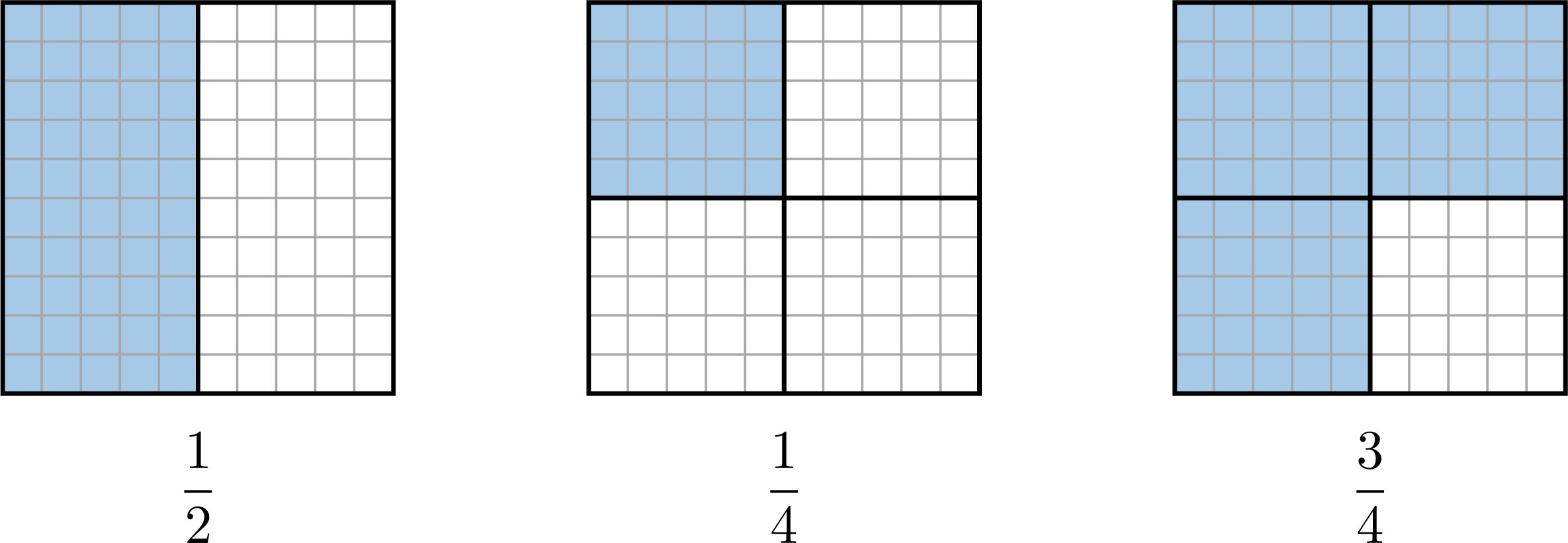
- Half of the \(100\) small squares is \(50\) small squares: $$\begin{aligned}[t] \frac{1}{2} &= \frac{50}{100} && \text{(half of 100 hundredths)} \\ &= \frac{5}{10} && \text{(50 hundredths are 5 tenths)} \\ &= 0.5 \end{aligned}$$
- Shared into \(4\) equal parts, the \(100\) small squares give \(25\) small squares each, since \(4\times 25=100\): $$\begin{aligned}[t] \frac{1}{4} &= \frac{25}{100} && \text{(a quarter of 100 hundredths)} \\ &= 0.25 && \text{(2 tenths and 5 hundredths)} \end{aligned}$$
- Three quarters are \(3\) times \(25\) small squares, that is \(75\) small squares: $$\begin{aligned}[t] \frac{3}{4} &= \frac{75}{100} && \text{(3 times 25 hundredths)} \\ &= 0.75 && \text{(7 tenths and 5 hundredths)} \end{aligned}$$
Skills to practice
- Understanding the Role of Zero
- Identifying Place Values
- Writing Decimal Numbers
- Finding the Digit in a Place Value
- Writing Decimal Numbers from Decimal Fractions
- Writing Decimal Fractions from Decimal Numbers
- Writing Decimal Numbers from Expanded Forms
- Writing Decimal Numbers from Expanded Forms II
- Writing Expanded Forms from Decimal Numbers
- Writing a Decimal Fraction as a Whole Number Plus Tenths and Hundredths
- Distinguishing the Digit from the Number of Tenths or Hundredths
III
Decimals on a Number Line
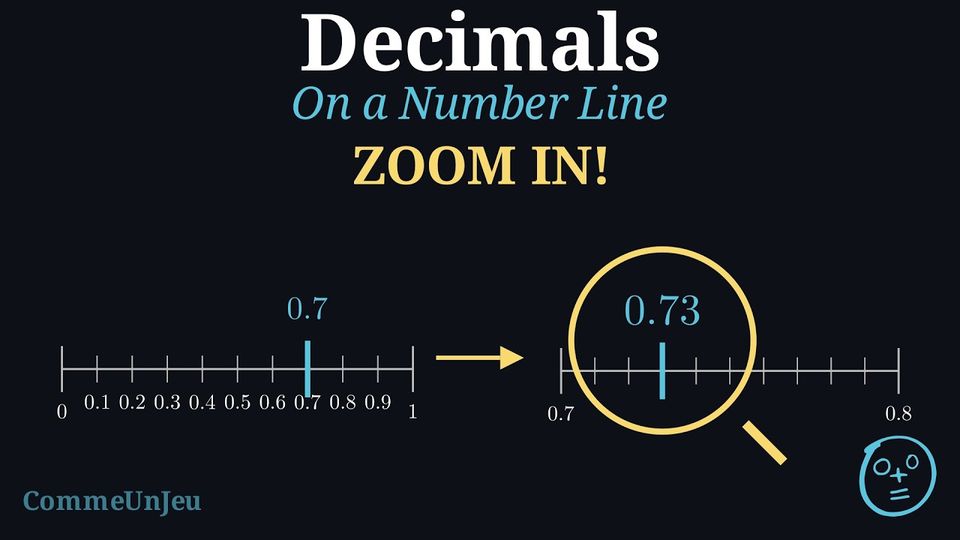
Every decimal number has an exact position on the number line.
- Finding Tenths
If we take the space between two whole numbers, like 0 and 1, and divide it into 10 equal parts, each part is one tenth (0.1).
- Finding Hundredths
If we magnify a small section, such as the one between 0 and 0.1, and divide it into 10 equal parts, each new part is one hundredth (0.01).
Method — Placing a Decimal on a Number Line
To place a decimal like 2.27 on a number line: - Find the start and end points. The number 2.27 is between \(2.2 = 2.20\) and \(2.3 = 2.30\).
- Draw the line and divide it into 10 equal parts. Each part will represent a hundredth.
- Count up from the start. The marks will be 2.21, 2.22, 2.23, and so on. Find the 7th mark to place 2.27.

Skills to practice
- Identifying Decimal Numbers on a Number Line
- Recognising the Point That Marks a Decimal
- Marking a Decimal on a Number Line
- Counting by Tenths and by Hundredths
IV
Comparing and Ordering Decimals
Method — Comparing Decimals Step-by-Step
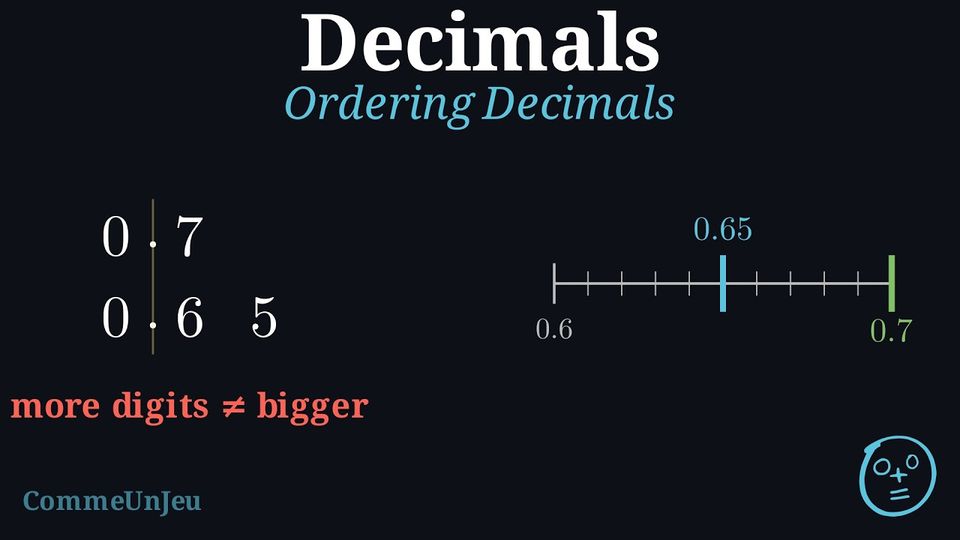
To find out which decimal number is bigger, follow these steps: - Line them up: Place the numbers one above the other, making sure the decimal points are perfectly aligned.
- Make them the same length: Add zeros to the end of the shorter number until both have the same number of decimal places. This doesn't change their value.
- Compare from left to right: Starting from the left, compare the digits in each place value column. The first number with a larger digit is the larger number. If one whole part has more digits than the other, that number is the larger one.
Example
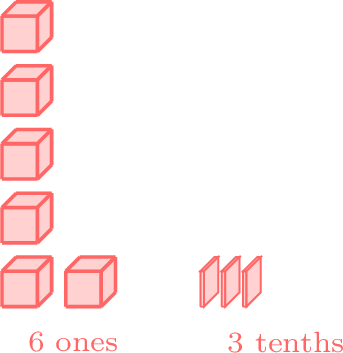
Compare 6.22 and 6.3. - Line them up:
\(6.22\)
\(6.3\) - Make them the same length: We add a zero to 6.3 to make it 6.30.
\(6.22\)
\(6.30\) - Compare:
- Ones place: Both have a 6.
- Tenths place: The top number has a 2, the bottom has a 3.
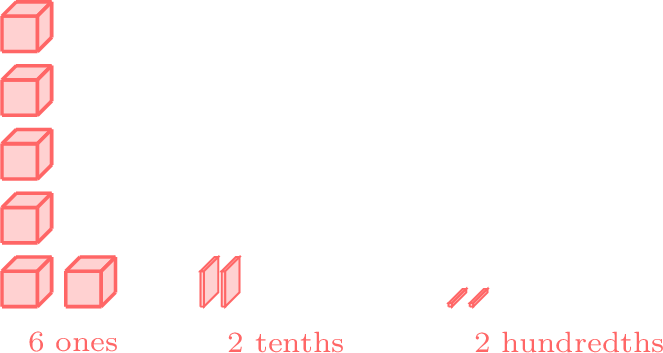 \(\lt\)
Method — Ordering Several Decimals
To order a list of decimal numbers, place them step by step: - Write all the numbers with the same number of decimal places by adding zeros — this changes nothing and makes them easy to compare.
- Find the smallest (or the largest) and set it first.
- Repeat with the numbers that remain, until the list is used up.
Example
Order the numbers \(3.7\), \(3.09\), \(3.71\) and \(3.2\) in ascending order.
$$\begin{aligned}[t] 3.70,\; 3.09,\; 3.71,\; 3.20 && \text{(same number of decimal places)} \\
3.09 && \text{(smallest: its tenths digit is } 0\text{)} \\
3.09 < 3.20 < 3.70 < 3.71 && \text{(then } 2 \text{ tenths, then } 70 < 71 \text{ hundredths)} \end{aligned}$$
Method — Comparing and Ordering Decimal Fractions
To compare two decimal fractions, write them with the same denominator, then compare the numerators: the larger numerator gives the larger fraction. Since one tenth is ten hundredths and one hundredth is ten thousandths, \(\dfrac{7}{10}=\dfrac{70}{100}\) and \(\dfrac{7}{100}=\dfrac{70}{1\,000}\). $$\dfrac{7}{10}=\dfrac{70}{100}\quad\text{and}\quad 70>65,\quad\text{so}\quad \dfrac{7}{10}>\dfrac{65}{100}.$$ One can also write them with a decimal point and compare the decimals: \(0.70>0.65\). To order several decimal fractions, write them all with the largest denominator, then order the numerators. Skills to practice
- Comparing Numbers
- Ordering Decimals in Real-World Problems
V
Bounding and Inserting Decimals
Method — Bounding and Inserting Decimals
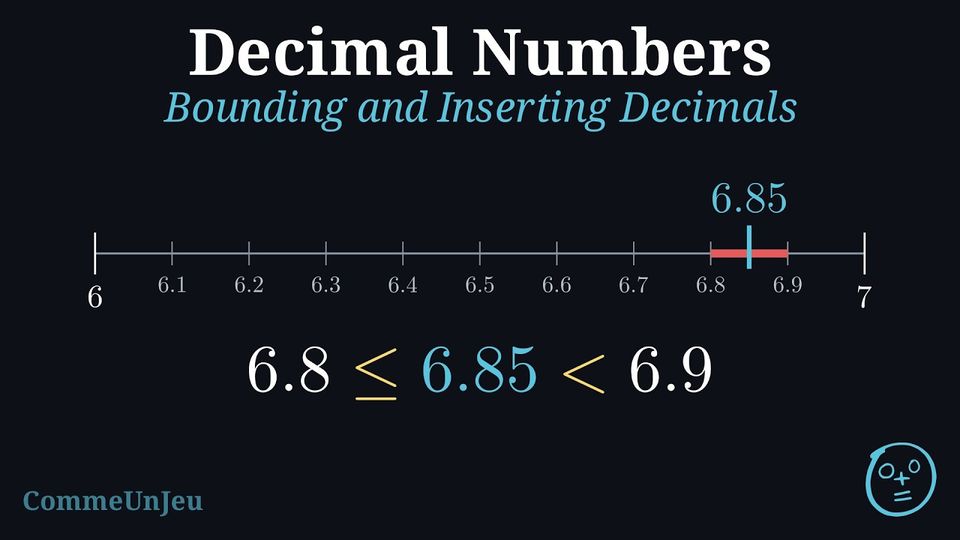
- To bound a decimal between two consecutive whole numbers: the whole part, the whole number written before the decimal point, gives the lower bound, and the next whole number gives the upper bound. For \(6.85\): $$6\leq 6.85<7$$ The sign \(\leq\) reads “is less than or equal to”: the number can be equal to its lower bound (\(6\leq 6<7\)), never to its upper bound.
- To bound a decimal between two consecutive tenths: keep the digits up to the tenths place: they give the lower bound; the next tenth gives the upper bound. For \(6.85\): $$6.8\leq 6.85<6.9$$ Here too, the number can be equal to its lower bound: \(6.1\leq 6.1<6.2\).

- To insert a decimal between two given numbers: first write both numbers with the same number of decimal places, then look for the numbers that lie between them: between \(2.3\) and \(2.6\) lie \(2.4\) and \(2.5\). Between two consecutive whole numbers, or between two consecutive tenths, no number with the same number of decimal places fits: write both numbers with one more decimal place. Between \(5.7=5.70\) and \(5.8=5.80\), we can insert \(5.71\), \(5.72\), …, \(5.79\).
Example
- Bound \(7.06\) between two consecutive whole numbers.
- Bound \(7.06\) between two consecutive tenths.
- Find three decimal numbers between \(9.6\) and \(9.7\).
- The whole part of \(7.06\) is \(7\), and the next whole number is \(8\), so: $$7\leq 7.06<8$$
- The digits of \(7.06\) up to the tenths place give \(7.0\): the tenths digit is \(0\). The next tenth is \(7.1\), so: $$7.0\leq 7.06<7.1$$ that is, \(7\leq 7.06<7.1\). On a half-line graduated in hundredths from \(7\) to \(7.1\), the number \(7.06\) is \(6\) graduations after \(7\):

- We write both numbers with one more decimal place: \(9.6=9.60\) and \(9.7=9.70\). The new graduations \(9.61\), \(9.62\), …, \(9.69\) all lie between them. For example: $$9.6<9.62<9.65<9.68<9.7$$

Example — Bounding and Inserting Decimal Fractions
- Bound \(\dfrac{347}{100}\) between two consecutive whole numbers, then between two consecutive tenths.
- Give a decimal fraction between \(\dfrac{3}{10}\) and \(\dfrac{4}{10}\).
- \(\dfrac{347}{100}=3.47\): its whole part is \(3\), so \(3<\dfrac{347}{100}<4\). In hundredths, the tenths \(\dfrac{34}{10}\) and \(\dfrac{35}{10}\) are \(\dfrac{340}{100}\) and \(\dfrac{350}{100}\), and \(340<347<350\): $$\dfrac{34}{10}<\dfrac{347}{100}<\dfrac{35}{10}.$$
- In hundredths, \(\dfrac{3}{10}=\dfrac{30}{100}\) and \(\dfrac{4}{10}=\dfrac{40}{100}\): between them lie \(\dfrac{31}{100}\), \(\dfrac{32}{100}\), …, \(\dfrac{39}{100}\). For example \(\dfrac{3}{10}<\dfrac{35}{100}<\dfrac{4}{10}\): \(\dfrac{35}{100}\) is exactly halfway.
Skills to practice
- Bounding a Decimal Between Two Consecutive Whole Numbers
- Bounding a Decimal Between Two Consecutive Tenths
- Inserting a Decimal Between Two Numbers
- Comparing, Bounding and Inserting Decimal Fractions
VI
Going further
Skills to practice
- Explaining Decimal Fractions and Digits
- Justifying a Comparison
- Reconstructing a Number from Clues
- Problems
- Quiz
Jump to section