International Baccalaureate · PYP 1
Subtraction Within 20
I
What is Subtraction?
You have 13 cubes and you give 5 cubes away. 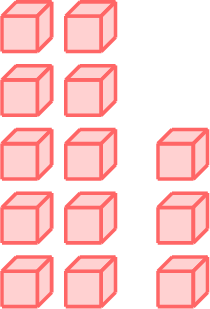 \(\quad\) take away \(\quad\)

How many cubes are left?
\(\quad\) take away \(\quad\)
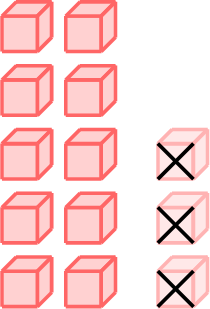
We cross out the 5 cubes given away: they are taken away. 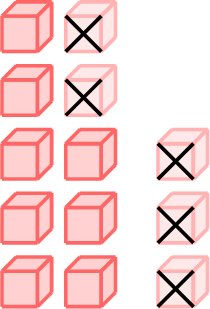
We count the cubes that are not crossed out: there are 8 cubes left. Taking away from a group to find how many are left is called subtraction.
Definition — Subtraction
Subtraction means taking an amount away from a group to find out what is left. This result is called the difference. - The minus sign (\(-\)) tells us to subtract.
- The equals sign (\(=\)) shows that what is on one side is the same amount as what is on the other side.
- With numbers: $$13 - 5 = 8$$
- With cubes: \(-\) \(=\)
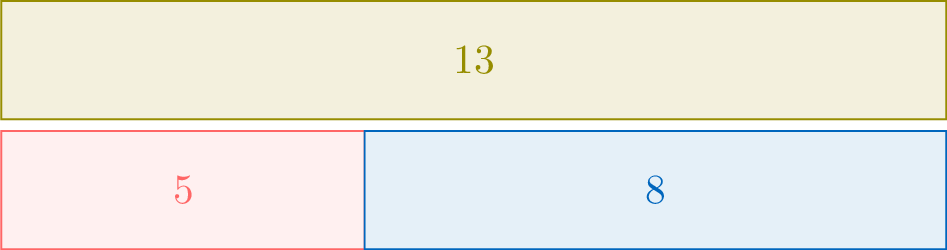
- With part-whole model:
Method — Subtracting by Counting Back
One way to subtract is to count back: start with the first number, then count backward.Solve: \(13 - 5 = ?\)
- Step 1: Start with the first number. Keep the number 13 in your head and say it out loud: “Thirteen.”
- Step 2: Get your fingers ready. The second number, 5, tells you how many steps to count back. Hold up 5 fingers to keep track of your steps.

- Step 3: Count back from 13. Now, put down one finger for each number you say as you count backward: “Twelve, eleven, ten, nine, eight.”
- Say “Twelve” \(\rightarrow\) Put down 1st finger.
- Say “Eleven” \(\rightarrow\) Put down 2nd finger.
- Say “Ten” \(\rightarrow\) Put down 3rd finger.
- Say “Nine” \(\rightarrow\) Put down 4th finger.
- Say “Eight” \(\rightarrow\) Put down 5th finger.
Subtracting Several Numbers
With several numbers in a subtraction, the order matters: we subtract from left to right, one number at a time.
Compute \(\textcolor{colordef}{15}-\textcolor{colorprop}{3}-\textcolor{olive}{2}\).
We first take \(\textcolor{colorprop}{3}\) away from \(\textcolor{colordef}{15}\), then \(\textcolor{olive}{2}\) away from what is left. 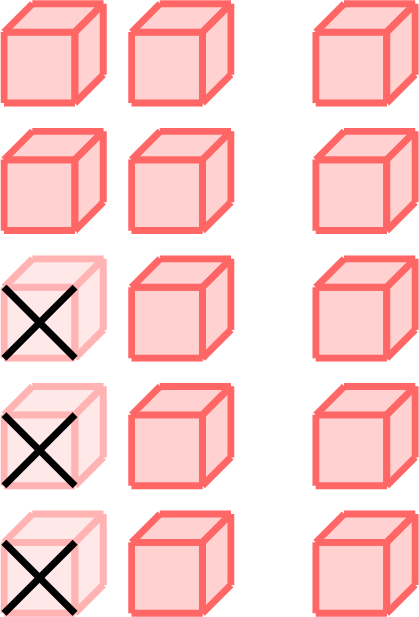 \(\quad\rightarrow\quad\)
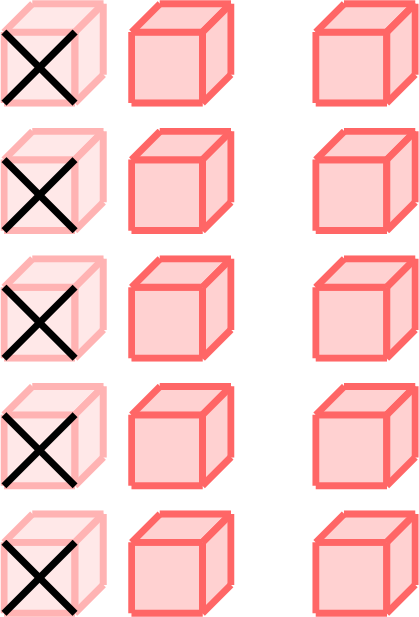
$$\begin{aligned}[t]\textcolor{colordef}{15}-\textcolor{colorprop}{3}-\textcolor{olive}{2} &= 12-\textcolor{olive}{2} && \text{(\(\textcolor{colordef}{15}-\textcolor{colorprop}{3}=12\))}\\
&=10\end{aligned}$$
Compute \(\textcolor{colordef}{15}-\textcolor{colorprop}{3}-\textcolor{olive}{2}\).
We first take \(\textcolor{colorprop}{3}\) away from \(\textcolor{colordef}{15}\), then \(\textcolor{olive}{2}\) away from what is left.
\(\quad\rightarrow\quad\) Skills to practice
- Subtracting by Taking Away Ones
- Subtracting by Taking Away Ones and One Ten
- Subtracting Multiple Numbers
II
Subtracting on the Number Line
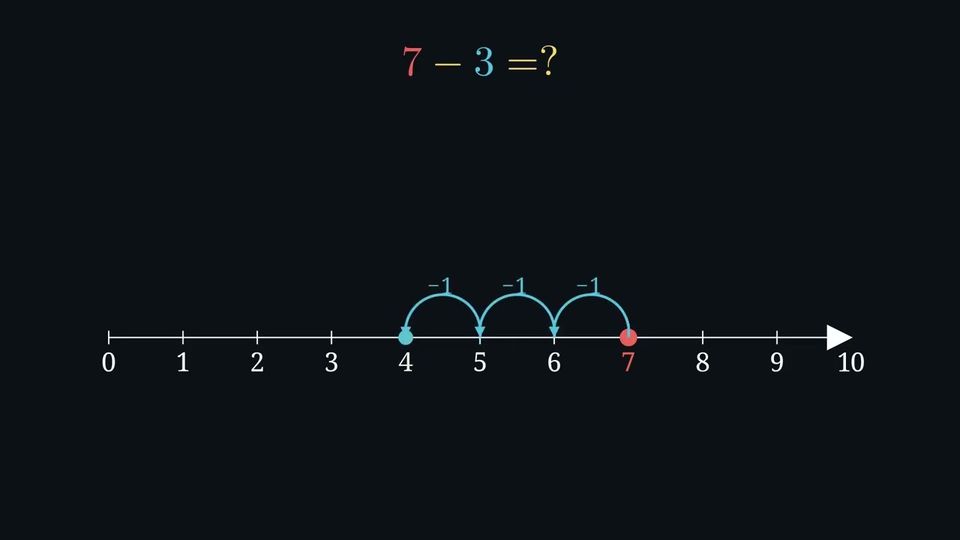
Method — Using a Number Line to Subtract
We can also use a number line to subtract: subtracting means taking steps backward on the line.Solve: \(7 - 3\)
- Start at the first number. Find the number 7 on the number line. This is your starting point.
- Jump backward. The second number, 3, tells you how many jumps to make. Since we are subtracting, we move to the left, where the numbers get smaller. Make 3 jumps backward.
- Find your landing spot. The number you land on is the answer.

Skills to practice
- Subtracting Using the Number Line
III
Making a Ten to Subtract
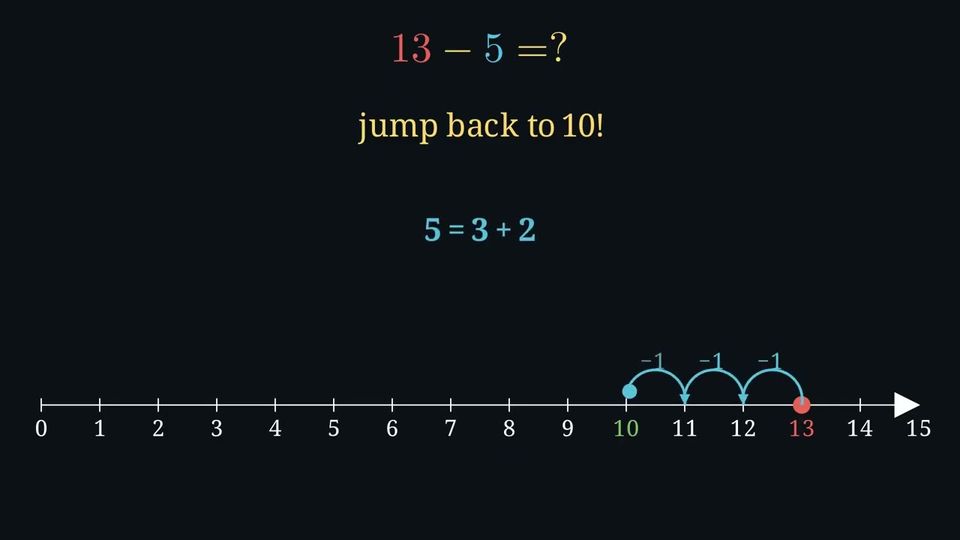
Method — Making a Ten to Subtract
With the “subtract to make 10” strategy, we break the subtraction into two smaller, easier steps: first, we jump back to 10, and then we subtract the rest.Solve: \(13 - 5\)
- Start at the first number, which is 13.
- Jump back to 10. How many steps do we take to get from 13 to 10? We take 3 steps back.
- Figure out the rest. We needed to subtract a total of 5. We already subtracted 3. How many more do we need to subtract? We can break 5 into 3 and 2 (\(5 = 3 + 2\)). So, we still need to subtract 2 more.
- Take the final jump. From 10, jump back 2 more steps. You land on 8.
\(-\)  \(=\) \(-\)
 \(-\)

\(\quad\)
 \(\textcolor{white}{-}\)
 \(=\)
 \(-\)
\(\quad\)
\(\textcolor{white}{-}\) \(=\) By breaking 5 into 3 and 2, we can solve the problem easily:$$\begin{aligned}[t]13 - 5 &= 13 - 3 - 2 && \text{(break \(5\) into \(3+2\))}\\ &= 10 - 2 && \text{(\(13-3=10\))}\\ &= 8\end{aligned}$$ So, \(13 - 5 = 8\).
Skills to practice
- Breaking Down Numbers to Make Ten
- Subtracting from Ten
- Making 10 after Breaking Down Numbers
- Subtracting Numbers Within 20
IV
Understanding Inverse Operations
We know that \(3+2=5\). Can we find \(5-2\) without counting the cubes again?
Here is what happens.
Here is what happens.
- First, we add. If you have 3 red cubes and you get 2 blue cubes, you have 5 cubes in total. $$ 3 + 2 = 5 $$

- Now, we subtract. If you start with those 5 cubes and take away the 2 blue ones, you are left with the 3 red cubes you started with. $$ 5 - 2 = 3 $$

Proposition — Link Between Addition and Subtraction
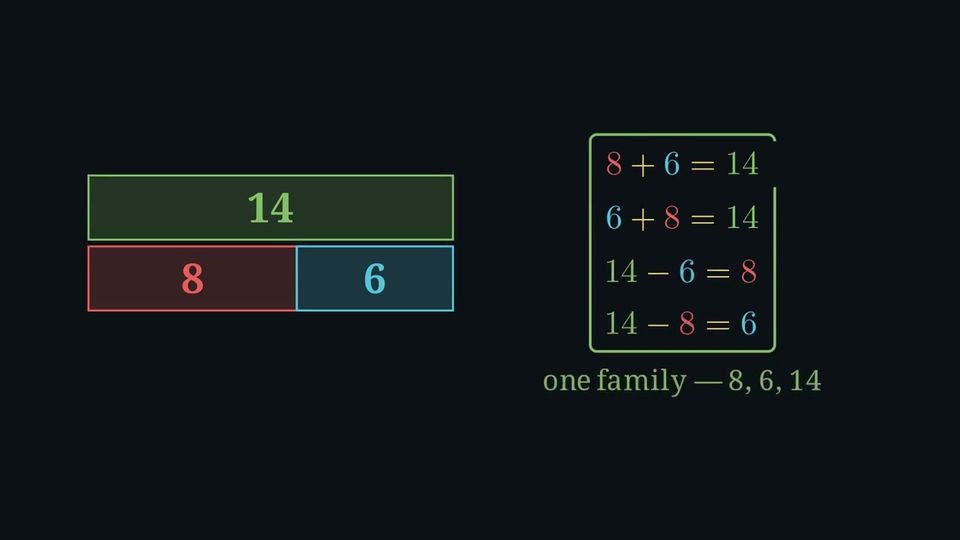
$$\textcolor{colordef}{\text{part 1}} + \textcolor{colorprop}{\text{part 2}}=\textcolor{olive}{\text{total}}$$ $$\textcolor{olive}{\text{total}} -\textcolor{colordef}{\text{part 1}} = \textcolor{colorprop}{\text{part 2}} \quad\quad \textcolor{olive}{\text{total}} -\textcolor{colorprop}{\text{part 2}} =\textcolor{colordef}{\text{part 1}} $$ 
Example
$$ \textcolor{colordef}{8} + \textcolor{colorprop}{6}=\textcolor{olive}{14} $$ $$ \textcolor{olive}{14} - \textcolor{colorprop}{6} = \textcolor{colordef}{8}\qquad \textcolor{olive}{14}- \textcolor{colordef}{8} = \textcolor{colorprop}{6} $$ 
Method — Using Addition to Solve Subtraction (Counting Up)
Because addition and subtraction are linked, you can solve a subtraction problem by thinking of it as a “missing part” addition problem.To solve \(\textcolor{olive}{13} - \textcolor{colordef}{9}\), ask yourself: “What do I add to 9 to make 13?”
- Start at \(\textcolor{colordef}{9}\).
- Count up until you reach \(\textcolor{olive}{13}\): “10, 11, 12, 13.”
- You counted \(\textcolor{colorprop}{4}\) numbers: \(10\), \(11\), \(12\), \(13\).
Skills to practice
- Finding the Number Taken Away
- Finding the Total in Subtraction Problems
- Finding the Missing Part
- Subtracting by Thinking Addition
- Finding Subtraction Using Addition
V
Problem-Solving with Part-Whole Models
Method — Steps to Solve Word Problems
These are the four steps already known (search, try, check, say), made more precise by the model: searching becomes understanding the story; trying becomes drawing a model and choosing the operation; checking and saying are in the last step: we calculate, make sure the answer makes sense, then give it. - Understand the Story: Read the problem to identify the parts and the whole.
- Draw a Model: Use a part-whole bar model to organize the information.
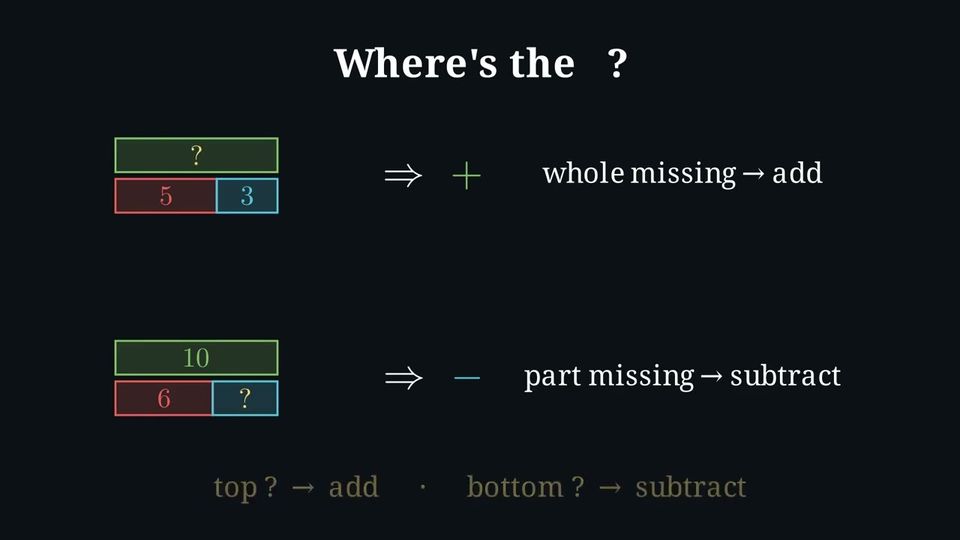
- Choose the Operation: If the whole is unknown, you add the parts. If a part is unknown, you subtract the known part from the whole.
- Solve and Check: Calculate the answer and make sure it makes sense in the context of the story.
Example
Léa has 5 candies, and her friend gives her 3 more. How many candies does Léa have in total? - Analysis: We know the two parts (5 and 3) and need to find the whole (total). We must add.
- Model:
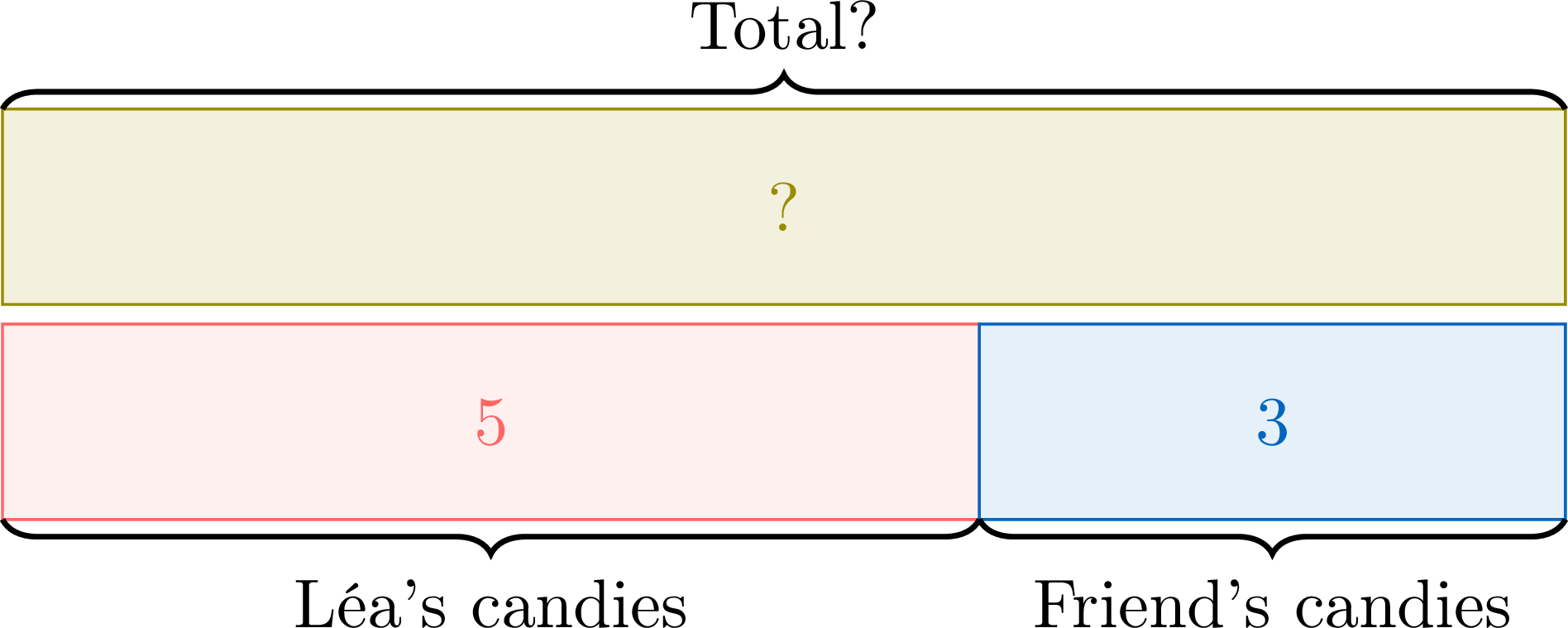
- Solve: \(\textcolor{colordef}{5}+\textcolor{colorprop}{3}=\textcolor{olive}{8}\). Léa has \(\textcolor{olive}{8}\) candies in total.
Example
A box holds 10 crayons. 6 crayons are red and the rest are blue. How many crayons are blue? - Analysis: We know the whole (10) and one part (6). We must subtract to find the other part.
- Model:
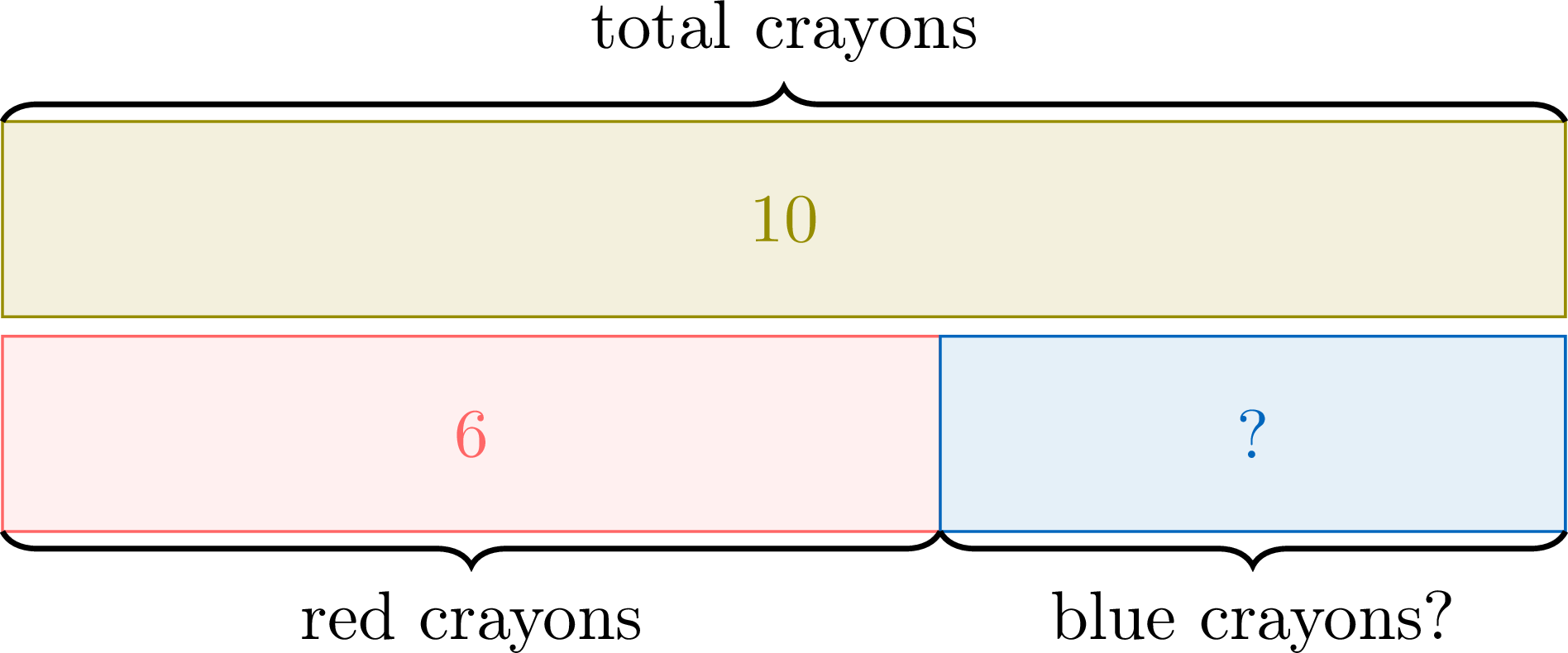
- Solve: \(\textcolor{olive}{10}-\textcolor{colordef}{6}=\textcolor{colorprop}{4}\). There are \(\textcolor{colorprop}{4}\) blue crayons.
Example
This afternoon, Emma put 6 flowers in her vase. Now the vase holds 13 flowers. How many flowers were in the vase this morning? - Analysis: The whole is the number of flowers now (13). One part is what was added (6). The other part is the number at the start: we subtract.
- Model:
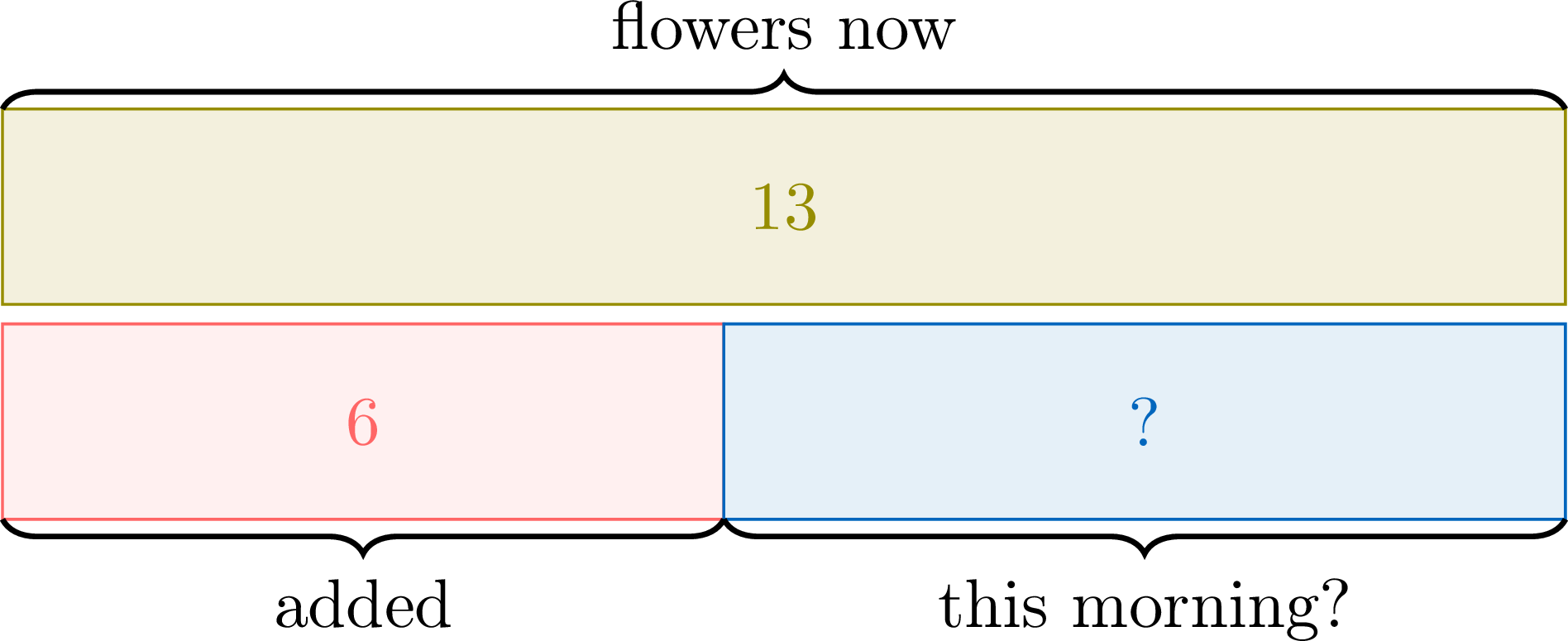
- Solve: \(\textcolor{olive}{13}-\textcolor{colordef}{6}=\textcolor{colorprop}{7}\). There were \(\textcolor{colorprop}{7}\) flowers this morning.
Skills to practice
- Finding the Whole
- Finding a Part or the Starting Number
VI
Going further
Skills to practice
- Completing Subtraction Equations with Pictures
- Linking Addition and Subtraction with Pictures
- Quiz
Jump to section