International Baccalaureate · PYP 3
3D Shapes
I
Justifying What a Solid Is
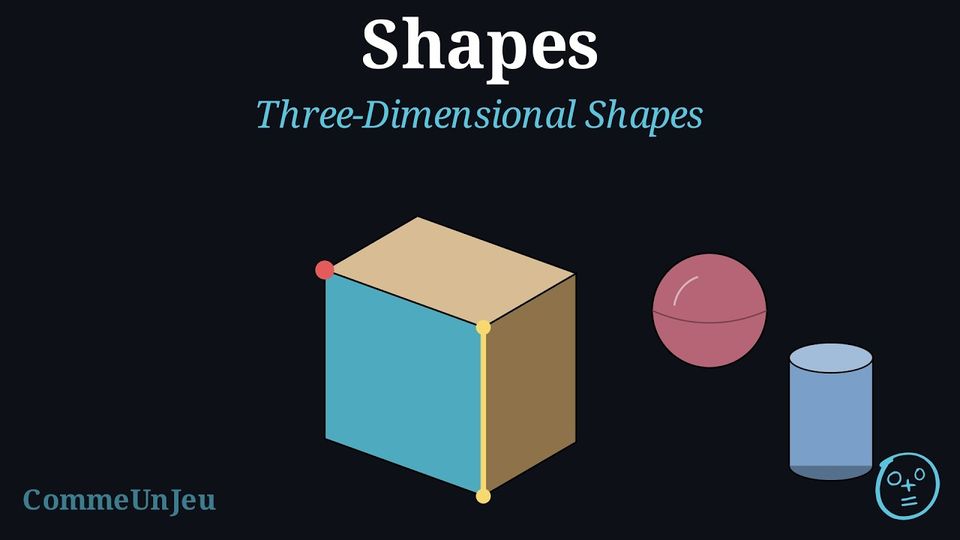
Method — Justifying What a Solid Is
Naming a solid is not enough: we say why. Three things are told, always in the same order: - the number and the nature of its faces — how many, and what shape they are;
- the number of its vertices — the corners where edges meet;
- the number of its edges — the segments where two faces meet.
| Solid | Faces | Vertices | Edges |
| Cube | \(6\) squares | \(8\) | \(12\) |
| Rectangular prism (a box) | \(6\) rectangles | \(8\) | \(12\) |
Example
Justify what each solid is. 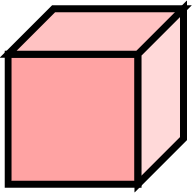
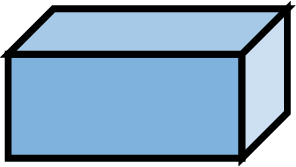
The first solid has \(6\) faces, and they are all squares; it has \(8\) vertices and \(12\) edges: it is a cube. The second has \(6\) faces too, but they are rectangles; it has \(8\) vertices and \(12\) edges: it is a rectangular prism (a box).
Skills to practice
- Justifying What a Solid Is
II
The Pyramid
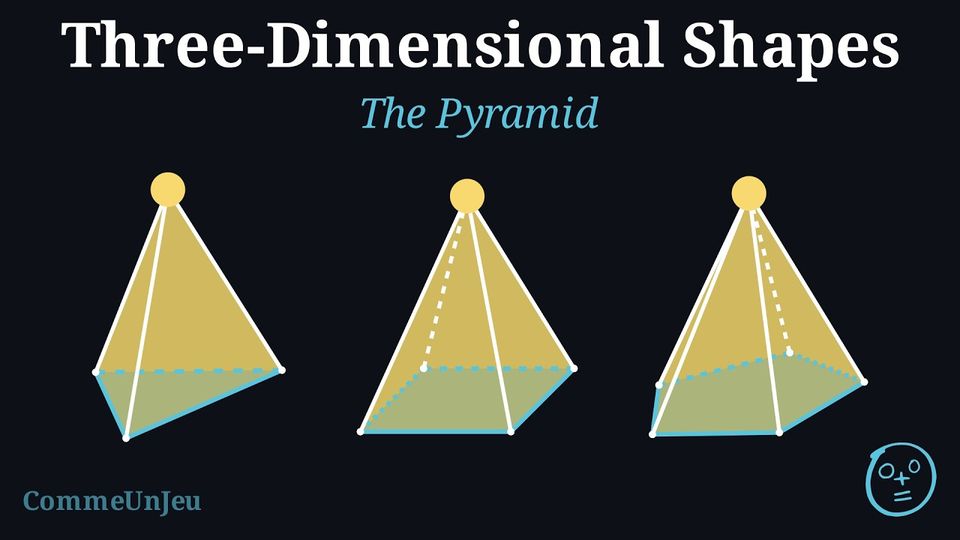
Tom has three pointed solids. Their bottom faces are different: a triangle for the first, a square for the second, a pentagon for the third. He says: “Their bases are not the same, so these are not three pyramids.” Is he right? 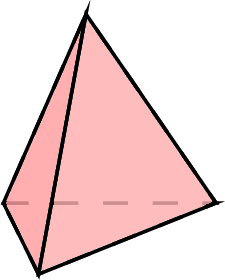
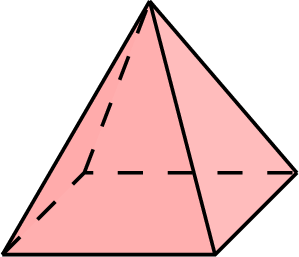
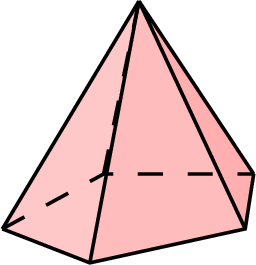
Tom is wrong. Look at the other faces: on all three solids they are triangles, and all these triangles meet at one and the same point, at the top. Only the bottom face changes. All three are pyramids: what makes a pyramid is the triangles meeting at a point, not the shape of its base — which is why a pyramid is named after its base.
Definition — The Faces of a Pyramid
In a pyramid, all the faces are triangles that share one common vertex — called the apex — except possibly one face, the base, which is a polygon with three sides or more.The pyramid is named after its base: a pyramid with a square base, with a pentagonal base…
| Base | Faces | Vertices | Edges |
| Triangle | \(4\) (\(4\) triangles) | \(4\) | \(6\) |
| Square | \(5\) (\(4\) triangles \(+ 1\) square) | \(5\) | \(8\) |
| Pentagon | \(6\) (\(5\) triangles \(+ 1\) pentagon) | \(6\) | \(10\) |
Example — Justifying What a Pyramid Is
Justify what this solid is, then count its vertices and its edges. 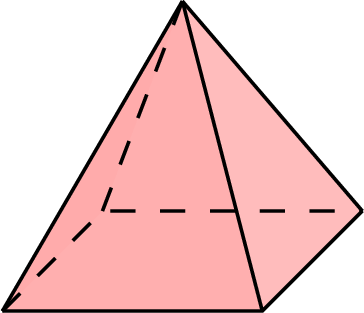
Its base is a square. The four other faces are triangles that meet at one common vertex: it is a pyramid with a square base. Its vertices: the \(4\) corners of the square and the apex, so \(5\). Its edges: the \(4\) sides of the square and the \(4\) segments going up to the apex, so \(8\).
Skills to practice
- Counting on a Pyramid
- Justifying What a Pyramid Is
III
Drawing Three-Dimensional Shapes
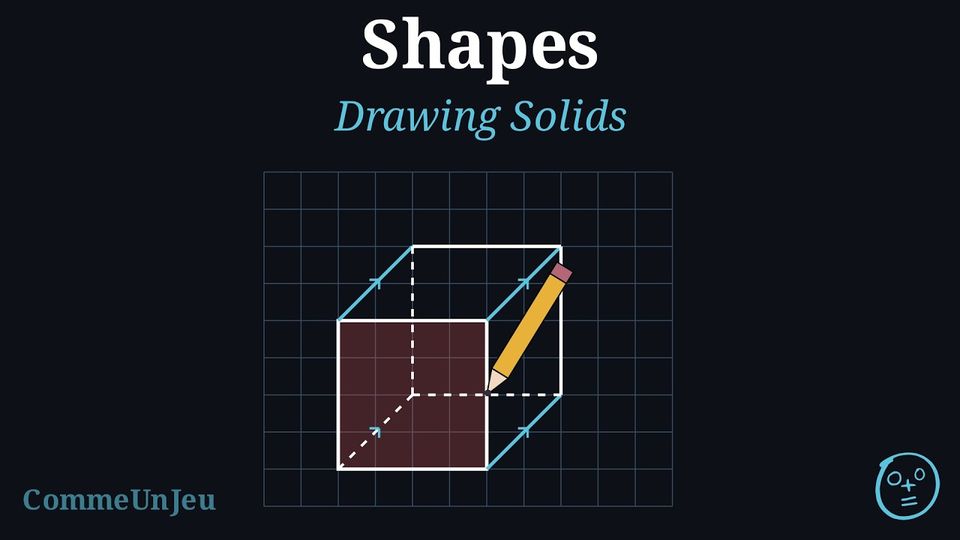
Léa wants to send a friend the picture of a wooden block she is holding, but she may use only a flat drawing on paper. On the paper she can show the front of the block, yet the back stays out of sight: some edges of the block fall behind the faces she can see. If she leaves those edges out, the friend cannot tell whether the block is a closed box or an open shell. 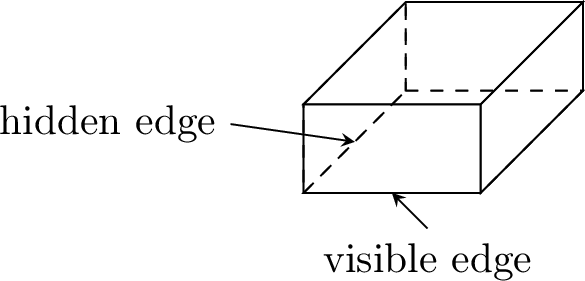
Instead of trusting the picture to look right, Léa describes the block by its parts: it has 6 faces, 12 edges, and 8 vertices, and every face is a rectangle. To draw it faithfully, she keeps the edges she can see as solid lines and draws the edges that fall behind as dashed lines. The flat drawing then carries the whole solid: a 2-D code her friend can read back into the 3-D block.
Method — Visible and Hidden Edges
When we draw a 3D (three-dimensional) shape on paper, we see it from one viewpoint only: some of its edges are behind the shape and cannot be seen. These are called hidden edges. To show that an edge is hidden but still part of the shape, we draw it with dashed lines. Solid lines show the edges we can see. Example — Identifying a Solid Seen in Perspective
Which solid is drawn here? The dashed lines are the hidden edges. 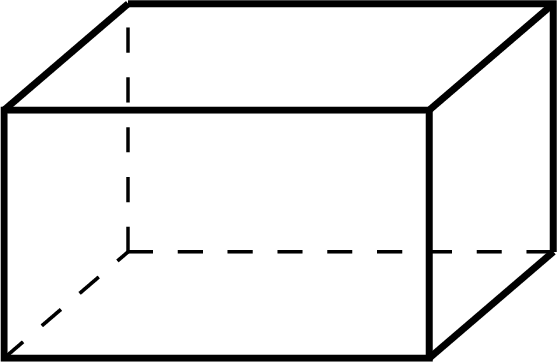
We count on the drawing, hidden edges included: \(6\) faces, \(8\) vertices, \(12\) edges. The front face is longer than it is high: it is not a square, so the solid is not a cube. It is a rectangular prism (a box). Three edges are dashed: they are behind the solid, and they meet at the hidden vertex — the one we would not see if the box were made of wood.
Skills to practice
- Recognising a Solid
- Counting and Drawing Hidden Edges
IV
The Net of a Cube
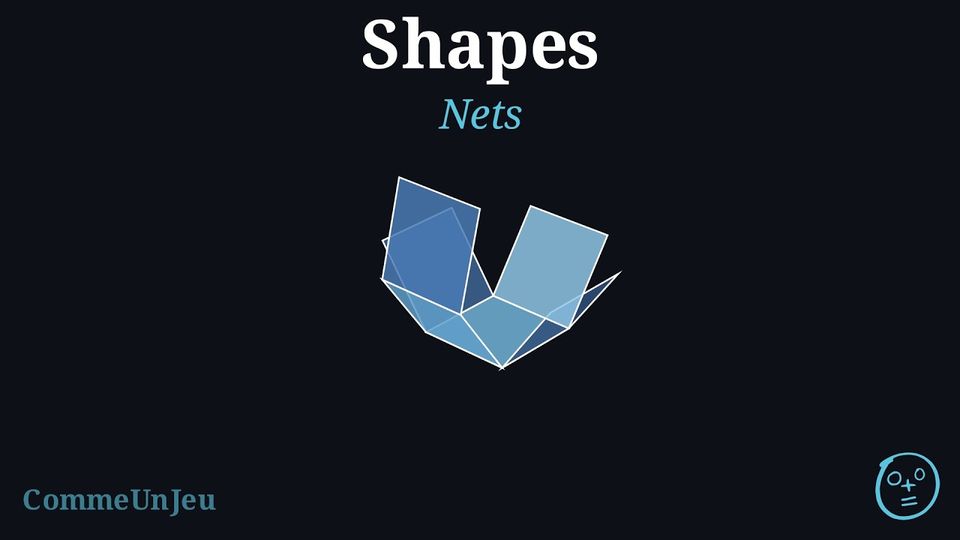
Nour unfolds a cardboard cube and lays it flat on the table. What does she see? 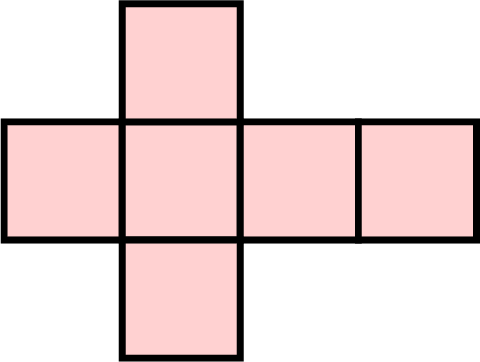
She sees \(6\) squares, all of the same size, joined along their sides. Each square was one face of the cube. Folded back up along the joins, the flat figure becomes the cube again.
Definition — Net
A net of a solid is a flat figure that can be folded up, or rolled up, to make that solid. When the solid has only flat faces and no curved surface — a cube, a rectangular prism (a box), a pyramid, a prism — the net is folded along the edges: the folds are the lines inside the net. A cylinder and a cone have a net too, but their curved surface has to be rolled rather than folded. A ball has no net at all: no flat sheet can be wrapped around it without creasing. 
Method — Recognising a Net of a Cube
To tell whether a flat assembly of polygons is a net of a cube, three checks, in this order: - Count the faces: there must be exactly \(6\).
- Check their nature and their size: all \(6\) must be squares, and all of the same size — a cube has equal faces.
- Fold mentally: every square must land on a different face, with no two squares falling on the same one, and the \(6\) faces must all be covered.
Example
Is this assembly a net of a cube? 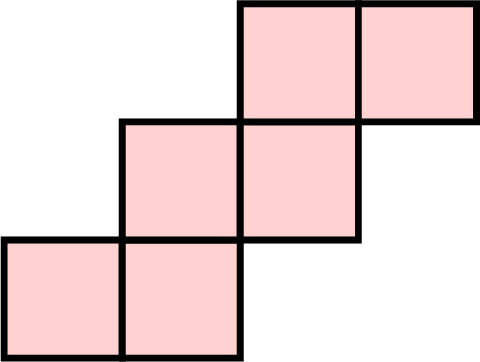
Six faces: yes. Six squares of the same size: yes. Folding: there is no strip of \(4\) squares here, so we fold step by step. Start from the square at the bottom left and lay it down as the floor; each next square of the staircase folds onto a face that is still free, and after the sixth the \(6\) faces are covered, with no two squares on the same one. It is a net of a cube. A net does not have to look like a cross.
Example
And this one? 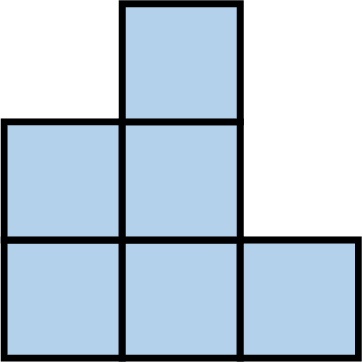
Six faces: yes. Six equal squares: yes — the first two checks pass. But look at the four squares that form a \(2 \times 2\) block, at the bottom left. Folding a block like that brings two of its squares onto the same face of the cube. It is not a net: the position of the faces matters as much as their number.
Skills to practice
- Recognising a Net
- Arguing About a Net
V
Going further
Skills to practice
- Counting on New Solids
- Drawing the Hidden Edges
- Quiz
Jump to section