International Baccalaureate · PYP 3
Capacity and Volume
I
The Millilitre
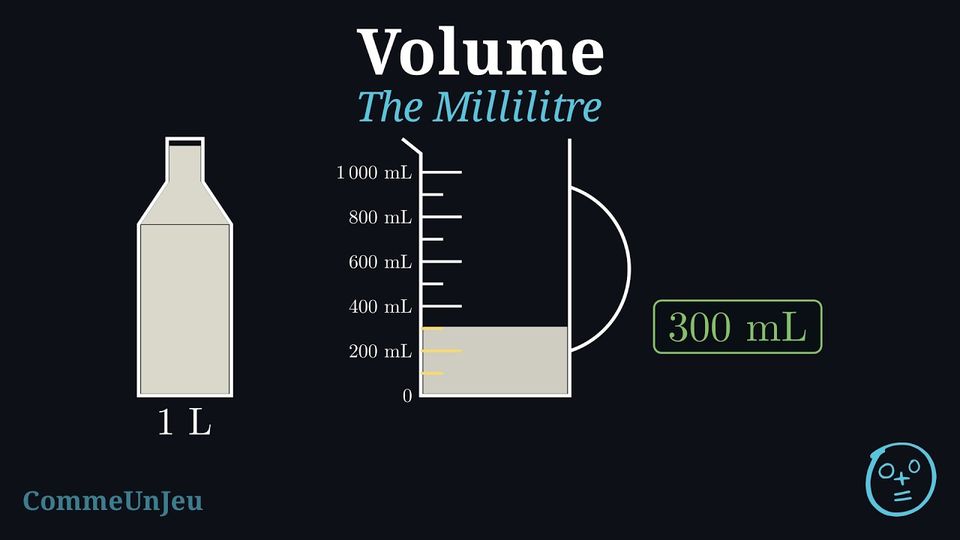
Léa makes pancakes. The recipe asks for \(300~\mathrm{mL}\) of milk. She has a full litre bottle of milk and this measuring jug. 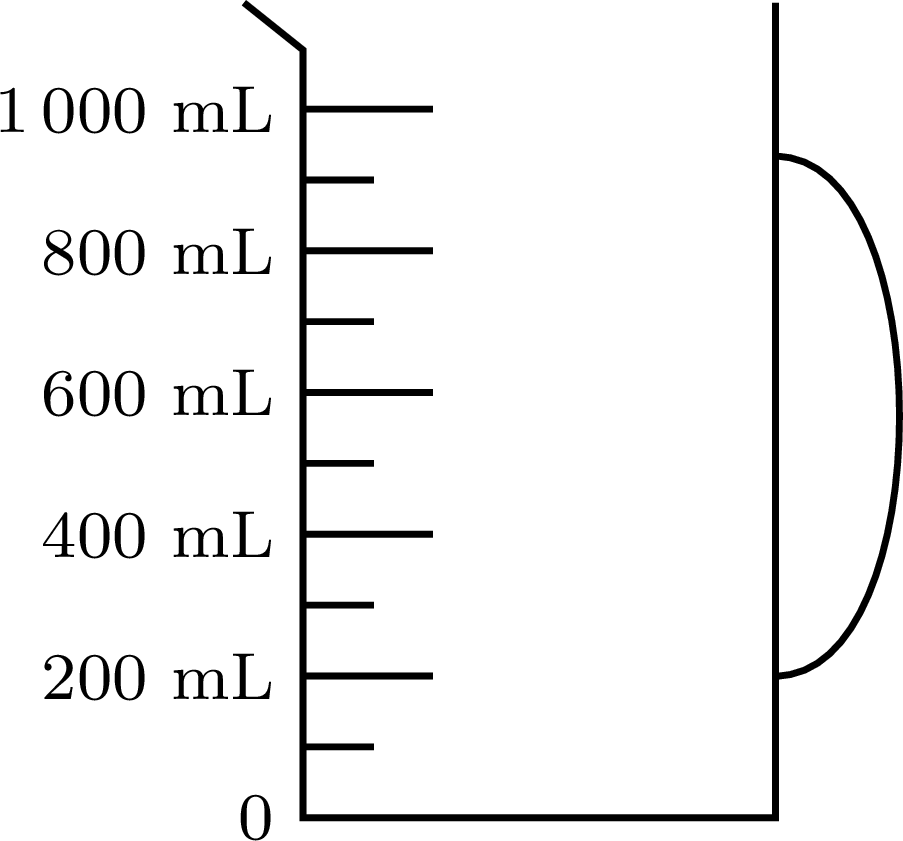
Say why the litre bottle alone cannot measure the milk of the recipe, and how the jug helps.
The bottle has no marks: it can only measure a whole litre, that is \(1\,000~\mathrm{mL}\), the top mark of the jug. \(300~\mathrm{mL}\) is much less: the bottle alone cannot tell when exactly \(300~\mathrm{mL}\) have been poured. The litre is too big a unit for this quantity, so the recipe uses a much smaller unit, the millilitre.
The jug has a mark every \(100~\mathrm{mL}\). Léa pours milk into it up to the third mark: \(100\), \(200\), \(300\). She has exactly \(300~\mathrm{mL}\).
The jug has a mark every \(100~\mathrm{mL}\). Léa pours milk into it up to the third mark: \(100\), \(200\), \(300\). She has exactly \(300~\mathrm{mL}\).
Definition — The Millilitre
The millilitre is a very small unit of capacity, written mL. One litre is one thousand millilitres: $$1~\mathrm{L} = 1\,000~\mathrm{mL}$$ A few benchmarks (approximate values): | a teaspoon | \(5~\mathrm{mL}\) |
| a glass of water | \(200~\mathrm{mL}\) |
| a can of juice | \(330~\mathrm{mL}\) |
| a bottle of water | \(1\,000~\mathrm{mL}\), that is \(1~\mathrm{L}\) |
Method — Reading a Measuring Jug
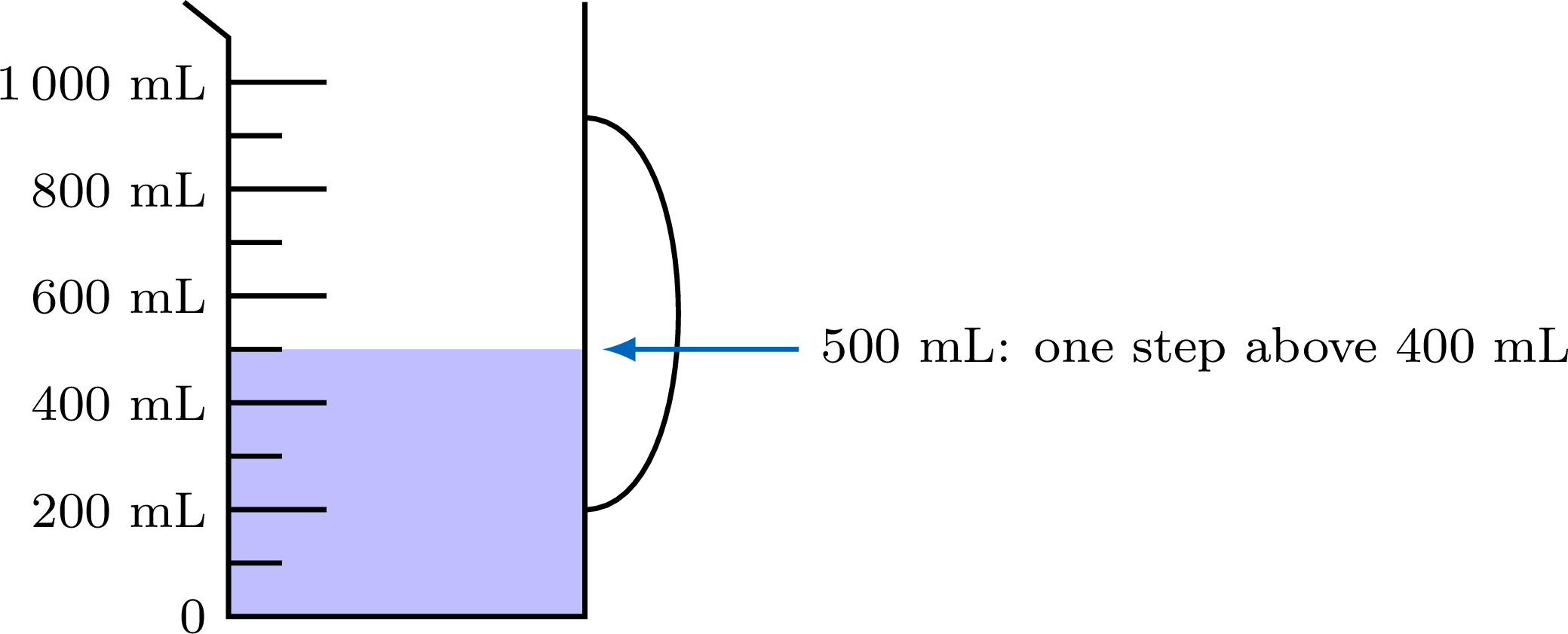
On a measuring jug, the marks go up by equal amounts (for example one mark every \(100~\mathrm{mL}\)), but only some of them carry a number. - Find what one step is worth: take two numbered marks that follow each other and count the steps between them. From \(200~\mathrm{mL}\) to \(400~\mathrm{mL}\), \(2\) equal steps make \(200~\mathrm{mL}\), so one step is \(100~\mathrm{mL}\).
- Start from the numbered mark just below the top of the liquid and add one step for each mark up to it: \(400~\mathrm{mL}\), then \(500~\mathrm{mL}\).
- Read at the top of the liquid, with the eyes level with it and the jug standing flat.
Example
Tom pours water into this measuring jug. 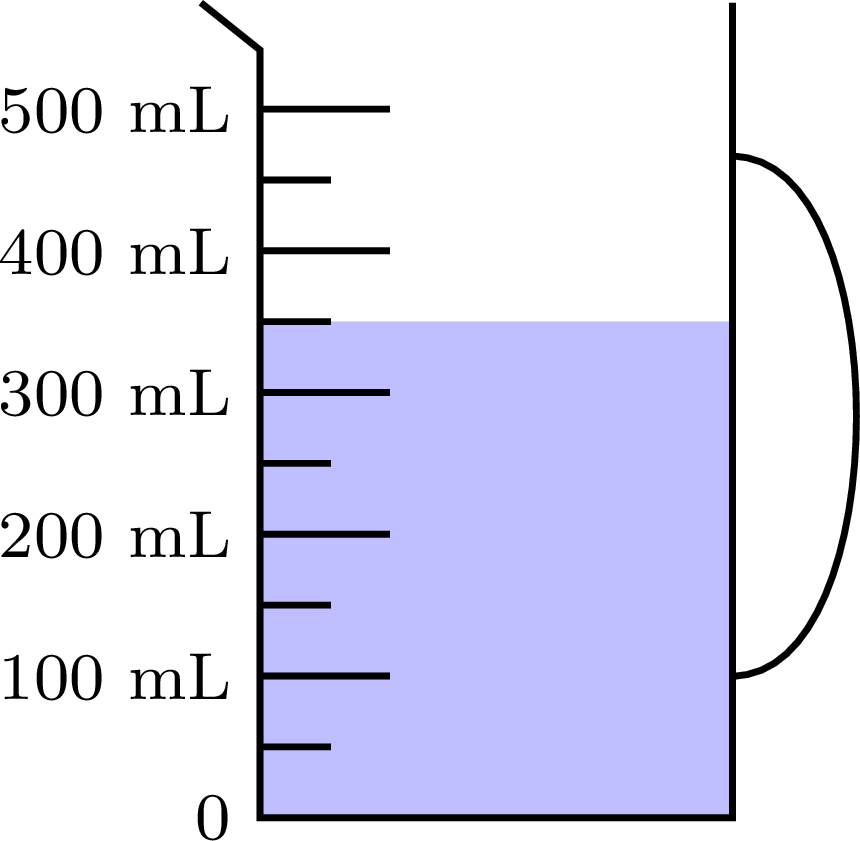
- One step: from \(100~\mathrm{mL}\) to \(200~\mathrm{mL}\), \(2\) equal steps make \(100~\mathrm{mL}\), so one step is \(50~\mathrm{mL}\).
- The level: the numbered mark just below the water is \(300~\mathrm{mL}\), and the water is one step higher.
Method — Converting Litres and Millilitres
Since \(1~\mathrm{L} = 1\,000~\mathrm{mL}\): - From litres to millilitres, each litre becomes \(1\,000~\mathrm{mL}\): \(3~\mathrm{L} = 3\,000~\mathrm{mL}\), and \(2~\mathrm{L}~350~\mathrm{mL} = 2\,000~\mathrm{mL} + 350~\mathrm{mL} = 2\,350~\mathrm{mL}\).
- From millilitres to litres, group the millilitres by thousands: each thousand makes \(1~\mathrm{L}\). \(5\,000~\mathrm{mL} = 5~\mathrm{L}\), and \(1\,750~\mathrm{mL} = 1\,000~\mathrm{mL} + 750~\mathrm{mL} = 1~\mathrm{L}~750~\mathrm{mL}\).
- Check: the millilitres left after the litres are always fewer than \(1\,000\).
Example
- A large jug holds \(4~\mathrm{L}~200~\mathrm{mL}\). Write this capacity in millilitres.
- A bottle of juice holds \(2\,650~\mathrm{mL}\). Write this capacity with litres and millilitres.
- Each litre becomes \(1\,000~\mathrm{mL}\): $$\begin{aligned} 4~\mathrm{L}~200~\mathrm{mL} &= 4\,000~\mathrm{mL} + 200~\mathrm{mL} &&\text{(}4~\mathrm{L} = 4\,000~\mathrm{mL}\text{)}\\ &= \textcolor{colorprop}{4\,200~\mathrm{mL}} \end{aligned}$$
- In \(2\,650\) there are \(2\) thousands and \(650\) left: $$\begin{aligned} 2\,650~\mathrm{mL} &= 2\,000~\mathrm{mL} + 650~\mathrm{mL} &&\text{(the thousands first)}\\ &= \textcolor{colorprop}{2~\mathrm{L}~650~\mathrm{mL}} &&\text{(}2\,000~\mathrm{mL} = 2~\mathrm{L}\text{)} \end{aligned}$$ Check: \(650\) is fewer than \(1\,000\), so no other whole litre can be made.
Method — Comparing Capacities in Litres and Millilitres
To compare or to order capacities, write them all in millilitres, then compare the numbers. - The trap: a big number is not always a big capacity. \(900~\mathrm{mL}\) is less than \(1~\mathrm{L}\), even though \(900\) is bigger than \(1\), because \(1~\mathrm{L} = 1\,000~\mathrm{mL}\).
- To order several capacities, order their numbers of millilitres, then give the answer in the units of the statement.
Example
Order these capacities from the smallest to the biggest: \(1~\mathrm{L}~200~\mathrm{mL}\), \(950~\mathrm{mL}\), \(1\,500~\mathrm{mL}\), \(2~\mathrm{L}\).
Everything goes into millilitres: $$1~\mathrm{L}~200~\mathrm{mL} = \textcolor{colordef}{1\,200}~\mathrm{mL} \qquad 2~\mathrm{L} = \textcolor{colordef}{2\,000}~\mathrm{mL}$$ Then the four numbers are compared: \(950 < 1\,200 < 1\,500 < 2\,000\).
From the smallest to the biggest: \(950~\mathrm{mL}\), \(1~\mathrm{L}~200~\mathrm{mL}\), \(1\,500~\mathrm{mL}\), \(2~\mathrm{L}\).
From the smallest to the biggest: \(950~\mathrm{mL}\), \(1~\mathrm{L}~200~\mathrm{mL}\), \(1\,500~\mathrm{mL}\), \(2~\mathrm{L}\).
Skills to practice
- Choosing Between Litres and Millilitres
- Reading a Measuring Jug
- Converting Litres and Millilitres
- Comparing Capacities in Litres and Millilitres
- Solving Capacity Problems
II
What Is Volume?
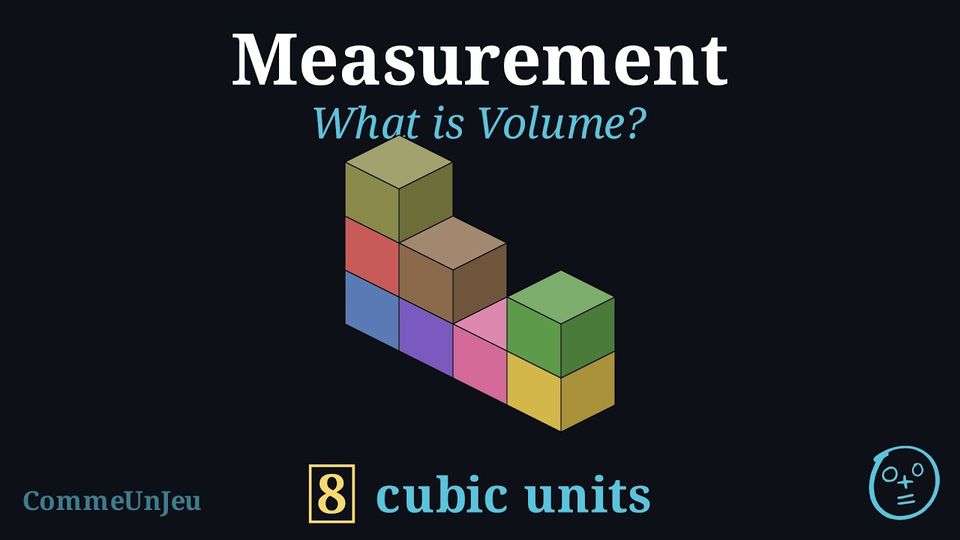
Definition — Volume
The volume of an object is the amount of space it takes up. We measure volume by counting how many cubic units can fit inside it. A cubic unit is a cube with edges that are 1 unit long. 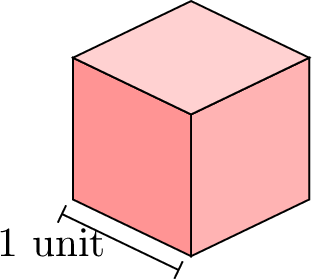
Capacity or Volume?
The capacity of a container is what can be poured into it; the volume of a solid is the room it takes up, counted in unit cubes.
Method — Counting Cubes to Find Volume
To find the volume of a solid made of cubes, simply count the total number of cubes (cubic units) it is made of. A good strategy is to count the cubes in each layer. Example
Find the volume of the solid below. 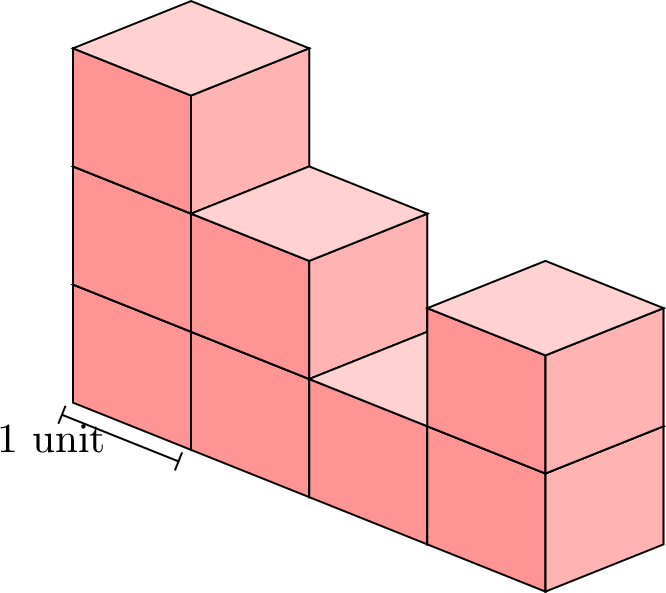
We can find the volume by counting the cubes in the solid. Each small cube has a volume of 1 cubic unit. 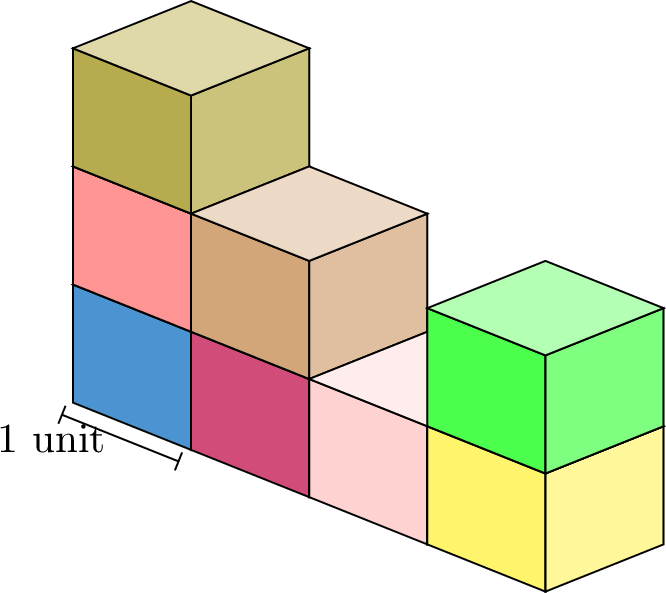
There are \(8\) cubes in total, so: $$ \begin{aligned}[t] \text{Volume} &= 8~\text{cubic units} \end{aligned} $$
Skills to practice
- Counting Cubes Layer by Layer
- Finding the Volume of a Solid
III
Review & Quizz
Skills to practice
- Quiz
Jump to section