International Baccalaureate · PYP 2
Mass and Capacity
I
Units of Mass
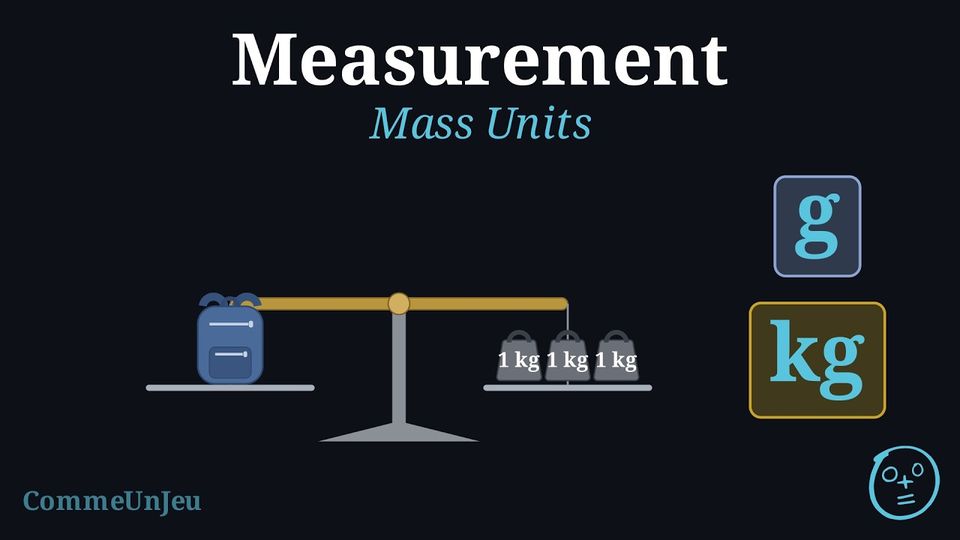
We could use marbles to measure mass, but what if your marbles are heavier than your friend's marbles? You would get different answers. To make sure everyone's measurements are the same, we use standard units. The standard units for mass are the gram and the kilogram.
Definition — Units of Mass
- Gram (\(\mathrm{g}\)) — A small unit of mass. We use grams to measure the mass of light objects, like a small candy or a paper clip.

- Kilogram (\(\mathrm{kg}\)) — A bigger unit of mass. We use kilograms to measure the mass of heavier objects, like a big book or a school bag.

Definition — Balance Scale
A balance scale is a tool used to compare or measure the mass of two objects. It has two pans. The heavier side goes down and the lighter side goes up. If both sides are level, the two objects have the same mass. 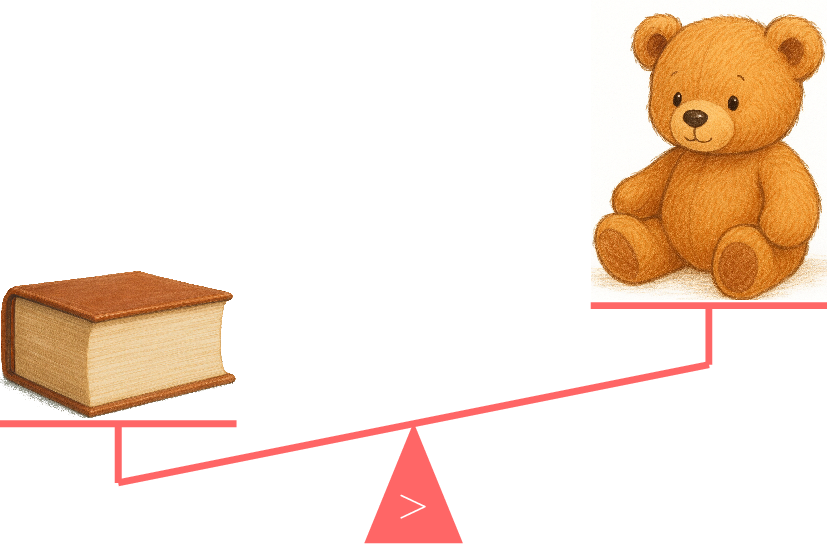
Proposition — Reference Masses
To estimate a mass without weighing, keep a few reference masses in mind (approximate values): | \(1\) g | a paper clip |
| \(100\) g | a bar of chocolate |
| \(1\) kg | a full one-litre bottle of water |
Method — Ordering Masses in Kilograms and Grams
To order masses written in kilograms, in grams, or in both: - Write each mass with its kilograms and its grams: \(1\,000\) g is \(1\) kg; \(1\) kg \(300\) g stays as it is.
- Compare the kilograms first: more kilograms means heavier — the remaining grams are always fewer than \(1\,000\). \(50\) kg is heavier than \(2\) kg \(100\) g.
- Same kilograms: compare the grams. \(1\) kg \(300\) g is heavier than \(1\) kg (\(1\,000\) g).
Example
Order from lightest to heaviest: \(1\) kg \(300\) g, \(1\,000\) g, \(50\) kg, \(2\) kg \(100\) g.
\(1\,000\) g \(= 1\) kg. Kilograms: \(1\), \(1\), \(2\), \(50\). The two masses of \(1\) kg: \(1\) kg (\(0\) g) is lighter than \(1\) kg \(300\) g. Order: \(1\,000\) g \(<\) \(1\) kg \(300\) g \(<\) \(2\) kg \(100\) g \(<\) \(50\) kg.
Skills to practice
- Choosing Grams or Kilograms
- Choosing a Reasonable Estimate
- Measuring the Masses of Objects
- Ordering Masses
II
The Litre
Definition — Capacity
The capacity of a container is the quantity of liquid it can hold. It says what can be poured into it, not how big the container looks.
Tom and Léa fill the same bucket with water. Tom fills it with a mug: he counts \(6\) mugs. Léa fills it with a small glass: she counts \(10\) glasses. 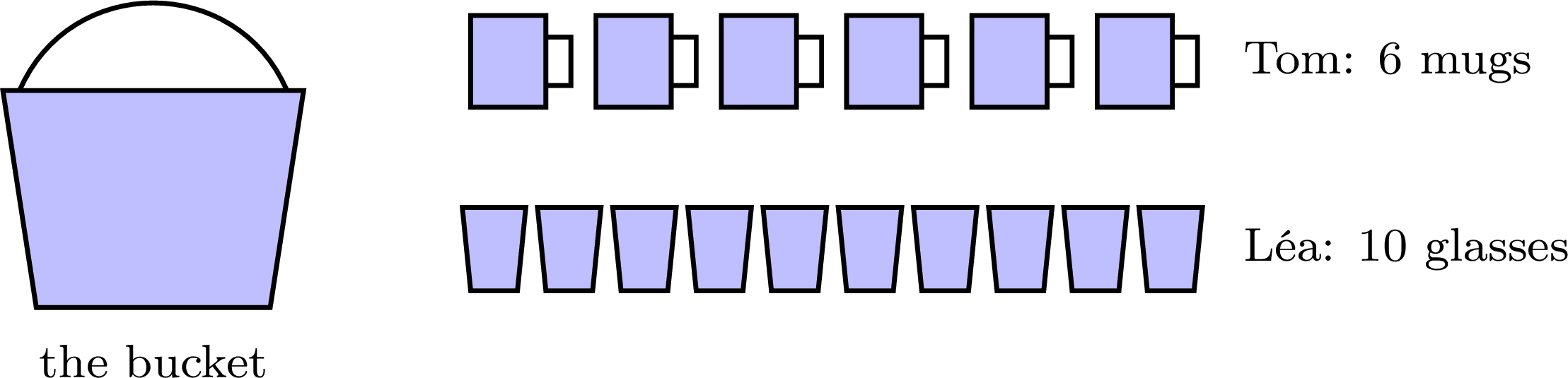
Tom says: “The bucket holds \(6\).” Léa says: “No, it holds \(10\).”
Say why they do not find the same number, and what they can do to agree.
Say why they do not find the same number, and what they can do to agree.
The bucket is the same, but Tom and Léa did not count with the same thing. The mug is bigger than the glass, so fewer mugs are needed: \(6\) mugs and \(10\) glasses fill the same bucket.
A number of mugs or of glasses depends on the cup that is used. To agree, everybody must measure with the same unit. For water and other liquids, this shared unit is the litre.
A number of mugs or of glasses depends on the cup that is used. To agree, everybody must measure with the same unit. For water and other liquids, this shared unit is the litre.
Definition — The Litre
The litre is a unit that measures how much a container can hold. A litre bottle, full of water, holds one litre, written \(1~\mathrm{L}\). 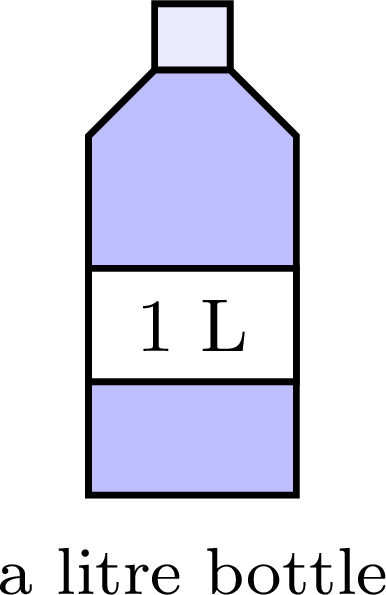
Example
Léa pours a full litre bottle into a jug: the jug is full before the bottle is empty. She fills the litre bottle again and pours it into a pot: the bottle is empty and the pot is not full. 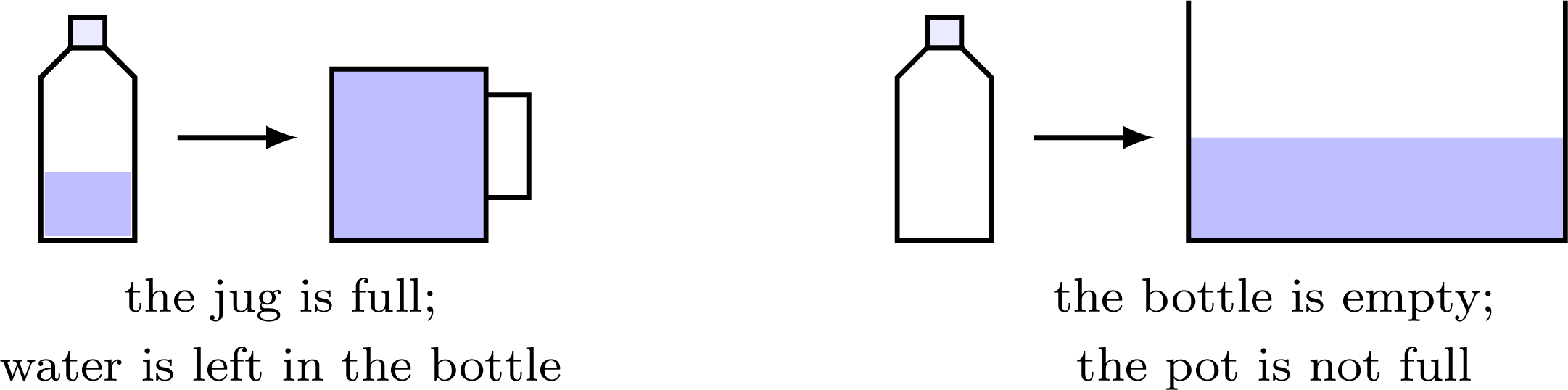
- The jug: it is full and water is still left in the bottle. The litre does not fit in the jug: the jug holds less than \(1~\mathrm{L}\).
- The pot: the whole litre went in and the pot is not full. There is room for more: the pot holds more than \(1~\mathrm{L}\).
Proposition — Capacity Benchmarks
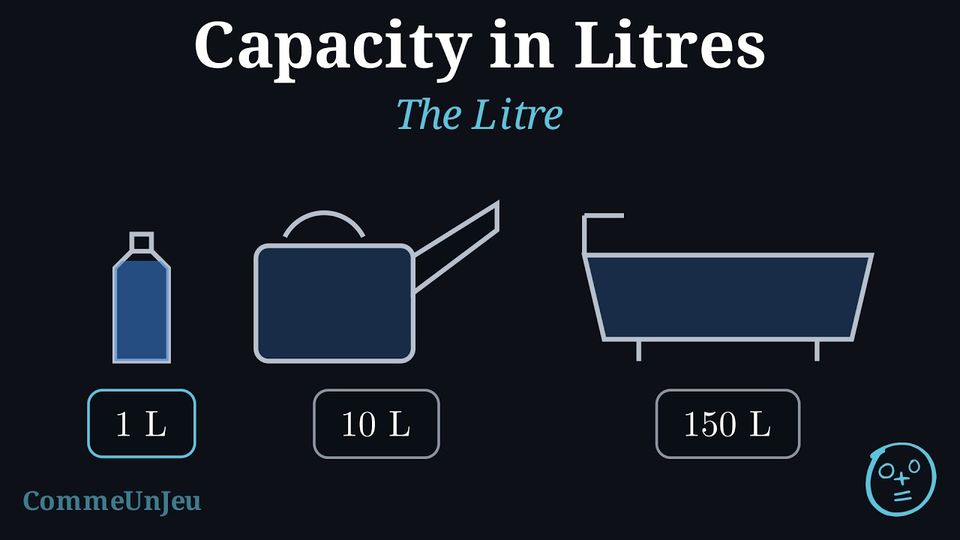
To estimate a capacity without measuring it, keep a few benchmarks in mind (approximate values): | a glass of water | much less than \(1~\mathrm{L}\) |
| a big bottle of water, a carton of milk (labelled \(1~\mathrm{L}\)) | \(1~\mathrm{L}\) |
| a bucket, a watering can | about \(10~\mathrm{L}\) |
| a bath | about \(150~\mathrm{L}\) |
Skills to practice
- Choosing More or Less Than a Litre
- Estimating a Capacity in Litres
III
Measuring and Comparing in Litres
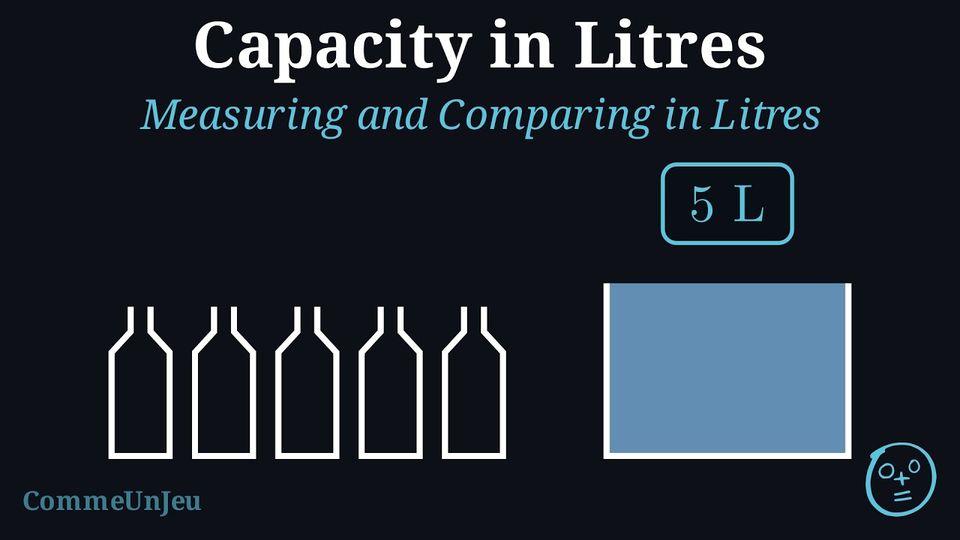
Method — Estimating, Then Checking
To find the capacity of a container in litres: - Estimate: compare the container with the benchmarks and guess its capacity in litres.
- Measure: fill a litre bottle, pour it into the container, and start again until the container is full. When the container becomes full just as the last bottle becomes empty, the number of bottles poured is the capacity in litres. If the container is full before the last bottle is empty, the capacity is between two numbers of litres: after \(4\) full bottles and part of a fifth one, it is more than \(4~\mathrm{L}\) and less than \(5~\mathrm{L}\).
- Check the estimate: compare it with the measure. The closer they are, the better the estimate.
Example
Tom thinks that the pot holds about \(3~\mathrm{L}\). He fills it with a litre bottle: the pot is full exactly when the last of these bottles is empty. 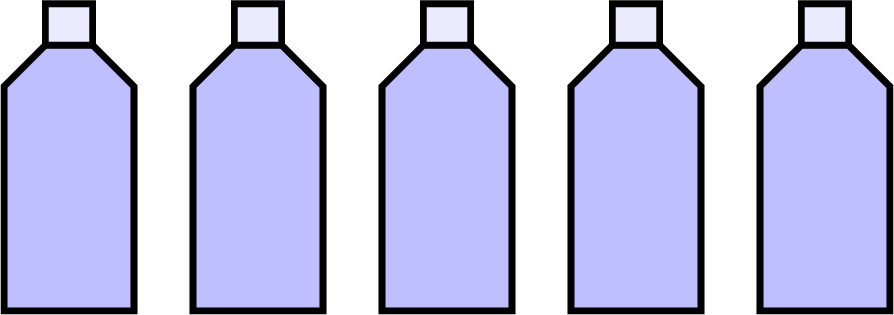
Tom poured \(5\) full bottles of \(1~\mathrm{L}\): $$\begin{aligned} \text{capacity} &= 1~\mathrm{L} + 1~\mathrm{L} + 1~\mathrm{L} + 1~\mathrm{L} + 1~\mathrm{L} &&\text{(one litre per bottle)}\\
&= \textcolor{colorprop}{5~\mathrm{L}} \end{aligned}$$ The pot holds \(5~\mathrm{L}\). Tom guessed \(3~\mathrm{L}\), and \(3 < 5\): his estimate was too small, by \(5 - 3 = 2~\mathrm{L}\).
Method — Reading a Container Marked in Litres
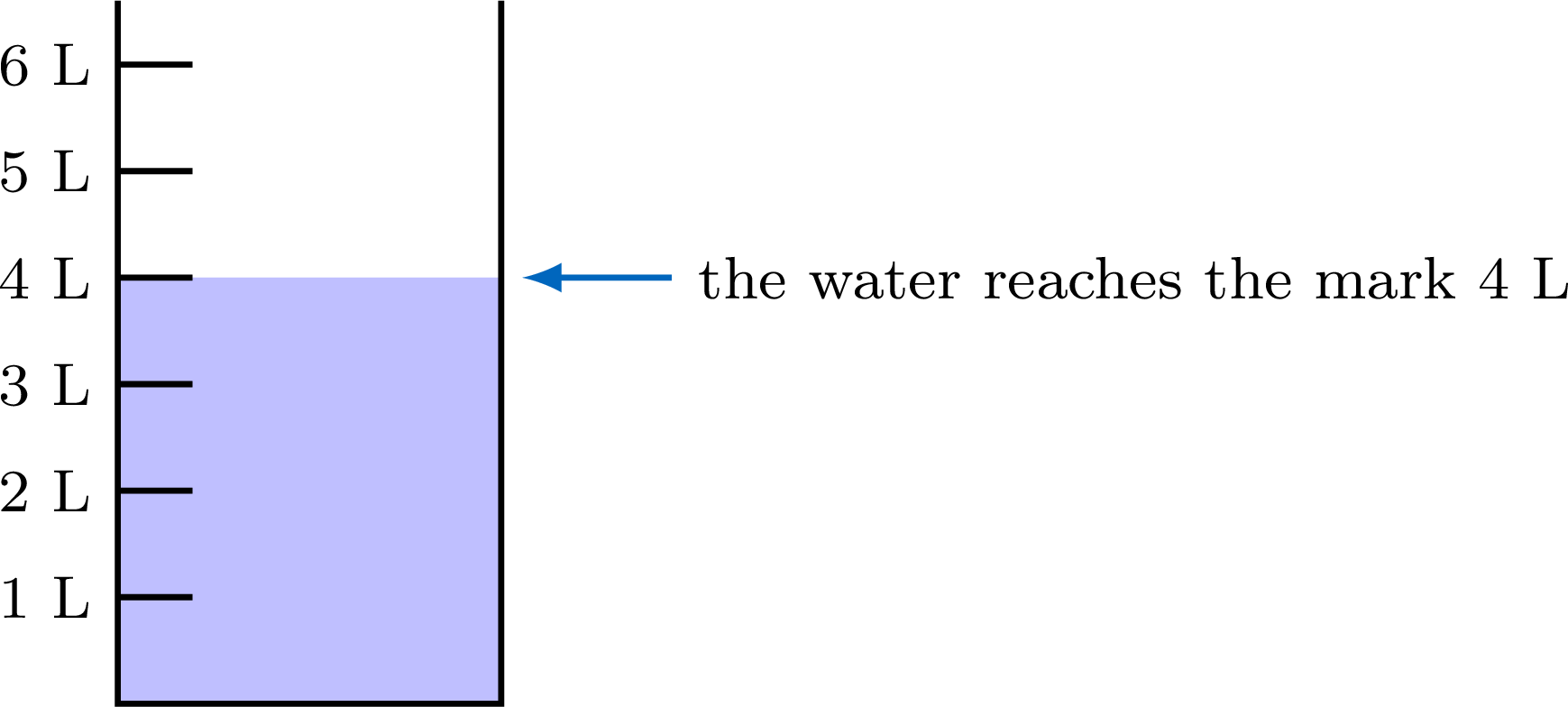
Some containers carry marks, one for each litre. On a container with straight sides, like the ones drawn here, the marks are all the same distance apart. - Look at the top of the water.
- Read the number of the mark that the water reaches: it tells how much water is in the container now, not its capacity.
- If a mark has no number, start from the numbered mark just below and count one litre for each mark up to the water.
Example
Only some marks of this tank carry a number. 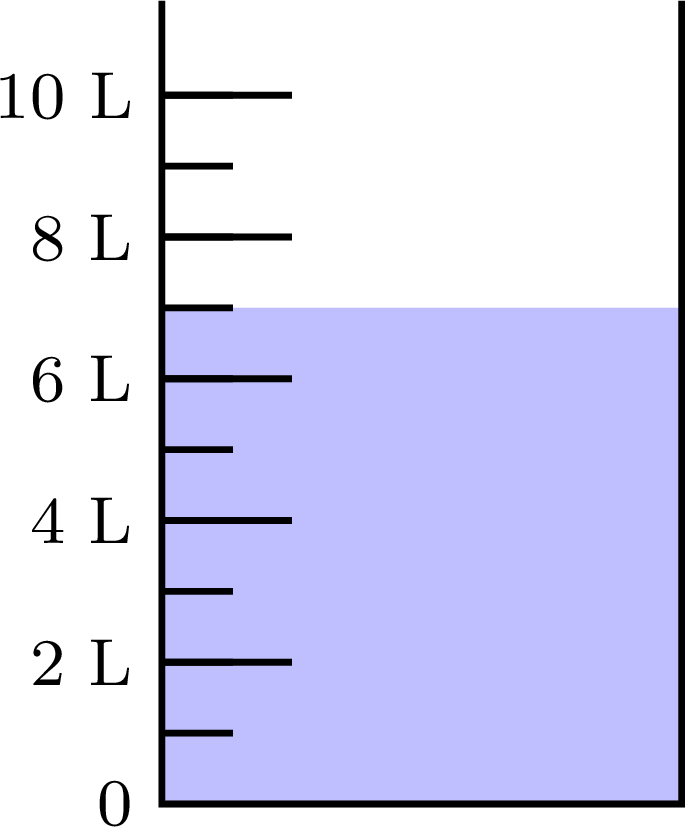
Between two numbered marks, for example from \(2~\mathrm{L}\) to \(4~\mathrm{L}\), there are \(2\) steps: each step is one litre, so every mark stands for one more litre.
The water is above the mark \(6~\mathrm{L}\), at the next mark: \(6 + 1 = 7\). There are \(7~\mathrm{L}\) of water in the tank. The tank is not full: its capacity is bigger, at least \(10~\mathrm{L}\).
The water is above the mark \(6~\mathrm{L}\), at the next mark: \(6 + 1 = 7\). There are \(7~\mathrm{L}\) of water in the tank. The tank is not full: its capacity is bigger, at least \(10~\mathrm{L}\).
Method — Comparing Capacities in Litres
When capacities are written in litres, they are compared like numbers. - More litres, more capacity: a bucket of \(12~\mathrm{L}\) holds more than a watering can of \(8~\mathrm{L}\), because \(12 > 8\).
- How many litres more? Subtract the smaller number from the bigger one: \(12 - 8 = 4\), so the bucket holds \(4~\mathrm{L}\) more.
- To order several capacities, order their numbers of litres.
Example
A watering can holds \(9~\mathrm{L}\), a bucket holds \(12~\mathrm{L}\) and a pot holds \(5~\mathrm{L}\). Order the three containers from the smallest capacity to the biggest. Then find how many litres more the bucket holds than the watering can.
All three capacities are in litres: we compare the numbers \(5 < 9 < 12\).
From the smallest capacity to the biggest: the pot (\(5~\mathrm{L}\)), the watering can (\(9~\mathrm{L}\)), the bucket (\(12~\mathrm{L}\)). $$\begin{aligned} 12~\mathrm{L} - 9~\mathrm{L} &= \textcolor{colorprop}{3~\mathrm{L}} &&\text{(bigger number minus smaller number)} \end{aligned}$$ The bucket holds \(3~\mathrm{L}\) more than the watering can.
From the smallest capacity to the biggest: the pot (\(5~\mathrm{L}\)), the watering can (\(9~\mathrm{L}\)), the bucket (\(12~\mathrm{L}\)). $$\begin{aligned} 12~\mathrm{L} - 9~\mathrm{L} &= \textcolor{colorprop}{3~\mathrm{L}} &&\text{(bigger number minus smaller number)} \end{aligned}$$ The bucket holds \(3~\mathrm{L}\) more than the watering can.
Skills to practice
- Measuring with a Litre Bottle
- Reading a Container Marked in Litres
- Finding How Many Litres More
IV
Going further
Skills to practice
- Reading the Balance
- Solving Problems with Several Questions
- Quiz
Jump to section