International Baccalaureate · PYP 2
Symmetry, Slides, Flips and Turns
I
Line Symmetry
Definition — Line of Symmetry of a Figure
A line is a line of symmetry of a figure (also called an axis of symmetry) when the two parts of the figure land exactly on each other as the figure is folded along this line. The figure is then said to be symmetrical about this line. Example
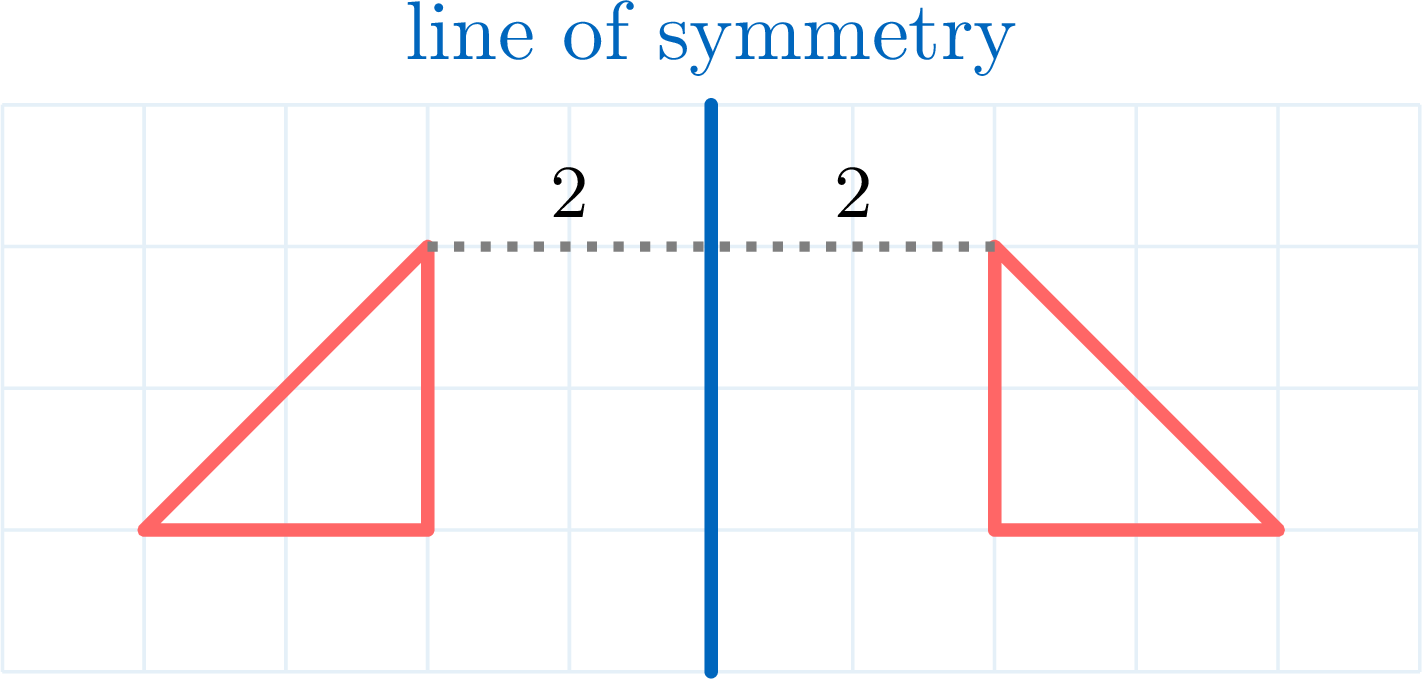
In the picture below, the two triangles are mirror images of each other. The vertical line is the line of symmetry of the figure formed by the two triangles. 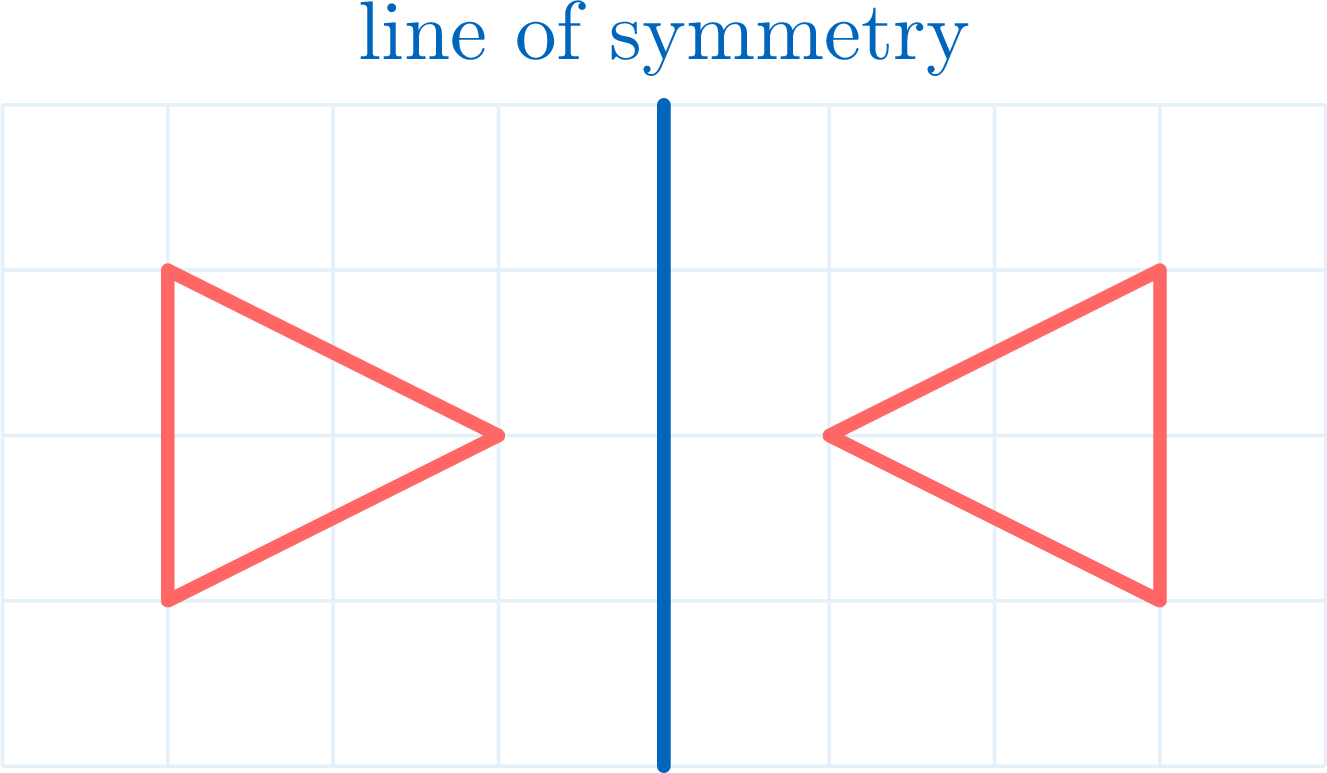
Example — Symmetry Around Us
Many things around us are symmetrical. Fold each picture along its dashed line: the two halves land exactly on each other. The dashed line is a line of symmetry. 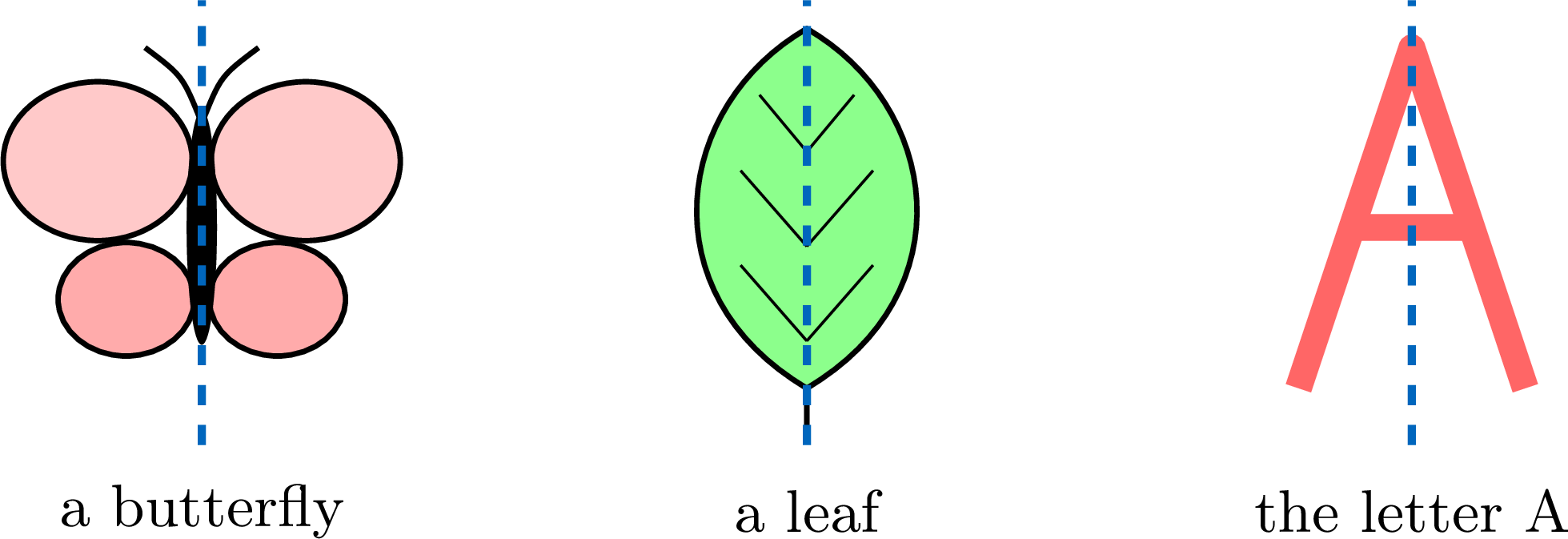
- The butterfly: its left wing lands on its right wing.
- The leaf: one half lands on the other half, along the middle vein.
- The letter A: its left stroke lands on its right stroke.
Method — Finding the Line of Symmetry
To find the line of symmetry between two shapes drawn on squared paper, count the squares. - Choose two matching corners: a corner of one shape and the corner that matches it on the other shape, on the same row.
- Count the squares between these two corners. Here, \(4\) squares.
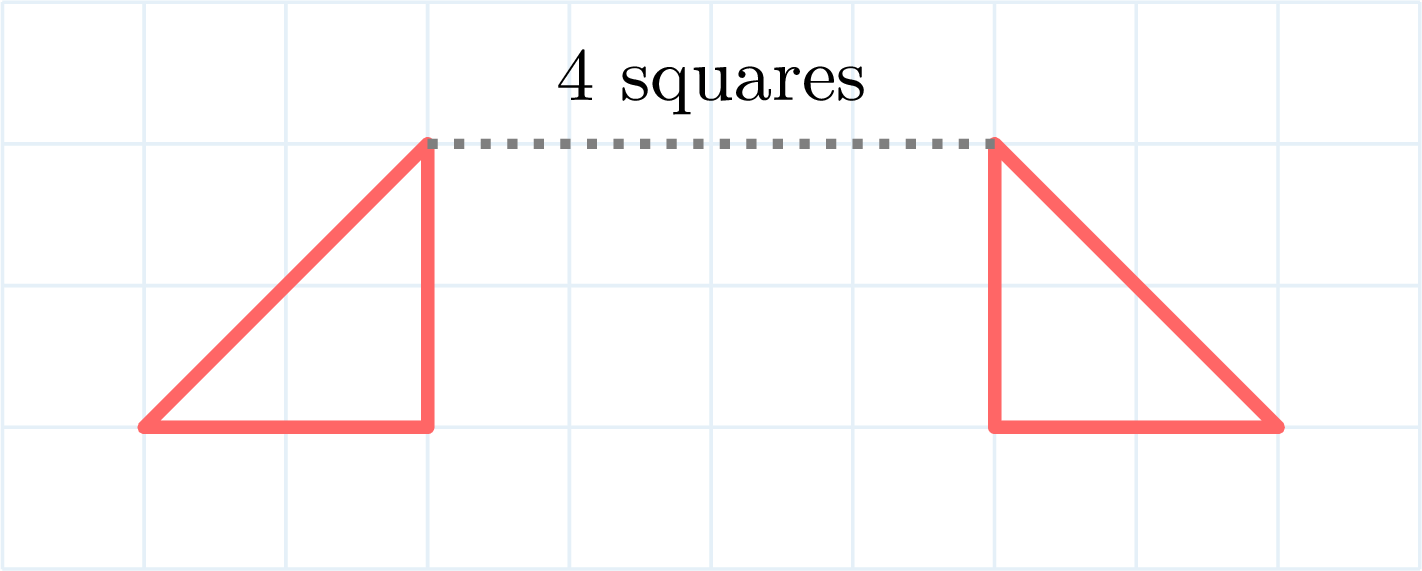
- Draw the line halfway: the line of symmetry passes in the middle, with as many squares on each side. Here, \(2\) squares on each side.
Skills to practice
- Drawing the Line of Symmetry
II
Drawing the Mirror Image of a Figure
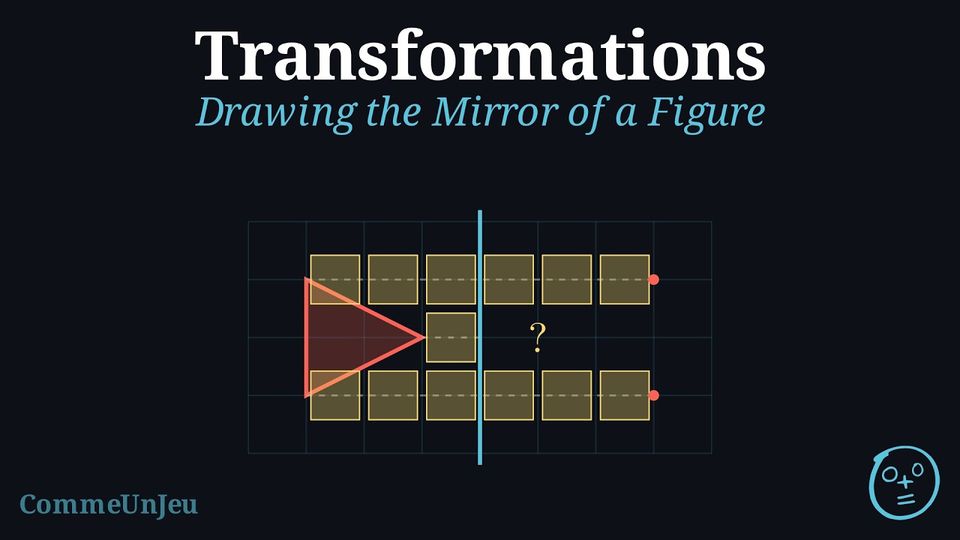
Method — Drawing the Mirror Image of a Figure
Here is how to draw the mirror image of a triangle on squared paper. 
- Draw the mirror vertices: For each vertex of the triangle, count how many squares it is from the axis of symmetry (to the left or to the right). Place a new point on the other side of the line, the same number of squares away, on the same row.
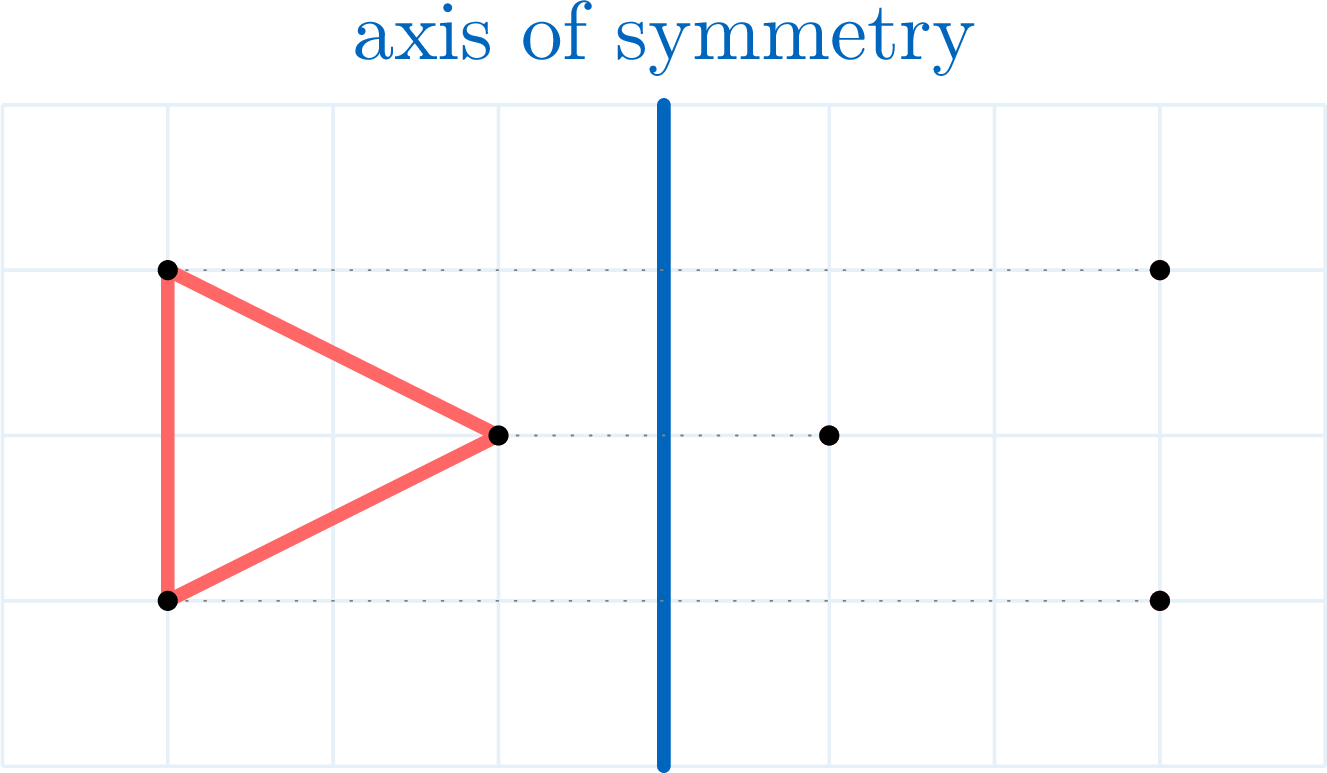
- Draw the mirror image: Connect the mirror vertices with straight lines in the same order as the original triangle.

Skills to practice
- Drawing Mirror Images
- Counting Squares to the Axis
III
Turns
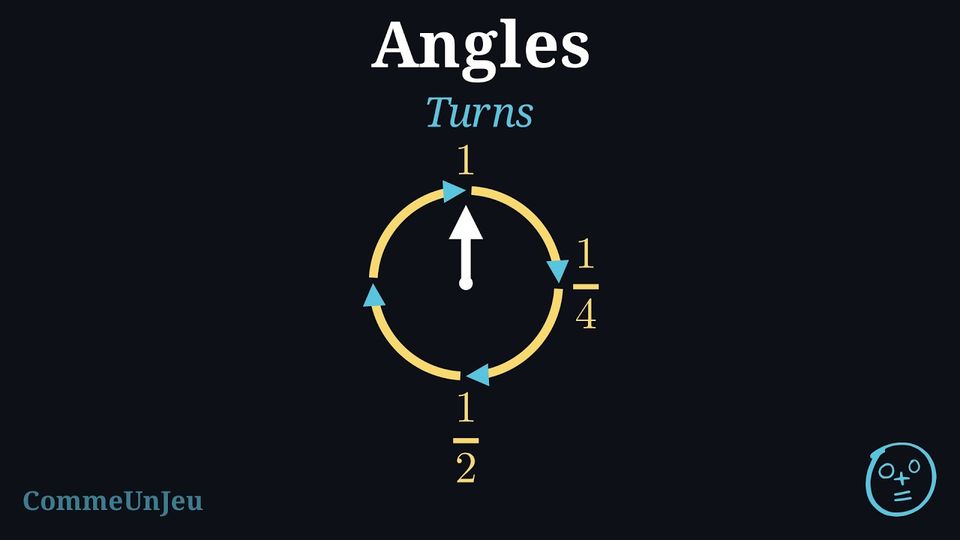
Léa, Tom and Sami stand in the middle of the classroom, facing the board. Each of them turns on the spot, always towards the right: 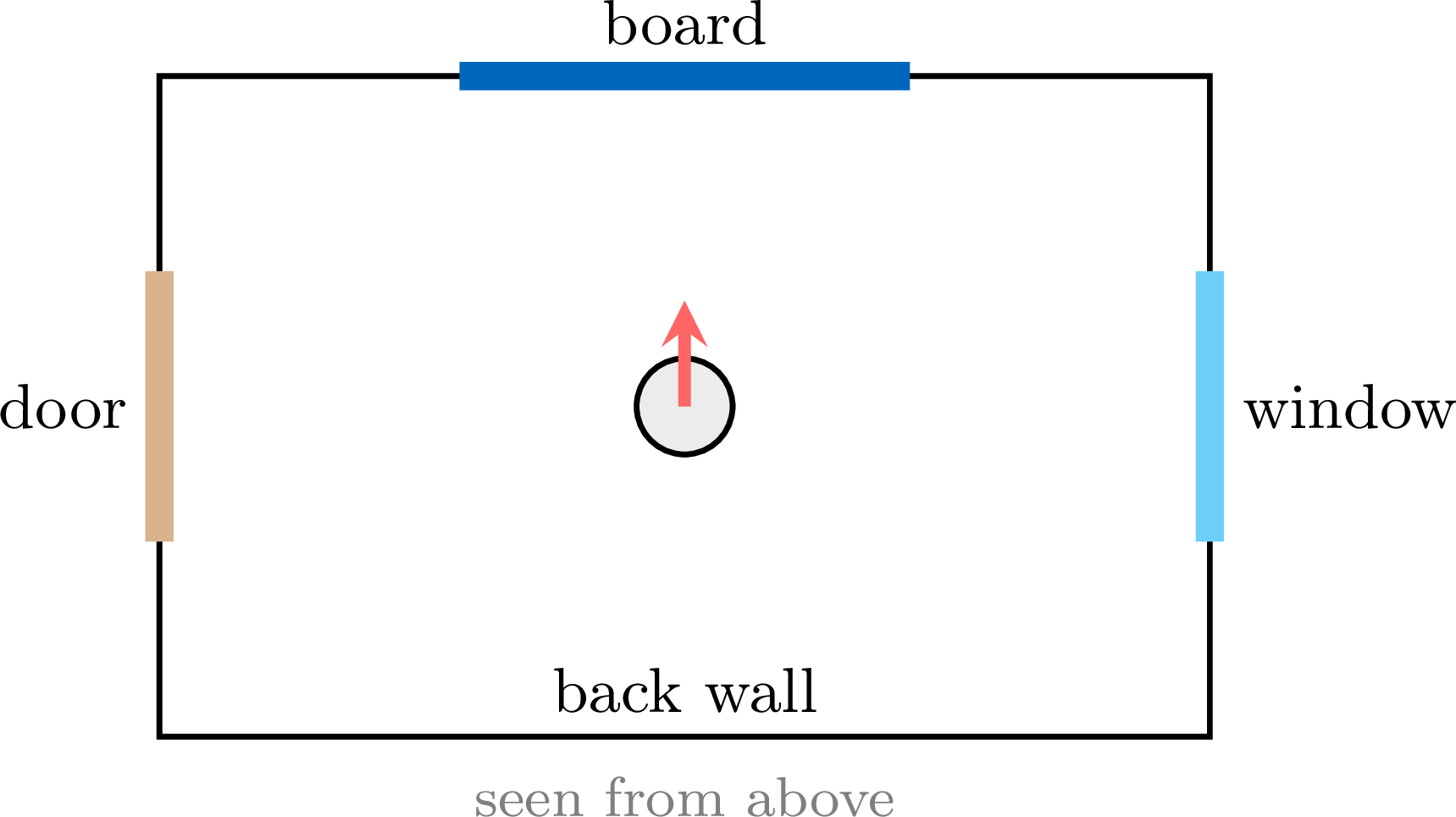
Who turned the most? How can we say exactly how far each child turned?
- Léa stops the first time she faces the window;
- Tom stops the first time he faces the back wall;
- Sami keeps turning until he faces the board again, for the first time.
Seen from above, the three children turn the same way, the way the hands of a clock turn.
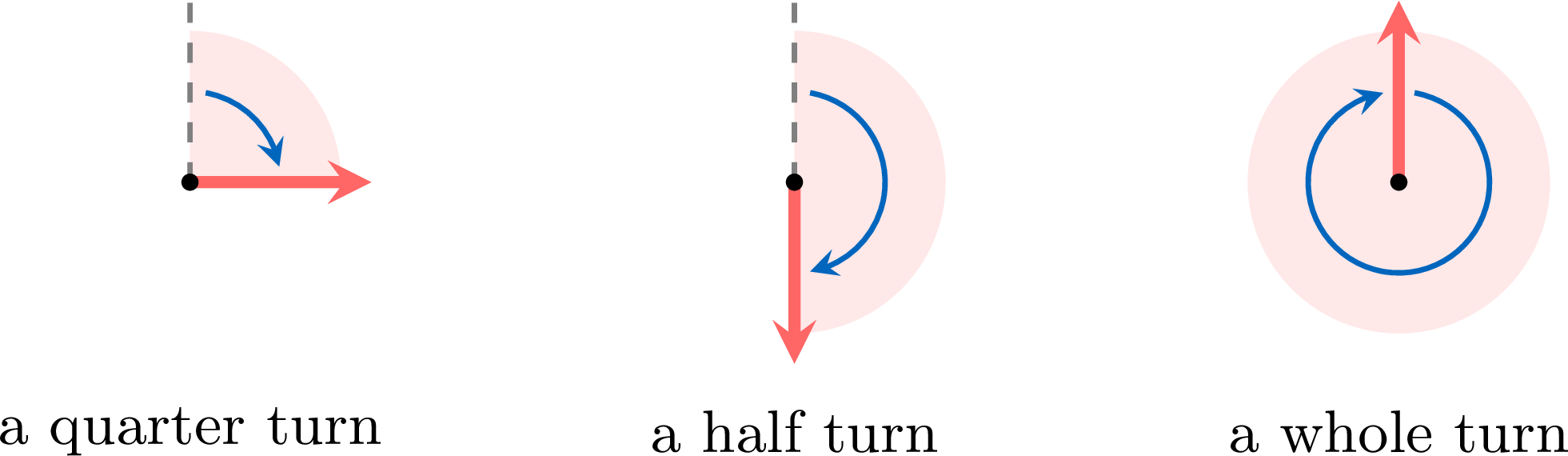
- Léa goes from the board to the window: she turns a quarter of the way round — a quarter turn.
- Tom goes on to the back wall: he turns twice as far, two quarter turns — a half turn. He now faces the opposite way.
- Sami turns all the way round: four quarter turns — a whole turn. He faces the board again, as at the start.
Definition — Whole Turn, Half Turn and Quarter Turn
To turn is to change the way we face while staying on the same spot. How far we turn is counted in turns: - after a whole turn (also called a full turn), we face the same way again;
- after a half turn, we face the opposite way;
- after a quarter turn, we face to one side: to the right or to the left.
Definition — Clockwise and Anticlockwise
The hands of a clock always turn the same way: turning that way is turning clockwise. Turning the other way is turning anticlockwise. 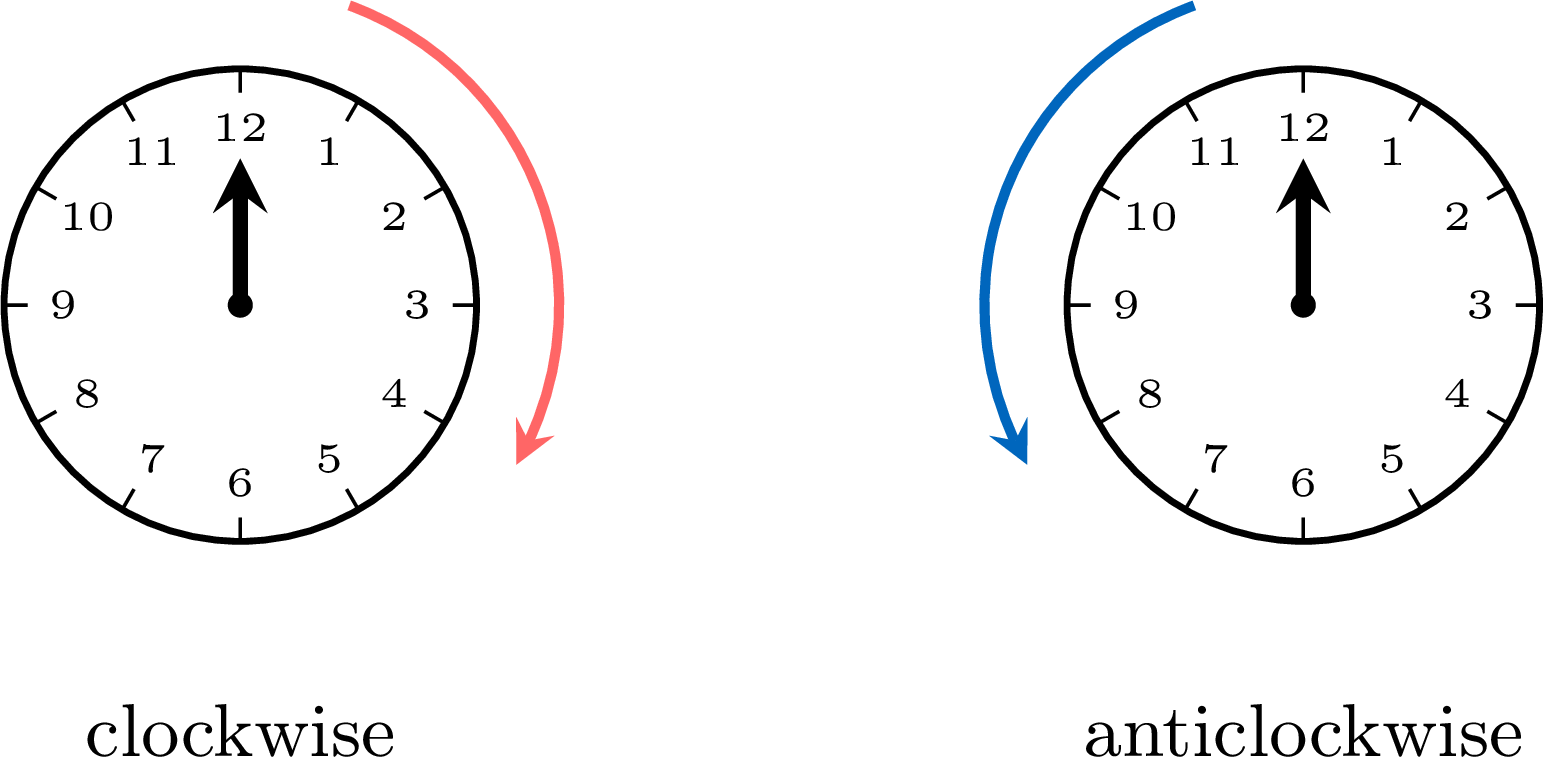
Method — Finding Which Way We Face After a Turn
- Start: note which way we face, or which way the arrow points.
- Count the quarter turns: a quarter turn counts \(1\), a half turn \(2\), a whole turn \(4\).
- Turn one quarter turn at a time, in the direction asked. Turning clockwise, an arrow that points up then points right, then down, then left. Turning anticlockwise, it points left, then down, then right.
Example
The minute hand of this clock points to \(12\). Where does it point after: - [(a)] a quarter turn clockwise?
- [(b)] a half turn clockwise?
- [(c)] a whole turn?
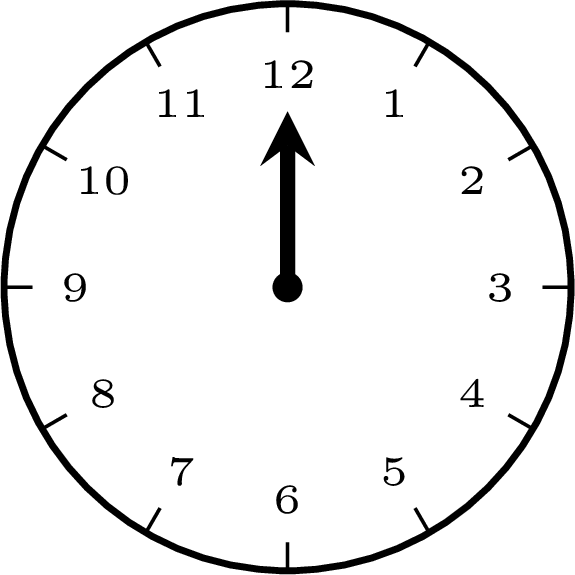
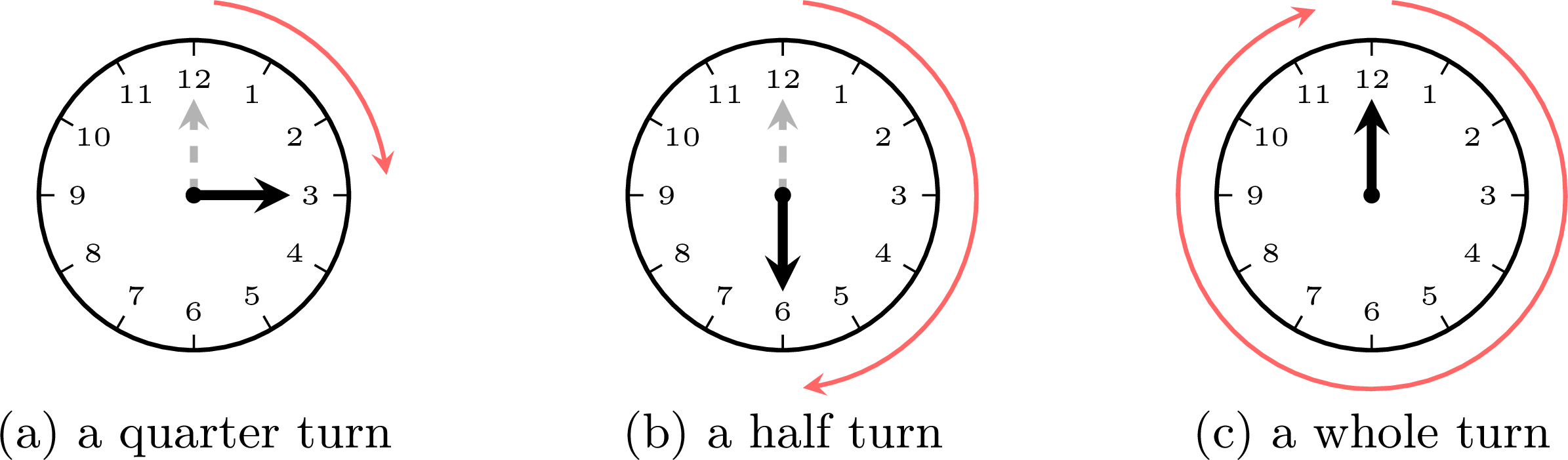
- [(a)] From \(12\), a quarter turn clockwise brings the hand to \(3\): a quarter of the way round the clock.
- [(b)] A half turn is two quarter turns: from \(12\) to \(3\), then to \(6\). The hand points to \(6\), opposite \(12\).
- [(c)] A whole turn is four quarter turns: \(3\), \(6\), \(9\), and back to \(12\).
Example
A card flag is pinned to the grid at the foot of its pole: it can only turn about the pin, like the hand of a clock, and it turns clockwise, less than a whole turn. Which turn takes flag \(A\) to flag \(B\)? Which turn takes flag \(A\) to flag \(C\)? 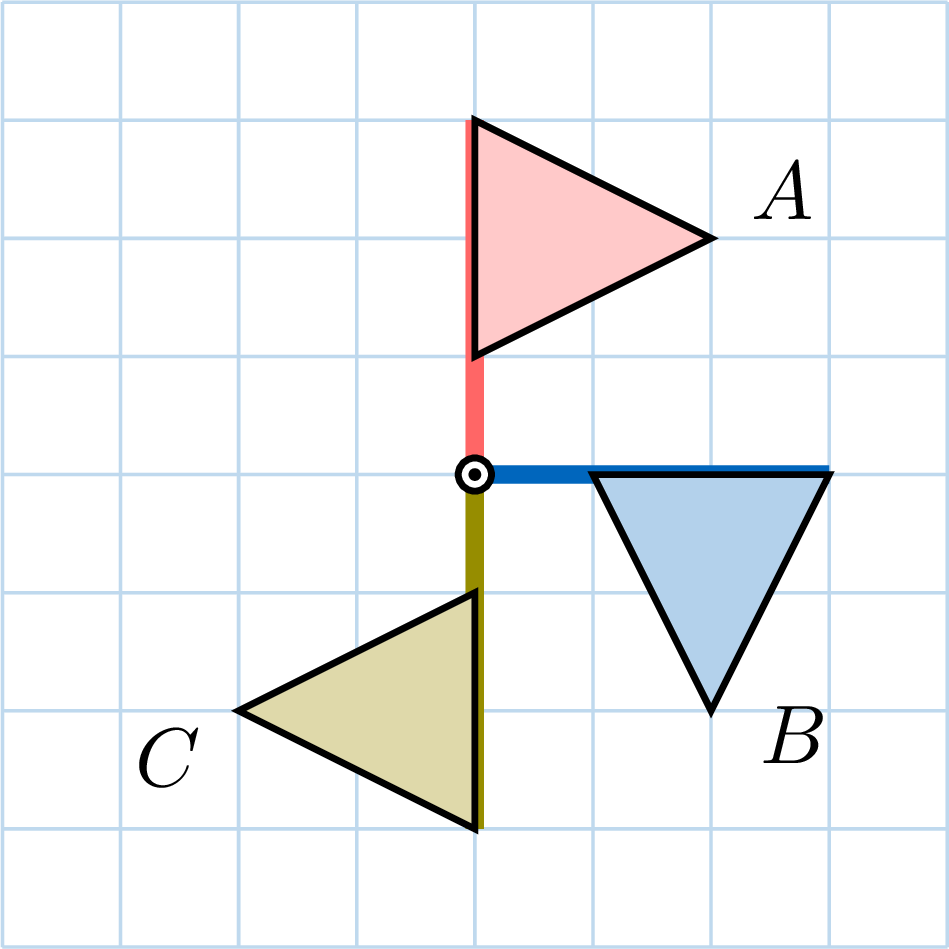
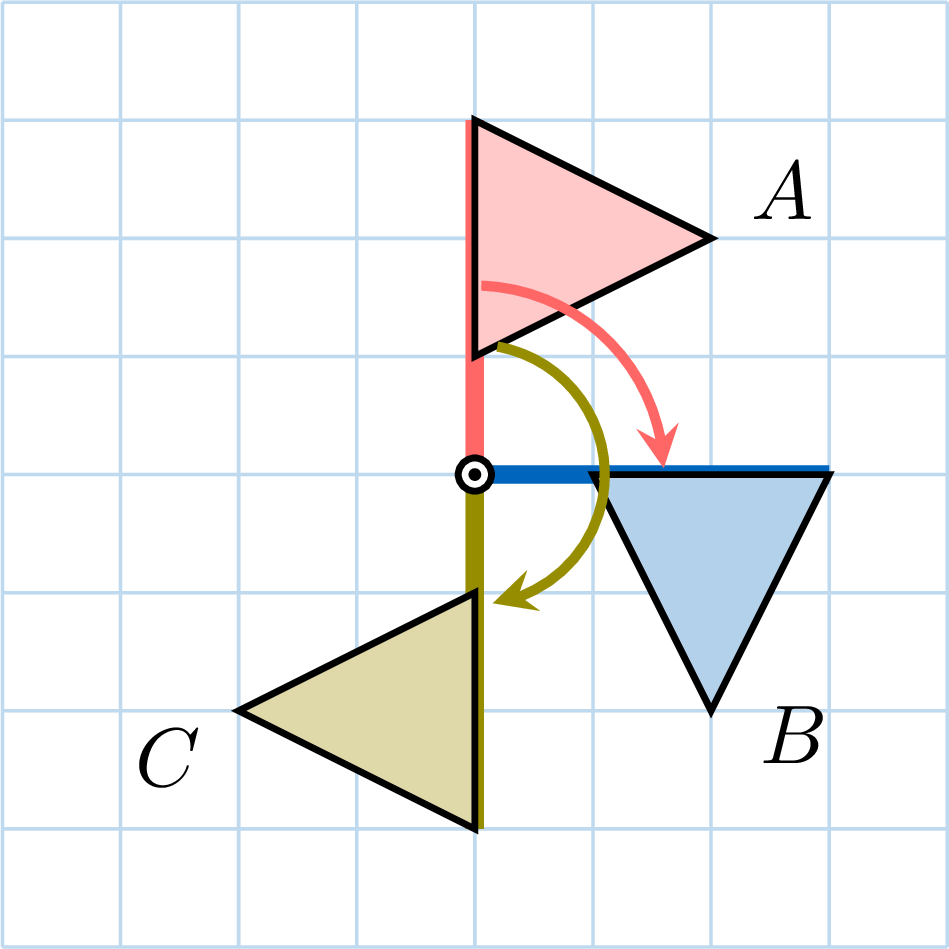
Skills to practice
- Naming a Turn
- Turning the Minute Hand
IV
Three Ways to Move a Shape
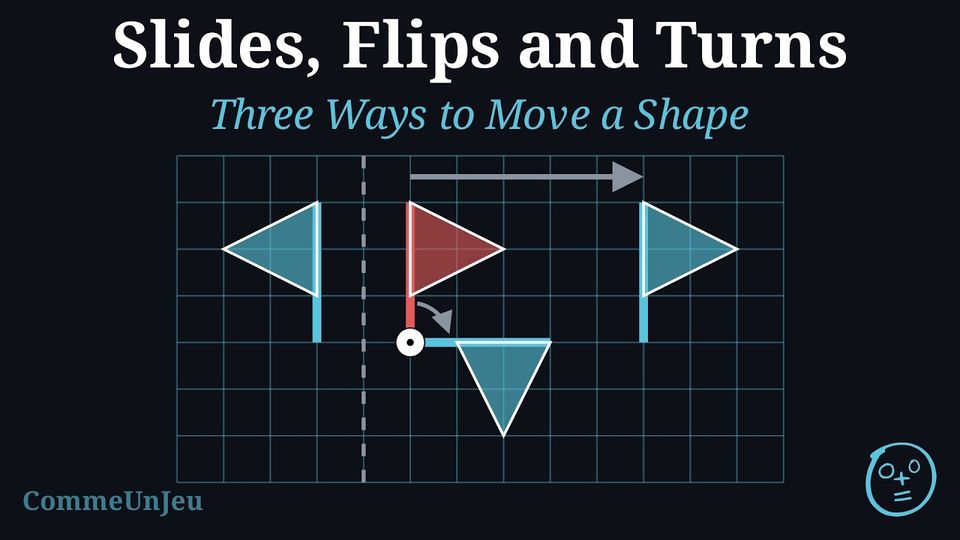
Léa has cut a flag out of card and laid it on squared paper. She moves it in three different ways: 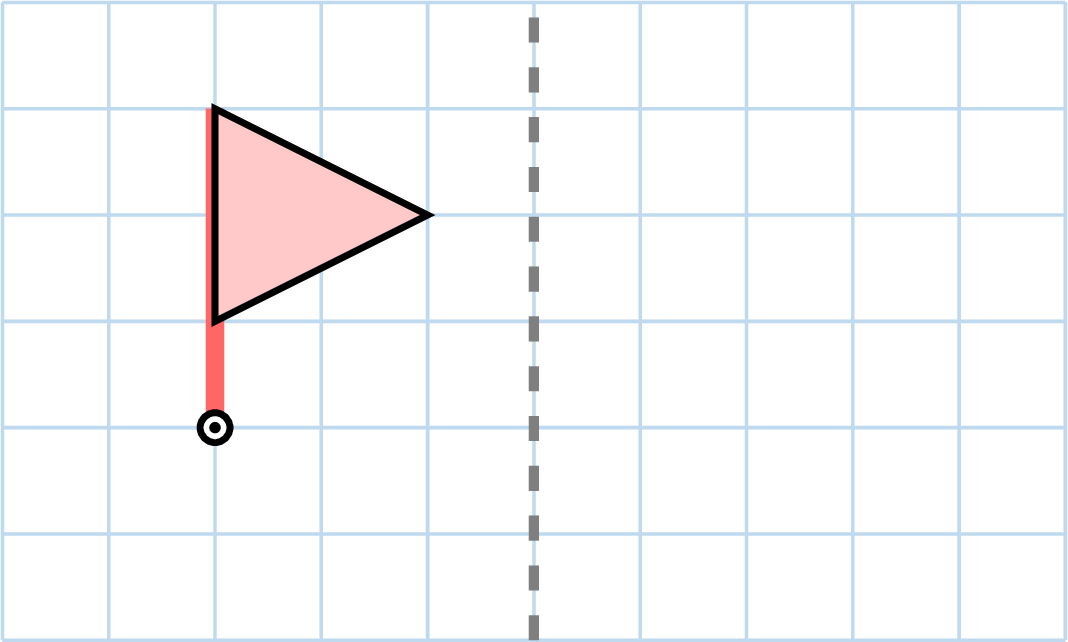
After each move, has the flag changed size? Has it changed shape? What has changed?
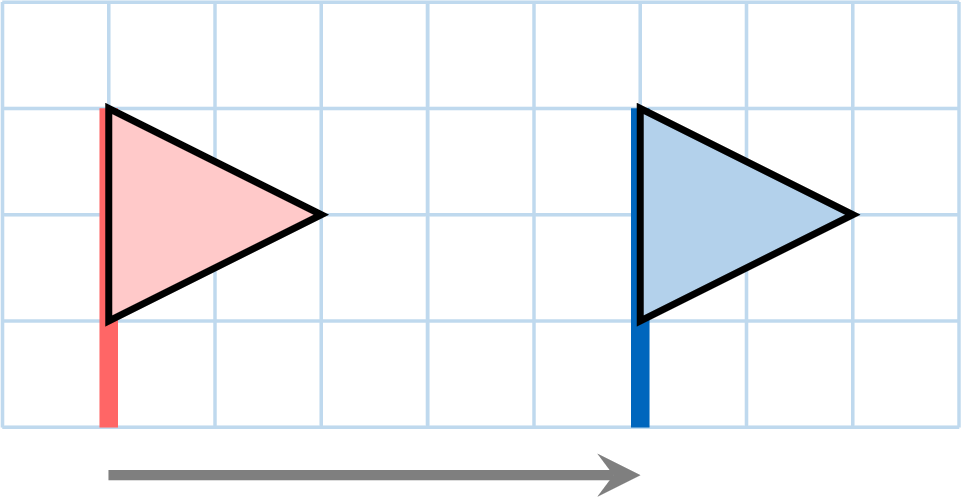
- she pushes it \(5\) squares to the right along the paper, without turning it;
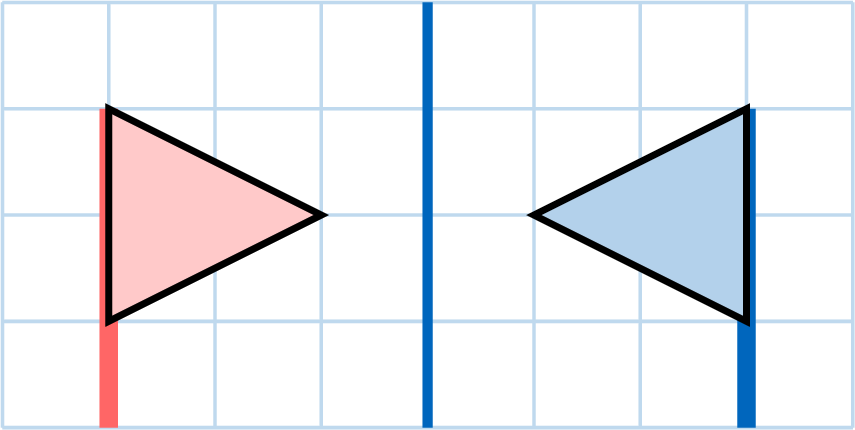
- she turns it over across the dashed line, like the page of a book;
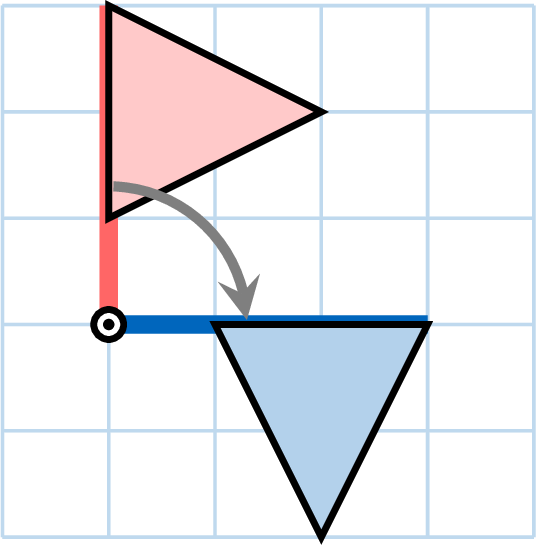
- she holds its foot down with a pin and turns it a quarter turn clockwise.
The flag never changes size and never changes shape: it is the same flag, only moved. What changes is different each time:
- pushed along, only its place changes: it still points the same way;
- turned over, it becomes its mirror image: it now points to the left;
- turned about the pin, the way it points changes: its pole now lies flat.
Definition — Slide, Flip and Turn
There are three basic ways to move a shape without changing its size or its shape. - A slide: the shape moves in a straight line, without turning. It still points the same way.
- A flip: the shape is turned over across a line, as in a mirror. We get its mirror image.
- A turn: the shape turns about a point, for example by a quarter turn or a half turn, clockwise or anticlockwise.
Definition — Object and Image
When we move a shape (we slide it, flip it or turn it), the shape we start with is called the object. The new shape, after the move, is called the image. Only the image of a flip is a mirror image. Method — Moving a Shape on a Grid
To draw a shape after a move, find where its corners go, one by one, then join them in the same order. - Slide: move every corner the same number of squares in the same direction.
- Flip: for every corner, count the squares to the line; put the new corner on the other side of the line, the same number of squares away — on the same row when the line stands up, in the same column when the line lies flat (the lines used here always stand up or lie flat).
- Turn: trace the shape on tracing paper, hold the point with the tip of a pencil, turn the tracing paper by the turn asked, then copy the shape where it has arrived.
Example
Draw the flag after each move: - [(a)] a slide of \(5\) squares to the right;
- [(b)] a flip over the blue line;
- [(c)] a half turn about the pin.
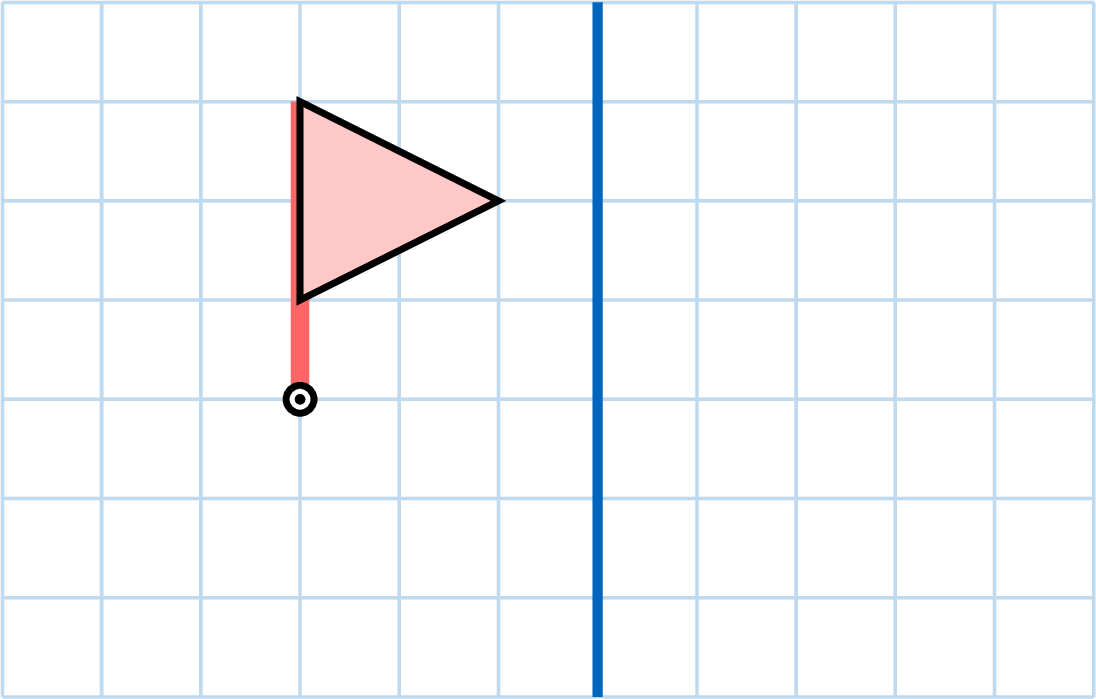
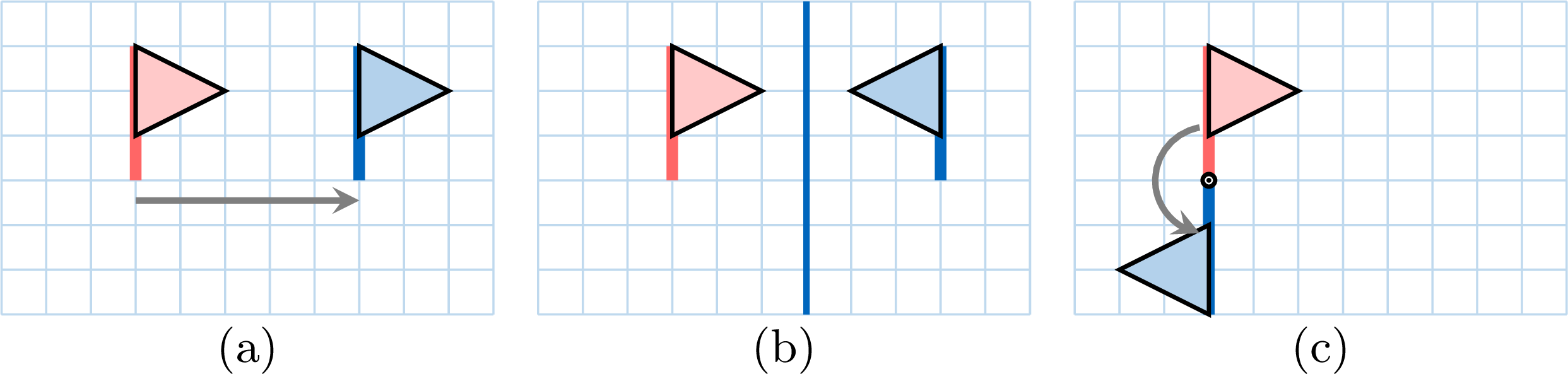
- [(a)] Each corner moves \(5\) squares to the right, and so does the foot of the pole. The flag still points to the right.
- [(b)] The pole is \(3\) squares to the left of the line: its image is \(3\) squares to the right of it. The tip of the flag, \(1\) square from the line, stays \(1\) square from it on the other side. The flag now points to the left.
- [(c)] With the tracing paper held at the pin, a half turn sends the pole downwards and the tip of the flag to the left.
Skills to practice
- Moving a Shape on a Grid
V
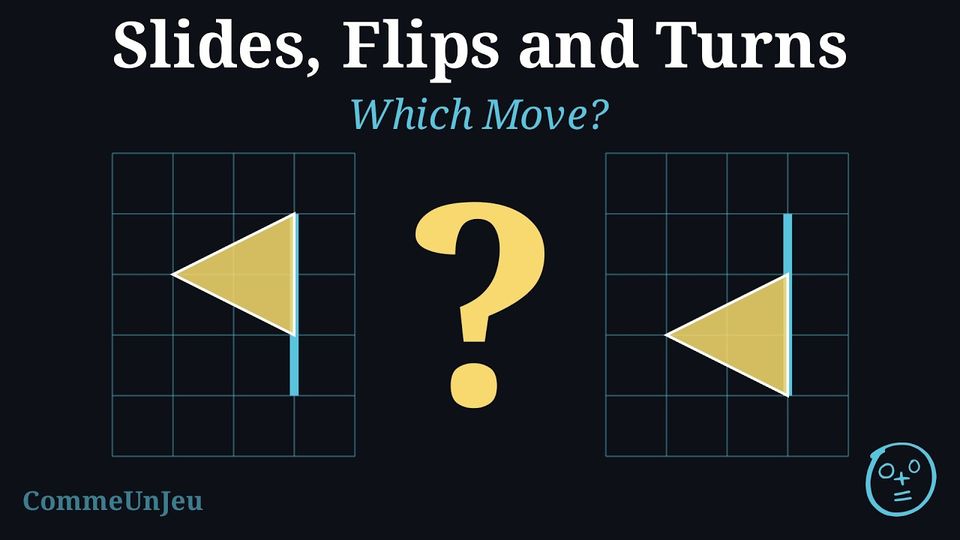
Which Move?
Method — Finding the Move
To find which move takes a shape to its new position, use a shape with a mark — a flag, a duck, the letter F — and compare the two positions: - the shape points the same way and only its place has changed: it is a slide;
- the shape has become its mirror image, turned over: it is a flip;
- the shape points another way but is not turned over: it is a turn.
Example
Which move takes flag \(A\) to flag \(B\)? to flag \(C\)? to flag \(D\)? 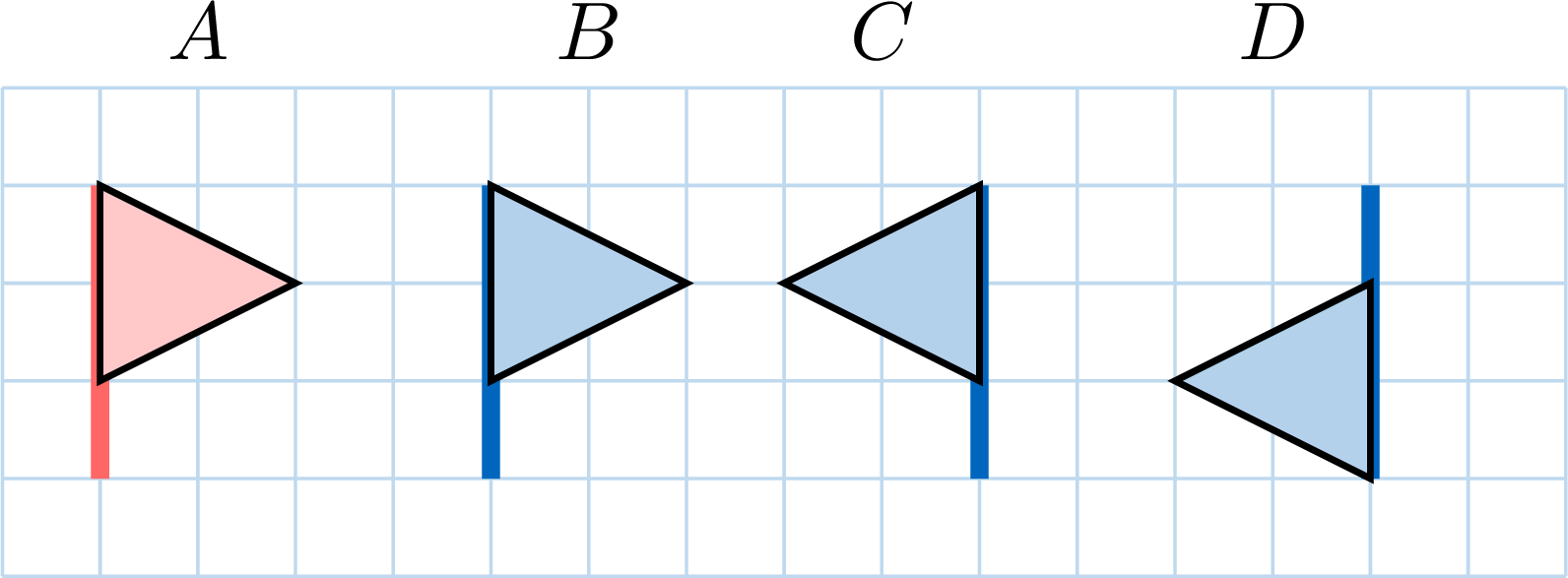
- \(B\) points the same way as \(A\): a slide, of \(4\) squares to the right.
- \(C\) points to the left, and its flag is still at the top of the pole: it is \(A\) turned over, its mirror image. A flip.
- \(D\) points to the left too, but it is upside down: its flag is at the bottom of the pole. The tracing of \(A\) covers \(D\) after a half turn on the table, without turning the paper over: a turn, a half turn.
Skills to practice
- Naming the Move
VI
Patterns
Definition — Pattern
A pattern is a design made by repeating the same move of a shape again and again: a slide, a flip or a turn (also called a translation, a reflection or a rotation). Example
The following pattern is created by repeating a translation: each duck is the image of the previous duck after a slide to the right. 
Skills to practice
- Drawing Patterns
VII
Review & Quizz
Skills to practice
- Quiz
Jump to section