International Baccalaureate · PYP 1
Number Bonds to 10 and Doubles
I
Complements to 10

We look for the pairs of numbers that make 10 together.
A ten-frame is a box that holds exactly 10 counters. There are 7 counters in the box. 
How many empty spaces are there? How many more counters do we need to make a full ten?
A ten-frame is a box that holds exactly 10 counters. There are 7 counters in the box.
By counting the empty spaces, we can see that we need 3 more counters to make 10. 
The number 3 is the complement of 7: together, they make 10.
Definition — Complements to 10
The complement to 10 of a number from 0 to 10 is the number we add to it to make 10: the two numbers form a number bond to 10. | Number | Complement | Sum | Cubes | Ten-Frame | Fingers |
| \(\textcolor{colordef}{0}\) | \(\textcolor{colorprop}{10}\) | \(\textcolor{colordef}{0}+\textcolor{colorprop}{10}=10\) | 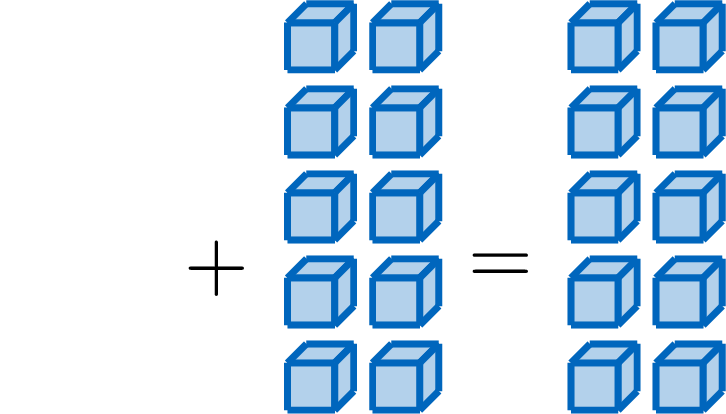 | 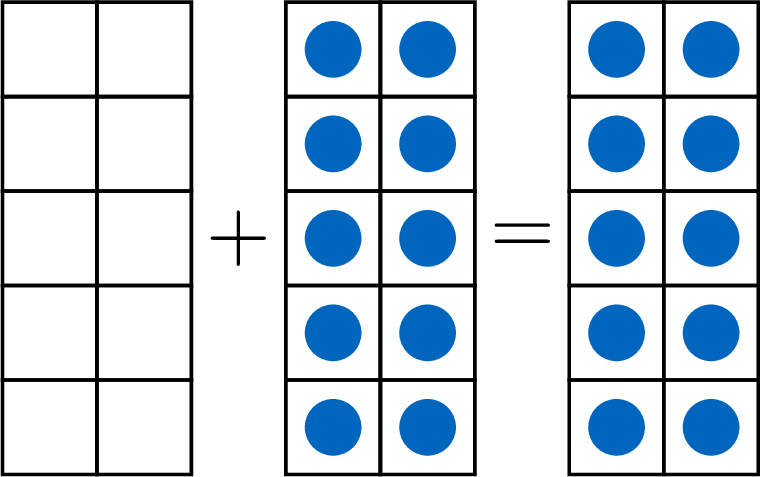 |  \(+\)  \(=\)  |
| \(\textcolor{colordef}{1}\) | \(\textcolor{colorprop}{9}\) | \(\textcolor{colordef}{1}+\textcolor{colorprop}{9}=10\) |  |  |  \(+\)  \(=\) |
| \(\textcolor{colordef}{2}\) | \(\textcolor{colorprop}{8}\) | \(\textcolor{colordef}{2}+\textcolor{colorprop}{8}=10\) |  |  |  \(+\)  \(=\) |
| \(\textcolor{colordef}{3}\) | \(\textcolor{colorprop}{7}\) | \(\textcolor{colordef}{3}+\textcolor{colorprop}{7}=10\) |  |  |  \(+\)  \(=\) |
| \(\textcolor{colordef}{4}\) | \(\textcolor{colorprop}{6}\) | \(\textcolor{colordef}{4}+\textcolor{colorprop}{6}=10\) |  |  |  \(+\)  \(=\) |
| \(\textcolor{colordef}{5}\) | \(\textcolor{colorprop}{5}\) | \(\textcolor{colordef}{5}+\textcolor{colorprop}{5}=10\) |  |  |  \(+\)  \(=\) |
| \(\textcolor{colordef}{6}\) | \(\textcolor{colorprop}{4}\) | \(\textcolor{colordef}{6}+\textcolor{colorprop}{4}=10\) |  |  |  \(+\)  \(=\) |
| \(\textcolor{colordef}{7}\) | \(\textcolor{colorprop}{3}\) | \(\textcolor{colordef}{7}+\textcolor{colorprop}{3}=10\) |  |  |  \(+\)  \(=\) |
| \(\textcolor{colordef}{8}\) | \(\textcolor{colorprop}{2}\) | \(\textcolor{colordef}{8}+\textcolor{colorprop}{2}=10\) |  |  |  \(+\)  \(=\) |
| \(\textcolor{colordef}{9}\) | \(\textcolor{colorprop}{1}\) | \(\textcolor{colordef}{9}+\textcolor{colorprop}{1}=10\) |  |  |  \(+\)  \(=\) |
Method — Counting Up to 10
To find the complement of a number, count up from this number to 10. For \(\textcolor{colordef}{7}\): \(8\), \(9\), \(10\) — we count 3 numbers, so \(\textcolor{colordef}{7}+\textcolor{colorprop}{3}=10\). We can raise one finger for each number counted. Example
Find the complement of \(\textcolor{colordef}{8}\).
Counting up from \(8\): \(9\), \(10\) — that is \(\textcolor{colorprop}{2}\) numbers, so \(\textcolor{colordef}{8}+\textcolor{colorprop}{2}=10\). 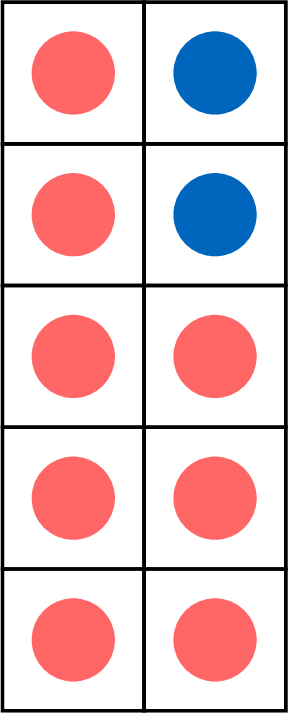
Skills to practice
- Finding Complements to 10 Using Ten-Frames
- Finding Complements to 10 Using Cubes
- Finding Complements to 10 Using Fingers
- Finding Complements to 10
II
The Doubles
Dad buys marbles for Hugo and Louis. To be fair, he buys 3 marbles for Hugo, and the same number for Louis. 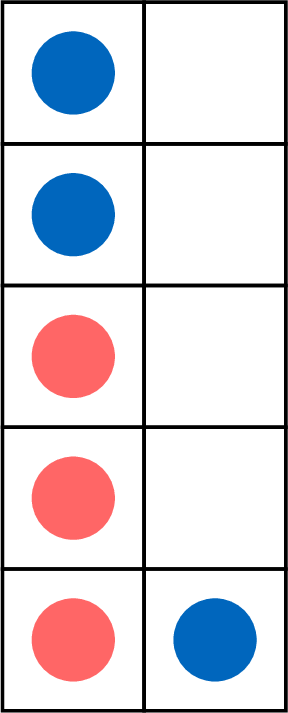
How many marbles does Dad buy in all?
Dad buys \(3 + 3 = \textbf{6}\) marbles: twice the same number. When we add a number to itself, we get its double: the double of 3 is 6.
Definition — Double
The double of a number is the number plus itself. $$\text{double of } 4 = 4 + 4 = 8$$ The doubles to know by heart: | Number | 1 | 2 | 3 | 4 | 5 | 6 | 7 | 8 | 9 | 10 |
| Double | 2 | 4 | 6 | 8 | 10 | 12 | 14 | 16 | 18 | 20 |
Example
Find the double of \(7\).
The double of \(7\) is \(\textcolor{colordef}{7} + \textcolor{colorprop}{7}\). The first \(\textcolor{colordef}{7}\) and \(\textcolor{colorprop}{3}\) of the second \(\textcolor{colorprop}{7}\) fill one ten-frame, and the other \(\textcolor{colorprop}{4}\) go into a second ten-frame. 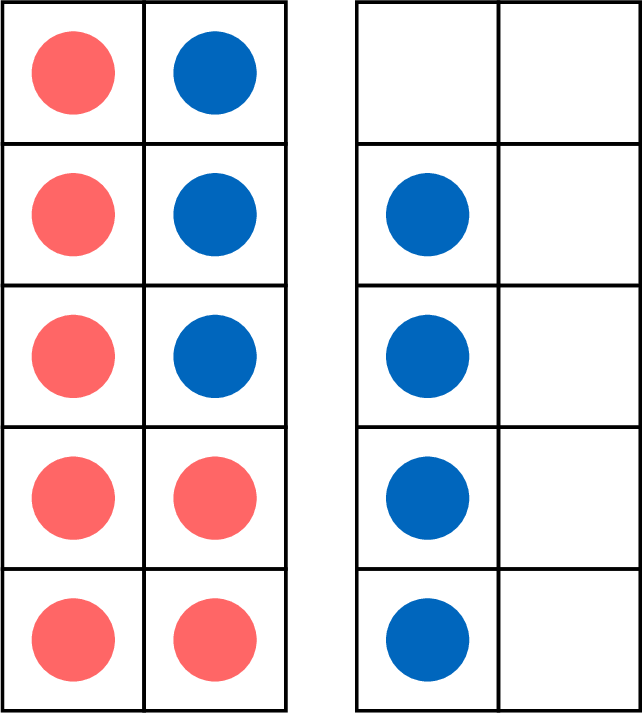
$$\begin{aligned}[t]\textcolor{colordef}{7}+\textcolor{colorprop}{7} &= \textcolor{colordef}{7}+\textcolor{colorprop}{3}+\textcolor{colorprop}{4} && \text{(split the second \(7\))}\\
&=10+\textcolor{colorprop}{4} && \text{(\(\textcolor{colordef}{7}+\textcolor{colorprop}{3}=10\))}\\
&=\textbf{14}\end{aligned}$$
Example
Find the double of \(40\).
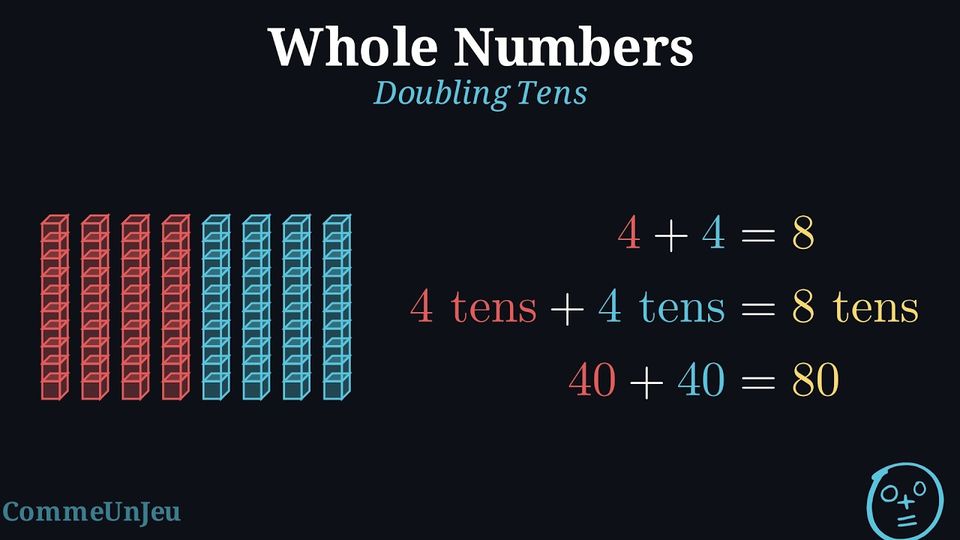
The double of \(40\): \(4\) tens plus \(4\) tens make \(8\) tens, so \(40 + 40 = \textbf{80}\).
Skills to practice
- Finding Doubles
- Finding the Number from its Double
- Solving Problems with Doubles
III
Going further
Skills to practice
- Completing 10 with Pictures
- Quiz
Jump to section