International Baccalaureate · PYP 0
Adding Within 10
I
What is Addition?
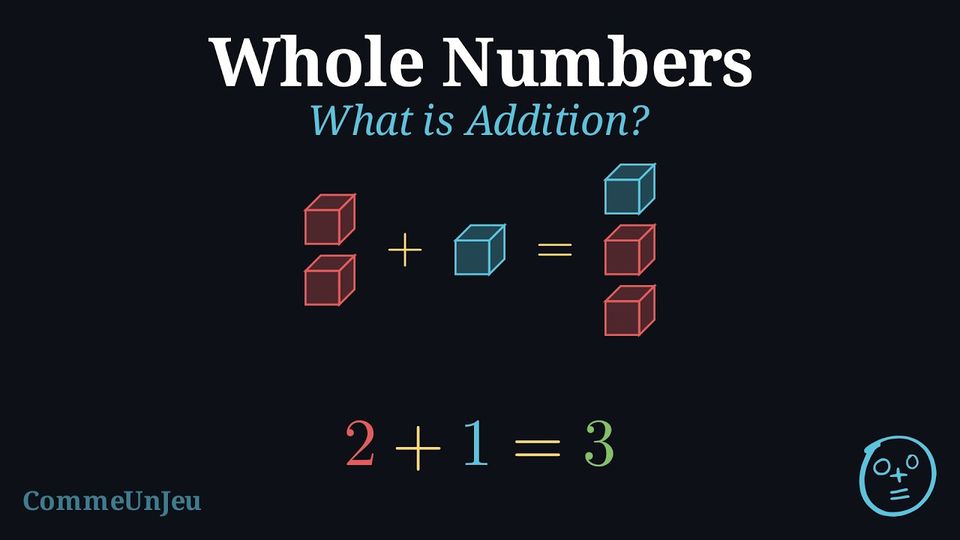
You have 4 red cubes and your friend gives you 2 blue cubes.  \(\quad\) and \(\quad\)

How many cubes do you have now?
\(\quad\) and \(\quad\)
We put the two groups together and count all the cubes: one, two, three, four, five, six. 
You have 6 cubes in total. Joining groups together to find how many there are in total is called addition.
Definition — Addition
Addition is joining groups together to find the total, called the sum.In mathematics, we use symbols to write this down:
- The plus sign (\(+\)) means to add.
- The equals sign (\(=\)) shows that what is on one side is the same amount as what is on the other side.
- With numbers: $$\textcolor{colordef}{4} + \textcolor{colorprop}{2} = \textcolor{olive}{6}$$
- With cubes: \(+\) \(=\)
- With fingers:
 \(+\)
 \(=\)

Proposition — The Order Does Not Matter
When we add two groups, we can start with either one: the total is the same.  \(+\)
 \(=\)
 \(+\) \(=\)

Skills to practice
- Adding Cubes Within 5
- Adding in the Ten-Frame Within 5
- Adding Fingers Within 5
- Adding Cubes Within 10
- Adding in the Ten-Frame Within 10
- Adding Fingers Within 10
- Adding in Both Orders
II
How to Add
Method — Counting All
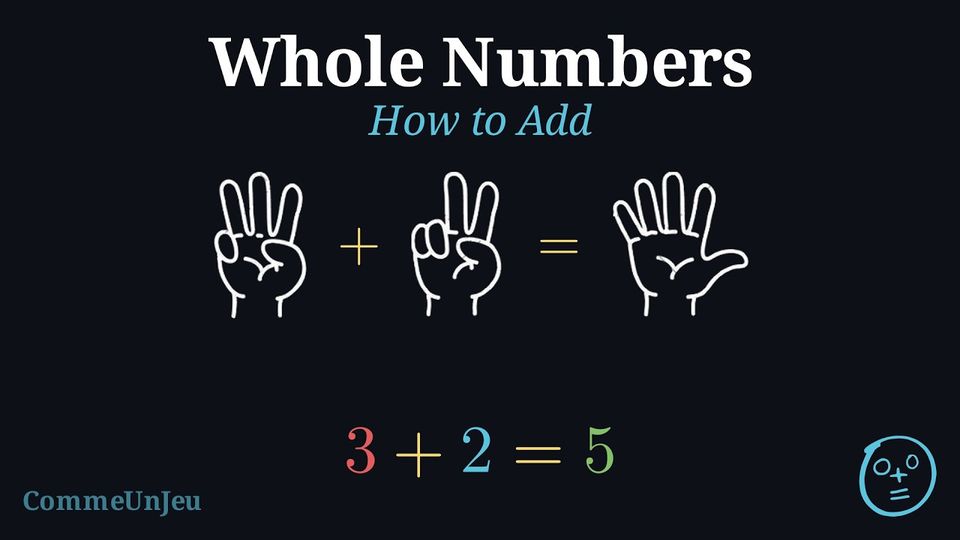
The first strategy to learn addition is called “Counting All.” This means we combine our groups and then count every single item from the beginning to find the total.Solve: \(3 + 2 = ?\)
- Step 1: Show the first number. Hold up 3 fingers on one hand.

- Step 2: Show the second number. Hold up 2 fingers on your other hand.

- Step 3: Count all the fingers that are up. Point to each one as you count: “One, two, three, four, five.”
 \(+\) \(=\)

Method — Counting On
A faster way to add is called “Counting On.” Instead of starting from 1, you start with the bigger number and then “count on” the smaller number.Solve: \(4 + 3 = ?\)
- Step 1: Start with the bigger number. The bigger number is 4. Show 4 fingers on one hand and say the number “Four” out loud.

- Step 2: Get ready to count on. We need to add 3 more. So, get 3 fingers ready on your other hand. These are the fingers we will count.

- Step 3: Count on from 4. Touch each of the 3 fingers one by one as you continue counting: “Five, six, seven.”
\(+\)  \(=\)

Skills to practice
- Adding Numbers Within 5
- Adding Fruits Within 10
- Adding Numbers Within 10 by Counting On
III
Adding on the Number Line
Method — Using a Number Line to Add
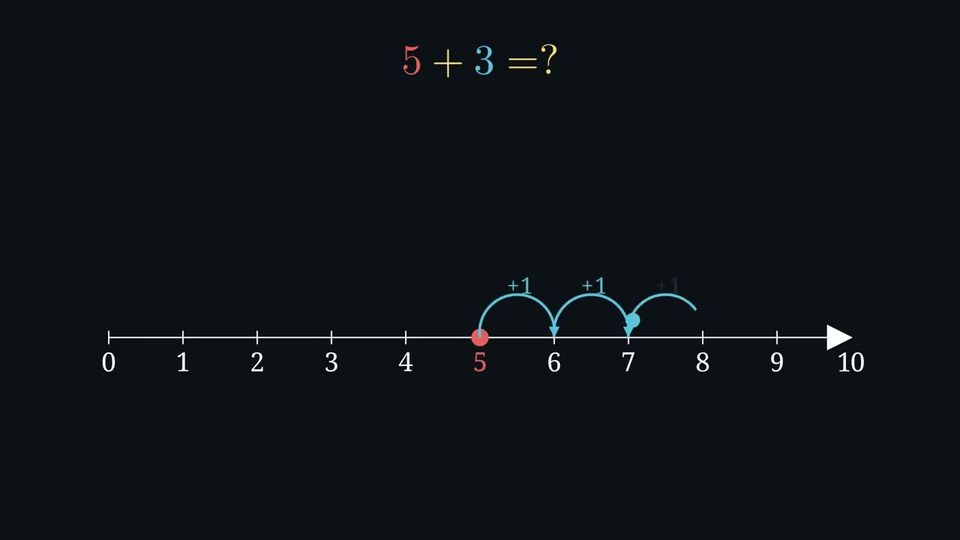
A number line shows addition as jumps to the right.Solve: \(5 + 3\)
- Start at the first number. Find the number 5 on the number line. This is your starting point.
- Jump forward. The second number, 3, tells you how many jumps to make. Since we are adding, we move to the right, where the numbers get bigger. Make 3 jumps.
- Find your landing spot. The number you land on is the answer.

Skills to practice
- Adding on the Number Line
IV
Doubles
Each hand shows 2 fingers. 
Two and two: how many fingers is that in all?
We count all the fingers: \(\textcolor{colordef}{2}+\textcolor{colorprop}{2}=4\). Two and two make four.
Definition — Doubles
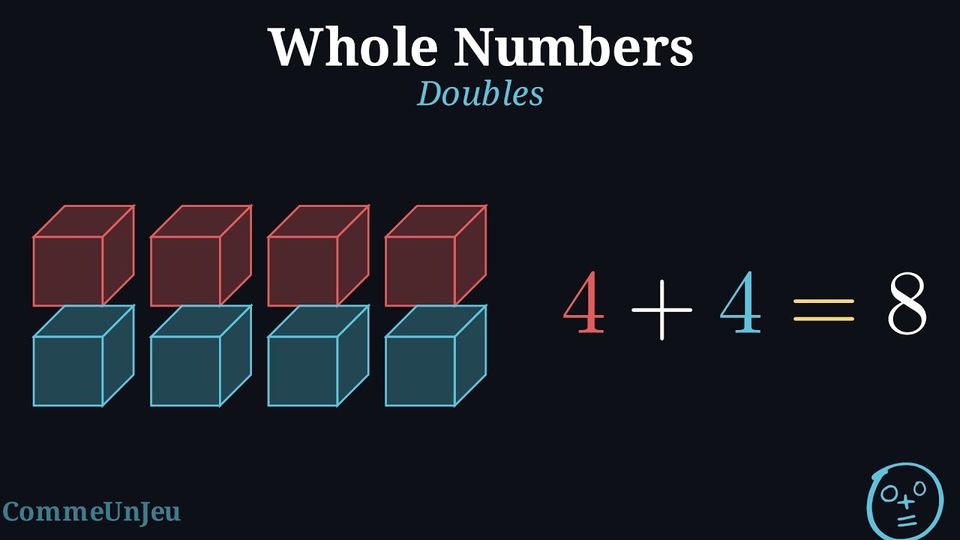
A double is a sum where we add a number to itself: the two groups have exactly the same number of objects.  \(+\)
Example
Find the double: \(\textcolor{colordef}{4}+\textcolor{colorprop}{4}=?\) \(+\) 
- \(+\) \(=\)
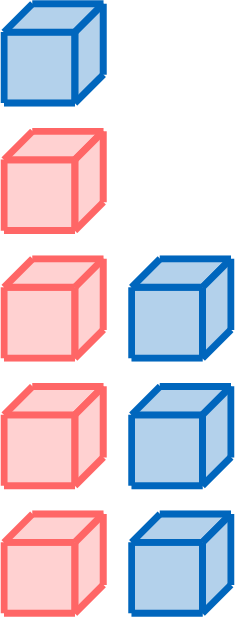
- \(\textcolor{colordef}{4}+\textcolor{colorprop}{4}=8\): four and four make eight.
Skills to practice
- Adding Doubles
V
Complements to 5
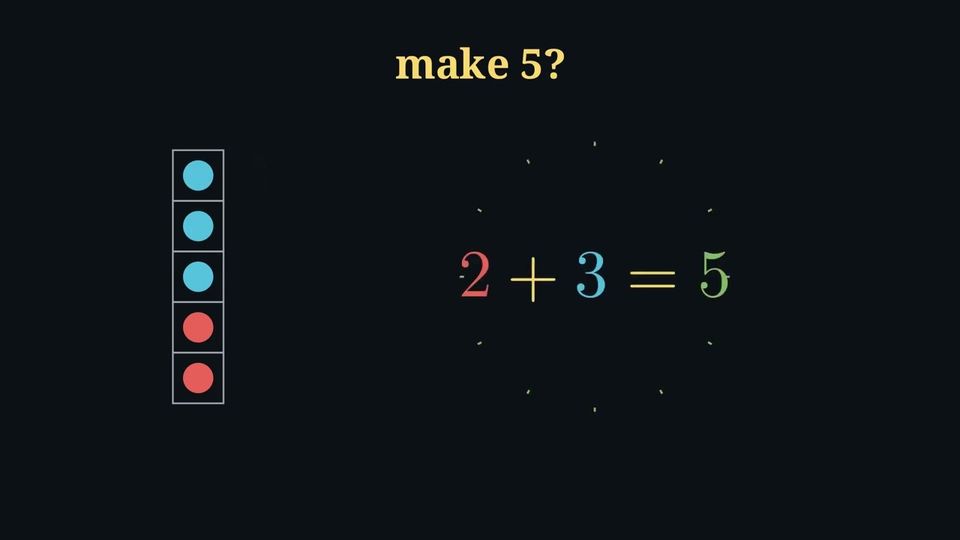
Here is a tower of 5 cubes. 3 of them are coloured. 
How many cubes are not coloured? How many more do we need to colour to make 5?
By counting the cubes that are not coloured, we can see that we need 2 more to make 5. 
The number 2 is the complement of 3: together, they make 5.
Definition — Complements to 5
The complement to 5 of a number from 0 to 5 is the number we add to it to make 5. Zero and five are partners too: \(0+5=5\) and \(5+0=5\). | Number | Complement | Sum | Cubes | Ten-Frame | Fingers |
| \(\textcolor{colordef}{0}\) | \(\textcolor{colorprop}{5}\) | \(\textcolor{colordef}{0}+\textcolor{colorprop}{5}=5\) | 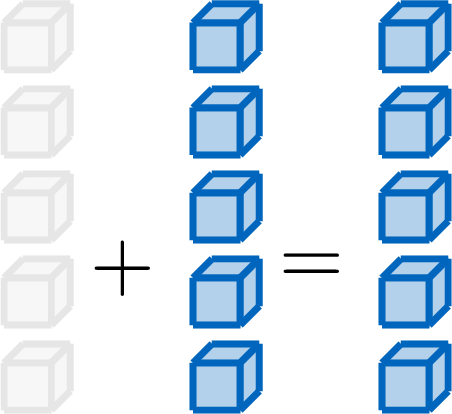 | 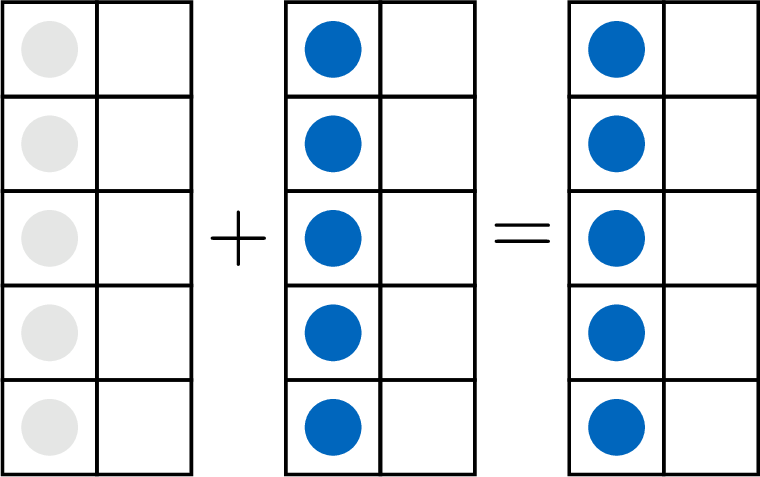 |  \(+\)  \(=\)  |
| \(\textcolor{colordef}{1}\) | \(\textcolor{colorprop}{4}\) | \(\textcolor{colordef}{1}+\textcolor{colorprop}{4}=5\) | 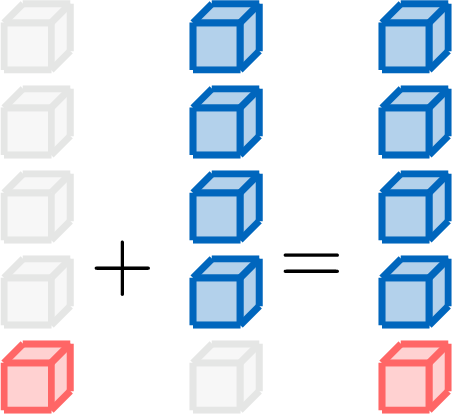 | 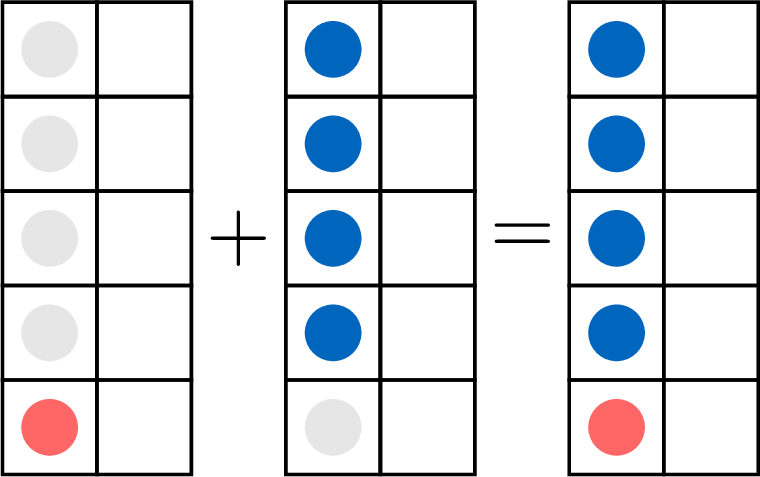 |  \(+\)  \(=\) |
| \(\textcolor{colordef}{2}\) | \(\textcolor{colorprop}{3}\) | \(\textcolor{colordef}{2}+\textcolor{colorprop}{3}=5\) | 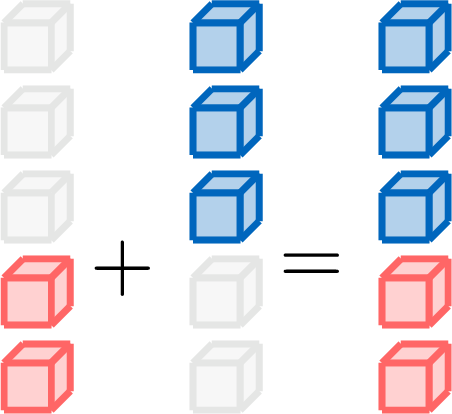 | 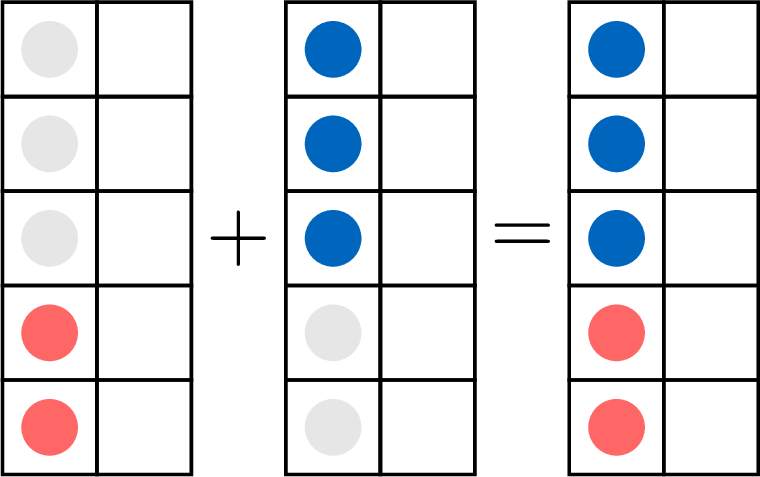 |  \(+\)  \(=\) |
| \(\textcolor{colordef}{3}\) | \(\textcolor{colorprop}{2}\) | \(\textcolor{colordef}{3}+\textcolor{colorprop}{2}=5\) | 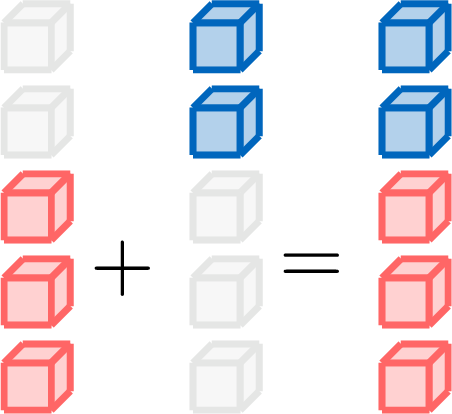 | 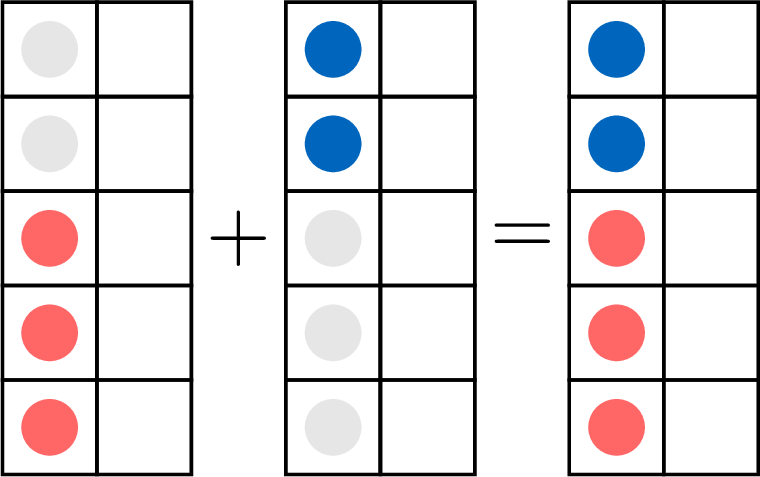 |  \(+\)  \(=\) |
| \(\textcolor{colordef}{4}\) | \(\textcolor{colorprop}{1}\) | \(\textcolor{colordef}{4}+\textcolor{colorprop}{1}=5\) | 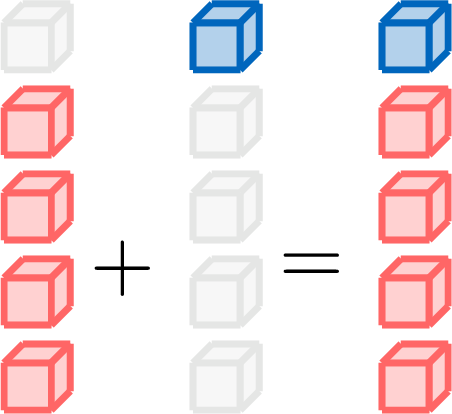 | 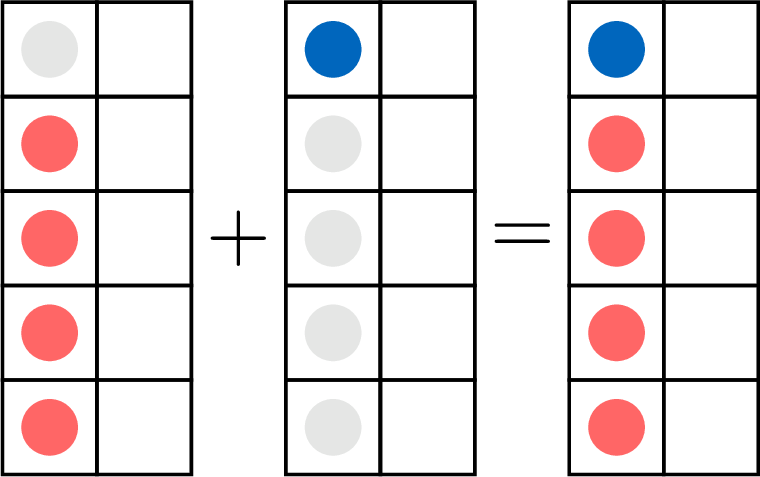 |  \(+\)  \(=\) |
Method — Counting Up to 5
To find the complement of a number, count up from this number to 5. For \(\textcolor{colordef}{3}\): \(4\), \(5\) — we count 2 numbers, so \(\textcolor{colordef}{3}+\textcolor{colorprop}{2}=5\). We can raise one finger for each number counted. Example
Find the complement of \(\textcolor{colordef}{4}\).
Counting up from \(4\): \(5\) — that is \(\textcolor{colorprop}{1}\) number, so \(\textcolor{colordef}{4}+\textcolor{colorprop}{1}=5\). 
Skills to practice
- Finding Complements Using Ten-Frames
- Finding Complements Using Cubes
- Finding Complements Using Fingers
- Finding Complements Without Pictures
VI
Solving Addition Problems
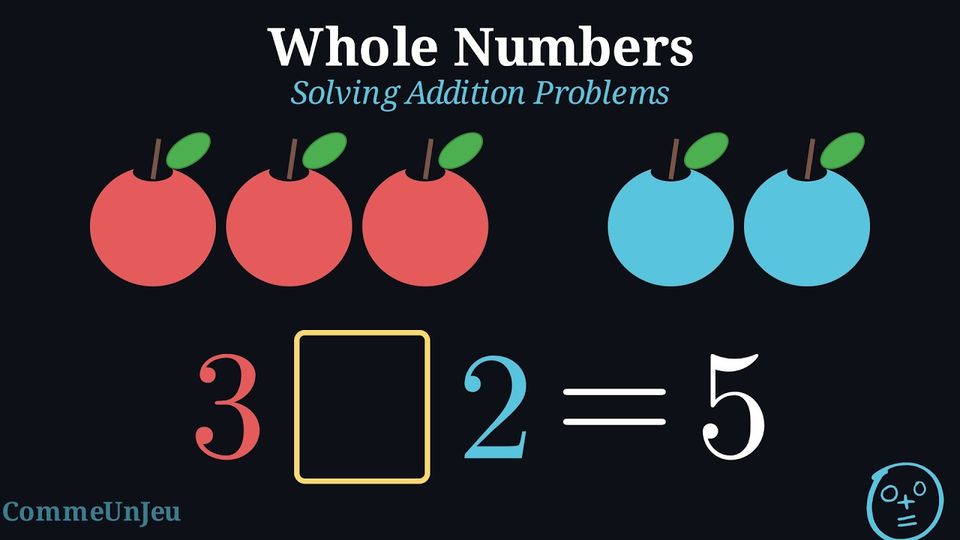
Hugo brings 3 apples. Aisha brings 2 apples. They put them together in one basket. 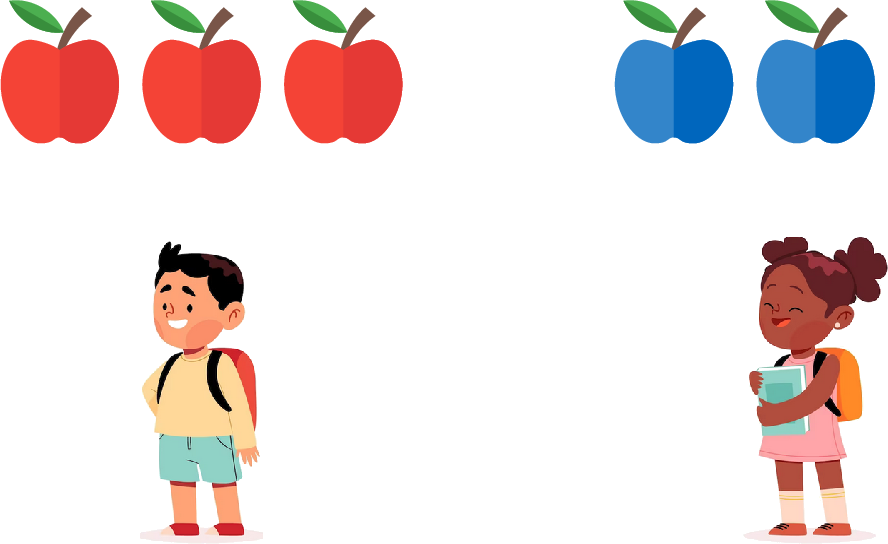
How many apples are in the basket? Nothing is written: we must find what to do.
Putting together is adding. Three red apples are already there; we keep counting with the blue ones: four, five. 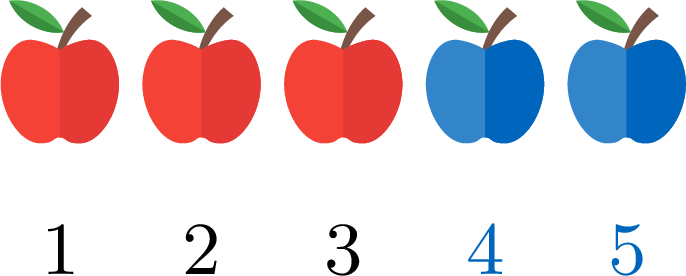
\(\textcolor{colordef}{3}+\textcolor{colorprop}{2}=5\). There are 5 apples in the basket. We check by counting the basket again.
Method — The Four Steps
A problem is a question whose answer we do not see right away: we have to find it. - Search. We look at the picture and listen to the question: what do we know? what do we want? Do things come together (then we add) or does something go away (then we subtract)?
- Try. We count, we draw, we use our fingers or cubes.
- Check. We count again to see if the answer is correct.
- Say. We say the answer with a sentence.
Example
Louis has 3 boxes with 2 cherries in each box. How many cherries are there in all? 
Search: the cherries are in groups that we put together, so we add.
Try: we count box by box: two, four, six — like the doubles: \(2+2=4\), then \(4+2=6\). 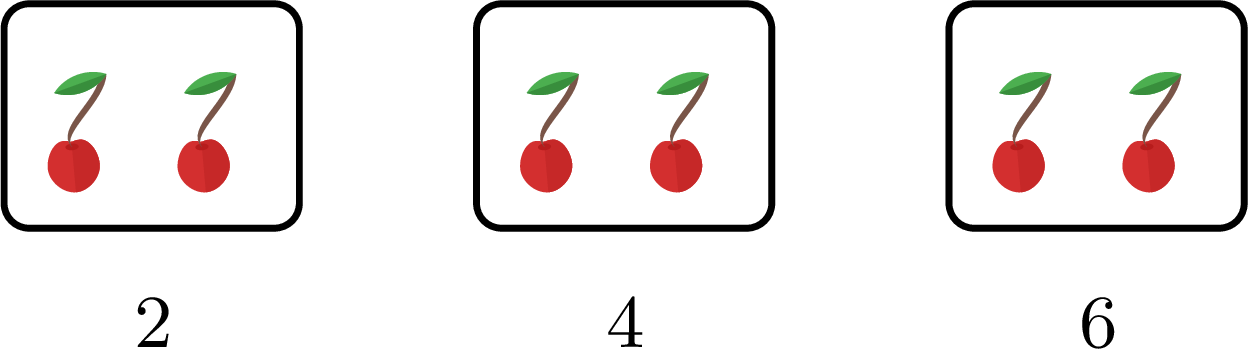
\(2+2+2=6\). Check: we count the cherries one by one: six. Say: there are 6 cherries in all.
Try: we count box by box: two, four, six — like the doubles: \(2+2=4\), then \(4+2=6\).
Skills to practice
- Finding the Total
- Grouping
- Finding What Was Added
- Moving Forward on the Track
VII
Going further
Skills to practice
- Completing Addition Equations with Pictures
- Quiz
Jump to section