International Baccalaureate · PYP 1
Money
I
What is Money?
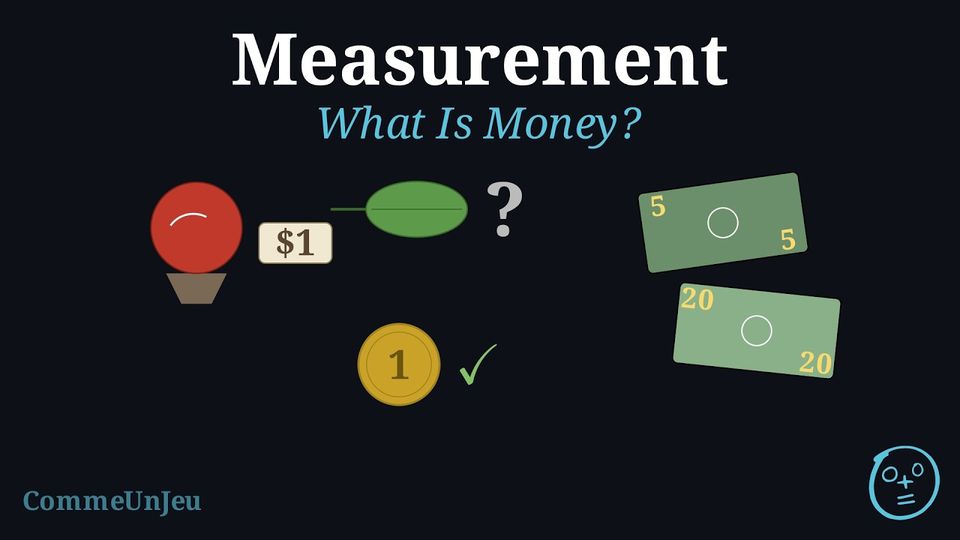
Definition — Money
Money is what we use to buy things, like food and toys. Different places in the world use different kinds of money.In the United States, the money is called the US dollar. The symbol for the dollar is \(\dollar\). We write dollar amounts with the dollar sign before the number, like \(\dollar 5\).
Money comes in metal coins and paper bills.
Definition — Dollars
Here are the US \(\dollar 1\) coin and some common US dollar bills: | 1 dollar (coin) | 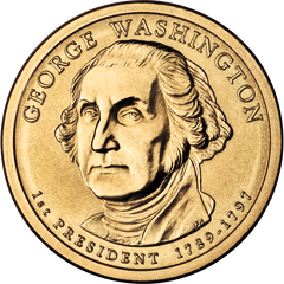 |
| 1 dollar (bill) |  |
| 2 dollars |  |
| 5 dollars |  |
| 10 dollars |  |
| 20 dollars |  |
Proposition — Same Value, Different Money
Two sets of coins and bills can have the same value without looking alike: ten \(\dollar 1\) coins are worth one \(\dollar 10\) bill, and so are five \(\dollar 2\) bills. To compare two sets, we count the value of each one, not the number of coins and bills.
Read the Value, Not the Size
To know what a coin or a bill is worth, we read the value written on it, in figures or in words. Its size and its weight do not tell us: a \(\dollar 1\) coin is thicker and heavier than a \(\dollar 20\) bill, but it is worth less. A big pile of coins can be worth less than a single bill: four \(\dollar 1\) coins are worth less than one \(\dollar 5\) bill. And all US bills have the same size: a \(\dollar 1\) bill is as big as a \(\dollar 20\) bill, but the \(\dollar 20\) bill is worth much more.
Example
Léa has a \(\dollar 5\) bill, a \(\dollar 2\) bill and another \(\dollar 2\) bill. Tom has a \(\dollar 10\) bill. Who has more? And which item is more expensive, a book at \(\dollar 8\) or a game at \(\dollar 12\)?
Léa: \(\dollar 5 + \dollar 2 + \dollar 2 = \dollar 9\). Tom: \(\dollar 10\). Tom has more, with a single bill. The game is more expensive (\(12 > 8\)), the book is cheaper.
Skills to practice
- Calculating the Total: Level 1
- Comparing Two Purses and Two Prices
II
Counting a Sum of Money
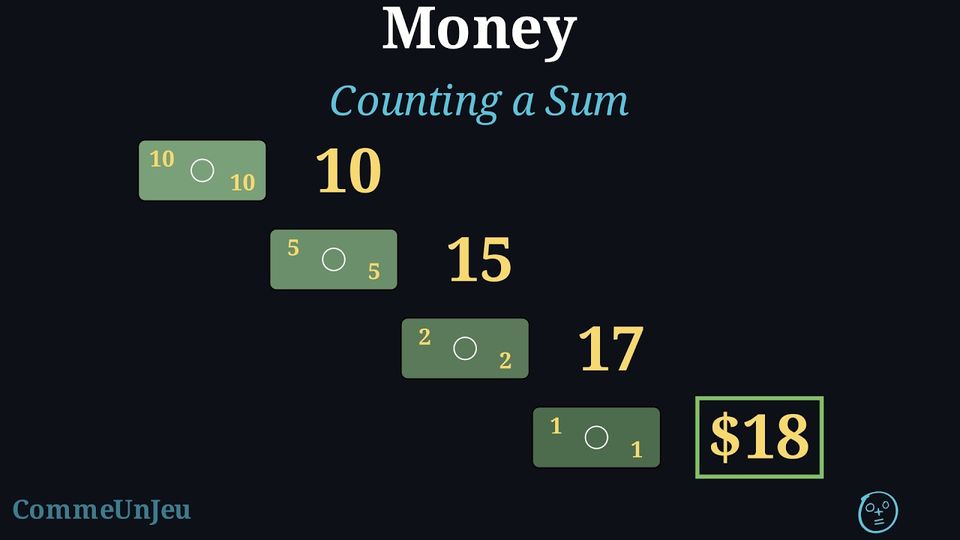
Method — Counting a Sum of Money
- Sort: Put the money in order, from the biggest value to the smallest.
- Count on: Add the money, bill or coin, one after the other, from the biggest to the smallest, and say the new total each time.
- Finish: The last number you say is the total.
Example
How much money is this? 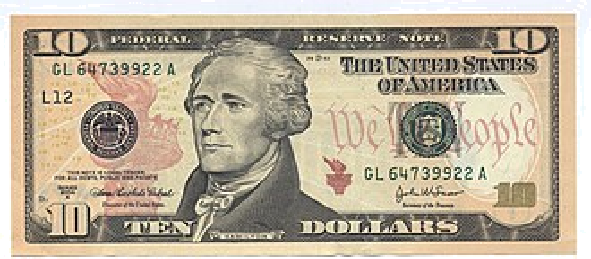
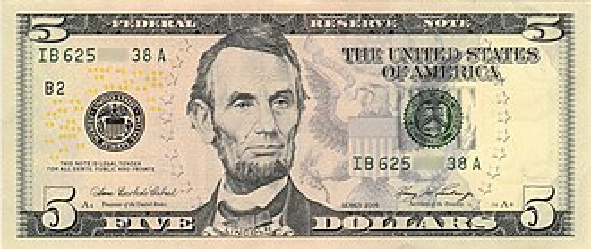
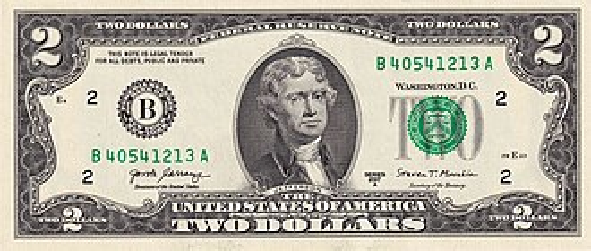
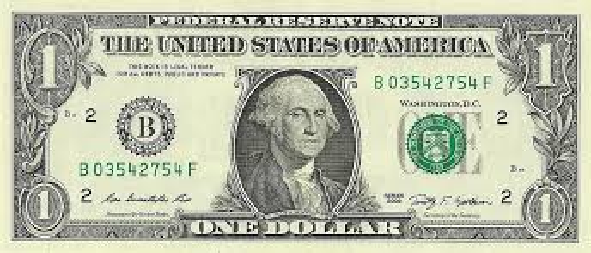
- We start with the biggest bill and count on: \(10\), then \(10+5=15\), then \(15+2=17\), then \(17+1=18\).
- \(\dollar 10 + \dollar 5 + \dollar 2 + \dollar 1 = \dollar 18\). There are \(18\) dollars.
Method — Making an Amount
To make an amount with the fewest bills and coins: - Take the biggest bill or coin that does not go past the amount.
- Look at what is missing, and again take the biggest bill or coin that does not go past it.
- Continue until you reach the amount exactly.
Example
Make 13 dollars with the fewest bills and coins. - The biggest bill that does not go past \(13\) is the \(\dollar 10\) bill. Missing: \(13-10=3\).
- The biggest that does not go past \(3\) is the \(\dollar 2\) bill. Missing: \(3-2=1\).
- We finish with a \(\dollar 1\) bill: \(\dollar 10 + \dollar 2 + \dollar 1 = \dollar 13\).
Skills to practice
- Calculating the Total: Level 2
- Making an Amount
- Making an Amount in Several Ways
III
Do I Have Enough?
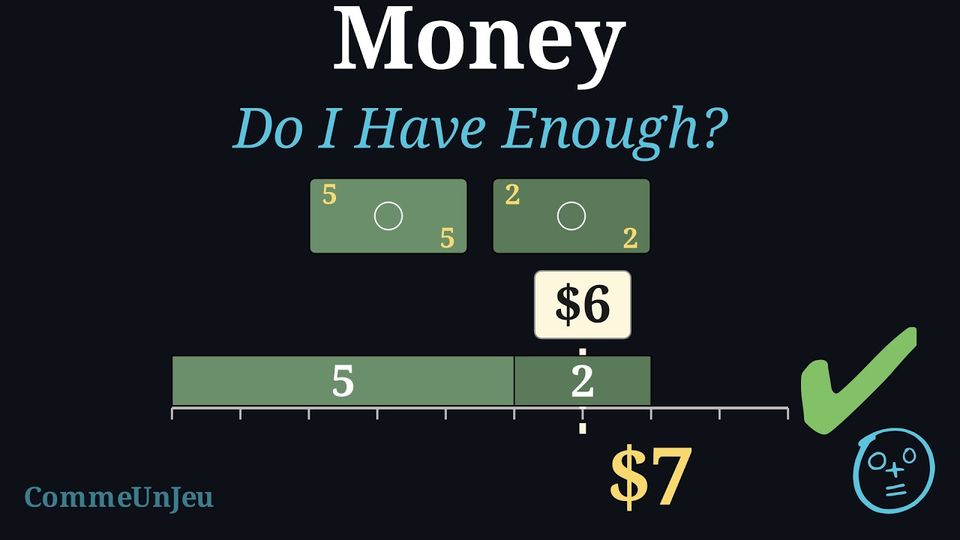
Method — Do I Have Enough?
- Count your money: Find the total you have.
- Look at the price: Find how much the item costs.
- Compare: If your money is the same as the price or more, you can buy it. If it is less, you cannot.
Example
Emma has this money. A toy costs 6 dollars. Does she have enough? - Count: \(\dollar 5 + \dollar 2 = \dollar 7\).
- Compare: \(7\) is more than \(6\).
- Emma has enough money: she can buy the toy.
Skills to practice
- Checking If You Have Enough Money
IV
Giving Change
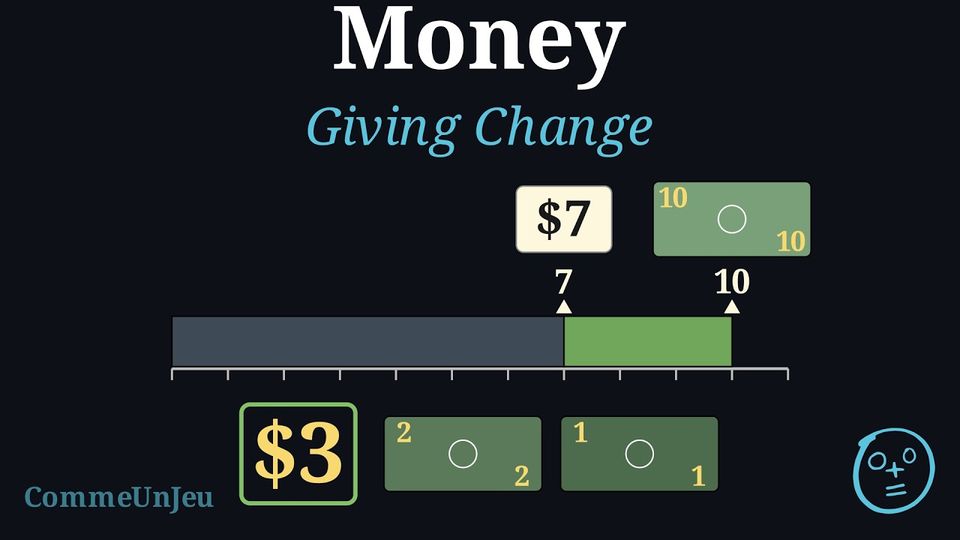
Method — Giving Change by Counting Up
The seller starts at the price and counts up to the money given: - Start at the price.
- Add coins or bills one by one, without going past the money given, and say the new total each time, until you reach the money given.
- The money you added is the change.
Example
A book costs 7 dollars. Louis gives 10 dollars to the seller. How much does the seller give back? - Count up from the price: \(7\), plus \(\dollar 1\) makes \(8\), plus \(\dollar 2\) makes \(10\).
- The seller gives back \(\dollar 1 + \dollar 2 = \dollar 3\).
- Check: \(\dollar 10 - \dollar 7 = \dollar 3\).
Skills to practice
- Counting Up from a Price
V
Going further
Skills to practice
- Completing Equations with Money
- Solving Problems with Several Questions
- Quiz
Jump to section