International Baccalaureate · PYP 1
2D and 3D Shapes
I
Plane Geometry
Maya empties a box of paper shapes onto her desk. She wants to gather all the triangles together. The shapes come in different colours and sizes, and some are turned sideways, so she cannot sort them just by how they look at a glance. 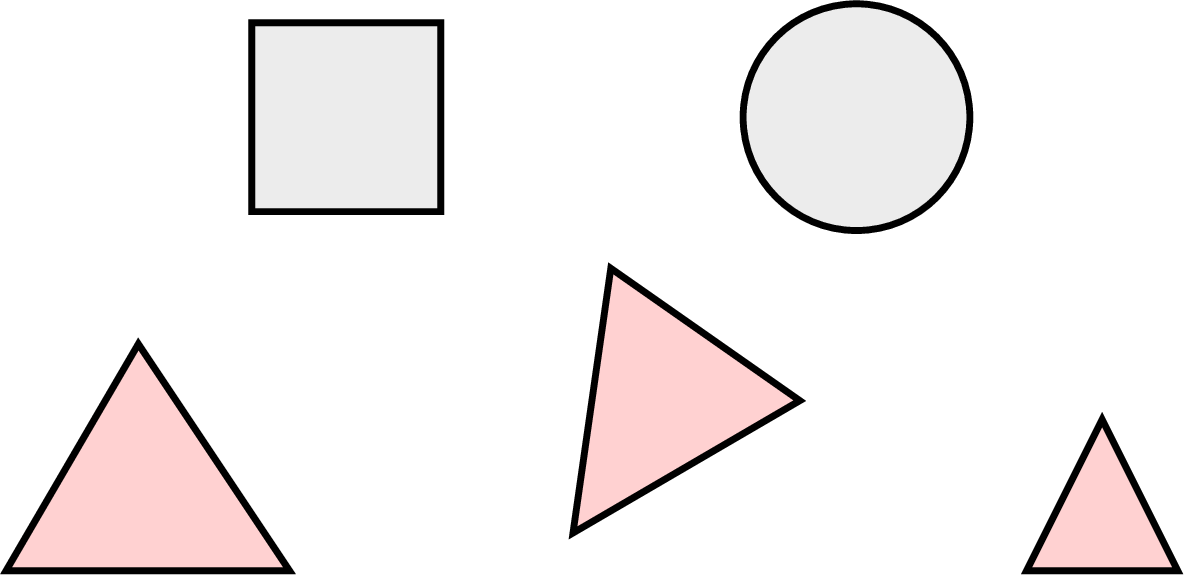
Instead, Maya looks at the parts of each shape. She runs her finger along its straight sides and counts its corners. A triangle always has 3 straight sides and 3 corners — whatever its colour, its size, or the way it is turned. By counting its sides and corners, Maya can gather all the triangles for certain.
Definition — Plane Geometry
Flat shapes are the shapes we draw on paper or see in pictures: discs (circles), triangles, squares, rectangles… Plane geometry is about these shapes. We draw them with straight or curved lines. We call them flat because they have length and width, but no thickness. 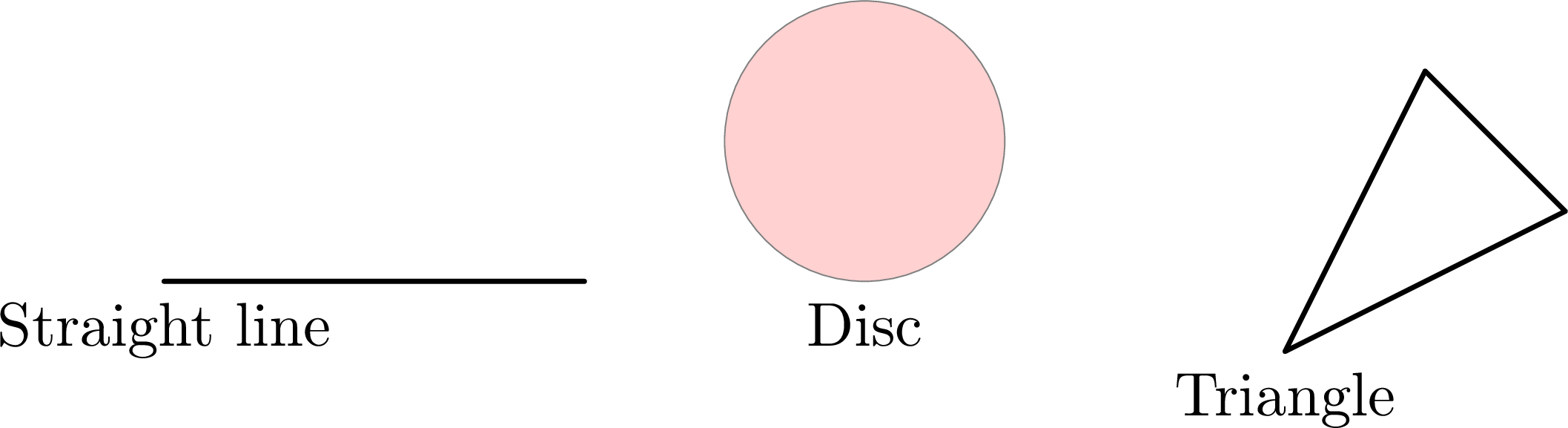
Definition — Side
A side is a straight edge of a shape. 
Definition — Vertex
A vertex (more than one: vertices) is a point where two sides meet. It is the geometry word for a corner. 
Definition — Horizontal and Vertical Lines
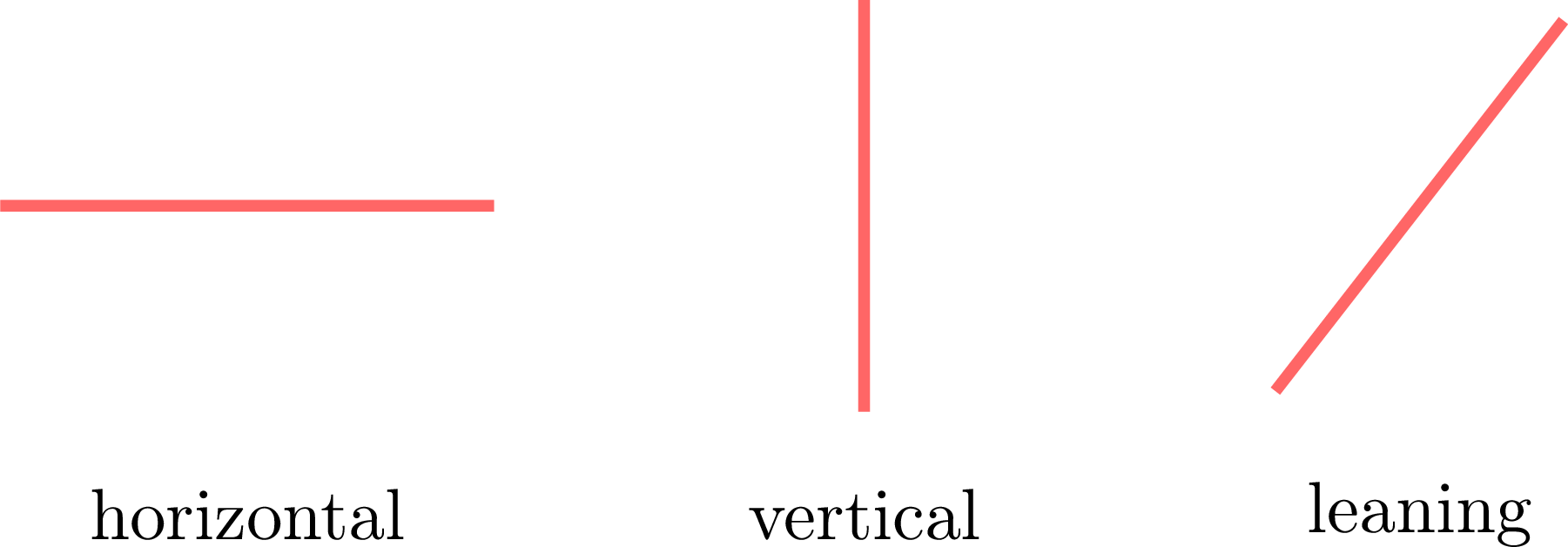
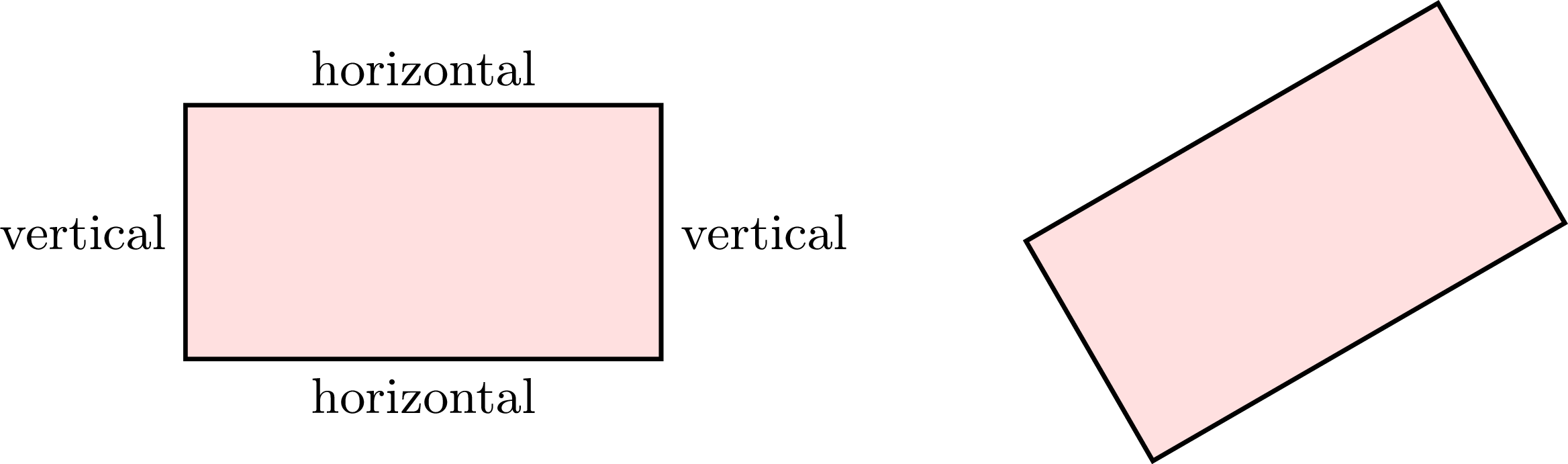
A straight line can lie in different ways. - A horizontal line goes straight across, from left to right, like the line where the sea meets the sky, or, on a page held upright in front of us, like the bottom of the page.
- A vertical line goes straight up and down, like a string that hangs with a weight at its end, or, on a page held upright, like the side of the page.
- A line that leans is neither horizontal nor vertical.
Skills to practice
- Finding the Sides
- Finding the Vertices
- Telling Horizontal from Vertical Lines
II
Classification
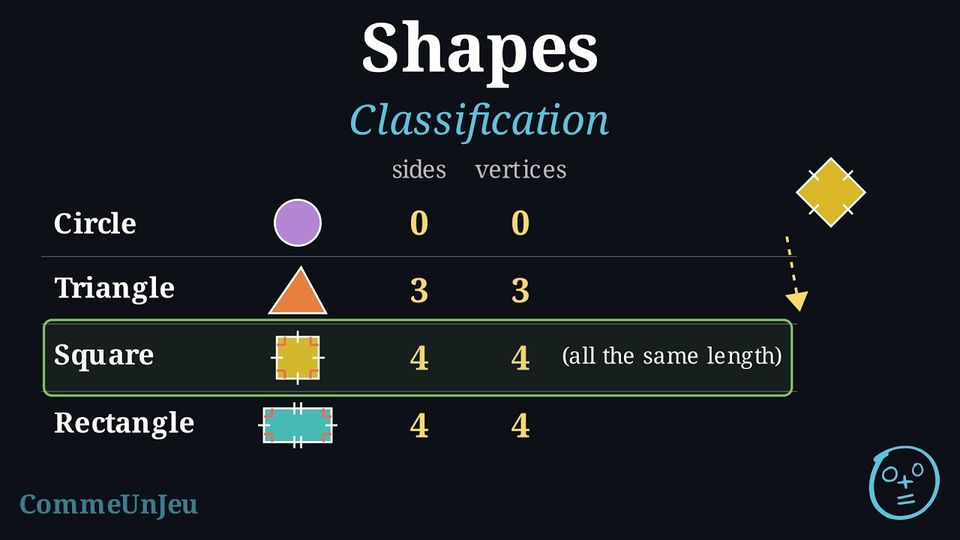
We give a shape its name by looking at its parts: its sides and its vertices — how many there are, and which sides are the same length. The same shape keeps its name when we colour it, make it bigger or smaller, or turn it around — it is what is true of its sides and vertices, not the way it looks, that decides what a shape is. This is how we recognise a figure.
Definition — Classification
We can classify shapes by looking at how many sides and vertices they have. The table below shows some common flat shapes. | Name | Shape | What you see | Sides | Vertices |
| Disc (also called a circle) |  | perfectly round, no corner | 0 | 0 |
| Triangle |  | 3 straight sides | 3 | 3 |
| Square |  | 4 equal straight sides, 4 corners all alike | 4 | 4 |
| Rectangle |  | 4 straight sides, 4 corners all alike | 4 | 4 |
Skills to practice
- Counting Shapes in Drawings and Pictures
III
Putting Shapes Together
Putting Together and Taking Apart
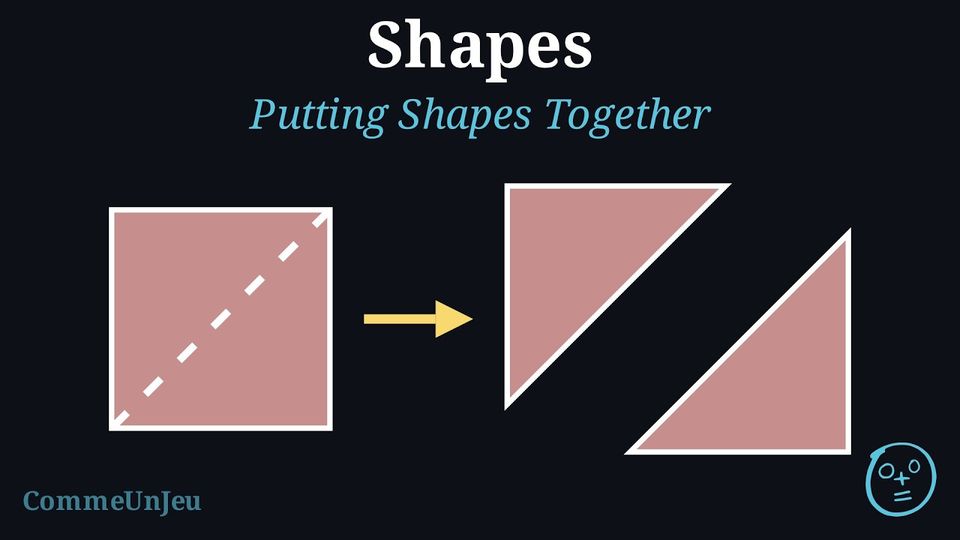
Maya cuts a paper square along a straight line, from one corner to the opposite corner. She gets 2 triangles. When she puts the 2 triangles back together, she gets the square again. 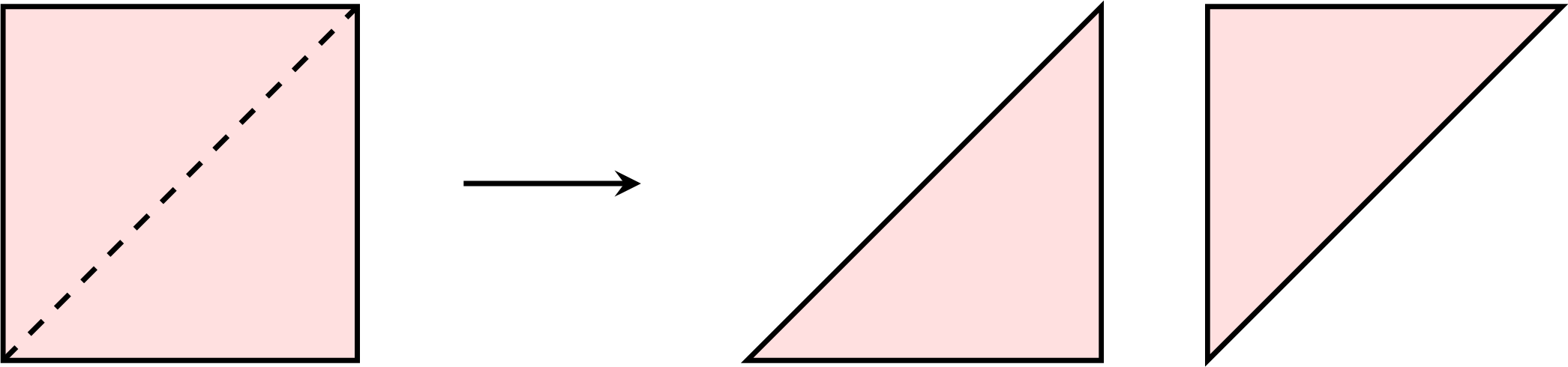
We can put shapes together to make a new shape, and take a shape apart by cutting it into smaller shapes. Two squares of the same size, put side by side, make a rectangle; this rectangle, cut in the middle, gives back the 2 squares. 
Example
The rocket is made of shapes put together. Name each piece and count the pieces. 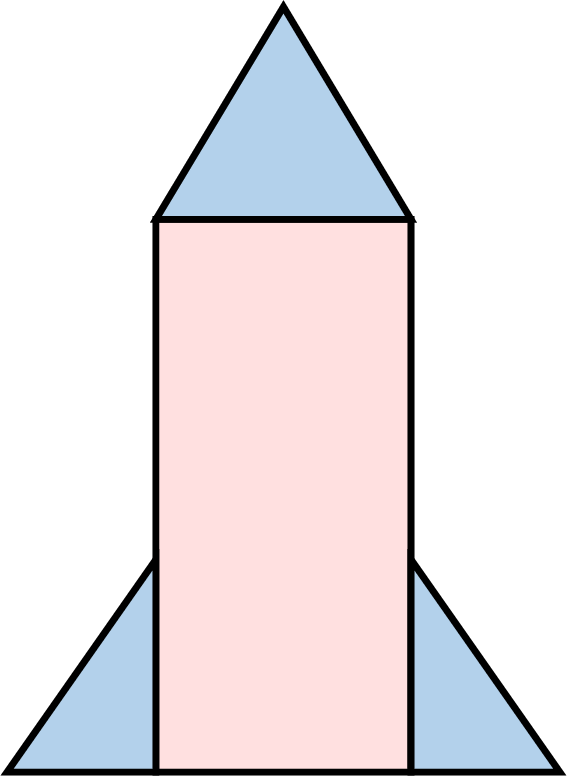
- The body is 1 rectangle: 4 straight sides and 4 corners all alike.
- The nose and the 2 fins are 3 triangles: each has 3 straight sides.
Skills to practice
- Choosing the Pieces That Make a Shape
- Cutting a Shape into Pieces
IV
The Ruler
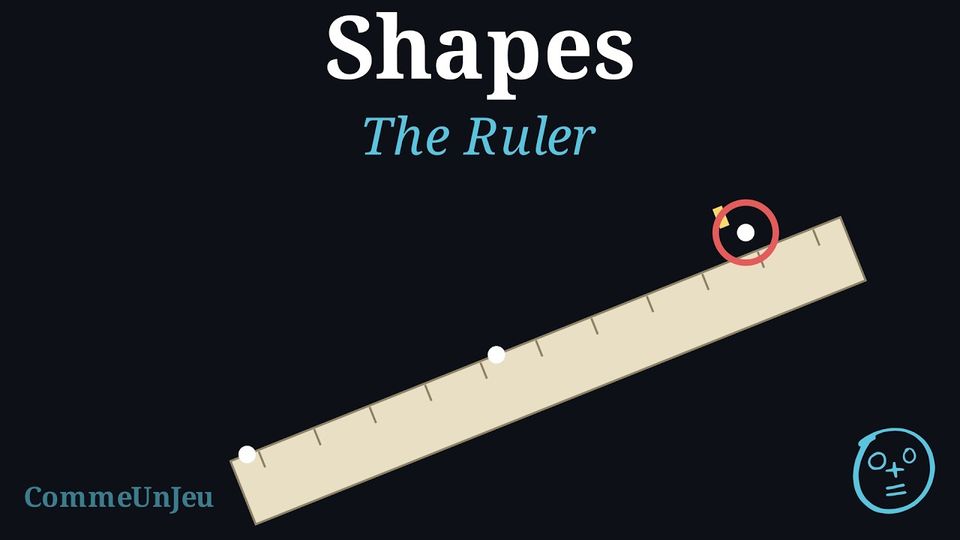
Method — Drawing a Straight Line with the Ruler
- Place the ruler: Lay the ruler on the paper so its edge passes through the two points to join.
- Hold it still: Press the ruler down firmly with one hand.
- Draw: Slide the pencil along the edge, from one point to the other.
Method — Checking an Alignment
Three points are aligned when they are all on the same straight line. - Place the edge of the ruler on two of the points.
- Look at the third point: if the edge passes through it too, the three points are aligned. If not, they are not aligned.
Example
Are the points A, B and C aligned? And the points A, B and D? 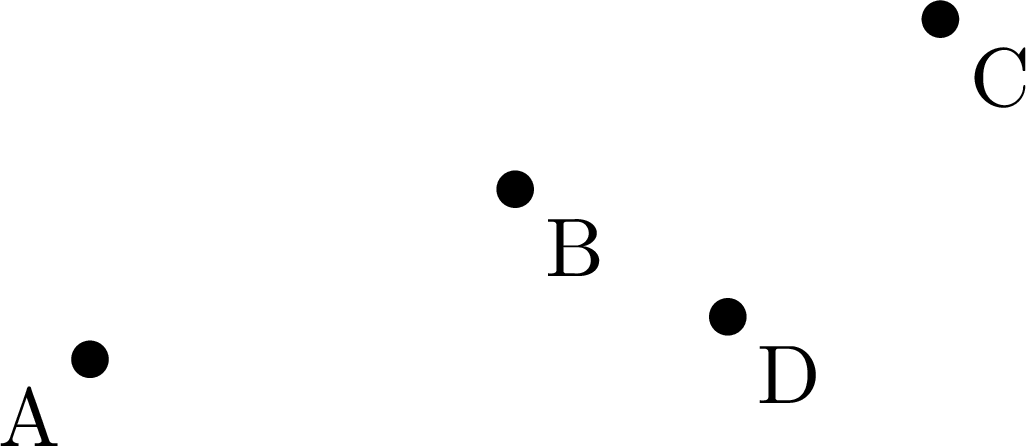
- We place the edge of the ruler on A and B and draw the line.
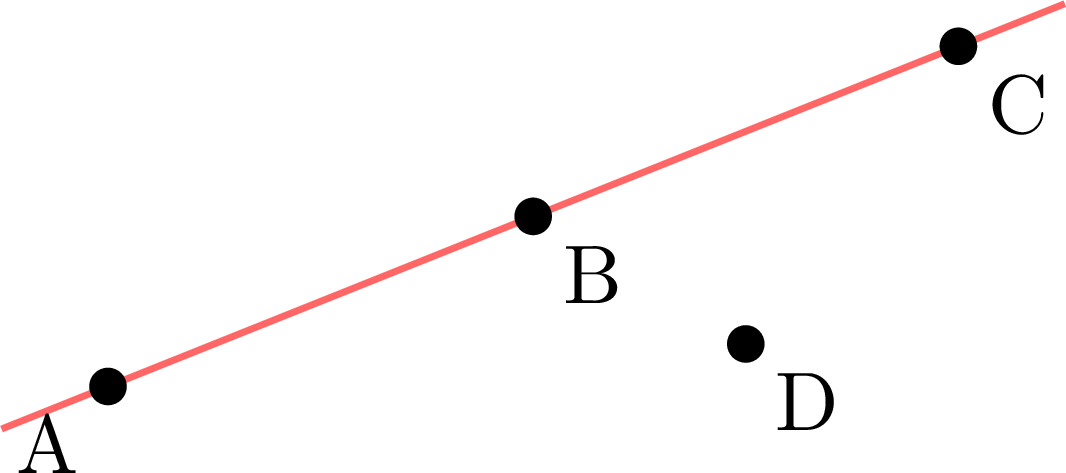
- C touches the line: A, B and C are aligned.
- D does not touch the line: A, B and D are not aligned.
Skills to practice
- Checking an Alignment
- Drawing with the Ruler
V
Solids and Their Faces
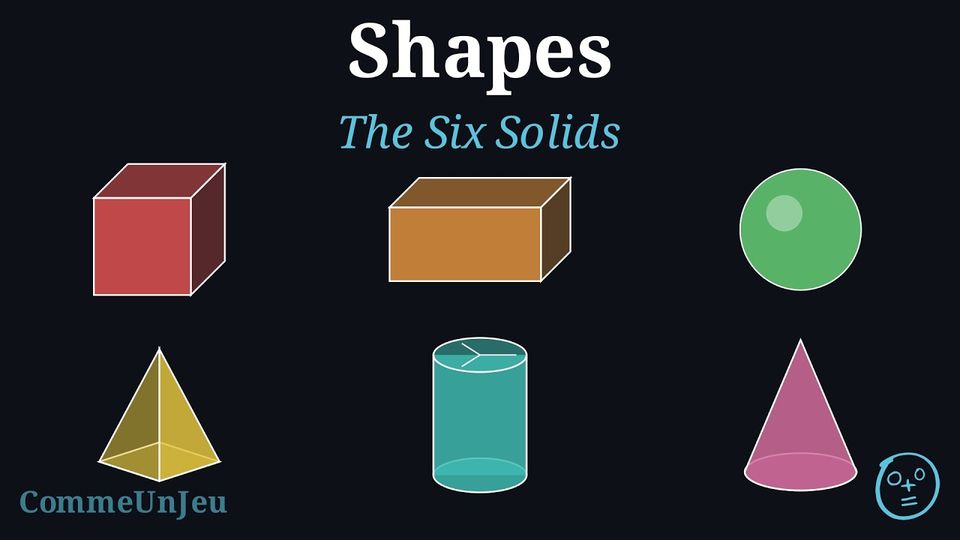
Definition — The Six Solids
| Solid | Name | Like… |
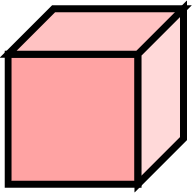 | the cube |  |
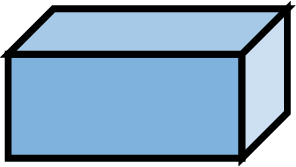 | the box | 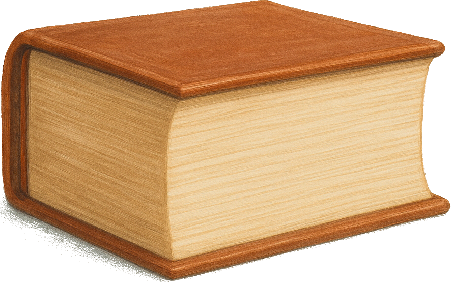 |
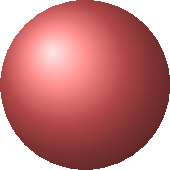 | the ball | 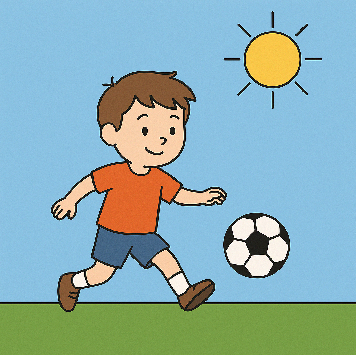 |
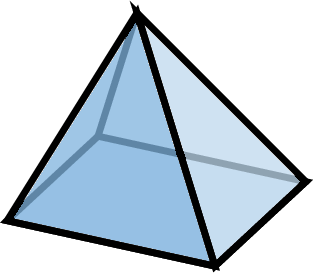 | the pyramid | 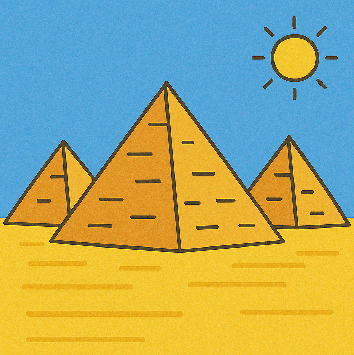 |
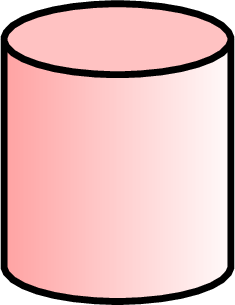 | the cylinder | 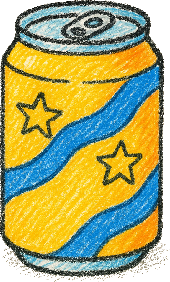 |
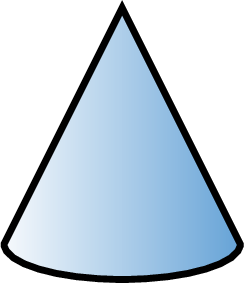 | the cone | 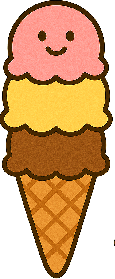 |
Example
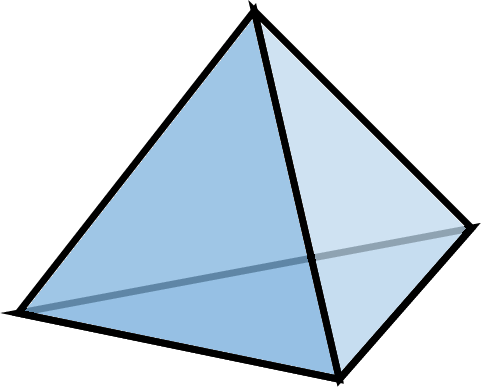
Here is another pyramid, on the right: its base is a triangle. It has a point, like the pyramid on the left, whose base is a square. 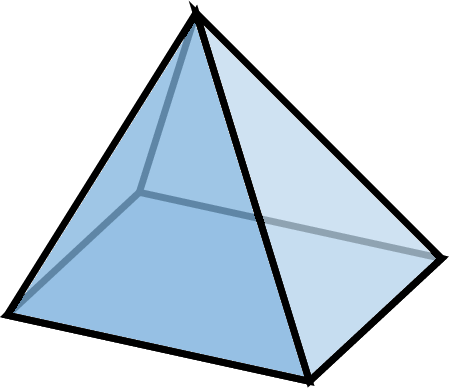
Flat Faces and Round Parts
Some solids have flat faces: rested on a flat face, they stay still and cannot roll. The cube, the box and the pyramid have only flat faces. Some solids are round: placed on their round part, they can roll. The ball is round all over. The cylinder and the cone are round on the side, but they also have flat faces to rest on: the cylinder has two, the cone has one.
Definition — Solids
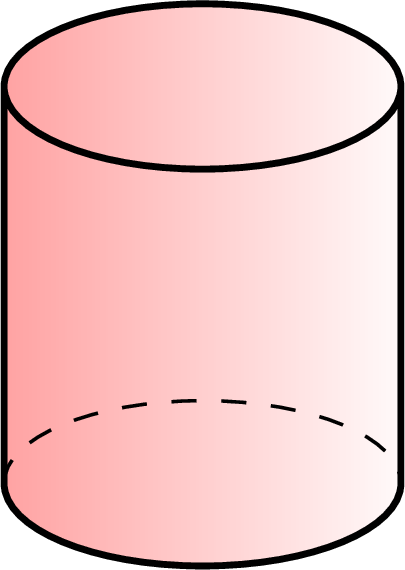
Solids are shapes that are not flat: they are the three-dimensional (3D) shapes, such as cubes, cylinders, and spheres. The diagrams below show some examples of these shapes. 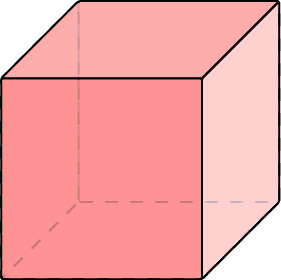 \(\quad\)
 \(\quad\)
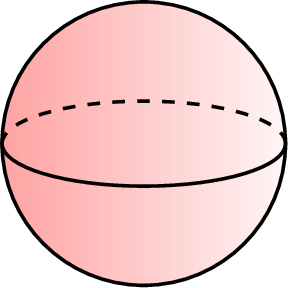 \(\quad\)
Definition — Surface
A surface is the outside of a three-dimensional (3D) shape. It is the part of the shape you can touch. Definition — Face
A face is a flat surface on a three-dimensional shape. Example
How many faces does this rectangular prism have? 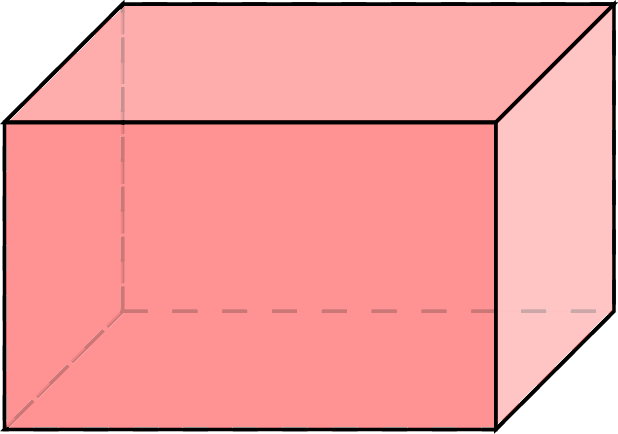
- We count the flat faces: the front and the back, the top and the bottom, the left side and the right side.
- The rectangular prism has 6 faces, like the cube — but its faces are rectangles.
Example
Look at the cylinder. What is its surface made of? 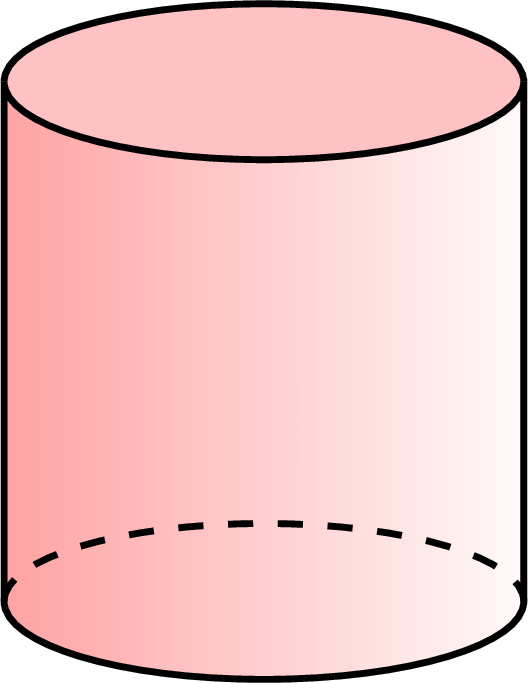
- The surface is everything we can touch on the outside.
- The cylinder has 2 flat faces (the top and the bottom) and 1 curved part on the side.
Skills to practice
- Identifying Flat or Solid Shapes
- Counting Faces
VI
Edges and Vertices
Noah tidies a box of wooden blocks. He wants to gather every block shaped like a cube. The blocks come in different colours and sizes, and a few are resting on a slanted side, so he cannot trust a quick glance: a long box turned end-on can look square from the front. 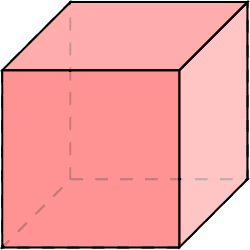 \(\quad\)\(\quad\)
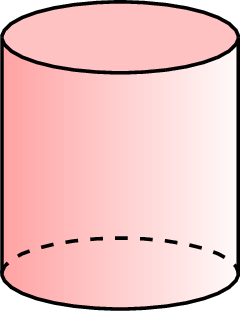 \(\quad\)
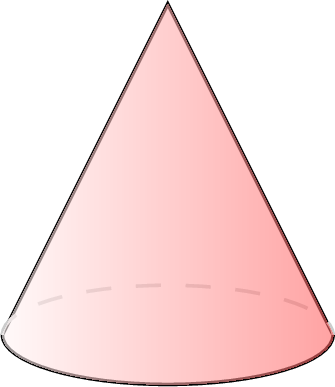
Instead, Noah looks at the parts of each block. He counts its flat faces, runs his finger along its straight borders, and feels for its corners. A cube has 6 square faces, all exactly the same — whatever its colour, its size, or the way it is resting. By naming the parts, Noah can tell a cube from a sphere, a cylinder, or a cone for certain.
\(\quad\)\(\quad\)\(\quad\) Definition — Edge
An edge is a straight line where two faces meet. Definition — Vertex
A vertex is a corner of a three-dimensional shape. It is a point where two or more edges meet. Example
This box-shaped solid has many faces, edges, and vertices. One example of each is shown. 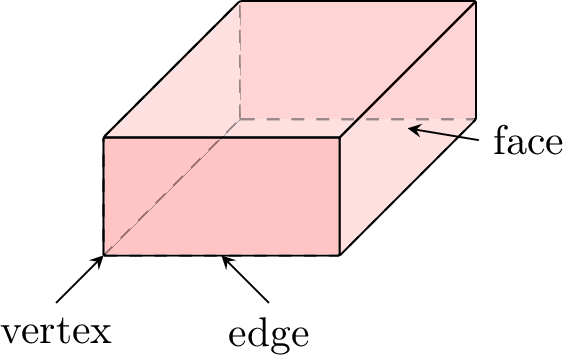
Example
Here is a square pyramid. On the drawing, the dashed lines are the hidden edges, behind the solid: count them too. Write its identity card: its faces and their shapes, its edges, its vertices. 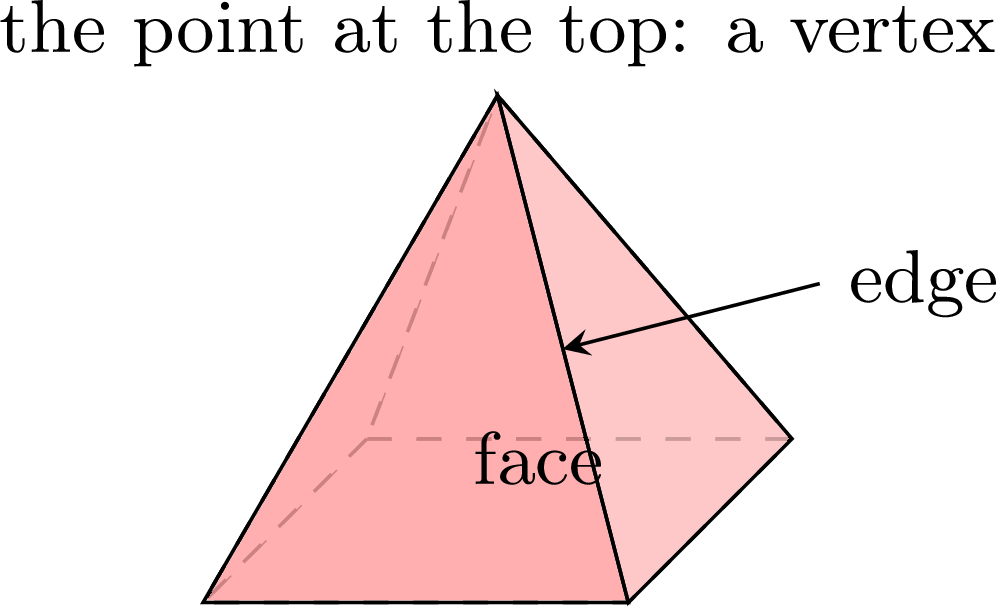
- Faces: the base underneath is a square; the \(4\) faces that climb to the point at the top are triangles. In all \(1 + 4 = 5\) faces.
- Edges: \(4\) edges around the square base, and \(4\) edges that go up to the point at the top: \(4 + 4 = 8\) edges.
- Vertices: the \(4\) corners of the base, and the point at the top: \(4 + 1 = 5\) vertices.
Definition — Classification
We can sort three-dimensional (3D) shapes by counting their faces, edges, and vertices. Some examples are shown in the table below. | Name | Shape | Faces | Edges | Vertices |
| Cube | | 6 (flat faces) | 12 | 8 |
| Rectangular Prism (a box) | 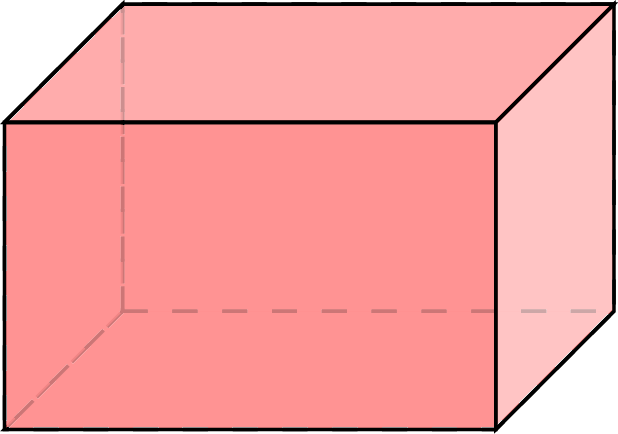 | 6 (flat faces) | 12 | 8 |
| Sphere (a ball) | | 0 flat faces (1 curved surface) | 0 | 0 |
| Square Pyramid | 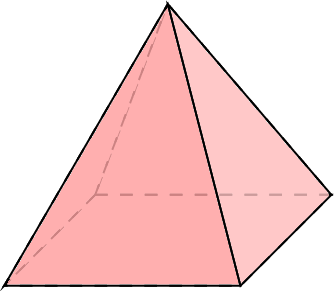 | 5 (flat faces) | 8 | 5 |
| Cylinder | | 2 flat faces (1 curved surface) | 0 | 0 |
Skills to practice
- Counting Edges and Vertices
VII
Recognising a Solid from Its Faces
Definition — The Usual Solids and their Faces
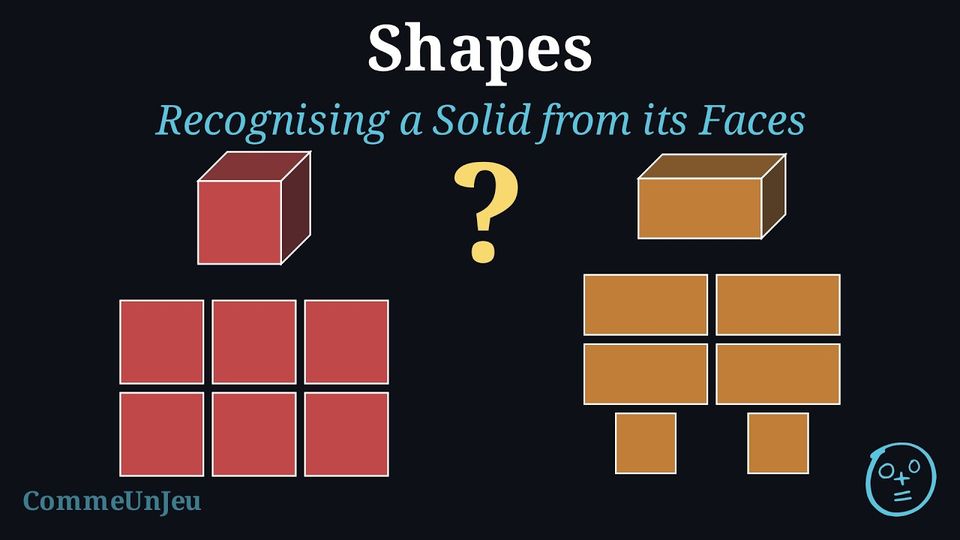
Counting the faces is not enough: a cube and a box both have \(6\). What tells the solids apart is the shape of their faces. | Solid | Name | Its faces |
| | the cube | \(6\) faces, all squares |
| | the box (a rectangular prism) | \(6\) rectangles (sometimes two of them are squares) |
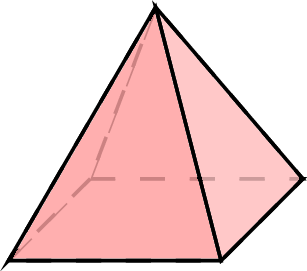 | the square pyramid | \(1\) square and \(4\) triangles up to the point at the top |
| | the cylinder | \(2\) flat discs (round shapes) and \(1\) round part |
| | the cone | \(1\) flat disc and \(1\) round part up to the point |
| | the ball (a sphere) | no flat face: round all over |
Example
The portrait game. Léa hides a solid in a bag and describes it: “I have \(6\) faces: \(4\) rectangles and \(2\) squares.” Then Noah: “I have one flat face, a disc, and a round part that climbs to a point.” Which solids are they? - Léa's solid: \(4\) rectangles and \(2\) squares: a box. It is not a cube: its faces are not all squares.
- Noah's solid: a disc and a round part with a point: a cone. A cylinder has two discs and no point; a ball has no flat face.
Skills to practice
- Playing the Portrait Game
- Finding and Describing Solids
VIII
Going further
Skills to practice
- Comparing Shapes with Numbers
- Quiz
Jump to section