International Baccalaureate · PYP 1
Numbers to 100
I
Place Value
Dr. Tariel's birthday cake holds many candles. 
Counting them one by one would take a long time. We look for a faster way.
Since we have 10 fingers, we make groups of ten. 
There are 4 groups of ten candles and 2 single candles left over.
4 tens and 2 ones make the number 42. Writing the number is quicker than drawing every candle. 
Since we have 10 fingers, we make groups of ten.
4 tens and 2 ones make the number 42. Writing the number is quicker than drawing every candle.
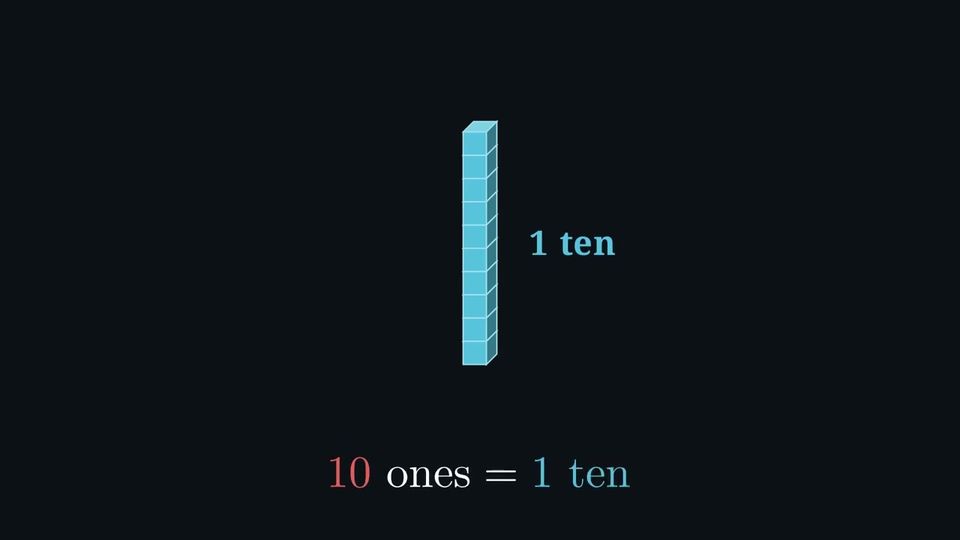
- We can group 10 single cubes (ones) to make 1 ten-stick (ten).
 = \(10\) ones \(= 1\) ten =

- To find out how many tens and ones are in a number, we can use a place value table. For the number 42:
Tens Ones 4 2 

Definition — Digits
The symbols we use to write numbers are called digits. There are ten digits we use to write every number. | Word | Digit | Cubes |
| zero | 0 | |
| one | 1 |  |
| two | 2 |  |
| three | 3 |  |
| four | 4 |  |
| five | 5 |  |
| six | 6 |  |
| seven | 7 |  |
| eight | 8 |  |
| nine | 9 |  |
Definition — Representing 2-Digit Numbers
A 2-digit number is written with two digits: the tens digit followed by the ones digit. The 2-digit numbers go from 10 to 99. The place of a digit in a number tells us its value. We can show a number in many ways: - With digits: $$42$$
- As tens and ones: $$ 4\text{ tens and } 2\text{ ones }$$
- As a sum: $$40 + 2$$
- With words:
forty-two - In a place value chart:
Tens Ones 4 2 - With cubes:

The Place Decides
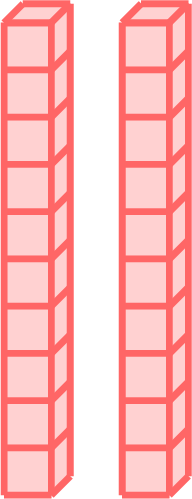
Here are two numbers written with the same two digits, a \(4\) and a \(2\) — only their places have been swapped.
\(\qquad\)
On the left, \(42\): four ten-sticks and two single cubes. On the right, \(24\): two ten-sticks and four single cubes. Look at the cubes — there are many more on the left. The digits are the same. Only their place has changed, and the number is not the same at all. In a number, a digit does not carry its value on its own: it is its place that says whether it counts tens or ones.
| Tens | Ones |
| 4 | 2 |
 |  |
| Tens | Ones |
| 2 | 4 |
 |  |
Zero is a special digit. It acts as a placeholder to show that a place is empty. For example, in the number 20, the zero shows that no ones are left on their own: the ones place is empty.
Example
A collection has \(3\) tens and \(17\) ones. Write it with a single digit for the tens and a single digit for the ones, then write the number.  \(\quad+ \quad \)

\(17\) ones are more than \(9\): ten of them make one more ten-stick. $$\begin{aligned}[t]3\text{ tens }+ \textcolor{colorprop}{17\text{ ones}} &= 3\text{ tens }+ \textcolor{colorprop}{1\text{ ten }+ 7\text{ ones}} &&\text{(ten ones make one ten)}\\
&= 4\text{ tens }+ 7\text{ ones}\\
&= 47\end{aligned}$$ \(\quad+ \quad \) \(\quad =\quad\)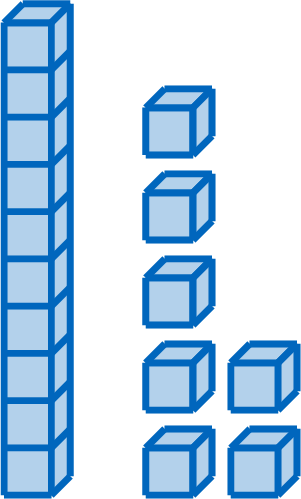
The collection is the number \(47\): \(4\) tens and \(7\) ones.
\(\quad+ \quad \) \(\quad =\quad\) Skills to practice
- Counting Fruits in a Table
- Counting Cubes in a Table
- Counting Ten-Frames in a Table
- Finding the Digit
- Writing Numbers From Tens and Ones
- Writing Numbers From Sums
- Breaking Down Numbers into Tens and Ones
- Drawing Tens and Ones
- Grouping by Tens
- Converting Ones into Tens and Ones
- Regrouping Ones into Tens and Adding the Extra Tens
II
Number Names
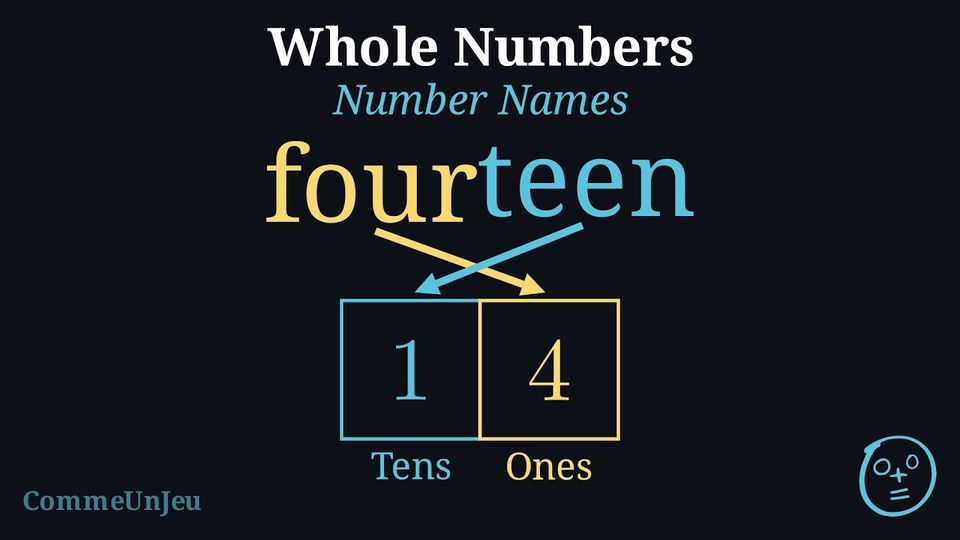
We now know how to write a number with digits: \(42\) is \(4\) tens and \(2\) ones. But a number also has a name, the word we say out loud. Sometimes the name follows the digits, and sometimes it does not. Learning to go from the name to the digits — and back — is the second half of knowing a number.
Definition — The Names of the Tens
Each whole ten has its own name. | Digits | Name | Tens |
| \(10\) | ten | \(1\) ten |
| \(20\) | twenty | \(2\) tens |
| \(30\) | thirty | \(3\) tens |
| \(40\) | forty | \(4\) tens |
| \(50\) | fifty | \(5\) tens |
| \(60\) | sixty | \(6\) tens |
| \(70\) | seventy | \(7\) tens |
| \(80\) | eighty | \(8\) tens |
| \(90\) | ninety | \(9\) tens |
Definition — The Names from Eleven to Nineteen
Between ten and twenty, the names do not all work the same way. | \(11\) | \(12\) | \(13\) | \(14\) | \(15\) |
| eleven | twelve | thirteen | fourteen | fifteen |
| \(16\) | \(17\) | \(18\) | \(19\) |
| sixteen | seventeen | eighteen | nineteen |
Method — From the Name to the Digits
Apart from the whole tens, which are one word (twenty, thirty…), the name of a number from \(21\) to \(99\) has two parts. - The first part gives the tens digit: forty-two \(\rightarrow\) \(4\) tens.
- The second part gives the ones digit: forty-two \(\rightarrow\) \(2\) ones.
Example
Write thirty-five with digits.
Thirty gives \(3\) tens, five gives \(5\) ones. $$\text{thirty-five} = 30 + 5 = 35$$
| Tens | Ones |
| 3 | 5 |
 |  |
Method — The Names That Trick Us
Careful: some names do not follow the digits. The numbers from \(13\) to \(19\) say the ones first and the ten last: $$\underbrace{\text{four}}_{4} \; \underbrace{\text{teen}}_{\text{ten}} \qquad \text{but we write} \qquad 14 \;=\; 1 \text{ ten and } 4 \text{ ones}$$ We hear \(4\) then ten, and we write \(1\) then \(4\). So fourteen is \(14\), not \(41\). Example
Write fourteen with digits, then say how many tens and ones it has.
The name says four, then teen. But a teen number always has one ten: $$\text{fourteen} = 10 + 4 = 14$$ So \(14\) has \(1\) ten and \(4\) ones.
Skills to practice
- Choosing the Right Name
- Writing Numbers from Words
- Writing Numbers in Words
III
On the Number Line
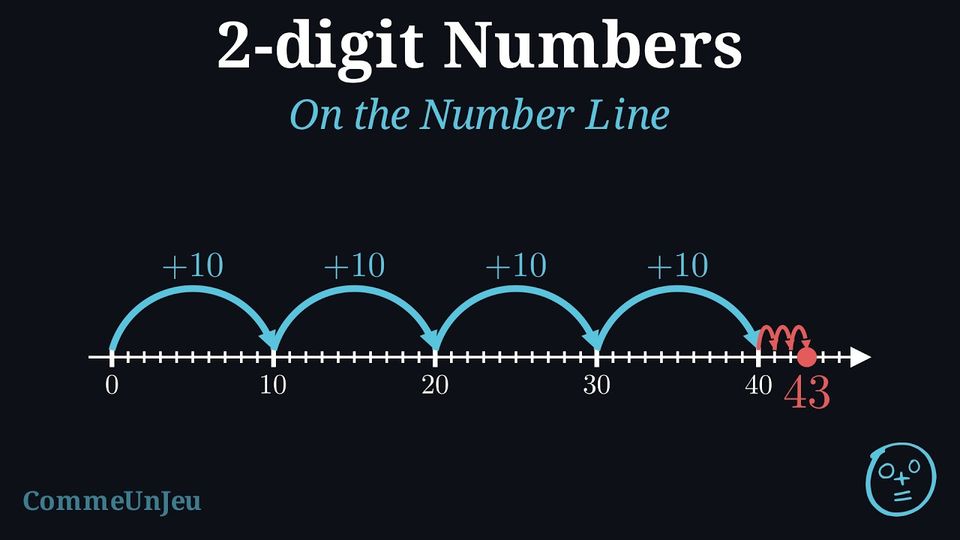
- A number line shows numbers in order, like a long ruler. The numbers get bigger as we move to the right.

- To count big numbers faster, we can take big jumps of 10. This is called counting by tens. We say: “ten, twenty, thirty…”

Four jumps of ten reach \(40\). One more jump of ten reaches \(50\): $$40 + 10 = 50$$ 
Definition — Number Line
A number line starts at an origin, marked \(0\), and shows the numbers in order, from smallest to largest; from one mark to the next, we always move on by the same step. 
A Number Is a Distance from Zero
The number line starts at \(0\): this point is its origin. From there, the line goes on to the right as far as we like — we only ever draw a part of it. A point placed on a mark of the line has a number. This number says how far the point is from \(0\), counted in steps of one. The point below is \(7\) steps of one away from \(0\): it is the point \(7\). 
For a point far from \(0\), we do not count every step of one: we count steps of ten, then steps of one. The point \(43\) is \(4\) steps of ten and \(3\) steps of one away from \(0\) — \(4\) tens and \(3\) ones, the same distance counted faster. 
Method — Placing a Number by Steps of One
On a number line marked in ones, we move on by \(1\) from one mark to the next. To place a number: - Start from the mark of its tens: \(52\) has \(5\) tens, so we start from the mark \(50\). A number less than \(10\) has \(0\) tens: we start from \(0\), the origin.
- Move on by as many steps of one as it has ones: \(2\) steps for \(52\).
- Check by reading the point back: the labelled ten and the steps made give the number again — \(50\) and \(2\) more make \(52\). When the number has ones, the steps left before the next ten complete \(10\): \(2\) steps after \(50\), \(8\) steps before \(60\), and \(2 + 8 = 10\).
Example
Place \(37\) on this part of the number line. 
\(37 = 30 + 7\): \(3\) tens and \(7\) ones. We start from the mark \(30\) and move on \(7\) steps of one — \(31\), \(32\), \(33\), \(34\), \(35\), \(36\), \(37\). 
Check by reading the point back: \(30\) and \(7\) more make \(37\); and \(7\) steps after \(30\), \(3\) steps before \(40\): \(7 + 3 = 10\).
Skills to practice
- Finding 2-Digit Numbers
- Placing a Number on the Number Line
IV
Reaching One Hundred
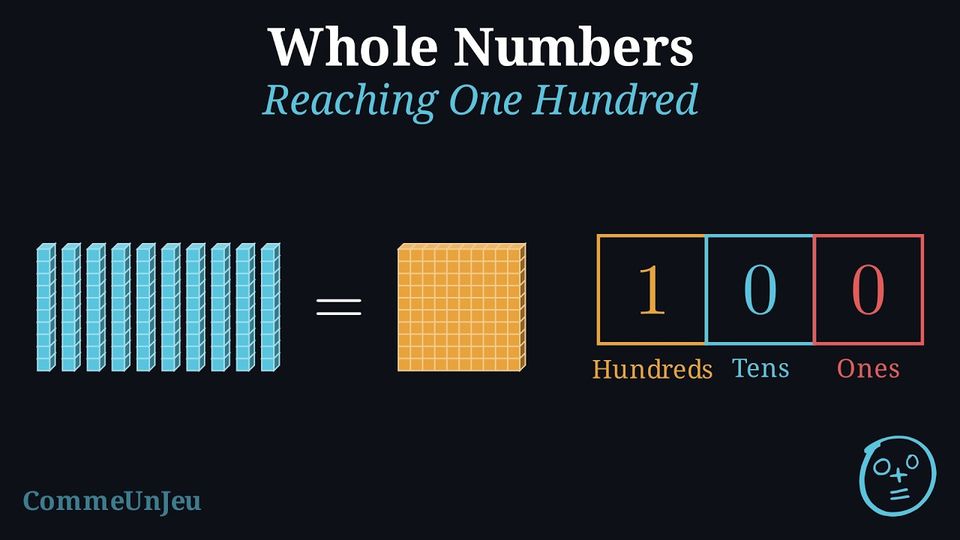
The class built \(10\) ten-sticks. 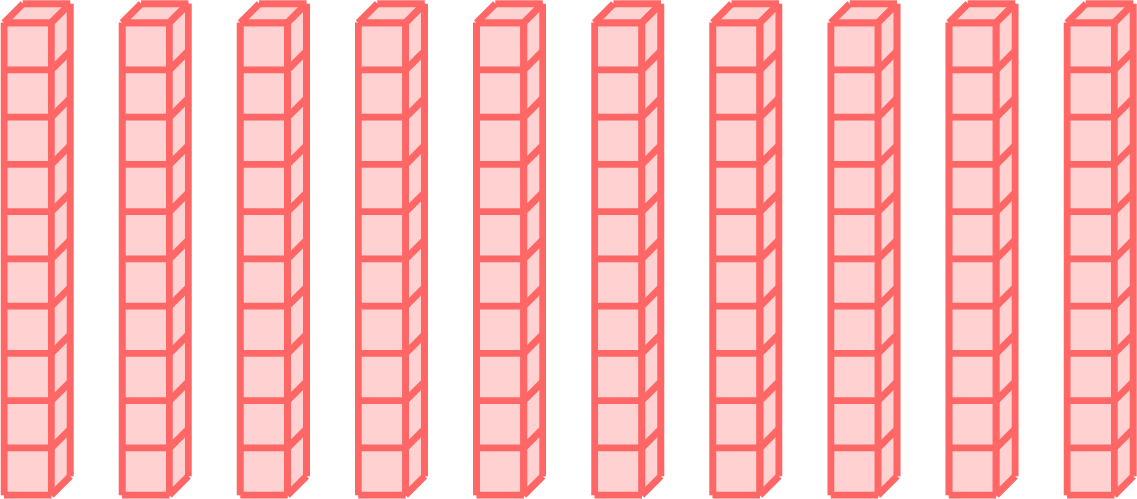
Count by tens: \(10\), \(20\), \(\dots\) How many cubes are there in all?
\(10\), \(20\), \(30\), \(40\), \(50\), \(60\), \(70\), \(80\), \(90\) — and one more ten. We need a new number: one hundred.  = \(10\) tens = \(100\) =

= \(10\) tens = \(100\) = Definition — One Hundred
Right after \(99\) comes a new number: one hundred. We write it \(100\): a \(1\) followed by two \(0\)s — the first number with three digits. Counting by tens, ten ten-sticks make one hundred. Example
Where does \(100\) sit on this line? 
On the mark just after \(90\): ten steps of ten from \(0\).
Skills to practice
- Counting to One Hundred
V
Estimating a Quantity
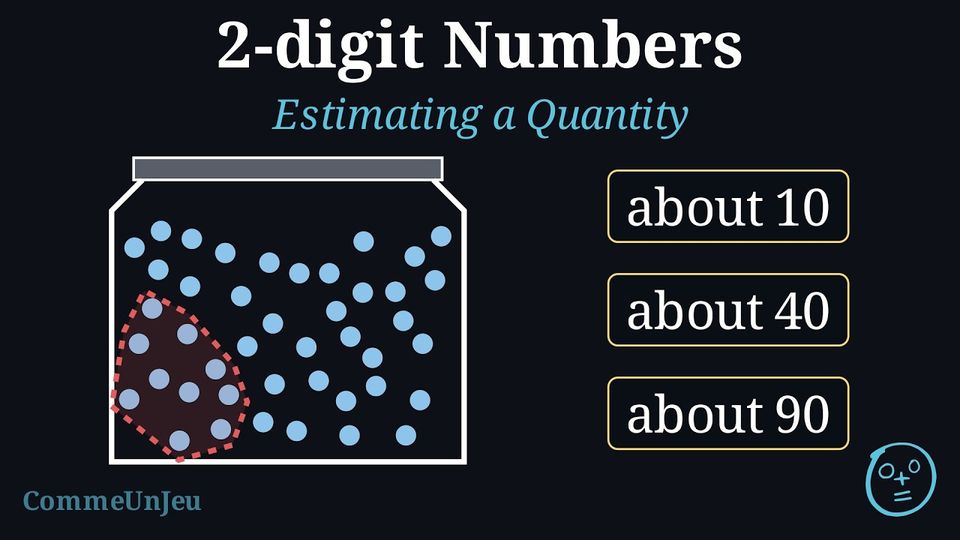
Léa's jar is full of marbles. 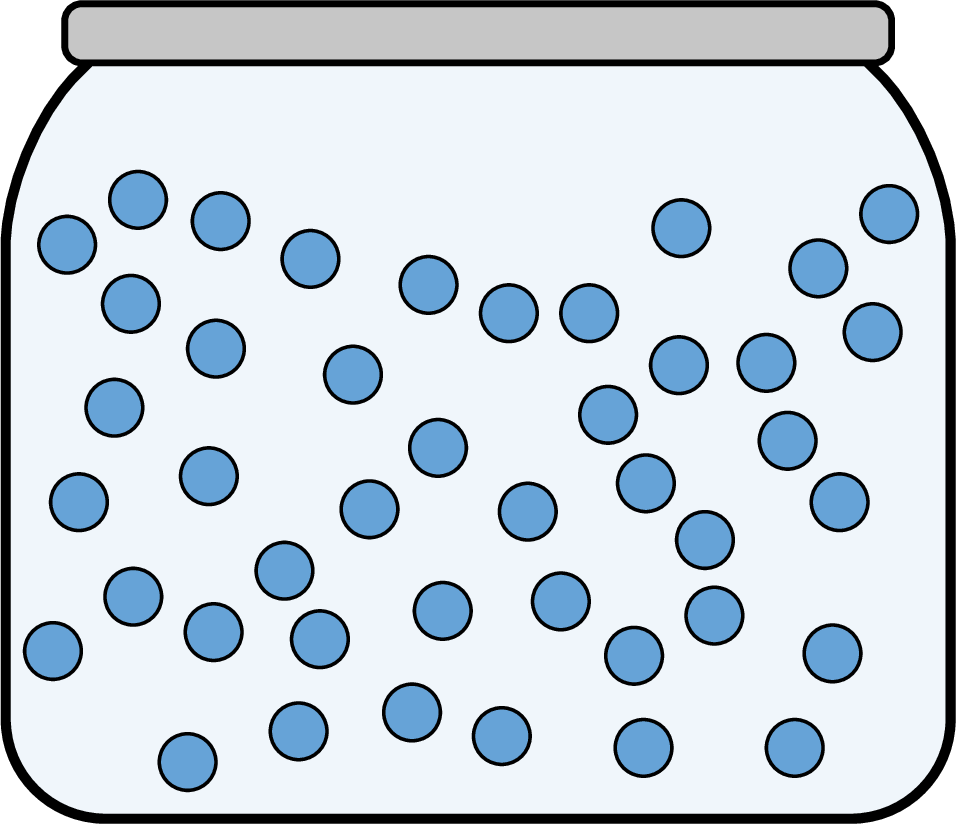
Tom says “about \(10\)”, Léa says “about \(40\)” and Sam says “about \(90\)”. Without counting the marbles one by one, say who is the closest.
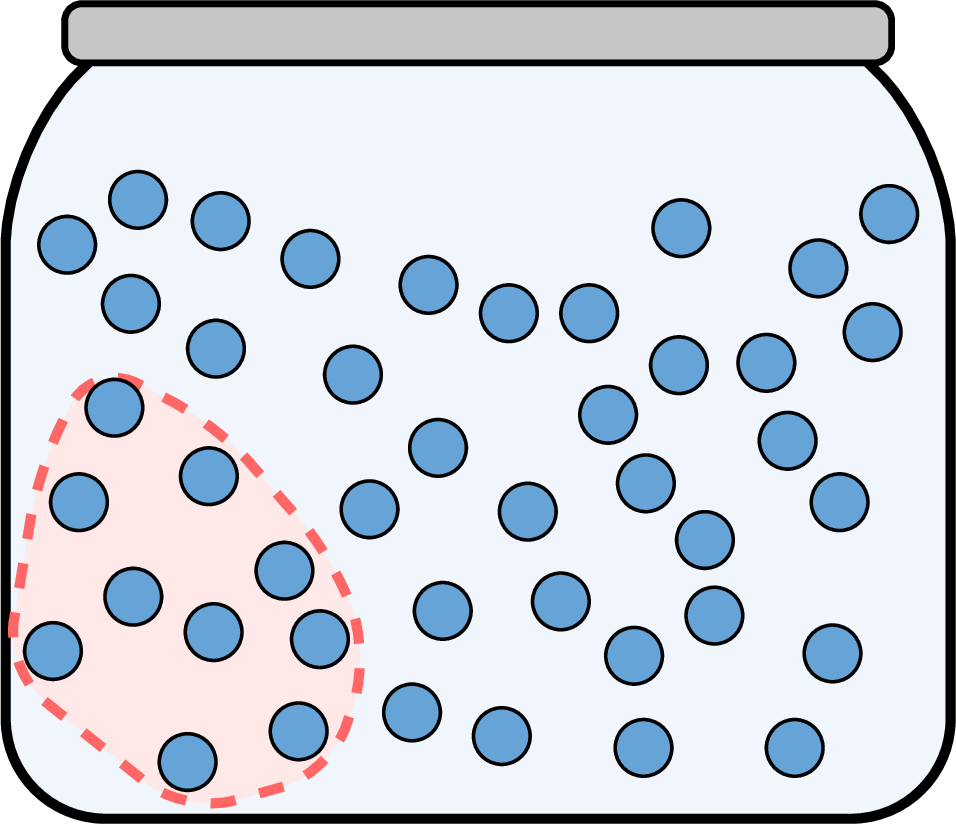
The \(10\) circled marbles fill a small part of the jar. About four groups like them fill the whole jar: there are about \(40\) marbles. Léa is the closest.
To check, the marbles are put in groups of ten: \(4\) tens and \(3\) ones, that is \(43\) marbles. \(43\) is close to \(40\). 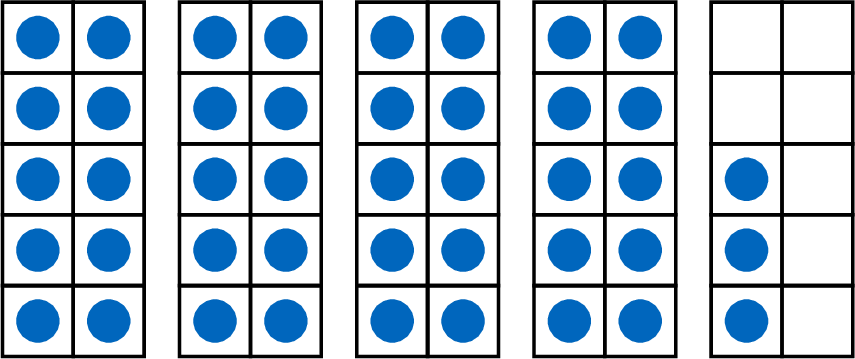
To check, the marbles are put in groups of ten: \(4\) tens and \(3\) ones, that is \(43\) marbles. \(43\) is close to \(40\).
Definition — Estimate
To estimate a quantity is to give quickly a number close to the real number, without counting the objects one by one. We say about: “about \(40\) marbles”.Counting gives the exact number: \(43\). Estimating gives a close number: about \(40\).
Method — Estimating with a Group of Ten
- Circle a group of ten objects: it shows how much room ten objects take.
- See how many groups like it would cover the whole collection, and count them by tens: about \(3\) groups make about \(30\).
- Check by counting in tens: put the objects in groups of ten, count the tens, then the ones left over.
A good estimate is often the ten closest to the count. For \(48\) objects: \(48\) is \(2\) steps from \(50\) and \(8\) steps from \(40\), so the ten closest to \(48\) is \(50\), and a good estimate is about \(50\).

Example
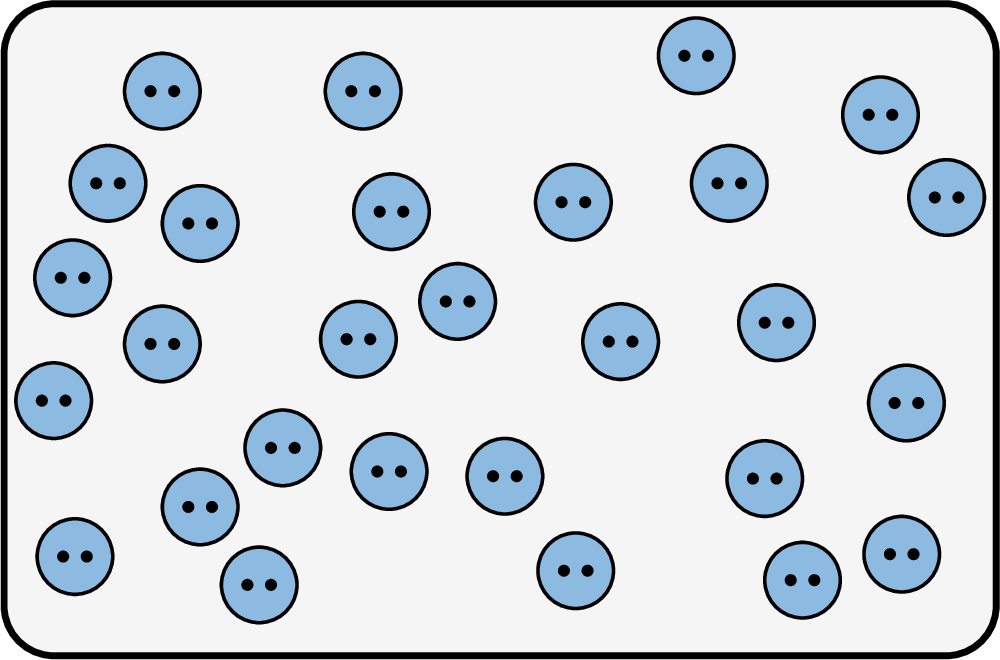
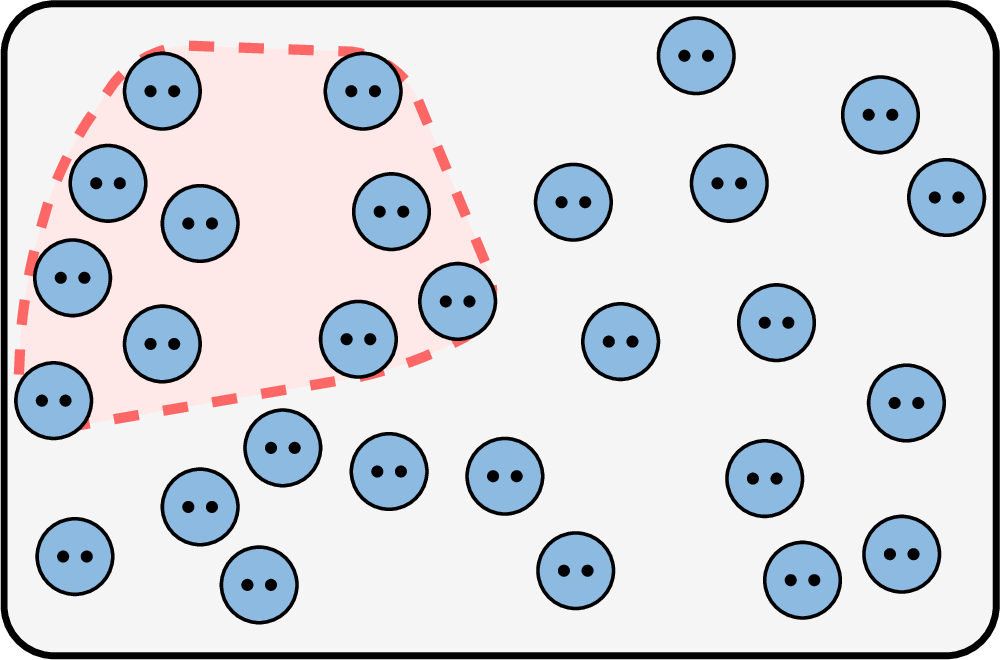
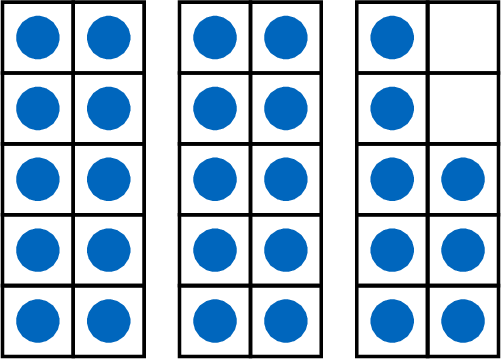
Check by tens: \(2\) tens and \(8\) ones, \(28\) buttons. \(28\) is close to \(30\), and far from \(10\) and from \(70\).
Example
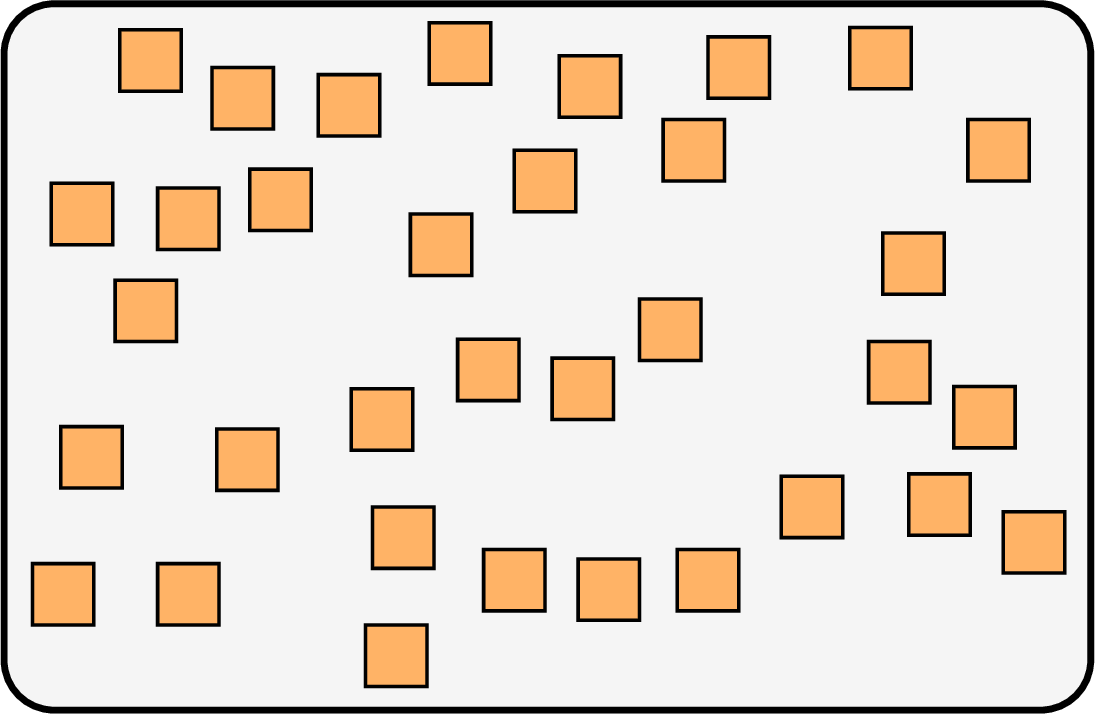
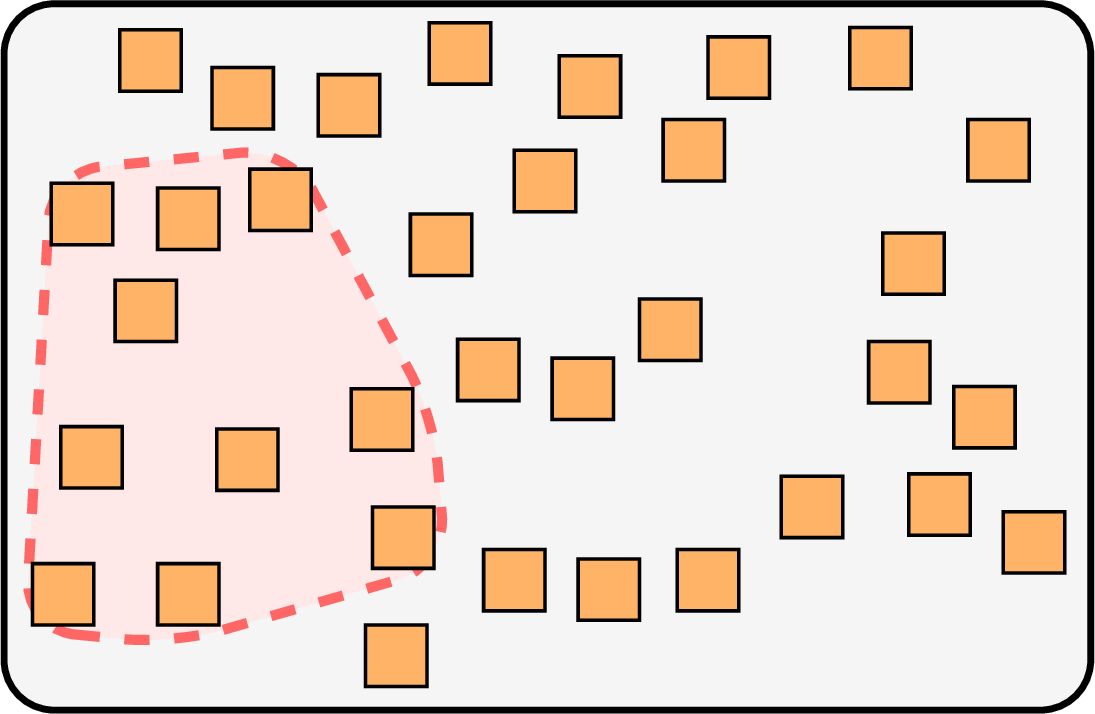
\(5\) groups of ten make \(50\): the cubes cover fewer than \(5\) groups, so there are probably fewer than \(50\).
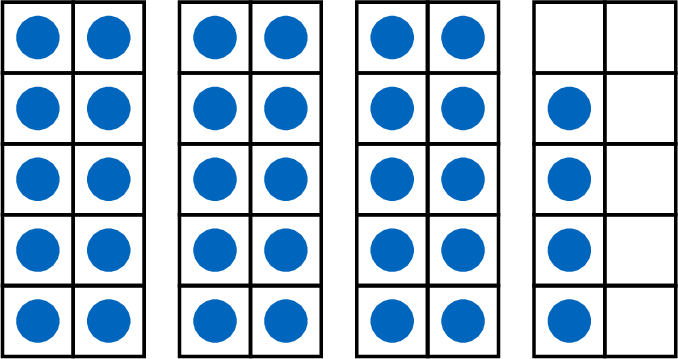
The count confirms the estimate: \(3\) tens and \(4\) ones, \(34\) cubes, between \(20\) and \(50\).
Skills to practice
- Choosing the Reasonable Estimate
- More or Fewer?
- Checking an Estimate
VI
Going further
Skills to practice
- Completing Equations with Pictures
- Problems
- Quiz
Jump to section