International Baccalaureate · PYP 1
Ordinal Numbers and Patterns
I
Positions from First to Twentieth
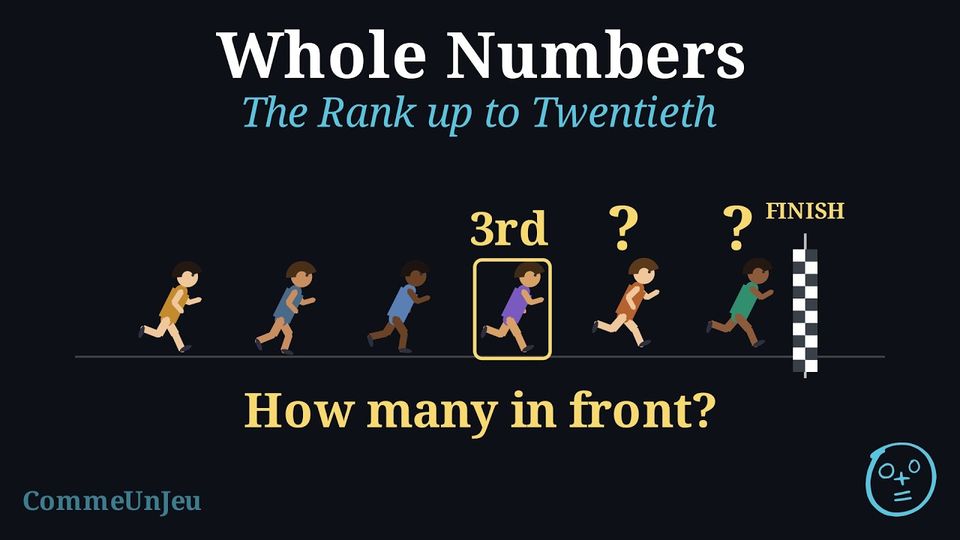
Six children are queuing for the slide. Léa says: “I am the third.” How many children are in front of her? And how many behind her? 
Léa is the third: the first and the second are in front of her, so \(2\) children are in front. Behind her come the fourth, fifth and sixth: \(3\) children. Check: \(2 + 1 + 3 = 6\).
Definition — Ordinal Numbers up to Twentieth
The position of an object in a line is its place counted from the start. The words that say a position are the ordinal numbers: | \(1\) first | \(6\) sixth | \(11\) eleventh | \(16\) sixteenth |
| \(2\) second | \(7\) seventh | \(12\) twelfth | \(17\) seventeenth |
| \(3\) third | \(8\) eighth | \(13\) thirteenth | \(18\) eighteenth |
| \(4\) fourth | \(9\) ninth | \(14\) fourteenth | \(19\) nineteenth |
| \(5\) fifth | \(10\) tenth | \(15\) fifteenth | \(20\) twentieth |
Method — The Position and Those Before
- From the position to those before: those before are one less than the position (all the smaller positions). The seventh has \(6\) before it.
- From those before to the position: if \(4\) people are in front of me, I am the fifth (\(4 + 1\)).
- The position depends on the start: counted from the other end of the line, the position can change (the third of six becomes the fourth; the third of five stays the third).
Example
Here is a list of numbers: \(2\), \(6\), \(10\), \(14\), \(18\), \(22\). (a) In which position is \(10\)? (b) Which number is in fifth position? (c) How many numbers come before \(14\)?
We count the positions from the start: \(2\) first, \(6\) second, \(10\) third, \(14\) fourth, \(18\) fifth, \(22\) sixth. (a) \(10\) is in third position. (b) The fifth number is \(18\). (c) \(14\) is fourth, so \(3\) numbers come before it. The position of a number in a list is not the number itself: the numbers of the list are the objects, not the positions.
Skills to practice
- Naming the Position
- Counting Those Before
- Finding the Position from the Other End
- Finding the Position in a List of Numbers
II
Counting in Steps
Hugo counts his candies one by one: 1, 2, 3, 4, 5, 6, 7, 8. Aisha counts the same candies two by two. 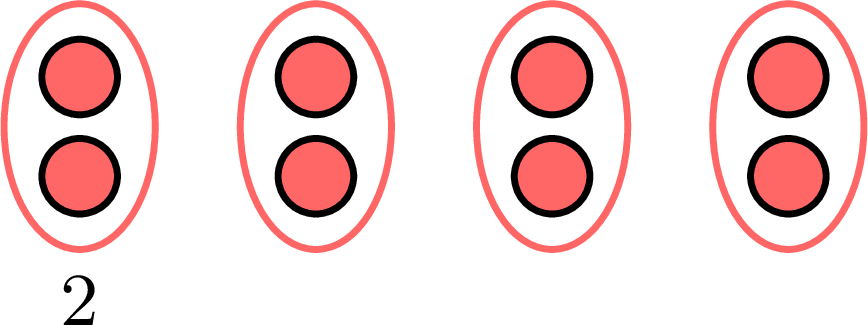
What does Aisha say?
Aisha says: \(2\), \(4\), \(6\), \(8\). Same candies, same total — but much faster. 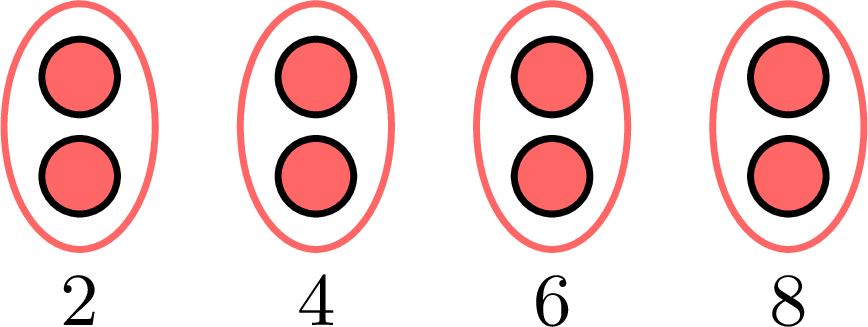
Method — Counting in Steps
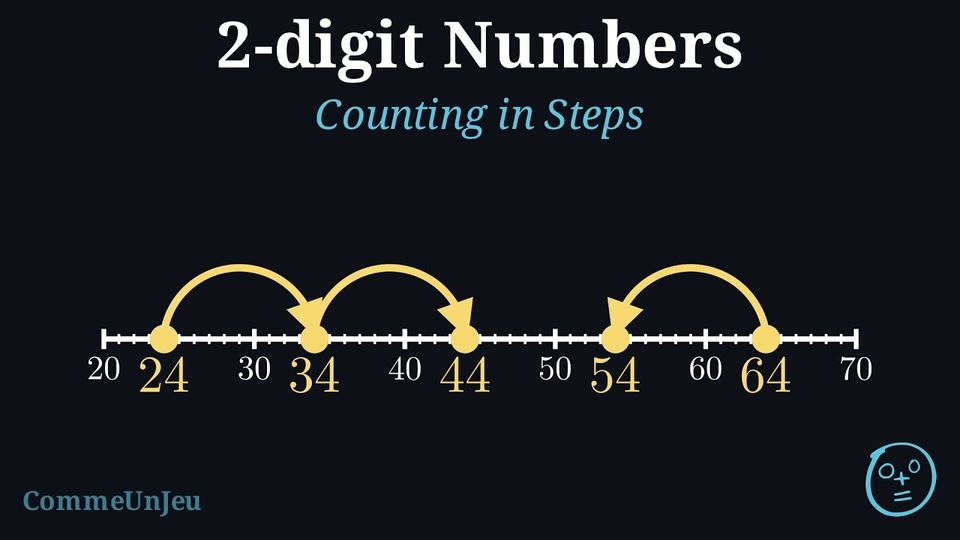
On the number line, we can jump with equal steps. - By twos: \(2\), \(4\), \(6\), \(8\), \(10\), \(\dots\)

- By tens: \(10\), \(20\), \(30\), \(\dots\), \(90\). We can start from any number: from \(24\), we get \(24\), \(34\), \(44\), \(\dots\)

Method — Counting Backward
We can also count backward, like a rocket before take-off: \(12\), \(11\), \(10\), \(9\), \(\dots\) down to \(0\). And backward by tens: \(90\), \(80\), \(70\), \(\dots\) down to \(0\). 

Example
Continue by tens: \(30\), \(40\), \(50\), \(\dots\) What are the next two numbers?
One step of ten each time: after \(50\) comes \(60\), then \(70\).
Example
The rocket counts down: \(12\), \(11\), \(10\), \(\dots\) What are the next two numbers?
One step back each time: after \(10\) comes \(9\), then \(8\).
Skills to practice
- Counting by Twos
- Counting by Tens
- Counting Backward
- Counting Back by Twos
- Adding or Subtracting 1 or 2
III
Periodic Sequence
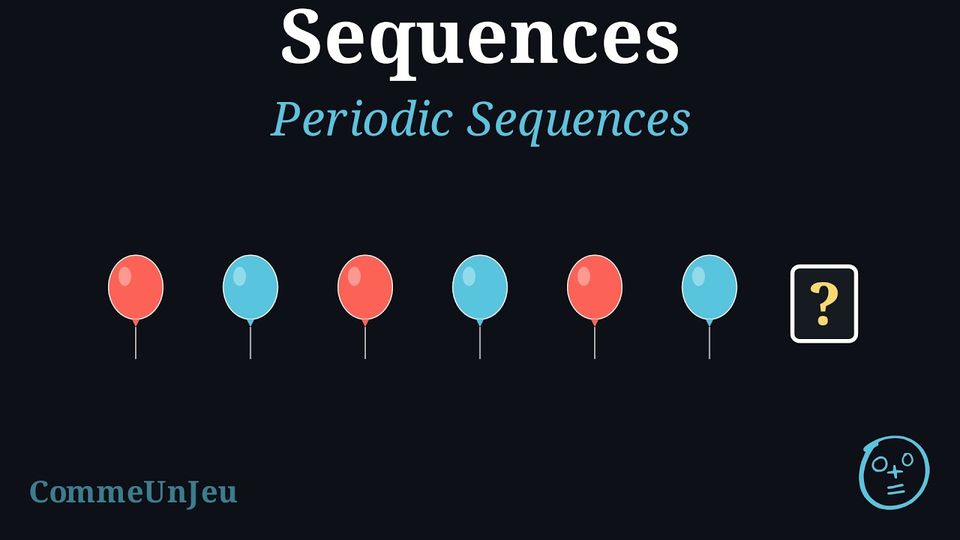
We see sequences and patterns in many parts of our daily lives. A periodic sequence is a type of pattern that repeats again and again in the same order. Think of the four seasons, the days of the week, or a pattern on wallpaper. When we notice these sequences, it helps us see regularity and guess what will come next.
Sometimes a sequence is made with shapes or colours. In mathematics, many important sequences are made with numbers. These number sequences follow a rule that tells us how to get from one number to the next.
Sometimes a sequence is made with shapes or colours. In mathematics, many important sequences are made with numbers. These number sequences follow a rule that tells us how to get from one number to the next.
Definition — Periodic Sequence
A periodic sequence is a pattern that repeats the same group again and again, always in the same order. The group that repeats is called the period. It can be made of shapes, colours, sounds or numbers. Example
Based on the repeating pattern, what is the colour of the next balloon in the sequence? 
The colour of the next balloon is red. The sequence follows a simple repeating pattern: red, blue, red, blue, and so on. 
Method — Finding the Shape at a Given Position
In a repeating pattern, we do not need to draw everything up to the position asked. - Find the period: the group that repeats, and count its shapes. In A B A B A B…, the group is “A B”, it has \(2\) shapes.
- Count by whole groups up to the position asked, then count what is left. For the nineteenth letter: \(9\) groups of \(2\) make \(18\) letters, and \(1\) is left.
- Read the leftover in the group: \(1\) left means the first letter of the group: the nineteenth letter is A. If nothing is left, it is the last shape of the group.
Example
In the pattern \(\triangle\) \(\times\) \(\square\) \(\circ\) \(\triangle\) \(\times\) \(\square\) \(\circ\) …, what is the twentieth symbol? And the ninth?
The group is “\(\triangle\) \(\times\) \(\square\) \(\circ\)”: \(4\) symbols. Twentieth: \(5\) groups of \(4\) make exactly \(20\), nothing is left, so it is the last symbol of the group: \(\circ\). Ninth: \(2\) groups of \(4\) make \(8\), \(1\) is left, so it is the first symbol: \(\triangle\).
Skills to practice
- Finding the Next Shape in the Pattern 1-1
- Finding the Next Shape in the Pattern 1-1-1
- Finding the Next Shape in the Pattern 1-1-1-1
- Finding the Next Shape in the Pattern 2-1
- Creating a Pattern
- Finding the Shape at a Given Position
IV
Numerical Sequence
Definition — Numerical Sequence
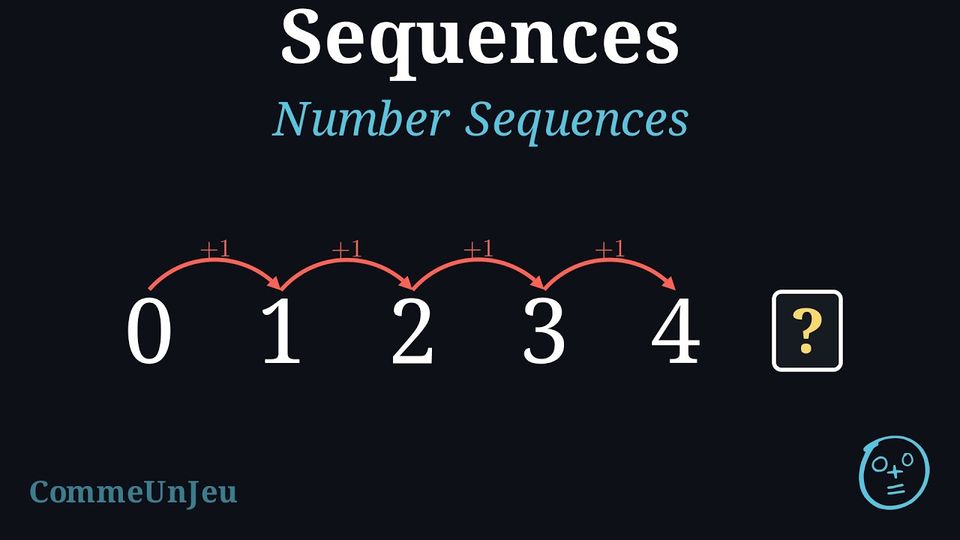
A numerical sequence is a list of numbers in a special order. Each number in the sequence is called a term, and the terms follow a rule that tells us how to find the next number. Example
What is the next number in the sequence? $$0, 1, 2, 3, 4, ?$$
The next number in the sequence is \(5\). In this sequence, we start at \(0\) and each time we add \(1\) to get the next number. 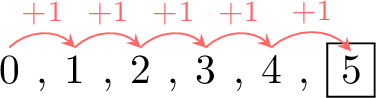
Example
What is the next number in the sequence? $$10, 8, 6, 4, ?$$
The next number in the sequence is \(2\). This sequence goes down: each time we take away \(2\) to get the next number, \(4 - 2 = 2\). 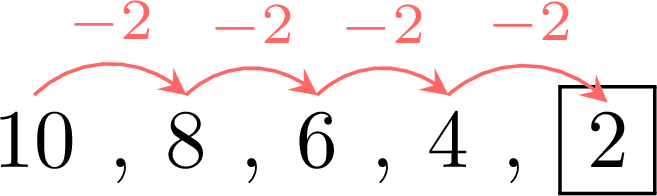
Method — Finding the Number at a Given Position
In a number sequence that moves by equal steps, we find the step (the jump from one number to the next), then we move step by step from the first number, counting the positions as we go: for \(1\), \(3\), \(5\), \(7\), \(9\)…, the step is \(+2\); first \(1\), second \(3\), third \(5\), fourth \(7\), fifth \(9\), sixth \(11\), seventh \(13\). A position counts the numbers, it is not one of them. Example
In the sequence \(5\), \(10\), \(15\), \(20\)…, what is the eighth number?
The step is \(+5\). First \(5\), second \(10\), third \(15\), fourth \(20\), fifth \(25\), sixth \(30\), seventh \(35\), eighth \(40\).
Skills to practice
- Finding the Next Number
- Finding the Number at a Given Position
V
Going further
Skills to practice
- Completing Sequences and Rules
- Problems
- Matching a Pattern to Its Sequence
- Quiz
Jump to section