International Baccalaureate · PYP 1
Comparing and Ordering Numbers
I
Comparing and Ordering 2-Digit Numbers
Definition — Comparison Symbols
We use special symbols to write down our comparisons: | Symbol | Meaning | Example |
| \(=\) | is equal to |  |
| \(>\) | is greater than |  |
| \(<\) | is less than | 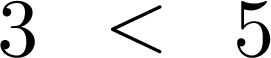 |
The Alligator Mouth
The symbols \(>\) and \(<\) can be pictured as the open mouth of a hungry alligator: the alligator eats the greater number. 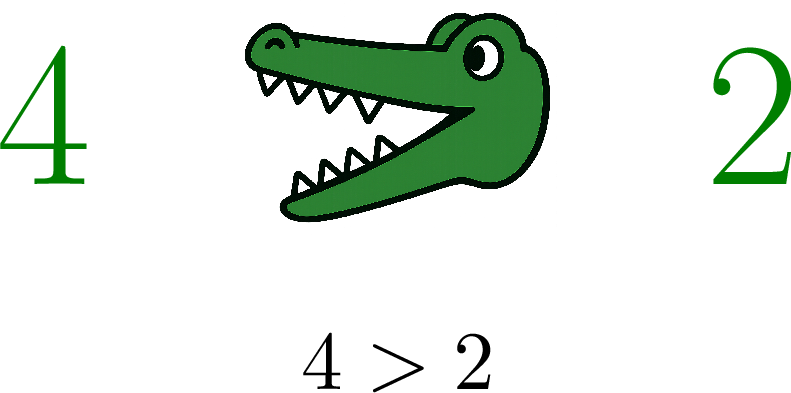 \(\quad\)
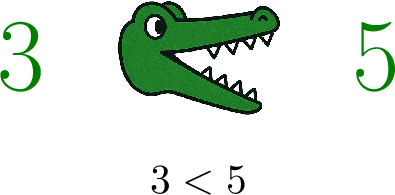
The open mouth always faces the greater number.
The symbols \(>\) and \(<\) can be pictured as the open mouth of a hungry alligator: the alligator eats the greater number.
\(\quad\) Method — Comparing 2-Digit Numbers
To compare two-digit numbers, we proceed in two steps, starting with the most important place value: the tens. - Step 1: Compare the Tens place. Look at the digit in the tens place for each number. The number with more tens is the bigger number.
- Step 2: Compare the Ones place (if needed). If the digits in the tens place are the same, compare the ones place. The number with more ones is the bigger number. If the ones are also the same, the two numbers are equal.
Example
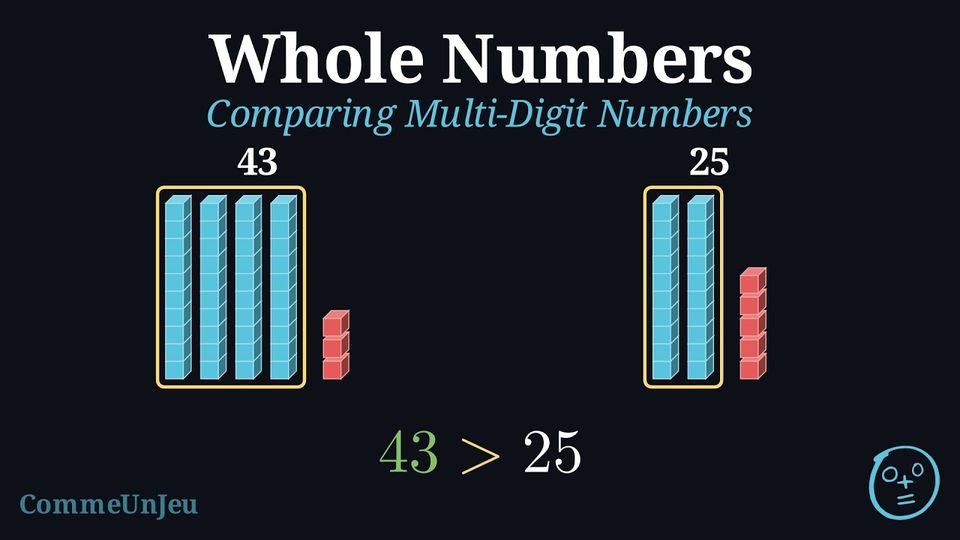
Compare 43 and 25. - Step 1: Compare the Tens.
- The number 43 has 4 tens.
- The number 25 has 2 tens.
- Since 4 tens is more than 2 tens, we know that 43 is greater than 25. We don't need to look at the ones.



\(43 \gt 25\)
Example
Compare 45 and 43. - Step 1: Compare the Tens.
- The number 45 has 4 tens.
- The number 43 has 4 tens.
- The tens are the same, so we move to the next step.
- Step 2: Compare the Ones.
- The number 45 has 5 ones.
- The number 43 has 3 ones.
- Since 5 ones is more than 3 ones, we know that 45 is greater than 43.


\(45 \gt 43\)
Method — Between Two Tens; a Number in Between
- Placing a number between two tens: we write the ten just before it and the ten just after it: \(70 < 74 < 80\). If the number is itself a ten, we take the ten before and the ten after: \(60 < 70 < 80\). The only number with no ten after it in our numbers is \(100\): we write \(90 < 100\).
- Finding a number in between: we look for a number between two others: between \(43\) and \(47\) we can put \(44\), \(45\) or \(46\). Between \(43\) and \(44\) there is no whole number to put.
- Ordering numbers: from the smallest to the largest is increasing order; from the largest to the smallest, decreasing order. We compare the tens first.
Example
(a) Write the ten just before \(58\) and the ten just after it. (b) Find a number between \(29\) and \(31\). (c) Order \(47\), \(74\), \(17\), \(71\), \(40\) from greatest to least.
(a) \(50 < 58 < 60\). (b) Only \(30\) fits between \(29\) and \(31\). (c) Tens first: \(74\) and \(71\) have \(7\) tens, then \(47\) and \(40\) have \(4\), then \(17\). Among equal tens we look at the ones: \(74 > 71 > 47 > 40 > 17\).
Skills to practice
- Comparing Numbers of Cubes
- Comparing Ten-Frames
- Comparing Numbers
- Comparing Numbers in Context
- Placing a Number Between Two Tens
- Finding a Number in Between and Ordering Numbers
- Ordering Five Numbers
II
Going further
Skills to practice
- Completing Comparisons
- Problems
- Quiz
Jump to section