International Baccalaureate · PYP 5
Money and Budgets
I
Profit and Loss
Definition — Profit and Loss
How well a business is doing is described by its profit or its loss. Two amounts are needed to calculate it: - Income (or Revenue): the total amount of money received from selling something.
- Expenses (or Costs): the total amount of money spent to make and sell the product.
Example
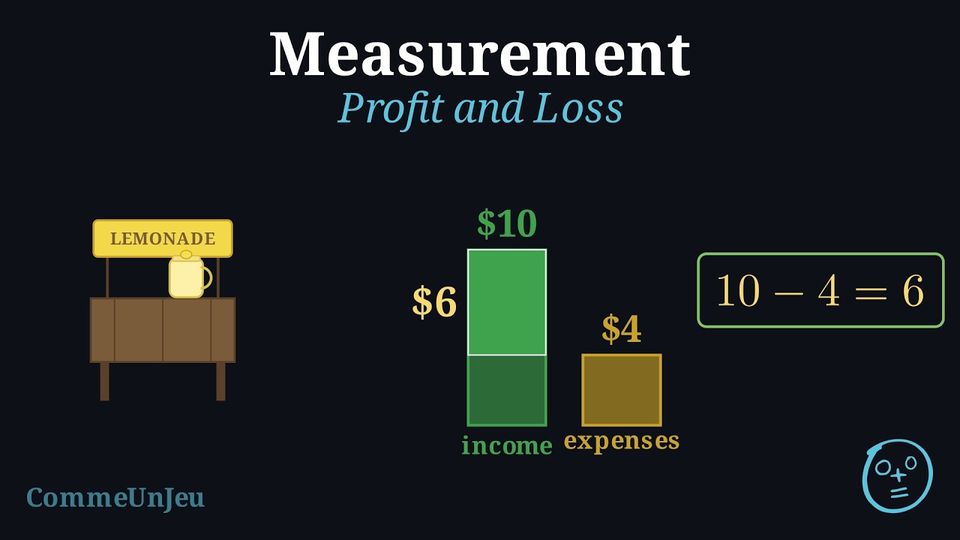
Sarah starts a lemonade stand. - Her income from selling lemonade is \(\dollar 10\).
- Her expenses for lemons and sugar are \(\dollar 4\).
First, compare income and expenses: \(\dollar 10\) (income) and \(\dollar 4\) (expenses).
Since her income is greater than her expenses, we calculate a profit. $$ \begin{aligned} \text{Profit} &= \text{Income} - \text{Expenses} \\ &= \dollar 10 - \dollar 4 \\ &= \dollar 6 \end{aligned} $$ Sarah made a profit of \(\dollar 6\).
Since her income is greater than her expenses, we calculate a profit. $$ \begin{aligned} \text{Profit} &= \text{Income} - \text{Expenses} \\ &= \dollar 10 - \dollar 4 \\ &= \dollar 6 \end{aligned} $$ Sarah made a profit of \(\dollar 6\).
Example
Tom sells home-made biscuits at the school fair. - His income from selling the biscuits is \(\dollar 18.50\).
- His expenses for flour, butter, sugar and paper bags are \(\dollar 21.25\).
First, compare income and expenses: \(\dollar 18.50\) (income) and \(\dollar 21.25\) (expenses).
Since his expenses are greater than his income, we calculate a loss. $$ \begin{aligned} \text{Loss} &= \text{Expenses} - \text{Income} \\ &= \dollar 21.25 - \dollar 18.50 \\ &= \dollar 2.75 \end{aligned} $$ Tom made a loss of \(\dollar 2.75\). With an income of \(\dollar 21.25\), exactly equal to his expenses, he would have made no profit and no loss: he would have broken even.
Since his expenses are greater than his income, we calculate a loss. $$ \begin{aligned} \text{Loss} &= \text{Expenses} - \text{Income} \\ &= \dollar 21.25 - \dollar 18.50 \\ &= \dollar 2.75 \end{aligned} $$ Tom made a loss of \(\dollar 2.75\). With an income of \(\dollar 21.25\), exactly equal to his expenses, he would have made no profit and no loss: he would have broken even.
Skills to practice
- Identifying Profit and Loss
- Calculating Profits
- Calculating a Loss
II
Budgets
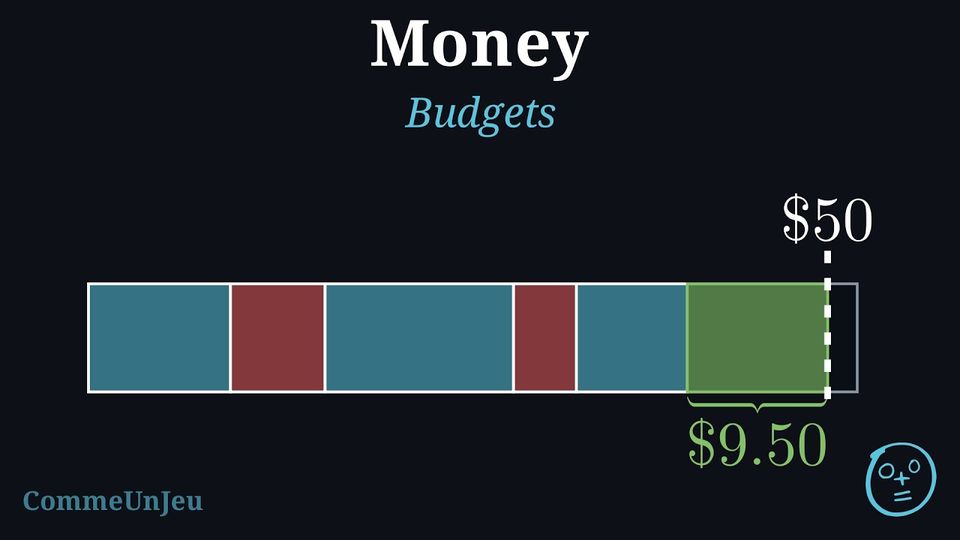
The class is running a pancake stall at the school fair. The teacher gives the class \(\dollar 50\) to buy what it needs, and not a cent more. The shopping list: flour \(\dollar 7.50\), eggs \(\dollar 9.60\), milk \(\dollar 6.40\), jam \(\dollar 12.75\) and paper plates \(\dollar 4.25\).
Say whether the class can buy everything with the \(\dollar 50\), then find how much money would be left.
Say whether the class can buy everything with the \(\dollar 50\), then find how much money would be left.
The total of the list, with the prices grouped into pairs that make whole dollars: $$\begin{aligned}[t] \text{Total} &= (\dollar 9.60 + \dollar 6.40) + (\dollar 12.75 + \dollar 4.25) + \dollar 7.50 &&\text{(pairs that make whole dollars)}\\
&= \dollar 16 + \dollar 17 + \dollar 7.50\\
&= \dollar 40.50 \end{aligned}$$ \(\dollar 40.50\) is less than \(\dollar 50\): yes, the class can buy everything. The money left is $$\dollar 50 - \dollar 40.50 = \dollar 9.50.$$ The \(\dollar 50\) that the class may spend is its budget, the shopping list with its total is a plan, and the \(\dollar 9.50\) left is the balance.
Definition — Budget
A budget is an amount of money that may be spent, as in “a budget of \(\dollar 50\)”. More generally, a budget plan shows the money that comes in, the income, and the money that goes out, the expenses — the same two words as for profit and loss. In a budget plan, the income is all the money that comes in: sales, as for profit and loss, but also pocket money or a gift. The money available is the income, or the budget set aside. - The plan is within budget when the expenses are not more than the money available; when they are less, we also say that it is under budget. The balance is then the money that is left: $$\textcolor{colordef}{\text{Balance} = \text{Money available} - \text{Expenses}}$$ When the expenses are equal to the money available, the plan is within budget and the balance is \(\dollar 0\).
- The plan is over budget when the expenses are more than the money available. The money available is not enough, and the plan is over budget by $$\textcolor{colordef}{\text{Expenses} - \text{Money available}}$$
Method — Making a Budget Plan
A budget plan is set out as a table, one line for each item. - List each item with its quantity and its unit price: the price of one item, of one pack, of one kilogram or of one litre.
- Cost of a line \(=\) quantity \(\times\) unit price.
- Total \(=\) the sum of the costs of all the lines.
- Compare the total with the budget. If the total is not more than the budget, the plan is within budget, and the balance is budget \(-\) total.
- If the total is more than the budget, the plan is over budget by total \(-\) budget. Then change the plan — fewer items, cheaper items, or one item left out — so that it saves at least that amount, and work out the new total.
Example
The \(12\) children of a club plan a picnic. Their budget is \(\dollar 50\). Here is their plan: | Item | Quantity | Unit price | Cost |
| Sandwich | \(12\) | \(\dollar 2.50\) | \(?\) |
| Bottle of juice | \(12\) | \(\dollar 1.20\) | \(?\) |
| Bag of apples | \(2\) | \(\dollar 3.45\) | \(?\) |
| Total | \(?\) |
The cost of each line is quantity \(\times\) unit price: $$\begin{aligned}[t] 12 \times \dollar 2.50 &= \dollar 30.00 &&\text{(sandwiches)}\\
12 \times \dollar 1.20 &= \dollar 14.40 &&\text{(bottles of juice)}\\
2 \times \dollar 3.45 &= \dollar 6.90 &&\text{(bags of apples)} \end{aligned}$$ $$\begin{aligned}[t] \text{Total} &= \dollar 30.00 + \dollar 14.40 + \dollar 6.90\\
&= \dollar 51.30 \end{aligned}$$
\(\dollar 51.30\) is more than \(\dollar 50\): the plan is over budget, by \(\dollar 51.30 - \dollar 50 = \dollar 1.30\). The club has to change its plan so that it saves at least \(\dollar 1.30\).
| Item | Quantity | Unit price | Cost |
| Sandwich | \(12\) | \(\dollar 2.50\) | \(\dollar 30.00\) |
| Bottle of juice | \(12\) | \(\dollar 1.20\) | \(\dollar 14.40\) |
| Bag of apples | \(2\) | \(\dollar 3.45\) | \(\dollar 6.90\) |
| Total | \(\dollar 51.30\) |
Example
A club's picnic plan costs \(\dollar 51.30\) for a budget of \(\dollar 50\): \(12\) sandwiches at \(\dollar 2.50\) each, \(12\) bottles of juice at \(\dollar 1.20\) each and \(2\) bags of apples at \(\dollar 3.45\) each. Two changes are proposed: - change A: \(12\) smaller sandwiches at \(\dollar 2.40\) each instead of \(\dollar 2.50\);
- change B: \(12\) cartons of juice at \(\dollar 0.95\) each instead of the bottles at \(\dollar 1.20\).
The plan is over budget by \(\dollar 51.30 - \dollar 50 = \dollar 1.30\): a change must save at least \(\dollar 1.30\).
- Change A saves \(\dollar 2.50 - \dollar 2.40 = \dollar 0.10\) on each sandwich: $$\begin{aligned}[t] \text{New total} &= \dollar 51.30 - 12 \times \dollar 0.10\\ &= \dollar 51.30 - \dollar 1.20\\ &= \dollar 50.10 \end{aligned}$$ \(\dollar 50.10\) is still more than \(\dollar 50\): over budget by \(\dollar 0.10\). The saving, \(\dollar 1.20\), is less than \(\dollar 1.30\).
- Change B saves \(\dollar 1.20 - \dollar 0.95 = \dollar 0.25\) on each drink: $$\begin{aligned}[t] \text{New total} &= \dollar 51.30 - 12 \times \dollar 0.25\\ &= \dollar 51.30 - \dollar 3.00\\ &= \dollar 48.30 \end{aligned}$$ \(\dollar 48.30\) is less than \(\dollar 50\): within budget.
Skills to practice
- Deciding Whether a Plan Is Within Budget
- Calculating Totals and Balances
- Making and Adjusting a Budget Plan
III
Review & Quizz
Skills to practice
- Quiz
Jump to section