International Baccalaureate · MYP 2
Linear Equations
I
What is an Equation?
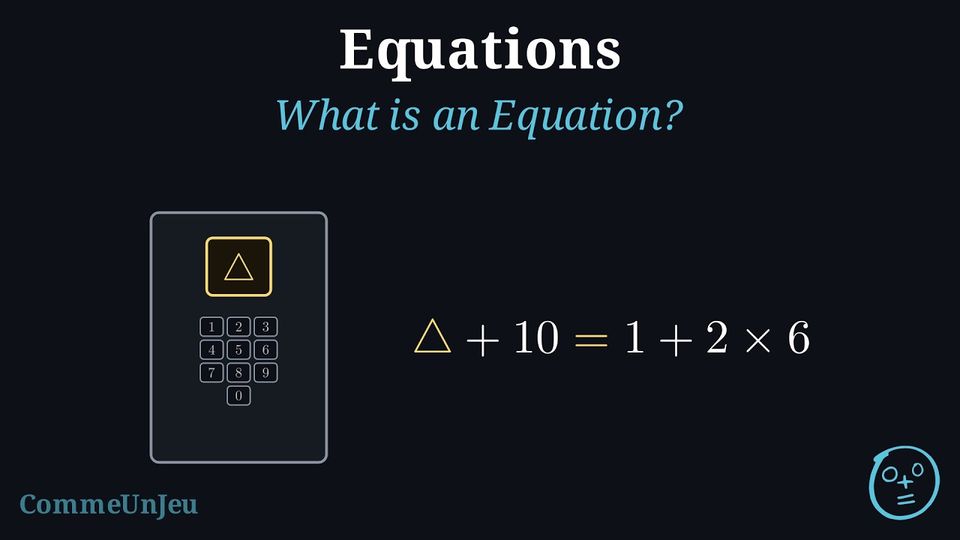
Welcome to the Maths Escape Room. Your team must solve a final puzzle to find the secret one-digit code (a number from \(0\) to \(9\)) and escape.
The clue is an equation where the code is represented by the symbol \(\triangle\): $$\triangle + 10 = 1 + 2 \times 6$$ You only have one chance to enter the correct digit. Two of your teammates suggest different answers:
The clue is an equation where the code is represented by the symbol \(\triangle\): $$\triangle + 10 = 1 + 2 \times 6$$ You only have one chance to enter the correct digit. Two of your teammates suggest different answers:
- Louis proposes entering \(\boxed{8}\).
- Su proposes entering \(\boxed{3}\).
To find the correct code, we test each suggestion to see which value for \(\triangle\) makes the equation a true statement.
First, simplify the right-hand side of the equation. Remember that we do the multiplication first: $$1 + 2 \times 6 = 1 + 12 = 13.$$ So the equation becomes: $$\triangle + 10 = 13.$$
First, simplify the right-hand side of the equation. Remember that we do the multiplication first: $$1 + 2 \times 6 = 1 + 12 = 13.$$ So the equation becomes: $$\triangle + 10 = 13.$$
- Test Louis's code: Substitute \(\textcolor{colordef}{\triangle = 8}\) into the equation. $$ \begin{aligned} \textcolor{colordef}{8} + 10 &= 18 \\ 18 &= 13 &&\text{(False)} \end{aligned} $$ Louis's code is incorrect.
- Test Su's code: Substitute \(\textcolor{colordef}{\triangle = 3}\) into the equation. $$ \begin{aligned} \textcolor{colordef}{3} + 10 &= 13 \\ 13 &= 13 &&\text{(True)} \end{aligned} $$ Su's code is correct.
From the Balance to the Equality
A balance with two identical bags and a \(6\) kg mass on one pan, and a \(14\) kg mass on the other, can be written as the missing-number equality \(\square + \square + 6 = 14\), that is \(2 \times \square + 6 = 14\). Removing \(6\) kg from both pans is subtracting \(6\) from both sides: \(2 \times \square = 8\). Sharing both pans in two is dividing both sides by \(2\): \(\square = 4\). The bar model, the balance and the equality are three pictures of the same reasoning.
Definition — Equation and Solution
An equation is a mathematical statement that says two expressions are equal. It contains an unknown: a symbol (like \(x\) or \(\triangle\)) standing for a fixed number we are looking for — not a quantity that varies.The two expressions on either side of the equals sign are the left-hand side and the right-hand side of the equation. Solving an equation means finding the value(s) of the unknown — among the numbers we work with — that make the equality true. Each of these values is called a solution of the equation.
Example
Show that \(x = 2\) is a solution to the equation \(3 + x = 5\).
We substitute \(\textcolor{colordef}{x = 2}\) into the equation and check if the left-hand side equals the right-hand side: $$\begin{aligned} 3 + \textcolor{colordef}{(2)} &= 5 \\
5 &= 5 \quad &&\text{(This is a true statement.)} \end{aligned}$$ Since the statement is true, \(x = 2\) is a solution.
Example
Show that \(x = 1\) is not a solution to \(3 + x = 5\).
We substitute \(\textcolor{colordef}{x = 1}\) into the equation: $$\begin{aligned} 3 + \textcolor{colordef}{(1)} &= 5 \\
4 &= 5 &&\text{(This is a false statement.)} \end{aligned}$$ Since the statement is false, \(x = 1\) is not a solution.
Skills to practice
- Finding the Code: Level 1
- Finding the Code: Level 2
- Finding the Code: Level 3
II
Solving by Inspection and Trial and Error
Method — Trial and Error
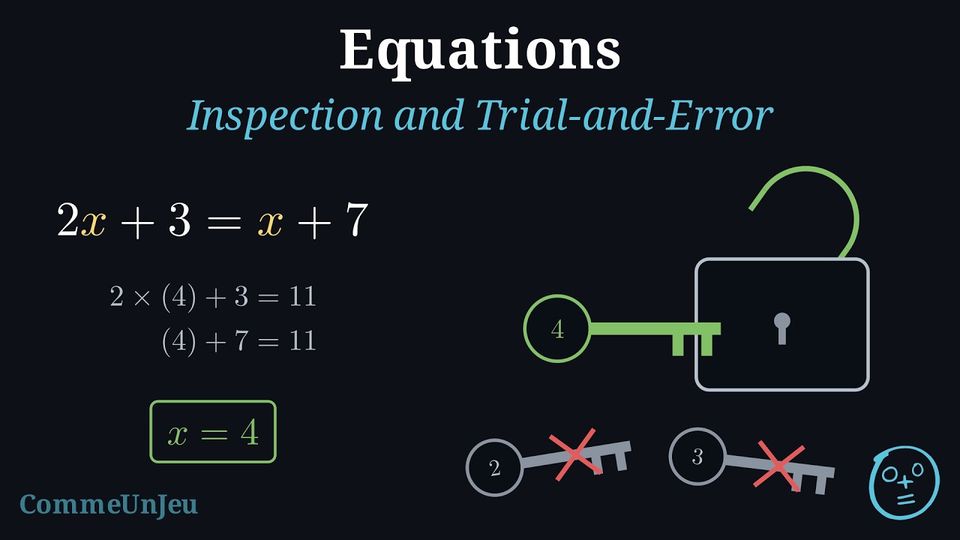
Trial and error can be used to solve an equation: test values for the unknown until one makes the equation true — that value is a solution (an equation may have several solutions). For each value, we substitute it into the equation and check whether the left-hand side equals the right-hand side.For simple equations, we can sometimes see the solution just by looking at the equation. This is called solving by inspection. If the solution is negative or not a whole number, testing may search for a long time: that is why methods that never guess are worth building.
Example
Consider the equation \(2x + 3 = x + 7\). Use the trial and error method to find the solution.
We test integer values for \(x\), computing both sides each time.
- Try \(\textcolor{colordef}{x = 2}\): left side \(2 \times \textcolor{colordef}{(2)} + 3 = 7\); right side \(\textcolor{colordef}{(2)} + 7 = 9\). \(7 \neq 9\) (False).
- Try \(\textcolor{colordef}{x = 3}\): left side \(2 \times \textcolor{colordef}{(3)} + 3 = 9\); right side \(\textcolor{colordef}{(3)} + 7 = 10\). \(9 \neq 10\) (False).
- Try \(\textcolor{colordef}{x = 4}\): left side \(2 \times \textcolor{colordef}{(4)} + 3 = 11\); right side \(\textcolor{colordef}{(4)} + 7 = 11\). \(11 = 11\) (True).
Method — Conjecturing a Solution with a Table of Values
Trial and error tests one value at a time. A table of values tests many of them at once and, when no tested value works, can show between which two values the solution lies. - Build three rows: one row for the values of the unknown, one row for the left-hand side, one row for the right-hand side.
- Fill the table by substituting each value of the unknown in both sides.
- Read the table: a value for which the two sides are equal is a solution, so the table conjectures it.
- Place the solution between two values when no tested value works: if the left-hand side is smaller than the right-hand side for one value and larger for the next one, the two sides have swapped order, so a solution lies between those two values — this holds when both sides are of the form \(ax + b\). A finer step then brings the conjecture closer.
- Confirm by substituting: a table gives a conjecture — the values it displays may be rounded, and a value that was not tested may be the solution. The value read is therefore substituted in the equation, and the two sides are computed once more.
| Start from \(x = 0\). |
| As long as \(5x + 2\) is less than \(3x + 10\), add \(1\) to \(x\). |
| Display \(x\). |
Example
Conjecture a solution of the equation \(5x + 2 = 3x + 10\) with a table of values, for \(x\) from \(0\) to \(5\), then confirm it.
Each value of \(x\) is substituted in both sides: {\setlength{\tabcolsep}{3pt}
} The left-hand side is smaller than the right-hand side for \(x = 0\), \(1\), \(2\), \(3\), and larger for \(x = 5\): the two sides have swapped order. They take the same value \(22\) for \(x = \textcolor{colorprop}{4}\), which the table conjectures as a solution. Confirmation by substituting \(x = 4\): $$\begin{aligned}[t] 5 \times \textcolor{colordef}{(4)} + 2 &= 20 + 2 && \text{(left-hand side)} \\
&= 22, \\
3 \times \textcolor{colordef}{(4)} + 10 &= 12 + 10 && \text{(right-hand side)} \\
&= 22. \end{aligned}$$ The two sides are equal, so \(x = 4\) is a solution.
| \(x\) | 0 | 1 | 2 | 3 | 4 | 5 |
| \(5x + 2\) | 2 | 7 | 12 | 17 | 22 | 27 |
| \(3x + 10\) | 10 | 13 | 16 | 19 | 22 | 25 |
Reading an equation or testing values solves it by guessing, more or less cleverly. To do better, we change the point of view: instead of asking “which number works?”, we ask how the result was built. A calculation program shows exactly that — and running one backwards is the seed of the method that never guesses: the inverse operation.
Skills to practice
- Finding a Solution: Level 1
- Finding a Solution: Level 2
- Conjecturing a Solution from a Table of Values
- Building a Table of Values to Conjecture a Solution
III
Solving by Inverse Operations
In a calculation program, the number we look for is the starting number. In an equation, that same unknown number is written with a letter, and the program becomes a single line: “multiply by \(3\)” is written \(3x\), and “the result is \(21\)” is written \(3x = 21\). Finding the starting number and solving the equation are therefore the same task, and the tool is the same: the inverse operation.
Around the year \(820\), at the House of Wisdom in Baghdad, the mathematician al-Khwârizmî wrote a book whose title contains the word al-jabr — and that is where our word algebra comes from. He had no letter for the unknown: he called it “the thing” (al-shay'), and he described every method in words, without a single symbol. Two of his gestures are still moves that solve an equation. Al-jabr, “restoring”, adds the same quantity to both sides to remove a subtracted term: it undoes a subtraction (\(x - b = c\) becomes \(x = c + b\)). Al-muqâbala, “balancing”, removes equal terms from both sides: it undoes an addition (\(x + b = c\) becomes \(x = c - b\)). And his own name, passed into Latin as algorismus, gave us the word algorithm — so the same man named both the calculation and the recipe for carrying it out.
Definition — Inverse Operations
An inverse operation is an operation that “undoes” another one. Let \(a\) be a number: - Addition and subtraction are inverse operations:
\(\boxed{x}\xrightarrow{+a}\boxed{x+a}\xrightarrow{-a}\boxed{x}\) - Multiplication and division are inverse operations:
\(\boxed{x}\xrightarrow{\times a}\boxed{ax}\xrightarrow{\div a}\boxed{x} \quad \text{with } a \neq 0\)
Method — Solving by an Inverse Operation
To solve an equation in which one single operation is applied to the unknown: - Read the operation applied to the unknown, and the result it gives.
- Undo it with the inverse operation, applied to the result: undo an addition with a subtraction, a subtraction with an addition, a multiplication with a division, a division with a multiplication.
- Check the value found in the original equation.
Example
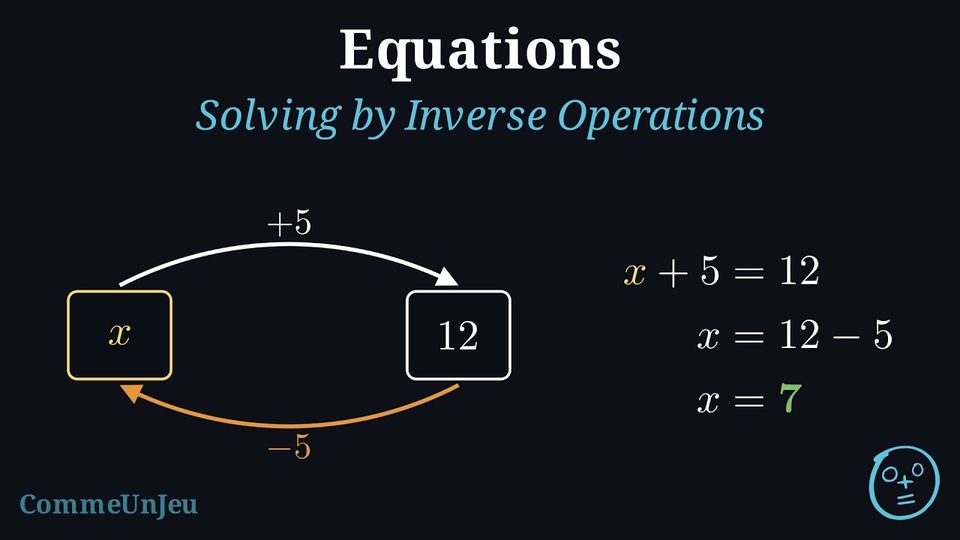
Solve the equation \(x + 5 = 12\).
The unknown \(x\) undergoes one operation, \(+5\), and the result is \(12\): $$\boxed{x}\xrightarrow{+5}\boxed{12}.$$ The inverse operation of \(+5\) is \(-5\), so it brings us back from \(12\) to \(x\): $$\boxed{12}\xrightarrow{-5}\boxed{x}.$$ Hence $$\begin{aligned}[t]x &= 12 - 5 && (\text{inverse operation of } +5) \\
&= \boldsymbol{7}.\end{aligned}$$ Check in the original equation: \(7 + 5 = 12\), which is true. The solution is \(x = 7\).
Example
Solve the equation \(3x = 21\).
Here \(3x\) means \(3 \times x\): the unknown undergoes one operation, \(\times 3\), and the result is \(21\): $$\boxed{x}\xrightarrow{\times 3}\boxed{21}.$$ The inverse operation of \(\times 3\) is \(\div 3\): $$\boxed{21}\xrightarrow{\div 3}\boxed{x}.$$ Hence $$\begin{aligned}[t]x &= 21 \div 3 && (\text{inverse operation of } \times 3) \\
&= \boldsymbol{7}.\end{aligned}$$ Check in the original equation: \(3 \times 7 = 21\), which is true. The solution is \(x = 7\).
For \(x + 5 = 12\), the solution can be seen at a glance, and reading it off is legitimate. The inverse operation is worth learning because it does not depend on seeing: it solves \(x + 386 = 1204\) and \(17x = 391\) just as surely, where inspection gives nothing and trial-and-error would take for ever. A method that always works is more valuable than a guess that sometimes does.
Example
Solve \(x - 5 = 9\), then \(\dfrac{x}{3} = 7\).
To undo a subtraction, add; to undo a division, multiply: $$\begin{aligned}[t] x - 5 &= 9 \\
x &= 9 + 5 && \text{(undo the } -5\text{)} \\
x &= 14 \end{aligned}\qquad\qquad\begin{aligned}[t] \dfrac{x}{3} &= 7 \\
x &= 7 \times 3 && \text{(undo the } \div 3\text{)} \\
x &= 21 \end{aligned}$$ Check: \(14 - 5 = 9\) and \(21 \div 3 = 7\).
Method — Solving \(ax + b \equal c\)
Here the unknown undergoes two operations: it is first multiplied by \(a\), then \(b\) is added. To find it, undo them in the reverse order — the operation performed last is the first one undone. For \(ax + b = c\), where \(a\) is a non-zero number (the last step divides by it): - undo the \(+\,b\): \(\quad ax = c - b\);
- undo the \(\times\,a\): \(\quad x = (c - b) \div a\).
Example
Solve the equation $$4x + 3 = 23.$$
The unknown is multiplied by \(4\), then \(3\) is added. Undo the addition first. $$\begin{aligned}[t] 4x &= 23 - 3 && (\text{inverse operation of } +3) \\
4x &= 20 \\
x &= 20 \div 4 && (\text{inverse operation of } \times 4) \\
&= \boldsymbol{5}. \end{aligned}$$ Check: \(4 \times 5 + 3 = 20 + 3 = 23\) \(\checkmark\)
Example
Solve the equation $$5x - 7 = 23.$$
This time \(7\) is subtracted, so the first thing to undo is a subtraction — and the inverse of a subtraction is an addition. $$\begin{aligned}[t] 5x &= 23 + 7 && (\text{inverse operation of } -7) \\
5x &= 30 \\
x &= 30 \div 5 && (\text{inverse operation of } \times 5) \\
&= \boldsymbol{6}. \end{aligned}$$ Check: \(5 \times 6 - 7 = 30 - 7 = 23\) \(\checkmark\)
Example
Solve the equations. - \(3x + 2x = 35\)
- \(x + 2x + 4 = 19\)
Here the unknown appears more than once in the left-hand side. First collect the like terms, so that the unknown appears only once; then undo the operations, the last one first, as before.
- $$\begin{aligned}[t] 3x + 2x &= 35\\ 5x &= 35 && (\text{collecting like terms: } 3x + 2x = 5x)\\ x &= 35 \div 5 && (\text{inverse operation of } \times 5)\\ x &= \boldsymbol{7}. \end{aligned}$$ Check: \(3 \times 7 + 2 \times 7 = 21 + 14 = 35\) \(\checkmark\)
- $$\begin{aligned}[t] x + 2x + 4 &= 19\\ 3x + 4 &= 19 && (\text{collecting like terms: } 1x + 2x = 3x)\\ 3x &= 19 - 4 && (\text{inverse operation of } +4)\\ 3x &= 15\\ x &= 15 \div 3 && (\text{inverse operation of } \times 3)\\ x &= \boldsymbol{5}. \end{aligned}$$ Check: \(5 + 2 \times 5 + 4 = 5 + 10 + 4 = 19\) \(\checkmark\)
Skills to practice
- Choosing the Inverse Operation
- Choosing the Inverse Operation in an Equation
- Choosing the Correct Line
- Solving \(x + b \equal c\)
- Solving \(ax \equal c\)
- Solving \(ax + b \equal c\)
- Collecting Like Terms Then Solving
- Solving an Equation Given by a Formula
- Writing the Solution Flow: Level 1
- Writing the Solution Flow: Level 2
IV
From Words to Equations
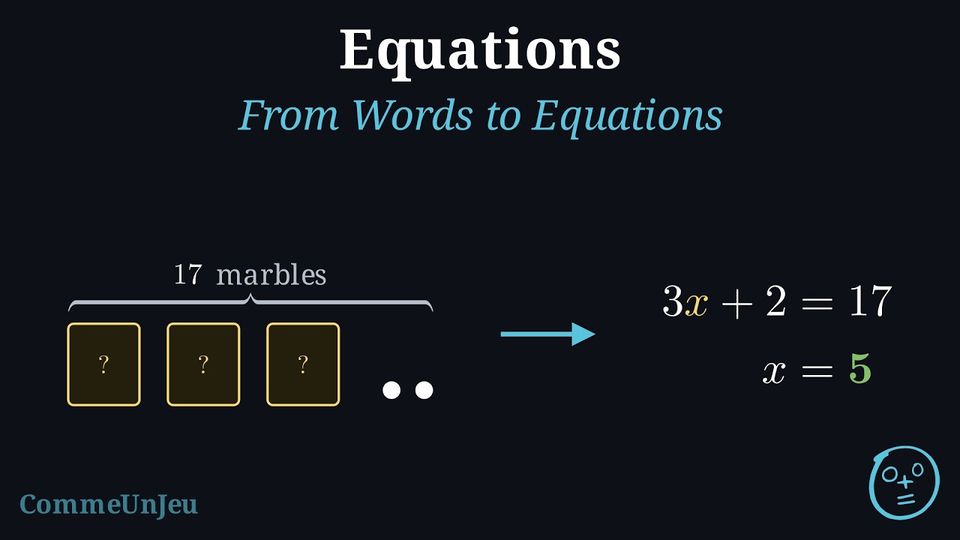
A word problem hides a calculation program: “three bags and two loose marbles make seventeen” runs a program on the number of marbles per bag. Naming that unknown number with a letter turns the whole sentence into a single line of mathematics — an equation — and everything we know about solving applies to it. The simplest equations carry one or two operations on the unknown: adding, subtracting, multiplying or dividing. The model shapes are \(x + b = c\), \(ax = c\) and \(ax + b = c\) (with \(a \neq 0\)); their subtraction and division twins undo in exactly the same way.
Definition — Setting up an Equation
Setting up an equation means: choose a letter for the unknown number and state what it stands for, with its unit if it has one; then write, with that letter, the equality stated by the sentence. Method — Translating a Sentence into an Equation
To solve a word problem with an equation: - Name the unknown: choose a letter and say what it stands for, with its unit.
- Translate piece by piece, in the order the sentence acts on the number.
- Write the equality stated by the sentence.
- Solve the equation: collect like terms; if the unknown is on both sides, bring it to one side; then undo the operations in reverse order.
- Answer in a sentence, with the unit, and check in the original sentence.
Example
“I think of a number, I add \(14\), and I get \(31\).” Find the number.
Let \(x\) be the number I think of. Piece by piece: “I think of a number” gives \(x\); “I add \(14\)” gives \(x + 14\); “I get \(31\)” states the equality: $$x + 14 = 31.$$ The unknown undergoes \(+14\), undone by \(-14\): $$\begin{aligned}[t]x &= 31 - 14 && (\text{inverse operation of } +14) \\
&= \boldsymbol{17}.\end{aligned}$$ The number is \(17\). Check in the sentence: think of \(17\), add \(14\), get \(31\) \(\checkmark\)
Example
Five identical books cost \(\dollar 60\) in all. 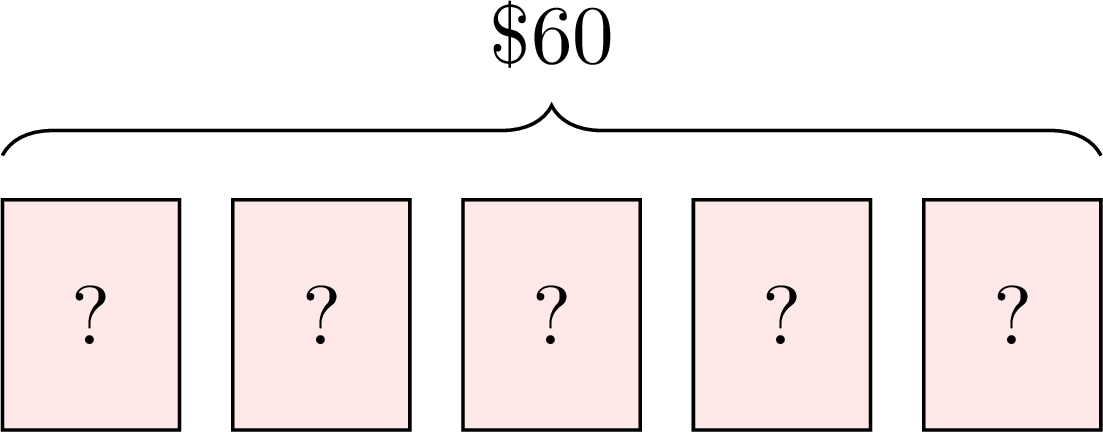
Let \(p\) be the price of one book, in dollars. Five identical books cost \(5 \times p = 5p\); the sentence states the equality: $$5p = 60.$$ The unknown undergoes \(\times 5\), undone by \(\div 5\): $$\begin{aligned}[t]p &= 60 \div 5 && (\text{inverse operation of } \times 5) \\
&= \boldsymbol{12}.\end{aligned}$$ One book costs \(\dollar 12\). Check in the story: five books at \(\dollar 12\) cost \(5 \times 12 = 60\) dollars \(\checkmark\)
Example
Three bags hold the same number of marbles each; with \(2\) loose marbles, there are \(17\) marbles in all. 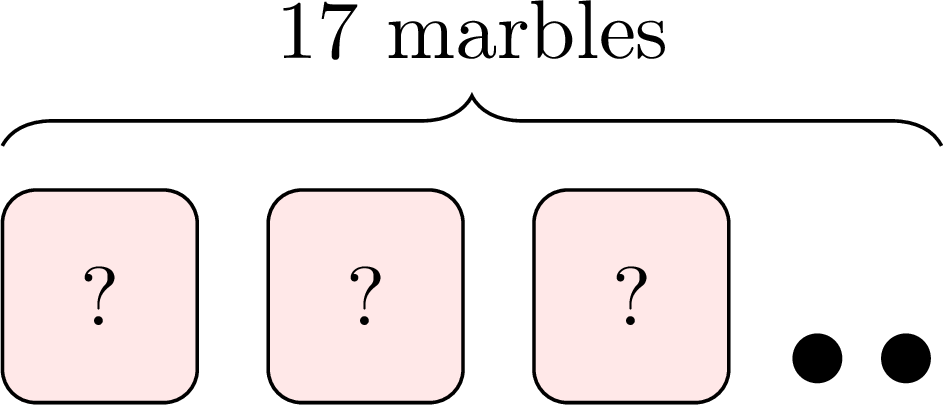
Let \(x\) be the number of marbles in one bag. Three bags give \(3x\); with the \(2\) loose marbles, \(3x + 2\); the sentence states the equality: $$3x + 2 = 17.$$ This time the unknown undergoes two operations — \(\times 3\), then \(+2\) — so we undo them one after the other, the last one first, exactly like a two-instruction program: $$\begin{aligned}[t]3x &= 17 - 2 && (\text{inverse operation of } +2) \\
3x &= 15 \\
x &= 15 \div 3 && (\text{inverse operation of } \times 3) \\
&= \boldsymbol{5}.\end{aligned}$$ Each bag holds \(5\) marbles. Check in the story: three bags of \(5\) plus \(2\) loose marbles make \(3 \times 5 + 2 = 17\) \(\checkmark\)
Word order is not symbol order. “\(3\) less than a number” is written \(x - 3\), not \(3 - x\): the sentence starts with the \(3\), the expression starts with the number. Translate the meaning of the sentence, not the order of its words.
Skills to practice
- Translating a Sentence
- Writing the Equation
- Translating and Solving: Level 1
- Translating and Solving: Level 2
- Translating and Solving: Level 3
V
Going further
Skills to practice
- Reasoning and Problem-Solving
- Solving Problems in Context
- Quiz
Jump to section