International Baccalaureate · MYP 2
Triangles and Quadrilaterals
I
Triangles
I.1
Naming Triangles by Their Sides and Their Angles
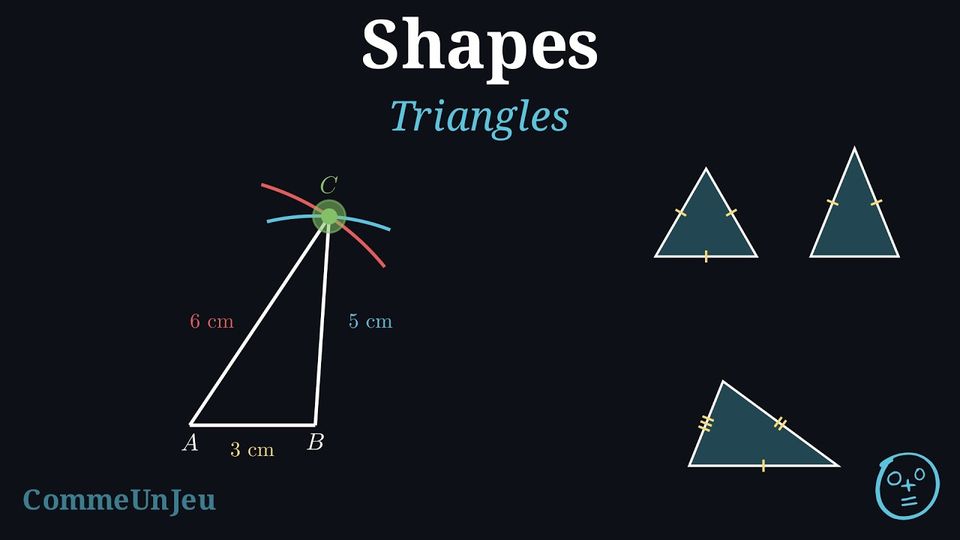
Definition — Isosceles triangle
An isosceles triangle is a triangle in which at least two sides are equal in length. When exactly two of them are equal, the third side is called the base, and the vertex opposite the base is called the apex. An equilateral triangle, whose three sides are equal, is therefore isosceles as well. 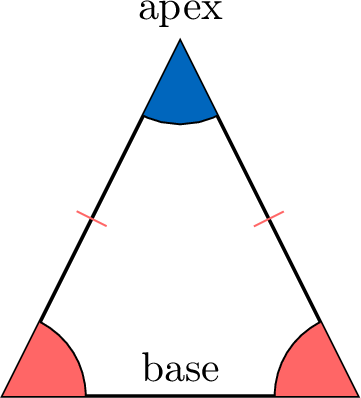
Definition — Scalene triangle
A scalene triangle is a triangle in which all three sides have different lengths (no sides are equal). 
Definition — Right-angled triangle
A right-angled triangle is a triangle with one right angle (\(90^\circ\)). The side opposite the right angle is called the hypotenuse. 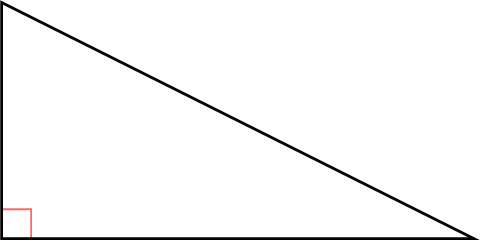
Definition — Acute-Angled and Obtuse-Angled Triangles
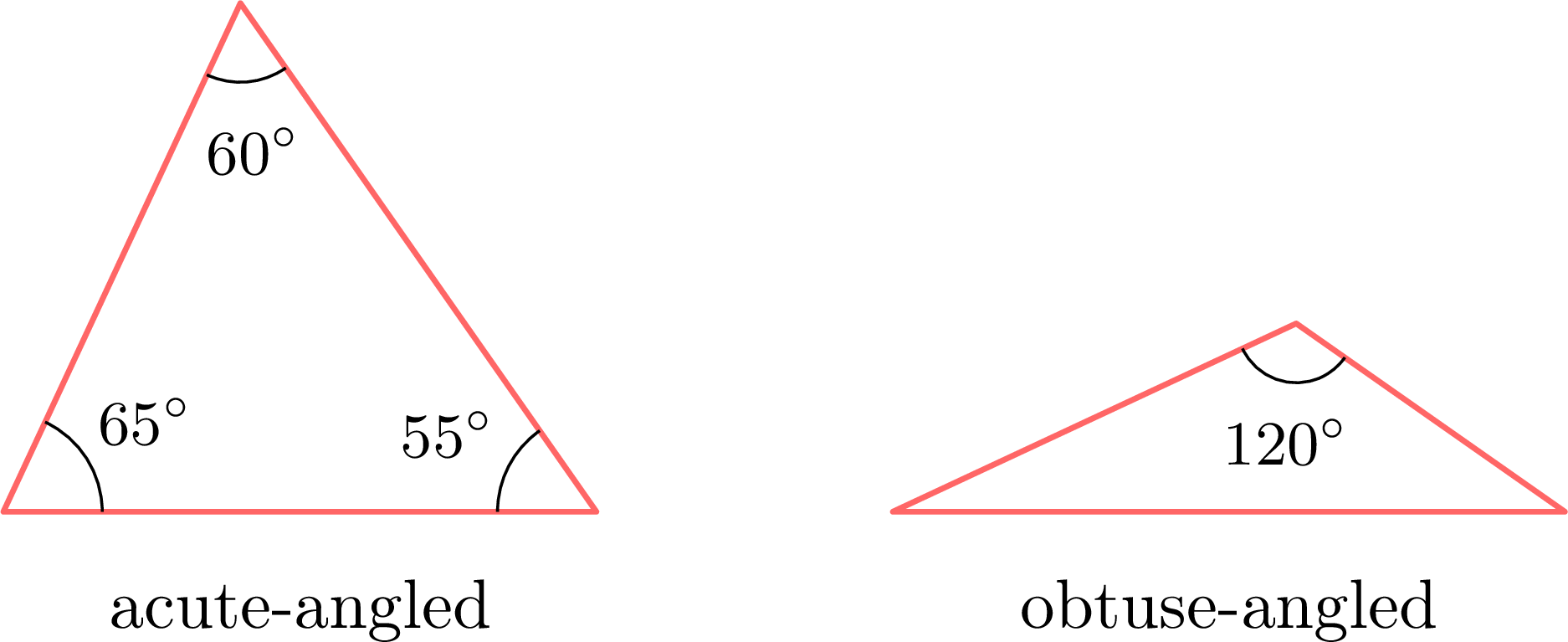
A triangle is acute-angled when its three angles are acute: each of them measures less than \(90^\circ\).A triangle is obtuse-angled when one of its angles is obtuse: it measures more than \(90^\circ\) and less than \(180^\circ\).
With the right-angled triangle, which has one right angle, these are the three types of triangles by their angles.
Example
Name each triangle by its sides and by its angles. 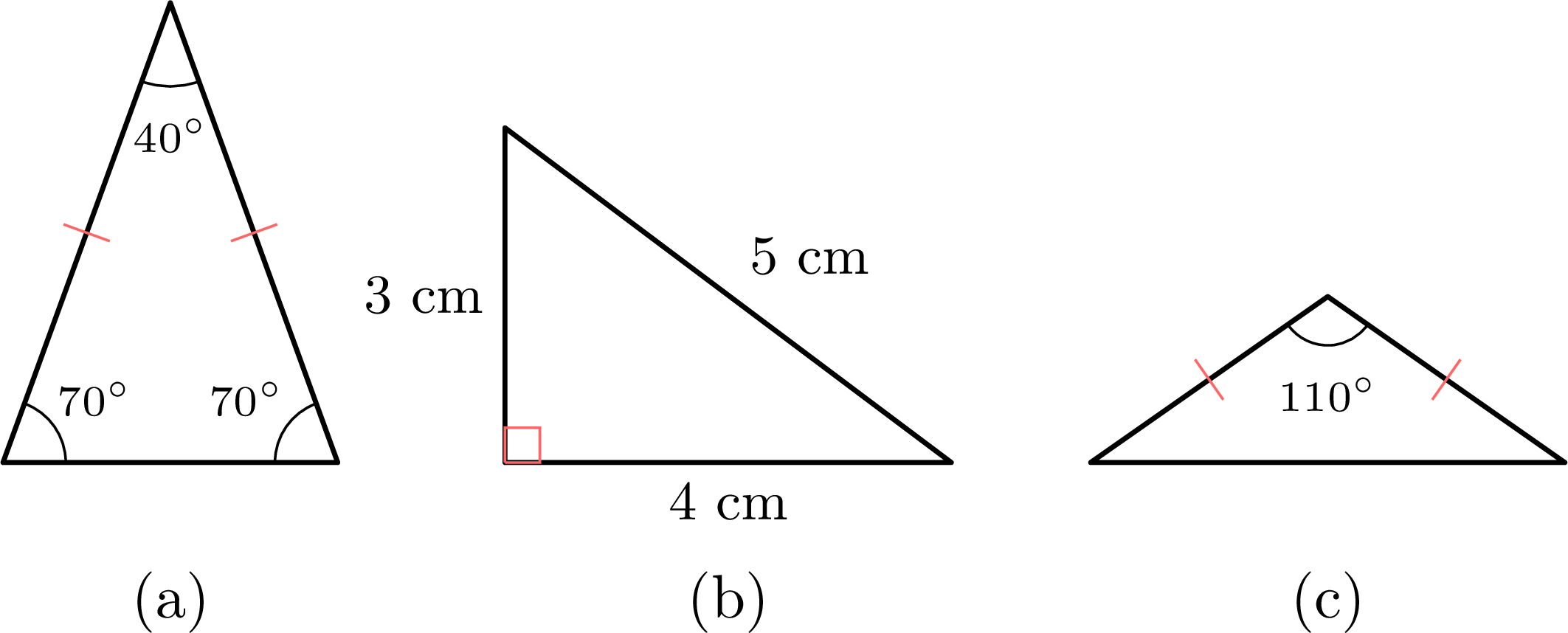
A triangle receives two names: one from its sides, one from its angles.
- (a) Two sides are marked equal: the triangle is isosceles. Its angles, \(70^\circ\), \(70^\circ\) and \(40^\circ\), are all acute: it is acute-angled. It is an isosceles and acute-angled triangle.
- (b) Its sides, \(3\) cm, \(4\) cm and \(5\) cm, all have different lengths: the triangle is scalene. It has a right angle: it is right-angled. It is a scalene and right-angled triangle.
- (c) Two sides are marked equal: the triangle is isosceles. Its angle of \(110^\circ\) is obtuse: it is obtuse-angled. It is an isosceles and obtuse-angled triangle.
Skills to practice
- Classifying Triangles by Their Angles
- Naming a Triangle by Its Sides and Its Angles
I.2
Angles of a Triangle
Three pupils each draw a triangle. Lea draws a wide flat one, Noah a tall thin one, Amir one with a right angle. Each of them follows the same five steps.
- Draw any triangle.
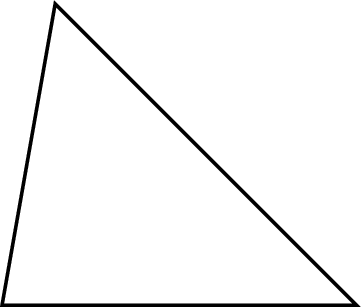
- Mark each angle of the triangle with a different colour.
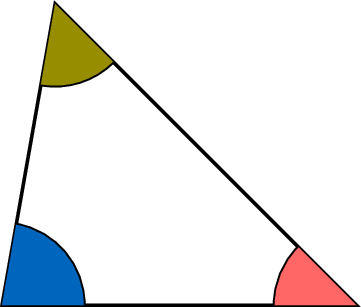
- Cut out each corner (angle) of the triangle by cutting along the coloured regions around each vertex.
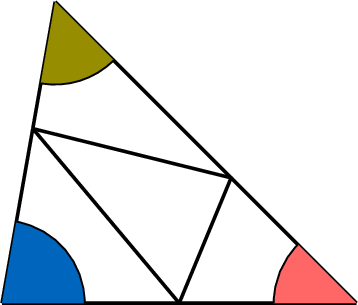
- Arrange the cut-out angles so that they are adjacent, with their vertices meeting at a single point and without overlapping.
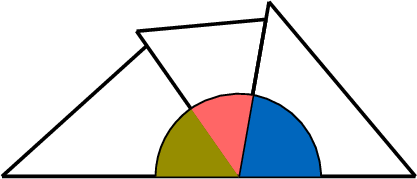
- Observe that the three angles now form a straight angle (an angle measuring \(180^\circ\)).
Proposition — Sum of the angles of a triangle
In any triangle, the sum of the three interior angles is \(180^\circ\). 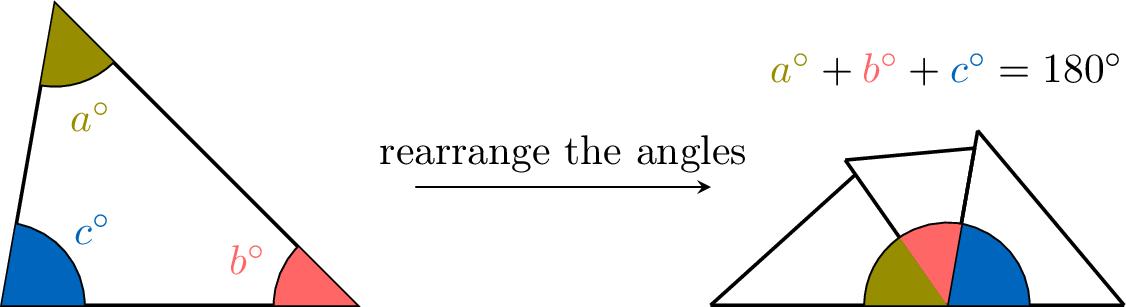
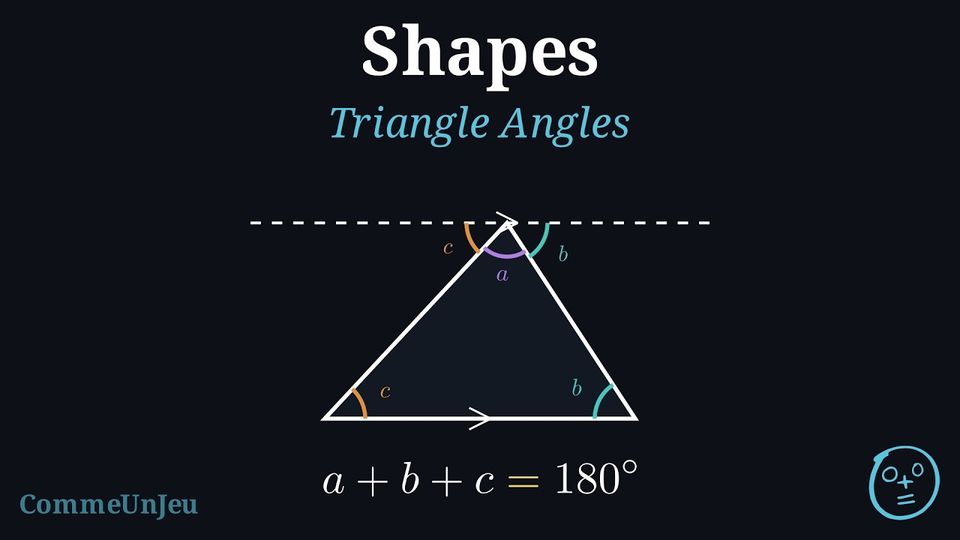
The cut-and-rearrange activity suggests the result; here we prove it. Through the vertex \(C\), draw the line parallel to the opposite side \(\Line{AB}\), meeting it nowhere. The two sides \(\Segment{CA}\) and \(\Segment{CB}\) are then transversals cutting a pair of parallel lines. 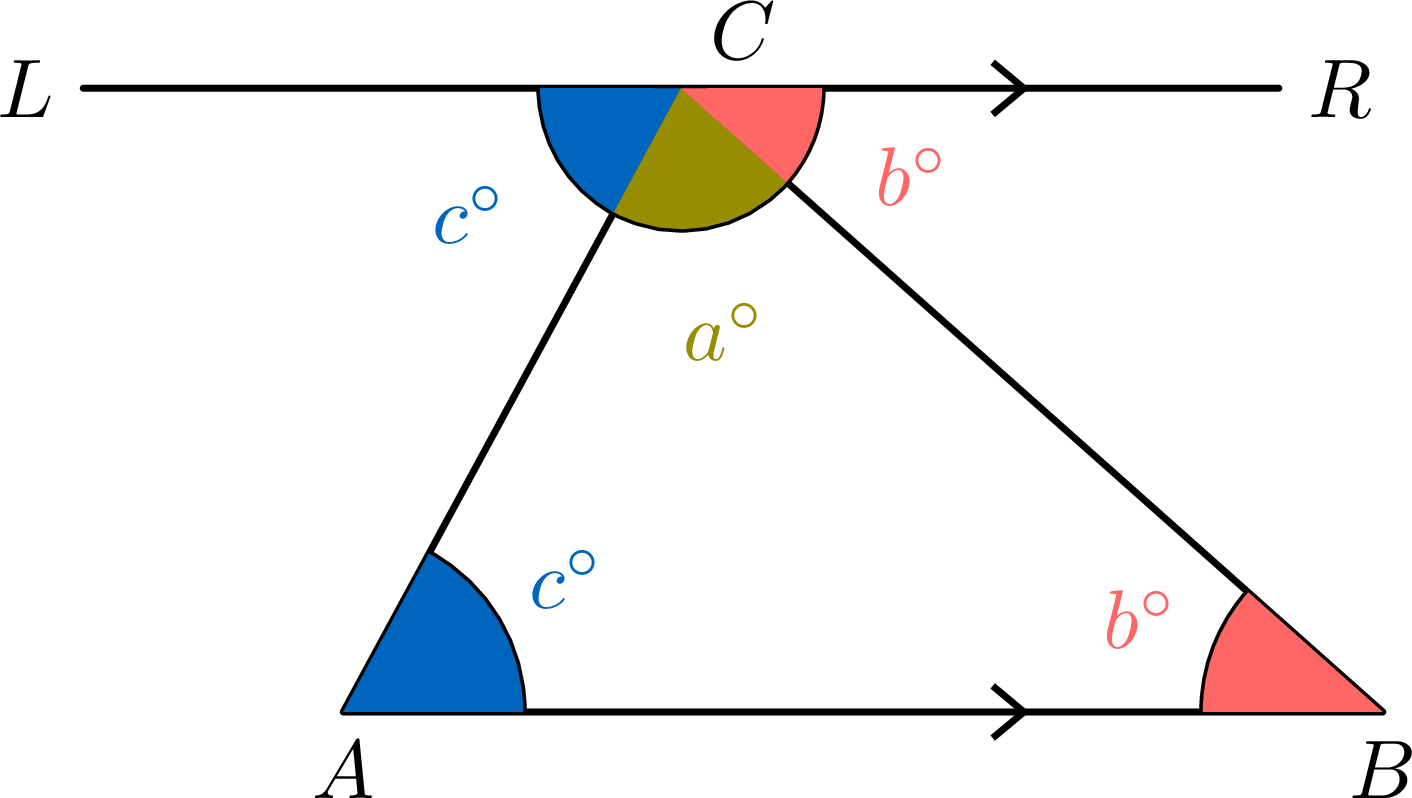
Each base angle reappears at \(C\) as an alternate angle: the transversal \(\Segment{CA}\) gives \(\Angle{LCA}=c^\circ\), and the transversal \(\Segment{CB}\) gives \(\Angle{BCR}=b^\circ\). The three angles at \(C\) lie along the straight line \(\Line{LR}\), so they form a straight angle: $$\begin{aligned}[t] \Angle{LCA}+\Angle{ACB}+\Angle{BCR} &= 180^\circ && \text{(angles on a straight line)}\\
c^\circ + a^\circ + b^\circ &= 180^\circ. && \text{(alternate angles, parallel lines)} \end{aligned}$$ Hence the three interior angles satisfy \(a^\circ+b^\circ+c^\circ=180^\circ\).
Method — Finding the Third Angle
Two angles of a triangle are known and the third is wanted. - Add the two known measures.
- Subtract the result from \(180^\circ\).
Example
Find the angle \(x^\circ\). 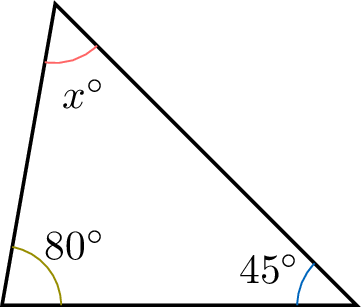
The sum of the angles in a triangle is \(180^\circ\). Therefore: $$\begin{aligned}[t] x^\circ + 45^\circ + 80^\circ &= 180^\circ \\
x^\circ + 125^\circ &= 180^\circ \\
x^\circ &= 180^\circ - 125^\circ \\
x^\circ &= 55^\circ \end{aligned}$$
Proposition — At Most One Right or Obtuse Angle
In a triangle, at most one angle is right or obtuse: the two other angles are always acute.So every triangle is exactly one of the three types: acute-angled, right-angled or obtuse-angled.
Suppose that two angles of a triangle each measure \(90^\circ\) or more. Then $$\begin{aligned}[t] \text{sum of these two angles} &\geq 90^\circ + 90^\circ && \text{(each one is at least } 90^\circ\text{)}\\
&= 180^\circ. \end{aligned}$$ The three angles of a triangle add up to \(180^\circ\) (sum of the angles of a triangle), so the third angle would measure \(0^\circ\) or less: impossible for an angle of a triangle. Hence at most one angle measures \(90^\circ\) or more, and the two others measure less than \(90^\circ\): they are acute.
The largest angle then decides the type: if it is acute, all three angles are acute and the triangle is acute-angled; if it is right, the triangle is right-angled; if it is obtuse, the triangle is obtuse-angled. Only one of these three cases can happen.
The largest angle then decides the type: if it is acute, all three angles are acute and the triangle is acute-angled; if it is right, the triangle is right-angled; if it is obtuse, the triangle is obtuse-angled. Only one of these three cases can happen.
Proposition — Angles of a Right-Angled Triangle
In a right-angled triangle, the two angles that are not the right angle add up to \(90^\circ\). 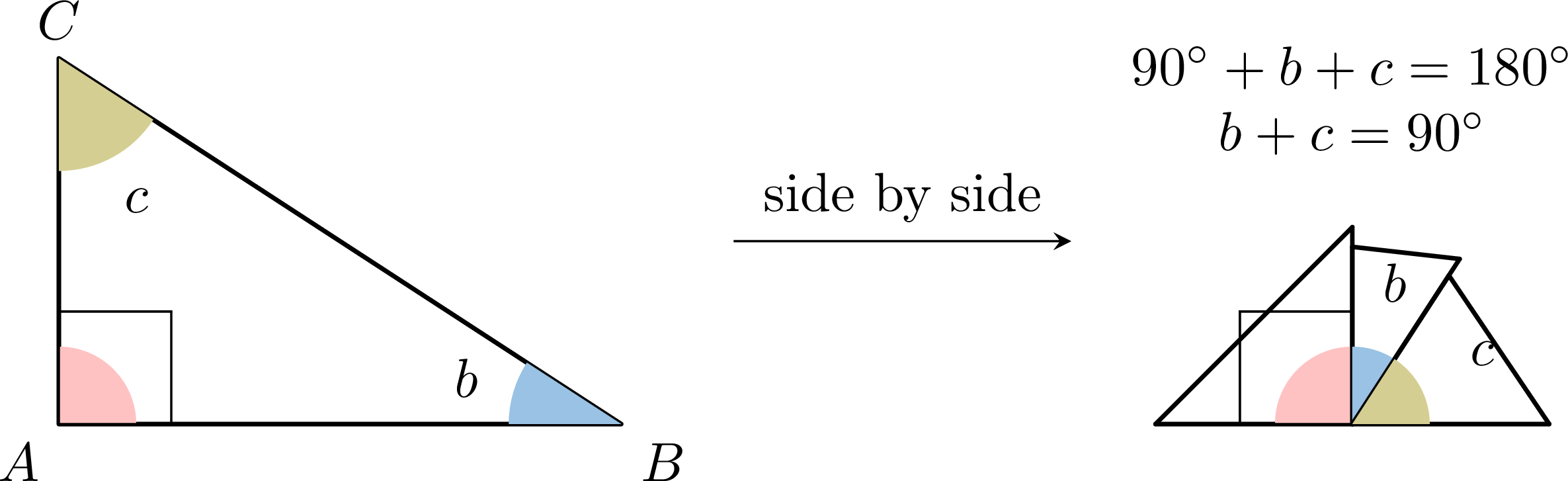
Proposition — Angles in an isosceles triangle
In any isosceles triangle, the angles opposite the equal sides (base angles) are equal. Conversely, if a triangle has two equal angles, then it is isosceles. 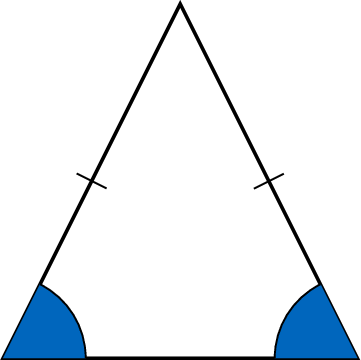
- Draw any isosceles triangle with two equal sides.
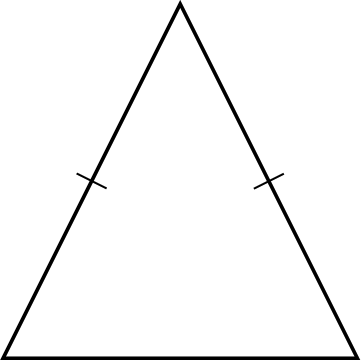
- Draw the segment joining the apex to the midpoint of the base. It divides the triangle into two triangles. Shade each one differently.
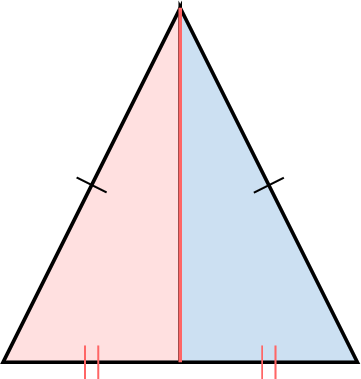
- Cut out the isosceles triangle and fold it along this segment. The two equal sides fall exactly onto each other. We accept here what the study of line symmetry established — an isosceles triangle has a line of symmetry, the line through its apex and the midpoint of its base; the folding shows it, it does not prove it.
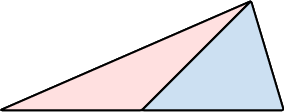
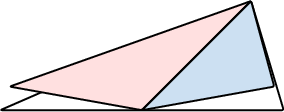
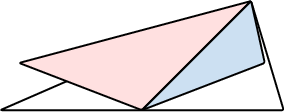
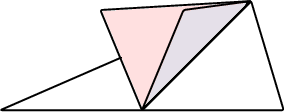
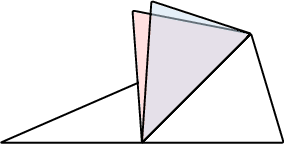
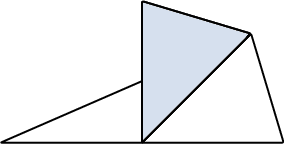
- Observe that the two halves coincide when folded. This shows that the base angles are equal because of the symmetry.
Example
In an isosceles triangle, the angle at the apex measures \(40^\circ\). Determine the measure of each of the two base angles.
The sum of the three angles is \(180^\circ\), and the two base angles of an isosceles triangle are equal. $$\begin{aligned}[t] 180 - 40 &= 140 && \text{(what is left for the two base angles)}\\
140 \div 2 &= 70 && \text{(the two base angles are equal)} \end{aligned}$$ Each base angle measures \(70^\circ\). Check: \(40 + 70 + 70 = 180\).
Proposition — Angles in an equilateral triangle
In any equilateral triangle, each angle measures \(60^\circ\). 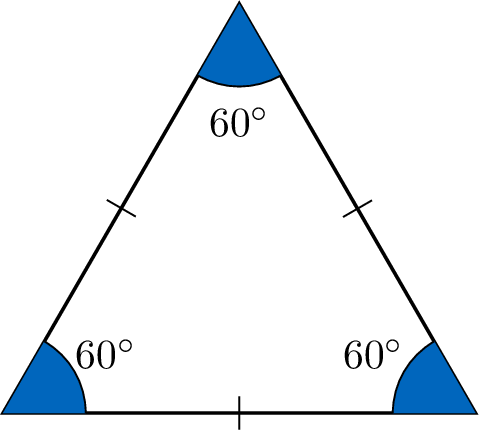
Consider an equilateral triangle with all sides equal. Since the angles opposite equal sides are equal, all three angles have the same measure, say \(x^\circ\). 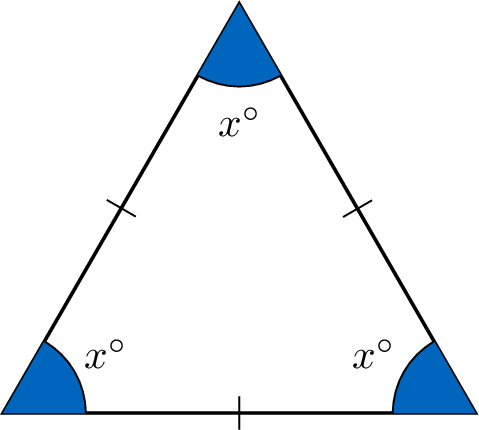
By the angle sum property of a triangle: $$\begin{aligned} x^\circ + x^\circ + x^\circ &= 180^\circ \\
3x^\circ &= 180^\circ \\
x^\circ &= 180^\circ \div 3 \\
x^\circ &= 60^\circ \end{aligned}$$ Thus, each angle in an equilateral triangle measures \(60^\circ\).
Proposition — Exterior-Angle Theorem
When one side of a triangle is extended, the exterior angle formed is equal to the sum of the two interior angles that are not next to it (the two remote interior angles). 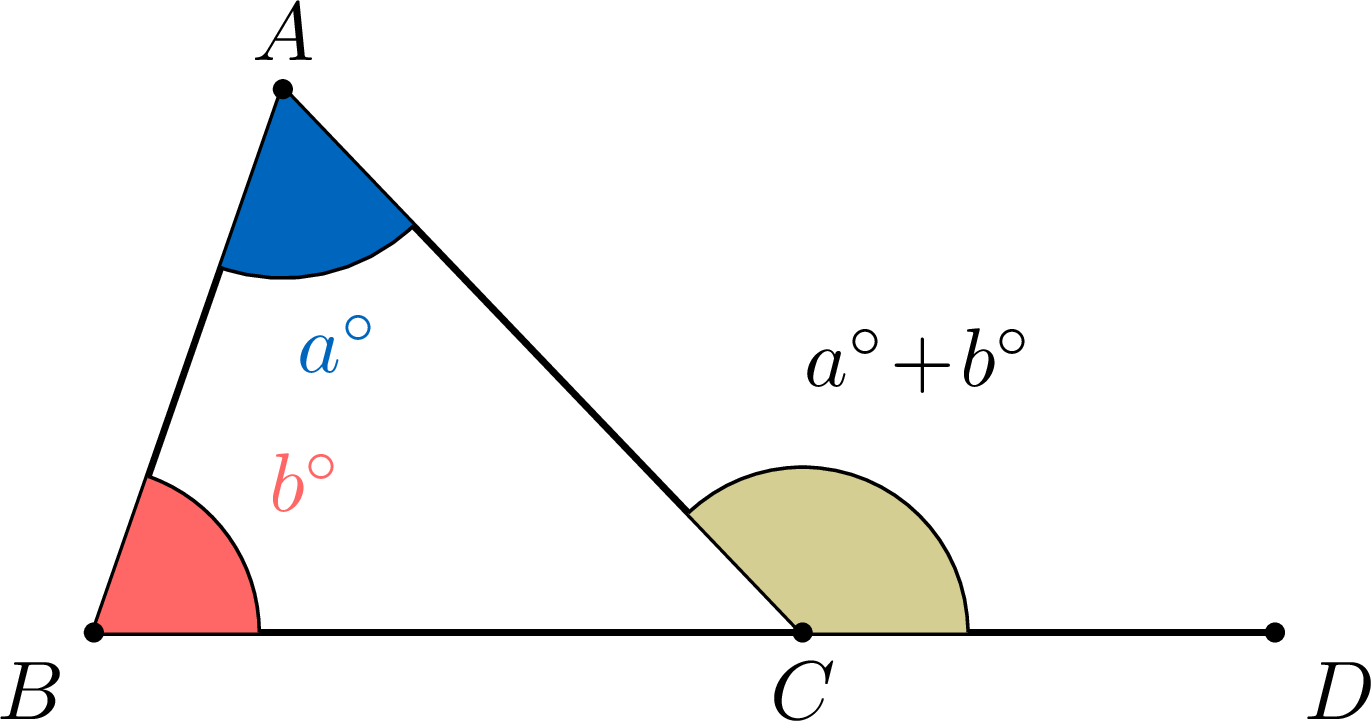
Write \(a^\circ\), \(b^\circ\) and \(c^\circ\) for the three interior angles of the triangle, at \(A\), \(B\) and \(C\). Extend the side \(\Segment{BC}\) beyond \(C\) to a point \(D\). The interior angle at \(C\) and the exterior angle \(\Angle{ACD}\) lie along the straight line \(\Line{BD}\), so they are supplementary. Therefore: $$\begin{aligned}[t] \Angle{ACD} &= 180^\circ - c^\circ && \text{(angles on a straight line)} \\
&= (a^\circ + b^\circ + c^\circ) - c^\circ && \text{(sum of the angles of a triangle)} \\
&= a^\circ + b^\circ. \end{aligned}$$ The exterior angle equals the sum of the two remote interior angles.
Skills to practice
- Finding the Third Angle to Classify a Triangle
- Finding an Unknown Angle
- Finding Angles in Isosceles Triangles
- Deducing Angles in Triangle Configurations
- Justifying Angle Facts in Triangles
I.3
The Triangle Inequality and Constructions
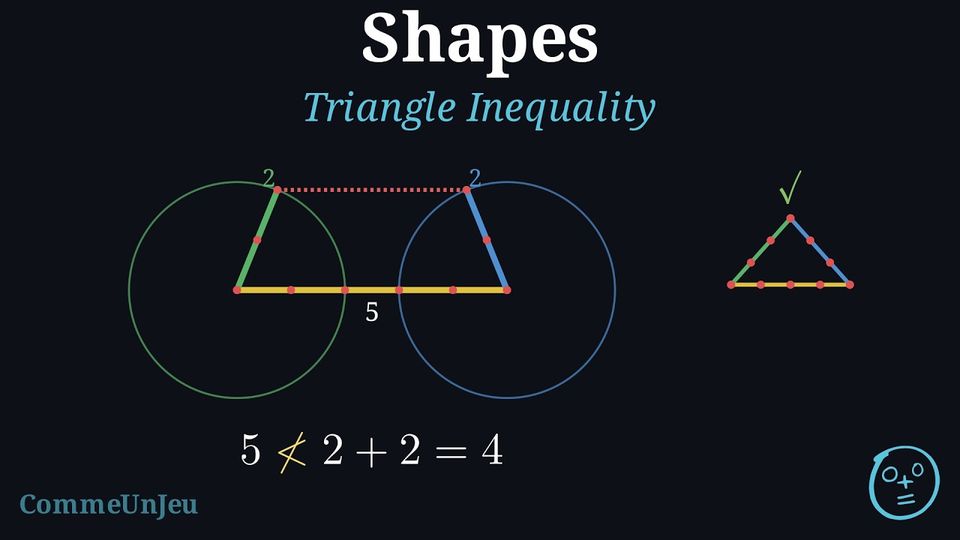
- Lay 4 matches end to end to form one side of a triangle.

- Using 9 matches, is it possible to construct a triangle with one side having a length of 5 matches?
-
-
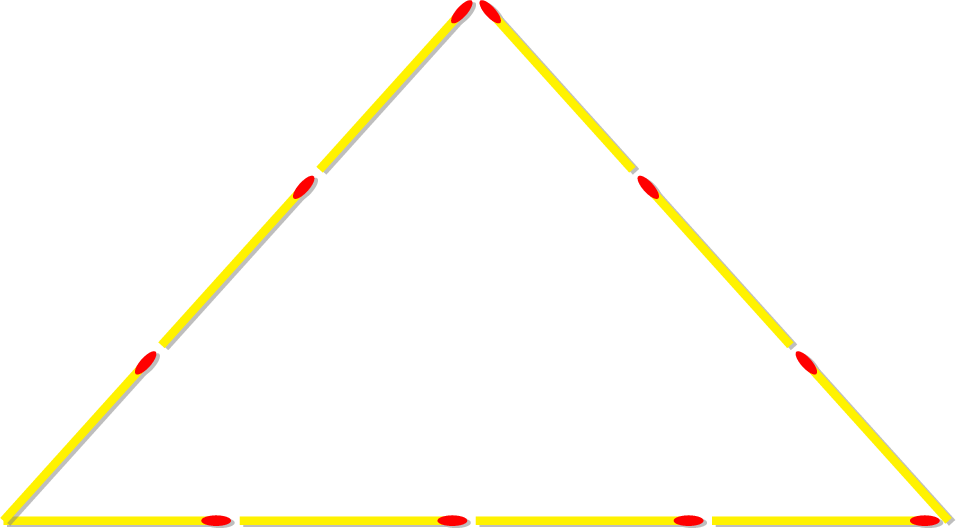
- Place 5 matches end to end to form one side of the triangle.
- This leaves 4 matches to form the other two sides.
- Suppose the second side uses 1 match. Then, the third side uses the remaining 3 matches.
- Try to form a triangle with sides of 5, 1, and 3 matches. When you attempt to connect the endpoints of the 5-match side with the 1-match and 3-match sides, the 1-match side is too short to reach the endpoint of the 3-match side, preventing the sides from forming a closed shape.

- Try another combination, such as using 2 matches for each of the other two sides. Again, when you attempt to connect the endpoints of the 5-match side with two 2-match sides, the sides do not meet to form a closed shape because the 5-match side is too long compared to the other two. No combination of the 4 remaining matches (for example, 1 and 3, or 2 and 2) allows the sides to connect properly.
- Therefore, with 9 matches, it is not possible to construct a triangle with one side of length 5 matches.
Theorem — Triangle inequality theorem
In any triangle, the length of each side must be less than the sum of the lengths of the other two sides. 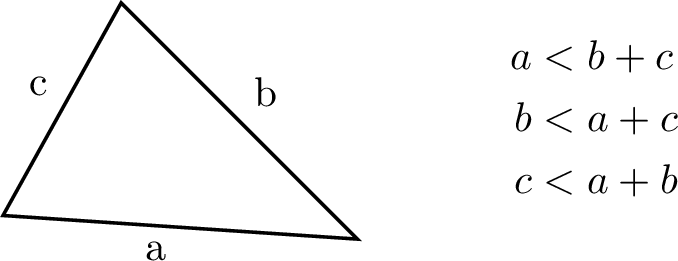
- If one side is longer than the sum of the other two sides, the sides cannot form a triangle because they do not meet to close the shape.

- If one side equals the sum of the other two sides, the result is a degenerate triangle (its three vertices lie on one line), which is not counted as a triangle.

Example
Could these be the side lengths of a triangle? 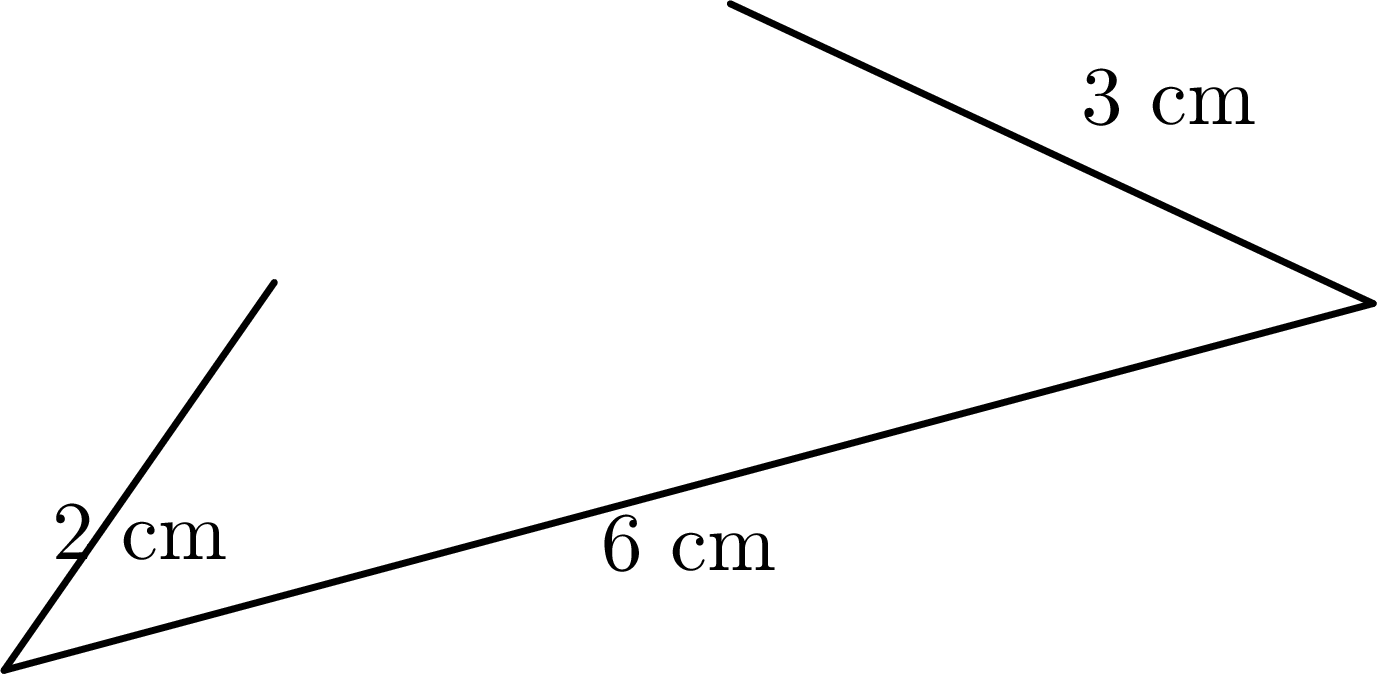
The triangle inequality theorem states that each side must be less than the sum of the other two sides. Check all three sides:
- \(2 < 6 + 3 = 9\) (holds)
- \(3 < 6 + 2 = 8\) (holds)
- \(6 \not< 3 + 2 = 5\) (does not hold)
Method — Constructing a Triangle from Three Pieces of Data
Three well-chosen pieces of data are enough to construct a triangle — three angles, for instance, are not, since they say nothing about its size. Here are the three usual cases; the construction itself shows whether the triangle exists. - Three lengths (side, side, side): draw one side; from each of its ends, draw an arc whose radius is the wanted length; the third vertex is where the two arcs meet. If the arcs do not meet, the triangle does not exist; if they only touch at one point, the three points are collinear and the triangle is flat — the triangle inequality, with its case of equality, is what decides.
- Two lengths and the angle between them (side, angle, side): draw one side; at one of its ends, mark the angle with the protractor, which gives a ray; on that ray, place the point at the second length; join.
- One side and its two adjacent angles (angle, side, angle): draw the side; mark each angle at its own end, both rays on the same side of the segment; the third vertex is where they meet. The two angles must add up to less than \(180^\circ\).
Skills to practice
- Determining Triangle Existence
- Applying the Triangle Inequality
- Constructing a Triangle from Two Sides and the Included Angle
- Constructing a Triangle from Two Angles and the Included Side
- Constructing and Classifying Triangles
II
Quadrilaterals
II.1
Convex Polygons and the Family of Quadrilaterals
Crossed and Non-Crossed Quadrilaterals
Joining four points \(A\), \(B\), \(C\), \(D\) in this order gives the four sides \(\Segment{AB}\), \(\Segment{BC}\), \(\Segment{CD}\), \(\Segment{DA}\). If these sides meet only at their endpoints, the quadrilateral \(ABCD\) is non-crossed — the usual case. If two sides cross each other, the quadrilateral is crossed, shaped like a bow tie. 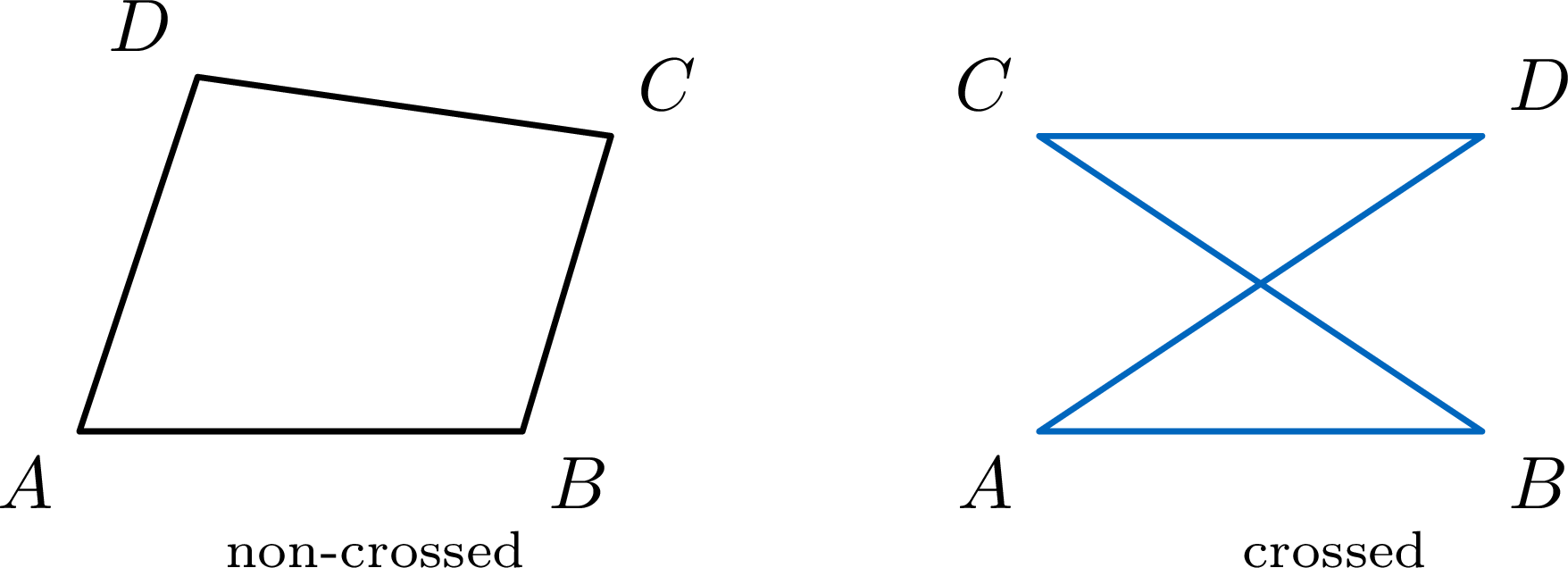
This distinction matters: the properties of the usual quadrilaterals, studied below, always assume a non-crossed quadrilateral.
Definition — Convex Polygon
A non-crossed polygon is convex when each of its interior angles is less than \(180^\circ\). A non-crossed polygon with at least one interior angle greater than \(180^\circ\) — a reflex angle — is concave, or non-convex. 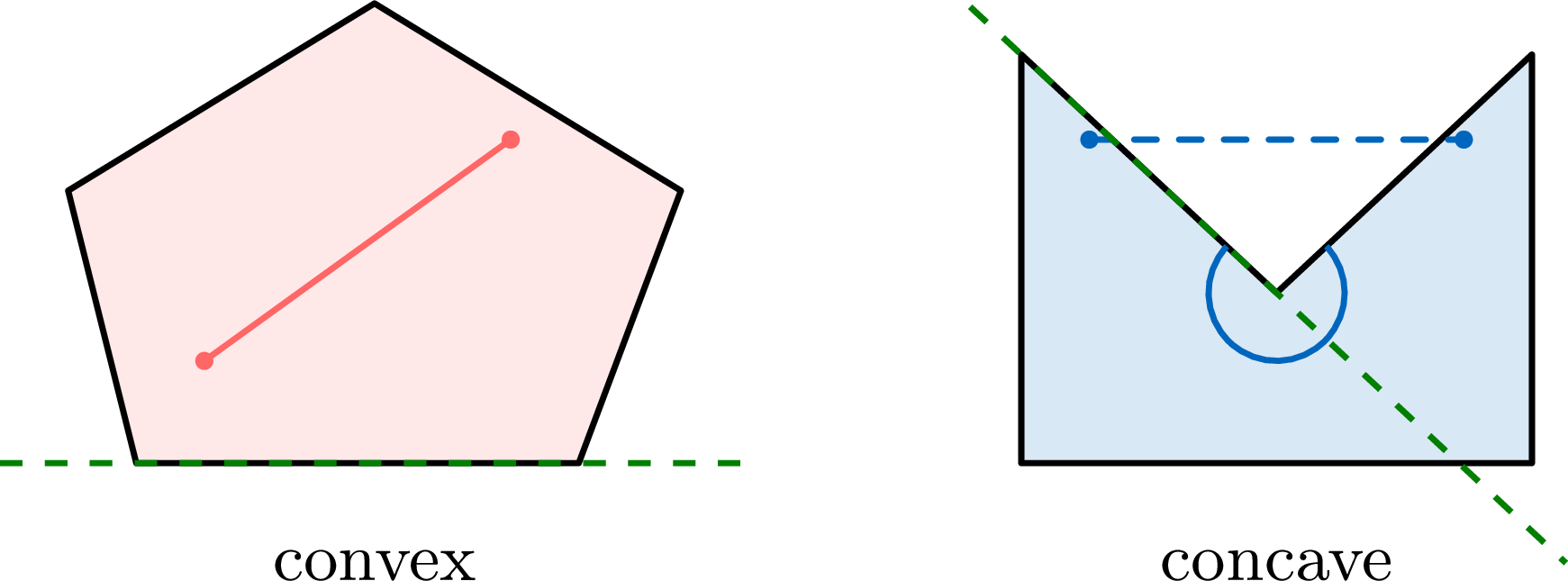
- the segment joining any two points inside the polygon stays inside the polygon;
- the line through any one of its sides leaves the whole polygon on the same side of it (green dashes).
Example
Which of these polygons are convex, and which are concave? 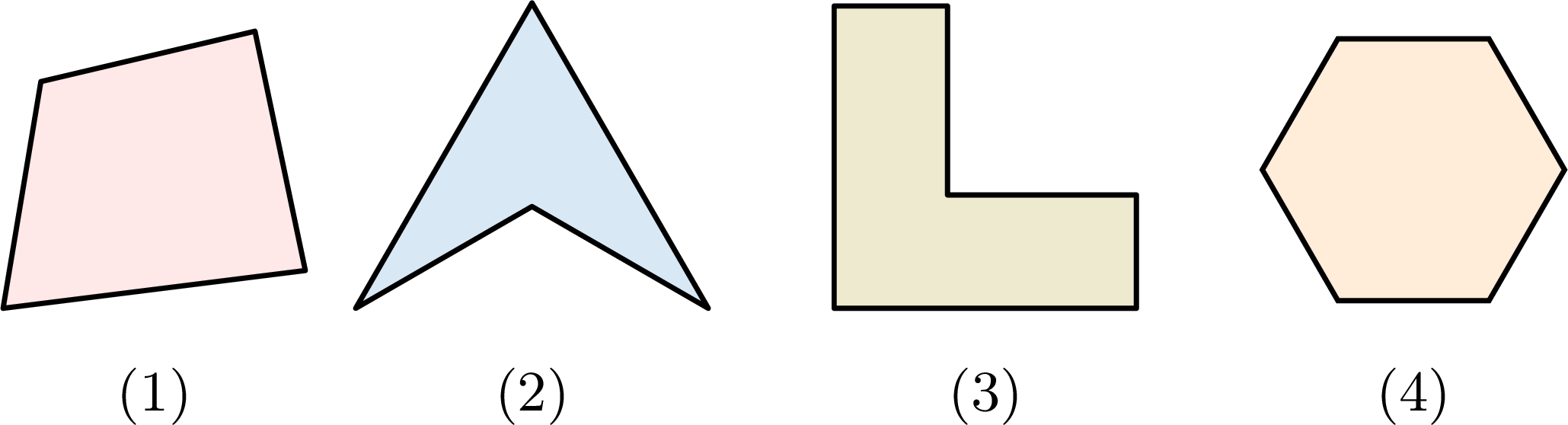
Look for a reflex angle (more than \(180^\circ\)), the corner that points inwards: 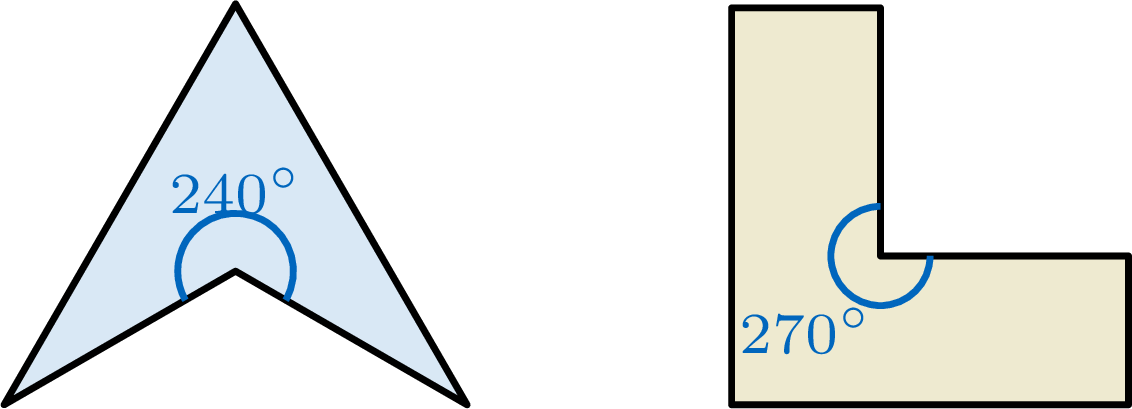
- (1) and (4) have no reflex angle: each of their angles is less than \(180^\circ\) — they are convex;
- (2) has a reflex angle at its inner corner (\(240^\circ\)): it is concave — this four-sided arrowhead is still a quadrilateral;
- (3) has a reflex angle of \(270^\circ\) at its inner corner: it is concave.
Definition — Trapezium
A trapezium is a quadrilateral with at least one pair of opposite sides parallel (in some countries, this is called a trapezoid). A pair of parallel sides is taken as the bases; the two other sides are the legs. 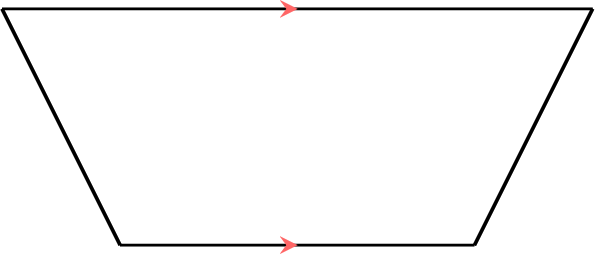
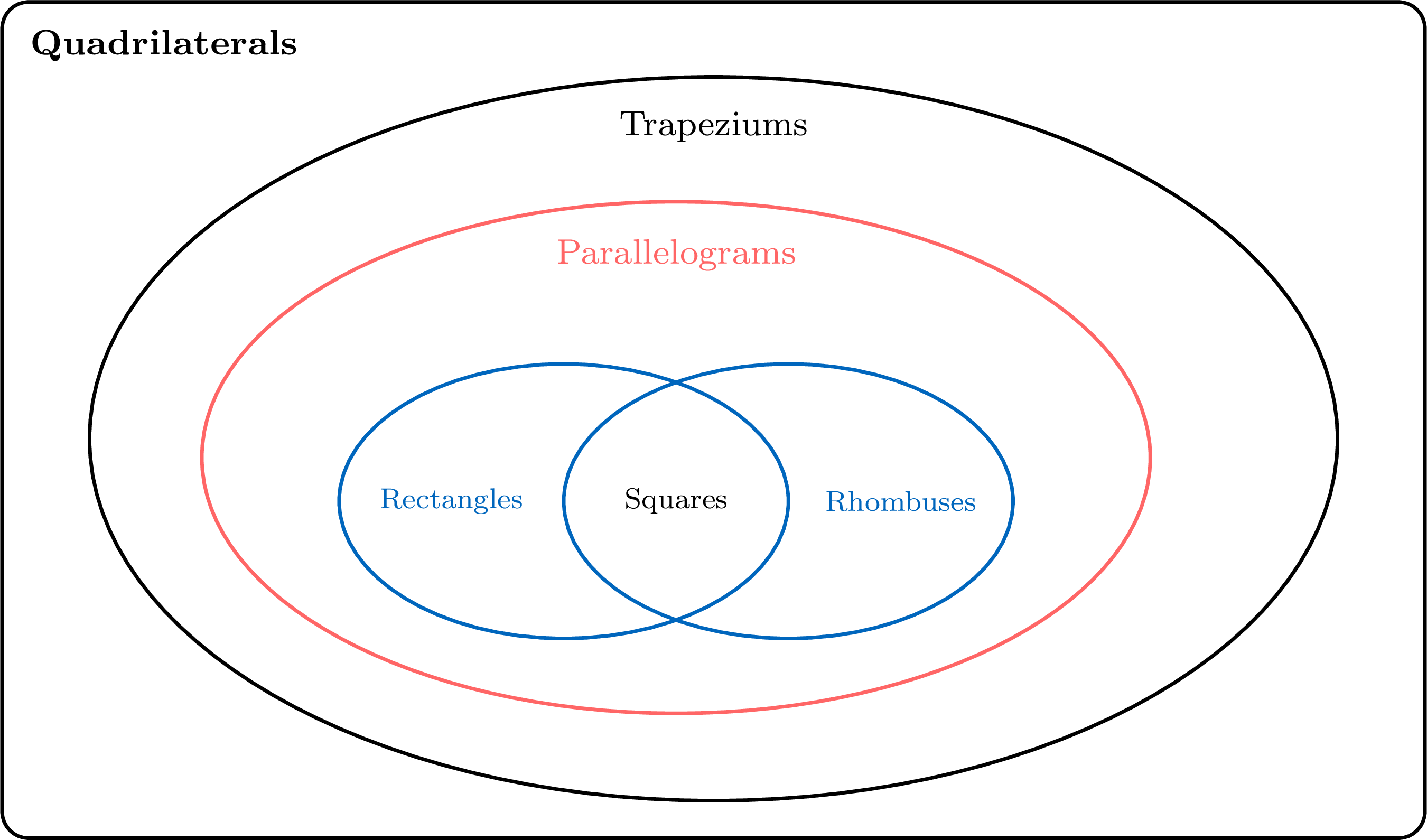
Proposition — The Family of Quadrilaterals
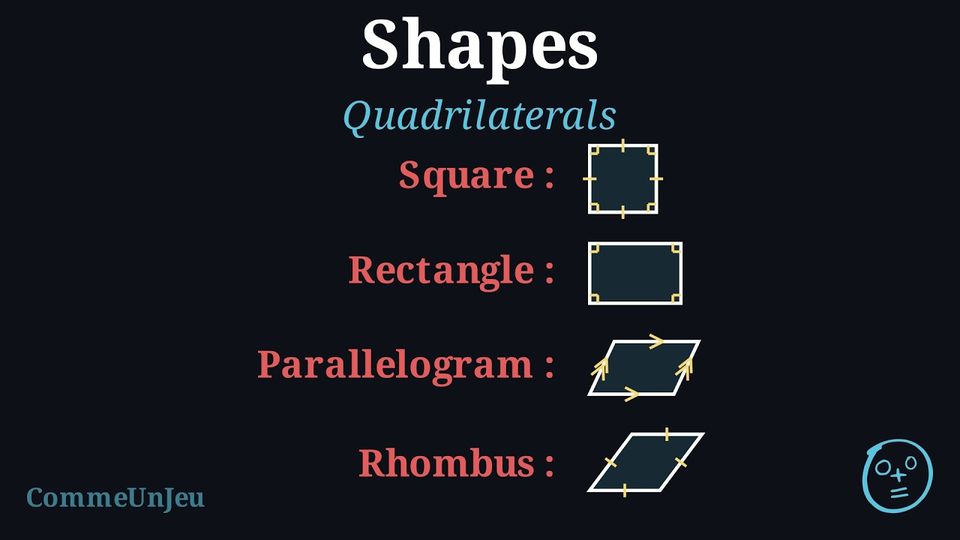
The special quadrilaterals are not separate kinds: some are special cases of others. - A square has four right angles, so every square is also a rectangle; a square also has four equal sides, so every square is also a rhombus.
- A rectangle and a rhombus each have both pairs of opposite sides parallel, so every rectangle and every rhombus is also a parallelogram.
- A parallelogram has a pair of parallel sides, so every parallelogram is also a trapezium; and every trapezium is a quadrilateral.
Skills to practice
- Recognising Convex Polygons
- Classifying Quadrilaterals
II.2
Angles of a Quadrilateral
Proposition — Sum of the Angles of a Quadrilateral
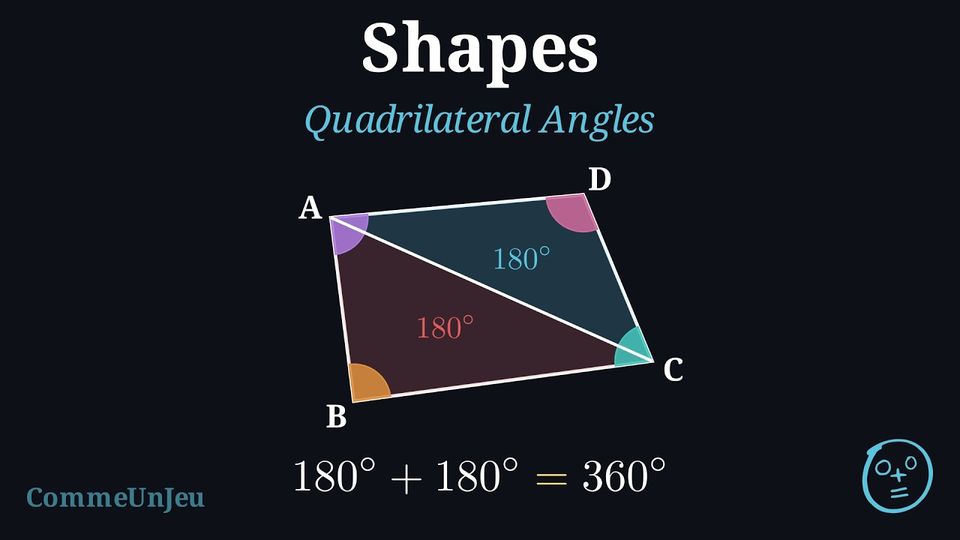
The sum of the interior angles of a non-crossed quadrilateral is \(360^\circ\). 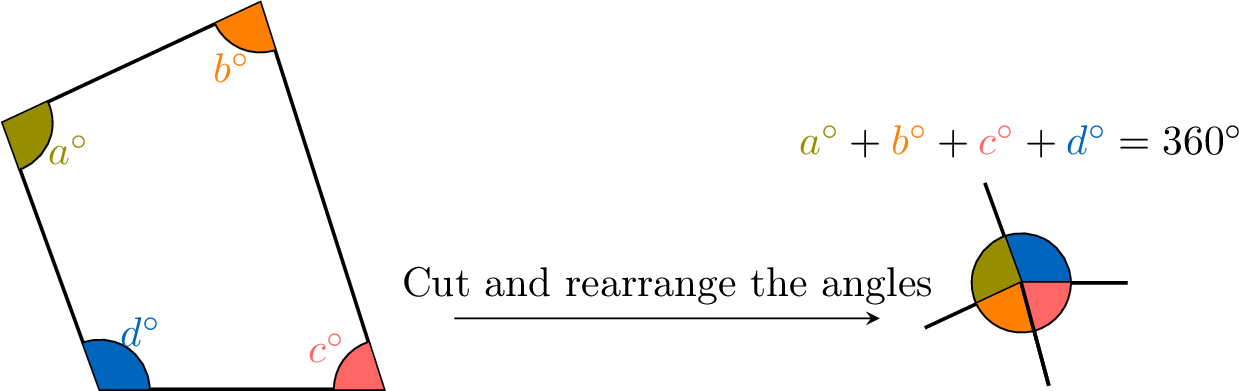
We cut the quadrilateral \(ABCD\) into two triangles, \(ABC\) and \(ACD\), along the diagonal \(\Segment{AC}\), which lies inside it (for a concave quadrilateral, the diagonal to choose is given in the Remark “Angle Sum of a Concave Polygon”). 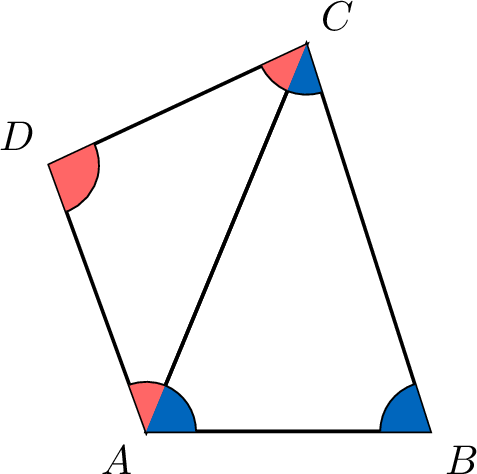
$$\begin{aligned} \text{Sum of the interior angles of quadrilateral } ABCD &= \text{Sum of the interior angles of } \triangle ABC \\
&\quad + \text{Sum of the interior angles of } \triangle ACD \\
&= 180^\circ + 180^\circ \\
&= 360^\circ \end{aligned}$$
Example
Find the unknown angle \(x^\circ\). 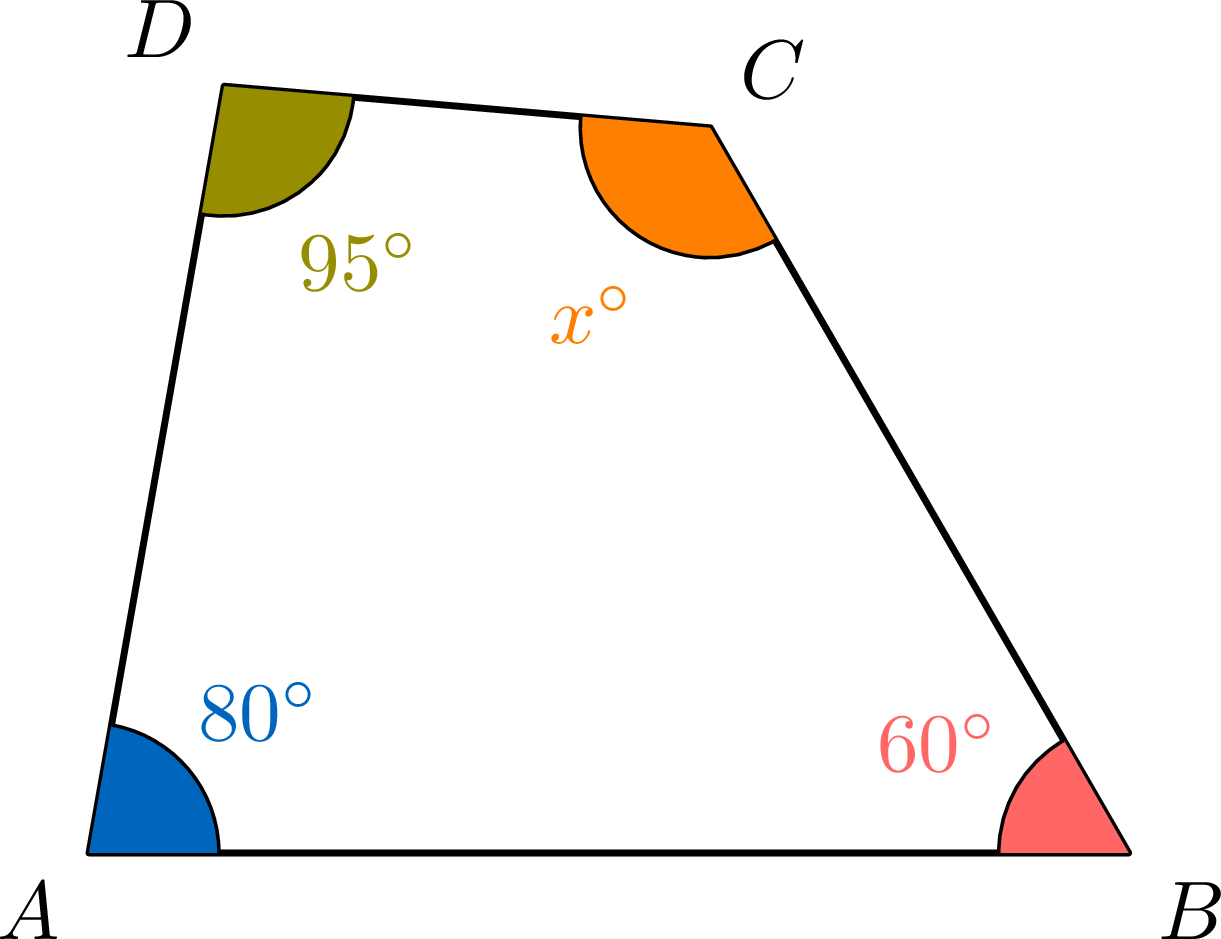
The sum of the angles of a quadrilateral is \(360^\circ\). The three known angles are \(60^\circ\), \(95^\circ\), and \(80^\circ\). $$\begin{aligned} x^\circ + 95^\circ + 80^\circ + 60^\circ &= 360^\circ \\
x^\circ + 235^\circ &= 360^\circ \quad &&\text{(adding the known angles)} \\
x^\circ &= 360^\circ - 235^\circ \quad &&\text{(subtracting \(235^\circ\) from both sides)} \\
x^\circ &= 125^\circ \end{aligned}$$
Angle Sum of a Concave Polygon
The sum of the angles of a non-crossed quadrilateral is \(360^\circ\) even when the quadrilateral is concave. The proof cuts the quadrilateral into two triangles along a diagonal; for a concave quadrilateral, choose the diagonal that starts at the vertex of the reflex angle: it lies inside the quadrilateral, while the other diagonal lies outside. In the arrowhead \(ABCD\) below, \(60^\circ + 30^\circ + 240^\circ + 30^\circ = 360^\circ\). 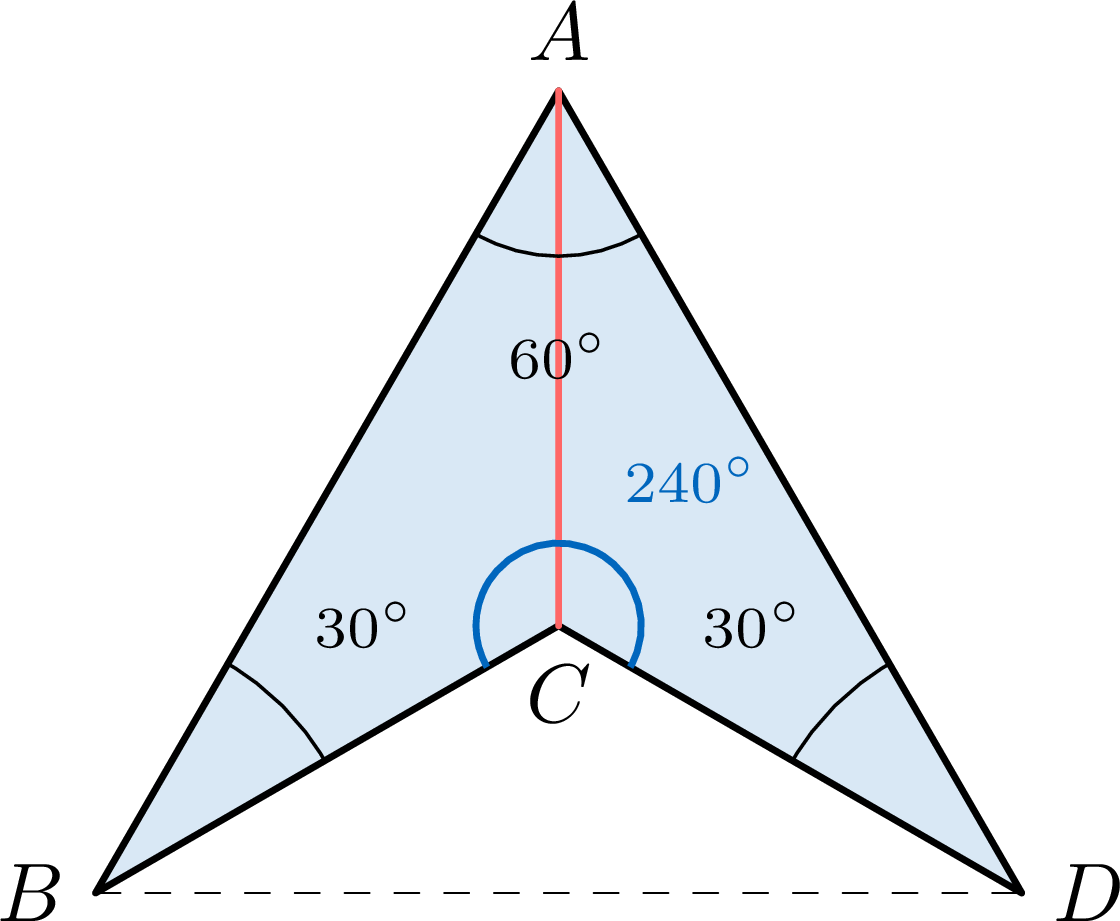
More generally, a non-crossed polygon with \(n\) sides, convex or concave, can always be cut into \(n - 2\) triangles by diagonals lying inside it, so the sum of its interior angles is \((n - 2) \times 180^\circ\): for \(n = 4\), \(2 \times 180^\circ = 360^\circ\).
Skills to practice
- Finding an Unknown Angle in a Quadrilateral
II.3
Properties of the Special Quadrilaterals
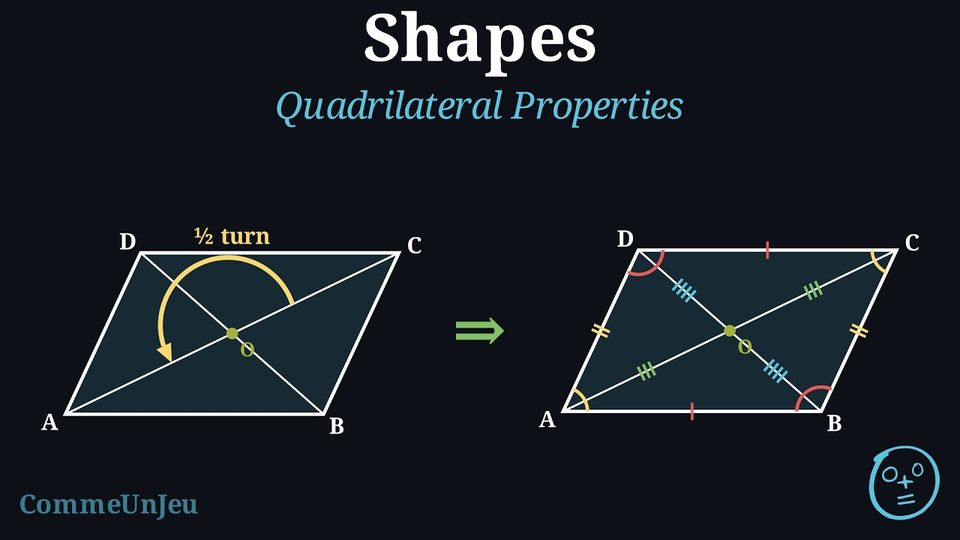
Léa lays two paper strips one across the other and looks at the shape where they overlap. 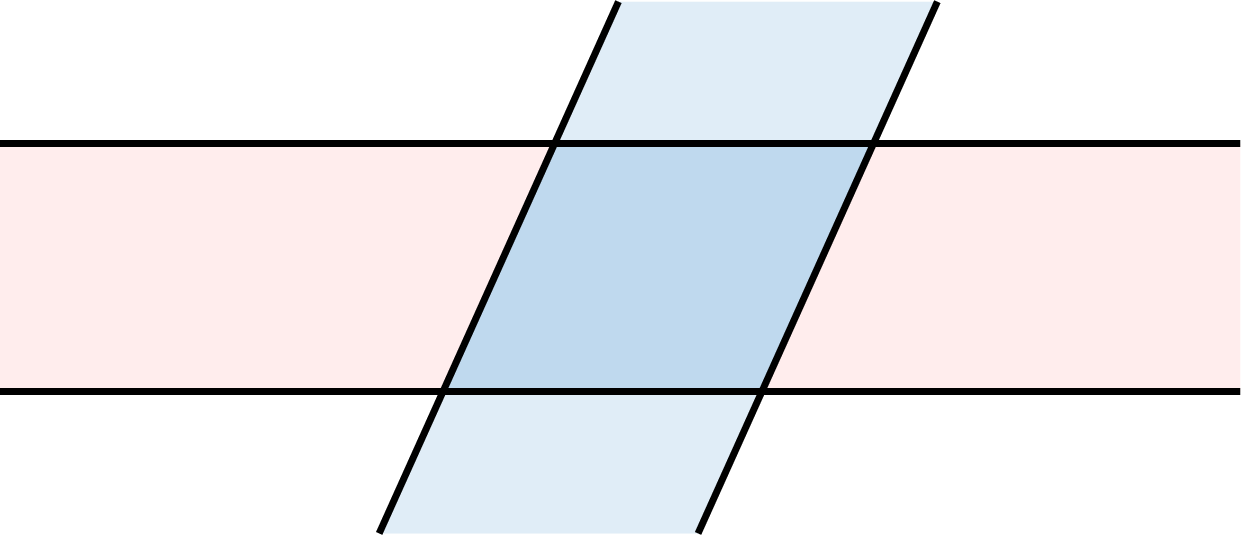
The strips cross (and are long enough for their ends to stay out of the overlap), so their edges are not parallel to each other. The two edges of a strip are parallel. The overlap has two sides on the edges of the first strip and two sides on the edges of the second: both pairs of its opposite sides are parallel, so the overlap is always a parallelogram — this is exactly the definition of a parallelogram. 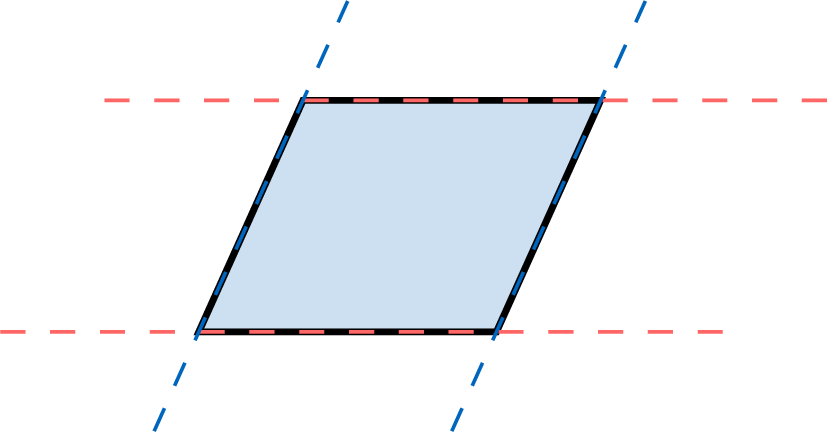
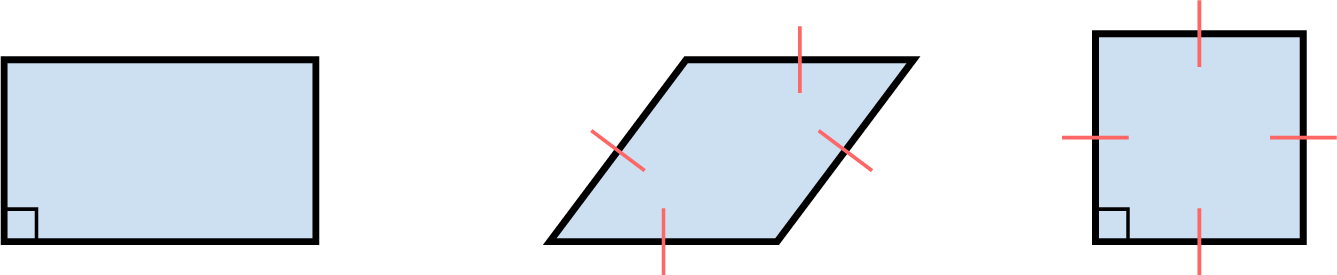
- if the strips are perpendicular, the overlap has right angles: it is a rectangle;
- if the strips have the same width, the overlap has four equal sides: it is a rhombus (measure to check it — computing the area of the overlap in two ways explains why);
- perpendicular and same width: a square.
Proposition — Properties of a Parallelogram
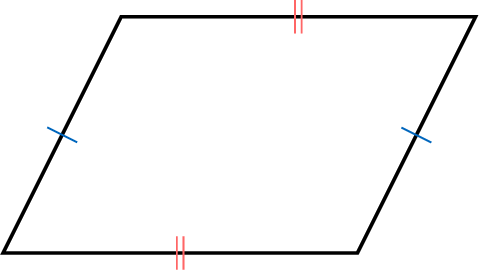
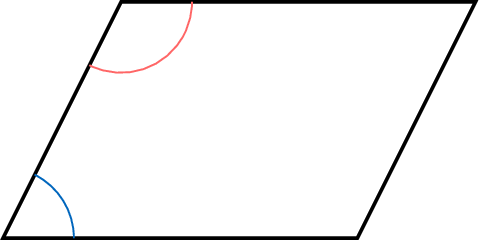
- The opposite sides are equal in length.
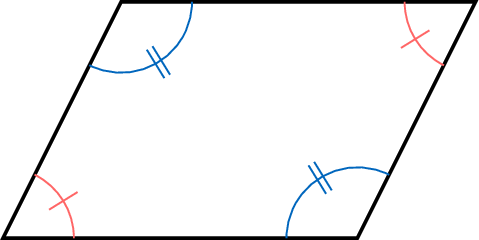
- The opposite angles are equal.
- The adjacent angles are supplementary (they add up to \(180^\circ\)).
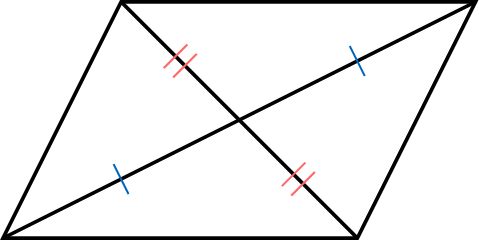
- The diagonals bisect each other (each one is cut in half by the other).
Proposition — Properties of a Square
- The opposite sides are parallel.

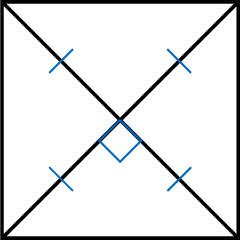
- The diagonals bisect each other, are perpendicular, and are equal in length.
Proposition — Properties of a Rectangle
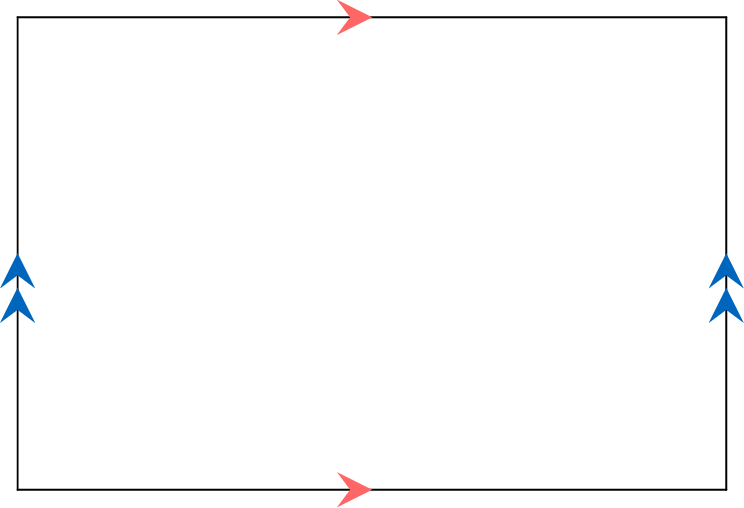
- The opposite sides are equal in length.
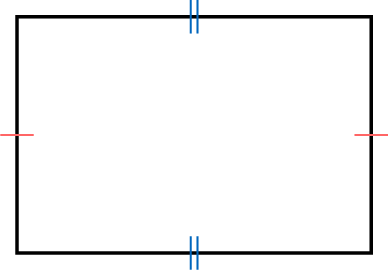
- The opposite sides are parallel.
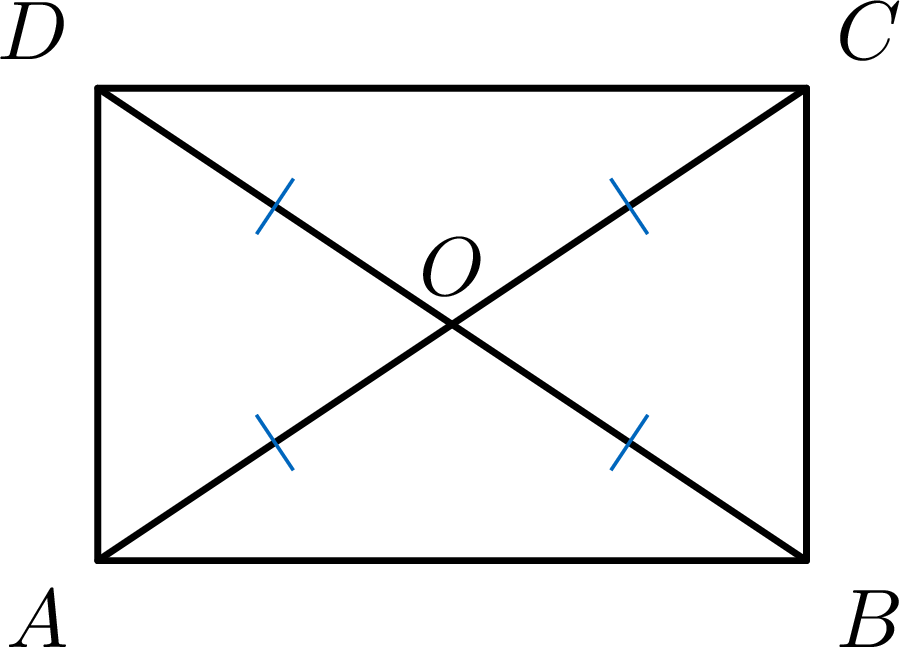
- The diagonals bisect each other and are equal in length.
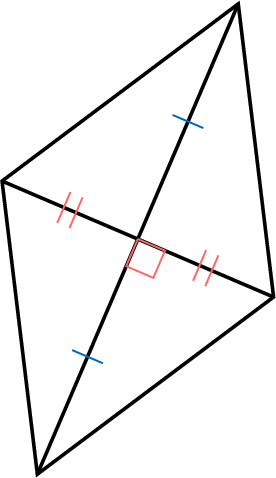
Proposition — Properties of a Rhombus
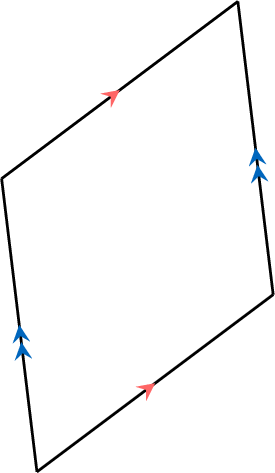
- The opposite sides are parallel.
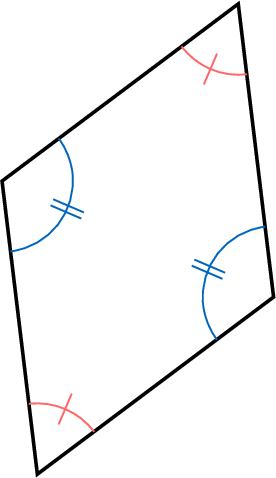
- The opposite angles are equal.
- The adjacent angles are supplementary (they add up to \(180^\circ\)).
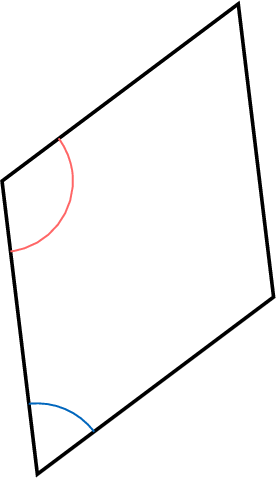
- The diagonals bisect each other at right angles.
Proposition — Properties of a Trapezium
- The two angles on the same leg are supplementary (they add up to \(180^\circ\)), because the two bases are parallel.
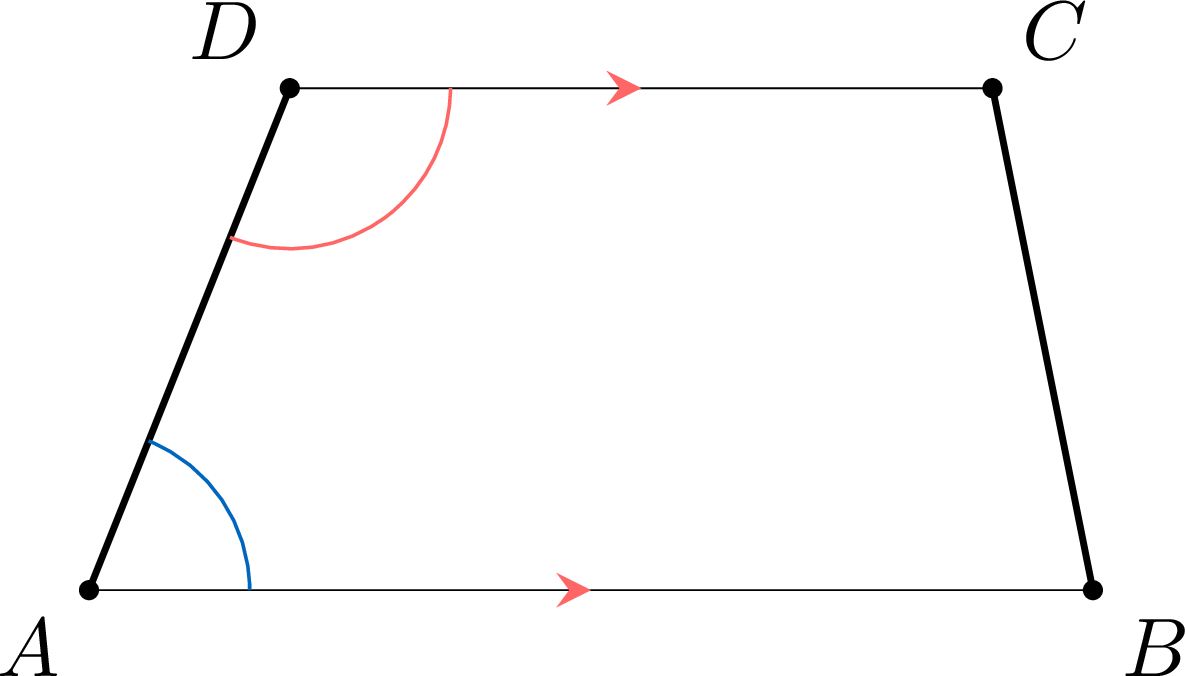
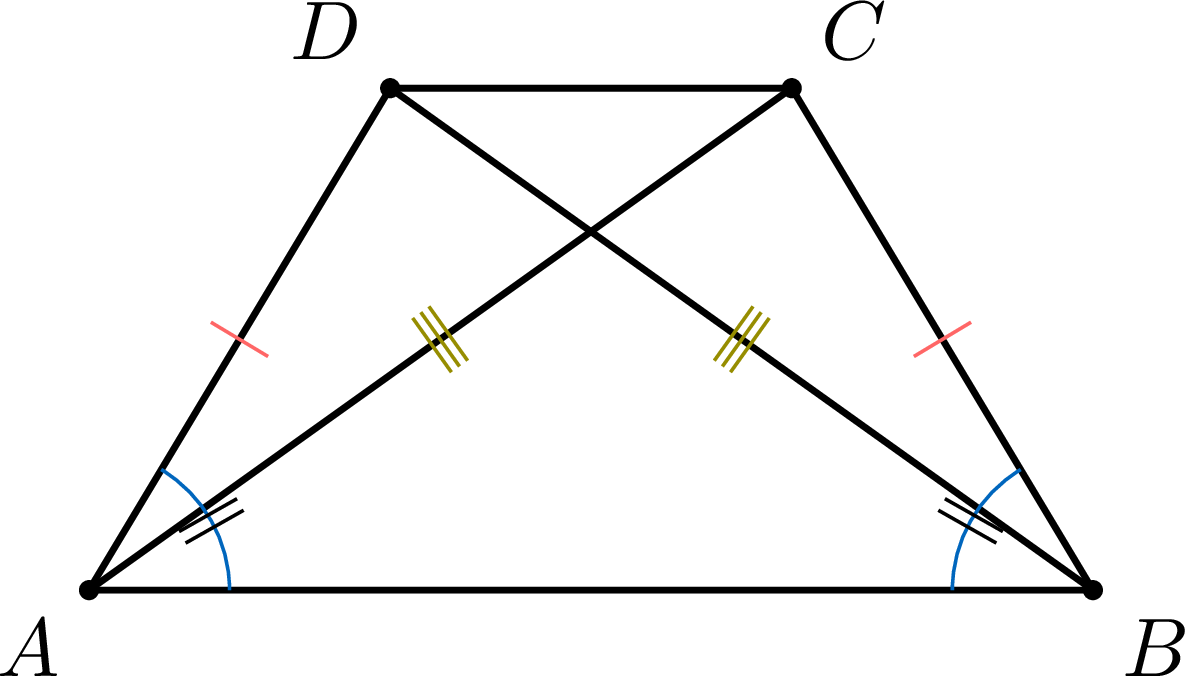
\(\Angle{A}+\Angle{D}=180^\circ\) - A trapezium whose two legs are equal is an isosceles trapezium (a parallelogram is not one). Then the two angles at each base are equal, and the two diagonals are equal.
Skills to practice
- Using the Properties of a Parallelogram
II.4
Properties of the Kite
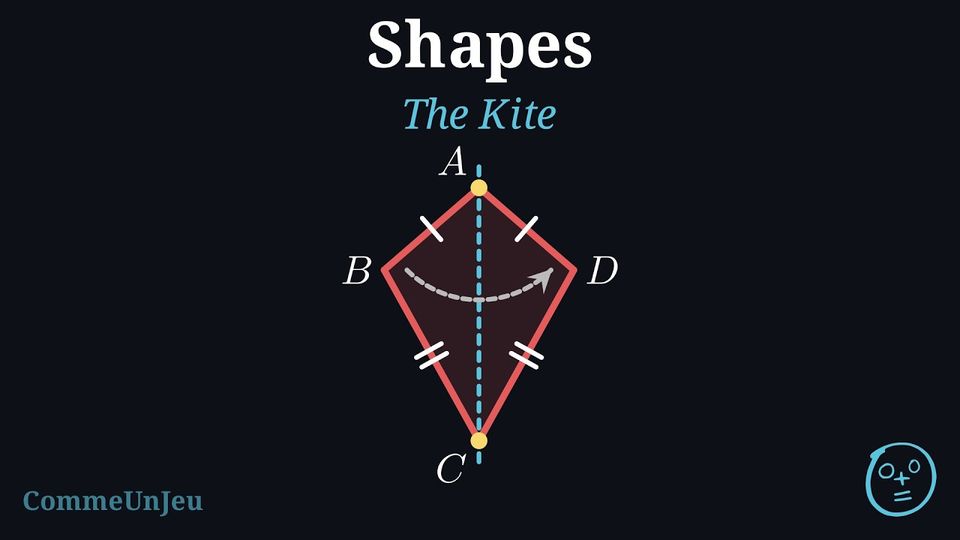
Definition — Kite
A kite is a quadrilateral with two pairs of equal adjacent sides: two sides that meet at a vertex have the same length, and the two other sides, which meet at the opposite vertex, have the same length too. 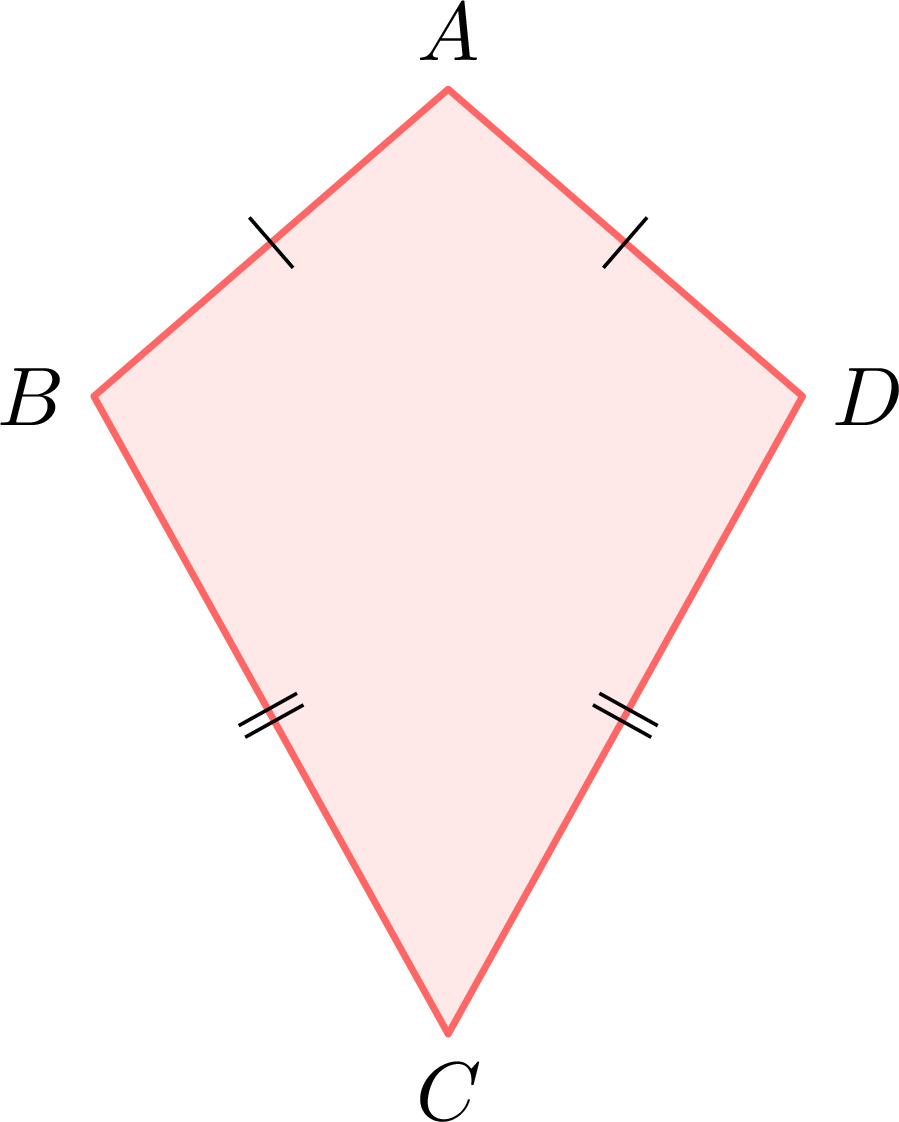
Proposition — Properties of a Kite
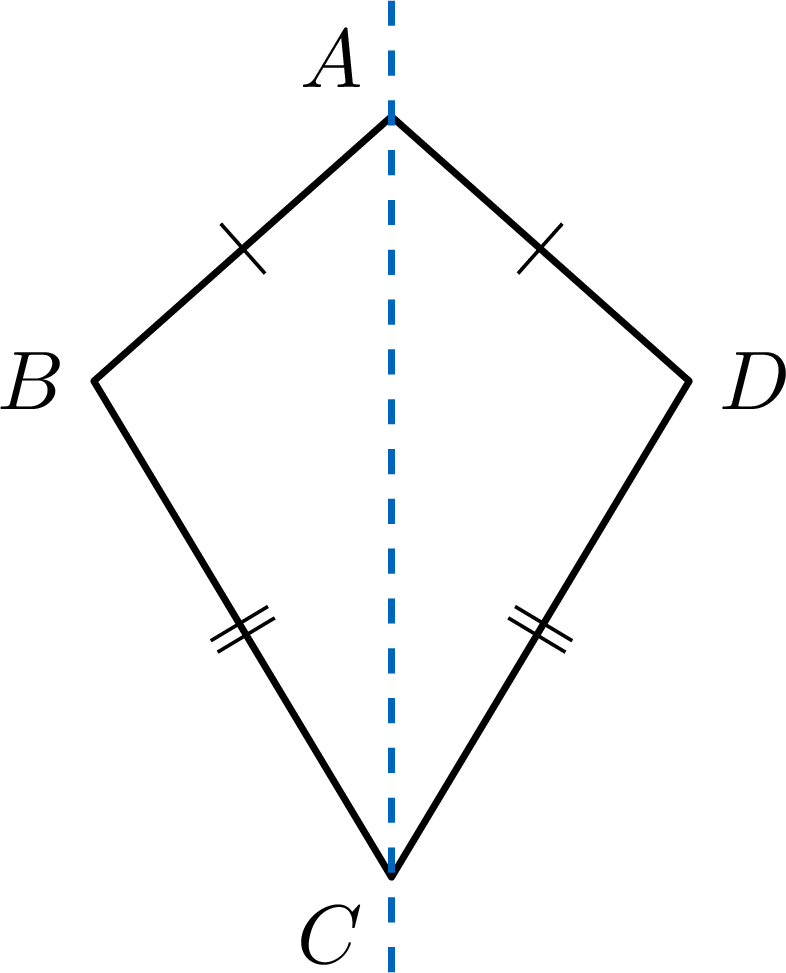
Let \(ABCD\) be a kite with \(AB = AD\) and \(CB = CD\): its equal sides meet at \(A\) and at \(C\). - The line \(\Line{AC}\), through the two vertices where the equal sides meet, is a line of symmetry of the kite. When the kite is not a rhombus, it is its only line of symmetry.
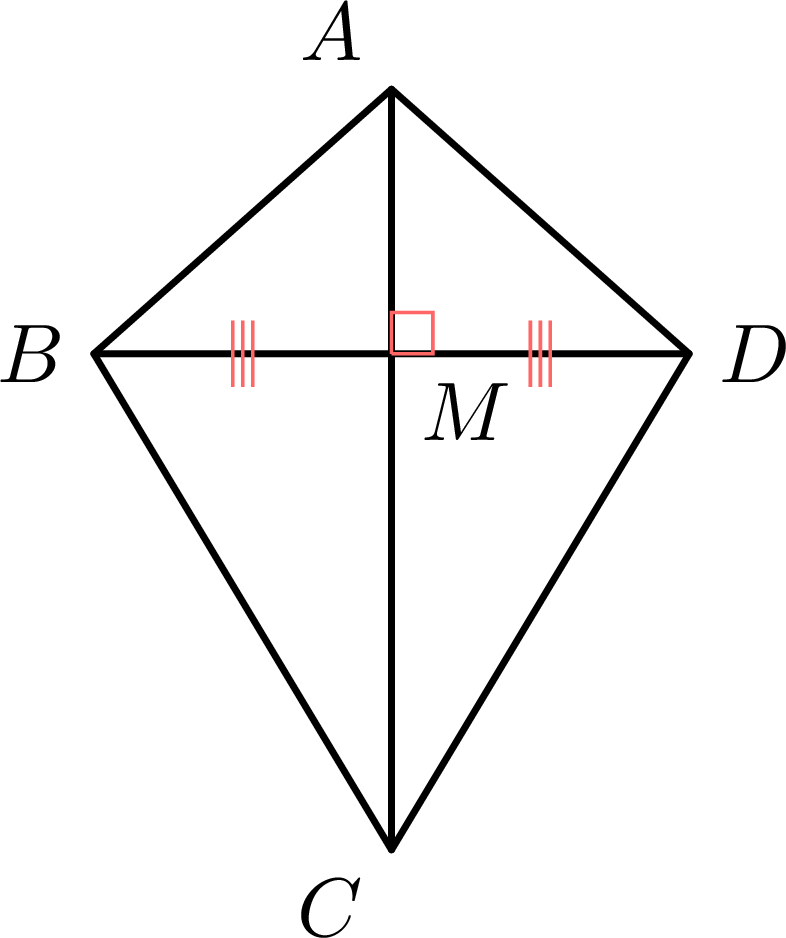
- The lines \(\Line{AC}\) and \(\Line{BD}\) through the diagonals are perpendicular, and \(\Line{AC}\) cuts the diagonal \(\Segment{BD}\) into two equal halves: \(\Line{AC}\) is the perpendicular bisector of \(\Segment{BD}\).
- The angles at \(B\) and at \(D\) are equal: \(\Angle{ABC} = \Angle{ADC}\). When the kite is not a rhombus, they are its two angles between unequal sides.
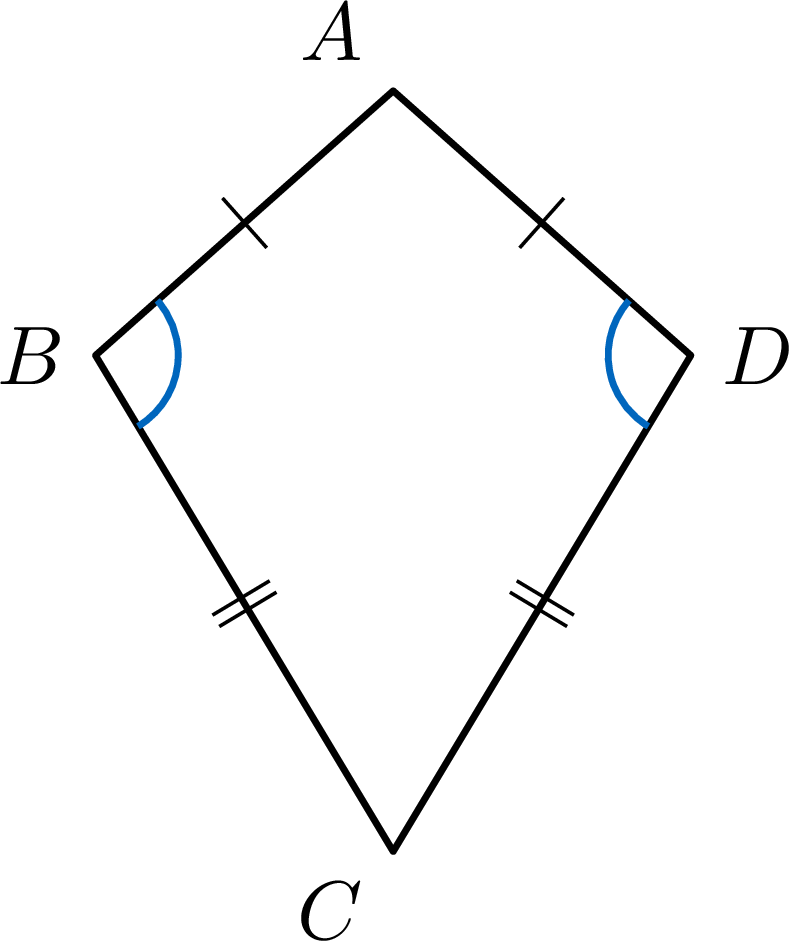
- The line of symmetry \(\Line{AC}\) bisects the angles at \(A\) and at \(C\): \(\Angle{BAC} = \Angle{DAC}\) and \(\Angle{BCA} = \Angle{DCA}\).
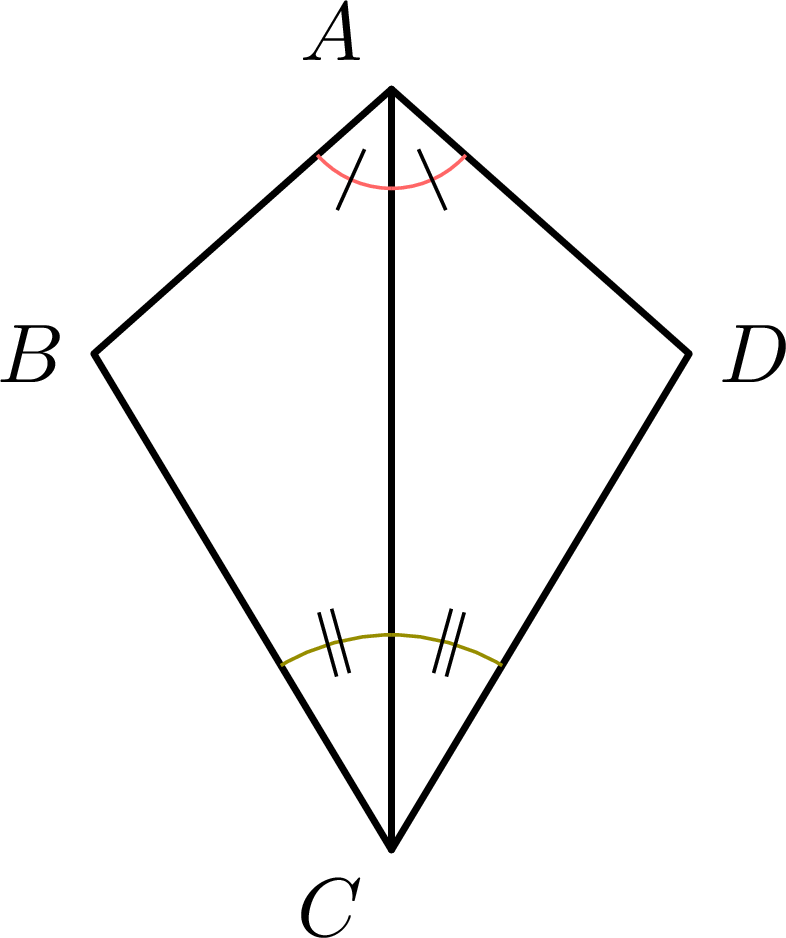
By definition of the kite, \(AB = AD\) and \(CB = CD\). 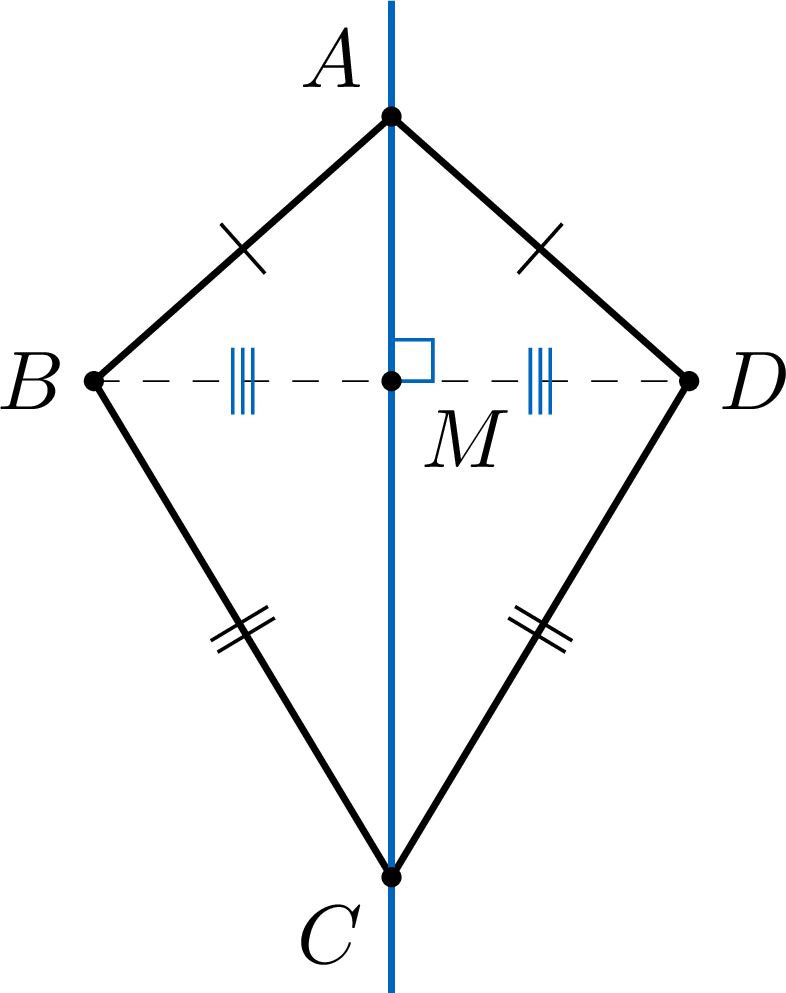
- The perpendicular bisector. The point \(A\) is at the same distance from \(B\) and from \(D\), so \(A\) lies on the perpendicular bisector of \(\Segment{BD}\) (property “Perpendicular bisector and equidistance”). For the same reason, \(C\) lies on it too. The points \(A\) and \(C\) are different, and only one line passes through both: the perpendicular bisector of \(\Segment{BD}\) is the line \(\Line{AC}\). So \(\Line{AC}\) is perpendicular to \(\Line{BD}\) and passes through the midpoint \(M\) of \(\Segment{BD}\).
- The line of symmetry. Since \(\Line{AC}\) is the perpendicular bisector of \(\Segment{BD}\), the reflection in \(\Line{AC}\) maps \(B\) onto \(D\) and \(D\) onto \(B\) (definition “Reflection of a Point”); it leaves \(A\) and \(C\) in place, since they lie on \(\Line{AC}\). It therefore maps the sides \(\Segment{AB}\), \(\Segment{BC}\), \(\Segment{CD}\), \(\Segment{DA}\) onto the sides \(\Segment{AD}\), \(\Segment{DC}\), \(\Segment{CB}\), \(\Segment{BA}\): the kite falls exactly onto itself, and \(\Line{AC}\) is a line of symmetry.
- The angles. A reflection keeps every angle (“Reflection is an isometry”). The reflection in \(\Line{AC}\) maps the angle \(\Angle{ABC}\) onto the angle \(\Angle{ADC}\), the angle \(\Angle{BAC}\) onto \(\Angle{DAC}\), and \(\Angle{BCA}\) onto \(\Angle{DCA}\): these angles are equal in pairs.
- Only one line of symmetry when the kite is not a rhombus. Then \(AB = AD = a\) and \(CB = CD = b\) with \(a \neq b\). A reflection that maps the kite onto itself maps each vertex onto a vertex and each side onto a side of the same length. The vertex \(A\) is the only vertex where two sides of length \(a\) meet, so the reflection leaves \(A\) in place; for the same reason, it leaves \(C\) in place. A reflection leaves in place only the points of its mirror line: that line passes through \(A\) and through \(C\), so it is the line \(\Line{AC}\).
Concave Kites
The definition of the kite also accepts a concave quadrilateral, shaped like an arrowhead (also called a dart): its reflex angle is at a vertex where two equal sides meet. The proof of the properties of a kite applies word for word: \(\Line{AC}\) is still the line of symmetry and the perpendicular bisector of \(\Segment{BD}\), and \(\Angle{ABC} = \Angle{ADC}\). But the diagonal \(\Segment{BD}\) now lies outside the kite, so the two diagonals do not cross each other: it is the lines \(\Line{AC}\) and \(\Line{BD}\) that are perpendicular, at the midpoint \(M\) of \(\Segment{BD}\). 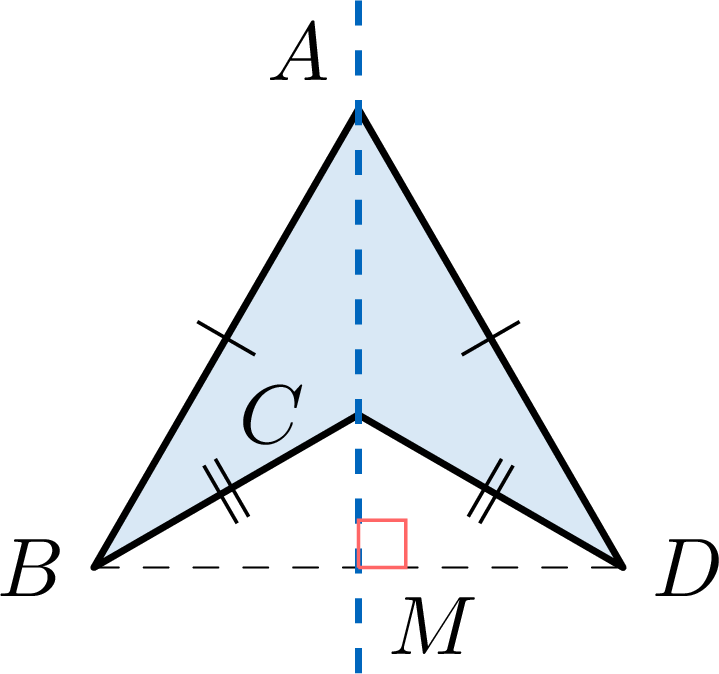
A Kite with a Pair of Parallel Sides
A kite \(ABCD\) (\(AB = AD\), \(CB = CD\)) that has a pair of parallel sides is a rhombus. Two adjacent sides meet at a vertex, so they cannot be parallel: the parallel sides are opposite, say \(\Line{AB} \parallel \Line{DC}\) (the case \(\Line{AD} \parallel \Line{BC}\) is the same, with \(B\) and \(D\) exchanged). 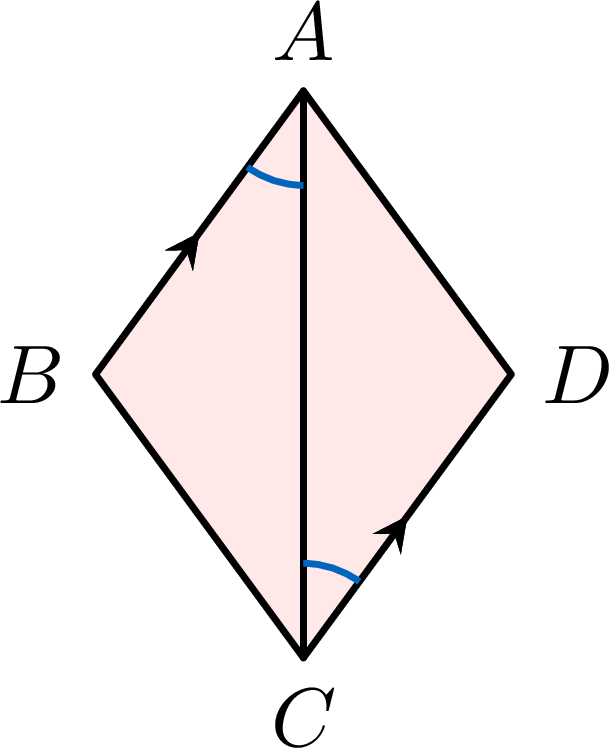
- With the transversal \(\Line{AC}\), the parallel lines \(\Line{AB}\) and \(\Line{DC}\) make equal alternate angles: \(\Angle{BAC} = \Angle{DCA}\) (“Alternate Angles are Equal”).
- The line of symmetry \(\Line{AC}\) bisects the angles at \(A\) and at \(C\): \(\Angle{DAC} = \Angle{BAC}\) and \(\Angle{BCA} = \Angle{DCA}\). Hence \(\Angle{DAC} = \Angle{BCA}\): the lines \(\Line{AD}\) and \(\Line{BC}\) also make equal alternate angles with \(\Line{AC}\), so they are parallel (“Parallel Lines from Equal Angles”).
- Both pairs of opposite sides are parallel: \(ABCD\) is a parallelogram, so its opposite sides are equal and \(AB = CD\). With \(AB = AD\) and \(CB = CD\), the four sides are equal: \(ABCD\) is a rhombus.
Example
\(ABCD\) is a kite with \(AB = AD\) and \(CB = CD\). Its angles at \(A\) and at \(C\) measure \(\Angle{BAD} = 70^\circ\) and \(\Angle{BCD} = 50^\circ\), and its diagonal \(\Segment{BD}\) measures \(6\) cm; the diagonals meet at \(M\). Find \(\Angle{ABC}\), \(\Angle{ADC}\), \(\Angle{BAC}\) and the length \(BM\). 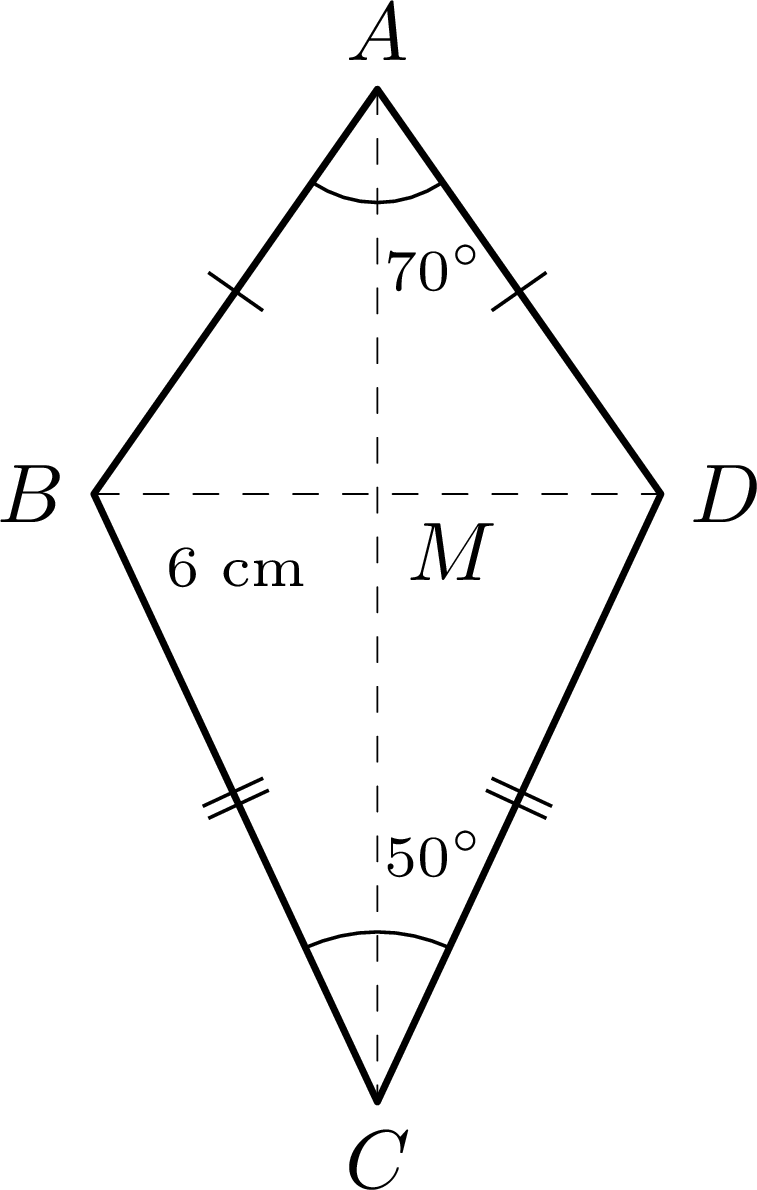
The angles \(\Angle{ABC}\) and \(\Angle{ADC}\), at the two vertices \(B\) and \(D\) off the line of symmetry \(\Line{AC}\), are equal (“Properties of a Kite”): write \(x^\circ\) for each. The four angles of the quadrilateral add up to \(360^\circ\): $$\begin{aligned}[t] 70^\circ + x^\circ + 50^\circ + x^\circ &= 360^\circ && \text{(sum of the angles of a quadrilateral)}\\
2x^\circ + 120^\circ &= 360^\circ && \text{(adding the known angles)}\\
2x^\circ &= 240^\circ && \text{(subtracting \(120^\circ\) from both sides)}\\
x^\circ &= 120^\circ. && \text{(dividing both sides by \(2\))} \end{aligned}$$ So \(\Angle{ABC} = \Angle{ADC} = 120^\circ\). The line of symmetry \(\Line{AC}\) bisects the angle at \(A\): \(\Angle{BAC} = 70^\circ \div 2 = 35^\circ\). It is also the perpendicular bisector of \(\Segment{BD}\), so \(M\) is the midpoint of \(\Segment{BD}\): \(BM = 6 \div 2 = 3\) cm. Check: \(70^\circ + 120^\circ + 50^\circ + 120^\circ = 360^\circ\).
Skills to practice
- Using the Properties of a Kite
- Justifying Properties of Kites and Rhombuses
II.5
Recognising a Parallelogram
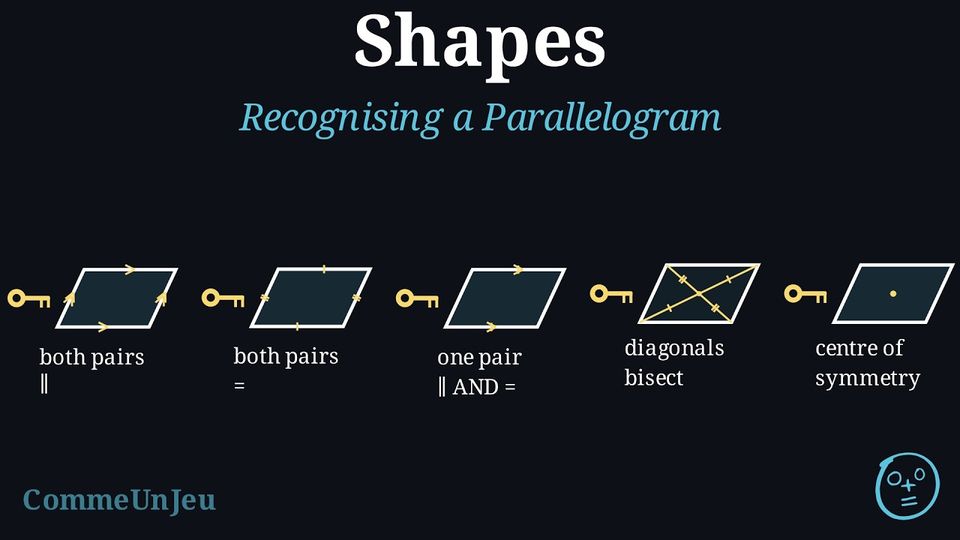
The properties so far start from a parallelogram and say what it must have. We often need the reverse: starting from a quadrilateral, decide whether it is a parallelogram. For this we use tests — conditions that are enough, on their own, to guarantee a parallelogram. Most of them are the converses of the properties above. All of them assume a non-crossed quadrilateral: in the bow tie of “Crossed and Non-Crossed Quadrilaterals”, \(AB = CD\) and \(BC = DA\) — the opposite sides are equal in pairs — and yet \(ABCD\) is not a parallelogram.
Proposition — Recognising a Parallelogram
A non-crossed quadrilateral is a parallelogram if any one of these conditions holds: - both pairs of its opposite sides are parallel (this is the definition);
- both pairs of its opposite sides are equal;
- two opposite sides are both parallel and equal;
- its diagonals cross at their common midpoint (they bisect each other).
Example
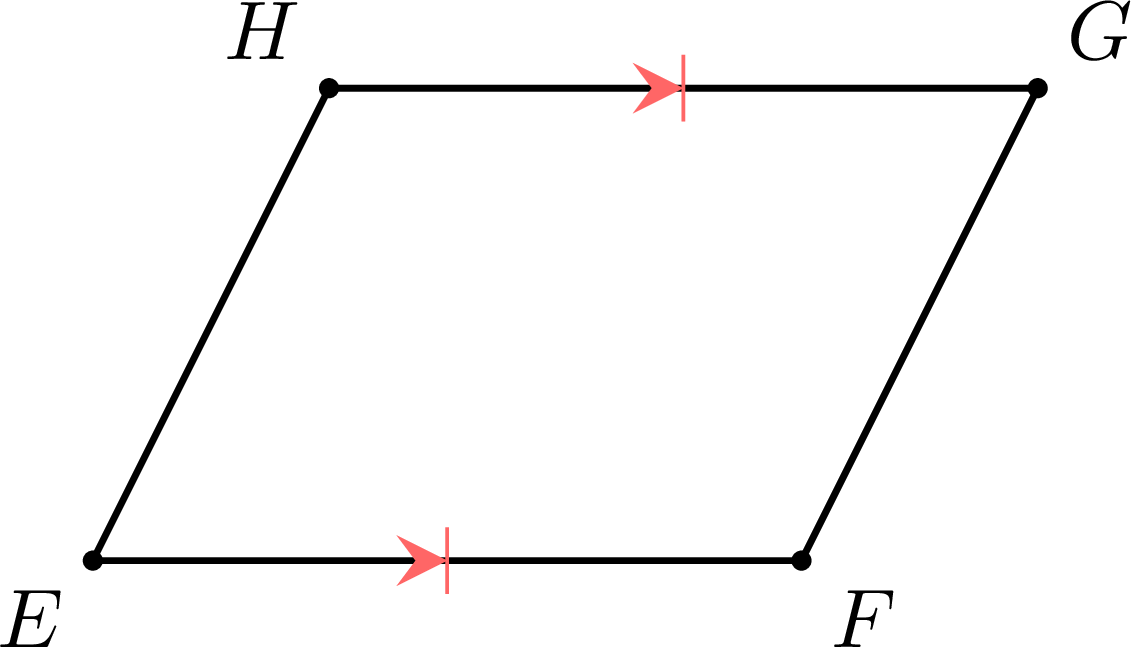
\(EFGH\) is a non-crossed quadrilateral in which the opposite sides \(\Segment{EF}\) and \(\Segment{HG}\) are parallel and have the same length, \(EF = HG = 4\) cm. Is \(EFGH\) a parallelogram?
Two opposite sides, \(\Segment{EF}\) and \(\Segment{HG}\), are both parallel and equal. By the test “two opposite sides parallel and equal” (for a non-crossed quadrilateral), \(EFGH\) is a parallelogram.
Proposition — Recognising Special Parallelograms
A parallelogram becomes a special quadrilateral as soon as one extra condition holds: - a parallelogram with one right angle is a rectangle;
- a parallelogram whose diagonals are equal is a rectangle;
- a parallelogram with two equal adjacent sides is a rhombus;
- a parallelogram whose diagonals are perpendicular is a rhombus;
- a parallelogram that is both a rectangle and a rhombus is a square.
Example
\(ABCD\) is a parallelogram with \(AB = 5\) cm and \(BC = 5\) cm. Which special quadrilateral is it?
\(ABCD\) is a parallelogram with two adjacent sides equal (\(AB = BC = 5\) cm). By the test for a rhombus, \(ABCD\) is a rhombus. 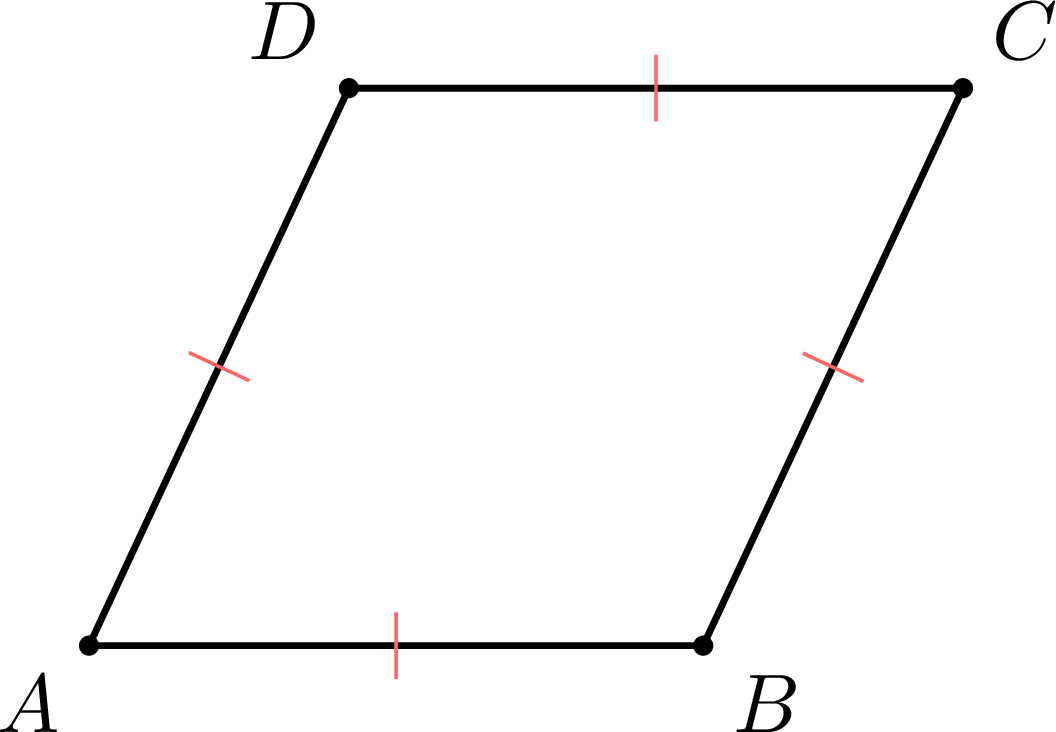
Skills to practice
- Deciding if a Quadrilateral Must Be a Parallelogram
- Proving a Quadrilateral Is a Parallelogram
- Recognising Special Parallelograms
III
Going further
Skills to practice
- Investigating Patterns in Triangles
- Solving Real-Life Problems with Quadrilaterals
- Quiz
Jump to section