International Baccalaureate · MYP 3
Square and Cube Roots
I
Finding Square Roots of Fractions and Decimals
Definition — Square root
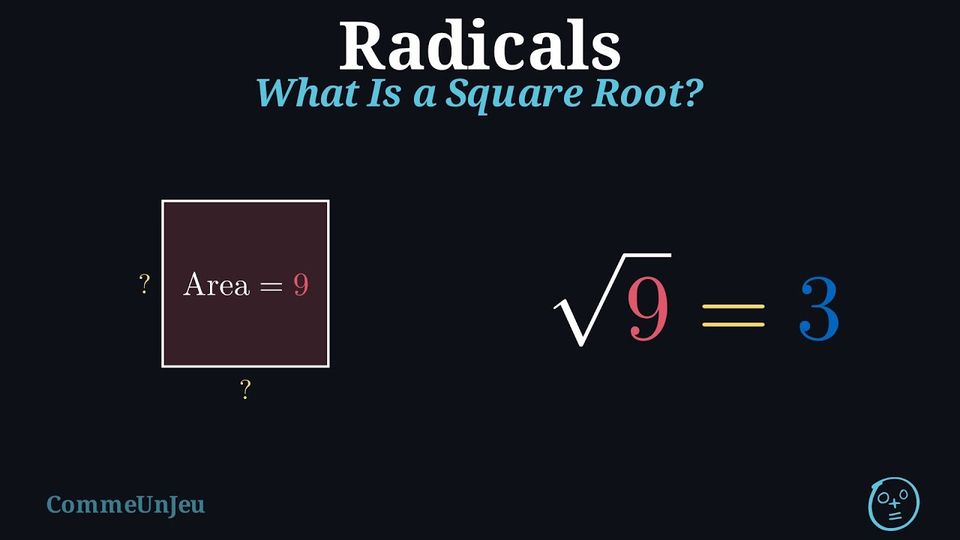
The square root of a non-negative number \(a\) (that is, \(a \ge 0\)), written as \(\sqrt{a}\), is the non-negative number that, when multiplied by itself, gives \(a\). $$ \left(\sqrt{a}\right)^2 = a $$
Note
- The square root symbol \(\sqrt{\quad}\) always asks for the non-negative root. For example, \(\sqrt{25} = 5\). It is a common mistake to think that \(\sqrt{25}\) is \(\pm 5\) (read: plus or minus \(5\)).
While it is true that both \(5^2 = 25\) and \((-5)^2 = 25\), the symbol \(\sqrt{25}\) refers only to the positive value, which is \(5\). - Why does a negative number have no square root?
Consider \(\sqrt{-9}\). To find this value, we need a number that, when multiplied by itself, gives \(-9\).- A positive number squared is positive (\(3 \times 3 = 9\)).
- A negative number squared is also positive (\((-3) \times (-3) = 9\)).
Definition — Perfect Squares
A perfect square is an integer that is the square of an integer. The square root of a perfect square is an integer. Example
The perfect squares of the whole numbers from \(0\) to \(12\) are: $$ 0, 1, 4, 9, 16, 25, 36, 49, 64, 81, 100, 121, 144. $$ Their square roots are the whole numbers themselves: $$ \sqrt{0} = 0, \quad \sqrt{1} = 1, \quad \sqrt{4} = 2, \quad \sqrt{9} = 3, \quad \sqrt{16} = 4, \quad \dots $$ $$ \sqrt{81} = 9, \quad \sqrt{100} = 10, \quad \sqrt{121} = 11, \quad \sqrt{144} = 12. $$ Example
The definition also applies to fractions: $$\sqrt{\dfrac{1}{4}} = \dfrac{1}{2} \quad \text{because} \quad \dfrac{1}{2} \times \dfrac{1}{2} = \dfrac{1}{4}, \qquad \sqrt{\dfrac{9}{16}} = \dfrac{3}{4} \quad \text{because} \quad \dfrac{3}{4} \times \dfrac{3}{4} = \dfrac{9}{16}.$$ Example
The definition also applies to decimal numbers: $$\sqrt{0.04} = 0.2 \quad \text{because} \quad 0.2 \times 0.2 = 0.04,$$ $$\sqrt{1.44} = 1.2 \quad \text{because} \quad 1.2 \times 1.2 = 1.44.$$ A decimal number can also be read as a fraction: \(0.04 = \dfrac{4}{100}\), and \(\dfrac{2}{10} \times \dfrac{2}{10} = \dfrac{4}{100}\), so \(\sqrt{0.04} = \dfrac{2}{10} = 0.2\). Careful: for a number between \(0\) and \(1\), the square root is larger than the number — \(\sqrt{0.04} = 0.2\) and \(0.2 > 0.04\) — whereas for a number larger than \(1\) it is smaller: \(\sqrt{1.44} = 1.2\) and \(1.2 < 1.44\). Skills to practice
- Calculating Square Roots of Fractions and Decimals
II
Estimating and Calculating Square Roots
While the square roots of perfect squares are easy to find, most numbers are not perfect squares. We can estimate their square roots or use a calculator for a more precise value.
Method — Placing a Square Root Between Two Integers
When a non-negative number is not a perfect square, its square root is not an integer, but it can be located between two consecutive integers. Since a larger area gives a longer side, the square root keeps non-negative numbers in the same order. - Place the number between the two consecutive perfect squares that surround it.
- Take the square roots: the square root lies between two consecutive integers.
Example
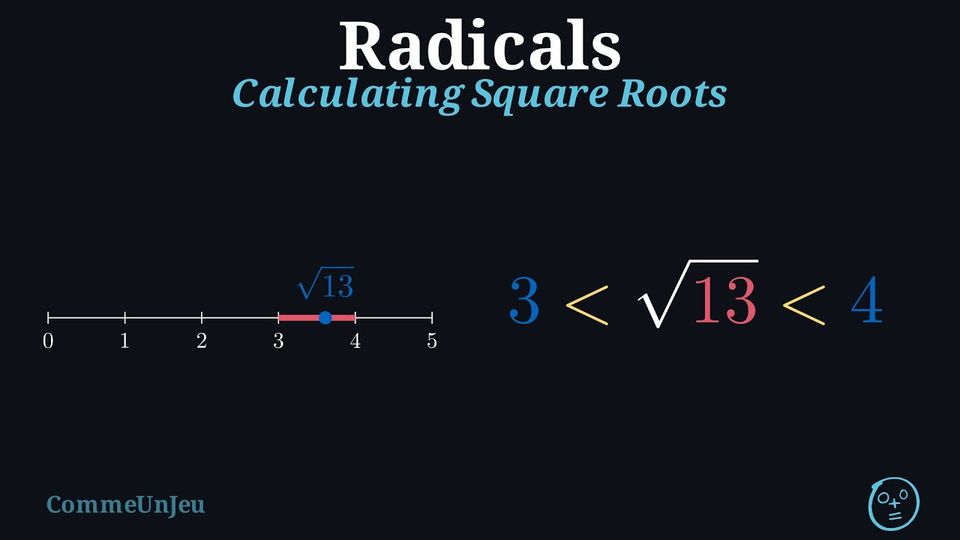
Place \(\sqrt{13}\) between two consecutive integers.
\(13\) is not a perfect square. $$\begin{aligned}[t] 9 &< 13 < 16 && \text{(\(9 = 3^2\) and \(16 = 4^2\) are consecutive perfect squares)}\\
\sqrt{9} &< \sqrt{13} < \sqrt{16} && \text{(the square root keeps the order)}\\
3 &< \sqrt{13} < 4. \end{aligned}$$ 
Method — Using a Calculator
On most calculators, one finds a square root using the \(\boxed{\sqrt{\;}}\) button. Example
Use a calculator to find \(\sqrt{7}\), rounded to \(2\) decimal places.
Entering \(\sqrt{7}\) into a calculator gives approximately \(2.645751\ldots\)
Rounded to \(2\) decimal places, \(\sqrt{7} \approx 2.65\).
Rounded to \(2\) decimal places, \(\sqrt{7} \approx 2.65\).
A square of area \(2\) certainly has a side: the square can be drawn. But what is its length? Placing it between numbers with one, then two decimal places gives $$1.4^2 = 1.96 < 2 < 2.25 = 1.5^2,$$ $$\text{then} \qquad 1.41^2 = 1.9881 < 2 < 2.0164 = 1.42^2,$$ so the side lies between \(1.41\) and \(1.42\). One more decimal place, and it lies between \(1.414\) and \(1.415\) (\(1.414^2 = 1.999396\) and \(1.415^2 = 2.002225\)). This can be continued for ever without ever landing on \(2\): no decimal number has \(2\) for its square — a fact that can be proved, not just observed. A number that is not the quotient of two integers either is called an irrational number, and \(\sqrt{2}\) is one of them. Careful: a decimal expansion that never ends is not enough to be irrational — \(\dfrac{1}{3} = 0.333\ldots\) never ends and is a fraction all the same. So the side of a square of area \(2\) is a length one can draw but cannot write exactly with decimals: only \(\sqrt{2}\) names it exactly.
Skills to practice
- Placing a Square Root Between Two Integers
- Using a Calculator
- Finding the Side Length of a Square
III
Solving \(x^2 \equal a\)
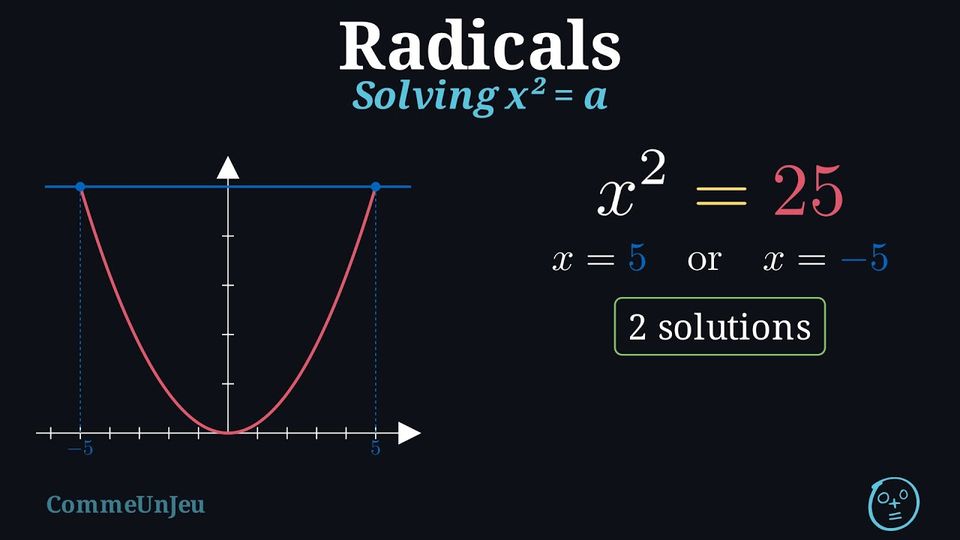
Find all the numbers whose square is \(25\).
Squaring \(5\) gives \(5^2 = 25\). But squaring \(-5\) also gives \((-5)^2 = 25\). So there are two numbers whose square is \(25\): the numbers \(5\) and \(-5\).
The symbol \(\sqrt{25}\) denotes only the positive one: \(\sqrt{25} = 5\). The equation \(x^2 = 25\) asks a wider question, and its solutions are \(5\) and \(-5\).
Proposition — Solutions of \(x^2 \equal a\)
Let \(a\) be a number. The solutions of the equation \(x^2 = a\) depend on the sign of \(a\): - if \(a > 0\), the equation has two solutions: \(x = \sqrt{a}\) and \(x = -\sqrt{a}\);
- if \(a = 0\), the equation has exactly one solution: \(x = 0\);
- if \(a < 0\), the equation has no solution: the square of a number is never negative.
Example
Solve each equation: - \(x^2 = 49\)
- \(x^2 = 7\)
- \(x^2 = -9\)
- \(49 > 0\): two solutions, \(x = \sqrt{49} = 7\) and \(x = -\sqrt{49} = -7\).
- \(7 > 0\): two solutions, \(x = \sqrt{7}\) and \(x = -\sqrt{7}\). These are the exact values; a calculator gives \(\sqrt{7} \approx 2.65\).
- \(-9 < 0\): no solution, because the square of a number is never negative.
The parabola \(y \equal x^2\)
All the points \((x, y)\) whose coordinates satisfy \(y = x^2\) form a curve called the parabola \(y = x^2\). It passes through \((0, 0)\), \((1, 1)\), \((2, 4)\), \((3, 9)\), and it is symmetric about the \(y\)-axis, because \((-x)^2 = x^2\).
Method — Solving \(x^2 \equal a\) Graphically
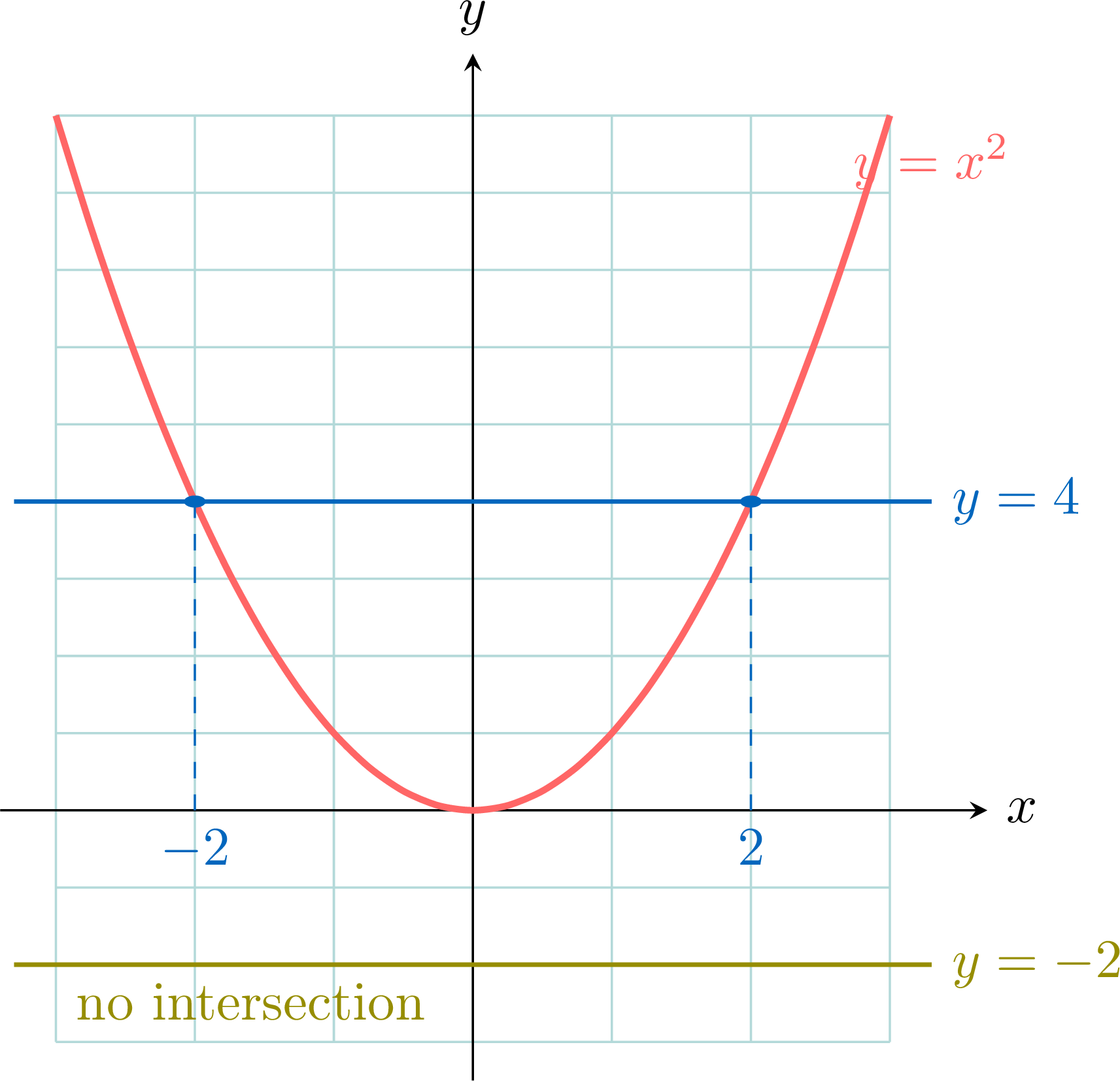
To solve the equation \(x^2 = a\) graphically: - On the given parabola \(y = x^2\), draw the horizontal line \(y = a\).
- Read the \(x\)-coordinates of their intersection points. When they seem to fall on grid lines, check them by calculation: they are then the solutions; otherwise the reading only gives an approximate value — the exact solutions are then \(-\sqrt{a}\) and \(\sqrt{a}\).
Example
Solve the equation \(x^2 = 4\) graphically, then check the solutions by calculation.
On the figure of the Method, the line \(y = 4\) cuts the parabola \(y = x^2\) at two points, whose \(x\)-coordinates are \(-2\) and \(2\).
Check: $$\begin{aligned}[t] 2^2 &= 4 && \text{(\(2\) is a solution)}\\ (-2)^2 &= 4 && \text{(\(-2\) is a solution)} \end{aligned}$$ The solutions of \(x^2 = 4\) are \(-2\) and \(2\).
Check: $$\begin{aligned}[t] 2^2 &= 4 && \text{(\(2\) is a solution)}\\ (-2)^2 &= 4 && \text{(\(-2\) is a solution)} \end{aligned}$$ The solutions of \(x^2 = 4\) are \(-2\) and \(2\).
Example
Solve the equation \(x^2 = 5\) graphically, with the parabola \(y = x^2\) and the line \(y = 5\), then give the exact solutions.
The line \(y = 5\) cuts the parabola at two points: 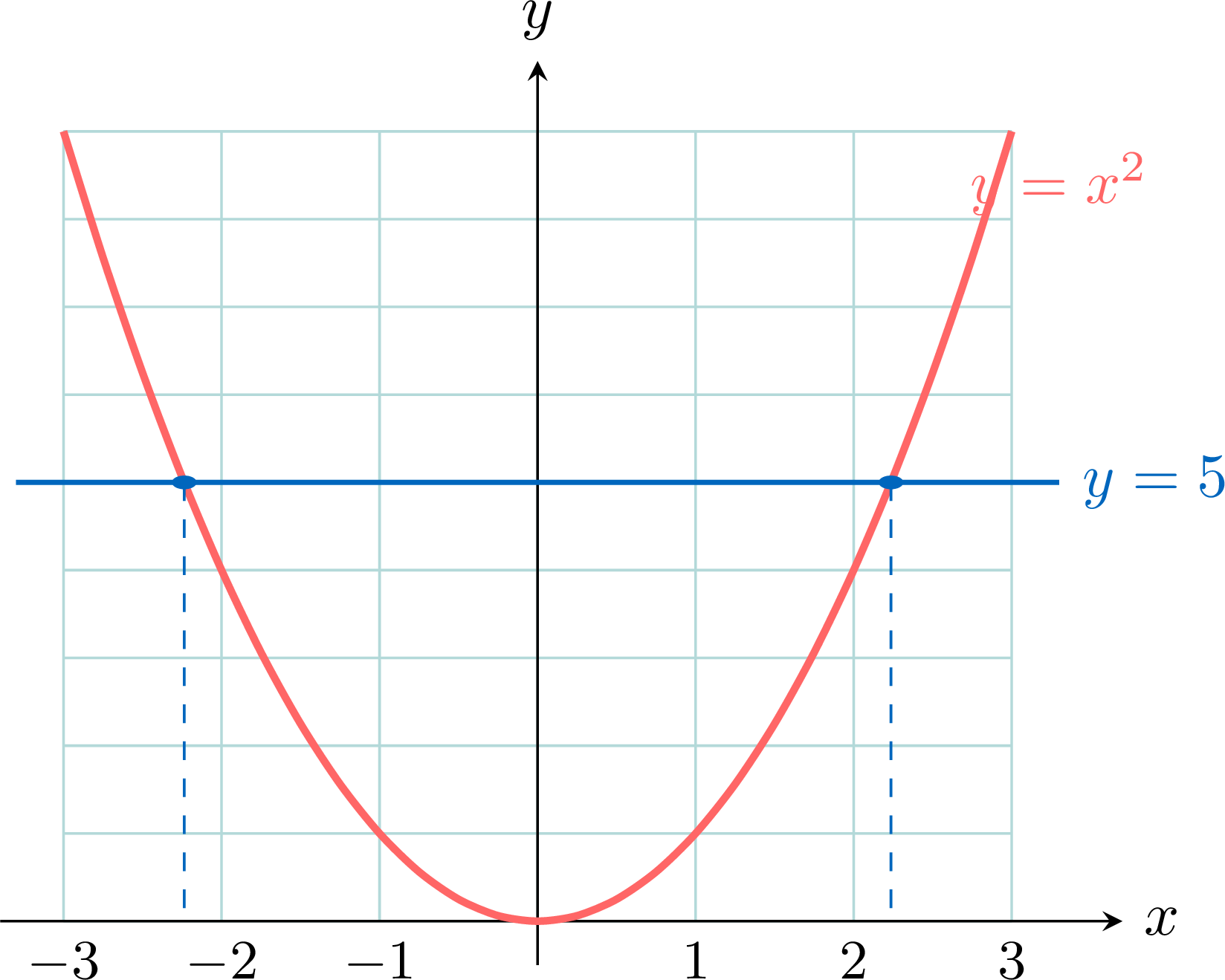
Their \(x\)-coordinates do not fall on grid lines: the figure only places them between two integers, \(-3 < x < -2\) for one of them and \(2 < x < 3\) for the other, a little above \(2\). The reading therefore gives only an approximate value. The exact solutions are $$x = -\sqrt{5} \quad \text{and} \quad x = \sqrt{5},$$ and a calculator gives \(\sqrt{5} \approx 2.24\), which agrees with the integer bounds read off the graph. A graph locates the solutions; only the calculation gives them exactly.
Solving an equation gives all the numbers that satisfy it. In a concrete problem, the situation then selects the solutions that make sense: a length or a duration must be positive.
Skills to practice
- Solving \(x^2 \equal a\) by Calculation
- Solving \(x^2 \equal a\) Graphically
IV
Solving \(x^3 \equal a\)
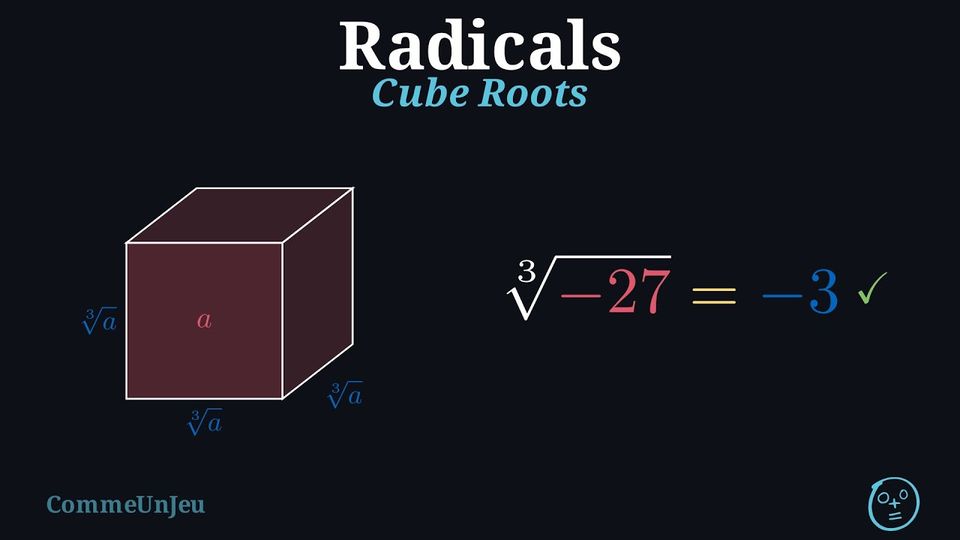
Just as the square root of a number is the side length of a square with a given area, the cube root \(\sqrt[3]{a}\) of a non-negative number \(a\) is the side length of a cube with volume \(a\). 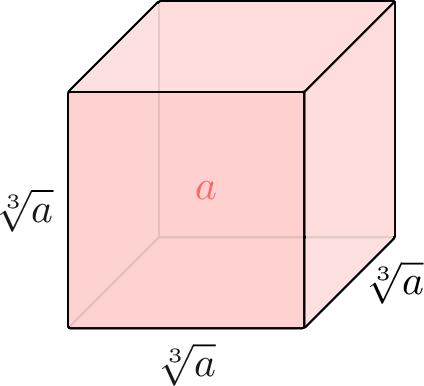
It is the inverse operation of cubing a number (raising it to the power of 3).
Definition — Cube Root
The cube root of a number \(a\), written \(\sqrt[3]{a}\), is the number which, when cubed, gives \(a\): $$\left(\sqrt[3]{a}\right)^3 = a$$
Note
Unlike square roots, cube roots are defined for all real numbers, including negatives. For example, \(\sqrt[3]{-27} = -3\) because \((-3) \times (-3) \times (-3) = -27\).
Proposition — Solutions of \(x^3 \equal a\)
For every number \(a\), the equation \(x^3 = a\) has exactly one solution: $$x = \sqrt[3]{a}.$$ Unlike the equation \(x^2 = a\), it never has a second, opposite solution, and it has a solution when \(a\) is negative: the solution of \(x^3 = -8\) is \(x = -2\).
The definition of the cube root gives the existence of the number \(\sqrt[3]{a}\) (accepted without proof), with \(\left(\sqrt[3]{a}\right)^3 = a\): it is a solution. It is the only one, by two facts.
- A number and its cube have the same sign: the cube of a negative number is a product of three negative factors, so it is negative; the cube of \(0\) is \(0\).
- Between two positive numbers, the larger one has the larger cube: if \(0 < x < y\), each of the three factors of \(y \times y \times y\) is larger than the matching factor of \(x \times x \times x\), so \(x^3 < y^3\).
Example
Solve each equation. Give the solution of the second one to \(2\) decimal places. - \(x^3 = -27\)
- \(x^3 = 50\)
- The only solution is \(x = \sqrt[3]{-27} = -3\), since \((-3) \times (-3) \times (-3) = -27\). There is no positive solution: the cube of a positive number is positive.
- The only solution is \(x = \sqrt[3]{50}\). The number \(50\) is not a perfect cube (\(3^3 = 27 < 50 < 64 = 4^3\)), so \(\sqrt[3]{50}\) lies between \(3\) and \(4\); the cube root key of the calculator gives \(\sqrt[3]{50} = 3.684\ldots\), so $$x \approx 3.68.$$ Check: \(3.68^3 \approx 49.84\), close to \(50\). By comparison, \(x^2 = 50\) has two solutions, \(\sqrt{50} \approx 7.07\) and \(-\sqrt{50} \approx -7.07\).
Skills to practice
- Solving \(x^3 \equal a\)
- Solving \(x^3 \equal a\) with a Calculator
V
Going further
Skills to practice
- Placing a Square Root Between Two Numbers with One Decimal Place
- Showing That \(\sqrt{2}\) Is Not a Decimal Number
- Solving Problems with Square and Cube Roots
- Quiz
Jump to section