International Baccalaureate · MYP 3
Linear Equations
I
Solving Linear Equations
I.1
The Principle of Balance
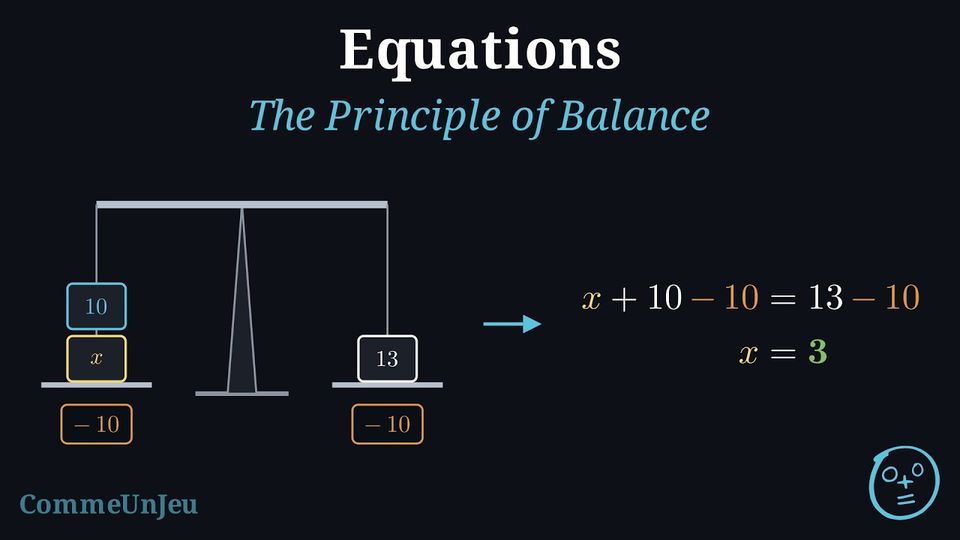
An equation is a statement that two expressions are equal. We can visualise this statement as a balanced scale, where the expression on the left side has the same value (weight) as the expression on the right.
The equation \(x + 10 = 13\) can be represented as: 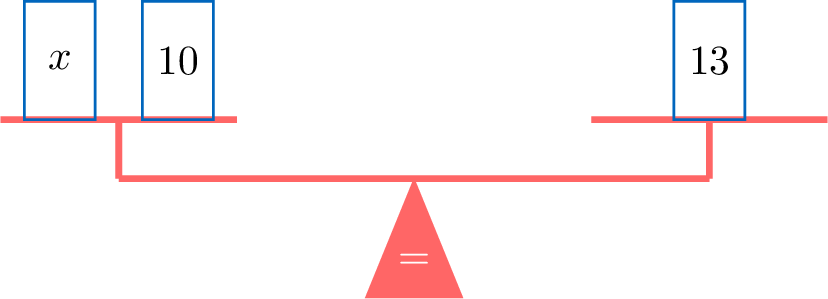
The scale is balanced. Our goal is to find the value of the unknown weight, \(x\), while keeping the scale balanced at all times.
What operation could we perform on both sides of the equation to isolate \(x\)?
The equation \(x + 10 = 13\) can be represented as:
What operation could we perform on both sides of the equation to isolate \(x\)?
To keep the scale balanced, any operation we perform must be done on both sides equally. To isolate \(x\), we see the weight \(13\) as \(3 + 10\); we need to remove the weight of 10 from the left pan. To maintain balance, we must also remove a weight of 10 from the right pan. 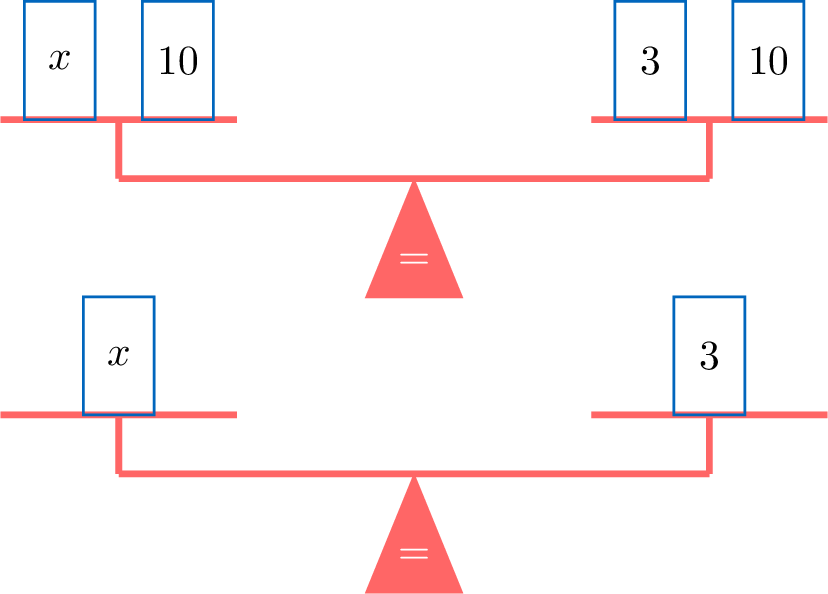
Algebraically, we subtract 10 from both sides: $$ \begin{aligned} x+10 &= 13 \\
x+10 - 10 &= 13 - 10 \\
x &= 3 \end{aligned} $$ This process shows that \(x+10=13\) is equivalent to \(x=3\). A solution to an equation is a value of the unknown that maintains the balance (makes the equation true). Here, the solution is \(x=3\).
Definition — Equivalent Equations
Two equations are equivalent if they have exactly the same solution(s). To solve an equation, we transform it into a series of simpler, equivalent equations until the solution is evident. Proposition — Golden Rules of Solving Equations
To create an equivalent equation, apply the same operation to both sides, using the golden rules below: - Addition/Subtraction Property: Adding or subtracting the same number from both sides produces an equivalent equation. $$A=B \quad \Longleftrightarrow \quad A+c = B+c$$ (and similarly \(A-c = B-c\))
- Multiplication/Division Property: Multiplying or dividing both sides by the same non-zero number produces an equivalent equation. $$A=B \quad \Longleftrightarrow \quad cA = cB \quad (c \neq 0)$$ $$A=B \quad \Longleftrightarrow \quad \frac{A}{c} = \frac{B}{c} \quad (c \neq 0)$$
Skills to practice
- The Principle of Balance
I.2
Undoing Up to Three Operations
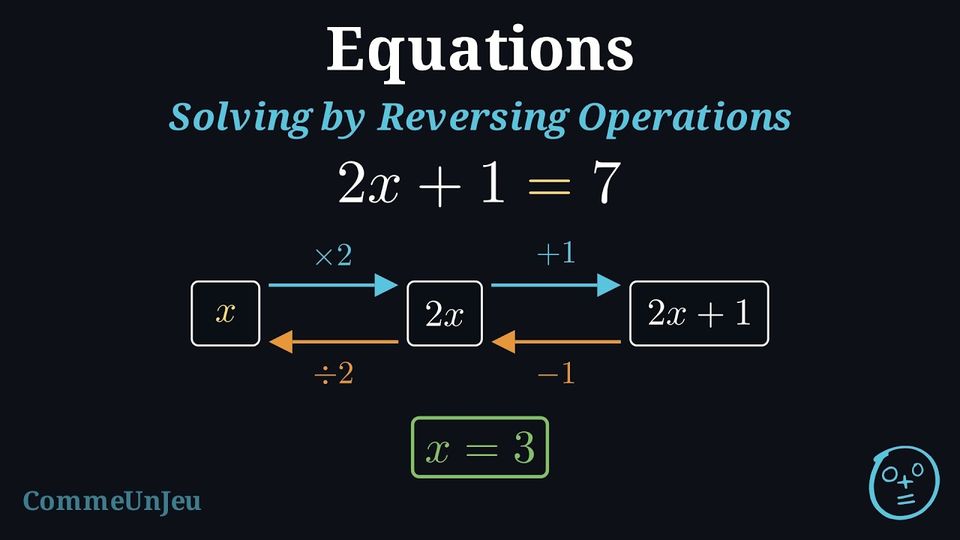
An algebraic expression like \(2x+1\) can be seen as a sequence of operations applied to the unknown \(x\). To solve an equation involving this expression, our goal is to reverse this sequence to get back to \(x\).
Definition — Inverse Operations
An inverse operation is an operation that “undoes” another operation. Let \(a\) be a number: - Addition and subtraction are inverse operations. \(\boxed{x}\xrightarrow{+a}\boxed{x+a}\xrightarrow{-a}\boxed{x}\)
- Multiplication and division are inverse operations. \(\boxed{x}\xrightarrow{\times a}\boxed{ax}\xrightarrow{\div a}\boxed{x} \quad \text{with }a\neq 0\)
Method — Solving by Reversing
In many linear equations, we can isolate the unknown by applying inverse operations in the reverse order. - Identify the sequence of operations used to build the expression containing the unknown.
- Reverse this sequence using the corresponding inverse operations, applying each step to both sides of the equation.
Example
Solve for \(x\): $$2x+1=7$$ - Sequence of operations on \(x\): First, \(x\) is multiplied by 2, then 1 is added. $$ \boxed{x}\xrightarrow{\times 2}\boxed{2x}\xrightarrow{+1}\boxed{2x+1} $$
- Reverse sequence with inverse operations: To isolate \(x\), we must first subtract 1, then divide by 2. $$ \boxed{2x+1}\xrightarrow{-1}\boxed{2x}\xrightarrow{\div 2}\boxed{x} $$
- Applying the steps: $$ \begin{aligned} 2x + 1 &= 7 \\ 2x + 1 - 1 &= 7 - 1 &&\text{(Subtract 1 from both sides)} \\ 2x &= 6 \\ \frac{2x}{2} &= \frac{6}{2} &&\text{(Divide both sides by 2)} \\ x &= 3 \end{aligned} $$ The solution is \(x = 3\).
Example
Solve each equation. The coefficient of the unknown is negative. - \(5 - 2x = 11\)
- \(\dfrac{7 - 3x}{2} = 5\)
- Since \(5 - 2x = -2x + 5\), the unknown is first multiplied by \(-2\), then \(5\) is added: $$\boxed{x}\xrightarrow{\times (-2)}\boxed{-2x}\xrightarrow{+5}\boxed{5-2x}$$ Undo these operations in reverse order: subtract \(5\), then divide by \(-2\) — the minus sign belongs to the coefficient, so the division is by \(-2\), not by \(2\). $$\begin{aligned}[t] 5 - 2x &= 11\\ 5 - 2x - 5 &= 11 - 5 &&\text{(subtract 5 from both sides)}\\ -2x &= 6\\ \frac{-2x}{-2} &= \frac{6}{-2} &&\text{(divide both sides by } -2\text{)}\\ x &= -3 \end{aligned}$$ Check: \(5 - 2 \times (-3) = 5 + 6 = 11\) \(\checkmark\)
- Three operations are applied to the unknown: multiply by \(-3\), add \(7\), divide by \(2\). $$\boxed{x}\xrightarrow{\times (-3)}\boxed{-3x}\xrightarrow{+7}\boxed{7-3x}\xrightarrow{\div 2}\boxed{\dfrac{7-3x}{2}}$$ Undo them in reverse order: multiply by \(2\), subtract \(7\), divide by \(-3\). $$\begin{aligned}[t] \frac{7 - 3x}{2} &= 5\\ 7 - 3x &= 10 &&\text{(multiply both sides by 2)}\\ -3x &= 3 &&\text{(subtract 7 from both sides)}\\ x &= \frac{3}{-3} &&\text{(divide both sides by } -3\text{)}\\ x &= -1 \end{aligned}$$ Check: \(\dfrac{7 - 3 \times (-1)}{2} = \dfrac{7 + 3}{2} = 5\) \(\checkmark\)
Skills to practice
- Building an Expression
- Undoing an Expression
- Solving Linear Equations: Level 1
- Solving Linear Equations: Level 2
- Solving with a Negative Coefficient
I.3
The Unknown on Both Sides
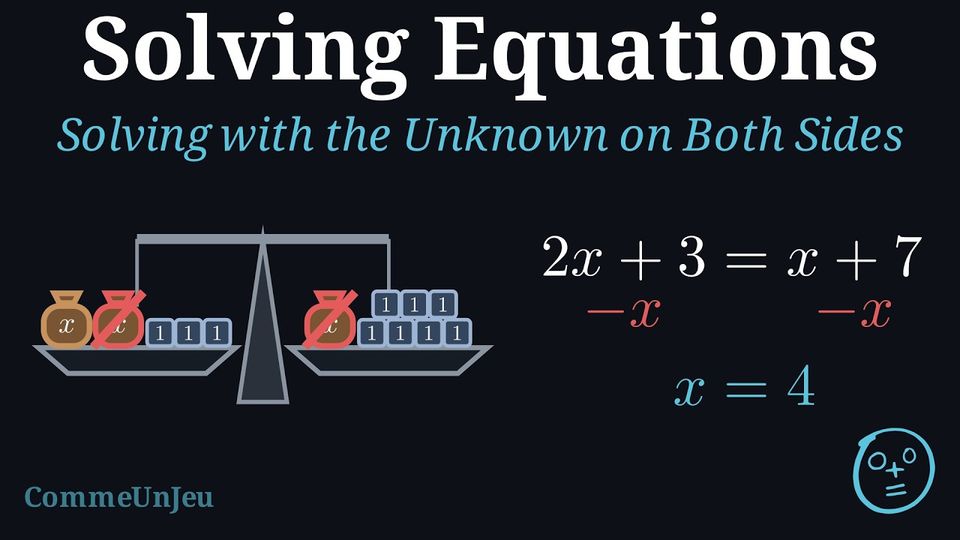
Trial and error gives the solution of \(2x + 3 = x + 7\). Can it now be found by calculation, as for \(2x + 1 = 7\)? The new difficulty: there is an \(x\) on both sides. What could be done to the two sides to make the right-hand \(x\) disappear?
Method — Bringing the Unknown to One Side
When the unknown appears on both sides of an equation (with two different \(x\)-coefficients): - Subtract the \(x\)-term with the smaller coefficient from both sides — an \(x\)-term is itself an (unknown) number, so the golden rules apply; the balance is kept, one side no longer contains \(x\), and the remaining coefficient is positive. (With a negative \(x\)-term, add its opposite instead.)
- The equation now has only one \(x\)-term: solve it by reversing the operations (if the \(x\) ends up on the right, the two sides may be swapped).
- Check: substitute the value into both sides of the original equation — they must give the same number.
Example
Solve for \(x\): \(5x + 2 = 3x + 10\).
$$\begin{aligned} 5x + 2 &= 3x + 10 \\
5x + 2 \textcolor{colordef}{- 3x} &= 3x + 10 \textcolor{colordef}{- 3x} \quad (\textcolor{colordef}{- 3x}) \\
2x + 2 &= 10 \\
2x + 2 \textcolor{colordef}{- 2} &= 10 \textcolor{colordef}{- 2} \quad (\textcolor{colordef}{- 2}) \\
2x &= 8 \\
\frac{2x}{2} &= \frac{8}{2} \quad (\div 2) \\
x &= \textcolor{colorprop}{4} \end{aligned}$$ Check: \(5 \times 4 + 2 = 22\) and \(3 \times 4 + 10 = 22\) — both sides agree. The opening equation is solved the same way: \(2x+3=x+7 \;\to\; x+3=7 \;\to\; x=4\) (check: \(11 = 11\)). 
Skills to practice
- Solving with the Unknown on Both Sides: Level 1
- Solving with the Unknown on Both Sides: Level 2
I.4
Solving Problems with Equations
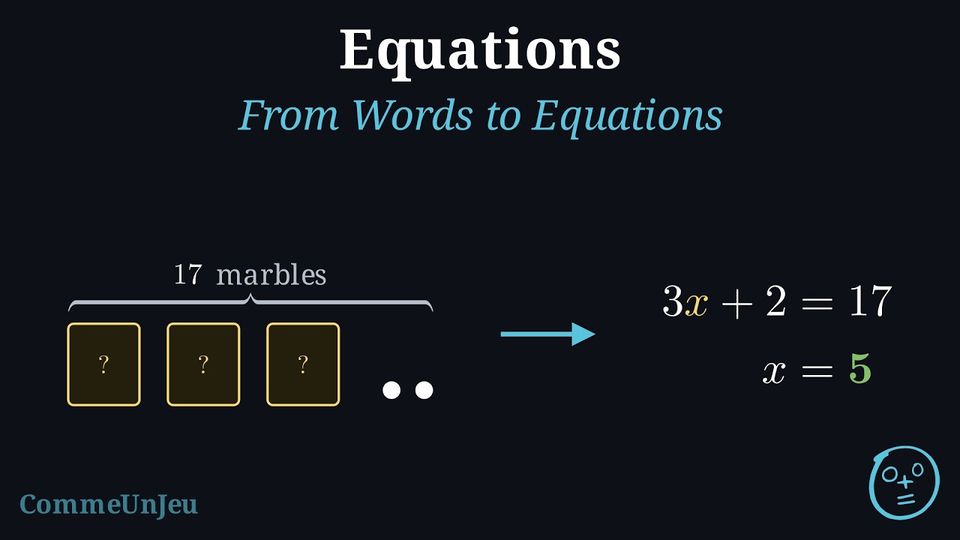
Definition — Setting up an Equation
Setting up an equation means: choose a letter for the unknown number and state what it stands for, with its unit if it has one; then write, with that letter, the equality stated by the sentence. Method — Translating a Sentence into an Equation
To solve a word problem with an equation: - Name the unknown: choose a letter and say what it stands for, with its unit.
- Translate piece by piece, in the order the sentence acts on the number.
- Write the equality stated by the sentence.
- Solve the equation: collect like terms; if the unknown is on both sides, bring it to one side; then undo the operations in reverse order.
- Answer in a sentence, with the unit, and check in the original sentence.
Skills to practice
- Translating with the Unknown on Both Sides
II
Inequalities
II.1
An Everyday Inequality
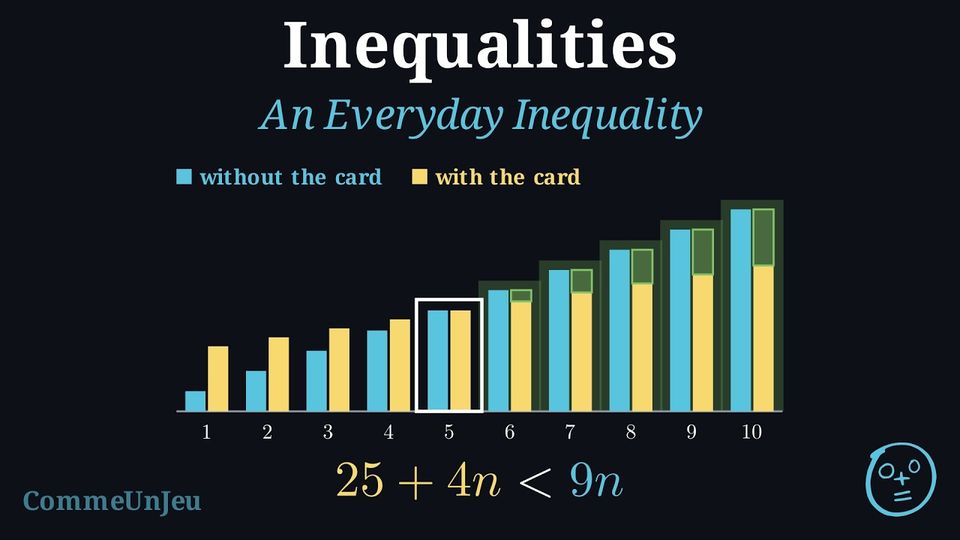
At the cinema, a ticket costs \(\dollar 9\). A loyalty card costs \(\dollar 25\), and with it each ticket only costs \(\dollar 4\).
- How much do \(4\) films cost without the card? With the card (card included)?
- And \(10\) films?
- From how many films onwards is the card the cheaper option?
- Without the card: \(4 \times 9 = 36\), so \(\dollar 36\). With the card: \(25 + 4 \times 4 = 41\), so \(\dollar 41\). For \(4\) films, the card is not worth it.
- Without: \(10 \times 9 = 90\), so \(\dollar 90\). With: \(25 + 4 \times 10 = 65\), so \(\dollar 65\). For \(10\) films, the card wins.
- For \(n\) films, the card is cheaper when $$25 + 4n < 9n.$$ We test values: for \(n = 5\): \(25 + 20 = 45\) and \(45\) — a tie. For \(n = 6\): \(49 < 54\) — the card wins. And it keeps winning: each extra film costs \(\dollar 4\) with the card against \(\dollar 9\) without, so the gap grows by \(\dollar 5\) per film. And before the tie, the card loses — as for \(4\) films in question 1. The answer is not one number but all the whole numbers from \(6\) on. Such a statement, \(25 + 4n < 9n\), is called an inequality — they can be solved by calculation, without testing every value.
Definition — Solution of an Inequality
A solution of an inequality is a number that makes it true when it replaces the letter. To test a number: replace, compute both sides, compare. Example
Is \(3\) a solution of the inequality \(2x - 1 \geq 5\)? And \(1\)?
For \(x = 3\): \(2 \times 3 - 1 = 5\), and \(5 \geq 5\) is true — with a non-strict sign, equality is enough: \(3\) is a solution.
For \(x = 1\): \(2 \times 1 - 1 = 1\), and \(1 \geq 5\) is false: \(1\) is not a solution.
For \(x = 1\): \(2 \times 1 - 1 = 1\), and \(1 \geq 5\) is false: \(1\) is not a solution.
Skills to practice
- Testing a Value
- Testing Values and Justifying
II.2
Representing the Solutions on a Number Line
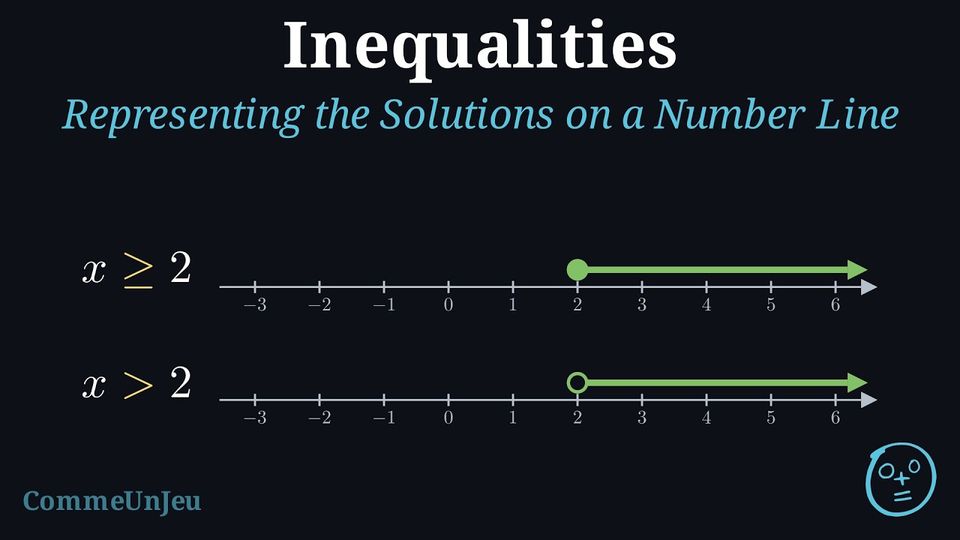
Such inequalities do not have one solution but infinitely many: all the numbers on one side of a boundary (for the cinema, only the whole numbers among them make sense). After counting film shows one by one, we now picture all these numbers at once on a number line.
Method — Representing the Solutions
On a number line: - Mark the boundary with a full circle \(\bullet\) if it is a solution (signs \(\leq\) or \(\geq\)), with a hollow circle \(\circ\) if it is not (signs \(<\) or \(>\)).
- Colour the ray of the solutions, with an arrow showing that it goes on forever.
Example
Represent the solutions of \(x \geq 2\) on a number line.
The solutions are \(2\) and all the numbers greater than \(2\). The boundary \(2\) is a solution (sign \(\geq\)): full circle. 
Example
Represent the solutions of \(x < -1\) on a number line.
The solutions are all the numbers less than \(-1\). The boundary \(-1\) is not a solution (sign \(<\)): hollow circle. 
Skills to practice
- Reading a Representation
- Representing Solutions
III
Going further
Skills to practice
- Reasoning and Problem-Solving
- Solving Problems in Context
- Quiz
Jump to section