International Baccalaureate · MYP 2
Perimeter and Area
I
Finding the Area of a Parallelogram
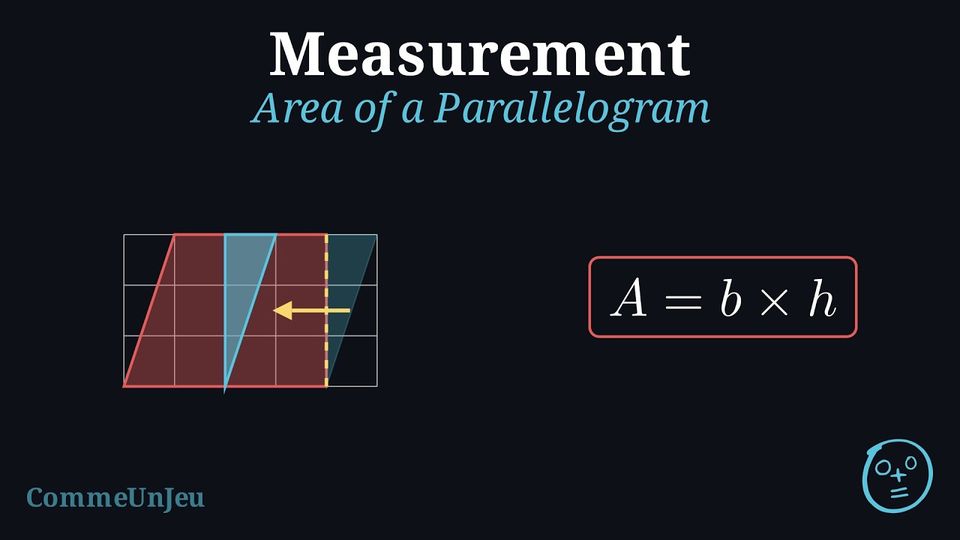
We can discover the formula for the area of a parallelogram by rearranging it into a rectangle. 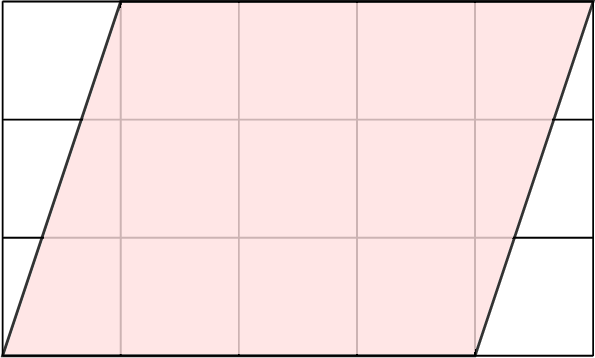
- Draw the height, which is a line from the top side to the bottom side that is perpendicular to the base:
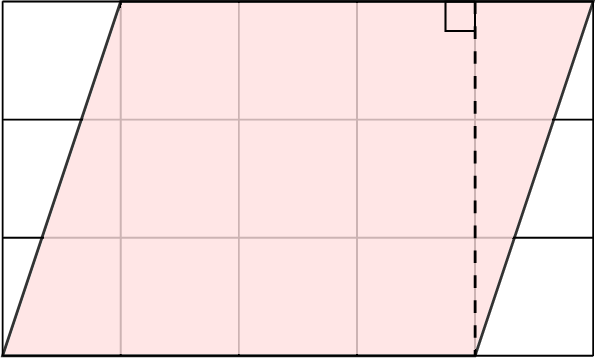
- Cut the triangle on the right side:
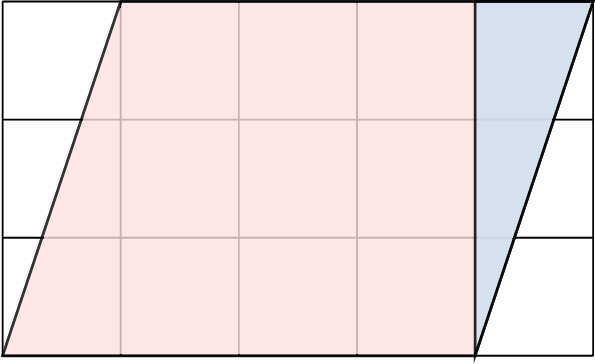
- Move the triangle to the left side to form a rectangle:
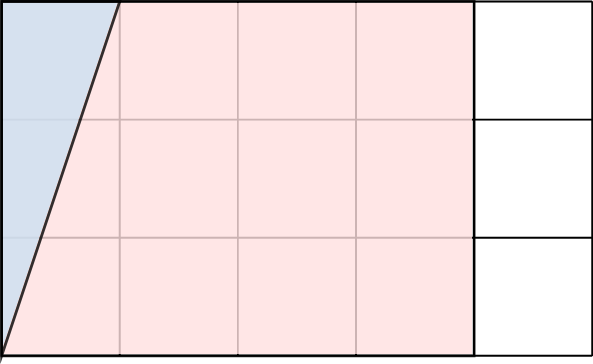
- Now we have a rectangle with a length (base) of \(4\) cm and a height of \(3\) cm. The area of the parallelogram is the same as the area of this rectangle, which is the base times the height: \(4 \times 3 = 12 \, \text{cm}^2\).
Definition — Height of a Parallelogram
In a parallelogram, a height relative to a side is a segment perpendicular to that side and to its opposite side, joining the line through one to the line through the other. That side is then called the base associated with the height. All the heights relative to the same pair of sides have the same length: a parallelogram thus has two families of heights, one for each pair of opposite sides (their lengths may be equal, as in a rhombus). 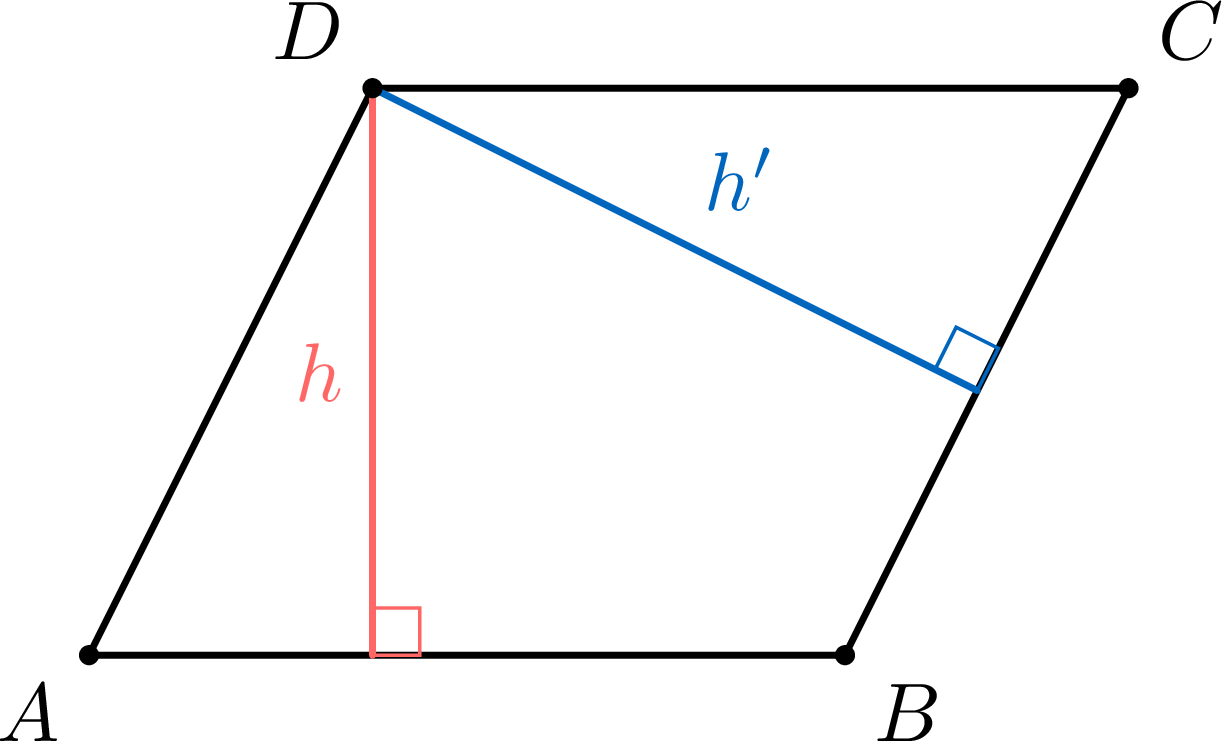
Proposition — Area of a Parallelogram
The area of a parallelogram is found by multiplying the base by the height: $$\text{Area of a parallelogram} = \text{base} \times \text{height}$$ $$A = b \times h,$$ where \(b\) is the base and \(h\) is the height. 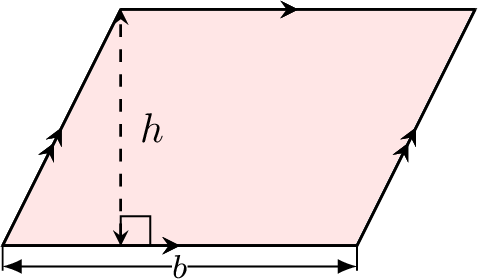
Example
Find the area of the parallelogram: 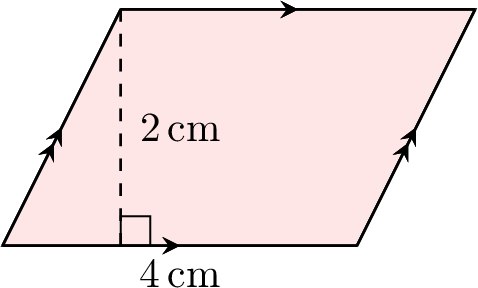
$$\begin{aligned}[t]A &= b \times h \\
&= 4 \times 2 \\
&= 8 \, \text{cm}^2\end{aligned}$$ So, the area of the parallelogram is \(8 \,\text{cm}^2\).
Example
The parallelogram below has sides of \(8\) cm and \(5\) cm; the height drawn measures \(4\) cm. Compute its area. 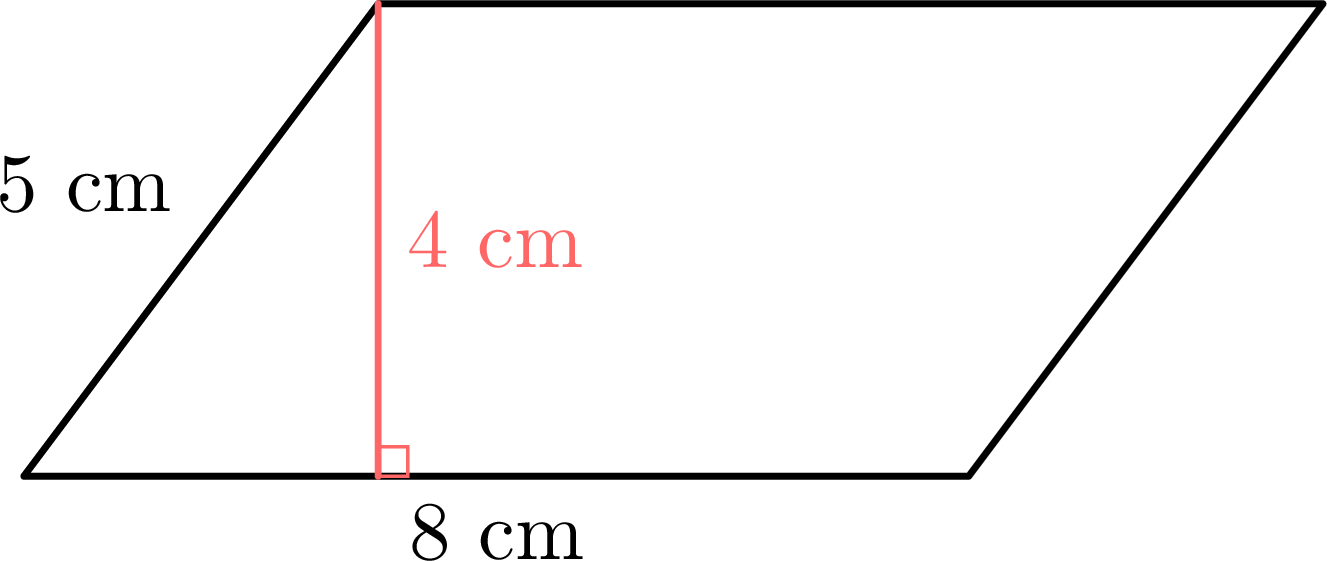
The height of \(4\) cm is perpendicular to the sides of \(8\) cm: its associated base is the side of \(8\) cm — not the side of \(5\) cm. $$\text{Area} = \text{base} \times \text{height} = 8 \times 4 = 32 \,\text{cm}^2.$$ 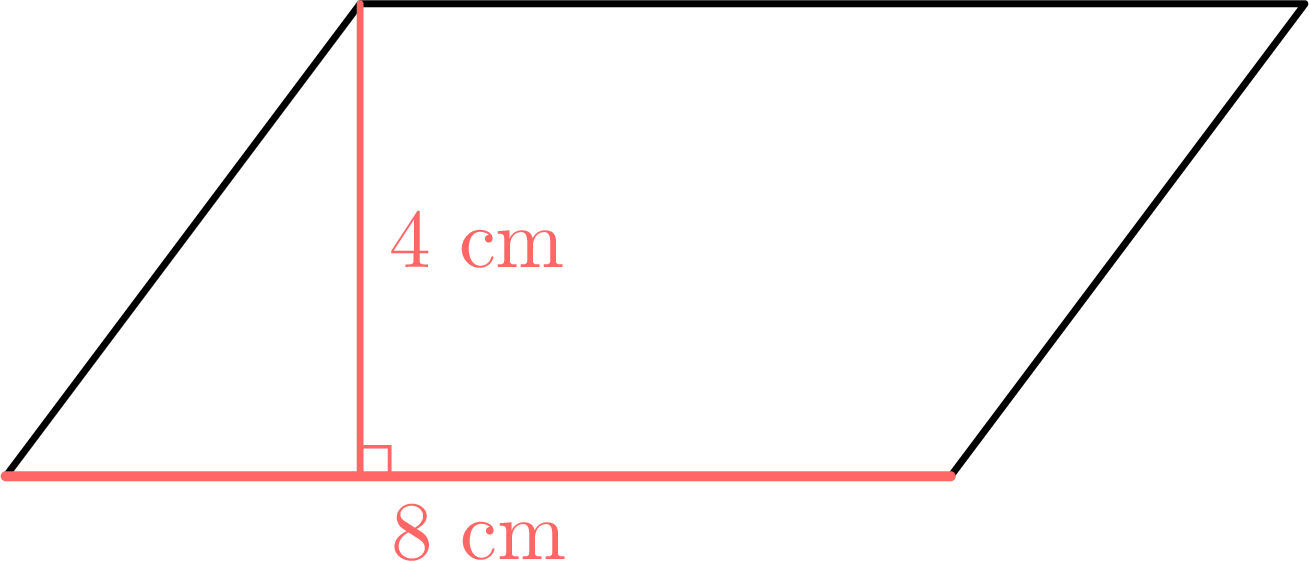
Skills to practice
- Finding Areas of Parallelograms
- Choosing the Base and Its Height
- Distinguishing Area and Perimeter
II
Using the Altitudes of a Triangle
Proposition — Area of a Triangle
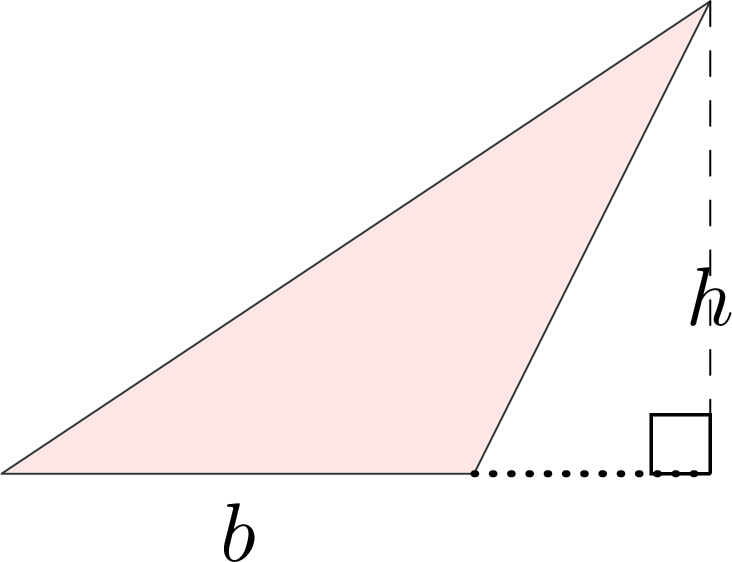
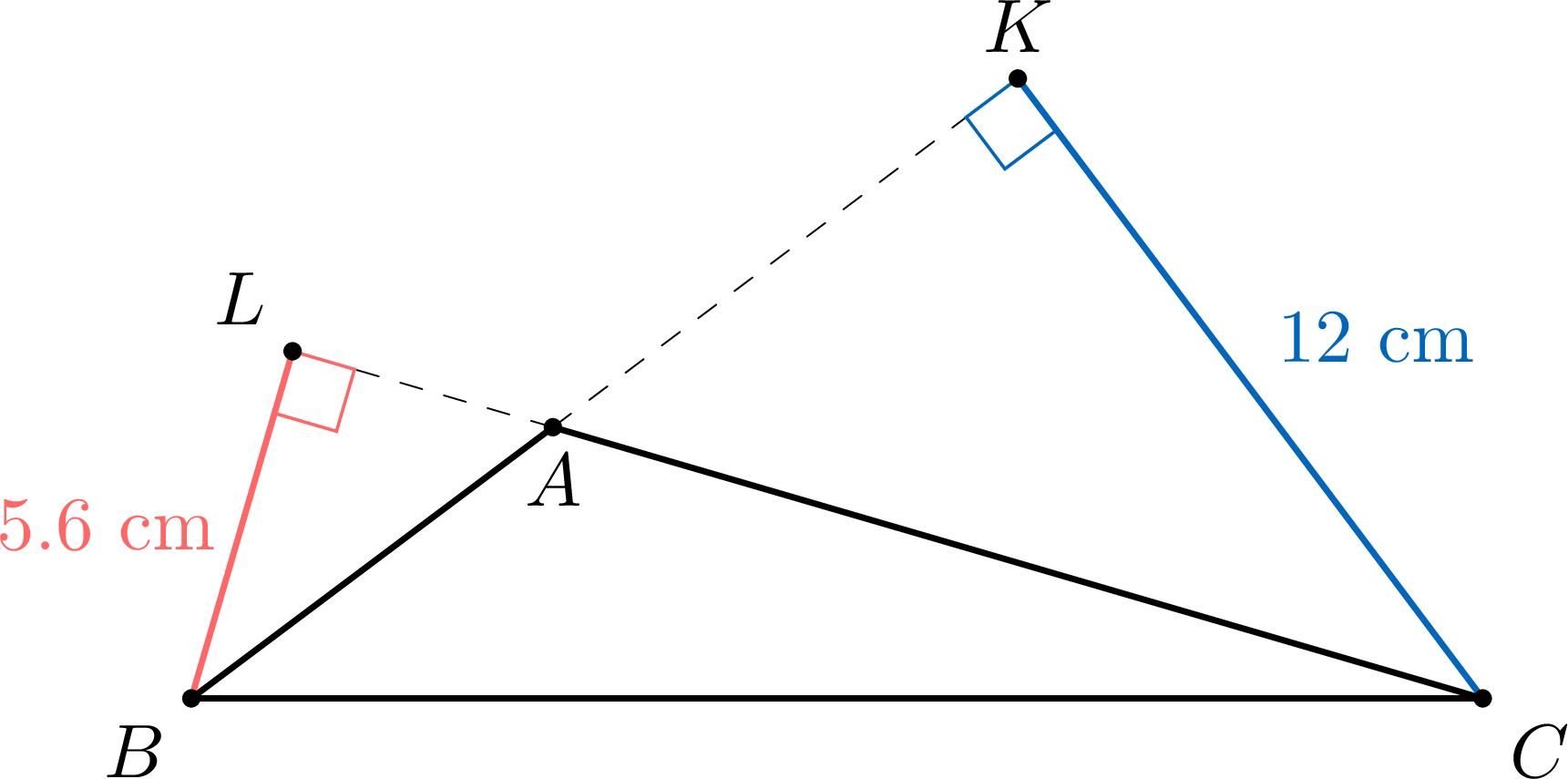
The area of a triangle is found by multiplying the base by the height and dividing by 2: $$\text{Area of a triangle} = \dfrac{\text{base} \times \text{height}}{2}$$ $$A = \dfrac{b \times h}{2}$$ where \(b\) is the length of the base and \(h\) is the corresponding height. The height can fall outside the triangle: the base is then extended with a dotted line, and the height meets this extension at a right angle (figure on the right). 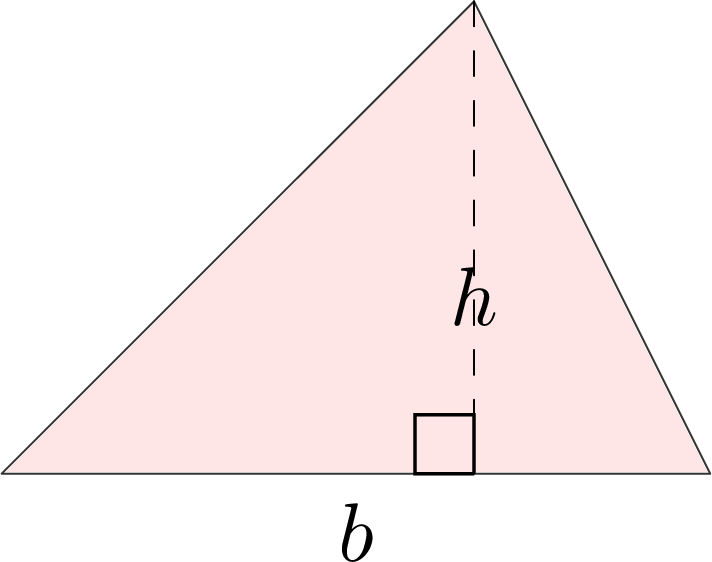
Definition — Altitude of a Triangle
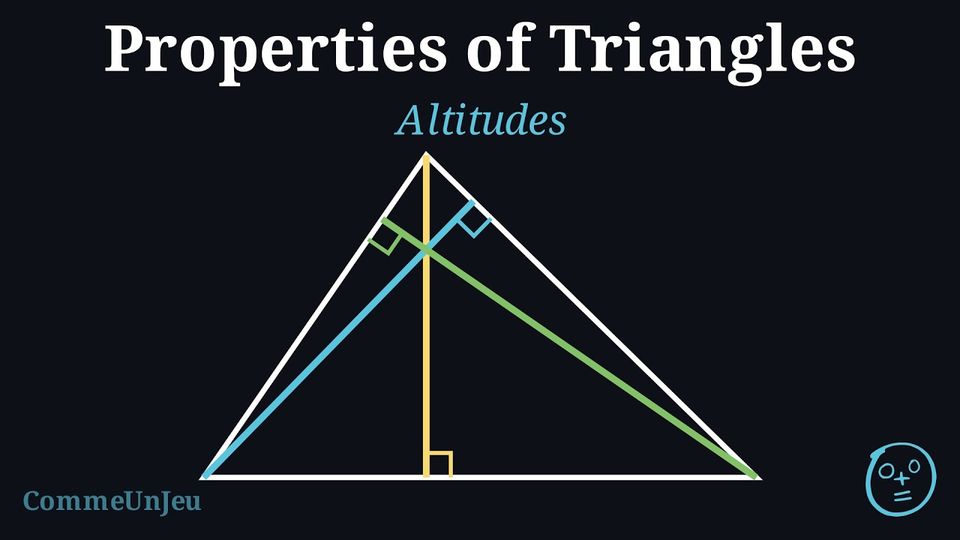
In a triangle, an altitude is a line that passes through a vertex and is perpendicular to the side opposite that vertex (or to its extension). One says: the altitude from \(B\), or the altitude relative to the side \(\Segment{AC}\) — that side is then said to be associated with the altitude. The word altitude also names the segment from the vertex to its foot — the point where the altitude meets the line through the opposite side —, and the length of that segment. That length is the height \(h\) of the area of a triangle, \(A = b \times h \div 2\), when the associated side is taken as the base \(b\). 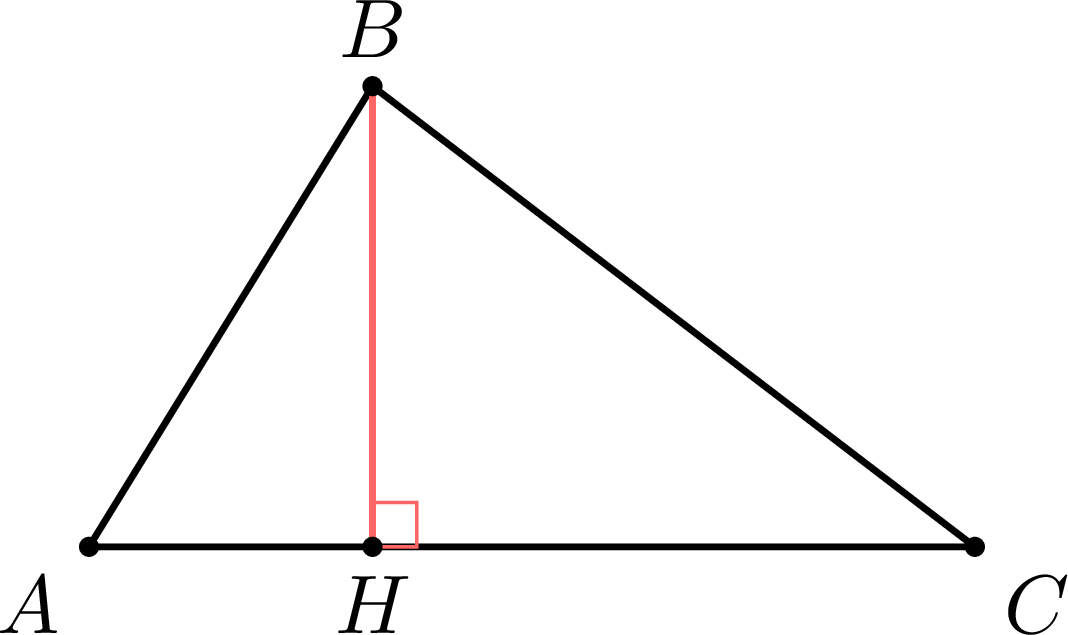
If the triangle has an obtuse angle, two of the altitudes touch the triangle only at their vertex: their feet fall outside, on the extension of the opposite side. If the triangle is right-angled, two of the altitudes coincide with the two sides of the right angle. 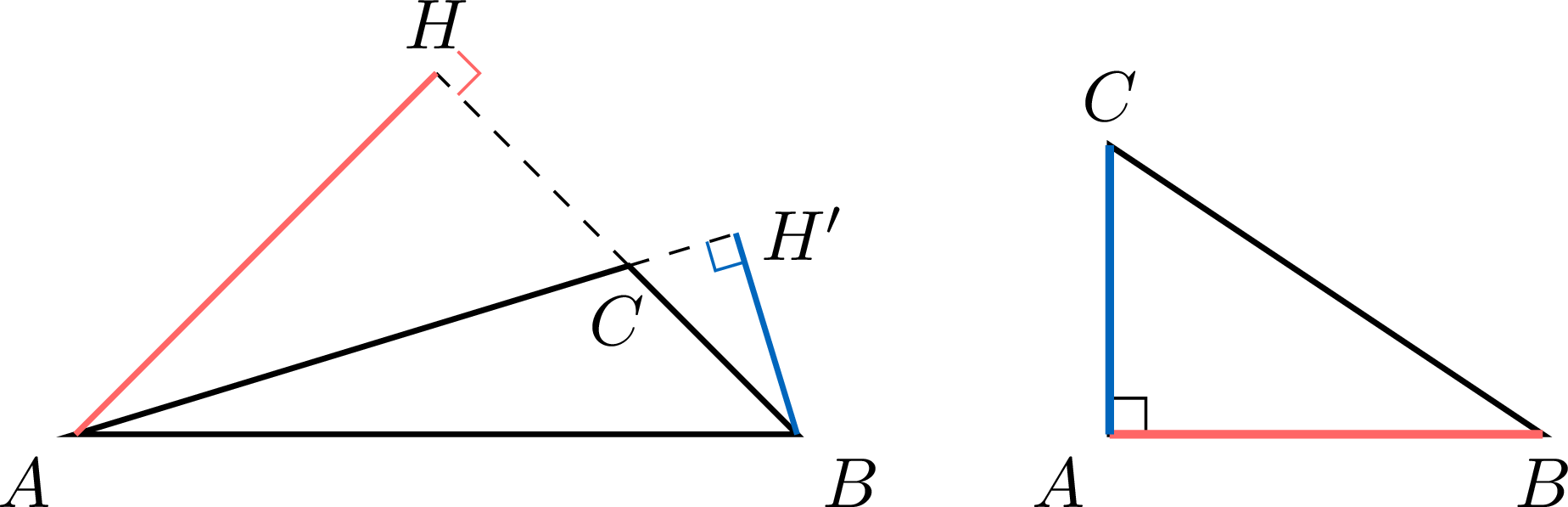
Proposition — Area of a Triangle by its Altitude
The area of a triangle is half the product of the length of an altitude segment and its associated side: $$\text{Area} = \dfrac{\text{altitude} \times \text{associated side}}{2}.$$ Any of the three altitudes may be used — the result is the same. Example
The triangle \(ABC\) has sides \(BC = 20\) cm, \(CA = 15\) cm and \(AB = 7\) cm. Its altitude from \(A\), relative to the side \(\Segment{BC}\), measures \(AH = 4.2\) cm. 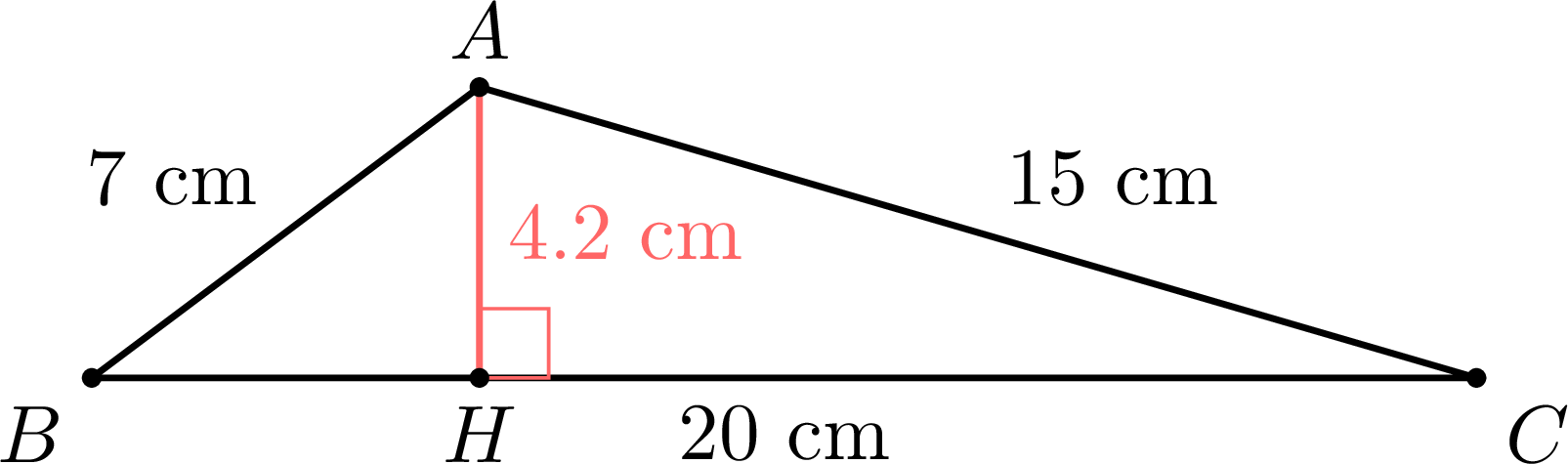
- Find the area of the triangle.
- Deduce the length of the altitude from \(B\) and the length of the altitude from \(C\).
- The altitude \(\Segment{AH}\) is associated with the side \(\Segment{BC}\): $$\begin{aligned}[t] \text{Area} &= \dfrac{\text{altitude} \times \text{associated side}}{2} && \text{(area of a triangle by its altitude)}\\ &= \dfrac{4.2 \times 20}{2}\\ &= 42 \text{ cm}^2. \end{aligned}$$
- Any of the three altitudes gives the same area: for each altitude, altitude \(\times\) associated side \(= 2 \times 42 = 84\). $$\begin{aligned}[t] \text{altitude from } B &= 84 \div 15 && \text{(associated side } CA = 15 \text{ cm)}\\ &= 5.6 \text{ cm},\\ \text{altitude from } C &= 84 \div 7 && \text{(associated side } AB = 7 \text{ cm)}\\ &= 12 \text{ cm}. \end{aligned}$$ Call \(L\) the foot of the altitude from \(B\) and \(K\) the foot of the altitude from \(C\). On the figure, the angle at \(A\) is obtuse: \(L\) lies on the extension of \(\Segment{CA}\) beyond \(A\), and \(K\) on the extension of \(\Segment{BA}\) beyond \(A\); both feet fall outside the triangle. Check: \(5.6 \times 15 \div 2 = 42\) and \(12 \times 7 \div 2 = 42\).
Skills to practice
- Calculating Areas with Altitudes
- Drawing Altitudes
III
Finding the Area of a Trapezium
Two identical tiles have the shape of a trapezium: their parallel sides measure \(5\) cm and \(3\) cm, and these sides are \(2\) cm apart. The second tile is turned upside down (a half-turn) and placed against the first one, along a slanted side. 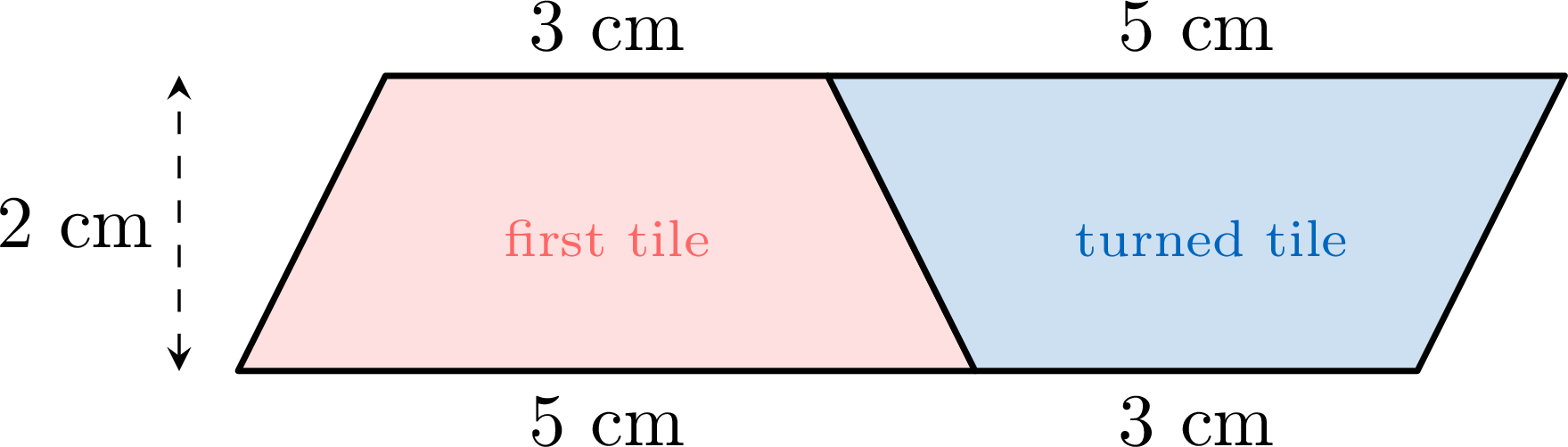
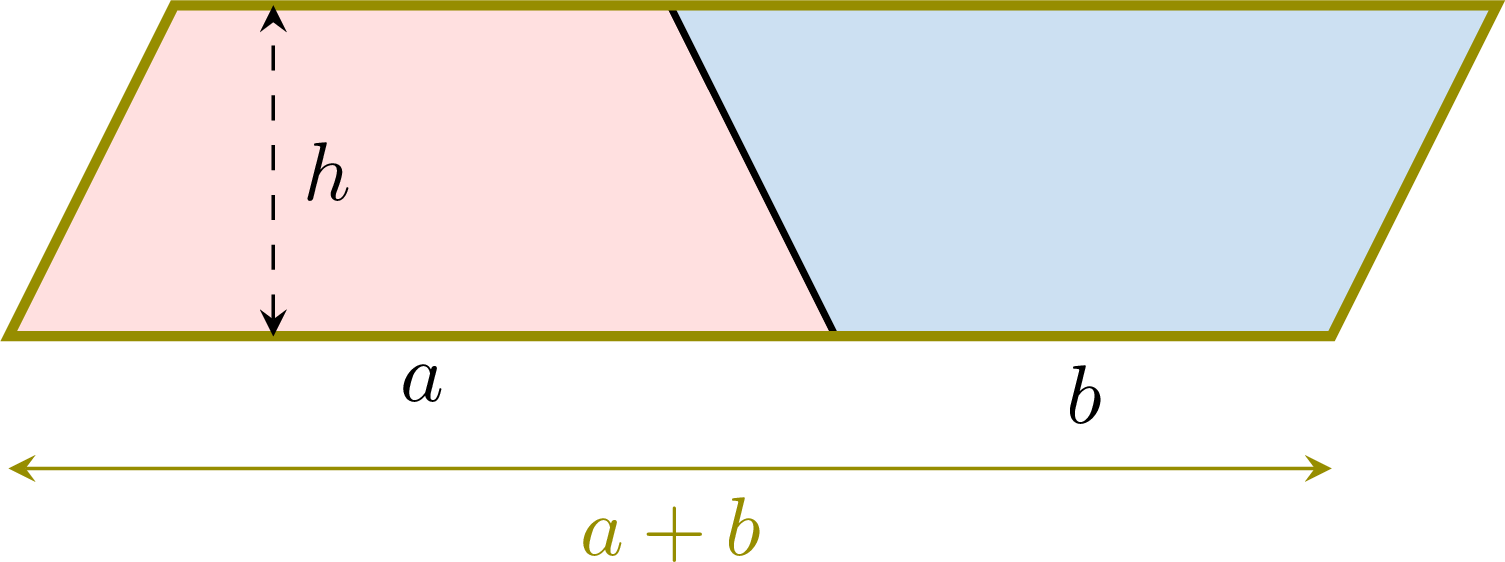
- What shape do the two tiles make together?
- What are the base and the height of this shape? Deduce its area, then the area of one tile.
- Can the same be done with any trapezium? Guess a formula for the area of a trapezium whose parallel sides measure \(a\) and \(b\) and whose height is \(h\).
- The bottom sides of the two tiles, \(5\) cm and \(3\) cm, follow the same line and make a side of \(8\) cm; their top sides, \(3\) cm and \(5\) cm, follow the same parallel line and make the opposite side, also \(8\) cm. Two opposite sides are parallel and equal: the two tiles make a parallelogram (Recognising a Parallelogram).
- Its base is \(5 + 3 = 8\) cm and its height is still \(2\) cm: $$\begin{aligned}[t] \text{Area of the parallelogram} &= \text{base} \times \text{height} && \text{(area of a parallelogram)}\\ &= 8 \times 2 = 16 \text{ cm}^2, \end{aligned}$$ and one tile is half of it: \(16 \div 2 = 8\) cm\(^2\).
- Yes: for any trapezium, the turned copy completes it into a parallelogram of base \(a + b\) and height \(h\). So the area of the trapezium seems to be \(\dfrac{(a + b) \times h}{2}\). A conjecture still needs a proof — given in the Proof of the Proposition “Area of a Trapezium”.
Definition — Height of a Trapezium
The height of a trapezium is the distance between its two bases, the parallel sides: the length of a segment perpendicular to both bases, going from the line of one base to the line of the other. All these segments have the same length. The height is not the length of a slanted side, unless that side is perpendicular to the bases. 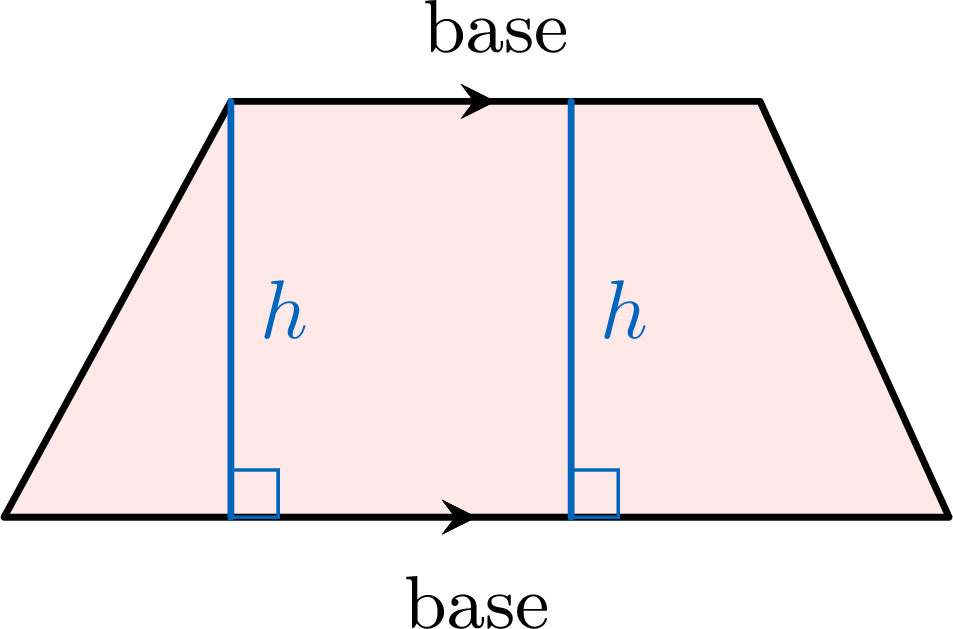
Proposition — Area of a Trapezium
The area of a trapezium whose parallel sides measure \(a\) and \(b\) and whose height is \(h\) is $$\text{Area of a trapezium} = \frac{(\text{sum of the parallel sides}) \times \text{height}}{2}$$ $$A = \frac{(a + b) \times h}{2},$$ also written \(A = \frac{1}{2}(a + b)h\): half the sum of the parallel sides, times the height. The order of \(a\) and \(b\) does not matter. 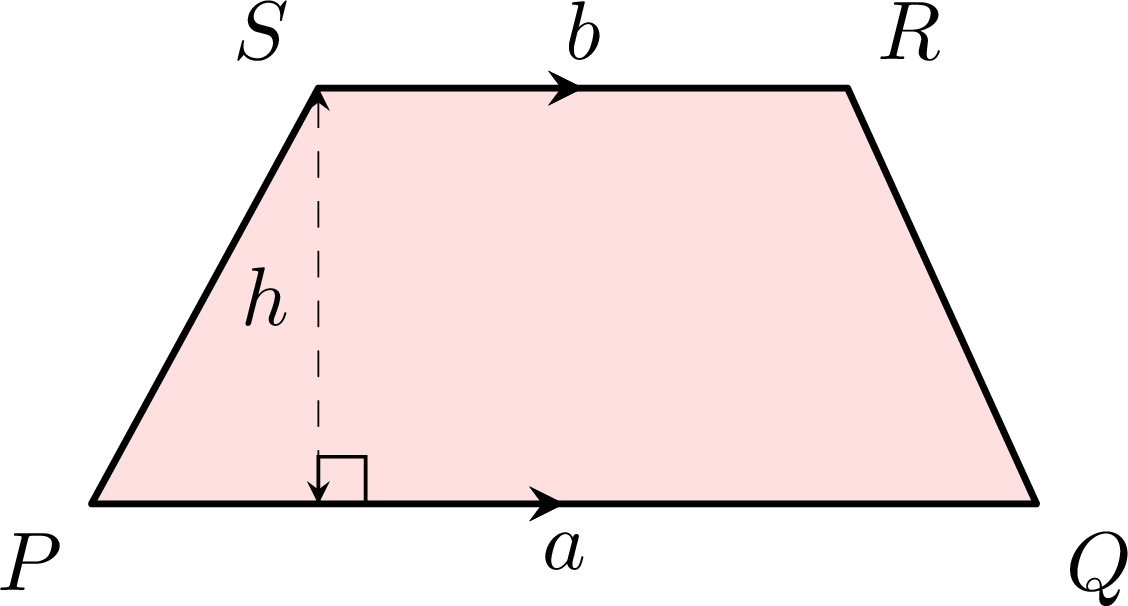
Let \(PQRS\) be a trapezium with \(\Line{PQ} \parallel \Line{SR}\), \(PQ = a\), \(SR = b\) and height \(h\). The diagonal \(\Segment{QS}\) cuts it into two triangles, \(PQS\) and \(QRS\). 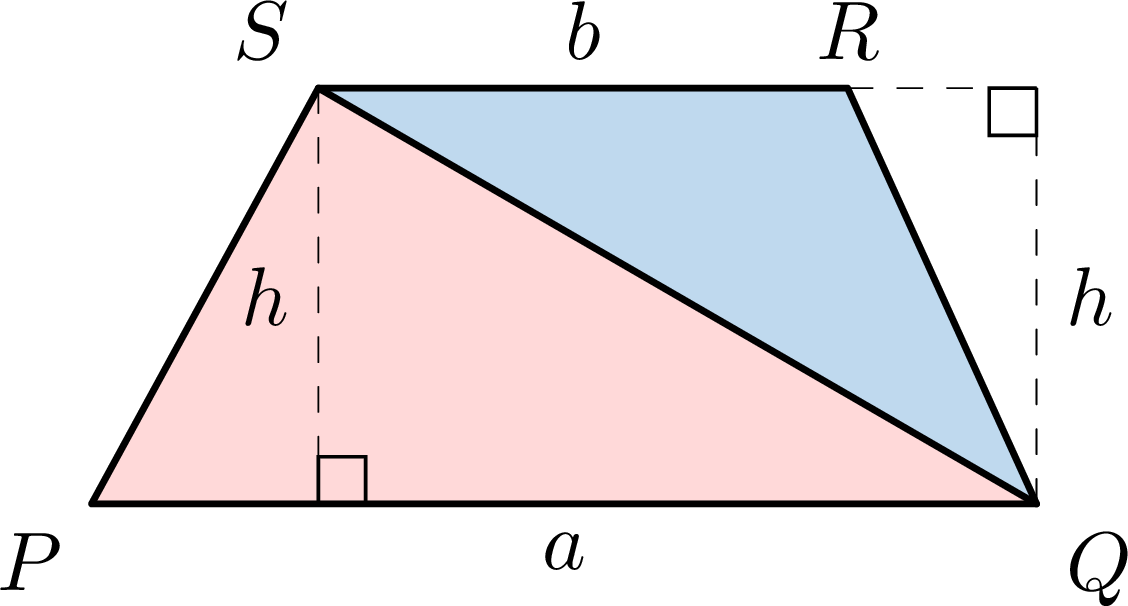
Another way gives the same result: two copies of the trapezium, one turned by a half-turn, make a parallelogram of base \(a + b\) and height \(h\), and the trapezium is half of it.
- In the triangle \(PQS\), take the base \(\Segment{PQ}\): the vertex \(S\) lies on the line \(\Line{SR}\), at the distance \(h\) from \(\Line{PQ}\), so the height relative to \(\Segment{PQ}\) is \(h\).
- In the triangle \(QRS\), take the base \(\Segment{SR}\): the vertex \(Q\) lies on \(\Line{PQ}\), at the distance \(h\) from \(\Line{SR}\), so the height relative to \(\Segment{SR}\) is \(h\) too.
Two Special Cases
The formula can be checked on two shapes whose area is already known.
- If the parallel sides are equal, \(b = a\), the trapezium is a parallelogram (two opposite sides parallel and equal), and the formula gives \(\dfrac{(a + a) \times h}{2} = \dfrac{2a \times h}{2} = a \times h\): base times height, the area of a parallelogram.
- If the top side shrinks to a point, \(b = 0\), the trapezium becomes a triangle of base \(a\), and the formula gives \(\dfrac{(a + 0) \times h}{2} = \dfrac{a \times h}{2}\): the area of a triangle.
Method — Finding the Area of a Trapezium
- Find the two parallel sides, \(a\) and \(b\) (they may be drawn in any direction).
- Find the height \(h\): a length measured perpendicular to the parallel sides — never a slanted side.
- Check that the three lengths are in the same unit.
- Write the formula \(A = \dfrac{(a + b) \times h}{2}\), replace the letters, compute, and give the area in square units.
Example
Find the area of this trapezium. 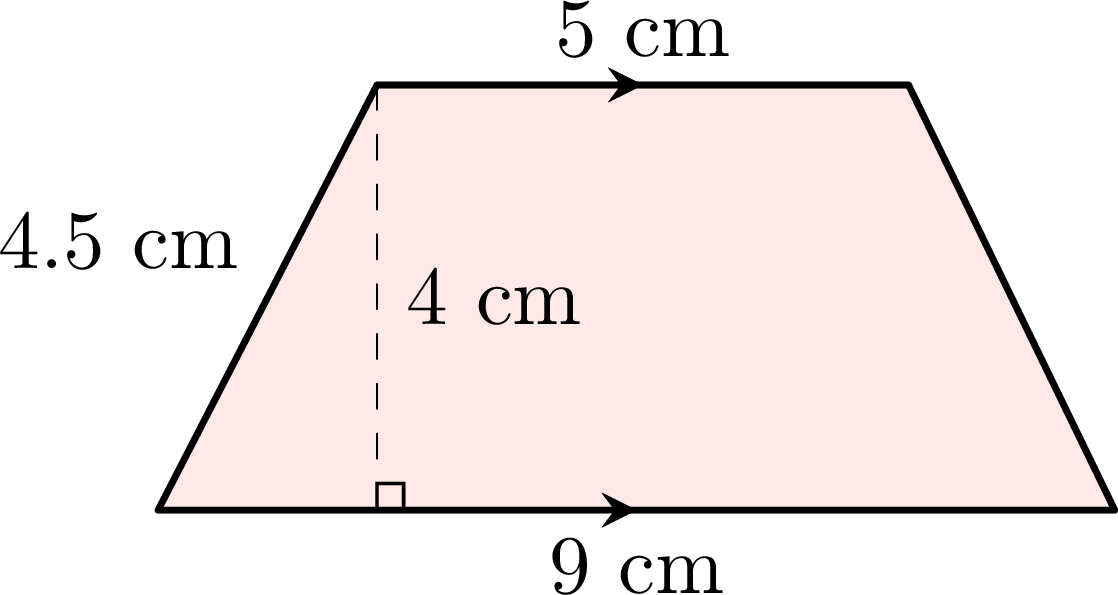
The parallel sides (arrows) measure \(a = 9\) cm and \(b = 5\) cm. The height is the dashed segment, perpendicular to them: \(h = 4\) cm — not the slanted side of \(4.5\) cm. $$\begin{aligned}[t] A &= \frac{(a + b) \times h}{2} && \text{(area of a trapezium)}\\
&= \frac{(9 + 5) \times 4}{2}\\
&= \frac{14 \times 4}{2}\\
&= \frac{56}{2} = 28 \text{ cm}^2. \end{aligned}$$
Example
A garden bed has the shape of a right-angled trapezium. Find its area. 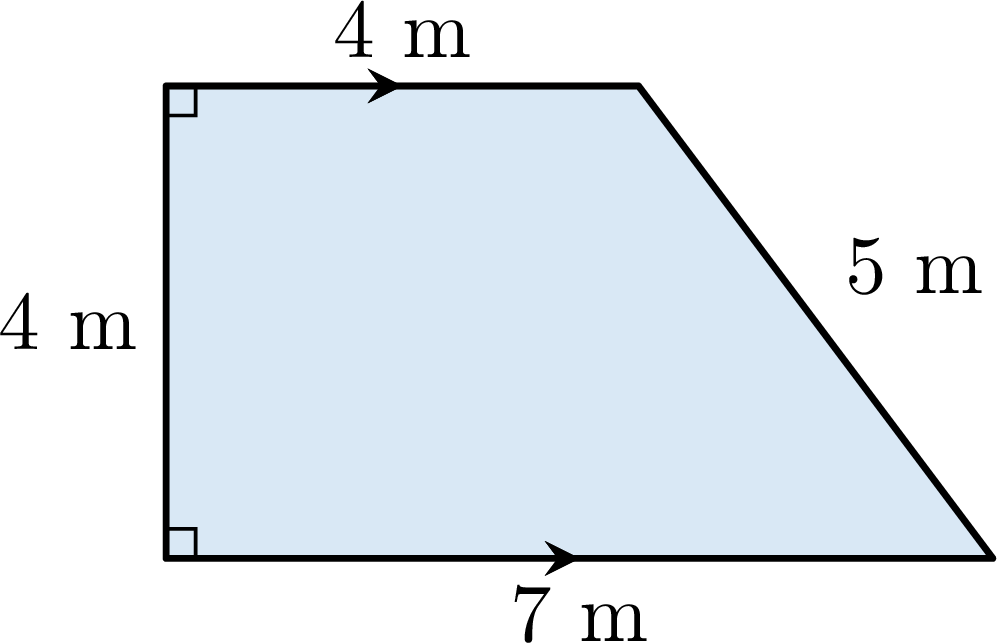
The parallel sides measure \(a = 7\) m and \(b = 4\) m. The side of \(4\) m on the left is perpendicular to both of them (two right angles): it is the height, \(h = 4\) m. The slanted side of \(5\) m is not used. $$\begin{aligned}[t] A &= \frac{(a + b) \times h}{2} && \text{(area of a trapezium)}\\
&= \frac{(7 + 4) \times 4}{2}\\
&= \frac{44}{2} = 22 \text{ m}^2. \end{aligned}$$
Example
A trapezium has an area of \(42\) cm\(^2\), and its parallel sides measure \(8\) cm and \(6\) cm. Find its height. 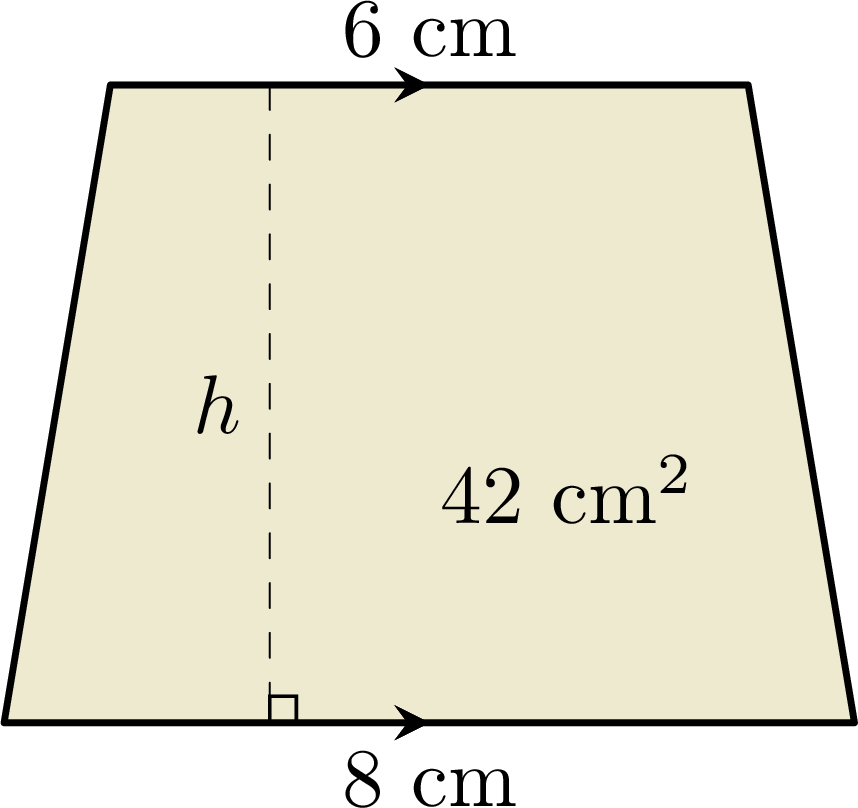
Replace the known lengths in the formula, then solve the equation for \(h\): $$\begin{aligned}[t] \frac{(8 + 6) \times h}{2} &= 42 && \text{(area of a trapezium)}\\
7 \times h &= 42 && \text{(\(14 \div 2 = 7\))}\\
h &= 6. && \text{(dividing both sides by \(7\))} \end{aligned}$$ The height is \(6\) cm. Check: \(\dfrac{(8 + 6) \times 6}{2} = \dfrac{84}{2} = 42\) cm\(^2\).
Example
A trapezium has an area of \(36\) cm\(^2\) and a height of \(4\) cm. Its shorter parallel side measures \(7\) cm. Find its longer parallel side. 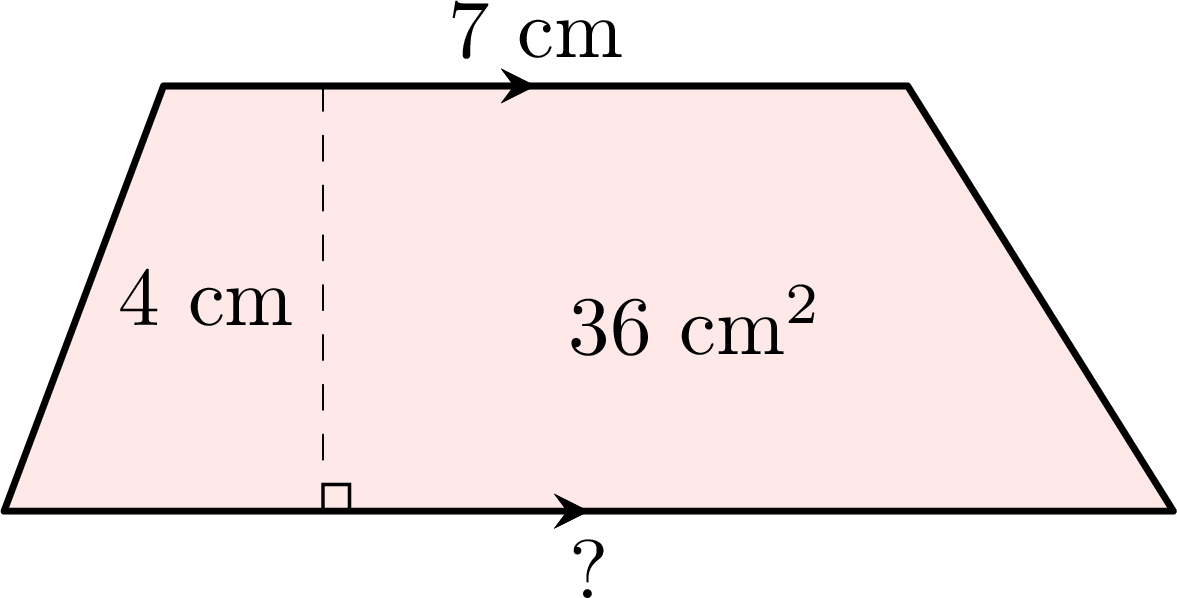
Replace the known lengths in the formula, with \(a\) the longer parallel side, then solve the equation for \(a\): $$\begin{aligned}[t] \frac{(a + 7) \times 4}{2} &= 36 && \text{(area of a trapezium)}\\
(a + 7) \times 2 &= 36 && \text{(\(4 \div 2 = 2\))}\\
a + 7 &= 18 && \text{(dividing both sides by \(2\))}\\
a &= 11. && \text{(subtracting \(7\) from both sides)} \end{aligned}$$ The longer parallel side measures \(11\) cm. Check: \(\dfrac{(11 + 7) \times 4}{2} = \dfrac{72}{2} = 36\) cm\(^2\).
Skills to practice
- Choosing the Bases and the Height
- Finding Areas of Trapeziums
- Finding a Missing Length
IV
Going further
Skills to practice
- Finding Areas of Composite Shapes
- Solving Area Problems in Context
- Investigating Area Formulas
- Quiz
Jump to section