International Baccalaureate · MYP 2
Decimals
I
Decimals and Fractions
I.1
Fractions and Decimals
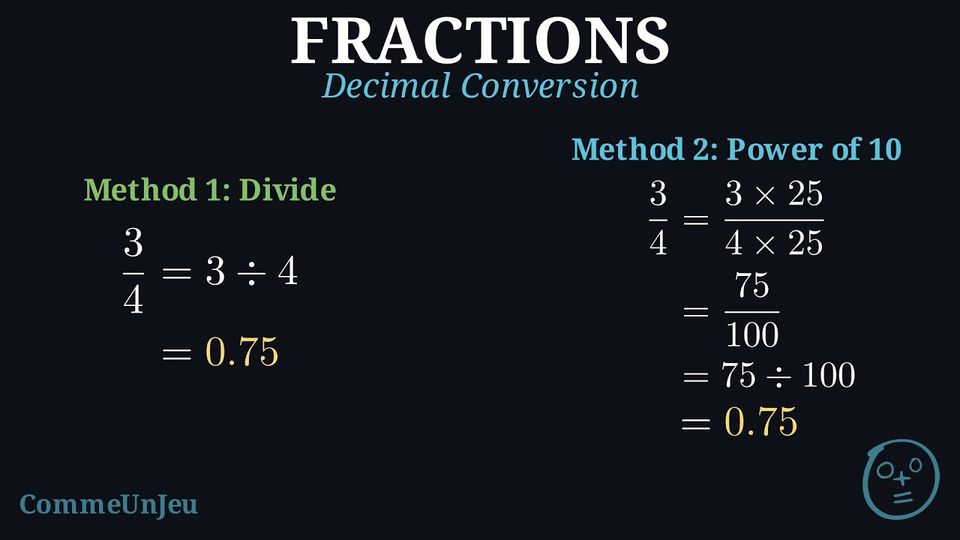
Method — Converting a Fraction to a Decimal Number
There are two primary methods for converting a fraction to a decimal number, when this is possible. - Method 1: Direct Division
Since a fraction \(\frac{a}{b}\) is equal to the quotient \(a \div b\), perform the division of the numerator by the denominator. When the division stops, it gives the decimal writing of the fraction; otherwise, the fraction is not equal to any decimal number. - Method 2: Denominator as a Power of 10 (equal fractions)
Find an equivalent fraction where the denominator is a power of 10 (e.g., 10, 100, 1000). This new fraction is then written as a decimal number: \(\dfrac{75}{100} = 0.75\). This method only works when the denominator can be turned into a power of \(10\) (for example \(2\), \(4\), \(5\), \(25\)). For a denominator such as \(3\), no power of \(10\) works, so use Method 1: \(\frac{1}{3} = 1 \div 3 = 0.333\ldots\) (the decimal expansion never ends).
Method — Converting a Decimal to a Fraction
The procedure for converting a terminating decimal to a fraction is as follows: - Write the decimal as the numerator of a fraction without the decimal point.
- The denominator is 1 followed by as many zeros as there are decimal places in the original number.
- Simplify the fraction to its lowest terms, if necessary.
Skills to practice
- Converting Between Negative Fractions and Decimals
II
Multiplying Decimals
II.1
Multiplying by 0.1, 0.01 and 0.001
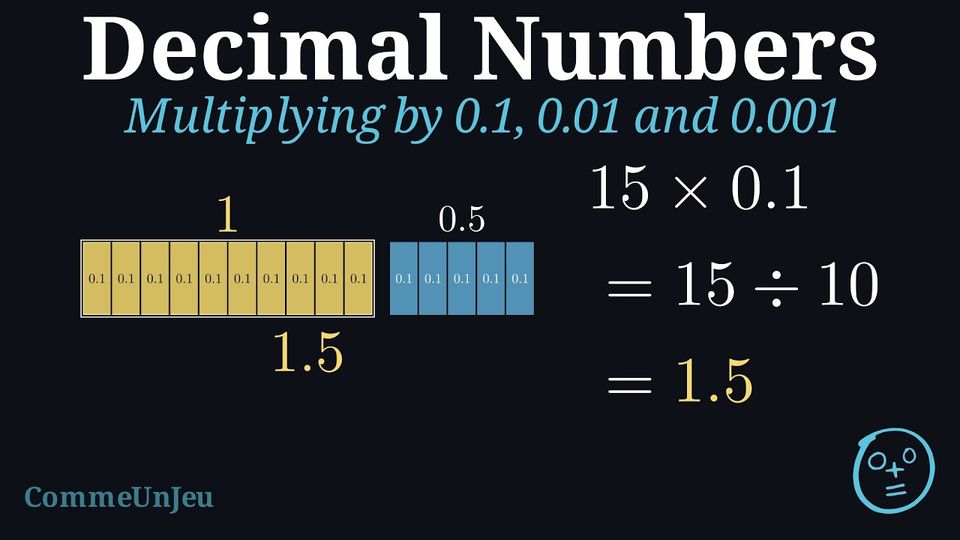
At the bakery, Nour buys \(15\) sweets at \(\dollar 0.10\) each. Before the baker has finished typing on the till, she announces: “\(\dollar 1.50\) — I just divided \(15\) by \(10\)!” Is she correct? Explain why.
Yes. Since \(0.1 = \dfrac{1}{10}\), multiplying by \(0.1\) is taking one tenth, that is, dividing by \(10\): $$15 \times 0.1 = 15 \times \dfrac{1}{10} = \dfrac{15}{10} = 15 \div 10 = 1.5.$$ The \(15\) sweets cost \(\dollar 1.50\).
Proposition — Multiplying by 0.1, 0.01 and 0.001
Since \(0.1 = \dfrac{1}{10}\), \(0.01 = \dfrac{1}{100}\) and \(0.001 = \dfrac{1}{1\,000}\): - multiplying by \(0.1\) is dividing by \(10\): the decimal point moves \(1\) place to the left;
- multiplying by \(0.01\) is dividing by \(100\): the decimal point moves \(2\) places to the left;
- multiplying by \(0.001\) is dividing by \(1\,000\): the decimal point moves \(3\) places to the left.
These equalities must be known by heart — they say that ten tenths make one unit, that ten hundredths make one tenth, and so on: $$1 = 10 \times 0.1 = 100 \times 0.01 = 1\,000 \times 0.001 \qquad\qquad 0.1 = 10 \times 0.01 = 100 \times 0.001 \qquad\qquad 0.01 = 10 \times 0.001$$ Read the other way round, they give a tenth of a tenth, \(0.1 \times 0.1 = 0.01\), and a tenth of a hundredth, \(0.1 \times 0.01 = 0.001\).
Example
Compute: \(0.6 \times 0.1\), \(345 \times 0.001\), \(1\,000 \times 0.1\), \(100 \times 0.01\).
$$\begin{aligned}[t] 0.6 \times 0.1 &= 0.6 \div 10 = 0.06 &&\text{(multiplying by \(0.1\) is dividing by \(10\))}\\
345 \times 0.001 &= 345 \div 1\,000 = 0.345 &&\text{(multiplying by \(0.001\) is dividing by \(1\,000\))}\\
1\,000 \times 0.1 &= 1\,000 \div 10 = 100\\
100 \times 0.01 &= 100 \div 100 = 1 &&\text{(one hundred hundredths make one unit)} \end{aligned}$$
Multiplying by \(0.1\) made the number smaller: \(15 \times 0.1 = 1.5\) is smaller than \(15\). So multiplying does not always make bigger. What it means to multiply by a decimal number remains to be explained.
Skills to practice
- Finding the Missing Factor
- Finding the Operation
- Multiplying by 0.1, 0.01 and 0.001
II.2
The Product of Two Decimals
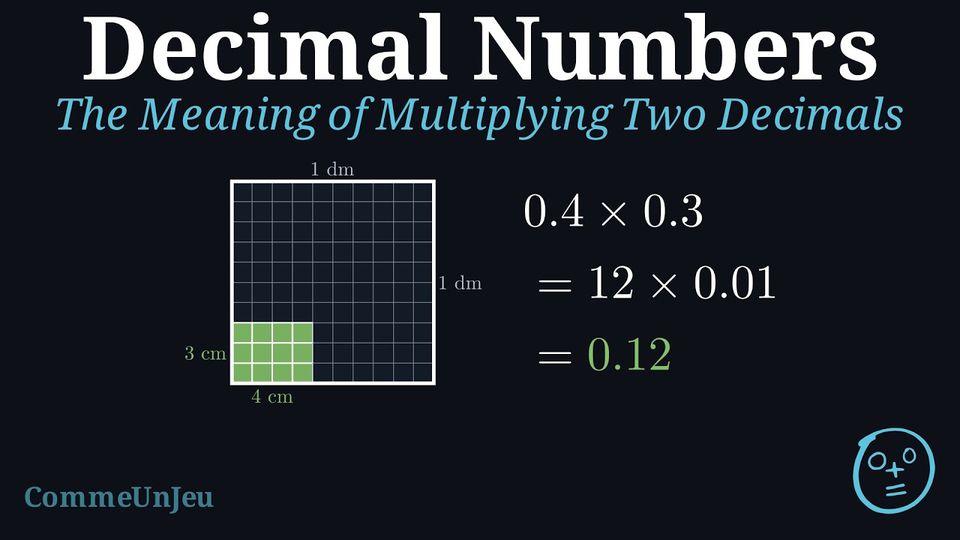
A rectangular floor tile measures \(0.4\) m by \(0.3\) m. Tom computes its area as \(0.4 \times 0.3\) and writes \(1.2\) m\(^2\). 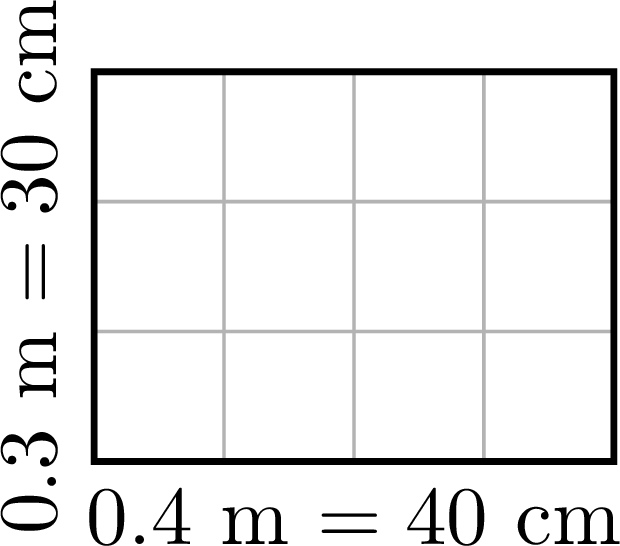
- Convert the two sides to centimetres and compute the area of the tile in cm\(^2\).
- Knowing that \(1\) m\(^2 = 10\,000\) cm\(^2\), give this area in m\(^2\).
- What is \(0.4 \times 0.3\)? Was Tom correct?
- \(0.4\) m \(= 40\) cm and \(0.3\) m \(= 30\) cm. The grid cuts the tile into \(4 \times 3 = 12\) squares of side \(10\) cm, each of area \(100\) cm\(^2\): the area of the tile is \(40 \times 30 = 1\,200\) cm\(^2\).
- A square metre holds \(10 \times 10 = 100\) squares of side \(10\) cm, so each square of the grid is one hundredth of \(1\) m\(^2\), and the \(12\) squares make \(\dfrac{12}{100}\) m\(^2 = 0.12\) m\(^2\). Check: \(1\,200\) cm\(^2 = \dfrac{1\,200}{10\,000}\) m\(^2 = 0.12\) m\(^2\).
- The area is also \(0.4 \times 0.3\), so \(0.4 \times 0.3 = 0.12\). Tom was wrong: the product is smaller than each of the two factors. Multiplying by \(0.3\) is not “adding \(0.4\) three times”; it is taking \(3\) tenths of \(0.4\).
Method — Decomposing to Multiply Two Decimals
To compute a product such as \(0.4 \times 0.3\) without any drawing: - Step 1: Write each decimal as a whole number times \(0.1\), \(0.01\) or \(0.001\). Here \(0.4 = 4 \times 0.1\) and \(0.3 = 3 \times 0.1\).
- Step 2: Change the order of the factors and group them differently — in a product, this is always allowed: the whole numbers together, the \(0.1\)'s together. $$0.4 \times 0.3 = (4 \times 0.1) \times (3 \times 0.1) = (4 \times 3) \times (0.1 \times 0.1)$$
- Step 3: Compute the two products. \(4 \times 3 = 12\) and \(0.1 \times 0.1 = 0.01\) (a tenth of a tenth). $$0.4 \times 0.3 = 12 \times 0.01 = 0.12$$
Example
Compute by decomposing: \(0.7 \times 0.08\), \(0.4 \times 2.5\), \(1.21 \times 0.4\).
$$\begin{aligned}[t] 0.7 \times 0.08 &= (7 \times 0.1) \times (8 \times 0.01) = (7 \times 8) \times (0.1 \times 0.01) = 56 \times 0.001 = 0.056\\
0.4 \times 2.5 &= (4 \times 0.1) \times (25 \times 0.1) = (4 \times 25) \times (0.1 \times 0.1) = 100 \times 0.01 = 1\\
1.21 \times 0.4 &= (121 \times 0.01) \times (4 \times 0.1) = (121 \times 4) \times (0.01 \times 0.1) = 484 \times 0.001 = 0.484 \end{aligned}$$
Bigger or Smaller?
Multiplying a positive number by a number greater than \(1\) gives a result greater than that number: \(0.4 \times 2.5 = 1\) is greater than \(0.4\). Multiplying by a number smaller than \(1\) gives a smaller result: \(0.4 \times 0.3 = 0.12\) is smaller than \(0.4\). This is the first thing to check on a product of decimals.
The decomposition also explains the rule for placing the decimal point in a column multiplication: \(0.4 \times 0.3\) has \(1 + 1 = 2\) decimal places because \(0.1 \times 0.1 = 0.01\).
The decomposition also explains the rule for placing the decimal point in a column multiplication: \(0.4 \times 0.3\) has \(1 + 1 = 2\) decimal places because \(0.1 \times 0.1 = 0.01\).
Skills to practice
- Decomposing to Multiply
- Deducing a Product from a Known Product
- Multiplying Mentally
- Explaining Products of Decimals
III
Calculating with Decimals
III.1
Dividing by a Decimal and Chaining Operations
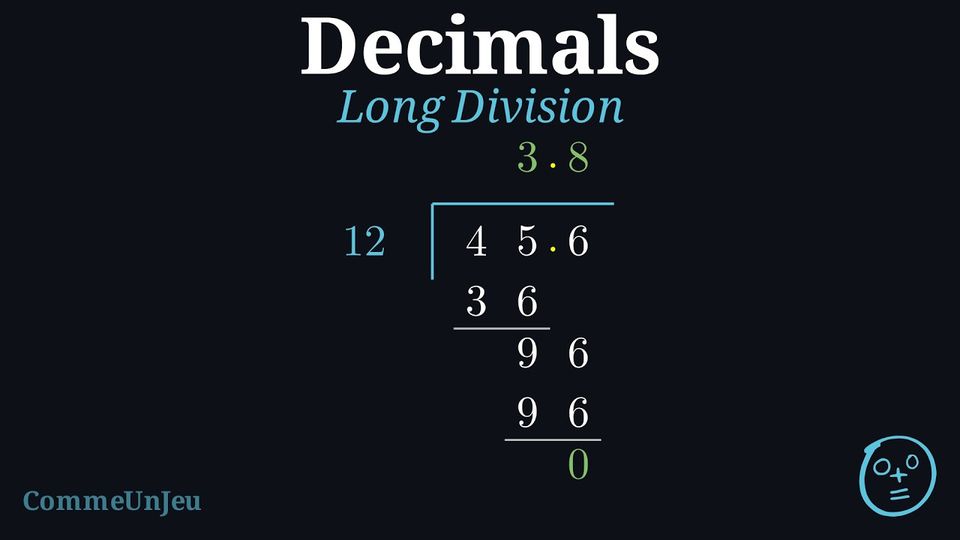
Method — Long Division by a Decimal Number
In long division, first convert the divisor to a whole number. - Step 1: Make the divisor whole. Move the decimal point in the divisor to the right until the divisor is a whole number. Count how many places you moved it.
- Step 2: Move the other decimal. Move the decimal point in the dividend the same number of places to the right, adding zeros if there are no digits left (\(6 \div 0.75\) becomes \(600 \div 75\)).
- Step 3: Divide. Now the problem is a "division by a whole number" problem. Follow the steps of that division.
Proposition — The Quotient Does Not Change
A quotient does not change when the dividend and the divisor are both multiplied by the same non-zero number: there are as many times \(1.2\) cm in \(4.56\) cm as \(12\) mm in \(45.6\) mm — changing the unit multiplies both numbers by \(10\) without changing the answer. $$4.56 \div 1.2 = (4.56 \times 10) \div (1.2 \times 10) = 45.6 \div 12$$ “Moving both decimal points one place to the right” is exactly “multiplying both numbers by 10”. The method replaces the division by a decimal with an equal division whose divisor is a whole number — a division that can already be set up. Skills to practice
- Chaining Operations on Decimals
- Chaining Operations and Justifying
- Solving Problems with Decimals
IV
Approximate Values
IV.1
Approximate Value of a Quotient
Definition — Approximate Value of a Quotient
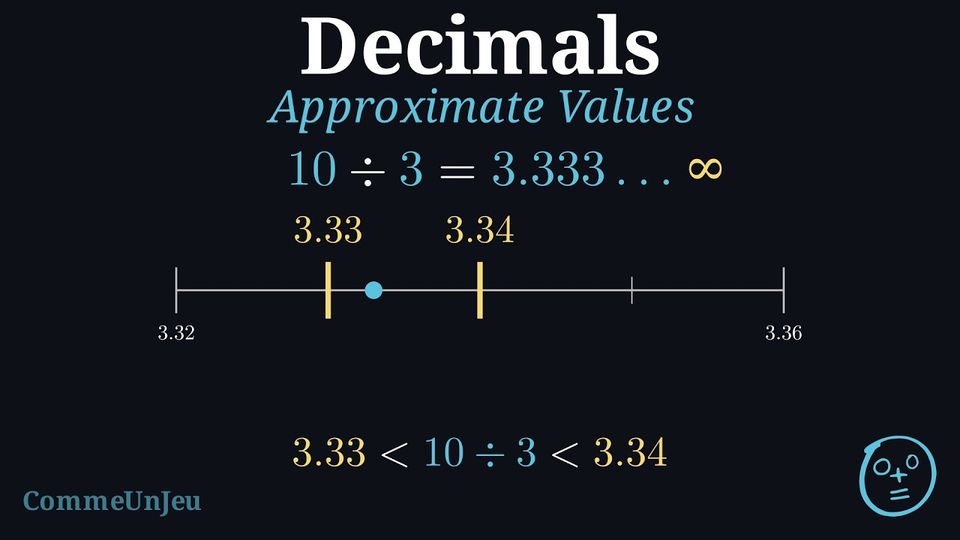
Some divisions never end: the quotient of \(10 \div 3\) is \(3.333\ldots\) and is not a decimal number. Such a quotient has no finite decimal writing; it is given by an approximate value at a chosen place. - The approximate value by default is obtained by cutting the quotient after the chosen place: \(3.33\) is the approximate value of \(10 \div 3\) by default to the hundredth.
- The approximate value by excess is one unit of that place above: \(3.34\) is the approximate value of \(10 \div 3\) by excess to the hundredth.
- The two values frame the quotient: $$3.33 < 10 \div 3 < 3.34$$
- The rounded value is the closer of the two: the thousandths digit of \(3.333\ldots\) is \(3\), which is “4 or less”, so \(10 \div 3 \approx 3.33\) rounded to the hundredth.
Example
Calculate \(22 \div 7\). - Give the approximate values of the quotient by default and by excess to the hundredth.
- Give the quotient rounded to the hundredth.
We push the division one place past the hundredths, to the thousandths: 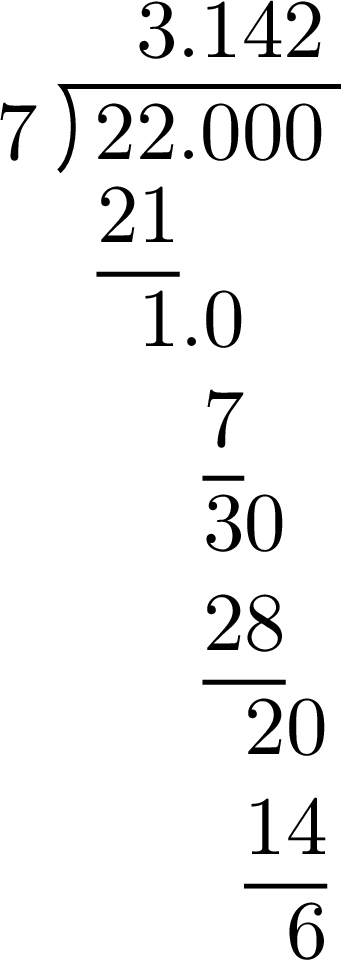
- How many 7s in 22? 3 (\(3 \times 7 = 21\)); the remainder is 1. The digits are used up: write the decimal point and append zeros (\(22 = 22.000\)).
- With 10 tenths: \(10 = 7 \times \textbf{1} + 3\). With 30 hundredths: \(30 = 7 \times \textbf{4} + 2\). With 20 thousandths: \(20 = 7 \times \textbf{2} + 6\).
- The remainder is still not zero: the division does not end here, and the Going further shows that it never ends: \(22 \div 7 = 3.142\ldots\)
- Cutting after the hundredths gives the approximate value by default, \(3.14\); one hundredth above gives the approximate value by excess, \(3.15\). The two values frame the quotient: $$3.14 < 22 \div 7 < 3.15$$
- The thousandths digit is \(2\), which is “4 or less”, so the hundredths digit stays the same: $$22 \div 7 \approx 3.14$$
Skills to practice
- Finding Approximate Values
- Rounding a Quotient
V
Going further
Skills to practice
- Reasoning with Estimates and Approximate Values
- Naming Properties and Mathematical Culture
- Investigating Patterns in Decimal Calculations
- Quiz
Jump to section