International Baccalaureate · MYP 2
Algebraic Expressions
I
The Language of Algebra
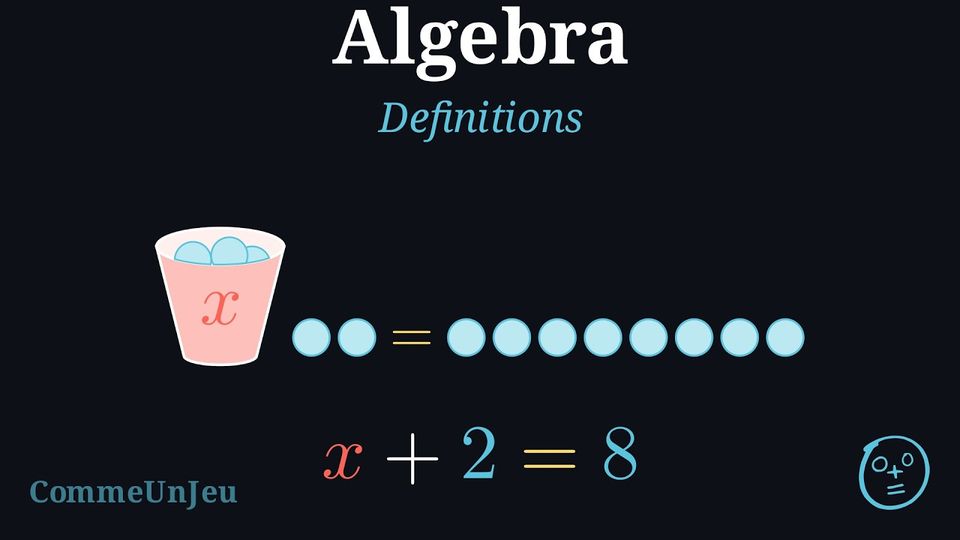
Definition — Constant
A constant is a number. Example
\(0, \; 3, \; 2.5\) Definition — Variable
A variable is a quantity which we represent by a letter. Example

Definition — Expression
An expression is a calculation written with numbers, letters and operation signs such as \(+\), \(-\), \(\times\), \(\div\) and \(\sqrt{\ }\), without an equal sign. A number or a letter on its own is also an expression. Example

Definition — Equation
An equation is an equality between two expressions, the left-hand side and the right-hand side, separated by an equal sign \(=\), and containing at least one unknown — a letter standing for a number we are looking for: the value that makes the equality true. Example

Definition — Formula
A formula is an equality that links quantities: it expresses one of them, the subject, in terms of the others. Its letters are variables: they can take many values. Formulas often come from the real world, physics or geometry. Example
For a triangle: 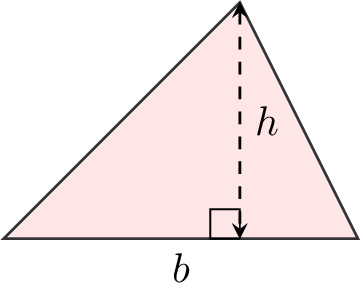 , \(A = \dfrac{b \times h}{2}\) is the formula for the area.
Proposition — Standard Expressions
For any number \(x\): - twice \(x\) is \(2 \times x = 2x\), and three times \(x\) is \(3 \times x = 3x\);
- half of \(x\) is \(x \div 2 = \dfrac{x}{2}\), and a third of \(x\) is \(x \div 3 = \dfrac{x}{3}\);
- the square of \(x\) is \(x \times x = x^2\), and its cube is \(x \times x \times x = x^3\).
Example
Express in terms of the letter: twice \(x\), a third of \(t\), the square of \(y\), the successor of the whole number \(n\).
Twice \(x\) is \(2x\), a third of \(t\) is \(\dfrac{t}{3}\), the square of \(y\) is \(y^2\) and the successor of \(n\) is \(n + 1\).
Skills to practice
- Identifying Expressions, Equations, Variables and Constants
- Writing Expressions
- Writing an Expression from Words
- Reading an Expression in Words
II
Algebraic Notation
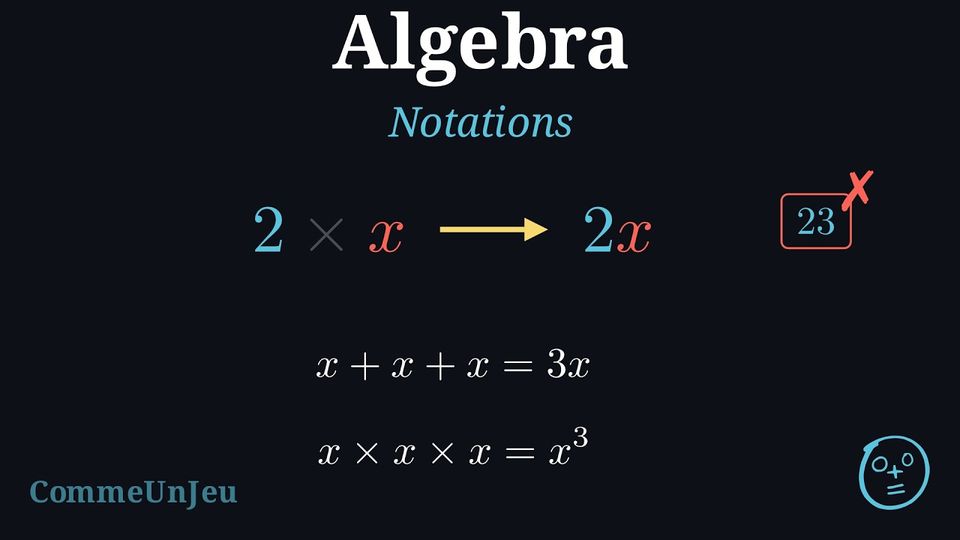
Definition — Product Notation
We can omit the \(\times\) sign when it is followed by a variable or by a bracket \((\) (also called a parenthesis). Example
- \(2 \times x = 2x\)
- \(2 \times (l+w) = 2(l+w)\)
Definition — Terms and Coefficients
In the expression \(3x + 5\), the terms are \(3x\) and \(5\): the parts joined by the signs \(+\) or \(-\). In the term \(3x\), the number \(3\) is the coefficient of \(x\). The term \(5\), which has no letter, is a constant term.
Three classic traps of the first encounter with letters:
- \(4x\) is a hidden multiplication: \(4x = 4 \times x\). The \(4\) and the \(x\) are not “glued”: if \(x = 3\), then \(4x = 12\), not \(43\).
- A letter on its own carries an invisible coefficient: \(x = 1x\).
- \(x + 2\) is a finished answer. Nothing forces the sum of a letter and a number into one symbol: \(x + 2\) cannot be written \(2x\).
Definition — Repeated Addition
$$\overbrace{x + x + \ldots + x}^{n\text{ terms}} = n\times x$$ Example

$$x + x + 1 + 1 + 1 = 2x +3$$
Definition — Repeated Multiplication
For a whole number \(n \geq 1\): $$\overbrace{x \times x \times \ldots \times x}^{n\text{ factors}} = x^n$$ Skills to practice
- Writing Without the Multiplication Sign
- Simplifying Repeated Addition
- Simplifying Repeated Multiplication
- Understanding Literal Notation
III
Identities and Like Terms
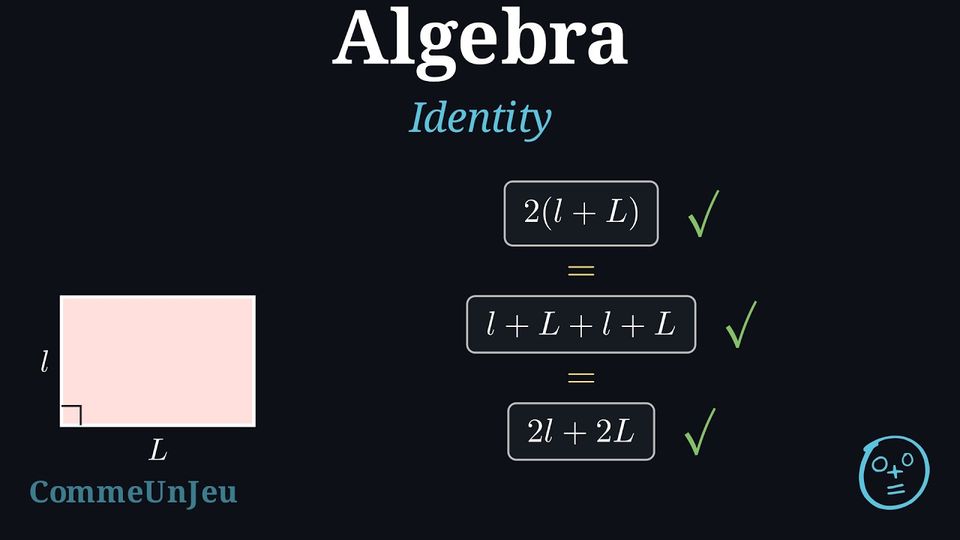
Three students were asked to find the formula for the perimeter of the rectangle of length \(L\) and width \(l\): 
They wrote:
- Su: \(P = 2(l + L)\)
- Louis: \(P = l + L + l + L\)
- Hugo: \(P = 2l + 2L\)
They are all correct. These three expressions \(2(l + L)\), \(l + L + l + L\) and \(2l + 2L\) produce the same result for the perimeter of the rectangle for all values of \(l\) and \(L\). The equalities between them, such as \(2(l + L) = 2l + 2L\), are called identities.
Definition — Identity
An identity is an equality between two expressions such that their evaluations produce the same value for all values of the variables.
Identities are fundamental in algebra: they allow us to transform and simplify expressions and are the foundation for solving equations and manipulating formulas.
Proposition — Properties of Multiplying by 1 and 0
$$1 \times x = x \qquad \text{and} \qquad 0 \times x = 0$$ Proposition — The Commutative Laws
$$\textcolor{colordef}{a} + \textcolor{colorprop}{b} = \textcolor{colorprop}{b} + \textcolor{colordef}{a}\qquad \text{and} \qquad\textcolor{colordef}{a} \times \textcolor{colorprop}{b} = \textcolor{colorprop}{b} \times \textcolor{colordef}{a}$$ Proposition — The Associative Laws
$$(\textcolor{colordef}{a} + \textcolor{colorprop}{b}) + \textcolor{olive}{c} = \textcolor{colordef}{a} + (\textcolor{colorprop}{b} + \textcolor{olive}{c})\qquad \text{and} \qquad(\textcolor{colordef}{a} \times \textcolor{colorprop}{b}) \times \textcolor{olive}{c} = \textcolor{colordef}{a} \times (\textcolor{colorprop}{b} \times \textcolor{olive}{c})$$ Example
Show that \(l + L + l + L = 2l + 2L\).
$$\begin{aligned}\textcolor{colordef}{l} + \textcolor{colorprop}{L} + \textcolor{colordef}{l} + \textcolor{colorprop}{L}&= \textcolor{colordef}{l + l} + \textcolor{colorprop}{L + L} && (\text{collecting terms}) \\
&= \textcolor{colordef}{2l} + \textcolor{colorprop}{2L} && (\text{repeated addition})\end{aligned}$$
Method — Simplifying by Collecting Like Terms
Simplifying an expression by collecting like terms involves combining terms that have the same variables raised to the same powers. - Identify like terms: Like terms are terms that have the same variable(s) raised to the same power. For example, \(3x\) and \(5x\) are like terms, but \(3x\) and \(3x^2\) are not.
- Combine like terms: Add or subtract the coefficients (numerical parts) of the like terms. The variable part remains the same.
Example
Simplify the expression: \(2x + 4 + x - 2\)
$$\begin{aligned}[t]2x + 4 + x - 2 &= \textcolor{colordef}{2x} \textcolor{colorprop}{+4} \textcolor{colordef}{+x} \textcolor{colorprop}{-2} &&(\text{identifying like terms}) \\
&= \textcolor{colordef}{(2+1)x} + \textcolor{colorprop}{4-2} &&(\text{combining like terms}) \\
&= \textcolor{colordef}{3x} + \textcolor{colorprop}{2} &&(\text{simplifying})\end{aligned}$$
Example
Simplify the products \(3x \times 5x\) and \(6 \times 2x\).
$$\begin{aligned}[t]3x \times 5x &= 3 \times x \times 5 \times x &&(\text{hidden multiplications}) \\
&= (3 \times 5) \times (x \times x) &&(\text{commutative and associative laws}) \\
&= 15x^2\end{aligned}$$ $$\begin{aligned}[t]6 \times 2x &= 6 \times 2 \times x &&(\text{hidden multiplication}) \\
&= 12x\end{aligned}$$ The numbers are multiplied together, and the letters together.
Skills to practice
- Combining Like Terms
- Simplifying Expressions
- Simplifying using Commutativity and Associativity
- Simplifying by Multiplying by Zero
- Simplifying with Decimal Coefficients
IV
Substituting and Testing an Equality
Definition — Substituting
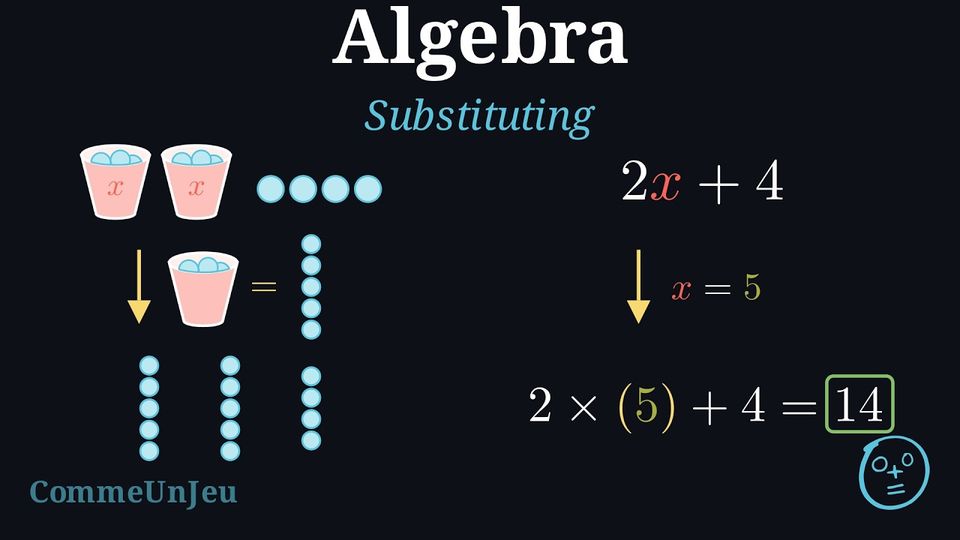
Substituting is replacing a variable in an expression or equation with a specific value.
To avoid confusion with signs, especially when substituting negative values, we usually write substitutions in brackets.
Method — Evaluating
To evaluate an expression, substitute a number for each variable and perform the arithmetic operations. Example


$$\begin{aligned}2x + 4 &= 2 \times \textcolor{olive}{(5)} + 4 \quad (\text{substituting } \textcolor{olive}{x} \text{ by } \textcolor{olive}{5}) \\
&= 10 + 4 \\
&= 14\end{aligned}$$ There are 14 marbles. 
Example
Evaluate the expressions \(3 - 2x\) and \(x^2 + x\) for \(x = -3\).
$$\begin{aligned}[t]3 - 2x &= 3 - 2 \times \textcolor{olive}{(-3)} &&(\text{replacing } x \text{ with } \textcolor{olive}{(-3)}) \\
&= 3 - (-6) \\
&= 3 + 6 \\
&= 9\end{aligned}$$ $$\begin{aligned}[t]x^2 + x &= \textcolor{olive}{(-3)} \times \textcolor{olive}{(-3)} + \textcolor{olive}{(-3)} &&(\text{replacing } x \text{ with } \textcolor{olive}{(-3)}) \\
&= 9 + (-3) \\
&= 6\end{aligned}$$ The brackets keep the sign of \(-3\) attached to the number.
Method — Testing an Equality
To test whether an equality between two expressions is true for a given value of the letter: - Substitute the value into each side separately — the same value everywhere the letter appears.
- Compute each side.
- Compare: same result, the equality is true for that value; different results, it is false for that value.
Example
Test the equality \(4n = 15 + n\) for \(n = 5\), then for \(n = 8\).
For \(n = 5\), each side separately: $$4 \times 5 = 20 \qquad\text{and}\qquad 15 + 5 = 20.$$ Same result: the equality is true for \(n = 5\).
For \(n = 8\): $$4 \times 8 = 32 \qquad\text{and}\qquad 15 + 8 = 23.$$ Different results: the equality is false for \(n = 8\). One equality, two verdicts — a test only ever speaks for its own value.
For \(n = 8\): $$4 \times 8 = 32 \qquad\text{and}\qquad 15 + 8 = 23.$$ Different results: the equality is false for \(n = 8\). One equality, two verdicts — a test only ever speaks for its own value.
Skills to practice
- Evaluating Expressions
- Testing an Equality: Level 1
- Testing an Equality: Level 2
V
Proving and Refuting
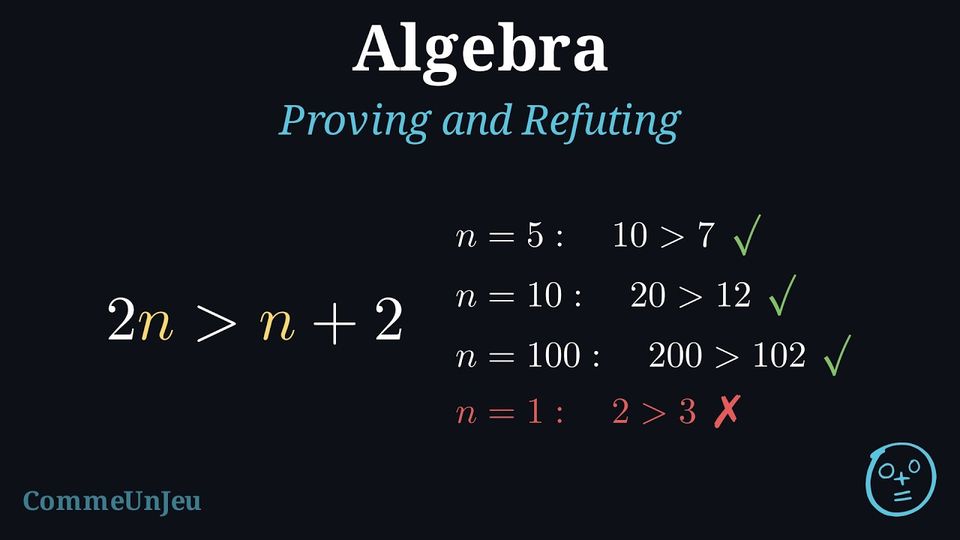
Some equalities are true for every value of the letter — they are identities. A claim that begins with “for every number” cannot be proved by tests: a thousand favourable values prove nothing — though one unfavourable value is enough to destroy it. Two tools decide such claims: algebra proves, and a counter-example refutes.
Method — Proving a General Property with Algebra
- Name the numbers with letters: a whole number is \(n\), its successor is \(n + 1\), twice the number is \(2n\).
- Translate the property into an expression.
- Transform the expression — collect like terms, and expand brackets with the distributive law — until the announced form appears.
- Conclude: the equality holds for every value of the letter at once — which no list of examples can ever do.
Example
Prove that the sum of a whole number and its successor is always an odd number.
Let \(n\) be a whole number; its successor is \(n + 1\). Their sum: $$\begin{aligned}[t]n + (n + 1) &= 2n + 1. && (\text{collect like terms})\end{aligned}$$ Now \(2n\) is twice \(n\), an even number — so \(2n + 1\), one more than an even number, is odd. This is proved for every whole number \(n\) at once. Illustration (not a proof): \(n = 4\) gives \(4 + 5 = 9\), odd indeed.
Method — Refuting with a Counter-Example
A claim of the form “for every number…” is refuted by one single value for which it fails: - Test the claim on values of the letter.
- Exhibit one value that fails, computing both sides — this value is a counter-example.
- Conclude: the claim is false. One counter-example suffices; checking many favourable values never proves.
Example
Zoé claims: “for every whole number \(n\), we have \(2n > n + 2\)”. She checked \(n = 5\), \(n = 10\) and \(n = 100\). Refute her claim.
Test \(n = 1\): $$2 \times 1 = 2 \qquad\text{and}\qquad 1 + 2 = 3,$$ and \(2 > 3\) is false: \(n = 1\) is a counter-example, so the claim is refuted. Zoé's three checks were correct — \(10 > 7\), \(20 > 12\), \(200 > 102\) — but favourable values, however many, never prove a “for every”: one failure destroys it.
Note the asymmetry: to prove “for every number”, checking examples is never enough — it takes a reasoning that covers all values at once, and algebra is such a tool; to refute, one single number is enough. Tests can only ever do the second job.
Method — Conjecturing with a Spreadsheet or an Algorithm
Tests never prove a claim about every number, but they are how such a claim is found. Running a calculation program for many starting numbers can reveal a regularity; stated for every starting number, this regularity is a conjecture — a claim that seems true and is not yet proved. - Run the program for many starting numbers, with a spreadsheet or with an algorithm.
- Read the regularity in the results: always the same number, always twice the starting number, always an odd number…
- State the conjecture for every starting number: “whatever the starting number, the result is…”.
- Prove it or refute it: however many rows agree, a conjecture is not a proof. Algebra, with a letter for the starting number, proves it; one single starting number for which it fails, a counter-example, refutes it.
=, and * is the multiplication sign. For the program “multiply by \(2\), add \(3\)”, cell B2 receives =2*A2+3; copying it downwards changes A2 into A3, A4…, so that each row runs the program on its own starting number: | A | B | |
| 1 | Starting number | Result |
| 2 | 1 | =2*A2+3 |
| 3 | 2 | =2*A3+3 |
| 4 | 3 | =2*A4+3 |
With an algorithm: a few lines in natural language do the same work.
| 1 | For \(n\) from \(1\) to \(10\), repeat lines 2 and 3. |
| 2 | Compute the result \(r\) of the program for \(n\). |
| 3 | Display \(n\) and \(r\). |
Example
Consider the program: “choose a number; add \(3\); multiply by \(2\); subtract twice the starting number”. - Run the program in a spreadsheet for several starting numbers.
- State a conjecture.
- Prove it with algebra.
- Cell B2 receives the formula
=(A2+3)*2-2*A2, copied downwards — the brackets make the addition come before the multiplication, as in the program. With starting numbers chosen small, large and decimal:A B 1 Starting number Result 2 \(0\) \(6\) 3 \(1\) \(6\) 4 \(2\) \(6\) 5 \(5\) \(6\) 6 \(10\) \(6\) 7 \(2.5\) \(6\) - Every row displays \(6\). Conjecture: whatever the starting number, the result is \(6\). Six rows are six tests, not a proof.
- Call \(n\) the starting number. The program builds, step by step: $$\begin{aligned}[t] n &\longrightarrow n + 3 && \text{(add 3)}\\ &\longrightarrow 2(n + 3) && \text{(multiply by 2)}\\ &\longrightarrow 2(n + 3) - 2n && \text{(subtract twice \(n\))}. \end{aligned}$$ Then: $$\begin{aligned}[t] 2(n + 3) - 2n &= 2n + 6 - 2n && \text{(distributivity)}\\ &= 0 + 6 && (2n - 2n = 0)\\ &= 6. \end{aligned}$$ The result is \(6\) for every starting number \(n\): the conjecture is proved. The spreadsheet showed it for six numbers; algebra shows it for all of them at once, and explains it: the multiplication by \(2\) doubles the starting number, the last step subtracts twice the starting number, and only \(2 \times 3 = 6\) remains.
Skills to practice
- Deciding What a Test Proves
- Conjecturing from a Table of Values
- Proving a General Property
- Refuting with a Counter-Example
- Conjecturing Then Proving
VI
Going further
Skills to practice
- Reasoning and Problem-Solving
- Quiz
Jump to section