International Baccalaureate · MYP 3
Formulae and Patterns
I
Using Formulae
I.1
Formulae and Their Subject
Definition — Formula
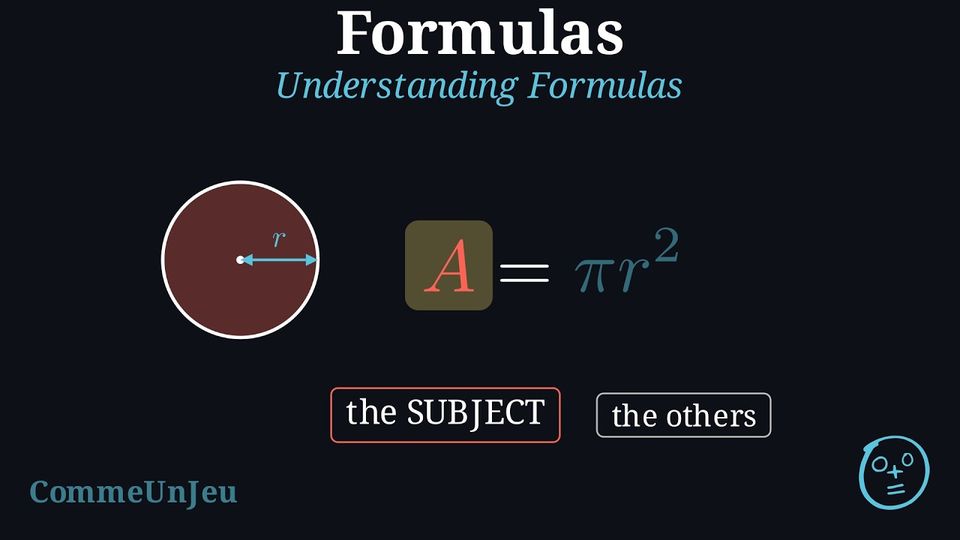
A formula is an equality that expresses one quantity in terms of others; its letters are variables. The single variable that stands alone on one side of the equality is called the subject of the formula. Example
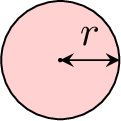 In the formula for the area of a circle, \(A = \pi r^2\), the subject is the area, \(A\).
Example
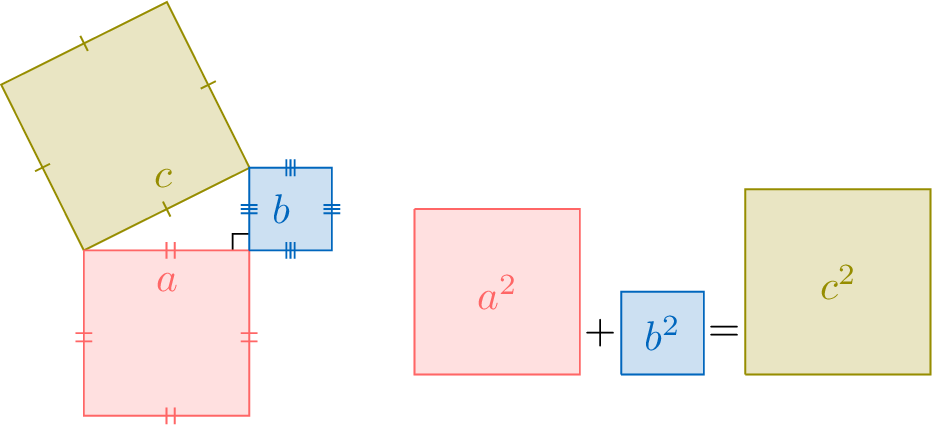 In Pythagoras' theorem, \(c^2 = a^2 + b^2\), it is \(c^2\) that stands alone on one side: the formula is not yet solved for \(c\).
Example
In each formula below, the variable to find is not the subject. - The area of a disc of radius \(r\) is \(A = \pi r^2\). A disc has an area of \(50\,\mathrm{cm}^2\). Find its radius \(r\), rounded to 2 decimal places.
- The volume of a cube of edge \(x\) is \(V = x^3\). A cube has a volume of \(64\,\mathrm{cm}^3\). Find \(x\).
- Substituting \(A = 50\) turns the formula into an equation whose unknown is \(r\). The unknown is squared, then multiplied by \(\pi\): we undo these operations in reverse order, the multiplication by \(\pi\) first, then the square. $$\begin{aligned}[t] 50 &= \pi r^2 && \text{(substituting \(A = 50\))}\\ r^2 &= \dfrac{50}{\pi} && \text{(dividing both sides by \(\pi\))}\\ r &= \sqrt{\dfrac{50}{\pi}} && \text{(taking the square root; a radius is positive)}\\ r &\approx 3.99 && \text{(rounding to 2 decimal places)} \end{aligned}$$ The radius is about \(3.99\) cm. Check: \(\pi \times 3.99^2 \approx 50.0\).
- Substituting \(V = 64\) gives an equation whose unknown \(x\) is cubed: we undo the cube with a cube root. $$\begin{aligned}[t] 64 &= x^3 && \text{(substituting \(V = 64\))}\\ x &= \sqrt[3]{64} && \text{(taking the cube root of both sides)}\\ x &= 4 && \text{(since \(4 \times 4 \times 4 = 64\))} \end{aligned}$$ The edge of the cube is \(4\) cm.
Skills to practice
- Finding an Unknown in a Formula
II
Constructing Formulae
II.1
Constructing a Formula
Method — Constructing a Formula
To construct a formula from a description or pattern: - Define variables: Assign symbols (e.g., \(x, y, C\)) to represent the quantities involved.
- Identify the relationship: Describe in words how the variables are connected. Look for a fixed starting amount (a constant) and a rate of change (a coefficient), or another pattern connecting them.
- Translate to algebra: Write the relationship as a formula.
Example
A taxi charges a \(\dollar 3\) initial fee, plus \(\dollar 2\) for every kilometre travelled. Construct a formula for the total cost, \(C\), of a journey of \(d\) kilometres. - Variables are defined: \(C\) for total cost and \(d\) for distance in kilometres.
- The relationship is: The total cost is the fixed fee of \(\dollar 3\) plus \(\dollar 2\) multiplied by the number of kilometres.
- The formula is: $$C = 2d + 3$$
Method — Constructing a Formula from a Pattern
One of the most powerful skills in mathematics is the ability to observe a pattern and generalise it into a formula. - Analyse specific cases: Start by collecting data from the first few examples in the pattern. Organise this data in a table.
- Identify the relationship: Look for a rule that connects the case number (e.g., diagram number, \(n\)) to the result (e.g., number of matchsticks, \(M\)). Look for a starting value and a common difference.
- Generalise the rule: Write the observation as a formula using variables.
- Test the formula: Check that the formula works for the cases analysed, then use it to predict the next case.
Example
Derive the formula for the area of a rectangle. - Specific Case: Consider a rectangle with a length of 4 units and a width of 3 units. We can calculate its area by counting the unit squares inside, which can be seen as 4 columns of 3 squares each.
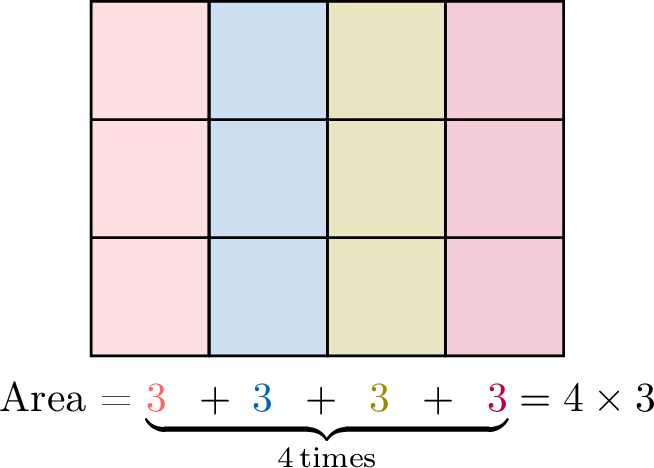
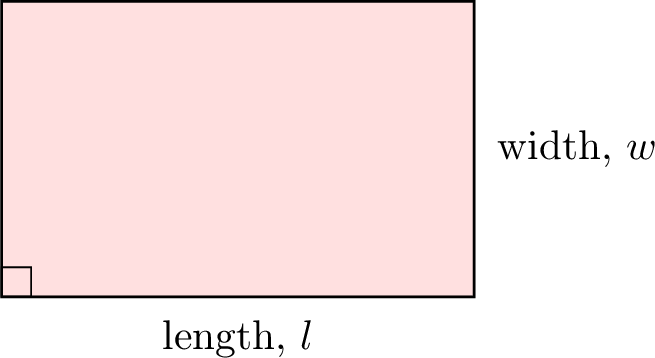
- General Case: We generalise this observation. For any rectangle with length \(l\) and width \(w\), the area \(A\) is given by the product of its dimensions.
Example
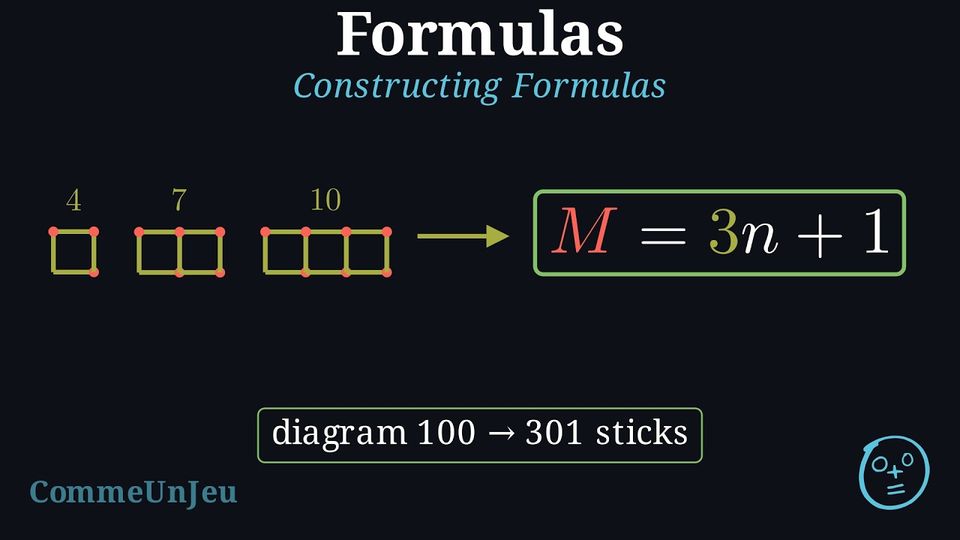
Examine the pattern of squares made from matchsticks: 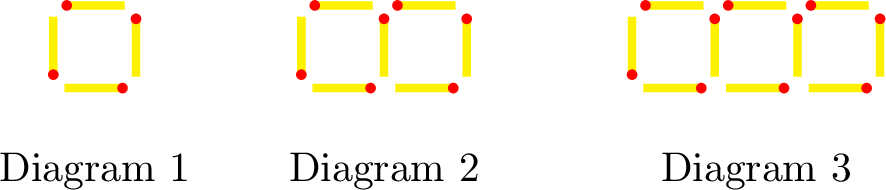
- Analyse specific cases: We count the matchsticks in each diagram and create a table.
Diagram Number (\(n\)) 1 2 3 Number of Matchsticks (\(M\)) 4 7 10 - Identify the relationship: We start with 4 matchsticks. To get to the next diagram, we add 3 more matchsticks each time. The common difference is 3. This indicates a linear relationship.
- Diagram 1: \(4\)
- Diagram 2: \(4 + 3\)
- Diagram 3: \(4 + 3 + 3 = 4 + 2 \times 3\)
- Generalise the rule: For Diagram \(n\), we start with 4 and add 3 a total of \((n-1)\) times. $$M = 4 + 3(n-1)$$ By expanding and simplifying, we get: $$M = 4 + 3n - 3 \implies M = 3n + 1$$
- Test the formula:
- For \(n=1\): \(M = 3(1) + 1 = 4\). Correct.
- For \(n=2\): \(M = 3(2) + 1 = 7\). Correct.
- For \(n=3\): \(M = 3(3) + 1 = 10\). Correct.
Skills to practice
- Modelling Linear Relationships with Algebra
- Modelling Areas and Volumes with Algebra
- Finding Patterns and Writing Formulae
III
Going further
Skills to practice
- Constructing and Checking Perimeter Formulae
- Quiz
Jump to section