International Baccalaureate · PYP 5
Volume and Capacity
I
Units of Volume from mm³ to m³
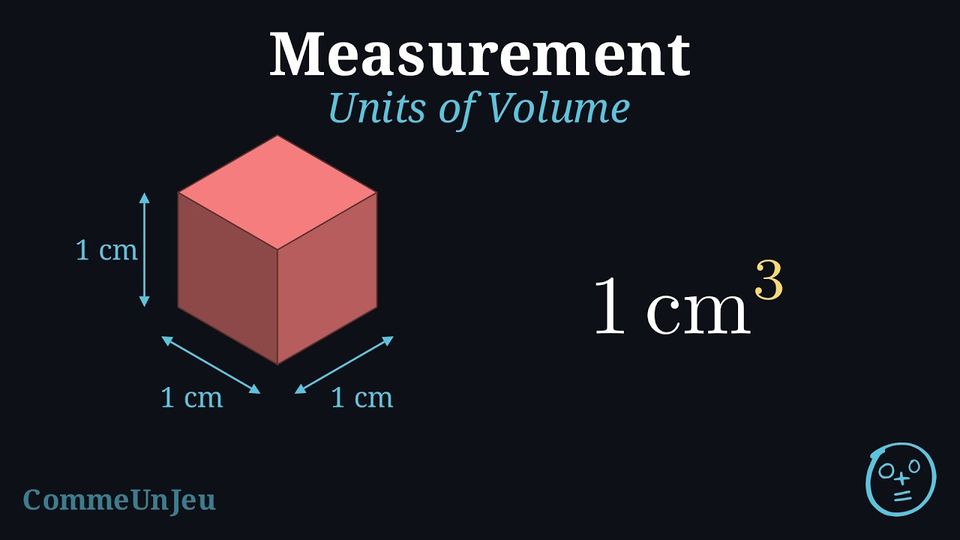
Definition — Units of Volume
- Cubic Millimetre \(\left(\mathrm{mm}^3\right)\): the volume of a cube with edges 1 mm long. This is about the size of a tiny grain of sand.


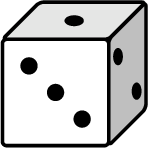
- Cubic Centimetre \(\left(\mathrm{cm}^3\right)\): the volume of a cube with edges 1 cm long. This is about the size of a small die.

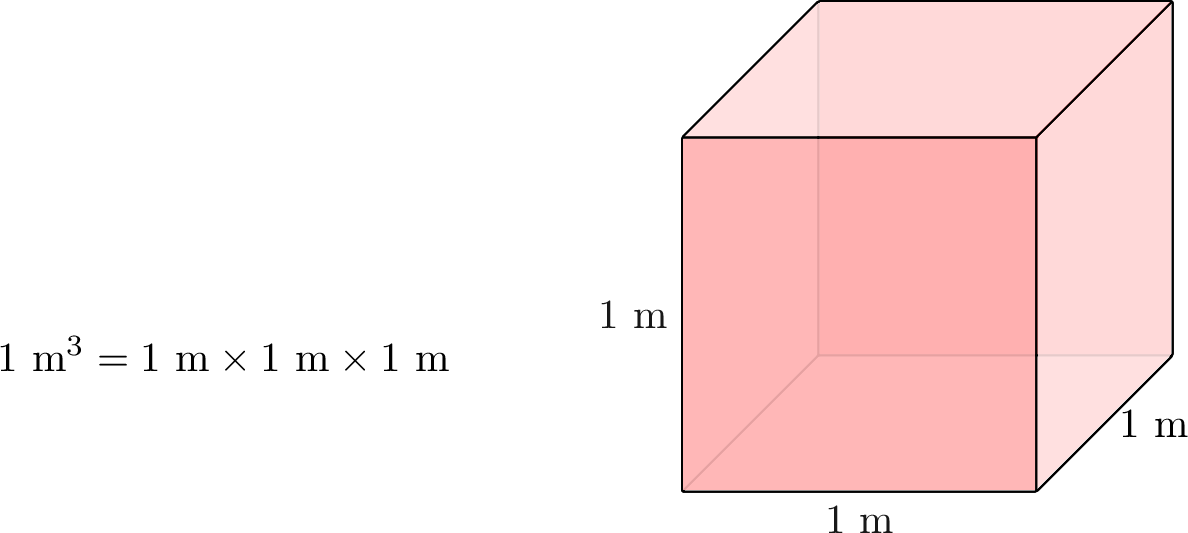
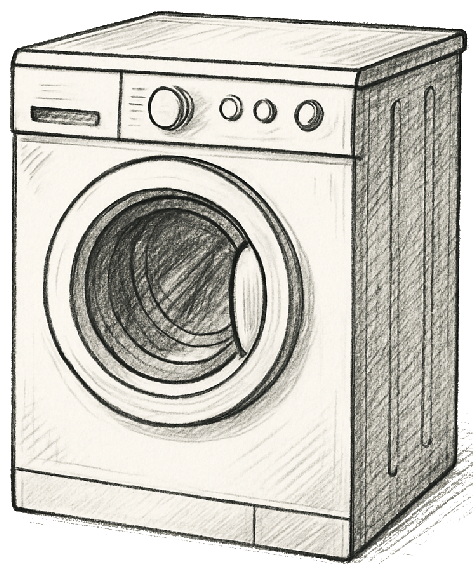
- Cubic Metre \(\left(\mathrm{m}^3\right)\): the volume of a cube with edges 1 m long. Three washing machines together take up about 1 cubic metre.
Skills to practice
- Choosing Units for Volume
II
Conversion of Volume Units
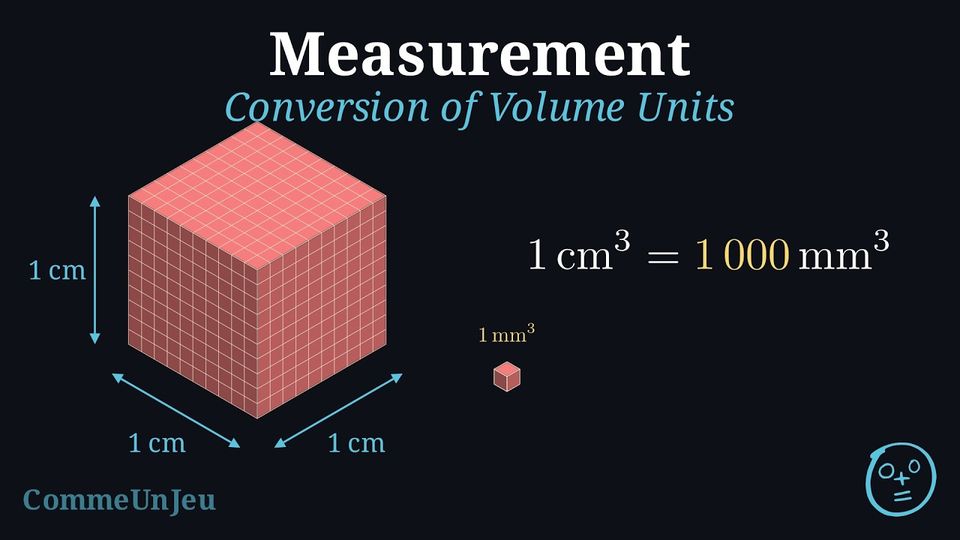
Here is how volume units are related. Consider a cube with a volume of 1 \(\mathrm{cm}^3\). Since \(1 \,\text{cm} = 10 \,\text{mm}\), each side of this cube is \(10 \,\text{mm}\) long. 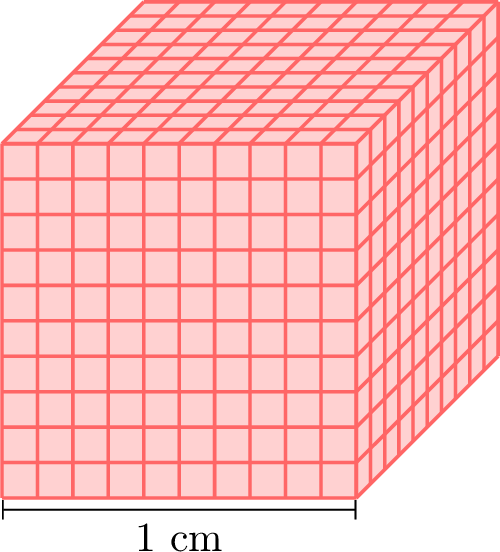
The volume of this cube is \(10 \,\text{mm} \times 10 \,\text{mm} \times 10 \,\text{mm}\).
The bottom layer has \(10 \times 10 = 100\) small cubes. Since the height is \(10 \,\text{mm}\), there are 10 layers.
Therefore, the total number of \(1 \,\mathrm{mm}^3\) cubes is \(100 \times 10 = 1\,000\).
$$\begin{aligned} 1 \, \text{cm}^3 &= 1 \, \text{cm} \times 1 \, \text{cm} \times 1 \, \text{cm} \\ &= 10 \, \text{mm} \times 10 \, \text{mm} \times 10 \, \text{mm} \quad (1 \, \text{cm} = 10 \, \text{mm}) \\ &= 1\,000 \, \text{mm}^3 \end{aligned}$$ So \(1 \,\text{cm}^3\) is the same as \(1\,000 \,\text{mm}^3\). This shows that when converting volume units, the conversion factor is cubed (for example, \(10\) becomes \(10^3 = 1\,000\)). The same reasoning works for the cubic metre: \(1 \,\text{m} = 100 \,\text{cm}\), so a cube of edge \(1 \,\text{m}\) holds \(100 \times 100 \times 100\) cubes of \(1 \,\text{cm}^3\), and \(1 \,\text{m}^3 = 1\,000\,000 \,\text{cm}^3\).
Proposition — Conversion of Volume Units
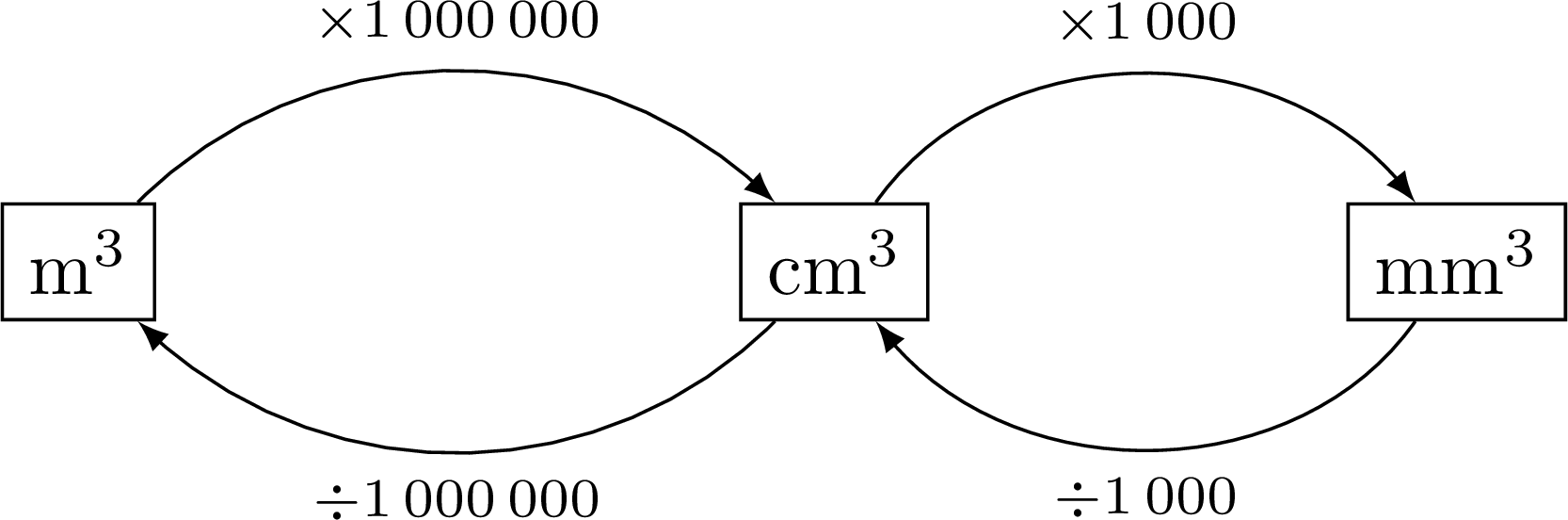
Because we multiply three lengths to get a volume, the conversion factors are cubed. - \(1 \, \text{cm} = 10 \, \text{mm}\), so \(1 \, \text{cm}^3 = (10 \times 10 \times 10) \, \text{mm}^3 = \mathbf{1\,000} \, \text{mm}^3\)
- \(1 \, \text{m} = 100 \, \text{cm}\), so \(1 \, \text{m}^3 = (100 \times 100 \times 100) \, \text{cm}^3 = \mathbf{1\,000\,000} \, \text{cm}^3\)
Method — Converting Using Multiplication or Division
- Use multiplication to go from a larger unit to a smaller one (like cubic metres to cubic centimetres).
- Use division to go from a smaller unit to a larger one (like cubic centimetres to cubic metres).
Method — Converting Using the Cubed Factor
To convert a volume, we start from the factor between the lengths, then cube it. 
- Find the volume factor between the two units: the length factor, cubed.
- Multiply by this factor to go to a smaller unit; divide by it to go to a larger unit.
- Move the decimal point: multiplying by \(1\,000\) or \(1\,000\,000\) moves it \(3\) or \(6\) places to the right; dividing moves it to the left. Fill any empty places with zeros.
Skills to practice
- Converting Volume Units
III
Litres and Millilitres with Decimals
Method — Converting Litres and Millilitres
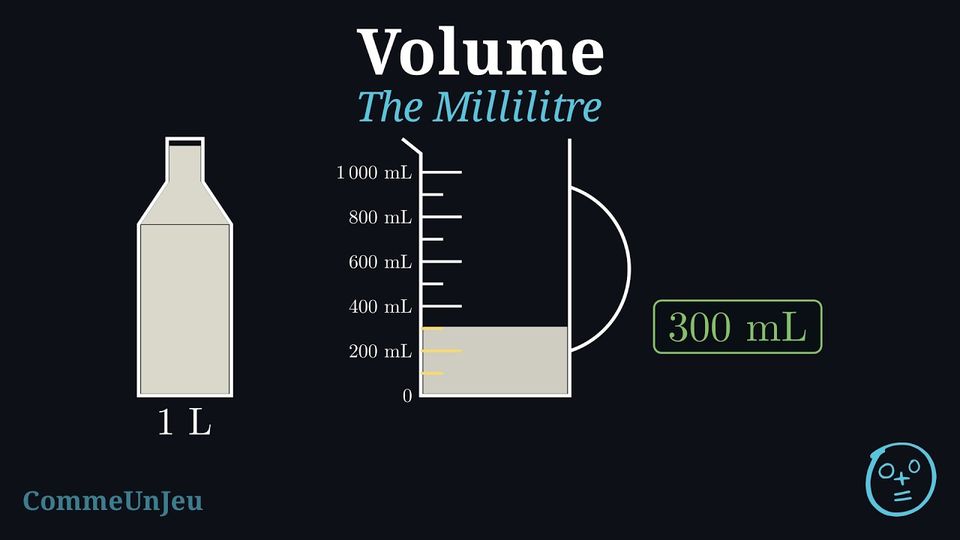
Since \(1~\mathrm{L} = 1\,000~\mathrm{mL}\): - From litres to millilitres, each litre becomes \(1\,000~\mathrm{mL}\): \(3~\mathrm{L} = 3\,000~\mathrm{mL}\), and \(2~\mathrm{L}~350~\mathrm{mL} = 2\,000~\mathrm{mL} + 350~\mathrm{mL} = 2\,350~\mathrm{mL}\).
- From millilitres to litres, group the millilitres by thousands: each thousand makes \(1~\mathrm{L}\). \(5\,000~\mathrm{mL} = 5~\mathrm{L}\), and \(1\,750~\mathrm{mL} = 1\,000~\mathrm{mL} + 750~\mathrm{mL} = 1~\mathrm{L}~750~\mathrm{mL}\).
- Check: the millilitres left after the litres are always fewer than \(1\,000\).
Example — Litres and Millilitres with Decimals
- A bottle of water holds \(1.5~\mathrm{L}\). Write this capacity in millilitres.
- A carton of juice holds \(750~\mathrm{mL}\). Write this capacity in litres.
- A jug holds \(2~\mathrm{L}~300~\mathrm{mL}\). Write this capacity in litres, as a decimal.
Since \(1~\mathrm{L} = 1\,000~\mathrm{mL}\), one millilitre is a thousandth of a litre: \(1~\mathrm{mL} = 0.001~\mathrm{L}\). From litres to millilitres, multiply by \(1\,000\); from millilitres to litres, divide by \(1\,000\). 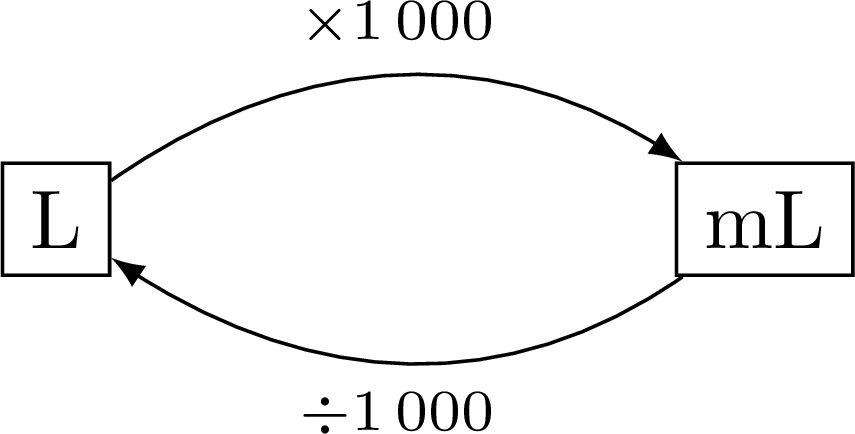
- From litres to millilitres: $$\begin{aligned} 1.5~\mathrm{L} &= 1.5 \times 1\,000~\mathrm{mL} &&\text{(}1~\mathrm{L} = 1\,000~\mathrm{mL}\text{)}\\ &= \textcolor{colorprop}{1\,500~\mathrm{mL}} \end{aligned}$$ Multiplying by \(1\,000\) moves the decimal point \(3\) places to the right: \(1.5\) becomes \(1\,500\). Check: \(1.5~\mathrm{L}\) is one litre and a half, and \(1\,000~\mathrm{mL} + 500~\mathrm{mL} = 1\,500~\mathrm{mL}\).
- From millilitres to litres: $$\begin{aligned} 750~\mathrm{mL} &= (750 \div 1\,000)~\mathrm{L} &&\text{(}1~\mathrm{mL}\text{ is a thousandth of a litre)}\\ &= \textcolor{colorprop}{0.75~\mathrm{L}} \end{aligned}$$ Dividing by \(1\,000\) moves the decimal point \(3\) places to the left: \(750\) becomes \(0.750\), that is \(0.75\). Check: \(750~\mathrm{mL}\) is less than \(1\,000~\mathrm{mL}\), and \(0.75~\mathrm{L}\) is less than \(1~\mathrm{L}\).
- The whole litres stay whole; the millilitres that do not make a whole litre (here \(300\), fewer than \(1\,000\)) become the decimal part: $$\begin{aligned} 2~\mathrm{L}~300~\mathrm{mL} &= 2~\mathrm{L} + (300 \div 1\,000)~\mathrm{L} &&\text{(}1~\mathrm{mL}\text{ is a thousandth of a litre)}\\ &= 2~\mathrm{L} + 0.3~\mathrm{L} &&\text{(the point moves 3 places left)}\\ &= \textcolor{colorprop}{2.3~\mathrm{L}} \end{aligned}$$ Careful with the zeros: \(30~\mathrm{mL} = 0.03~\mathrm{L}\), so \(2~\mathrm{L}~30~\mathrm{mL} = 2.03~\mathrm{L}\), not \(2.3~\mathrm{L}\).
Skills to practice
- Deciding Which Container Holds More
- Converting Litres and Millilitres with Decimals
- Reading a Measuring Jug in Litres
IV
Capacity and Volume
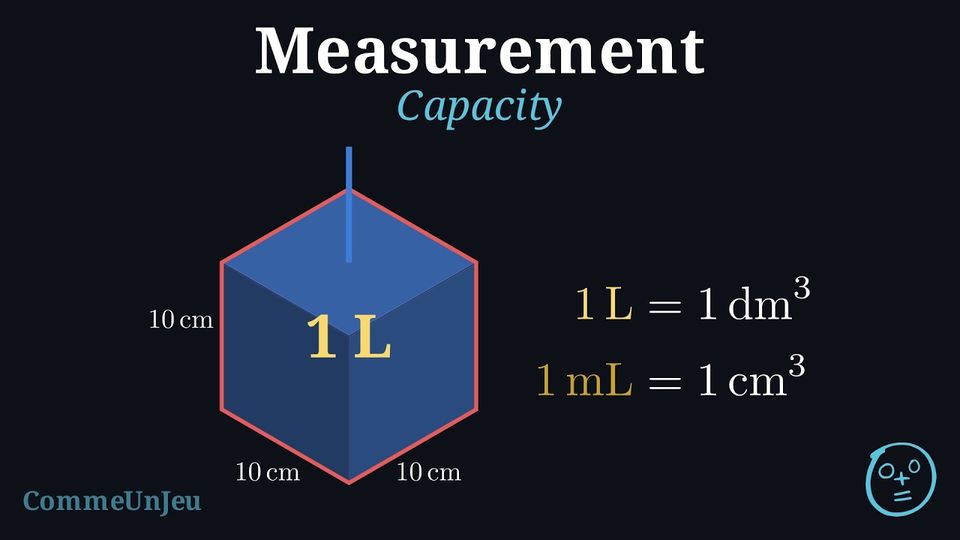
So far, volume has measured the space an object takes up, in cubic units like \(\text{cm}^3\) and \(\text{m}^3\). When we measure how much a container can hold — especially a liquid like water, milk, or juice — we talk about its capacity, and we use the litre (L).
Capacity and volume measure the same kind of thing, so their units match up exactly: $$ 1 \,\text{mL} = 1 \,\text{cm}^3, \qquad 1 \,\text{L} = 1\,000 \,\text{cm}^3, \qquad 1\,000 \,\text{L} = 1 \,\text{m}^3 . $$ Using litres and millilitres makes liquid amounts easier to compare and understand.
A box measures \(10\) cm on each side, on the inside. It is filled with water to the top: how many litres of water does it hold?
Proposition — Volume of a Rectangular Prism
The volume of a rectangular prism (also called a cuboid) is found by multiplying its length, width, and height: $$\text{Volume} = \textcolor{colordef}{\text{length}} \times \textcolor{colorprop}{\text{width}} \times \textcolor{olive}{\text{height}}$$ $$V = \textcolor{colordef}{l} \times \textcolor{colorprop}{w} \times \textcolor{olive}{h}$$ 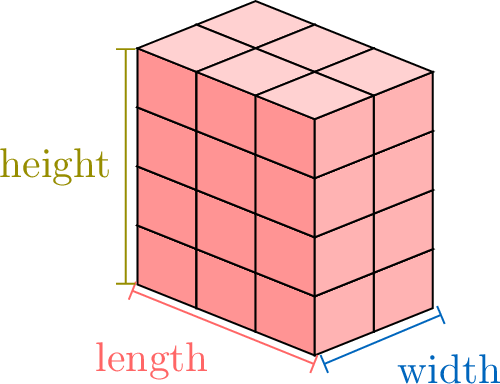
Example — From Cubic Centimetres to Litres
Leo has a cube-shaped box. Measured on the inside, it is \(10~\mathrm{cm}\) long, \(10~\mathrm{cm}\) wide and \(10~\mathrm{cm}\) high. 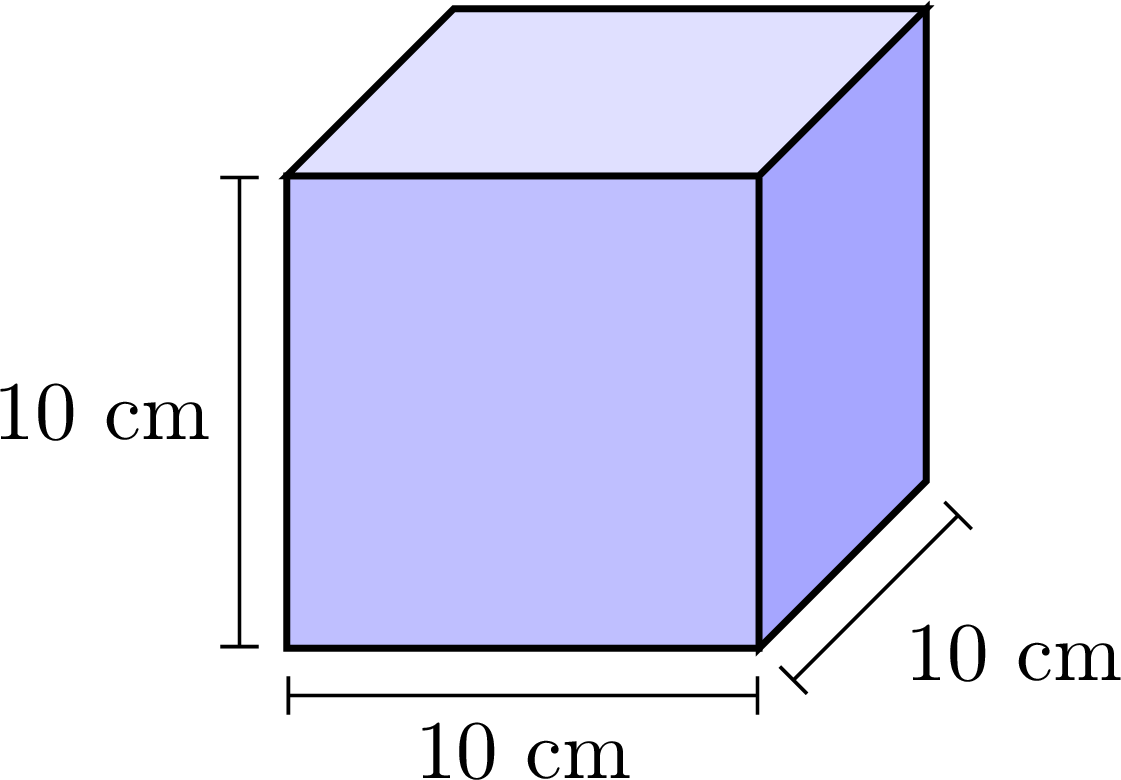
- Find the volume of the box in cubic centimetres.
- Leo fills the box to the top with water. How much water does it hold, in millilitres, then in litres?
- A water tank has a volume of \(1~\mathrm{m}^3\). How many litres of water does it hold?
- Inside, the box is a rectangular prism whose three edges measure \(10~\mathrm{cm}\): $$\begin{aligned} V &= \text{length} \times \text{width} \times \text{height} &&\text{(volume of a rectangular prism)}\\ &= 10~\mathrm{cm} \times 10~\mathrm{cm} \times 10~\mathrm{cm}\\ &= 100 \times 10~\mathrm{cm}^3\\ &= \textcolor{colorprop}{1\,000~\mathrm{cm}^3} \end{aligned}$$
- One millilitre of water fills exactly one cubic centimetre, so each of the \(1\,000\) cubic centimetres of the box holds \(1~\mathrm{mL}\): $$\begin{aligned} 1\,000~\mathrm{cm}^3 &= 1\,000~\mathrm{mL} &&\text{(}1~\mathrm{cm}^3 = 1~\mathrm{mL}\text{)}\\ &= (1\,000 \div 1\,000)~\mathrm{L} &&\text{(}1\,000~\mathrm{mL} = 1~\mathrm{L}\text{)}\\ &= \textcolor{colorprop}{1~\mathrm{L}} \end{aligned}$$ The box holds \(1\,000~\mathrm{mL}\), that is \(1~\mathrm{L}\). Its edges measure \(10~\mathrm{cm} = 1~\mathrm{dm}\): it is the cubic decimetre. So one litre is one cubic decimetre: $$1~\mathrm{L} = 1~\mathrm{dm}^3 = 1\,000~\mathrm{cm}^3.$$
- A cubic metre is a cube of edge \(1~\mathrm{m}\), that is \(100~\mathrm{cm}\), and each of its cubic centimetres holds one millilitre: $$\begin{aligned} 1~\mathrm{m}^3 &= (100 \times 100 \times 100)~\mathrm{cm}^3 &&\text{(}1~\mathrm{m} = 100~\mathrm{cm}\text{)}\\ &= 1\,000\,000~\mathrm{cm}^3 &&\text{(conversion of volume units)}\\ &= 1\,000\,000~\mathrm{mL} &&\text{(}1~\mathrm{cm}^3 = 1~\mathrm{mL}\text{)}\\ &= (1\,000\,000 \div 1\,000)~\mathrm{L} &&\text{(}1\,000~\mathrm{mL} = 1~\mathrm{L}\text{)}\\ &= \textcolor{colorprop}{1\,000~\mathrm{L}} \end{aligned}$$ The tank holds \(1\,000~\mathrm{L}\) of water: \(1~\mathrm{m}^3 = 1\,000~\mathrm{L}\).
Skills to practice
- Converting Between Units of Volume and Capacity
- Filling a Box with Water
V
Review & Quizz
Skills to practice
- Quiz
Jump to section