International Baccalaureate · PYP 4
3D Shapes
I
The Usual Solids and their Faces
Proposition — The Usual Solids and their Faces
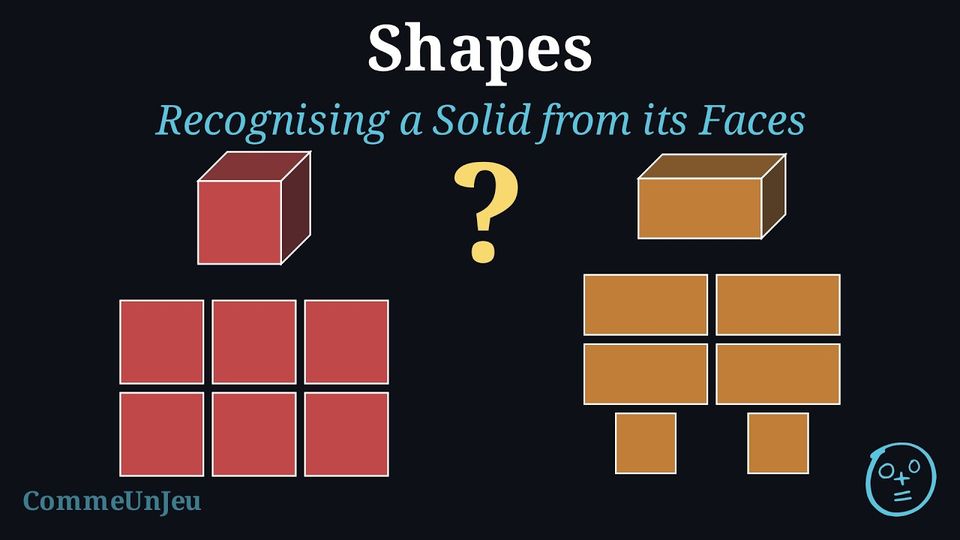
Counting the faces is not enough to tell two solids apart: a cube and a rectangular prism (a box) that is not a cube both have \(6\). What tells them apart is the shape of those faces. Each usual solid is described by how many flat faces it has, what shape they are, and whether it also has a curved surface (the round part). Here face always means a flat face: a curved surface, like the one that wraps a cylinder, is never counted among them. - A cube: 6 faces, all of them squares.
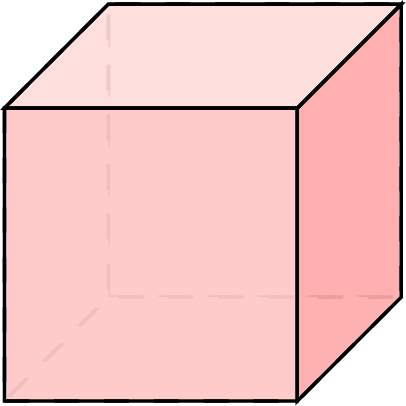
- A rectangular prism (a box): 6 faces, all of them rectangles. When those \(6\) rectangles are all squares, the prism is a cube — a cube is a special rectangular prism.
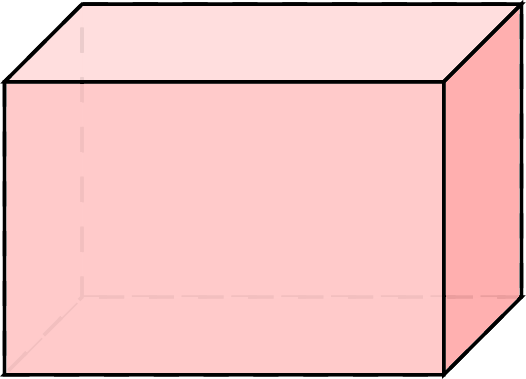
- A right prism: 2 identical polygon bases, one exactly facing the other, and rectangles all around — one rectangle for each side of the base. When the two bases are triangles it is called a triangular prism, and it has \(5\) flat faces: \(2\) triangles and \(3\) rectangles. On a perspective drawing those rectangles look slanted, but rectangles they are. A rectangular prism is itself a right prism, one whose bases are rectangles.
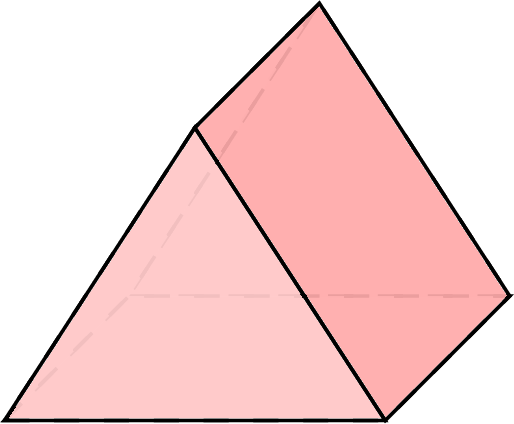
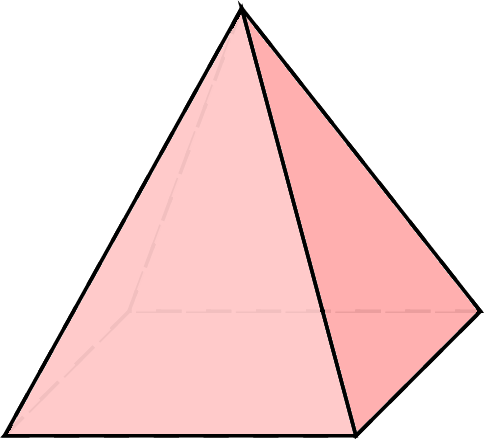
- A pyramid: one polygon base, and triangles that all meet at the same vertex, the apex — one triangle for each side of the base. The usual one is the square pyramid: \(5\) flat faces, \(1\) square and \(4\) triangles.
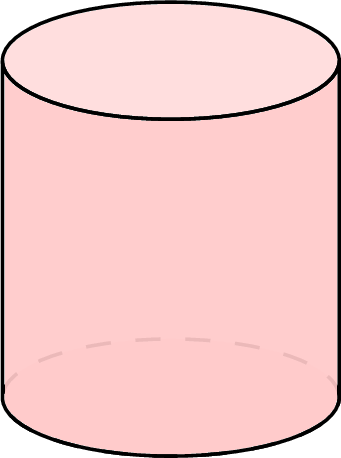
- A cylinder: 2 identical flat faces that are discs, joined by one curved surface. On a perspective drawing those discs are drawn as ellipses, but discs they are.
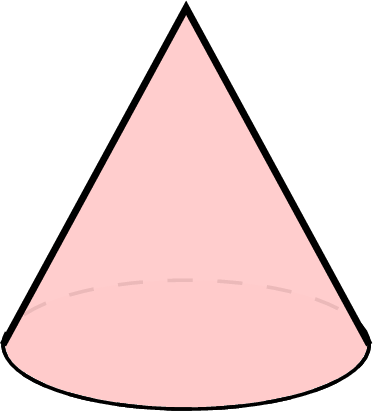
- A cone: one flat face that is a disc — drawn as an ellipse in perspective — and one curved surface that joins the whole rim of that disc to a single point, the apex.
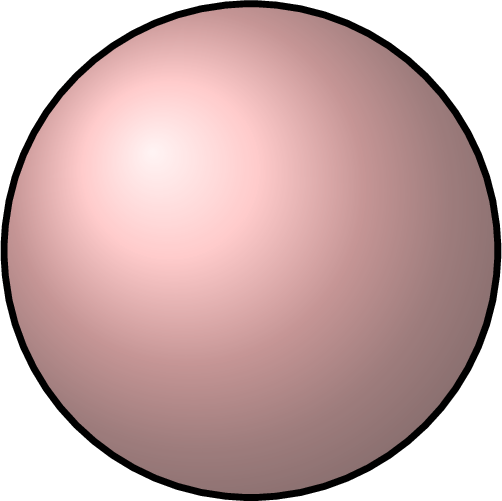
- A ball: no flat face at all, only a single curved surface.
Skills to practice
- Recognising a Solid from its Faces
- Describing a Solid by its Faces
II
Front, Side and Top Views
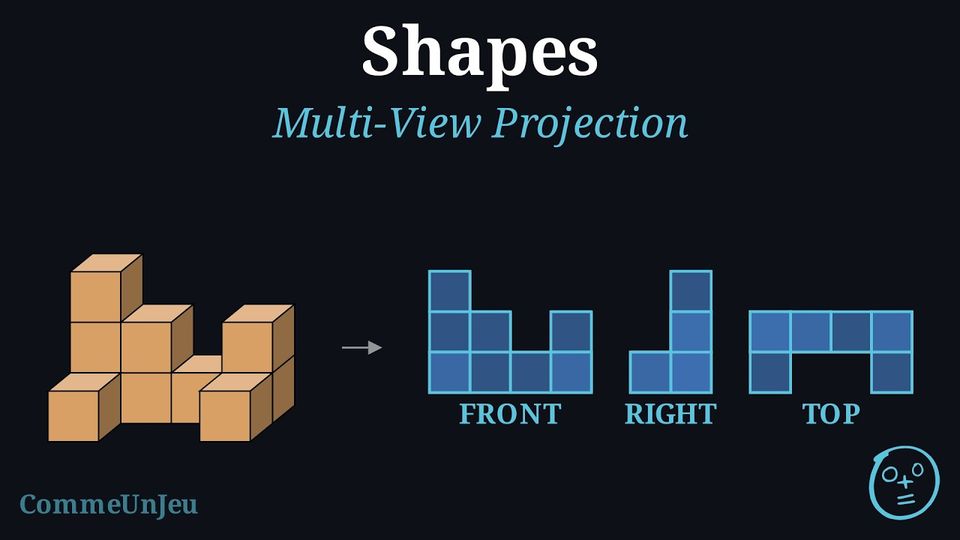
An architect must tell a builder exactly how to stack a set of cube-shaped rooms. She first tries a single drawing in perspective, but the builder is unsure: the cubes hidden at the back could be there or missing, and the perspective makes the heights hard to compare. One picture from one direction does not fix the solid. 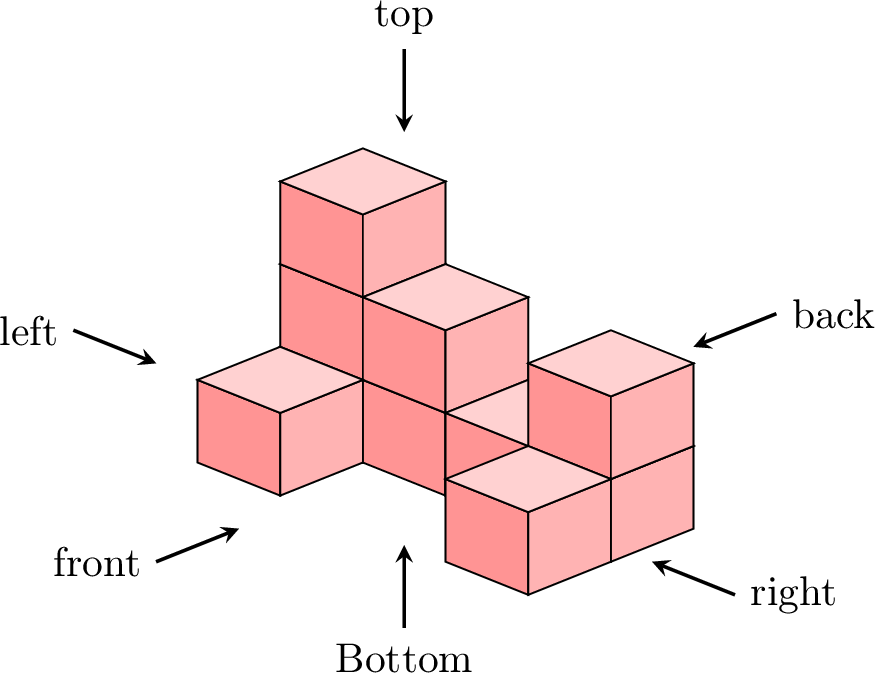
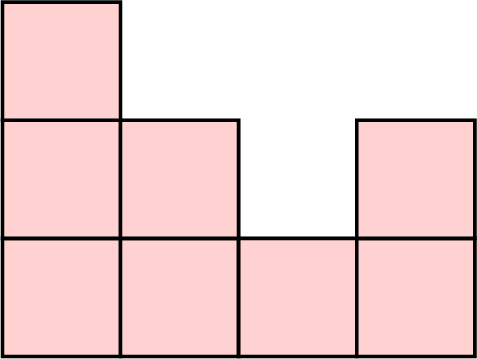
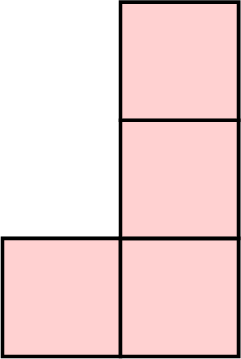
Instead, the architect gives the builder three flat views: how the stack looks from the front, from the right side, and from the top. Each view is a 2D code of one direction; read together, the three views of this stack describe its heights, widths, and depths without any guessing, so the builder can reconstruct it exactly.
| Front view | Right view | Top view |
 |  |  |
Definition — Multi-view Projection
A multi-view projection is a way to show a 3D shape using several 2D drawings. Each drawing shows how the shape looks from a different side, such as the front, the right side, or the top. These views help us understand the shape more clearly. Example
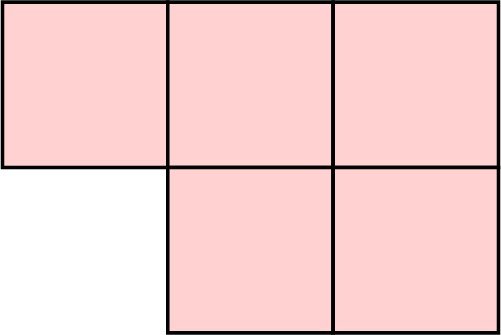
Draw the front, right, and top views of this solid. 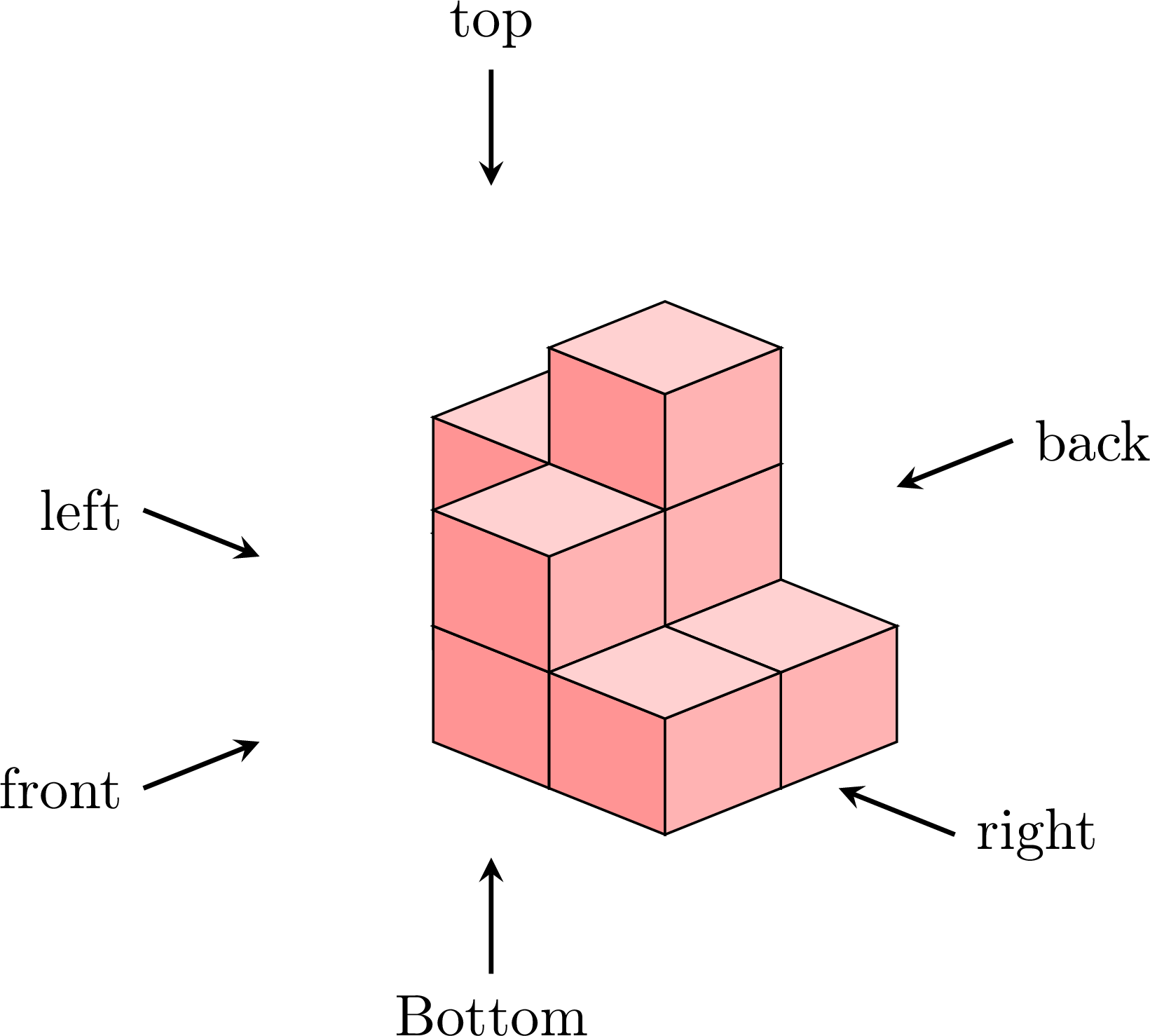
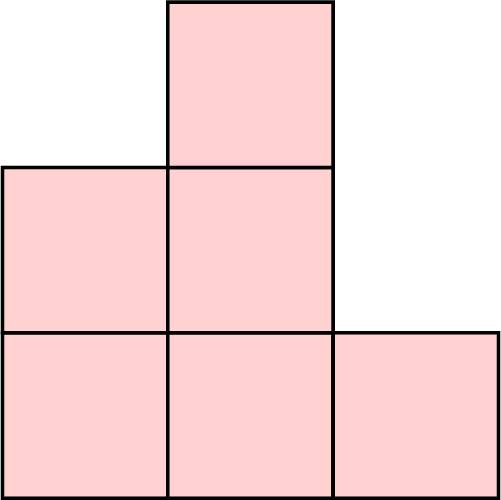
- Front view:\(\quad\)
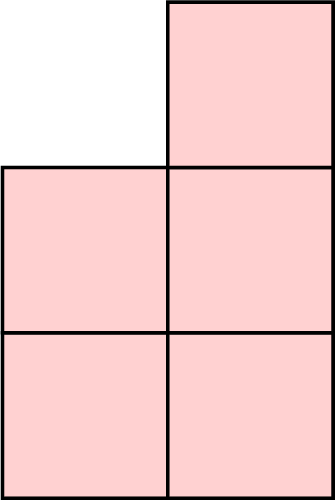
- Right view:\(\quad\)
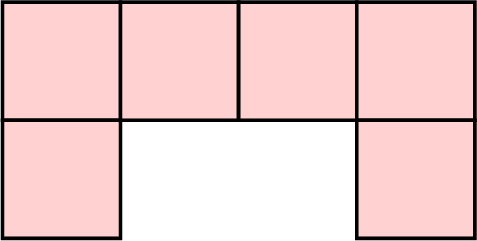
- Top view:\(\quad\)
Skills to practice
- Finding the Projection
- Drawing the Projection
III
The Base Plan of a Cube Assembly
Definition — Base Plan
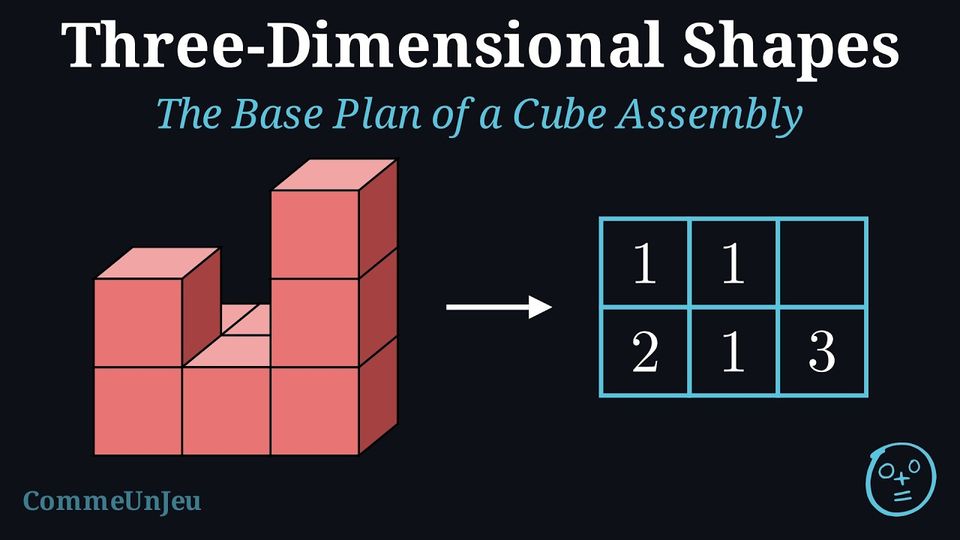
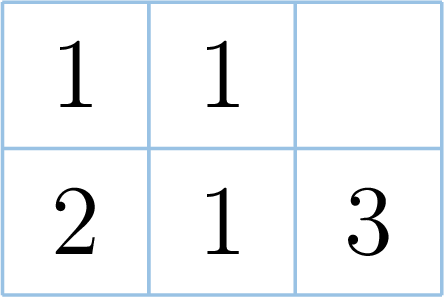
Cubes of the same size are stacked on the squares of a grid. The base plan of the assembly is that grid drawn seen from above, with, in each square, the number of cubes stacked on it. The grid is the smallest rectangle of squares that holds the assembly, and a square carrying no cube is left empty — it still belongs to the plan. 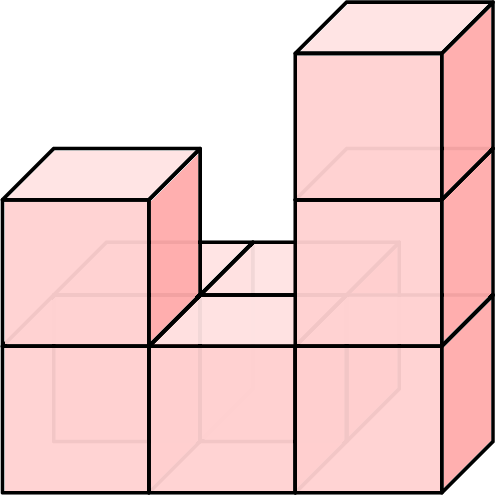 \(\qquad\)
Method — Reading and Writing a Base Plan
- To read a base plan: each number is the height of one stack. The total number of cubes is the sum of all the numbers — and an empty square adds nothing.
- To write the base plan of an assembly: first draw the whole rectangle of the base, empty squares included. Then take the squares one at a time, count the cubes stacked on that square only, and write the number. Leave a square empty if it carries no cube.
- To check: read your plan again square by square against the assembly — each number must be the height of the stack standing on that square. The total of the numbers is also the number of cubes; but that count alone does not check the plan: two different assemblies can have the same one (below).
Proposition — Counting is Not Describing
Two assemblies can be made of exactly the same number of cubes and not look alike at all. Here are two of them: each is made of eight cubes. \(\qquad\)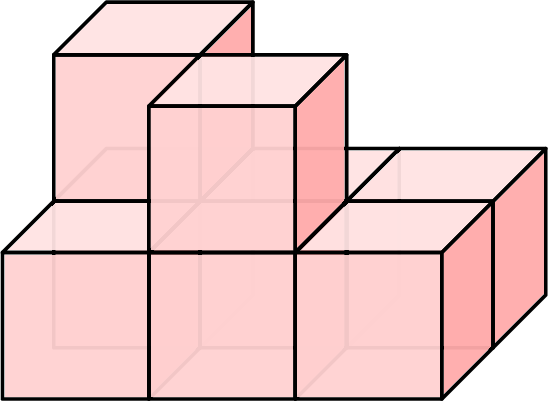 \(\qquad\)
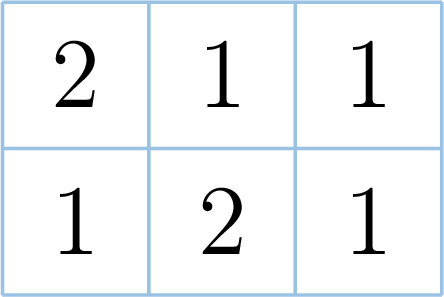
Example
How many cubes does this base plan describe, and which square carries the tallest stack? 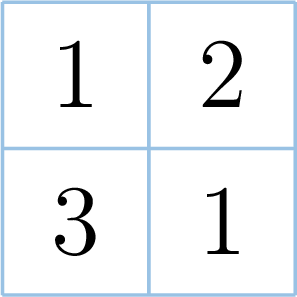
\(3 + 1 + 1 + 2 = \mathbf{7}\) cubes. The tallest stack is the one of three cubes, on the square at the front left. \(\qquad\)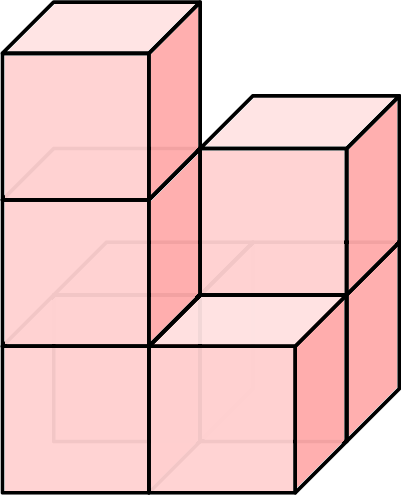
\(\qquad\) Example
Write the base plan of this assembly. 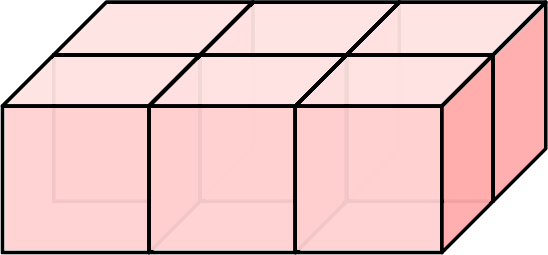
The assembly covers \(3\) squares by \(2\), so we draw that rectangle. Then, square by square: one cube everywhere — no stack is higher than one. The check agrees: \(6\) ones make \(6\) cubes. 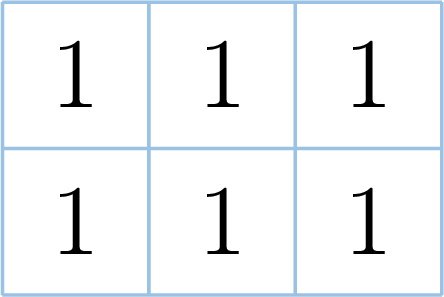
Skills to practice
- Reading and Writing a Base Plan
IV
Review & Quizz
Skills to practice
- Quiz
Jump to section