International Baccalaureate · PYP 2
Times Tables 2, 5 and 10
I
A Tool for Fast Multiplication
There are 5 boxes, each with 9 pencils. 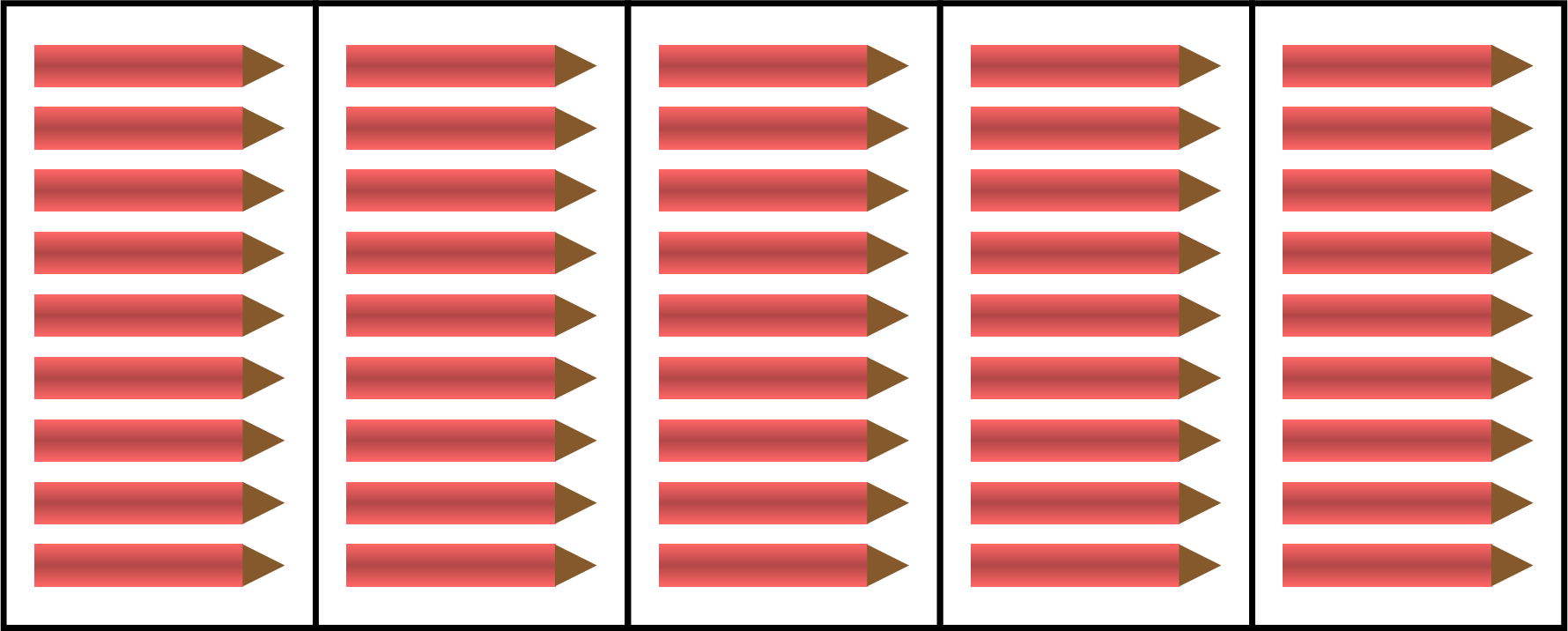
Hugo wants to find the total number of pencils. How many pencils are there in total?
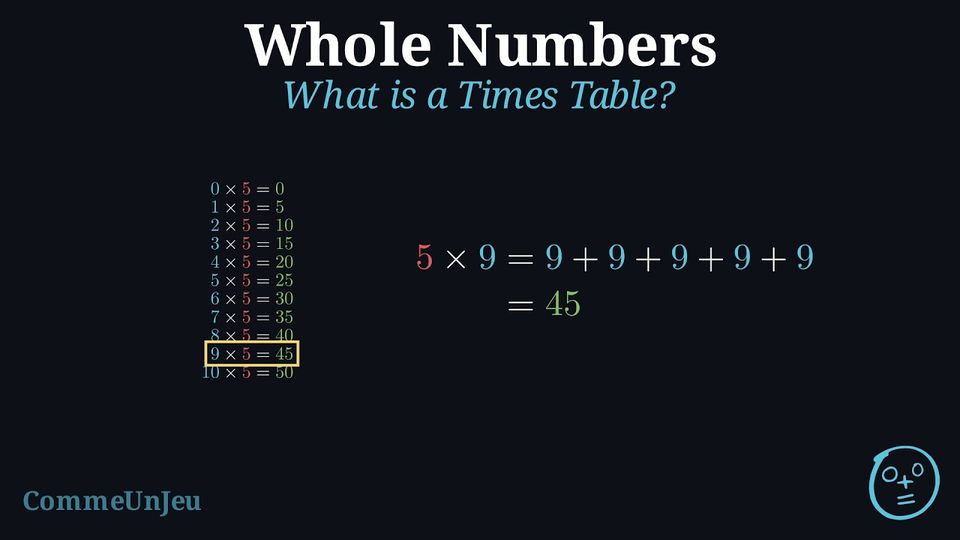
Hugo could use repeated addition: $$9+9+9+9+9$$ But this can be slow. A much faster way is to use multiplication: $$5 \times 9$$ If we know our times tables, we obtain the result immediately: \(\textcolor{colordef}{5}\times \textcolor{colorprop}{9}=\textcolor{olive}{45}\), so there are 45 pencils. The times tables give the result of a multiplication without computing the repeated addition.
Definition — Times Table
A times table is a helpful chart that shows the results of multiplying a number by other numbers (usually from 0 to 10). Each number has its own times table. Example
Use the times table for 5 to calculate \(5\times 9\).$$\begin{aligned}\textcolor{colordef}{5}\times \textcolor{colorprop}{0}&=\textcolor{olive}{0}\\
\textcolor{colordef}{5}\times \textcolor{colorprop}{1}&=\textcolor{olive}{5}\\
\textcolor{colordef}{5}\times \textcolor{colorprop}{2}&=\textcolor{olive}{10 }\\
\textcolor{colordef}{5}\times \textcolor{colorprop}{3}&=\textcolor{olive}{15 }\\
\textcolor{colordef}{5}\times \textcolor{colorprop}{4}&=\textcolor{olive}{20 }\\
\textcolor{colordef}{5}\times \textcolor{colorprop}{5}&=\textcolor{olive}{25 }\\
\textcolor{colordef}{5}\times \textcolor{colorprop}{6}&=\textcolor{olive}{30 }\\
\textcolor{colordef}{5}\times \textcolor{colorprop}{7}&=\textcolor{olive}{35 }\\
\textcolor{colordef}{5}\times \textcolor{colorprop}{8}&=\textcolor{olive}{40 }\\
\textcolor{colordef}{5}\times \textcolor{colorprop}{9}&=\textcolor{olive}{45 }\\
\textcolor{colordef}{5}\times \textcolor{colorprop}{10}&=\textcolor{olive}{50}\end{aligned}$$
Looking at the times table for 5, we can find the line for \(5\times 9\) and see that the answer is 45.
Proposition — The 1s Times Table
The very first times table is the easiest one: multiplying by \(1\) does not change the number. One single group of \(\textcolor{colorprop}{7}\) is just \(\textcolor{colorprop}{7}\): $$\textcolor{colordef}{1}\times \textcolor{colorprop}{7}=\textcolor{olive}{7} \qquad \textcolor{colordef}{7}\times \textcolor{colorprop}{1}=\textcolor{olive}{7}$$ This works for every number: the 1s times table repeats each number.
Multiplying by 0
Every times table starts with a line for \(0\). Here are \(\textcolor{colordef}{3}\) empty boxes: \(\textcolor{colordef}{3}\) groups of \(\textcolor{colorprop}{0}\) pencils. There is no pencil at all. 
$$\textcolor{colordef}{3}\times \textcolor{colorprop}{0}=\textcolor{olive}{0}$$ With no box at all, there is no pencil either: \(\textcolor{colordef}{0}\) groups of \(\textcolor{colorprop}{9}\) make \(\textcolor{olive}{0}\). $$\textcolor{colordef}{0}\times \textcolor{colorprop}{9}=\textcolor{olive}{0}$$ \(0\) groups, or groups of \(0\), make \(0\): multiplying by \(0\) always gives \(0\).
Skills to practice
- Using a Times Table and the 1s Table
II
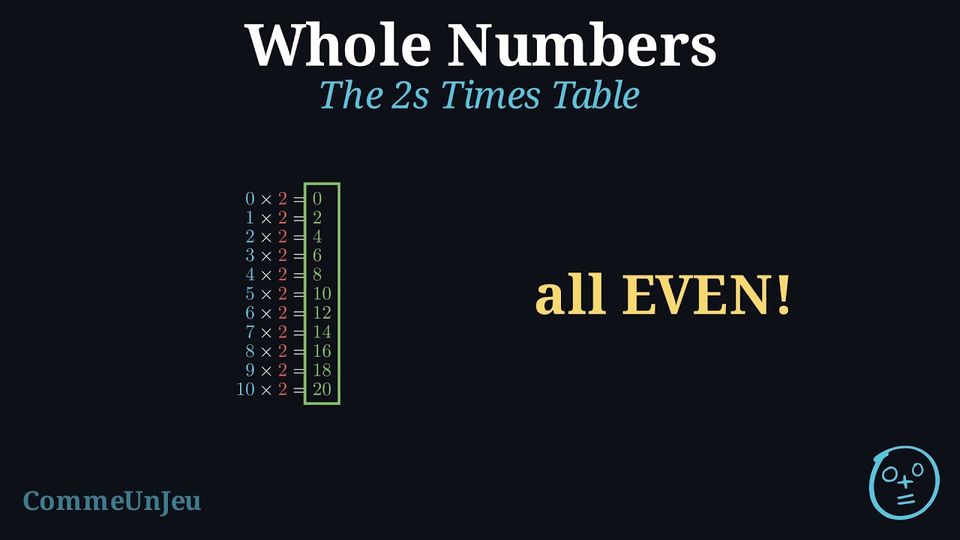
The 2s Times Table
How many eyes are there in total? 
We have 5 groups, and each group has 2 eyes. We can skip-count by 2s: 2, 4, 6, 8, 10. 
This is the same as the multiplication: $$\begin{aligned}[t]5\times 2 &= 2+2+2+2+2 && \text{(5 groups of 2)}\\
&= 10.\end{aligned}$$ The result is the same in either order: \(5 \times 2 = 2 \times 5\). The second form is easier to calculate: \(5 + 5 = 10\).
Proposition — The 2s Times Table
Skills to practice
- Counting by 2s Using a Number Line
- Multiplying by 2 Using Cubes
- Finding the Missing Number with Cubes
- Multiplying by 2 in Either Order
- Calculating 2 Times
III
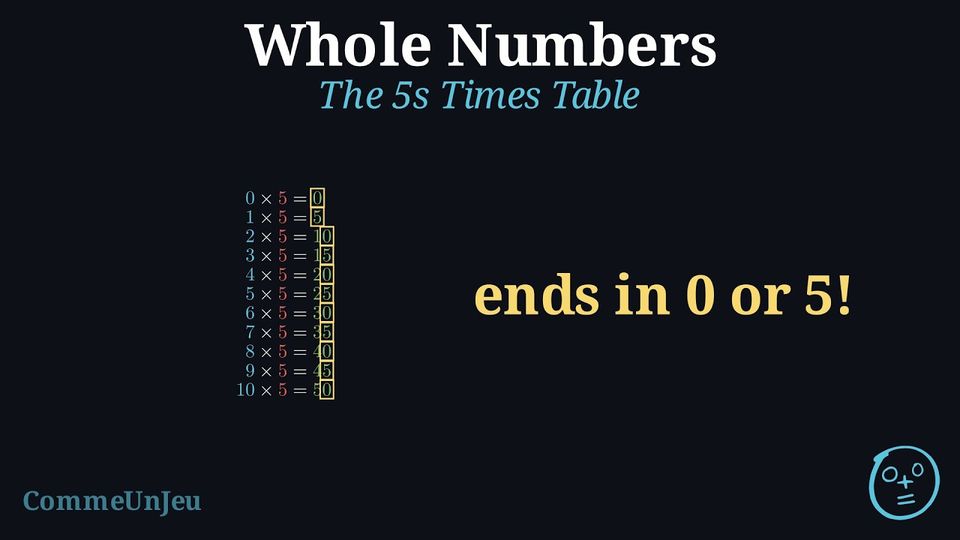
The 5s Times Table
How many cubes are there in total? 
We see 3 groups of 5. We can skip-count by 5s: 5, 10, 15. 
There are $$\begin{aligned}[t]3\times 5 &= 5+5+5 && \text{(3 groups of 5)}\\
&= 15\end{aligned}$$ cubes.
Proposition — The 5s Times Table
Skills to practice
- Counting by 5s Using a Number Line
- Multiplying by 5 Using Cubes
- Multiplying by 5 in Either Order
- Multiplying by 5
IV
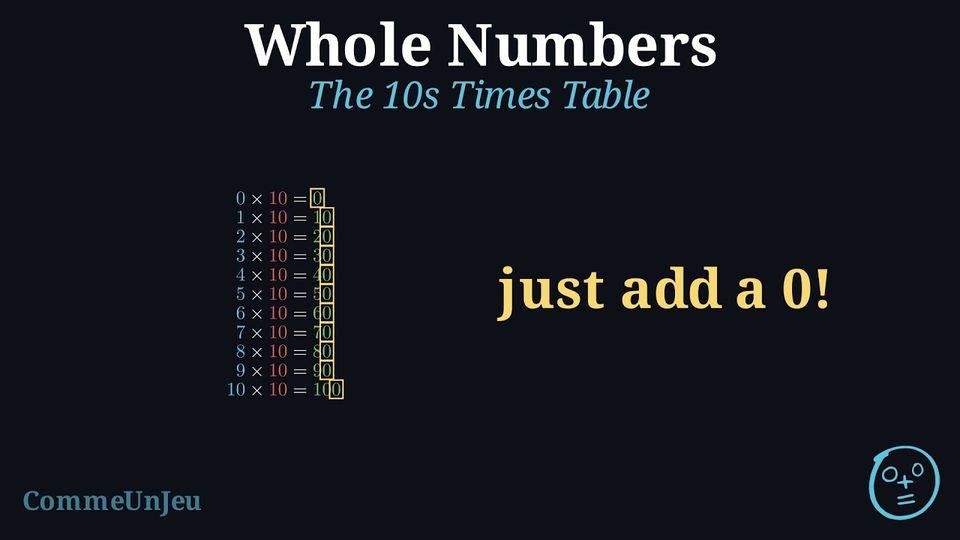
The 10s Times Table
How many cubes are in these 3 groups of 10? 
We have 3 groups of 10. We can skip-count by 10s: 10, 20, 30. 
There are $$\begin{aligned}[t]3\times 10 &= 10+10+10 && \text{(3 groups of 10)}\\
&= 30\end{aligned}$$ cubes.
Proposition — The 10s Times Table
Method — Multiplying a Number by 10
The times table stops at \(10 \times 10\). To multiply any number by \(10\), read the number as tens:\(34 \times 10\) is \(34\) tens, that is \(340\). $$34 \times 10 = 340$$
Example
Calculate \(72 \times 10\).
\(72 \times 10\) is \(72\) tens, that is \(720\). $$72 \times 10 = 720$$
Skills to practice
- Counting by 10s Using a Number Line
- Multiplying by 10 Using Cubes
- Multiplying by 10 Using Items
- Multiplying by 10
- Multiplying a Number by 10
V
Half of the 10s Table: the 5s Table
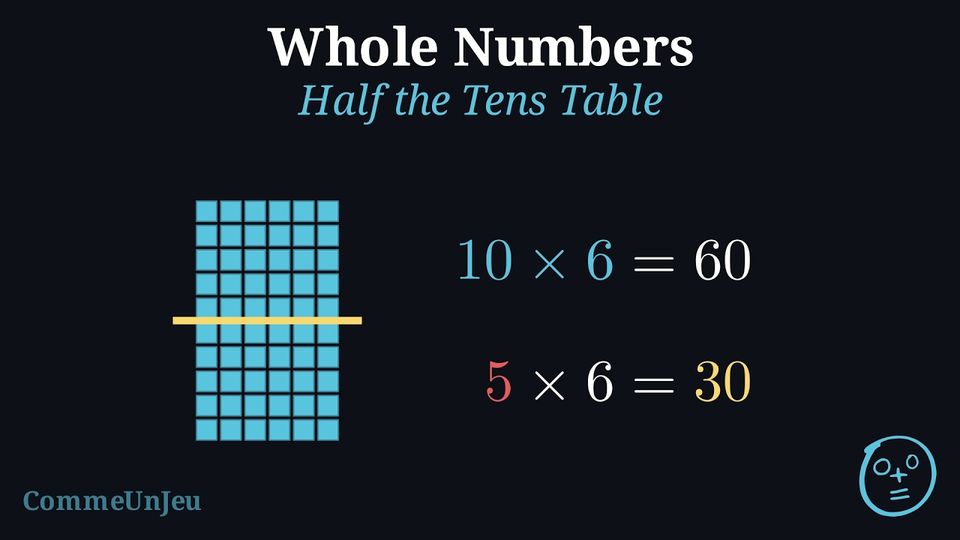
Method — Half of the 10s Table
Every result in the 5s table is half of the result in the 10s table:\(10 \times 8 = 80\), and half of \(80\) is \(40\) — so \(5 \times 8 = 40\).
When the number of tens is odd, split the tens: \(10 \times 7 = 70\), and \(70 = 60 + 10\), so half of \(70\) is \(30 + 5 = 35\) — so \(5 \times 7 = 35\).
If you forget a fact of the 5s table, multiply by \(10\), then take half.
Example
Find \(5 \times 6\) by halving the 10s table.
\(10 \times 6 = 60\). Half of \(60\) is \(30\). $$5 \times 6 = \textbf{30}$$
Proposition — The Multiples of 25
Four results to know by heart: \(1 \times 25 = 25\), \(2 \times 25 = 50\), \(3 \times 25 = 75\), \(4 \times 25 = 100\).The results of the 25s table are the multiples of \(25\): \(25\), \(50\), \(75\), \(100\), …
They come from the halves: \(25\) is half of \(50\), and \(50\) is half of \(100\). And \(75 = 50 + 25\): three \(25\)s are two \(25\)s and one more \(25\).
Example
Complete: (a) \(3 \times 25 = \ldots\), (b) \(100 = 4 \times \ldots\), (c) \(2 \times \ldots = 50\).
(a) \(75\). (b) \(25\): four \(25\)s make \(100\). (c) \(25\): \(50\) is double \(25\).
Skills to practice
- Building the 5s Table by Halving the 10s
- Finding a 5s Fact from the 10s Table
- The Multiples of 25
VI
Review & Quizz
Skills to practice
- Quiz
Jump to section