International Baccalaureate · PYP 2
Comparing and Ordering Numbers to 1000
I
How to Compare 3-Digit Numbers
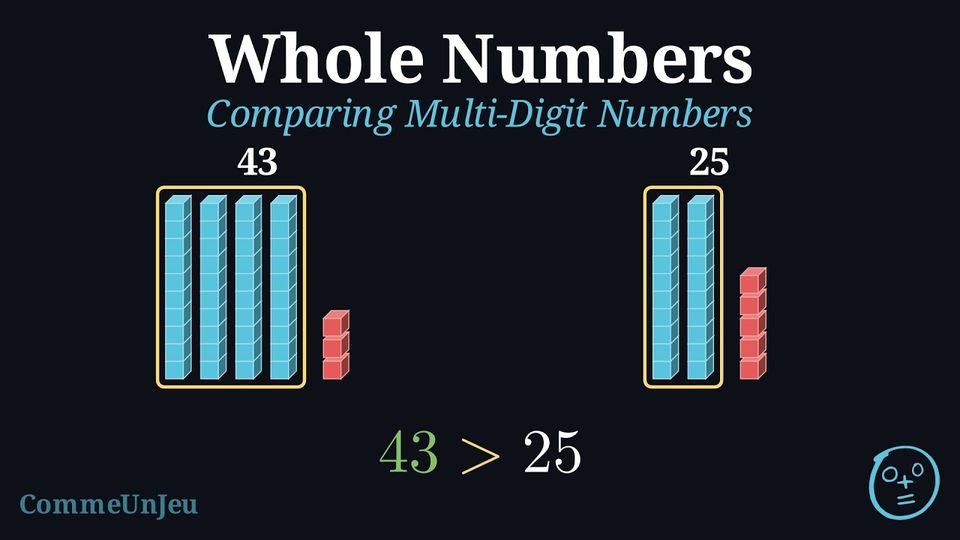
Léa and Tom are counting their marbles. There are far too many to draw.
Drawing them or counting them one by one would take all day: there is no picture to look at. Say who has more marbles.
| Léa | Tom |
| \(372\) marbles | \(358\) marbles |
Léa has more. Matching the marbles one by one or counting them is closed here: there is nothing to look at, and nothing small enough to count. What is left is the writing of the two numbers — their digits, and the place each one holds. The method for two digits compares the tens; with three digits, the hundreds come first. Both numbers have \(3\) hundreds, so the hundreds do not settle it. It is the next place that does: \(372\) has \(7\) tens, \(358\) has \(5\). So a rule is needed, one that reads the places in order. That is what comes next.
Method — Comparing 3-Digit Numbers
To compare numbers, we always start by looking at the place with the biggest value. For 3-digit numbers, this is the hundreds place. First, count the digits. A 3-digit number has at least one hundred; a 2-digit number has none (\(0\) hundreds): the number with more digits is the greater one. When both numbers have three digits: - Step 1: Compare the Hundreds place. Look at the digit in the hundreds place. The number with more hundreds is the greater number. Why does the biggest place decide? One hundred is worth more than all the tens and ones of a number put together, which make at most \(99\).
- Step 2: Compare the Tens place (if needed). If the hundreds are the same, then we look at the tens place. The number with more tens is the greater number.
- Step 3: Compare the Ones place (if needed). If the hundreds and the tens are the same, then we look at the ones place. The number with more ones is the greater number.
- Equal numbers. If the hundreds, the tens and the ones are all the same, the two numbers are equal.
Example
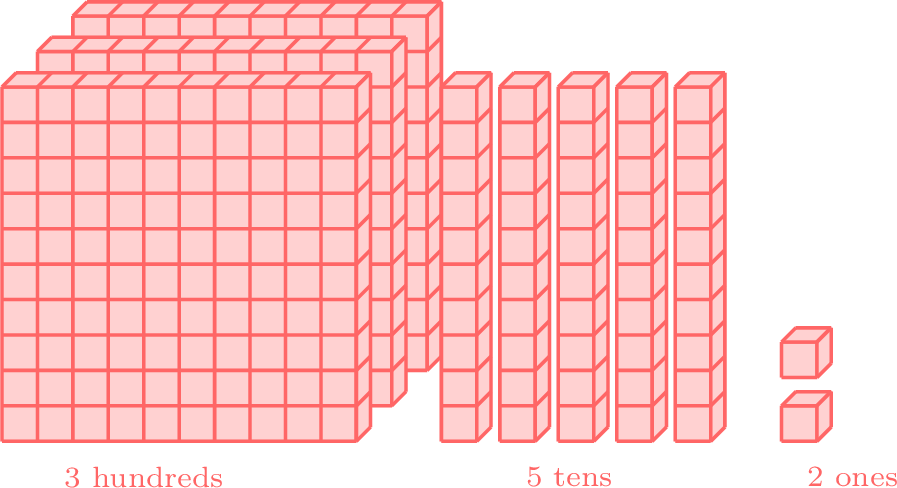
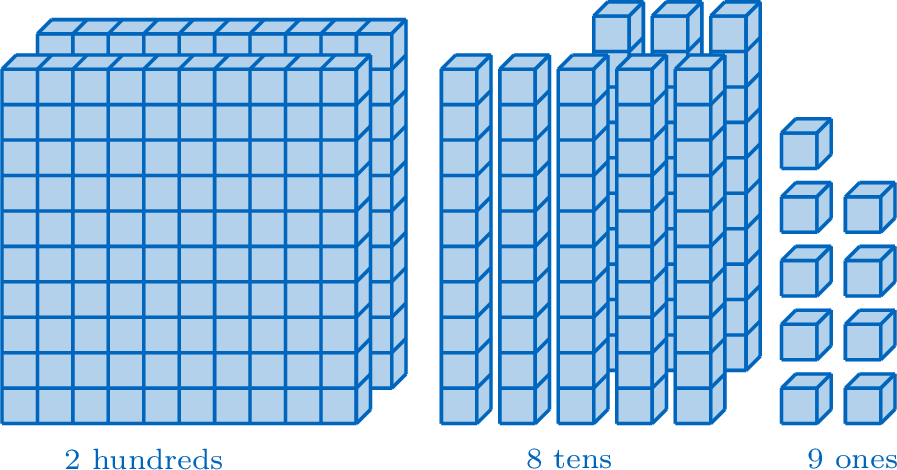
Compare 352 and 289. - Step 1: Compare the Hundreds.
- The number 352 has 3 hundreds.
- The number 289 has 2 hundreds.
- Since 3 hundreds is more than 2 hundreds, we know that 352 is greater than 289. We don't need to look at the tens or ones.
 \(\quad \Huge > \quad\)
\(352 > 289\)
Example
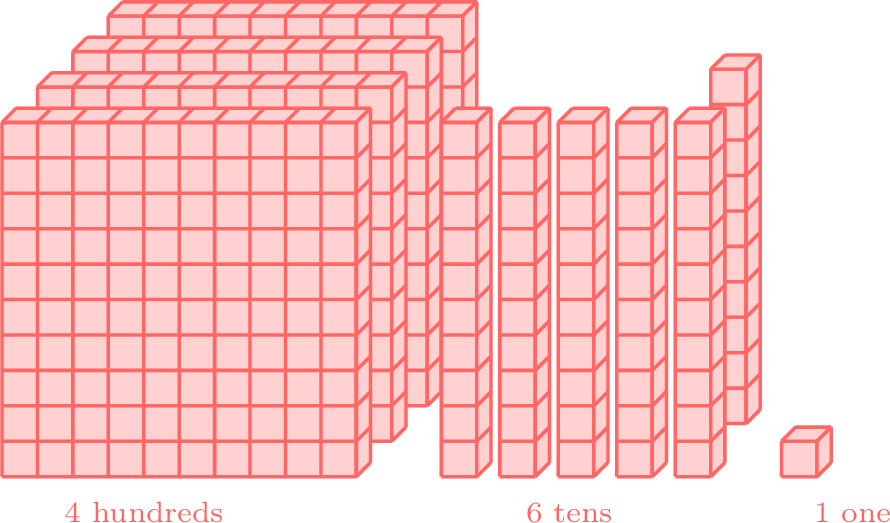
Compare 461 and 438. - Step 1: Compare the Hundreds.
- The number 461 has 4 hundreds.
- The number 438 has 4 hundreds.
- The hundreds are the same, so we move to the next step.
- Step 2: Compare the Tens.
- The number 461 has 6 tens.
- The number 438 has 3 tens.
- Since 6 tens is more than 3 tens, we know that 461 is greater than 438.
 \(\quad \Huge > \quad\)
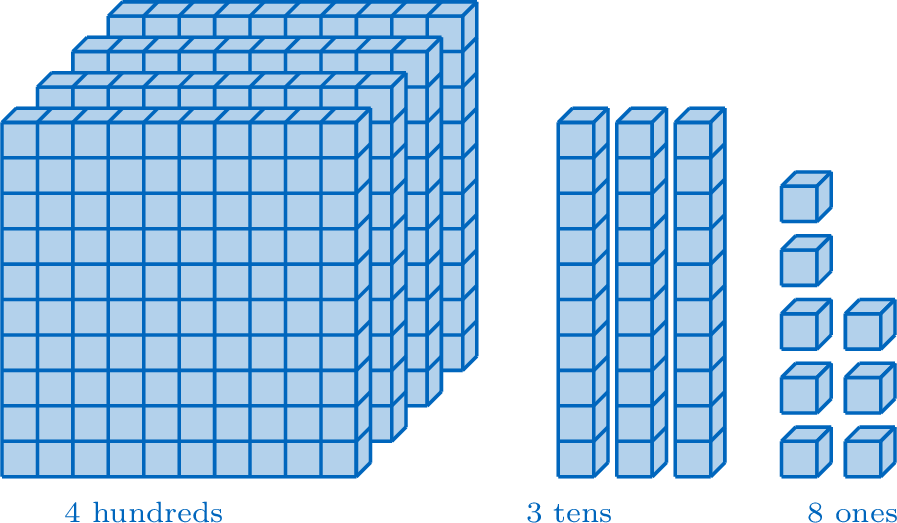
\(461 > 438\)
Example
Compare 203 and 206. - Step 1: Compare the Hundreds.
- The number 203 has 2 hundreds.
- The number 206 has 2 hundreds.
- The hundreds are the same, so we move to the next step.
- Step 2: Compare the Tens.
- The number 203 has 0 tens.
- The number 206 has 0 tens.
- The tens are the same, so we move to the next step.
- Step 3: Compare the Ones.
- The number 203 has 3 ones.
- The number 206 has 6 ones.
- Since 3 ones is less than 6 ones, we know that 203 is less than 206.
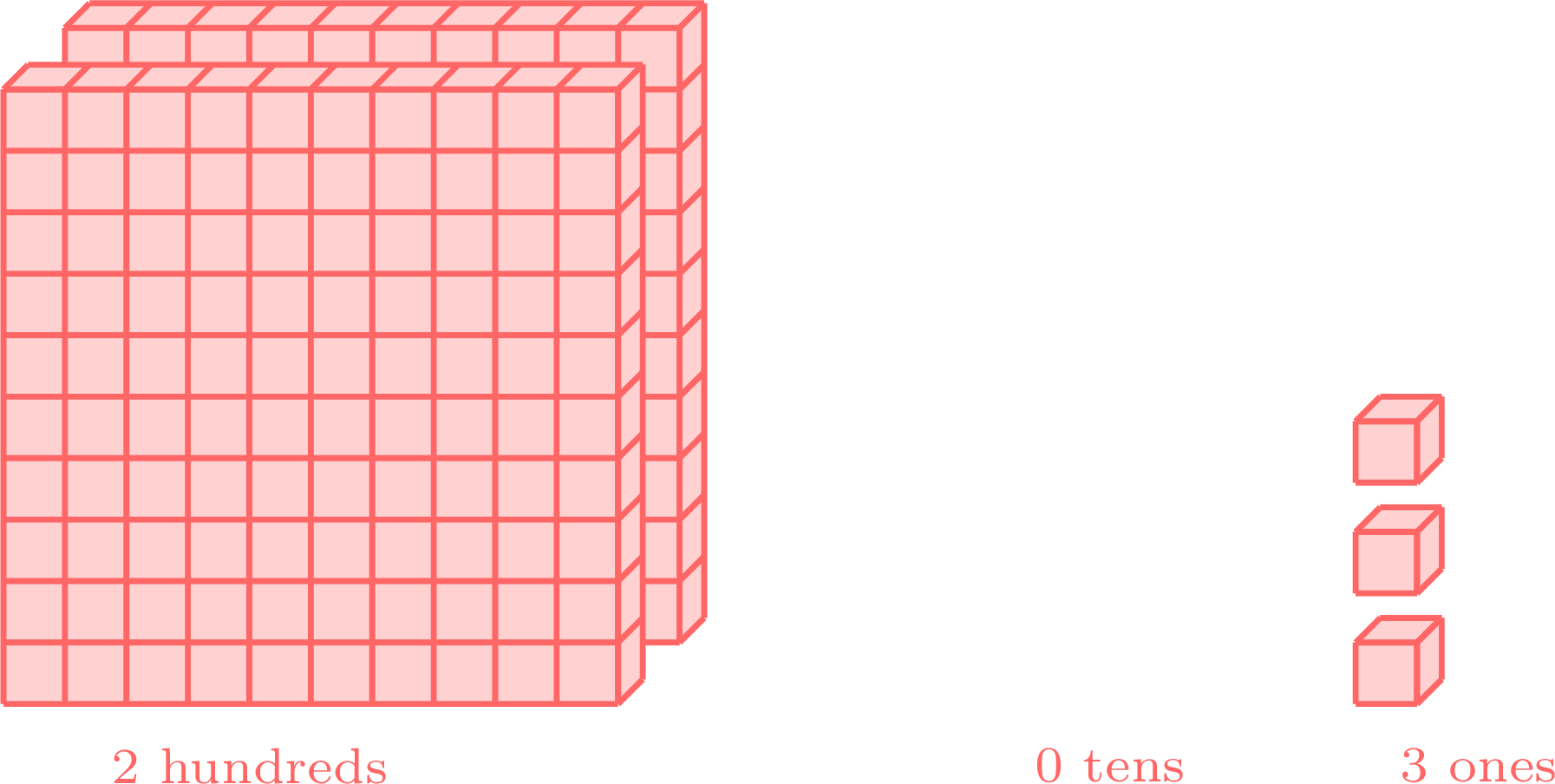 \(\quad \Huge < \quad\)
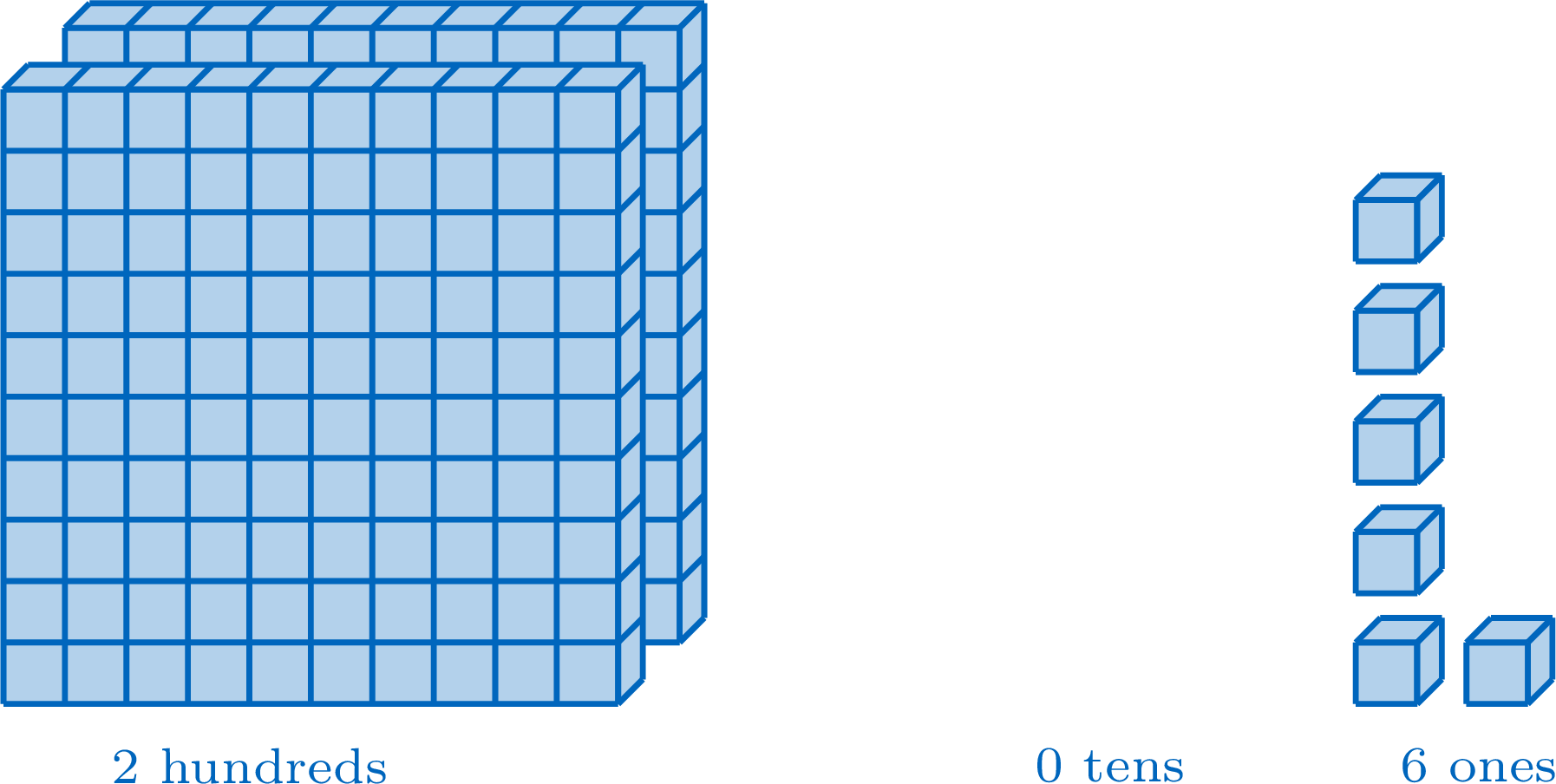
\(203 < 206\)
Method — Ordering Several Numbers
To compare two numbers, we look at the places one after the other. To put several numbers in order, we use that same comparison again and again. - Step 1: Find the smallest of all the numbers. Compare them place by place, starting with the hundreds. Write that number down first.
- Step 2: Start again with the numbers that are left. Among those, find the smallest one, and write it after the first.
- Step 3: Carry on until no number is left. Each time, we look only at the numbers not yet written down.
- To order the other way round. From the smallest to the greatest is increasing order; from the greatest to the smallest is decreasing order. It is the same method: at each turn we look for the biggest of the numbers not yet written, instead of the smallest.
- Check. Read the list from left to right: in increasing order, each number is smaller than the one that follows it; in decreasing order, greater.
Example
Order these numbers from least to greatest: $$204, \quad 87, \quad 150, \quad 96$$ - Step 1. \(87\) and \(96\) have no hundreds, \(150\) has \(1\) hundred, \(204\) has \(2\) hundreds. So the smallest is \(87\) or \(96\). Both have \(0\) hundreds, so we look at the tens: \(8\) tens against \(9\) tens. The smallest is \(87\).
- Step 2. There remain \(204\), \(150\) and \(96\). Only \(96\) has no hundreds: it is the smallest.
- Step 3. There remain \(204\) and \(150\). \(150\) has \(1\) hundred and \(204\) has \(2\) hundreds, so \(150\) comes first, then \(204\).
- Result. $$87 \lt 96 \lt 150 \lt 204$$
- Check. \(87\) is smaller than \(96\), \(96\) is smaller than \(150\), and \(150\) is smaller than \(204\). The list is in order.
Skills to practice
- Comparing Numbers of Cubes
- Comparing Numbers
- Comparing Numbers in Context
- Ordering Numbers
- Ordering Both Ways
II
Between Two Numbers
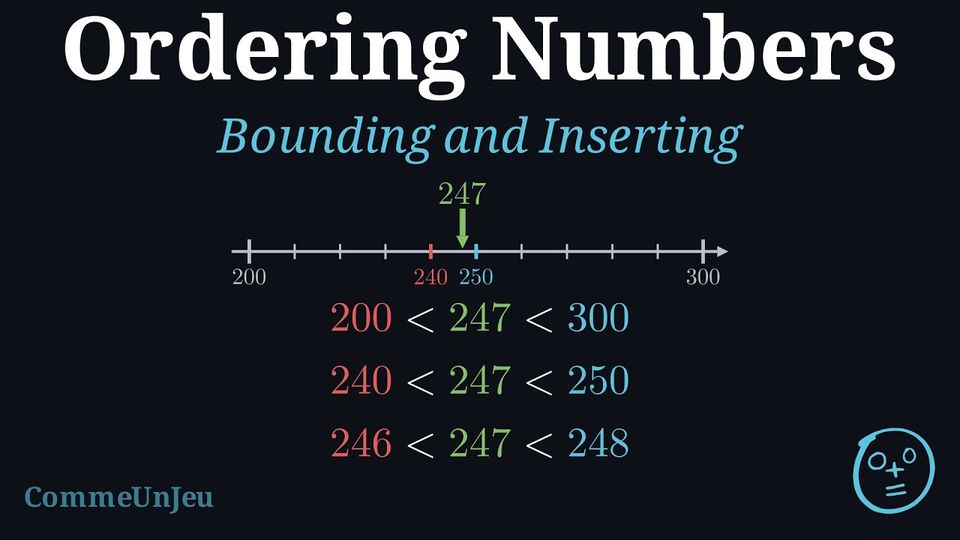
This number line counts in hundreds. The arrow points at \(247\) — but there is no mark for \(247\). 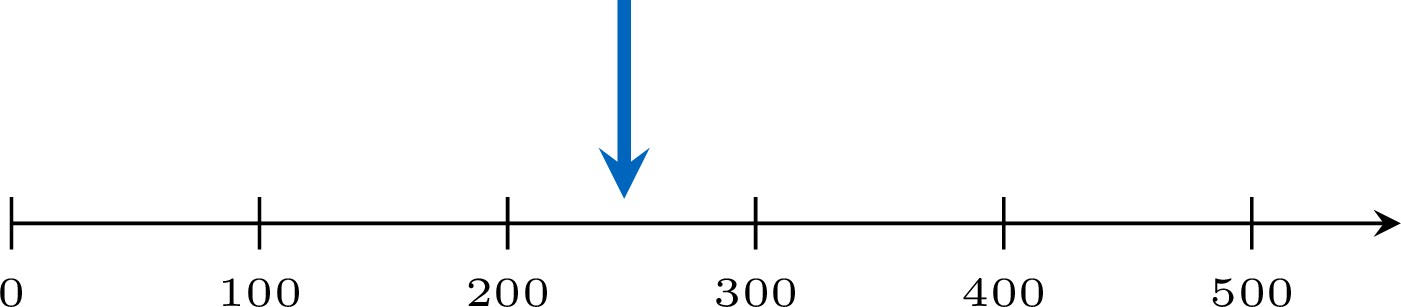
Say between which two marks the arrow stands.
The arrow stands between \(200\) and \(300\). It is past the \(200\) mark and has not reached the \(300\) one.
We write it with two symbols at once: $$200 \lt 247 \lt 300$$
We write it with two symbols at once: $$200 \lt 247 \lt 300$$
Method — Placing a Number Between Two Hundreds or Two Tens
To place a number between two hundreds, read how many whole hundreds it contains: the number lies between that many hundreds and one more. \(247\) has \(2\) hundreds: it is between \(200\) and \(300\). It is written with two symbols at once, and read aloud with the words between … and …. $$200 \lt 247 \lt 300 \qquad \text{read: } 247 \text{ is between } 200 \text{ and } 300$$ The same number can also be placed between two tens: the two numbers around it are then closer together. | Between two | It contains | Writing |
| hundreds | \(2\) whole hundreds | \(200 \lt 247 \lt 300\) |
| tens | \(24\) whole tens | \(240 \lt 247 \lt 250\) |
This only works if the number is not itself a whole hundred or a whole ten. \(300\) is exactly \(3\) hundreds: it sits on the mark, not between two marks. To place it between two hundreds anyway, take the mark before and the mark after: \(200 \lt 300 \lt 400\), just as with tens: \(60 \lt 70 \lt 80\).
Do not confuse the digit with the number of tens. The tens digit of \(247\) is \(4\), but \(247\) contains \(24\) tens: \(24\) is its number of tens. The digit says what sits in that place; the number of tens says how many there are altogether.
The closest of all are the neighbours. Nothing is counted here: it is the number just before and the number just after. $$246 \lt 247 \lt 248$$
Method — Finding a Number in Between
Finding a number in between is the other way round: instead of looking for the two numbers around a number, we look for a number that fits between two given numbers. - Between \(246\) and \(249\). The numbers that fit are \(247\) and \(248\): they are bigger than \(246\) and smaller than \(249\).
- When the two numbers are neighbours, nothing fits. Between \(246\) and \(247\) there is no whole number: \(246\) and \(247\) follow each other.
- On a strip counting in ones, each empty box holds the number that follows the one before it.
| \(471\) | \(472\) | \(473\) | \(\phantom{474}\) | \(\phantom{475}\) | \(476\) | \(477\) | \(478\) |
Skills to practice
- Placing a Number Between Two Hundreds or Two Tens
- Finding a Number in Between
- Saying a Comparison with Words
III
Going further
Skills to practice
- Writing Comparisons with Pictures
- Problems
- Quiz
Jump to section