International Baccalaureate · PYP 2
Chance
I
Not, Or, And
Mia's bag holds 6 counters: 2 red round counters, 1 red square counter, 1 blue round counter and 2 blue square counters. She picks one counter without looking. 
Mia says: “Picking a counter that is red or round is certain.” Is she correct?
No. We draw two hoops: one for “red”, one for “round”. 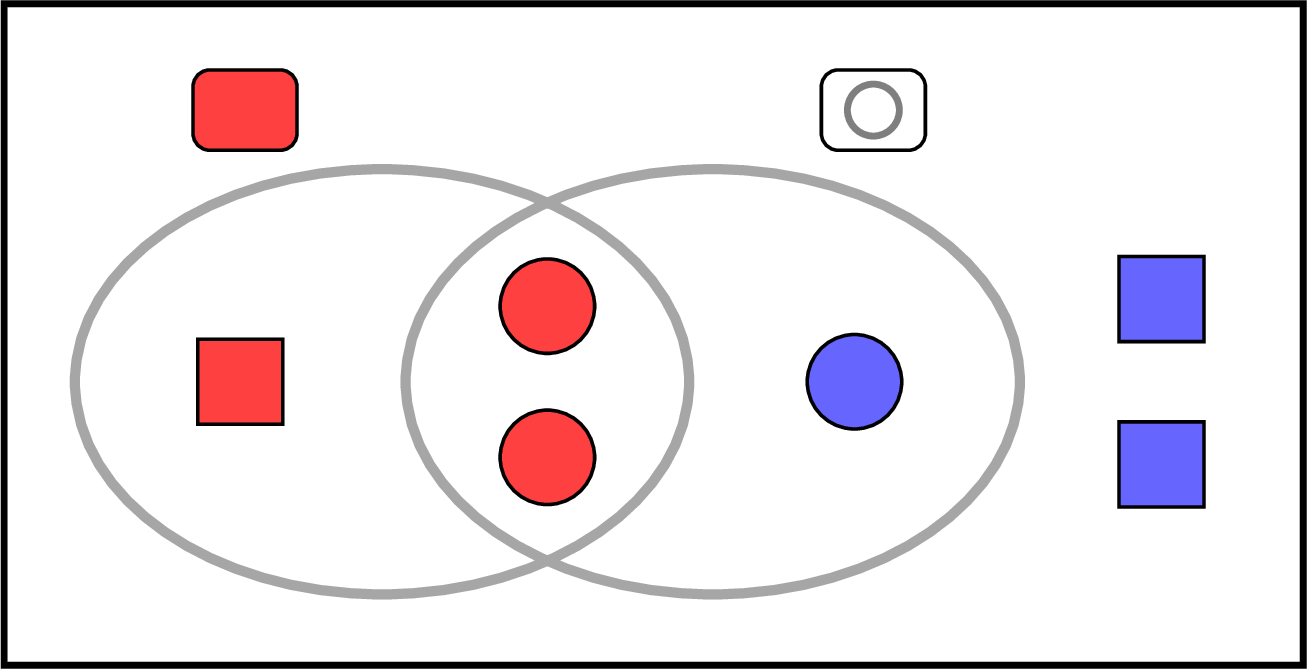
The 2 red round counters are in both hoops, where they cross. “Red or round” holds every counter that is in at least one hoop: the 2 red round counters, the red square counter and the blue round counter — 4 counters. The 2 blue square counters are outside both hoops, and Mia can pick one of them. Picking a counter that is red or round is possible, not certain.
Definition — Not, Or, And with Hoops
For a sentence about the counter we pick, we draw a hoop: inside it, the counters that make the sentence true. With two hoops, “red” and “round”: - “not red”: the counters outside the hoop “red”;
- “red and round”: the counters in both hoops, where the hoops cross;
- “red or round”: the counters in at least one hoop — the first one, the second one, or both. A counter in both hoops counts for “or” too.
The hoop is the loop of a Venn diagram: inside it, the counters that make the sentence true; outside it, in the frame, the others. The counters outside the hoop “red” make up the box “not red” of a Carroll diagram.
Example
We roll a die. Hoop \(A\) holds the faces that make “more than 4” true. Hoop \(B\) holds the faces that make “even” true: 2, 4 and 6. Which faces make “not more than 4” true? “More than 4 and even”? “More than 4 or even”?
Hoop \(A\) holds the faces 5 and 6; hoop \(B\) holds the faces 2, 4 and 6. 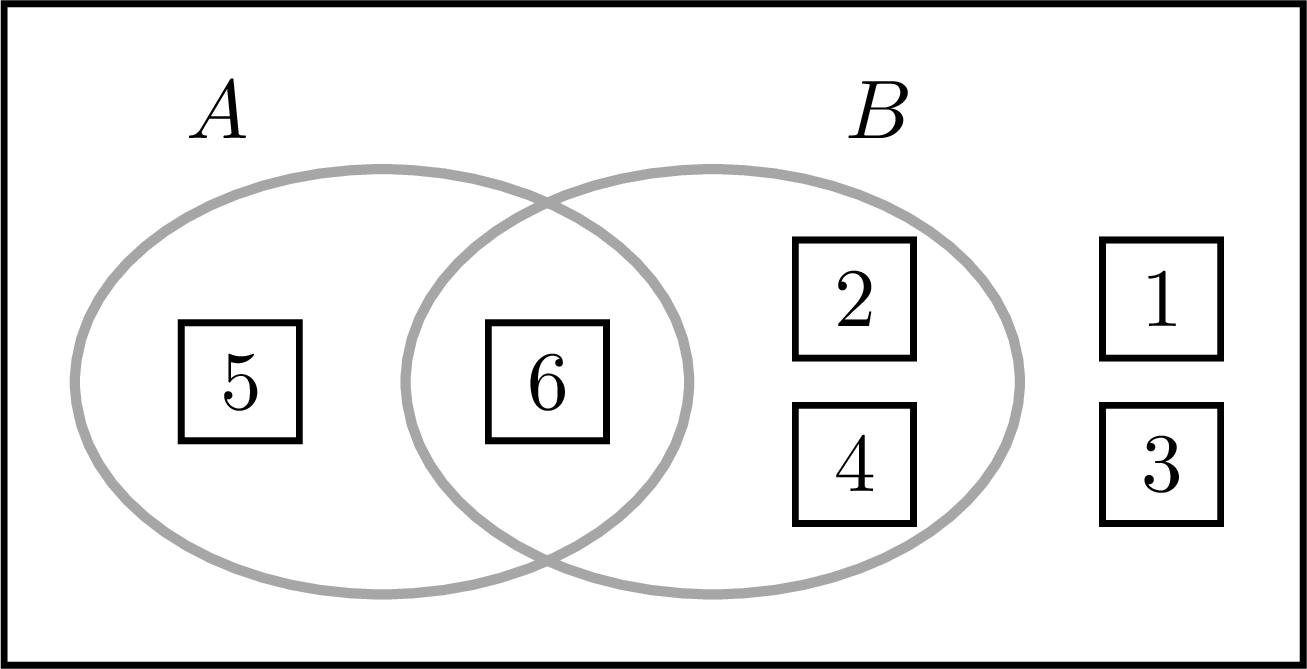
- “not more than 4”: the faces outside hoop \(A\): 1, 2, 3 and 4;
- “more than 4 and even”: the face in both hoops: 6;
- “more than 4 or even”: the faces in at least one hoop: 2, 4, 5 and 6 — the face 6 is counted once.
Skills to practice
- Finding the Counters That Are Not…
- Using Two Hoops
II
From Impossible to Certain
Definition — Chance
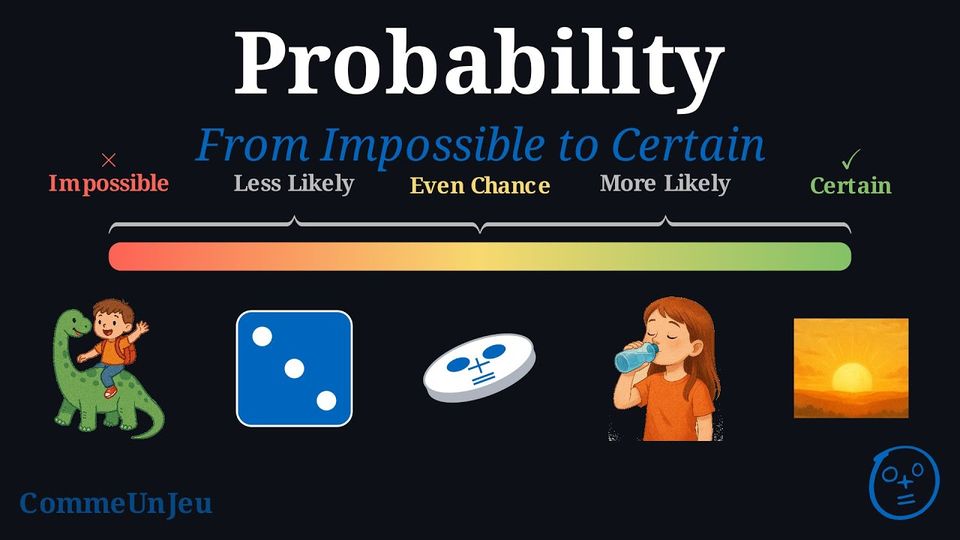
The chance of something tells us how likely it is to happen. We can show different chances on a line, from impossible to certain. Here, every example comes from one roll of a die: its 6 faces show 1, 2, 3, 4, 5 and 6, and each face has the same chance of coming out. Under each word, the hoop holds the faces that make the example happen. 
- Impossible: It can never happen.
Example: Rolling a die and getting a 7. - Unlikely (or Less Likely): It probably will not happen.
Example: Rolling a die and getting a 3. - Even Chance: It has an equal chance of happening or not happening.
Example: Rolling a die and getting an even number. - Likely (or More Likely): It probably will happen.
Example: Rolling a die and not getting a 3. - Certain: It must happen.
Example: Rolling a die and getting a number from 1 to 6.
Method — Comparing the Counts in the Bag
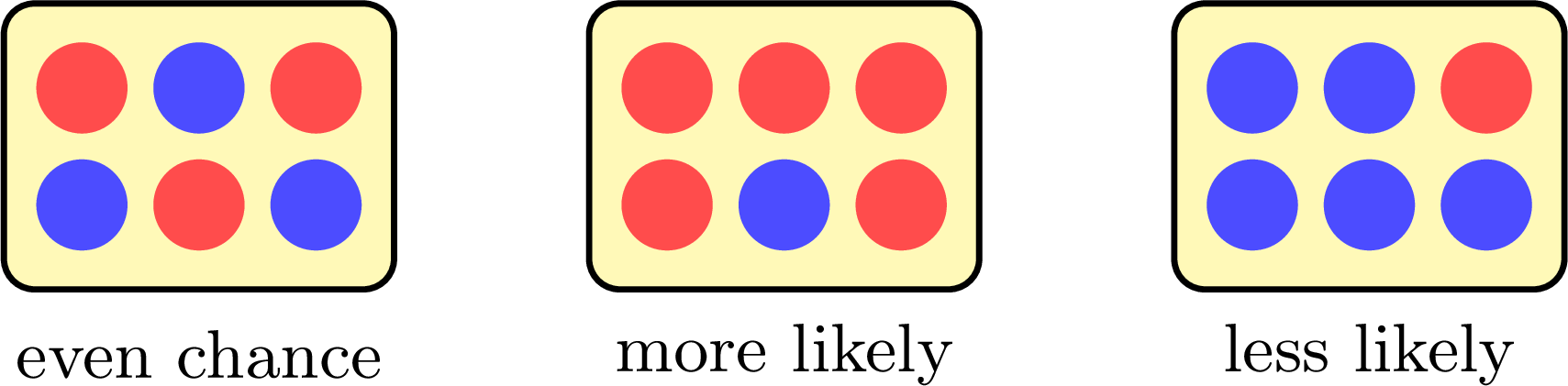
We pick one counter without looking from a bag that holds only red and blue counters, and every counter has the same chance of being picked. To place “picking a red counter” on the line, we compare the number of red counters with the number of blue counters: - as many red as blue: an even chance;
- more red than blue: more likely — the more red counters there are, the closer it gets to certain;
- fewer red than blue: less likely.
Skills to practice
- Placing Everyday Events on the Line
- Placing a Draw on the Line
- Placing a Roll on the Line
III
Going further
Skills to practice
- Colouring and Placing Chances
- Quiz
Jump to section