International Baccalaureate · MYP 4
Radicals and Surds
I
Calculating nth Roots
Definition — Cube Root
The cube root of a number \(a\), written \(\sqrt[3]{a}\), is the number which, when cubed, gives \(a\): $$\left(\sqrt[3]{a}\right)^3 = a$$
Note
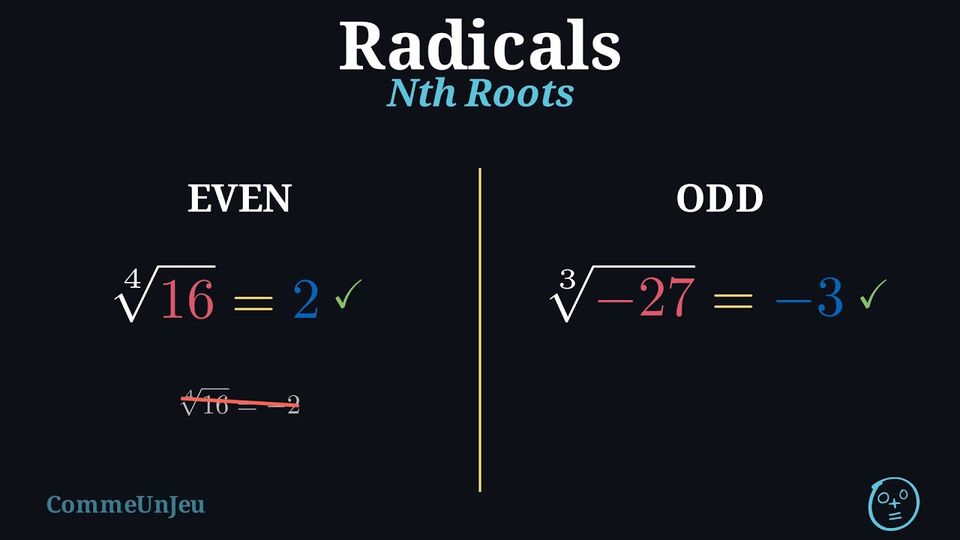
Unlike square roots, cube roots are defined for all real numbers, including negatives. For example, \(\sqrt[3]{-27} = -3\) because \((-3) \times (-3) \times (-3) = -27\).
Definition — Nth Root
The concept of a root can be generalised. For a positive integer \(n\), the nth root of a real number \(a\), written \(\sqrt[n]{a}\), is a number which, when raised to the power of \(n\), gives \(a\), chosen as follows: for an odd \(n\), it is the only real number whose \(n\)th power is \(a\); for an even \(n\), it exists only when \(a \ge 0\), and it is the non-negative number whose \(n\)th power is \(a\). Whenever it exists, $$\left(\sqrt[n]{a}\right)^n = a.$$ The rules for their domains depend on whether the index \(n\) is even or odd. - Even roots (e.g.\ \(\sqrt[2]{a}, \sqrt[4]{a}, \dots\)): an even root of a negative number is not a real number. For even \(n\), \(\sqrt[n]{a}\) is only defined for \(\boldsymbol{a \ge 0}\), and it denotes the non-negative number whose \(n\)th power is \(a\) (e.g.\ \(\sqrt[4]{16} = 2\), not \(-2\)).
- Odd roots (e.g.\ \(\sqrt[3]{a}, \sqrt[5]{a}, \dots\)): an odd root is defined for all real numbers \(a\).
Example
Calculate each root, or explain why it is not a real number: - \(\sqrt[4]{625}\)
- \(\sqrt[5]{-243}\)
- \(\sqrt[4]{-625}\)
- \(5^4 = 5 \times 5 \times 5 \times 5 = 625\) and \(5 \geq 0\), so \(\sqrt[4]{625} = 5\). The number \(-5\) also has \(625\) as its fourth power, but the fourth root is the non-negative one.
- The index \(5\) is odd, so the fifth root of the negative number \(-243\) exists. Since \((-3)^5 = (-3) \times (-3) \times (-3) \times (-3) \times (-3) = -243\), we have \(\sqrt[5]{-243} = -3\).
- The index \(4\) is even and \(-625 < 0\). An even power of a real number is never negative, so no real number has \(-625\) as its fourth power: \(\sqrt[4]{-625}\) is not a real number.
Skills to practice
- Understanding nth Roots
- Calculating nth Roots
II
Using the Laws of Radicals
Definition — Square root
The square root of a non-negative number \(a\) (that is, \(a \ge 0\)), written as \(\sqrt{a}\), is the non-negative number that, when multiplied by itself, gives \(a\). $$ \left(\sqrt{a}\right)^2 = a $$ Definition — Perfect Squares
A perfect square is an integer that is the square of an integer. The square root of a perfect square is an integer.
Expressions involving square roots are called radical expressions (or simply radicals). To simplify and manipulate these expressions, we use a set of important laws.
Proposition — Multiplication Law
For any real numbers \(a,b \ge 0\): $$\textcolor{colorprop} {\sqrt{a} \times \sqrt{b} = \sqrt{ab}} $$
By definition, squaring a square root gives the original number. Look at the square of the expression \(\sqrt{a} \times \sqrt{b}\): $$\begin{aligned}[t] \left(\sqrt{a} \times \sqrt{b}\right)^2 &= (\sqrt{a} \times \sqrt{b}) \times (\sqrt{a} \times \sqrt{b}) && \text{(definition of squaring)} \\
&= (\sqrt{a} \times \sqrt{a}) \times (\sqrt{b} \times \sqrt{b}) && \text{(commutativity)} \\
&= a \times b && \text{(\((\sqrt{a})^2 = a\) and \((\sqrt{b})^2 = b\))} \\
&= ab. \end{aligned}$$ Moreover \(\sqrt{a} \times \sqrt{b} \ge 0\), as a product of two non-negative numbers. So \(\sqrt{a} \times \sqrt{b}\) is the non-negative number whose square is \(ab\): it is the square root of \(ab\).
Example
Check that \(\sqrt{4} \times \sqrt{9} = \sqrt{36}\) by calculating each side.
Each side is calculated on its own, without using the Multiplication Law. $$\begin{aligned}[t] \sqrt{4} \times \sqrt{9} &= 2 \times 3 && \text{(\(2^2 = 4\) and \(3^2 = 9\))} \\
&= 6 \\
\sqrt{36} &= 6. && \text{(\(6^2 = 36\))} \end{aligned}$$ Both sides are equal to \(6\): the equality is true, as the Multiplication Law states, since \(4 \times 9 = 36\).
Proposition — Square Root of a Square
For any real number \(a \ge 0\): $$ \textcolor{colorprop}{\sqrt{a^2} = a} $$
By definition, \(\sqrt{a^2}\) is the non-negative number whose square is \(a^2\). The number \(a\) is non-negative and its square is \(a^2\). So: $$\sqrt{a^2} = a$$
Example
Find \(\sqrt{13^2}\) and \(\sqrt{0.7^2}\) without calculating the squares.
$$\begin{aligned}[t] \sqrt{13^2} &= 13 && \text{(Square Root of a Square, \(13 \geq 0\))} \\
\sqrt{0.7^2} &= 0.7. && \text{(Square Root of a Square, \(0.7 \geq 0\))} \end{aligned}$$ There is no need to calculate \(13^2 = 169\) or \(0.7^2 = 0.49\): the square root undoes the square of a non-negative number.
Proposition — Simplifying Law
For any real numbers \(a,b \ge 0\): $$ \textcolor{colorprop}{\sqrt{a^2 b} = a\sqrt{b}} $$
$$\begin{aligned}[t] \sqrt{a^2 b} &= \sqrt{a^2} \times \sqrt{b} && \text{(by Multiplication Law)} \\
&= a \times \sqrt{b} && \text{(by Square Root of a Square Law)} \\
&= a\sqrt{b} \end{aligned}$$
Definition — Simplest Radical Form
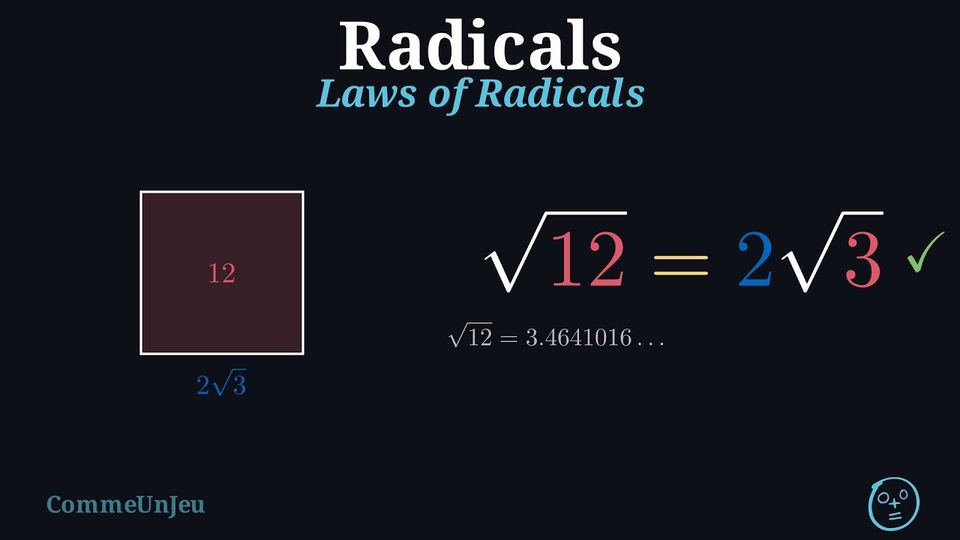
A radical is written in simplest form when the number under the square root sign has no perfect-square factor other than \(1\). For example, \(\sqrt{12}\) is not in simplest form, because \(12 = 4 \times 3\) and \(4\) is a perfect square; its simplest form is \(2\sqrt{3}\). Method — Writing a Radical in Simplest Form
Let \(n \geq 1\) be a whole number. To write \(\sqrt{n}\) in simplest form: - Find the largest perfect square that divides \(n\), and write \(n = a^2 \times b\) with \(a > 0\).
- Split the root with the Multiplication Law: \(\sqrt{n} = \sqrt{a^2} \times \sqrt{b}\).
- Extract the square: \(\sqrt{a^2} = a\) (since \(a > 0\)), so \(\sqrt{n} = a\sqrt{b}\).
Example
Simplify \(\sqrt{72}\).
First, find the largest perfect square factor of \(72\), which is \(36\). $$\begin{aligned}[t] \sqrt{72} &= \sqrt{36 \times 2} && \text{(\(36\) is the largest square factor)} \\
&= \sqrt{6^2 \times 2} && \text{(\(36 = 6^2\))} \\
&= 6\sqrt{2}. && \text{(by Simplifying Law)} \end{aligned}$$ With the smaller square factor \(4\), the result \(\sqrt{72} = \sqrt{4 \times 18} = 2\sqrt{18}\) is not yet in simplest form, because \(18 = 9 \times 2\) still contains a perfect square: taking the largest square factor finishes in one step.
Proposition — Division Law
For any real numbers \(a \ge 0\) and \(b>0\): $$ \textcolor{colorprop}{\sqrt{\frac{a}{b}} = \frac{\sqrt{a}}{\sqrt{b}}} $$
Look at the square of the expression \(\dfrac{\sqrt{a}}{\sqrt{b}}\): $$\begin{aligned}[t] \left(\frac{\sqrt{a}}{\sqrt{b}}\right)^2 &= \frac{\sqrt{a}}{\sqrt{b}} \times \frac{\sqrt{a}}{\sqrt{b}} && \text{(definition of squaring)} \\
&= \frac{(\sqrt{a})^2}{(\sqrt{b})^2} && \text{(multiply the fractions)} \\
&= \frac{a}{b}. && \text{(\((\sqrt{a})^2 = a\) and \((\sqrt{b})^2 = b\))} \end{aligned}$$ Moreover \(\dfrac{\sqrt{a}}{\sqrt{b}} \ge 0\), as a quotient of non-negative numbers (with \(\sqrt{b} > 0\)). So it is the non-negative number whose square is \(\dfrac{a}{b}\): it is the square root of \(\dfrac{a}{b}\).
Example
Simplify \(\sqrt{\dfrac{5}{9}}\).
$$\begin{aligned}[t] \sqrt{\frac{5}{9}} &= \frac{\sqrt{5}}{\sqrt{9}} && \text{(by Division Law)} \\
&= \frac{\sqrt{5}}{3}. && \text{(\(\sqrt{9} = 3\))} \end{aligned}$$ The numerator \(5\) is not a perfect square: the Division Law still applies, and only the denominator becomes a whole number.
Surds and Exact Values
The square roots \(\sqrt{2}\), \(\sqrt{3}\) or \(\sqrt{12} = 2\sqrt{3}\) are irrational numbers: none of them can be written as a fraction of two integers, so none of them is equal to a terminating decimal. A root of this kind, whose value is irrational, is also called a surd; the word is used for other roots too, such as \(\sqrt[3]{5}\).
- A number written with its roots, such as \(\sqrt{12}\) or \(2\sqrt{3}\), is written in exact form: both are exact values, while a calculator only gives an approximation, \(\sqrt{12} \approx 3.464\).
- Unless a question asks for a decimal value, an answer is given in exact form, with its roots in simplest form: \(2\sqrt{3}\) rather than \(\sqrt{12}\).
Skills to practice
- Writing as a Single Root
- Simplifying the Square Root of a Perfect Square
- Simplifying Square Roots
- Simplifying Quotients of Square Roots
III
Finding the Root of a Square and the Root of a Sum
Proposition — Square Root of a Square: the General Case
For every real number \(a\): $$\sqrt{a^2} = \begin{cases} a & \text{if } a \geq 0,\\
-a & \text{if } a < 0. \end{cases}$$ This single result — the non-negative one of \(a\) and \(-a\) — is written \(\lvert a \rvert\), the absolute value of \(a\). In short: $$\sqrt{a^2} = \lvert a \rvert.$$ In particular, \(\sqrt{x^2} = x\) is false when \(x\) is strictly negative.
By definition, \(\sqrt{a^2}\) is the non-negative number whose square is \(a^2\). We distinguish two cases.
- If \(a \geq 0\): the number \(a\) is non-negative and its square is \(a^2\), so \(\sqrt{a^2} = a\).
- If \(a < 0\): the number \(-a\) is positive, and \((-a)^2 = a^2\), so \(\sqrt{a^2} = -a\).
Example
Compute \(\sqrt{(-5)^2}\), and explain why the result is not \(-5\).
$$\begin{aligned}[t] \sqrt{(-5)^2} &= \sqrt{25} \\
&= 5 \\
&= \lvert -5 \rvert. \end{aligned}$$ The square root of a number is non-negative by definition: it cannot equal \(-5\). The rule \(\sqrt{a^2} = \lvert a \rvert\) gives the correct sign automatically.
Proposition — Comparing Positive Numbers by their Squares
For all real numbers \(a \geq 0\) and \(b \geq 0\): $$a < b \quad \text{if and only if} \quad a^2 < b^2.$$ Two non-negative numbers are ordered like their squares: to compare them, it is enough to compare their squares.
The key is the factorisation \(b^2 - a^2 = (b - a)(b + a)\).
- If \(a < b\): then \(b - a > 0\), and \(b + a > 0\) since \(b > a \geq 0\). The product \((b - a)(b + a)\) is positive, so \(b^2 - a^2 > 0\), that is \(a^2 < b^2\).
- If \(a^2 < b^2\): then \(b^2 > 0\), so \(b > 0\) and \(b + a > 0\). The product \((b - a)(b + a) = b^2 - a^2\) is positive and its second factor is positive, so \(b - a > 0\), that is \(a < b\).
Example
Compare \(\sqrt{7}\) and \(2.7\) without a calculator.
Both numbers are non-negative, so we compare their squares: $$\begin{aligned}[t] \left(\sqrt{7}\right)^2 &= 7 \\
2.7^2 &= 7.29. \end{aligned}$$ Since \(7 < 7.29\): \(\quad \sqrt{7} < 2.7\).
Proposition — The Root of a Sum
For all real numbers \(a > 0\) and \(b > 0\): $$\sqrt{a + b} < \sqrt{a} + \sqrt{b}.$$ The square root is not additive: \(\sqrt{a+b}\) is never equal to \(\sqrt{a} + \sqrt{b}\) when \(a\) and \(b\) are positive.
The two numbers \(\sqrt{a+b}\) and \(\sqrt{a} + \sqrt{b}\) are positive; to compare them, we compare their squares. $$\begin{aligned}[t] \left(\sqrt{a+b}\right)^2 &= a + b \\
\left(\sqrt{a} + \sqrt{b}\right)^2 &= a + 2\sqrt{a}\sqrt{b} + b && \text{(expanding the square)}\\
&= (a + b) + 2\sqrt{ab}. && \text{(multiplication law)} \end{aligned}$$ Since \(a > 0\) and \(b > 0\), we have \(\sqrt{ab} > 0\), so $$\left(\sqrt{a} + \sqrt{b}\right)^2 = (a+b) + 2\sqrt{ab} > \left(\sqrt{a+b}\right)^2.$$ Two positive numbers compare as their squares do, hence \(\sqrt{a} + \sqrt{b} > \sqrt{a+b}\).
Example
Check the proposition with \(a = 16\) and \(b = 9\).
$$\begin{aligned}[t] \sqrt{16 + 9} &= \sqrt{25} = 5 \\
\sqrt{16} + \sqrt{9} &= 4 + 3 = 7 \end{aligned}$$ Indeed \(5 < 7\): taking the root of the sum gives a smaller number than summing the roots.
Skills to practice
- Deciding Whether a Root Equality Holds
- Computing Roots of Squares
IV
Adding, Subtracting and Expanding Radicals
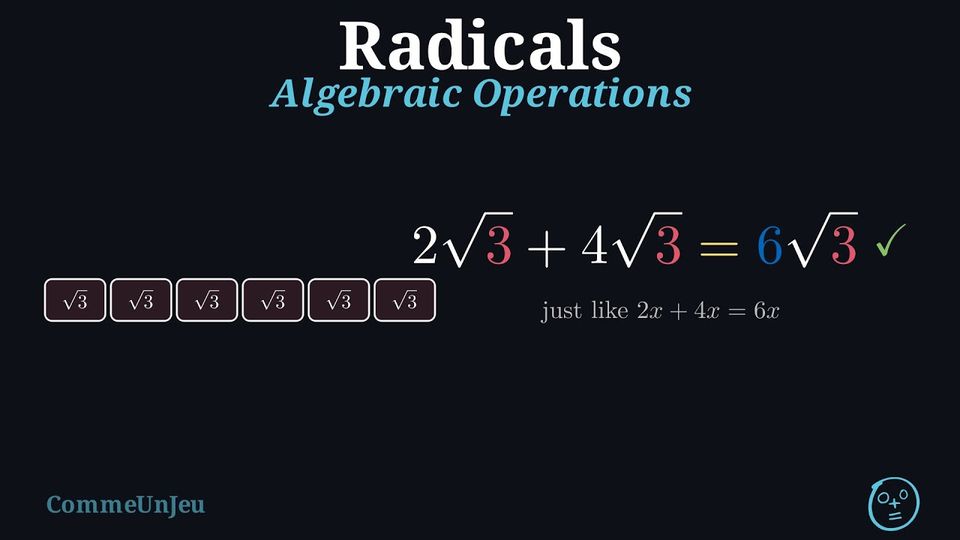
- A sum or a difference of radicals can be combined into a single term only when they are like radicals, which means they have the same index and exactly the same number under the root sign.
As in algebra, \(2x+4x\) simplifies to \(6x\), but \(2x+4y\) cannot be simplified. In the same way, \(2\sqrt{3} + 4\sqrt{3}\) can be simplified, but \(2\sqrt{3} + 4\sqrt{5}\) cannot. Radicals that do not look alike may become like radicals after simplification: \(\sqrt{12} + \sqrt{27} = 2\sqrt{3} + 3\sqrt{3} = 5\sqrt{3}\). - When multiplying expressions with radicals, we use the same rules as in algebra, such as the distributive law for expanding brackets, together with the laws of radicals.
Method — Algebraic Operations
We can perform operations with radicals (square roots) in a similar way to ordinary numbers, provided we respect the radical laws. In particular: - We can add and subtract like radicals (i.e.\ the same number under the root) in the same way that we add and subtract like algebraic terms: $$ \textcolor{colorprop}{c\sqrt{a} + d\sqrt{a} = (c + d)\sqrt{a}} $$
- We can use the usual rules for expanding brackets (such as the distributive law).
Example
Simplify: \(6\sqrt{5} - 2\sqrt{5} + \sqrt{5}\)
Just like \(6x - 2x + x = 5x\), we combine the coefficients of the like radical; the last term is \(\sqrt{5} = 1 \times \sqrt{5}\), with the coefficient \(1\): $$\begin{aligned}[t] 6\sqrt{5} - 2\sqrt{5} + \sqrt{5} &= (6 - 2 + 1)\sqrt{5} && \text{(factor out \(\sqrt{5}\))} \\
&= 5\sqrt{5}. && \text{(\(6 - 2 + 1 = 5\))} \end{aligned}$$
Example
Expand and simplify \(\sqrt{3}(5 - \sqrt{3})\).
$$\begin{aligned}[t] \sqrt{3}(5 - \sqrt{3}) &= (\sqrt{3} \times 5) - (\sqrt{3} \times \sqrt{3}) && \text{(distributive law)} \\
&= 5\sqrt{3} - 3. && \text{(\(\sqrt{3} \times \sqrt{3} = 3\))} \end{aligned}$$
Example
Expand and simplify \((2 + \sqrt{3})(4 - \sqrt{3})\).
Each term of the first bracket multiplies each term of the second one, then the like radicals are collected. $$\begin{aligned}[t] (2 + \sqrt{3})(4 - \sqrt{3}) &= 2 \times 4 - 2\sqrt{3} + 4\sqrt{3} - \sqrt{3} \times \sqrt{3} && \text{(expanding two brackets)} \\
&= 8 - 2\sqrt{3} + 4\sqrt{3} - 3 && \text{(\(\sqrt{3} \times \sqrt{3} = 3\))} \\
&= 5 + 2\sqrt{3}. \end{aligned}$$
Example
Expand and simplify: - \((3 - \sqrt{2})^2\)
- \((\sqrt{5} + \sqrt{2})(\sqrt{5} - \sqrt{2})\)
The identities of algebra hold for radicals: \((a - b)^2 = a^2 - 2ab + b^2\) and \((a + b)(a - b) = a^2 - b^2\).
- With \(a = 3\) and \(b = \sqrt{2}\): $$\begin{aligned}[t] (3 - \sqrt{2})^2 &= 3^2 - 2 \times 3 \times \sqrt{2} + (\sqrt{2})^2 && \text{(square of a difference)} \\ &= 9 - 6\sqrt{2} + 2 && \text{(\((\sqrt{2})^2 = 2\))} \\ &= 11 - 6\sqrt{2}. \end{aligned}$$
- With \(a = \sqrt{5}\) and \(b = \sqrt{2}\): $$\begin{aligned}[t] (\sqrt{5} + \sqrt{2})(\sqrt{5} - \sqrt{2}) &= (\sqrt{5})^2 - (\sqrt{2})^2 && \text{(difference of two squares)} \\ &= 5 - 2 \\ &= 3. \end{aligned}$$
Skills to practice
- Adding and Subtracting Like Radicals: Level 1
- Adding and Subtracting Like Radicals: Level 2
- Expanding Products with Radicals
V
Dividing by a Square Root
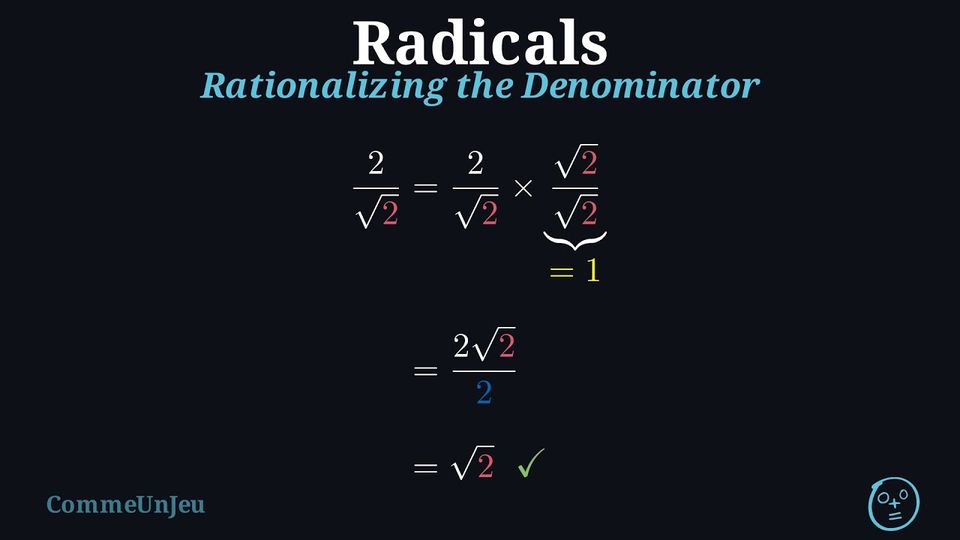
In mathematics, it is standard practice to write expressions without radicals in the denominator. The process of removing a radical from the denominator is called rationalising the denominator. This does not change the value of the expression but converts it to a conventional form which is often easier to work with.
Method — Rationalising a Monomial Denominator
To rationalise a denominator of the form \(\sqrt{b}\) (where \(b>0\)), multiply the numerator and the denominator by \(\sqrt{b}\).$$ \frac{a}{\sqrt{b}} = \frac{a}{\sqrt{b}} \times \frac{\sqrt{b}}{\sqrt{b}} = \frac{a\sqrt{b}}{b} $$ This works because multiplying by \(\frac{\sqrt{b}}{\sqrt{b}}\) is equivalent to multiplying by 1, which does not change the value. Example
Rationalise the denominator of \(\frac{6}{\sqrt{2}}\).
We multiply the numerator and denominator by \(\sqrt{2}\).$$\begin{aligned}[t]\frac{6}{\sqrt{2}} &= \frac{6}{\sqrt{2}} \times \frac{\sqrt{2}}{\sqrt{2}} && \text{(multiply by 1)} \\
&= \frac{6\sqrt{2}}{2} && \text{(\(\sqrt{2} \times \sqrt{2} = 2\))} \\
&= \boldsymbol{3\sqrt{2}}\end{aligned}$$
Skills to practice
- Writing With an Integer Denominator: Level 1
- Writing With an Integer Denominator: Level 2
VI
Going further
Skills to practice
- Exact Lengths in a Square
- Approximating Roots
- Comparing and Proving with Radicals
- Using Exact Values in Context
- Quiz
Jump to section